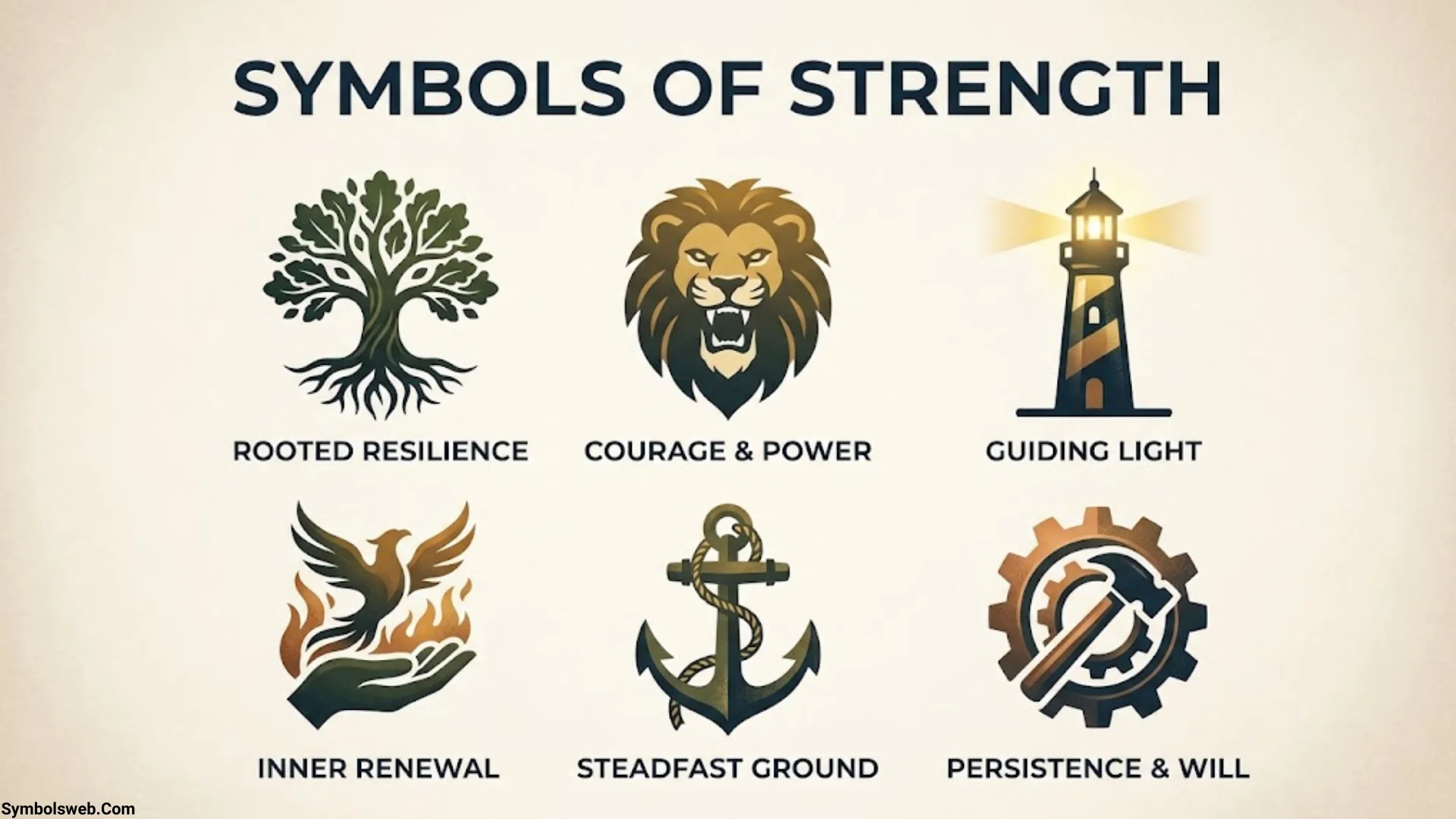
Strength means more than physical power. It can mean standing up for your beliefs, protecting people you love, finding courage during difficult times, or rebuilding your life after a setback. Across history, people have used animals, plants, sacred objects, and mythological figures to express these qualities.
Symbols of strength help turn complex ideas into images you can recognize and remember. A lion may represent courage and leadership, while an oak tree can suggest endurance and stability. The phoenix offers a different message: even after destruction, renewal remains possible.
However, these meanings aren’t universal. A symbol may carry religious significance in one culture and a different meaning in another. Understanding its history helps you appreciate what it represents instead of relying on popular interpretations alone.
In this guide, you’ll discover 42 symbols of strength and courage, explore their cultural origins, and learn which symbols represent physical power, inner strength, spiritual resilience, protection, and perseverance.
What Are Symbols of Strength and Courage?
Symbols of strength and courage are images, objects, animals, or designs that represent qualities such as bravery, endurance, authority, resilience, and determination. People have used them in mythology, religious traditions, architecture, jewelry, national emblems, and works of art.
Some symbols come from the natural world. The lion’s physical power makes it a recognizable emblem of courage, while a mountain suggests stability because it can withstand changing If over long periods.
Other symbols have specific historical or religious roots. The ankh belongs to ancient Egyptian visual culture, Mjölnir comes from Norse mythology, and Adinkra symbols communicate ideas within Akan cultural traditions.
It’s helpful to distinguish four common types of strength:
- Physical strength: Muscle, stamina, force, and the ability to endure physical challenges.
- Inner strength: Emotional resilience, self-control, confidence, and determination.
- Spiritual strength: Faith, devotion, moral commitment, or a sense of connection with something greater.
- Collective strength: Cooperation, unity, loyalty, and the ability of people to achieve more together.
A single image can represent several qualities, but its meaning depends on its history and context. For example, a shield primarily suggests defense, while a sword may represent authority, justice, or the responsibility to act.
Animal Symbols of Strength and Courage
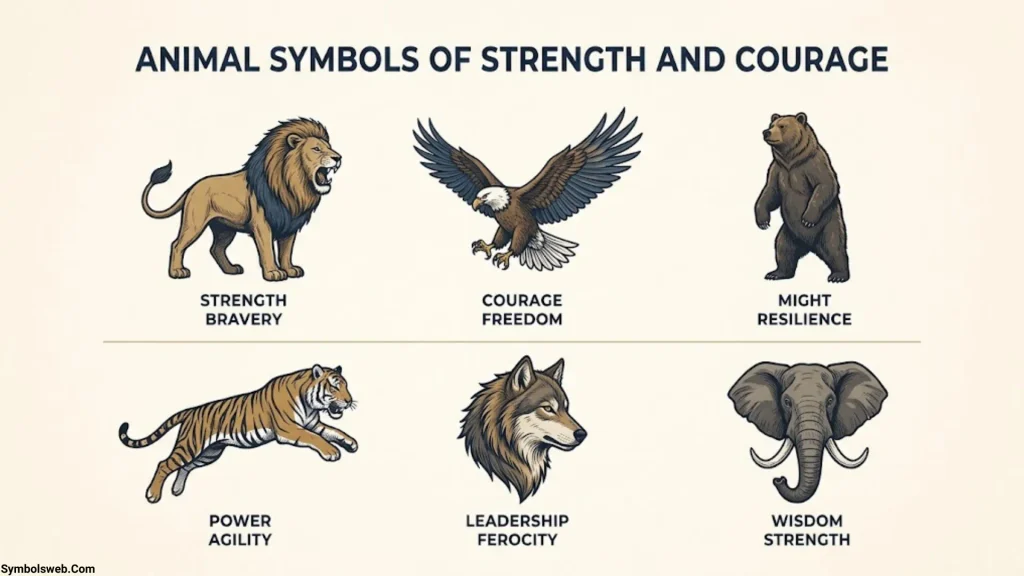
Animals often become powerful symbols of strength because people associate their physical traits and behavior with qualities such as bravery, endurance, loyalty, and authority. Their meanings also develop through folklore, religious beliefs, and historical traditions.
Lion: Strength, Courage, and Leadership
The lion is one of the most recognizable symbols of courage and power. Its muscular body, loud roar, and position as a major predator have helped make it an emblem of authority in art, literature, and heraldry.
In European heraldry, lions frequently appear on coats of arms and royal emblems. They can communicate bravery, nobility, and readiness to defend a community. Lion imagery also appears in ancient Near Eastern and Mediterranean art.
The lion’s meaning extends beyond physical strength. People often associate it with leadership because a lion can represent confidence, responsibility, and the ability to face danger.
The lion commonly represents:
- Courage in difficult situations
- Leadership and authority
- Physical power and confidence
- Protection and bravery
If you want a symbol that communicates boldness and determination, the lion is a familiar choice. However, its meaning depends on the particular artistic or cultural tradition in which it appears.
Eagle: Freedom, Vision, and Power
The eagle is widely used as a symbol of strength, independence, and authority. Its ability to fly at great heights and its sharp eyesight have made it a compelling image of vision and ambition.
Eagles appear on national emblems, military insignia, flags, and official seals. The bald eagle, for example, serves as the national bird and a national symbol of the United States.
Golden eagles also appear in heraldic and historical imagery. Their symbolism varies by region, so it’s important not to assume every eagle represents precisely the same qualities.
As a personal symbol, the eagle can represent the determination to rise above obstacles, maintain perspective, and pursue ambitious goals.
Bear: Protection, Endurance, and Physical Strength
The bear represents formidable physical strength because of its size, muscular build, and ability to survive in challenging environments. In folklore and contemporary symbolism, it can also suggest independence, resilience, and protection.
Bear imagery appears in many different traditions, but its meaning isn’t identical everywhere. Some Indigenous communities have specific relationships with bears expressed through their own ceremonies, stories, and cultural practices. Those meanings deserve attention within their individual contexts.
In modern personal symbolism, a bear can represent the courage to protect loved ones, the patience to endure hardship, or the ability to stand firm when circumstances become difficult.
Tiger: Power, Courage, and Determination
The tiger is a powerful animal symbol associated with strength, confidence, and fearlessness. Its speed, muscular body, and hunting ability make it a natural image of physical power.
In Chinese art and cultural traditions, tiger imagery can serve protective and martial purposes. Tigers also appear in Hindu religious imagery, including depictions of the goddess Durga riding a tiger or lion.
The tiger can therefore represent different qualities depending on the context. In one image, it may communicate protection; in another, it may emphasize courage or authority.
Bull: Physical Power and Determination
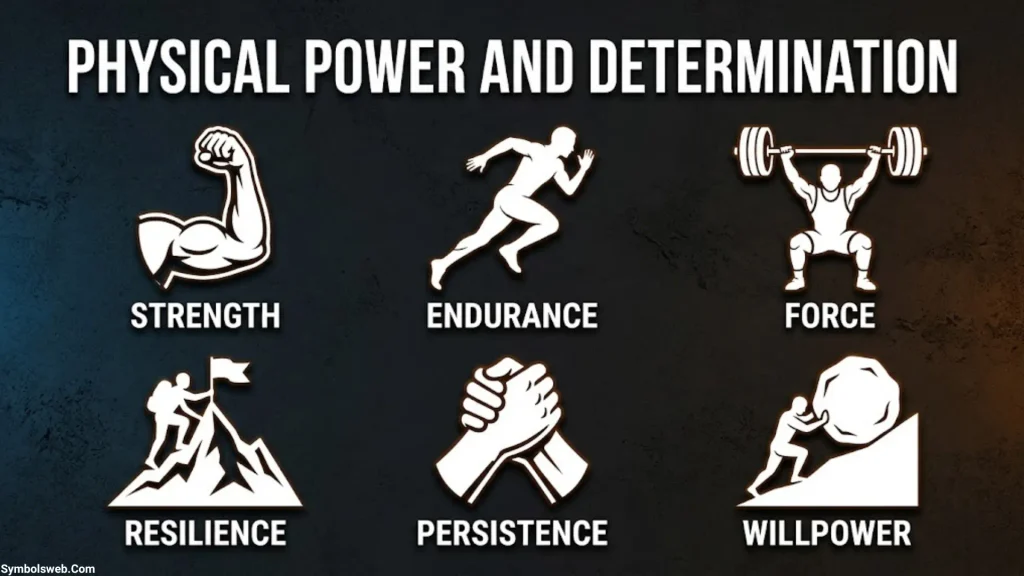
The bull has long appeared in art, religious imagery, and mythology as a symbol of physical strength, vitality, and fertility. Its powerful build and charging behavior make it an effective representation of force and determination.
Bull imagery played an important role in several ancient Mediterranean cultures. In Minoan Crete, for example, bull-leaping scenes appeared in palace art, demonstrating the animal’s cultural importance.
Today, the bull can symbolize the determination to keep moving toward a goal. It may also suggest stubbornness, so the image can represent either admirable persistence or an unwillingness to change.
Wolf: Loyalty, Endurance, and Independence
The wolf represents strength in a different way from the lion or bull. Rather than relying only on physical power, wolf symbolism often emphasizes endurance, adaptability, loyalty, and cooperation.
Wolves appear in Norse mythology and numerous European folktales. Their roles vary: some stories portray them as dangerous creatures, while others emphasize their power, intelligence, or connection with the wilderness.
In modern symbolism, the wolf can represent independence without complete isolation. Its social behavior also makes it a useful image of teamwork and collective strength.
Elephant: Wisdom, Patience, and Steadiness
The elephant combines physical power with symbolic associations involving wisdom, memory, patience, and stability.
In Hindu traditions, Ganesha is depicted with an elephant’s head and is associated with the removal of obstacles, among other religious roles. Elephant imagery also appears in Buddhist art and teachings, although specific meanings vary between traditions.
As a symbol of inner strength, the elephant can remind you that power doesn’t always require aggression. Patience, careful judgment, and steady action can be just as valuable as force.
Horse: Endurance, Freedom, and Courage
The horse has played a major role in transportation, agriculture, warfare, and communication throughout history. Its stamina and speed helped shape its symbolic connection with endurance, freedom, and courage.
Horses appear in the art and mythology of many societies. In warrior traditions, they could represent mobility, status, and military capability.
A horse can serve as a symbol of perseverance when you face a long journey. Rather than suggesting one dramatic act of bravery, it often fits the idea of continuing to move forward despite fatigue or difficulty.
Dragon: Authority, Power, and Protection
The dragon is a mythological creature with very different meanings across cultures.
In Chinese traditions, dragons are associated with imperial authority, auspicious power, and forces connected with water and weather. Chinese dragon imagery often communicates prosperity and good fortune.
In many European legends, by contrast, dragons appear as dangerous opponents that heroes must defeat. Some stories portray them as guardians of treasure or as threats to entire communities.
These differences matter. A Chinese dragon and a Western dragon shouldn’t automatically be assigned the same meaning simply because both are legendary creatures.
Phoenix: Rebirth and Resilience
The phoenix is among the best-known symbols of resilience and transformation. In classical accounts, this legendary bird is associated with renewal and a cycle of death and rebirth.
The phoenix later became a widespread literary and artistic metaphor for recovering after disaster. It can represent rebuilding after failure, beginning again after a painful experience, or finding a new direction after major change.
Its appeal comes from a simple idea: an ending doesn’t always have to be final.
The phoenix is particularly suitable when you want a symbol of strength that emphasizes recovery rather than domination.
Griffin: Guardianship and Authority
The griffin, a mythological creature combining the body of a lion with the head and wings of an eagle, appears in ancient Mediterranean and later European art.
Its combination of two powerful animals helped make it an image of guardianship, vigilance, and authority. In later heraldry, griffins could serve as protective or prestigious emblems.
The griffin’s symbolic appeal lies in its dual nature. It combines the lion’s terrestrial power with the eagle’s association with the sky, making it a striking image of strength in more than one form.
Boar: Ferocity and Warrior Strength
The boar appears in ancient European art and mythology as an animal associated with danger, aggression, and formidable defensive power.
In Norse traditions, boars appear in stories connected with deities and in imagery associated with warriors. Boar figures and motifs also appeared in some historical helmets and other objects.
As a symbol, the boar can represent determination and readiness to face confrontation. Its meaning is more specifically tied to ferocity and martial imagery than to gentleness or emotional resilience.
Nature Symbols of Strength and Resilience
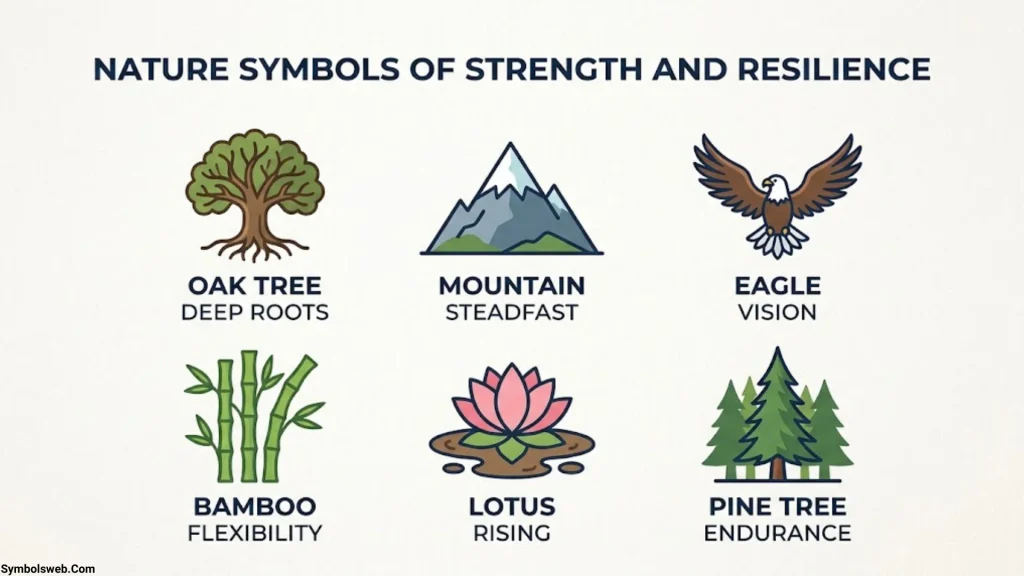
Nature offers some of the clearest metaphors for endurance. Trees survive changing seasons, mountains withstand weathering, and plants grow in difficult environments. These characteristics have inspired nature symbols of strength across literature, art, and personal expression.
Oak Tree: Endurance and Stability
The oak tree is a traditional symbol of strength, longevity, and steadfastness. Its sturdy wood and long life make it an effective representation of durability.
Oak imagery appears in several European cultural traditions, including traditions associated with Zeus in ancient Greek religion. The tree also carries historical and literary associations with endurance and dignity.
An oak tree is a useful symbol when you want to communicate dependable strength. Its message isn’t about winning quickly. It’s about developing deep roots and remaining steady over time.
Tree of Life: Growth and Interconnectedness
The Tree of Life appears in different forms across religious, mythological, artistic, and cultural traditions. It often represents relationships between life, growth, continuity, and the natural world.
Its roots, trunk, and branches offer a powerful visual metaphor. Roots suggest origins and support, the trunk represents stability, and branches can symbolize growth or connection.
However, the Tree of Life isn’t one single symbol with a universal origin. Its interpretation varies across traditions, including ancient Near Eastern imagery, religious texts, and later decorative designs.
Lotus Flower: Spiritual Strength and Renewal
The lotus flower is a significant symbol in Hindu and Buddhist traditions. Its associations include purity, spiritual development, and religious awakening.
The flower grows from muddy environments and rises above the water’s surface. That natural process has also inspired modern interpretations of the lotus as a symbol of resilience and the ability to grow through difficult circumstances.
The lotus appears in Buddhist art, including historical sculptures and architectural decoration. The Metropolitan Museum of Art documents lotus imagery in an ancient Indian Buddhist context, where the flower alludes to the Buddha’s enlightenment. The Metropolitan Museum of Art
The lotus is an especially meaningful choice if you’re looking for a symbol of inner strength, spiritual growth, or perseverance without aggression.
Rock or Mountain: Stability and Fortitude
Rocks and mountains are common metaphors for strength because they appear solid and enduring. Mountains, in particular, have long featured in religious imagery, literature, and stories about journeys or difficult achievements.
A mountain can represent a challenge that requires patience to overcome. A rock can suggest reliability and a firm foundation.
These are broad symbolic associations rather than fixed meanings belonging to one culture. Their simplicity makes them easy to adapt for personal reminders, artwork, or designs.
Sun: Vitality and Life Giving Power
The sun symbolizes life, energy, renewal, and authority in many cultural traditions. Its importance is understandable: sunlight supports ecosystems and influences the rhythms of life on Earth.
In ancient Egypt, solar imagery played a major role in religion. Ra was associated with the sun, while the Aten was represented by the solar disk in a religious context especially prominent during the reign of Akhenaten.
The sun can symbolize strength as the ability to sustain life, bring clarity, or begin again after a dark period.
Lightning and Thunderbolt: Divine Authority
Lightning is a dramatic natural force, so it often becomes an image of power, speed, and decisive action. In Greek mythology, the thunderbolt is a defining attribute of Zeus.
Thunderbolt imagery can therefore suggest authority that is sudden and overwhelming. In modern designs, lightning may also represent energy, ambition, or boldness.
Although lightning and thunder are closely related, a mythological thunderbolt is more than a depiction of weather. Its meaning comes from the story and deity associated with it.
Pine Tree: Persistence and Longevity
Many pine trees remain green throughout the year, making them useful symbols of persistence and endurance. Their evergreen foliage can suggest life continuing through winter and other difficult conditions.
The exact meaning of a pine tree varies across cultural traditions. In contemporary personal symbolism, however, it can represent steadiness, long-term growth, and the ability to keep going when circumstances change.
Iron: Toughness and Resolve
Iron has shaped tools, buildings, and weapons for thousands of years. Its historical usefulness helped inspire metaphors such as an iron will or an iron resolve.
As a symbol of physical strength, iron can represent toughness and durability. As a symbol of character, it suggests discipline, determination, and the ability to stay committed under pressure.
Iron doesn’t have one universal sacred meaning. Its symbolic power often comes from its material properties and its role in human history.
Ancient, Religious, and Cultural Symbols of Strength
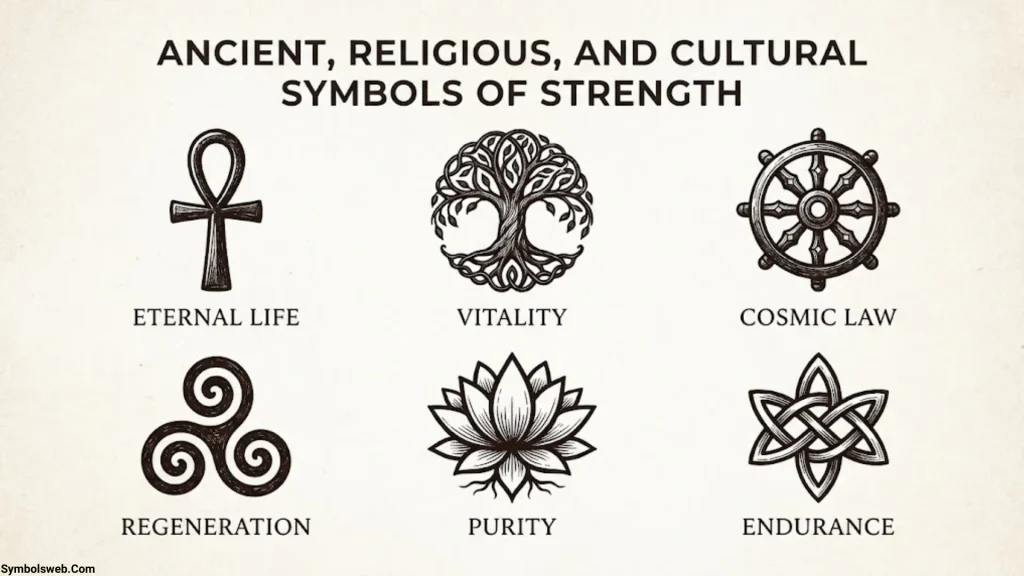
Ancient symbols often communicate more specific meanings than modern inspirational images. Their original purposes may involve religious beliefs, protection, royal authority, or ideas about life and death. Understanding those origins helps you distinguish documented history from newer interpretations.
Ankh: Life and Vitality
The ankh is an ancient Egyptian hieroglyph shaped like a cross with a loop at the top. Its name means “life,” and Egyptian art frequently shows gods holding the ankh or presenting it to kings.
The ankh represents life and appears in religious imagery connected with divine power and continued existence. It was also used in amulets.
The Global Egyptian Museum documents the ankh’s use in ancient Egyptian art and explains its connection with the concept of life. Read about the ankh.
Although the ankh is often described today as a symbol of strength, its more firmly established historical meaning concerns life and vitality. Its connection with strength comes through the broader idea of sustaining life and overcoming death.
Djed Pillar: Stability and Endurance
The djed pillar is one of the clearest ancient examples of a symbol directly associated with stability and endurance.
In ancient Egyptian religion, the djed was closely connected with Osiris. Its imagery also became associated with resurrection and the continuation of life. Egyptians used djed-shaped amulets, and the symbol appeared in religious art.
The Egyptian Ministry of Tourism and Antiquities describes the djed as a symbol of stability and continuity and explains its association with Osiris. Learn about the djed pillar.
Its meaning makes it a particularly strong example of ancient symbols of strength. Unlike a symbol focused on aggression, the djed communicates the ability to remain stable and endure.
Scarab Beetle: Regeneration and Protection
The scarab beetle held an important place in ancient Egyptian symbolism. Egyptians associated the beetle with Khepri, a deity connected with the rising sun and renewal.
Scarab-shaped amulets were widely used in ancient Egypt. Some carried inscriptions or protective symbols, while others served as seals. The beetle’s association with the sun’s daily journey helped establish its connection with rebirth and regeneration.
The Metropolitan Museum of Art documents scarab amulets from the Middle Kingdom, including examples dating to approximately 1850–1640 BCE. Explore ancient Egyptian scarabs.
The scarab represents strength through renewal. It reminds us that recovery and continued growth can be just as meaningful as physical power.
Hamsa Hand: Protection
The hamsa hand is a palm-shaped motif associated with protection in several Middle Eastern and North African cultural and religious contexts.
It is often connected with protection against the evil eye, although specific interpretations vary among communities. The motif appears in jewelry, decorative objects, and amulets.
People sometimes describe the hamsa as a symbol of strength because protection can provide a sense of security during uncertainty. Still, its traditional associations with protection and good fortune are more precise than a general claim that it represents strength in every culture.
If you choose the hamsa for jewelry or artwork, understanding its cultural context is more meaningful than treating it as a generic decorative hand.
Christian Cross: Faith, Sacrifice, and Hope
The Christian cross is the central symbol of Christianity. It represents the crucifixion of Jesus Christ and, within Christian belief, connects with sacrifice, redemption, faith, and the hope of resurrection.
Its association with strength differs from symbols such as the lion or sword. The cross can communicate spiritual endurance, the willingness to make sacrifices for others, and commitment to one’s beliefs during suffering.
For Christians, its meaning comes from a specific religious history rather than a general concept of power. Any discussion of the cross should preserve that context.
Anchor: Hope and Steadfastness
The anchor is a practical maritime object that helps keep a vessel in position. Its function made it a natural metaphor for stability, security, and remaining grounded.
Anchors also have a history in Christian symbolism, where they can represent hope and steadfast faith. In contemporary designs, an anchor may express loyalty, emotional stability, or commitment to a person or principle.
The anchor is particularly useful as a symbol of inner strength because it suggests staying grounded when circumstances become unpredictable.
Thor’s Hammer (Mjölnir): Strength and Protection
Mjölnir, the hammer of Thor, is one of the best-known objects in Norse mythology. Thor is associated with thunder and with defending the divine world against its enemies.
Archaeological discoveries show that small hammer pendants were used during the Viking Age. The Swedish History Museum documents Thor’s hammer pendants and their connection with Norse religious practice. Read about Thor’s hammer.
Mjölnir is associated with power and protection, making it a strong example of a Norse symbol of strength. Its historical use as an amulet also shows that symbols could express religious identity, not just admiration for a powerful mythological figure.
Helm of Awe (Ægishjálmur): Protection and Courage
The Helm of Awe, often written as Ægishjálmur, is a symbol associated with Icelandic magical traditions. Modern versions frequently feature a radial design with arms extending from a central point.
The symbol appears in later Icelandic magical texts and is commonly interpreted in contemporary settings as representing protection, courage, or the ability to intimidate opponents.
However, its modern popularity as a Viking emblem can create historical confusion. It shouldn’t automatically be presented as a universal symbol used by all Viking warriors. Its documented context is more specific than that.
If historical accuracy matters to you, distinguish medieval Icelandic magical traditions from the broader Viking Age.
Uruz Rune: Vitality and Physical Strength
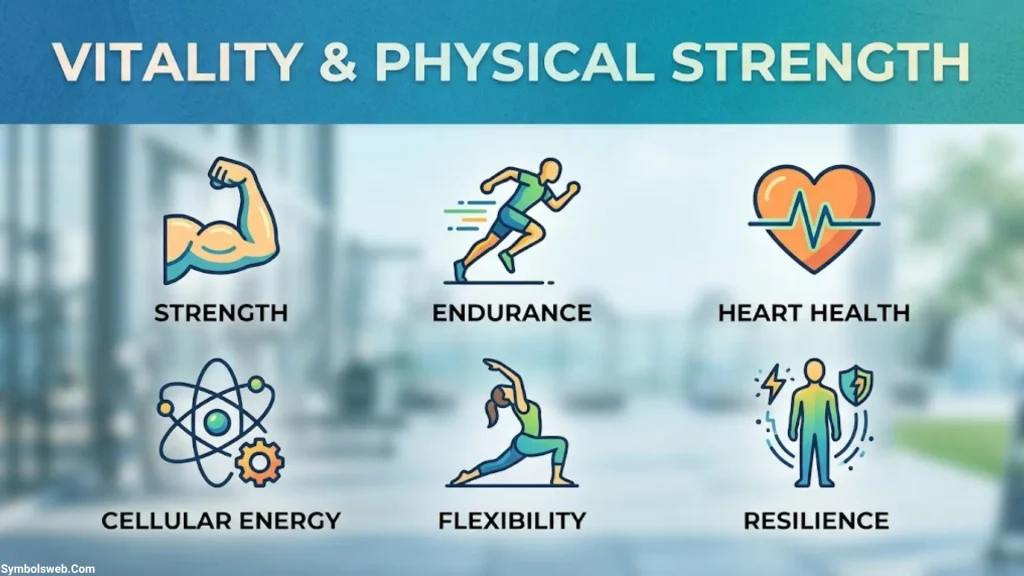
Uruz is the conventional name of the second rune in the Elder Futhark, an early Germanic runic alphabet. Its historical name is associated with the aurochs, a now-extinct type of wild cattle.
The aurochs was a large, powerful animal, which helps explain why modern rune interpretations often connect Uruz with vitality, physical strength, endurance, and transformation.
The distinction between historical evidence and modern interpretation is important. The rune’s association with the aurochs has a historical basis, but many detailed spiritual meanings assigned to it today belong to contemporary rune practices.
Celtic Dara Knot: Inner Strength and Roots
The Dara knot is a modern Celtic-inspired design associated with the oak tree and its roots. Its name is linked to the Irish word dair, meaning oak.
Today, the design is commonly used to represent inner strength, resilience, and connection with one’s roots. Its interwoven lines can suggest a network of support or the strength that comes from a stable foundation.
The historical evidence for the specific Dara knot design is more limited than popular descriptions sometimes suggest. It is best described as a contemporary Celtic-inspired symbol rather than an unquestionably documented emblem used throughout ancient Celtic society.
Triskelion: Movement and Personal Growth
The triskelion is a three-part spiral motif found in ancient European art. Its name comes from a Greek term referring to three legs, although the design also appears in forms made from three curved arms or spirals.
The motif has been interpreted in modern contexts as representing movement, cycles, balance, and personal growth. These ideas make it useful as a contemporary symbol of resilience and transformation.
However, not every modern meaning can be assigned confidently to every ancient example. The motif’s historical presence is clear, but its precise meaning depended on the object and cultural setting in which it appeared.
Tabono: Hard Work and Persistence
Tabono is an Adinkra symbol associated with Akan visual culture in Ghana and neighboring parts of West Africa. It is commonly interpreted as representing hard work, persistence, and the effort needed to achieve a goal.
Adinkra symbols communicate ideas through recognizable designs. Their meanings are connected with particular cultural traditions, rather than forming a universal symbolic dictionary.
Tabono is especially relevant when you’re searching for symbols of strength and perseverance. Its message centers on effort and commitment instead of status or physical dominance.
Pempamsie: Unity and Collective Strength
Pempamsie is another Adinkra symbol commonly associated with readiness, unity, and strength through cooperation.
Collective strength differs from individual power. A group may achieve more by sharing responsibilities, supporting one another, and preparing carefully than any member could achieve alone.
Pempamsie’s contemporary interpretations make it suitable for themes involving teamwork, family bonds, community, and mutual support.
When using Adinkra symbols, preserve their Akan cultural context and verify the meaning of the specific design through a reliable cultural or historical reference.
Okodee Mmowere: Bravery and Valor
Okodee Mmowere is an Adinkra symbol associated with the eagle’s talons. It is commonly interpreted as representing bravery, power, and valor.
Its imagery connects strength with the ability to act decisively. It can therefore represent courage in the face of challenges, particularly when the situation demands resolve.
As with other Adinkra symbols, its meaning comes from a specific cultural tradition. It shouldn’t be separated from that background simply to create a generic emblem of power.
Wawa Aba: Toughness and Resilience
Wawa Aba is an Adinkra symbol associated with the seed of the wawa tree. Its common interpretation centers on toughness, hardiness, and perseverance.
The seed provides a natural metaphor for resilience. Something small can carry the potential for growth, while toughness suggests the ability to withstand pressure.
Wawa Aba is a useful symbol for someone who values determination and persistence over outward displays of power.
Mythological and Warrior Symbols of Power
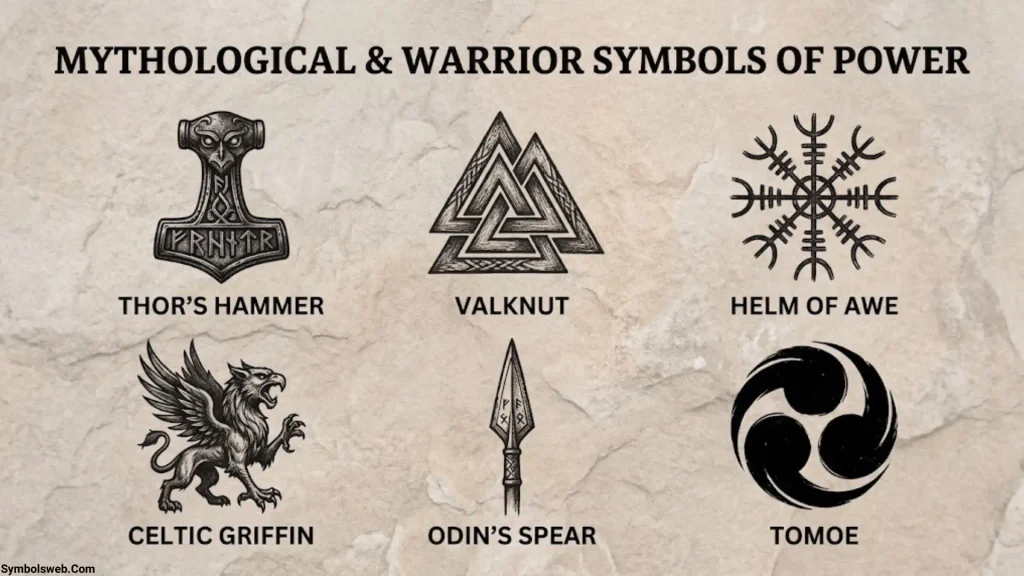
Warrior imagery often connects strength with action, defense, authority, and responsibility. These symbols can be powerful, but their meanings depend on the historical traditions and stories behind them.
Club of Hercules: Physical Strength
The club of Hercules is one of the hero’s best-known attributes in Greek and Roman mythology. Hercules, called Heracles in Greek, became famous for extraordinary strength and for completing a series of difficult labors.
The club represents physical power and the ability to confront formidable challenges. It also connects with heroic effort: Hercules’ stories repeatedly test his endurance, courage, and determination.
As a modern emblem, the club can communicate toughness and the willingness to work through demanding tasks.
Sword: Authority, Justice, and Victory
The sword is a widely recognized symbol of strength, but its meaning extends beyond the ability to fight.
In historical heraldry and ceremonial imagery, swords can represent authority, justice, military service, or the duty to defend a community. Their meaning often depends on how the sword appears and who carries it.
A sword can therefore represent decisive action, but it can also remind us that power requires judgment. Strength without restraint can cause harm rather than protect anyone.
Shield: Defense, Honor, and Protection
The shield represents defensive strength. Historically, shields helped protect warriors from weapons, and their designs could also communicate group identity through colors, patterns, and emblems.
In heraldry, shields became important surfaces for displaying family, political, or institutional symbols. Their visual role connects them with identity as well as protection.
As a metaphor, a shield can represent personal boundaries, loyalty, and the willingness to protect others. It is especially fitting when your idea of strength involves responsibility rather than aggression.
Doric Column: Solidity and Order
The Doric column belongs to one of the principal architectural orders of ancient Greece. Doric columns are generally recognized by their sturdy proportions and relatively simple capitals.
Their appearance can communicate stability, order, and structural strength. Ancient Greek architecture influenced later Roman architecture and many subsequent Western building traditions.
Calling the Doric column a universal symbol of masculine strength would be too broad. Its more defensible association is with architectural solidity and the visual language of classical design.
Sekhmet: Divine Power and Protection
Sekhmet is an ancient Egyptian goddess commonly depicted with a lioness’s head. She is associated with warfare, destructive power, and protection.
Her character illustrates how ancient symbols can carry more than one meaning. Destructive force and protective power are not always opposites in mythology; a deity capable of bringing danger may also defend divine or royal order.
Sekhmet is a strong example of ancient Egyptian imagery that connects power with both danger and protection.
Shakti: Divine Energy and Creative Power
Shakti is a central concept in Hindu traditions, referring to divine power or energy. In many contexts, it is especially connected with the divine feminine and the power through which the universe acts and changes.
Shakti is more than a decorative emblem. It is a religious concept with different expressions across Hindu philosophies and devotional traditions.
Modern discussions sometimes reduce Shakti to a general symbol of feminine confidence. Although that interpretation may resonate personally, it doesn’t capture the full theological meaning of the concept.
Symbols of Strength From Different Cultures
Symbols become more meaningful when you understand where they come from. The following overview highlights several cultural traditions without suggesting that all members of a culture interpret every symbol identically.
| Cultural tradition | Examples | Common associations |
| Ancient Greek | Lion, thunderbolt, club of Hercules | Courage, divine authority, heroic strength |
| Ancient Egyptian | Ankh, djed pillar, scarab | Life, stability, renewal |
| Norse | Mjölnir, Thor imagery | Strength, protection, divine power |
| Celtic-inspired modern designs | Dara knot, triskelion | Roots, growth, movement |
| Hindu | Shakti, lotus, Ganesha imagery | Divine energy, spiritual growth, overcoming obstacles |
| Buddhist | Lotus | Purity and spiritual awakening |
| Akan, West African | Tabono, Pempamsie, Wawa Aba | Persistence, unity, toughness |
| Chinese | Dragon, tiger | Authority, auspicious power, protection in particular contexts |
| Christian | Cross, anchor in Christian art | Faith, sacrifice, hope |
Greek Symbols of Strength
Greek mythology connects strength with gods, heroes, and extraordinary challenges. Zeus’s thunderbolt represents divine authority, while Hercules represents heroic endurance through his labors.
The lion also appears in Greek myth and art, often in connection with danger or heroic achievement. Together, these images show that Greek symbols of strength can communicate physical power, authority, and the courage to face difficult tasks.
Egyptian Symbols of Strength
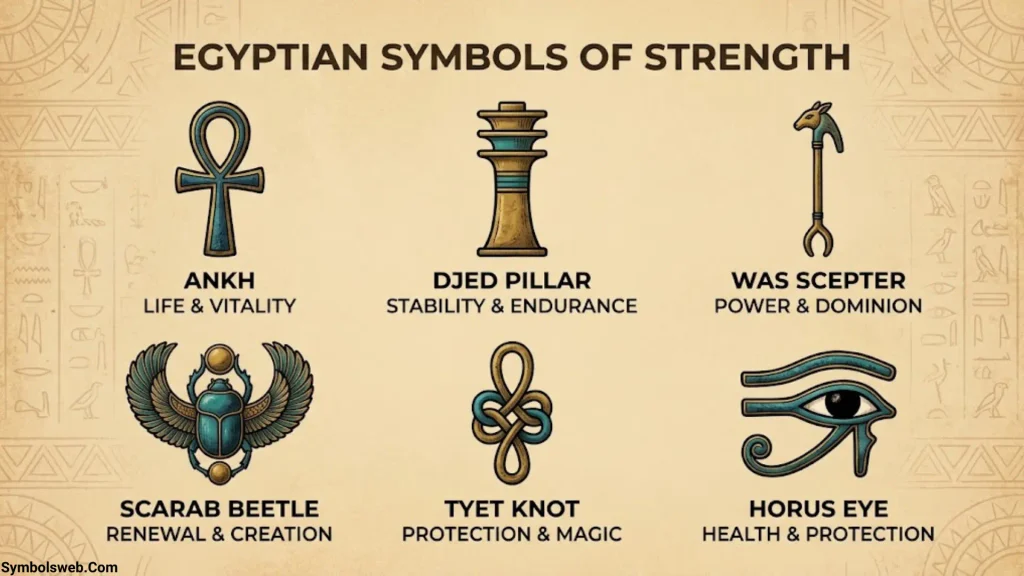
Ancient Egyptian symbols often connect power with life, stability, and religious order.
The ankh represents life, the djed pillar represents stability and endurance, and the scarab connects with renewal and regeneration. These symbols appeared in religious imagery, amulets, and funerary objects.
Their original meanings are more precise than modern descriptions that label all of them simply as symbols of strength.
Norse and Viking Symbols of Strength
Norse mythology features powerful gods, supernatural creatures, and objects with religious significance. Mjölnir, Thor’s hammer, is especially well known.
Archaeological discoveries of hammer pendants demonstrate that Thor’s imagery mattered in Viking Age religious practice. These finds provide firmer historical evidence than modern internet lists that assign ancient origins to every popular Norse-inspired design.
The Uruz rune also has a historical basis in the early Germanic runic alphabet, although some of its current spiritual interpretations are modern.
Celtic Symbols of Strength
Celtic art includes intricate interlacing patterns, spirals, and other designs that appear in archaeological and historical objects. The triskelion is an example of a three-part motif with ancient precedents.
Modern Celtic-inspired designs often assign meanings such as unity, resilience, and inner strength to knots and spirals. These can be meaningful contemporary interpretations, but the exact meanings of specific designs shouldn’t be assumed to have remained unchanged since antiquity.
Hindu and Buddhist Symbols of Strength
Hindu and Buddhist traditions contain symbols associated with spiritual development, religious teachings, and divine power.
The lotus appears in both traditions, although its interpretation varies. In Buddhist art, it is associated with purity and enlightenment. In Hindu traditions, the lotus appears in imagery connected with deities and auspiciousness.
Shakti represents divine energy in Hindu thought, while Ganesha’s elephant-headed form carries religious associations that include overcoming obstacles.
These symbols offer ways to think about strength beyond physical force. They also require respectful interpretation within their religious contexts.
African and Adinkra Symbols of Strength
Adinkra symbols are part of Akan cultural traditions, particularly associated with Ghana and neighboring regions. They communicate ideas through recognizable visual forms.
Tabono is commonly associated with persistence and hard work, Pempamsie with unity and readiness, Okodee Mmowere with bravery, and Wawa Aba with toughness.
These meanings show that strength can be individual or collective. It can involve continuing through difficulty, preparing carefully, or cooperating with others to achieve something important.
Native American Symbols of Strength
There is no single set of symbols that represents every Native American nation or community. Indigenous peoples across North America have distinct languages, histories, ceremonies, and relationships with animals and the natural world.
Eagle feathers, bear imagery, and other animal motifs can hold significant meanings within particular traditions. However, those meanings depend on the community and context.
If you want to use an Indigenous symbol, identify the specific nation or tradition associated with it and consult reliable sources from that community. Avoid treating sacred objects or ceremonial practices as interchangeable decorative symbols.
Chinese Symbols of Strength
Chinese symbolism includes dragons, tigers, and other images associated with power, protection, and authority.
The Chinese dragon is particularly associated with auspicious power and imperial imagery. Its role differs from that of many Western dragons, which often appear as dangerous adversaries in legends.
Tiger imagery can convey strength and martial power, and it appears in selected protective artistic traditions. Understanding the setting is essential when interpreting either animal.
Symbols of Inner Strength and Emotional Resilience
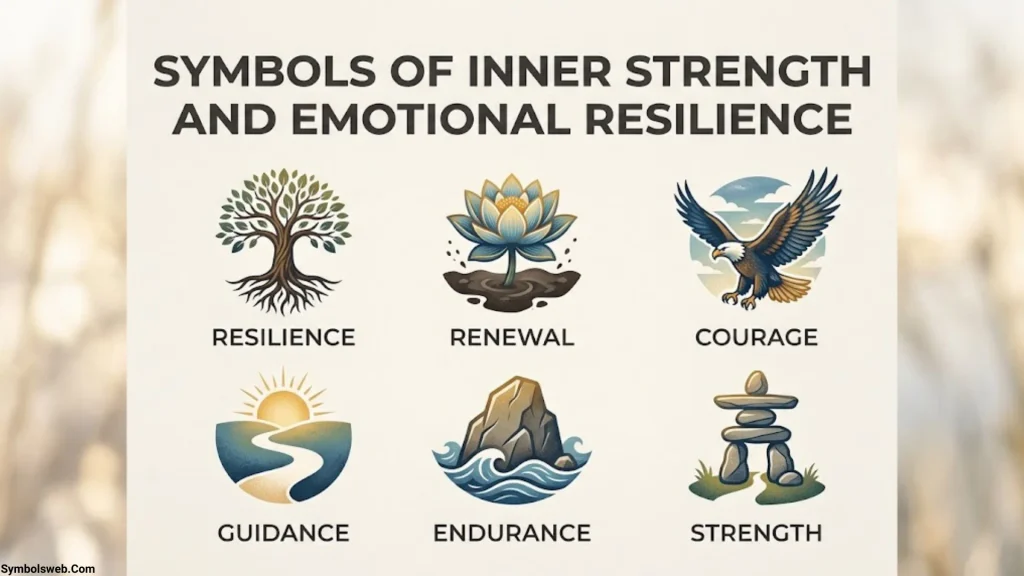
Inner strength doesn’t always look impressive from the outside. Sometimes it means staying calm during conflict, asking for help when you need it, or continuing to work toward a goal after disappointment.
Several symbols offer useful ways to express these qualities.
- Lotus flower: Represents spiritual growth and purity in Hindu and Buddhist traditions. Modern interpretations also connect it with resilience through difficult circumstances.
- Mountain: Suggests steadiness, patience, and the willingness to face demanding challenges.
- Oak tree: Represents endurance and a strong foundation.
- Phoenix: Symbolizes renewal and the possibility of beginning again after loss or failure.
- Anchor: Suggests hope, stability, and staying grounded when life feels uncertain.
- Shield: Represents protection, boundaries, and the responsibility to defend what matters.
The best symbol for inner strength depends on what strength means to you. If you’re rebuilding after a setback, the phoenix may express your experience. If you want to remain steady through uncertainty, an oak tree or anchor may fit better.
Symbols of Physical Strength, Courage, and Leadership
Physical power is only one part of leadership. The strongest leaders also need judgment, patience, and the ability to protect people who depend on them.
| Symbol | Primary association | What it can communicate |
| Lion | Courage and authority | Confidence and leadership |
| Bull | Physical power | Determination and force |
| Bear | Strength and endurance | Protection and persistence |
| Eagle | Vision and authority | Ambition and perspective |
| Club of Hercules | Heroic strength | Overcoming demanding challenges |
| Sword | Justice and action | Decisiveness and responsibility |
| Shield | Defense and protection | Loyalty and safeguarding others |
| Dragon | Power and authority | Command and formidable presence |
These symbols of physical strength and leadership can work well in artwork, logos, personal emblems, and storytelling. Their effectiveness depends on the message you want to convey.
For example, a sword emphasizes action, while a shield emphasizes defense. Neither is automatically better. One communicates the courage to act, while the other suggests the discipline to protect.
Symbols of Spiritual Strength, Faith, and Protection
Spiritual strength can involve faith, religious devotion, moral commitment, or the ability to maintain hope during hardship. Symbols in this category often carry meanings that come directly from particular religious traditions.
- Christian cross: Represents Christ’s crucifixion and, within Christianity, sacrifice, redemption, and hope.
- Ankh: Represents life in ancient Egyptian religious and artistic traditions.
- Lotus flower: Holds important meanings involving purity and spiritual development in Hindu and Buddhist traditions.
- Shakti: Represents divine energy in Hindu religious thought.
- Hamsa hand: Serves as a protective motif in several Middle Eastern and North African contexts.
- Mjölnir: Connects strength and protection with Thor in Norse mythology.
- Djed pillar: Represents stability and continuity in ancient Egyptian religion.
It’s important to distinguish traditional religious meanings from personal interpretations. You may find a symbol personally inspiring, but that doesn’t mean every religious community understands it in the same way.
Symbols of Feminine Power and Masculine Strength
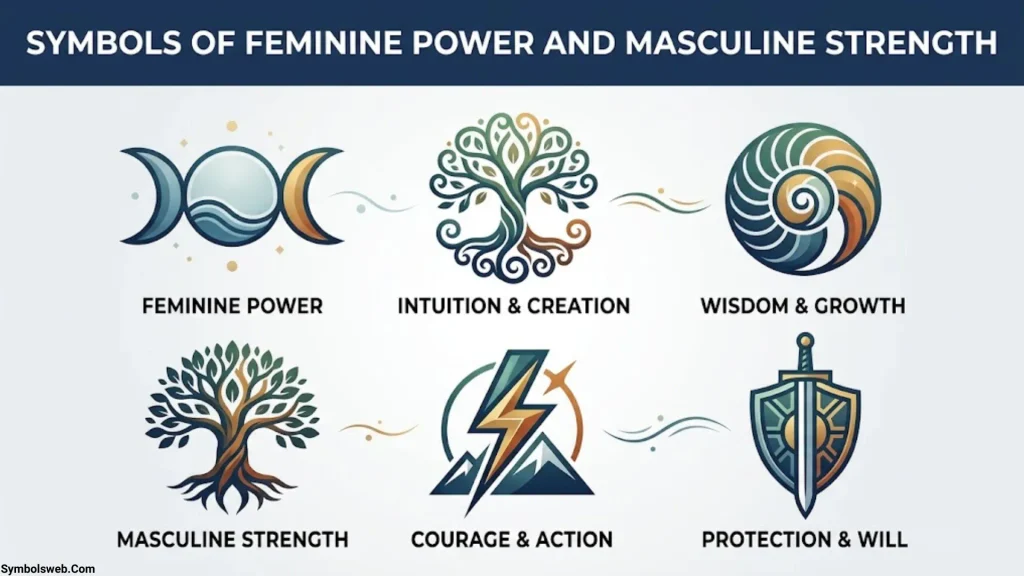
Many societies have associated strength with particular gods, goddesses, animals, or heroic figures. However, symbols don’t have fixed gender meanings across all cultures.
Symbols associated with feminine power include Shakti in Hindu traditions and Sekhmet in ancient Egyptian religion. Shakti expresses divine energy, while Sekhmet combines associations with warfare, destructive force, and protection.
Symbols often described as representing masculine strength include the bull, Hercules’s club, and the lion. These images commonly emphasize physical power, heroic action, or authority.
Yet strength doesn’t belong exclusively to one gender. An oak tree can represent endurance, a lotus can express spiritual development, and a shield can represent protection regardless of who uses the image.
Choose a symbol based on the qualities you want to express rather than assuming that strength must look masculine or feminine.
How to Choose a Symbol of Strength
Choosing the right symbol becomes easier when you start with its meaning instead of its appearance.
Identify the Type of Strength You Want to Represent
First, decide which quality matters most to you.
- For courage, consider the lion or a historical warrior emblem.
- For resilience, consider the phoenix or lotus.
- For stability, consider the oak tree, mountain, or djed pillar.
- For protection, consider a shield or a culturally appropriate protective symbol.
- For spiritual strength, explore symbols within your own religious or philosophical tradition.
- For unity, consider Pempamsie and its associations with cooperation.
These are starting points, not rigid rules. Your personal interpretation can matter as long as you understand the symbol’s cultural background.
Consider the Symbol’s Cultural Origins
Before choosing an ancient or religious symbol, learn where it originated and how people used it.
A historically documented symbol may have a meaning quite different from the one popular social media posts assigned to it. This is especially important when selecting sacred imagery for tattoos, jewelry, or permanent designs.
Decide Where You’ll Use It
The intended use can help narrow your options.
- For a tattoo: Choose a design whose meaning will remain important to you over time.
- For jewelry: Consider the symbol’s history, cultural significance, and personal relevance.
- For a business logo: Look for a recognizable image that fits your brand’s actual values.
- For a personal reminder: Choose something that reflects the quality you want to practice each day.
- For artwork: Consider how the image, colors, and surrounding elements change its meaning.
Look Beyond Appearance
A dramatic design may catch your eye, but the meaning behind it matters more if you want a lasting personal connection.
Ask yourself three questions:
- What quality does this symbol represent?
- Where does its traditional meaning come from?
- Does it express the kind of strength I want to develop or communicate?
Your answers can help you choose a symbol that feels meaningful rather than merely fashionable.
Frequently Asked Questions About Symbols of Strength
What Is the Most Powerful Symbol of Strength?
There is no single symbol that represents strength in every culture. The lion is widely associated with courage and leadership, the oak tree with endurance, and the phoenix with renewal after hardship.
The most meaningful choice depends on the type of strength you want to express.
What Animal Symbolizes Strength and Courage?
The lion is one of the best-known animal symbols of courage and authority. The bear can suggest physical strength and endurance, while the eagle often represents vision and power. Tigers and bulls also have strong associations with physical force and determination.
Their meanings vary by cultural context.
What Flower Symbolizes Strength and Resilience?
The lotus flower is a popular choice for expressing resilience and spiritual growth. Its religious significance in Hindu and Buddhist traditions includes meanings related to purity and spiritual development.
Its ability to grow in muddy environments has also inspired contemporary interpretations of the lotus as a symbol of overcoming adversity.
What Tree Symbolizes Strength?
The oak tree is a strong choice because its sturdy wood and long life have inspired associations with endurance, stability, and longevity.
The Tree of Life offers a different message, emphasizing growth, continuity, and interconnectedness. A pine tree can also suggest persistence because many varieties remain green throughout the year.
What Ancient Symbols Represent Power and Protection?
Several ancient symbols have documented connections with power, life, stability, or protection.
- Ankh: Life and vitality in ancient Egyptian symbolism.
- Djed pillar: Stability, endurance, and continuity.
- Scarab: Renewal and protective associations in ancient Egypt.
- Mjölnir: Thor’s hammer in Norse mythology, associated with power and protection.
- Hamsa hand: A protective motif in several Middle Eastern and North African contexts.
Their histories and meanings differ, so each should be understood within its own tradition.
What Symbols Represent Inner Strength?
The lotus, oak tree, mountain, phoenix, and anchor are common choices for expressing inner strength.
The lotus suggests spiritual growth, the oak tree represents endurance, and the mountain communicates steadiness. The phoenix emphasizes renewal, while the anchor suggests hope and stability.
What Symbols Represent Strength Through Unity?
Pempamsie, an Adinkra symbol associated with Akan cultural traditions, is commonly interpreted in terms of unity, readiness, and cooperation.
The idea of collective strength also appears in many other cultural traditions, although their symbols and meanings differ. Unity can represent people combining their skills and supporting one another to overcome shared challenges.
What Symbol Represents Strength Through Faith?
The Christian cross represents faith and hope within Christianity. The lotus carries important religious meanings in Hindu and Buddhist traditions, while Shakti represents divine energy in Hindu thought.
The most appropriate symbol depends on your beliefs and the tradition you want to represent.
What Are the Best Symbols of Strength for a Tattoo?
Popular choices include the lion, phoenix, oak tree, mountain, lotus, and shield. Each communicates a different idea, from courage and endurance to renewal and protection.
Before getting a tattoo, verify the symbol’s history and make sure its traditional meaning aligns with your intention. This is particularly important for sacred symbols or designs associated with specific cultural communities.
Conclusion
Symbols of strength express many qualities, from physical power and courage to patience, faith, resilience, and protection. The lion represents boldness, the oak tree suggests endurance, and the phoenix offers a powerful image of renewal after hardship.
Ancient symbols add another layer of meaning. The ankh and djed pillar connect strength with life and stability, while Mjölnir represents Thor’s power in Norse mythology. Adinkra symbols such as Tabono and Wawa Aba emphasize persistence and toughness within Akan cultural traditions.
The most meaningful symbol isn’t necessarily the fiercest or most dramatic. It’s the one whose meaning reflects what you value and want to express. By learning its history and respecting its cultural context, you can choose a symbol that represents strength with greater understanding.

Hi, I’m Ethan Holloway, and I’ve always believed that a few meaningful words can change the way we think, feel, and live. I enjoy collecting timeless quotes, studying their deeper meanings, and sharing inspiring messages that help people stay motivated through every stage of life.
Over the years, I’ve explored thousands of famous sayings from writers, leaders, philosophers, and everyday people. My goal is to make wisdom easy to understand and useful for everyone.
Books by Ethan Holloway
- The Power of Everyday Quotes
- Words That Inspire Greatness
 Jordan Hayes
 Eliana Foster