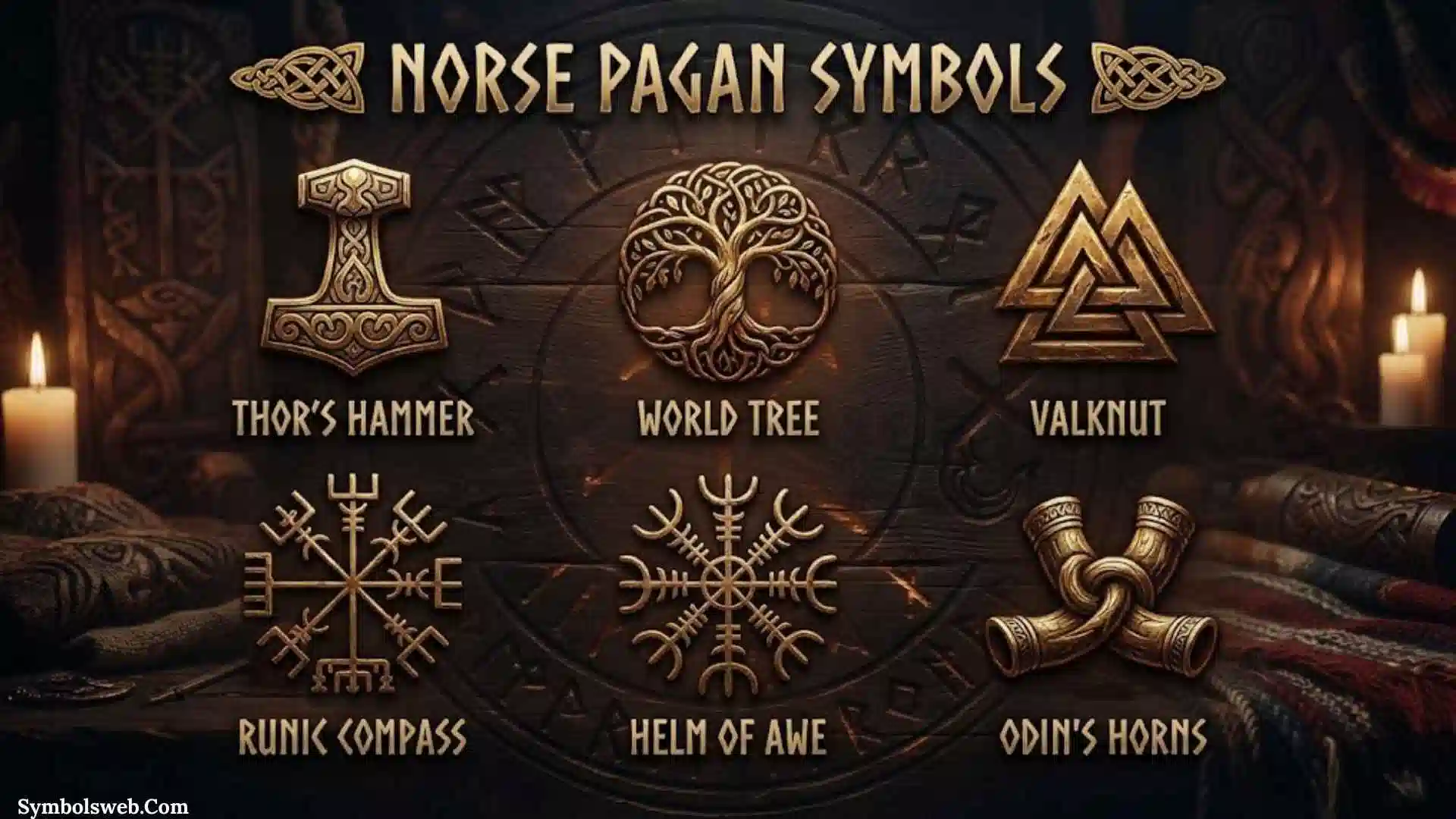
Norse pagan symbols have fascinated people for centuries because they carry powerful stories of gods, warriors, fate, protection, and spiritual transformation. These ancient symbols were more than decorative marks. They represented beliefs that shaped the lives of the Viking and Germanic peoples of Northern Europe.
From mysterious runes to legendary symbols linked with Odin and Thor, these sacred signs continue to inspire modern spirituality, art, tattoos, and personal identity. Understanding their deeper meanings reveals not only ancient traditions but also timeless truths about courage, destiny, wisdom, and the human spirit.
Quick Answer
Norse pagan symbols are sacred signs and visual representations used in ancient Norse religion and Viking culture to express spiritual beliefs, divine protection, wisdom, strength, fate, and connections to the gods. Symbols such as the Valknut, Mjölnir, Yggdrasil, and runes remain important in mythology, modern paganism, and cultural heritage.
Quick Facts About Norse Pagan Symbols
| Aspect | Information |
| Origin | Ancient Scandinavia and Germanic Europe |
| Historical Significance | Used in Viking Age religion, rituals, art, and cultural identity |
| Main Meaning | Protection, wisdom, destiny, power, and connection to the divine |
| Spiritual Meaning | Personal transformation, spiritual growth, and cosmic balance |
| Cultural Importance | Central to Norse mythology and Viking heritage |
| Modern Usage | Tattoos, jewelry, spiritual practices, artwork, and historical studies |
What Are Norse Pagan Symbols?
Norse pagan symbols are visual emblems associated with the ancient Norse religion practiced throughout Scandinavia before Christianity became dominant. These symbols appeared on weapons, jewelry, stones, ships, clothing, monuments, and ritual objects.
The Norse people believed that the universe was interconnected through powerful spiritual forces. Symbols served as reminders of these forces and often acted as protective charms or sacred representations of divine concepts.
The Viking Age, generally dated from approximately 793 CE to 1066 CE, saw widespread use of symbolic imagery. Archaeological discoveries across Norway, Sweden, Denmark, Iceland, and parts of Britain reveal how deeply embedded these symbols were in everyday life.
Many Norse symbols were connected to famous gods such as Odin, Thor, Freyja, Tyr, and Heimdall. Others represented broader ideas like fate, eternity, sacrifice, rebirth, wisdom, and cosmic order.
Today, historians, archaeologists, artists, and spiritual seekers continue to study these symbols because they provide valuable insight into one of Europe’s most fascinating ancient cultures.
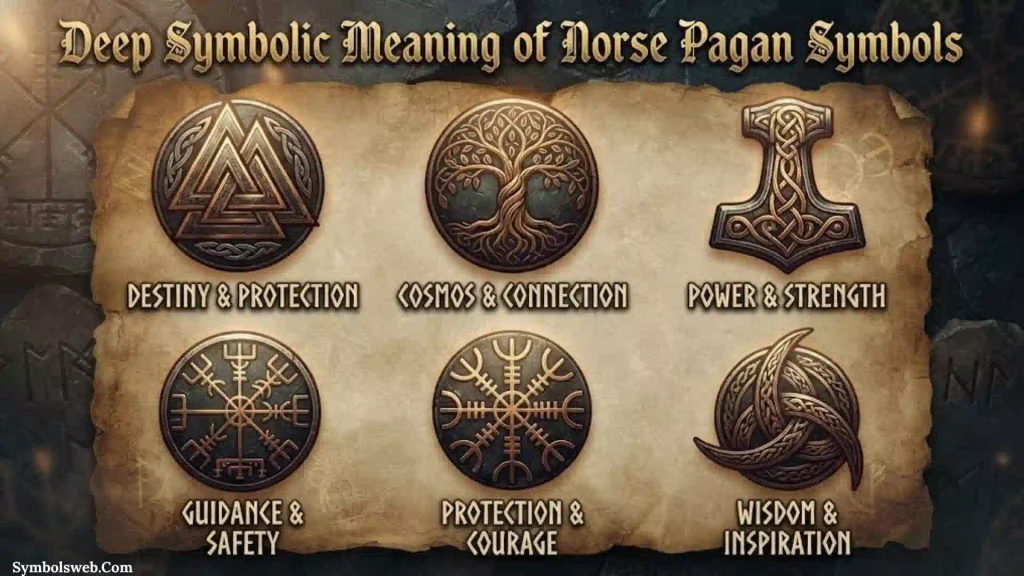
Deep Symbolic Meaning of Norse Pagan Symbols
Spiritual Level
At the spiritual level, Norse pagan symbols represent humanity’s connection to unseen cosmic forces.
The Norse worldview described a universe held together by Yggdrasil, the World Tree, which connected multiple realms of existence. Symbols often reflected this interconnectedness.
Many practitioners viewed symbols as sacred tools that could:
- Promote spiritual awareness
- Offer divine protection
- Strengthen personal courage
- Encourage wisdom and self-discovery
- Connect individuals to ancestral traditions
The symbols were not merely artistic designs. They carried spiritual intention and sacred significance.
Psychological Level
From a psychological perspective, Norse symbols resonate because they embody universal human experiences.
Swiss psychologist Carl Jung proposed that humans share collective archetypes. Many Norse symbols reflect these archetypal themes.
Examples include:
- The hero’s journey
- Sacrifice for wisdom
- Death and rebirth
- Strength in adversity
- The search for meaning
The Valknut, for example, can symbolize confronting mortality, while Yggdrasil reflects personal growth and interconnected life experiences.
Cultural Level
Within Norse society, symbols reinforced community values.
These included:
- Honor
- Loyalty
- Courage
- Wisdom
- Responsibility
- Respect for ancestors
A Viking warrior wearing Thor’s Hammer was expressing not only faith but also cultural identity and social belonging.
Types and Variations of Norse Pagan Symbols
Mjölnir (Thor’s Hammer)
Visual Description
A hammer-shaped pendant or emblem.
Meaning
Protection, strength, blessing, and divine power.
Symbolism
Mjölnir represents the mighty hammer wielded by the thunder god Thor.
Cultural Connection
Widely worn during the Viking Age.
Where It Appears
- Jewelry
- Burial sites
- Religious artifacts
- Modern tattoos
Valknut
Visual Description
Three interlocking triangles.
Meaning
Death, transition, destiny, and Odin’s power.
Symbolism
The Valknut is often associated with warriors and the afterlife.
Cultural Connection
Frequently appears near depictions of Odin.
Where It Appears
- Rune stones
- Memorial carvings
- Modern Norse-inspired art
Yggdrasil
Visual Description
A massive sacred tree connecting multiple worlds.
Meaning
Life, unity, wisdom, and cosmic balance.
Symbolism
Represents the structure of the universe.
Cultural Connection
Central to Norse cosmology.
Where It Appears
- Mythological texts
- Spiritual artwork
- Contemporary pagan symbolism
Vegvisir
Visual Description
A compass-like symbol with eight arms.
Meaning
Guidance and protection during life’s journey.
Symbolism
Often interpreted as helping travelers avoid becoming lost.
Cultural Connection
Associated with Icelandic magical traditions.
Where It Appears
- Tattoos
- Jewelry
- Spiritual practices
Aegishjalmur (Helm of Awe)
Visual Description
Eight spiked arms radiating from a central point.
Meaning
Protection and courage.
Symbolism
Believed to inspire fearlessness and strength.
Cultural Connection
Connected with magical traditions and warrior culture.
Where It Appears
- Talismans
- Tattoos
- Modern pagan artwork
Runes
Visual Description
Angular alphabetic symbols.
Meaning
Communication, magic, wisdom, and destiny.
Symbolism
Each rune possesses unique meanings and energies.
Cultural Connection
Used for writing, divination, and rituals.
Where It Appears
- Stones
- Weapons
- Jewelry
- Manuscripts
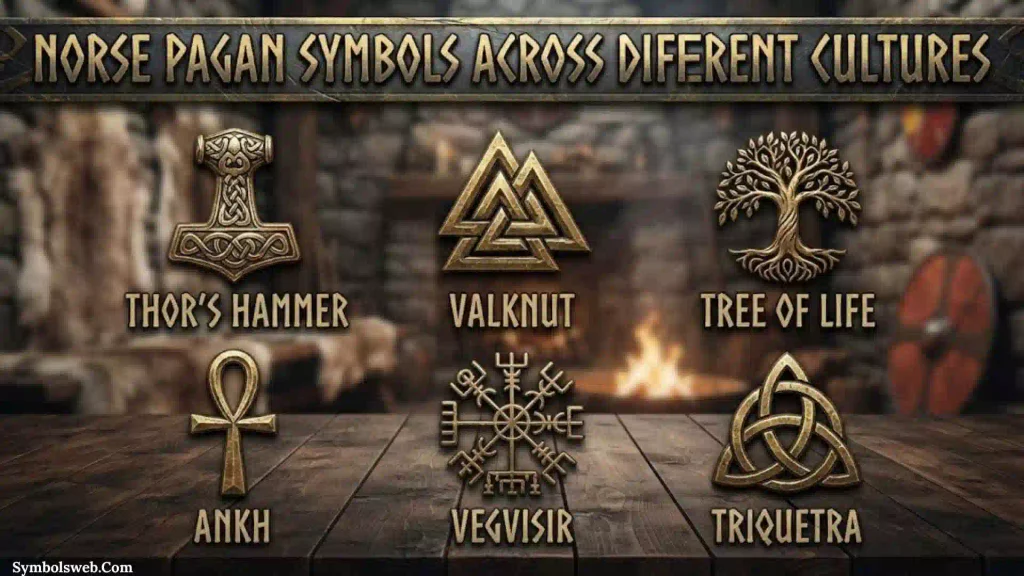
Norse Pagan Symbols Across Different Cultures
Ancient Egypt
Ancient Egyptians used symbols such as the Ankh to represent life and immortality. Like Norse symbols, these signs connected people to divine forces and the afterlife.
Ancient Greece
Greek culture employed symbols associated with gods such as Zeus and Athena. Similar to Thor’s Hammer, these symbols reflected divine authority and protection.
Roman Culture
Roman military standards and religious emblems reinforced identity and loyalty, much like Norse symbols did for Viking communities.
Eastern Traditions
Eastern spiritual systems often use sacred symbols such as the Yin Yang and lotus flower to represent balance and enlightenment. These concepts resemble the Norse emphasis on cosmic harmony.
Indigenous Traditions
Many Indigenous cultures use symbolic imagery connected to nature, ancestors, and spiritual guidance. This mirrors the Norse respect for sacred landscapes and ancestral wisdom.
Modern Interpretations
Today, Norse symbols are embraced by historians, artists, spiritual practitioners, and people exploring their heritage. Their meanings continue to evolve while retaining ancient roots.
Similar Symbols and Their Meanings
| Symbol | Similar To | Similarity | Difference |
| Valknut | Celtic Triquetra | Interconnected design | Valknut is linked to Odin and fate |
| Yggdrasil | Tree of Life | Represents interconnected existence | Different mythological origins |
| Mjölnir | Cross | Protective spiritual symbol | Different religious traditions |
| Vegvisir | Compass Rose | Guidance and direction | Spiritual rather than navigational focus |
| Runes | Ancient alphabets | Communication systems | Runes also carried magical meanings |
Common Misconceptions
One common misconception is that every Norse symbol has a single universally agreed meaning. In reality, interpretations often vary among scholars, archaeologists, and modern practitioners.
Norse Pagan Symbols in Mythology and Folklore
Norse mythology is filled with powerful symbolic stories.
Odin sacrificed himself upon Yggdrasil to gain the wisdom of the runes. This myth transformed runes into symbols of knowledge, sacrifice, and enlightenment.
Thor’s Hammer became a symbol of divine protection because Thor defended gods and humans against destructive forces.
The Valknut appears in imagery connected to Odin and fallen warriors, linking it to themes of fate and the journey beyond death.
Stories of Ragnarök, the Norse apocalypse, also reinforce symbolic themes of destruction followed by renewal and rebirth.
These myths continue to shape modern interpretations of Norse symbols.
Norse Pagan Symbols in Art, Literature, Movies, and Pop Culture
Paintings
Artists frequently depict Yggdrasil, Odin, and Thor’s Hammer to explore themes of mythology and destiny.
Literature
Norse symbols appear in countless novels, fantasy stories, and historical works inspired by Viking culture.
Poetry
Ancient skaldic poetry used symbolic imagery to communicate complex spiritual and heroic themes.
Movies
Popular films inspired by Norse mythology often feature Thor’s Hammer, runes, and Viking iconography.
Television
Modern fantasy series regularly incorporate Norse-inspired symbols to create rich mythological worlds.
Tattoos
Norse tattoos remain among the most popular symbolic tattoo styles worldwide.
Common choices include:
- Valknut
- Vegvisir
- Mjölnir
- Yggdrasil
- Rune designs
Fashion
Jewelry, clothing, and accessories often feature Norse symbols as expressions of heritage and identity.
Modern Design
Graphic designers use Norse motifs because of their strong visual impact and timeless symbolism.
Spiritual and Dream Meaning of Norse Pagan Symbols
Dreams involving Norse symbols can have powerful personal significance.
Yggdrasil in Dreams
May symbolize:
- Personal growth
- Life connections
- Spiritual development
Thor’s Hammer in Dreams
May represent:
- Protection
- Strength
- Overcoming challenges
Valknut in Dreams
Often relates to:
- Transformation
- Endings and beginnings
- Acceptance of change
Runes in Dreams
Can symbolize:
- Hidden knowledge
- Important messages
- Personal insight
Positive Messages
- Courage
- Wisdom
- Renewal
- Protection
- Guidance
Cautionary Messages
- Resistance to change
- Fear of transformation
- Ignoring personal growth
Positive and Negative Meanings of Norse Pagan Symbols
| Positive Meaning | Negative Meaning |
| Strength | Aggression |
| Wisdom | Obsession with power |
| Protection | Fear-based control |
| Transformation | Painful change |
| Courage | Recklessness |
| Spiritual growth | Spiritual pride |
| Loyalty | Blind devotion |
| Destiny | Fatalism |
The same symbol can reflect both light and shadow depending on how it is understood and applied.
Why Humans Are Attracted to Norse Pagan Symbols
Humans naturally seek symbols that help explain life’s mysteries.
Norse symbols resonate because they tell stories about universal experiences:
- Facing fear
- Seeking wisdom
- Finding purpose
- Building resilience
- Connecting with ancestry
Psychologically, people are drawn to meaningful patterns. Symbols act as shortcuts for complex ideas and emotions.
The image of Yggdrasil instantly communicates interconnectedness. Thor’s Hammer evokes strength and protection. The Valknut reminds us of life’s mysteries and transformations.
These symbols survive because they speak to enduring aspects of human nature.
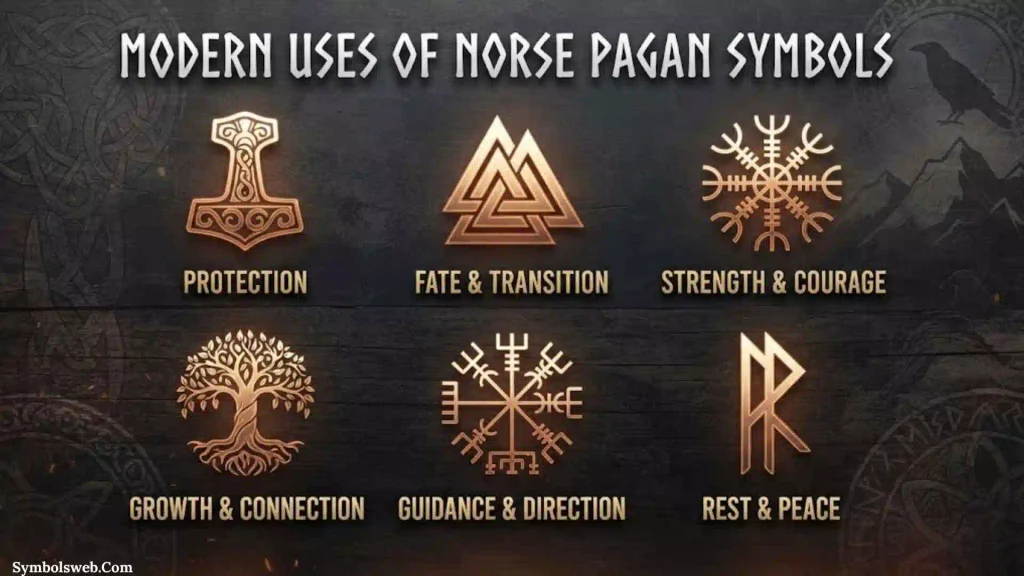
Modern Uses of Norse Pagan Symbols
Tattoos
Many people choose Norse symbols to express personal values and spiritual beliefs.
Jewelry
Thor’s Hammer pendants remain among the most recognizable Norse-inspired accessories.
Fashion
Norse imagery appears in modern clothing, footwear, and accessories.
Branding
Some companies use Norse-inspired designs to communicate strength, endurance, and authenticity.
Social Media
Users often share Norse symbols as representations of identity and heritage.
Contemporary Spirituality
Modern pagan communities continue to incorporate ancient symbols into rituals and meditation practices.
Home Decor
Wall art, sculptures, and decorative pieces frequently feature Yggdrasil and rune designs.
Personal Expression
Many people connect with Norse symbols because they reflect personal journeys of growth, courage, and self-discovery.
Interesting Facts About Norse Pagan Symbols
- Thor’s Hammer pendants have been discovered in hundreds of Viking archaeological sites.
- Valknut’s exact historical meaning remains debated among scholars.
- The word “rune” can be translated as “secret” or “mystery.”
- Yggdrasil connects nine realms in Norse cosmology.
- Odin sacrificed an eye in his quest for wisdom.
- Many modern rune systems are based on the Elder Futhark alphabet.
- Vegvisir comes from later Icelandic manuscripts rather than the Viking Age itself.
- Norse symbols experienced renewed popularity during the nineteenth century.
- Archaeologists continue discovering Viking artifacts featuring symbolic carvings.
- Several Norse symbols remain active elements of modern pagan spiritual practice.
Frequently Asked Questions
What is the most important Norse pagan symbol?
Many consider Yggdrasil and Mjölnir among the most important symbols because they represent the structure of the universe and divine protection.
What does the Valknut symbolize?
The Valknut is commonly associated with Odin, fate, death, transformation, and the journey between worlds.
Are Norse pagan symbols still used today?
Yes. They are widely used in tattoos, jewelry, artwork, historical studies, and contemporary pagan spirituality.
Is Vegvisir a Viking symbol?
Vegvisir is often associated with Viking culture, but historical evidence places it in later Icelandic magical manuscripts rather than the Viking Age itself.
What are Norse runes used for?
Runes were used for writing, communication, memorial inscriptions, divination, and symbolic spiritual practices.
Do Norse pagan symbols have spiritual meanings?
Yes. Many symbols represent protection, wisdom, transformation, destiny, courage, and connection with divine forces.
Conclusion
Norse pagan symbols are far more than ancient designs carved into stone and metal. They are powerful expressions of humanity’s search for wisdom, protection, identity, and meaning. From the mighty hammer of Thor to the cosmic branches of Yggdrasil, each symbol tells a story that has endured for centuries.
Their continued popularity reveals something profound about human nature. We are drawn to symbols that help us understand ourselves and our place in the world. The enduring legacy of Norse pagan symbols reminds us that courage, growth, and the pursuit of wisdom remain timeless journeys shared across generations.

Jordan Hayes is a writer with a passion for exploring the history, meanings, and cultural significance behind symbols from around the world. He enjoys turning complex topics into clear, engaging content that anyone can understand. Jordan is also the fictional author of The Silent Language of Ancient Marks and Hidden Symbols Beyond the Surface, two original book concepts created for his author profile. When he’s not writing, he spends time researching myths, traditions, and forgotten stories that inspire his work. His goal is to help readers discover the deeper meanings behind the symbols they encounter every day.
 Eliana Foster
 Ethan Holloway