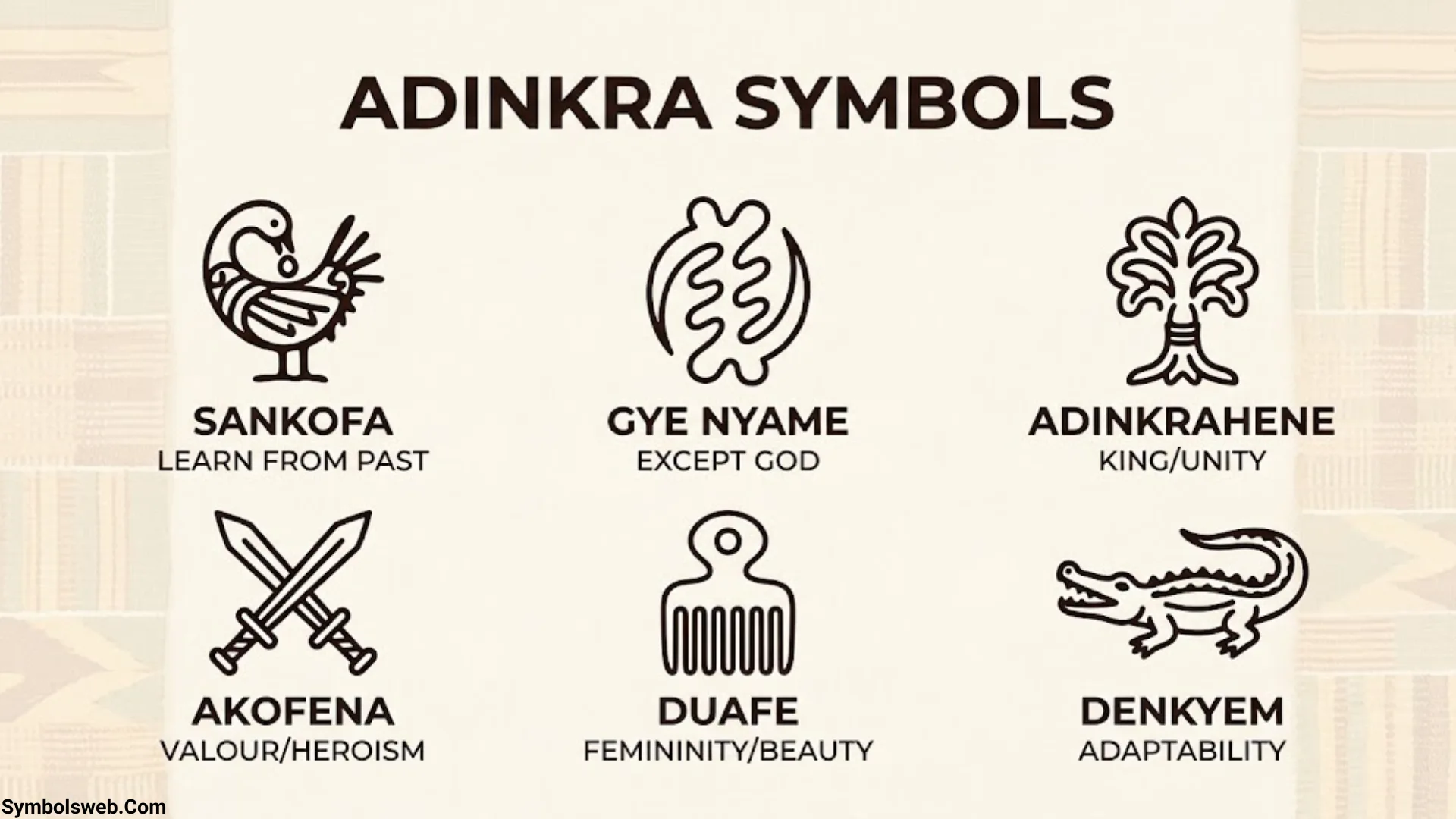
Adinkra symbols are more than decorative shapes on fabric. They carry ideas about wisdom, faith, freedom, resilience, responsibility, and the connections between people and their communities. Rooted in Akan cultural traditions in Ghana, these symbols form a rich visual language that connects art with philosophy and everyday life.
When you look closely at Adinkra symbolism, you discover how a simple shape can communicate a much larger idea. A bird looking backward, for example, can represent the value of learning from the past. Other symbols draw on familiar objects, plants, tools, and abstract forms to express cultural values and traditional knowledge.
Today, Adinkra symbols appear on clothing, jewelry, architecture, public monuments, and contemporary graphic designs. Their continued use reflects both the strength of Ghanaian cultural heritage and the ability of traditional art to find meaning in new settings.
This guide explores Adinkra symbol meanings, historical origins, traditional cloth-making methods, design principles, modern applications, and respectful ways to engage with this important cultural tradition.
What Are Adinkra Symbols?
Adinkra symbols are visual motifs associated with Akan cultural traditions, particularly those of the Asante people of Ghana. Many represent ideas, moral principles, proverbs, or aspects of spiritual and social life. Artisans have traditionally printed these motifs onto cloth using carved stamps and dark vegetable-based dye.
Rather than functioning as a conventional alphabet, Adinkra forms a symbolic system. A symbol can communicate an idea without spelling out a spoken word or sentence. Its meaning often comes from its name, visual form, associated proverb, and cultural context.
For example, Sankofa expresses the importance of looking back to gain knowledge that can guide the future. Gye Nyame is widely associated with the supremacy of God. These meanings help explain why Adinkra motifs can communicate complex ideas through relatively simple visual forms.
The symbols also demonstrate how African symbolic art can connect practical craftsmanship with philosophy, storytelling, and identity.
Key Characteristics of Adinkra Symbolism
Several features distinguish the Adinkra tradition:
- Symbolic meanings: Many motifs express wisdom, unity, courage, faith, protection, or other values.
- Visual communication: A recognizable form communicates an idea without relying on a long written explanation.
- Textile craftsmanship: Traditional artisans stamp or draw motifs on cloth using specialized tools and dye.
- Cultural context: Names, proverbs, oral traditions, and community knowledge help explain individual symbols.
- Adaptability: Adinkra motifs appear on traditional textiles as well as jewelry, buildings, monuments, and modern designs.
Adinkra cloth and kente cloth are both important in Ghanaian textile culture, but they use different techniques. Traditional Adinkra cloth features stamped or drawn designs, while kente is known for its woven patterns.
According to Smarthistory’s overview of Adinkra cloth, these textiles have also communicated identity, social standing, and cultural affiliations. Their visual patterns are therefore more than decoration.
History and Origins of Adinkra Symbols
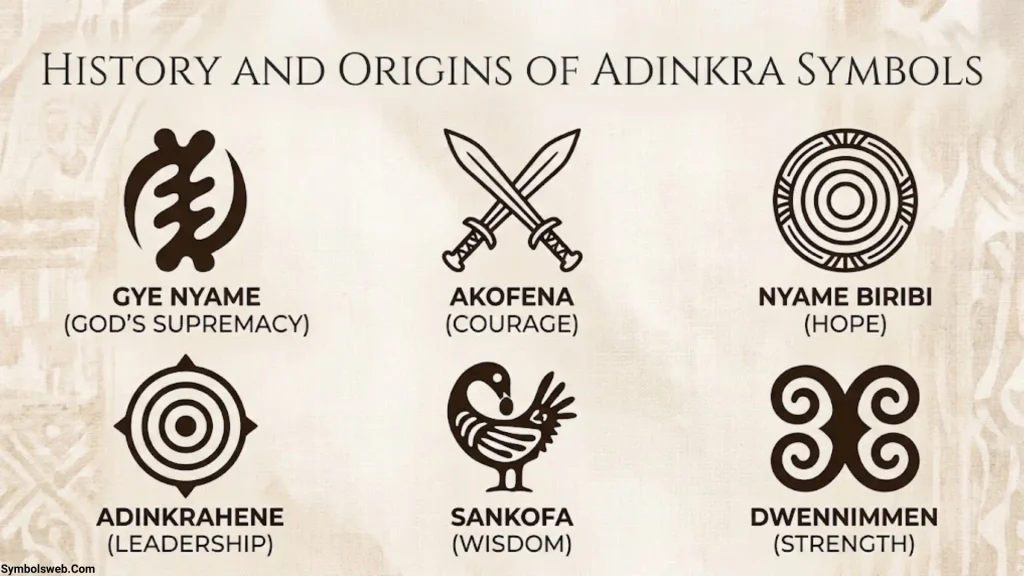
The history of Adinkra combines oral traditions, historical objects, textile craftsmanship, and cultural exchange. Researchers study surviving cloth, museum records, and accounts passed down through generations to understand how the tradition developed.
Adinkra is strongly associated with the Akan peoples of present-day Ghana, especially the Asante. Historical accounts also connect its development to Gyaman, a polity associated with areas of present-day Côte d’Ivoire.
However, no single origin story explains every aspect of Adinkra’s development. The history of the symbols, the history of Adinkra cloth, and the evolution of individual meanings are related but distinct subjects.
Where Did Adinkra Symbols Originate?
Adinkra developed within the broader cultural world of the Akan peoples of West Africa. The Asante, whose historic kingdom became a major political and cultural power in what is now Ghana, played a central role in the tradition’s development and spread.
One well-known oral account links Adinkra cloth to Nana Kwadwo Agyemang Adinkra, the king of Gyaman. According to this account, the Asante defeated Gyaman in the early nineteenth century and subsequently adopted elements of its textile tradition.
Other historical accounts trace aspects of the craft to earlier exchanges among neighboring communities. Recent scholarship also emphasizes that Adinkra emerged through interactions among different peoples, artisans, and cultural traditions rather than from an isolated source.
These accounts should be treated as historical traditions, not as proof that every symbol was invented by one person or at one moment.
The 1817 Adinkra Cloth and Early Documentation
One of the most important surviving examples is an Adinkra cloth dated to 1817, now held by the British Museum. The museum records its acquisition in 1818 through Thomas Edward Bowdich, a British traveler who visited the Asante capital of Kumasi.
The textile is made from cotton and features patterns created with carved calabash stamps and traditional dye. Its arrangement of repeated motifs shows that artisans had developed a structured method for combining individual symbols into a larger composition.
The museum’s catalog also documents the use of bark from the badie tree and iron slag in producing the dark printing mixture. This evidence provides a concrete record of historical materials and techniques.
You can examine the original object in the British Museum collection.
How Adinkra Symbols Evolved Over Time
Adinkra has changed as communities have adapted the tradition to new circumstances. Early examples are closely connected with textile production and ceremonial use, while contemporary examples appear across a much wider range of objects.
Traditional artisans continue to produce hand-stamped fabrics. At the same time, machine printing and digital reproduction have made Adinkra-inspired designs accessible through commercial clothing, illustrations, and graphic products.
This expansion creates opportunities to preserve and share cultural knowledge. It also makes accurate documentation important because a motif can spread far beyond the community in which its name and meaning are best understood.
What Do Adinkra Symbols Mean?
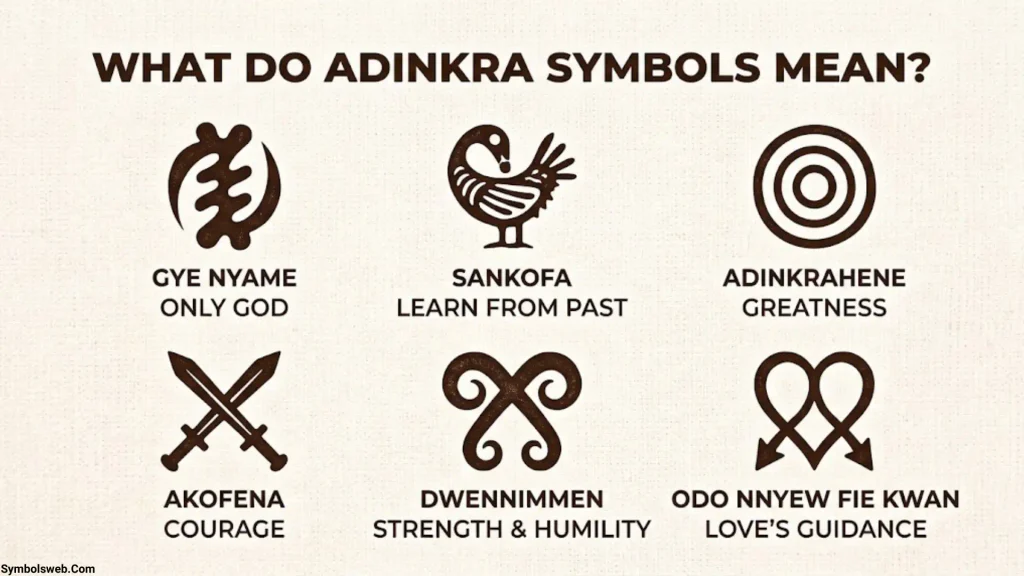
Adinkra symbol meanings cover a wide range of subjects, including spiritual beliefs, ethical principles, relationships, leadership, personal growth, and community life. Many motifs have recognizable interpretations, but researchers have also documented differences in the names and meanings assigned to some designs.
The table below introduces seven well-known symbols and their commonly reported associations.
| Adinkra symbol | Common meaning | Main theme |
| Sankofa | Learn from the past to guide the future | Wisdom and memory |
| Gye Nyame | Supremacy of God | Faith and spirituality |
| Duafe | Beauty, grooming, and feminine virtue | Care and character |
| Fawohodie | Freedom and independence | Liberty and responsibility |
| Eban | Safety and protection | Security and home |
| Nkyinkyim | Adaptability and life’s changing path | Resilience |
| Aya | Endurance and independence | Strength and perseverance |
These descriptions are useful starting points rather than exhaustive definitions. A symbol’s interpretation can depend on its name, the proverb associated with it, and the circumstances in which it appears.
Sankofa — Learning From the Past
Sankofa is among the most widely recognized Adinkra symbols. It is commonly represented as a bird turning its head backward, sometimes toward an egg resting on its back. Another familiar form resembles a heart.
The symbol expresses an important idea: you can look back at the past without becoming trapped in it. Instead, you can recover useful knowledge, understand earlier mistakes, and apply those lessons to the future.
This principle connects Sankofa with cultural memory, family history, and intergenerational knowledge. Communities can preserve their traditions while still changing and growing.
For example, a teacher might use Sankofa to encourage students to study their heritage before developing new ideas. A family might choose the symbol to represent the importance of remembering ancestors and learning from their experiences.
Sankofa is therefore not simply about nostalgia. Its deeper message is that the past can provide practical guidance for what comes next.
Gye Nyame — The Supremacy of God
Gye Nyame is a prominent symbol associated with the supremacy and power of God in Akan religious thought. Its name is commonly translated as an expression meaning that, except for God, one fears no one.
The motif has a distinctive curved, abstract shape. It appears on fabrics, jewelry, buildings, artwork, and many other objects associated with Ghanaian identity.
For many people, Gye Nyame communicates faith, reverence, and the belief that divine power exceeds human authority. Ghanaian Christians have also embraced the symbol as an expression of their religious beliefs.
Its widespread use shows how a traditional motif can retain cultural significance while also taking on meanings within different religious communities.
Duafe — Beauty, Care, and Feminine Virtue
Duafe is associated with a wooden comb. Its visual form recalls a practical object used for grooming, but its traditional interpretations extend beyond physical appearance.
The symbol is commonly connected with beauty, cleanliness, care, and qualities associated with feminine virtue. It can also suggest the importance of patience and thoughtful conduct.
Duafe offers an example of how Adinkra iconography draws meaning from familiar objects. A comb becomes a way to communicate ideas about personal presentation and character.
When you encounter Duafe in jewelry or artwork, its meaning may reflect beauty, cultural identity, or an appreciation of traditional Akan values.
Fawohodie — Freedom and Independence
Fawohodie represents freedom and independence. It is often associated with liberation and the value of being able to direct one’s own life.
Freedom, however, is not simply the absence of restrictions. It can also involve responsibility, self-discipline, and respect for the rights of others.
The symbol’s common interpretation makes it relevant to discussions of independence, self-determination, and human dignity. In contemporary designs, it may communicate a personal commitment to freedom or a broader appreciation of liberty.
Because individual symbol interpretations can vary among sources, consult a reliable cultural reference when you need an exact traditional explanation of its form or name.
Eban — Safety and Protection
Eban is associated with a fence or enclosure. In its traditional context, the fence can represent the protection surrounding a home and the security that allows a family to live together.
A fence creates a boundary between an interior space and the outside world. In this way, Eban can express safety, shelter, and the value of a protected home.
The motif also provides an example of how traditional African symbols often draw on familiar objects and everyday experiences. The underlying idea is easy to understand because most people recognize the purpose of a fence.
Eban may appear in artwork or decorative objects intended to express protection, family bonds, or a sense of belonging.
Nkyinkyim — Adaptability and Life’s Twisting Path
Nkyinkyim is associated with a twisting or winding form. Its common interpretation emphasizes life’s changing course and the need to adapt when circumstances become difficult.
The symbol connects with resilience, initiative, and the ability to respond to challenges. Rather than assuming that life follows a straight path, it recognizes that progress often involves unexpected turns.
Think of someone learning a new skill. They may need to change their approach several times before they succeed. Nkyinkyim offers a visual way to express this willingness to adjust and keep moving.
Its meaning makes it especially relevant to discussions of perseverance and personal growth, although its traditional interpretation should remain grounded in credible cultural sources.
Aya — Endurance and Resilience
Aya is associated with a fern. The plant provides a fitting reference for endurance because ferns can grow in challenging environments and spread through their surroundings.
The symbol is commonly interpreted as a sign of endurance, independence, and the ability to withstand hardship. It can represent a person who continues despite obstacles rather than giving up when circumstances become difficult.
Aya’s meaning also connects to growth through discomfort. Challenges may demand patience and adjustment, but they can also reveal strengths that were not obvious before.
When used in contemporary artwork, the symbol may express perseverance, personal development, or pride in overcoming difficulties.
The Cultural and Philosophical Significance of Adinkra
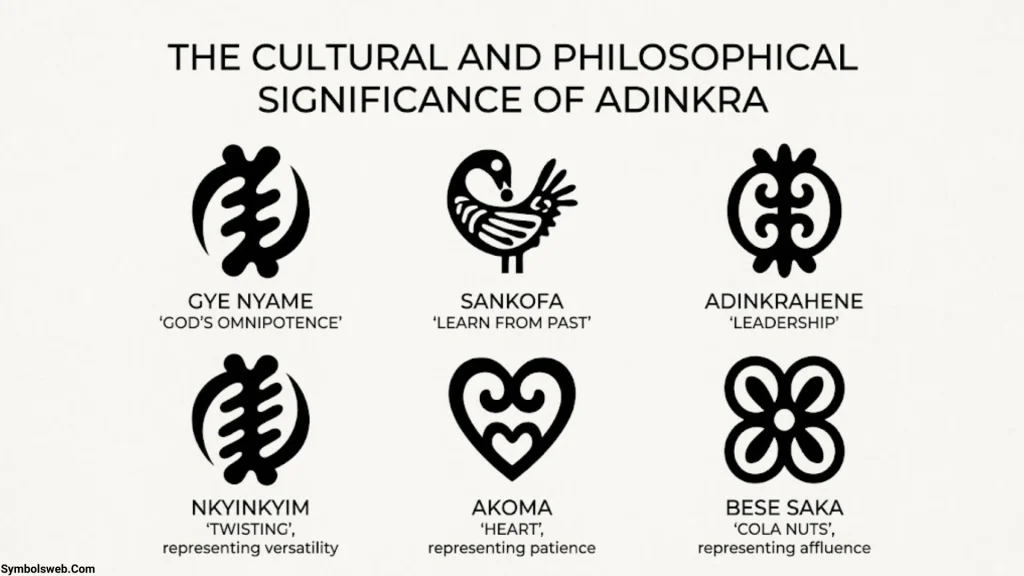
Adinkra symbols communicate ideas that extend beyond the appearance of the designs themselves. Their meanings connect with Akan philosophy, oral traditions, religious beliefs, social relationships, and the values that communities pass from one generation to the next.
Understanding this context helps explain why a symbol may carry more significance than a decorative pattern. A motif can refer to a proverb, a familiar object, a spiritual idea, or a lesson about human behavior.
Adinkra Symbols and Akan Proverbs
Proverbs play an important role in Akan oral traditions. They allow people to express complicated ideas through short, memorable statements grounded in everyday experience.
Adinkra symbols can provide a visual counterpart to this kind of communication. Instead of writing out a complete proverb, an artisan may select a motif associated with its central idea.
Sankofa illustrates this relationship particularly well. Its connection to looking back and learning from the past offers a memorable way to communicate a principle about wisdom and decision-making.
However, not every symbol corresponds to one universally fixed proverb. Researchers have documented differences in how certain designs are named and interpreted. The meaning of a motif should therefore be checked against credible cultural sources rather than copied from an unverified symbol chart.
Spiritual Beliefs and Moral Values
Some Adinkra meanings concern spiritual life, while others communicate lessons about conduct, relationships, or personal character.
Gye Nyame, for instance, expresses the supremacy of God. Other motifs are associated with endurance, cooperation, courage, leadership, or the importance of treating others fairly.
These ideas demonstrate the breadth of Adinkra symbolism and philosophy. The tradition does not communicate only religious beliefs or only practical advice. Its motifs address different parts of human experience.
You can understand the symbols more fully by asking three questions:
- What does the symbol’s name mean?
- Which traditional value, proverb, or idea is associated with it?
- How does the surrounding cultural context influence its interpretation?
These questions help separate established cultural meanings from modern interpretations added for commercial or personal purposes.
Ancestral Knowledge and Cultural Identity
Cultural knowledge survives through many channels. Families share stories, elders explain traditions, artisans teach practical skills, and communities preserve important objects and practices.
Adinkra can contribute to this process by making ideas visible. A symbol printed on cloth can remind someone of a family value, a spiritual belief, or a lesson learned from earlier generations.
This role connects Adinkra with intergenerational knowledge, ancestral traditions, and African cultural heritage. The motifs can serve as recognizable references to a shared cultural history, especially when people understand the stories and ideas associated with them.
At the same time, cultural identity is not fixed. People may interpret inherited traditions in new ways as they encounter different social, artistic, and religious environments.
Adinkra Symbols in Ceremonies and Traditional Life
Adinkra cloth has a documented historical connection with mourning and funerals among the Asante. Its colors, motifs, and arrangements can communicate messages connected with the occasion.
Traditional cloth also has a wider history of use. Some fabrics were associated with royal status and important public occasions, while lighter or more decorative versions could be suitable for different settings.
The British Museum documents historical Adinkra textiles featuring repeated designs, geometric divisions, and combinations of motifs. These objects show how textile composition and symbolic meaning work together.
Today, Adinkra motifs also appear on everyday clothing, jewelry, public buildings, and decorative objects. Their use beyond traditional cloth demonstrates how a cultural visual language can continue to evolve.
How Is Traditional Adinkra Cloth Made?
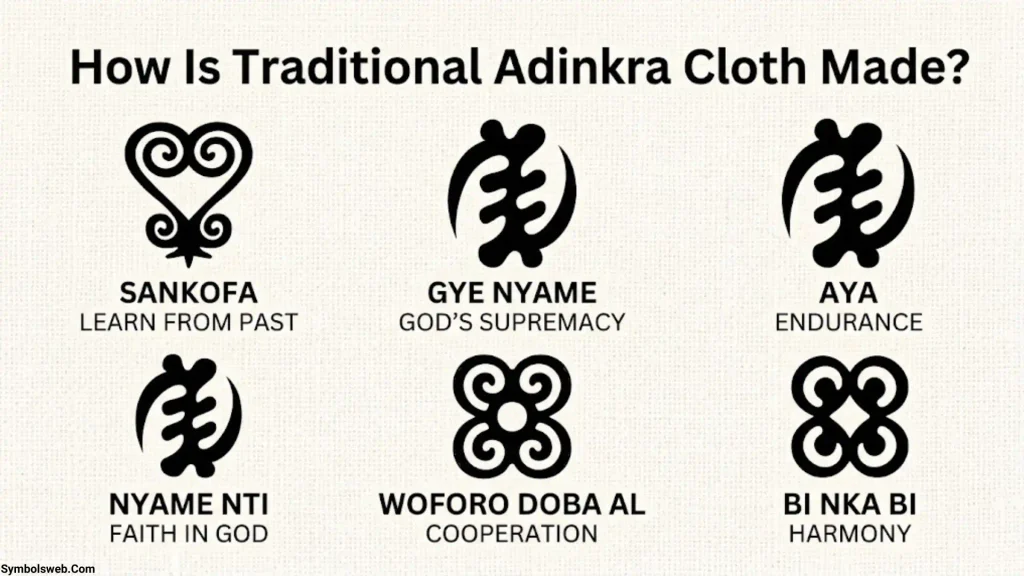
Traditional Adinkra cloth is created by applying designs to fabric, often using carved stamps and dark dye prepared from plant material. The process combines textile preparation, toolmaking, pattern planning, and printing.
The finished cloth reflects the artisan’s technical skill as well as decisions about which motifs to use and how to arrange them.
Materials Used in Adinkra Textile Production
Traditional production relies on several materials, although methods and supplies can vary.
| Material or tool | Purpose |
| Cotton cloth | Provides the surface for printing |
| Calabash or gourd | Supplies material for carving stamps |
| Carving tools | Shape the stamp’s printing surface |
| Badie tree bark | Provides material for traditional dye |
| Iron slag | Helps produce the dark printing mixture |
| Dye container | Holds the mixture during printing |
| Measuring and marking tools | Help organize the cloth’s pattern layout |
Historical examples show that artisans used both locally woven cotton and imported cotton fabric. The finished textile could also include sewn strips, borders, and other decorative details.
How Adinkra Stamps Are Carved
A traditional Adinkra stamp is commonly carved from dried calabash. The artisan shapes its surface to create a recognizable motif and may attach a handle to make repeated printing easier.
Different stamps represent different forms. Some resemble familiar objects, while others use more abstract combinations of lines and curves.
The carving process requires care because the stamp must produce a recognizable impression. If its shape is poorly formed or the printing surface is uneven, repeated impressions may become difficult to control.
Specialized carvers and textile makers preserve this practical knowledge through experience and teaching.
How Traditional Adinkra Dye Is Prepared
Traditional black Adinkra dye is associated with the badie tree, whose bark is processed to create a dark liquid. Historical descriptions explain that the bark is soaked, pounded, and boiled. Iron slag may be added to help produce the dense printing mixture.
This preparation differs from using ordinary commercial fabric ink. The traditional mixture reflects knowledge of local materials and how they behave during textile production.
The British Museum’s record of its 1817 Adinkra cloth documents bark-based dye and iron slag as part of the historical process. You can read the technical details in its collection record.
How Symbols Are Printed on Fabric
Once the cloth and dye are ready, the artisan plans the composition. Traditional fabrics may be divided into squares, rectangles, rows, or other sections that help organize the motifs.
The printing process generally follows these steps:
- Prepare the fabric and decide on its layout.
- Mark out sections or guide lines where needed.
- Dip the carved stamp into the dye.
- Press the stamp onto the fabric to create an impression.
- Repeat the process to build rows, borders, or groups of motifs.
- Allow the finished fabric to dry.
Some textiles use one repeated symbol within a section, while others combine several designs. The artisan’s choices influence the overall appearance and the way the symbols interact.
Traditional and Modern Adinkra Printing Methods
Traditional hand-stamping gives each impression a direct connection to the artisan’s tools and technique. Small differences in pressure, dye, and placement may create subtle variations across the fabric.
Modern printing methods can reproduce motifs in large quantities and at consistent sizes. Commercially produced Adinkra-inspired textiles may use printing technologies that differ from traditional methods.
Neither method automatically determines the cultural value of a design. To understand a textile, consider its origin, production technique, the meanings of its motifs, and the people who created it.
How Adinkra Patterns Use Shape, Repetition, and Geometry
Adinkra designs offer useful examples of how visual patterns organize individual shapes into a larger composition. Their structure can be studied through geometric patterns, repetition, spacing, symmetry, and contrast.
These features are visible in the textiles themselves. However, describing them as design principles does not mean that every Adinkra motif follows one universal mathematical system.
Geometric Forms and Symbol Construction
Individual motifs may contain circles, curves, parallel lines, angles, or shapes inspired by plants, animals, tools, and familiar objects.
Some designs are easy to recognize because they resemble their namesakes. Others are more abstract and require cultural knowledge to interpret.
This variety contributes to the richness of Adinkra designs. Artisans work with different visual forms rather than relying on one standard shape or construction method.
Repetition, Symmetry, and Visual Rhythm
Repeated motifs help establish rhythm across a piece of fabric. A single stamp may appear several times in a row, while borders or dividing lines create structure between groups.
Some symbols feature symmetrical arrangements, while others depend on irregular curves or directional movement. Symmetry is therefore a feature to examine in specific designs rather than an assumption to apply to the entire tradition.
Repetition also helps individual motifs remain recognizable within a larger pattern.
Positive Space and Negative Space
The printed portions of a textile create positive space, while the surrounding unprinted areas create negative space. Both contribute to the design’s appearance.
If motifs sit too close together, their outlines may become difficult to distinguish. If the spaces between them are carefully planned, each symbol can remain clear while still contributing to the overall composition.
These principles are useful for understanding traditional textiles and for studying how designers adapt cultural motifs to contemporary formats.
Pattern Grids and Textile Composition
Some Adinkra cloths use grids to organize symbols into distinct sections. A grid may make it easier for the artisan to repeat a motif consistently, establish borders, and balance different visual elements.
The British Museum’s 1817 cloth, for example, contains repeated designs arranged within a structured layout. This surviving textile provides direct evidence of how artisans organized motifs on fabric.
Such examples illustrate visual balance, pattern composition, and visual rhythm without requiring the assumption that all Adinkra textiles use identical layouts.
How Adinkra Symbols Are Used in Modern Life
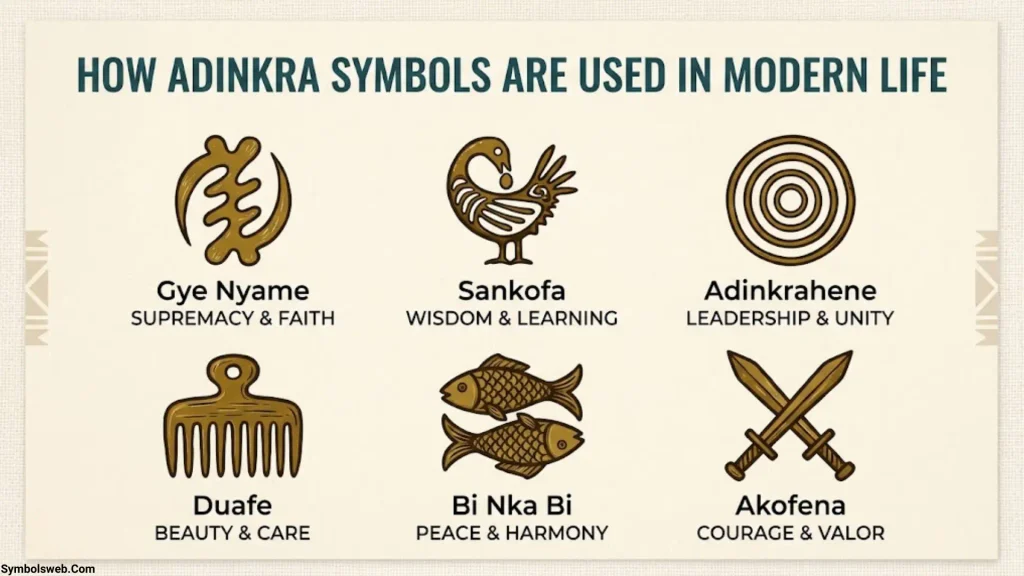
Adinkra motifs have moved beyond traditional textiles into many forms of contemporary art and design. You can find them on accessories, decorative objects, architectural surfaces, public monuments, and clothing.
These uses show how a traditional visual language can remain meaningful while adapting to different materials and audiences.
Adinkra Symbols in Clothing and Fashion
Adinkra-inspired fabrics appear in traditional garments and contemporary fashion. Designers may use individual motifs as focal points or arrange repeated patterns across an entire piece of clothing.
The choice of design can communicate cultural pride, personal values, or a connection to Ghanaian heritage. For example, someone may choose a garment featuring Sankofa because they value history and the lessons it offers.
However, not every garment marketed as African-inspired uses authentic Adinkra motifs. If the cultural origin matters to you, check the seller’s description and look for information about the design, maker, and production method.
Adinkra Symbols in Jewelry and Decorative Art
Jewelry provides a compact surface for displaying individual symbols. Pendants, bracelets, earrings, and other accessories may feature motifs associated with faith, wisdom, protection, or resilience.
Smaller objects require careful reproduction because fine lines and details can disappear when a design is reduced. A well-made piece preserves the symbol’s recognizable features while adapting it to the chosen material.
Decorative objects offer similar opportunities. The meaning of a motif can become part of the object’s personal or cultural significance rather than serving only as decoration.
Adinkra Symbols in Architecture and Public Art
Adinkra motifs also appear on buildings and public monuments. Their placement can connect a structure with Ghanaian cultural identity and make traditional symbolism visible in shared spaces.
Examples documented by Smarthistory include Adinkra motifs on the exterior of the former City Hotel in Kumasi and on the Embassy of Ghana in Washington, D.C.
The symbols have also appeared in memorial settings, including the African Burial Ground National Monument in New York City. Such uses show how African design traditions can contribute to contemporary architecture and public storytelling.
Adinkra Symbols in Logos and Branding
Businesses and organizations may incorporate Adinkra motifs into logos, packaging, or other visual identities. A symbol associated with unity, resilience, or wisdom may appear relevant to an organization’s values.
Still, a designer should understand the original meaning before using a motif commercially. A symbol associated with a specific spiritual or cultural idea may communicate something quite different from the message a business intends.
Responsible branding begins with research, accurate attribution where appropriate, and respect for the people and traditions associated with the design.
Can Adinkra Symbols Be Used in Digital and Graphic Design?
Yes. Adinkra symbols can be reproduced in digital illustrations, vector graphics, educational resources, and visual identities. However, digitizing a symbol requires more than tracing its outline. Designers should preserve its recognizable features and document its cultural meaning.
Adinkra Symbols in Digital Illustration
Digital tools allow designers to create scalable versions of traditional motifs. Vector graphics are particularly useful because they can be resized without the same loss of sharpness that often affects raster images.
A careful workflow includes:
- Starting with a reliable reference image or documented example.
- Preserving the motif’s proportions and distinctive details.
- Recording its traditional name and verified meaning.
- Identifying the source of the reference and checking relevant usage rights.
- Comparing the digital version with the original design before publication.
These steps help preserve the connection between a symbol’s visual form and its cultural context.
Adinkra Typography and Digital Symbol Fonts
An Adinkra symbol font allows users to insert motifs into digital documents through a typeface or another supported input method. A symbol library, by contrast, may provide individual image files or vector graphics for use in design projects.
Neither format automatically makes Adinkra a conventional alphabet. Most Adinkra symbols communicate concepts through symbolic forms rather than mapping directly to speech sounds in the way letters do.
This distinction matters when creating educational resources or discussing African alphabets and writing systems. Different African cultures have developed different approaches to writing and visual communication, and they should not be treated as interchangeable.
Adinkra Symbols in UI and UX Design
Designers may explore Adinkra motifs for culturally specific websites, museum interfaces, educational platforms, and heritage projects.
However, a symbol’s traditional meaning does not guarantee that users will understand it as a digital interface icon. For example, an Adinkra symbol associated with protection should not automatically replace a familiar security icon without testing whether users understand the intended function.
Effective user interface (UI) design and user experience (UX) design require clarity, accessibility, and appropriate user feedback.
When incorporating Adinkra into a digital product, consider the following:
- Explain unfamiliar symbols through labels or supporting text.
- Test the interface with people from the intended audience.
- Maintain enough contrast for users to distinguish the design.
- Avoid using a culturally significant motif where a functional icon could create confusion.
- Provide accessible alternatives when a symbol communicates important information.
The goal is to create an interface that respects cultural meaning without sacrificing usability.
Preserving Cultural Meaning During Digitization
Digitization can help preserve and share traditional designs, but it can also separate symbols from the knowledge that gives them meaning.
A digital archive should ideally record each motif’s name, source, documented interpretation, and relevant historical information. If researchers disagree about a meaning, the archive should acknowledge that uncertainty rather than presenting one interpretation as universally accepted.
Collaboration with Ghanaian cultural practitioners and knowledgeable researchers can make these resources more accurate. It can also help ensure that digitization supports cultural preservation rather than reducing traditional knowledge to an uncredited collection of graphics.
Cultural Appreciation and Ethical Use of Adinkra Symbols
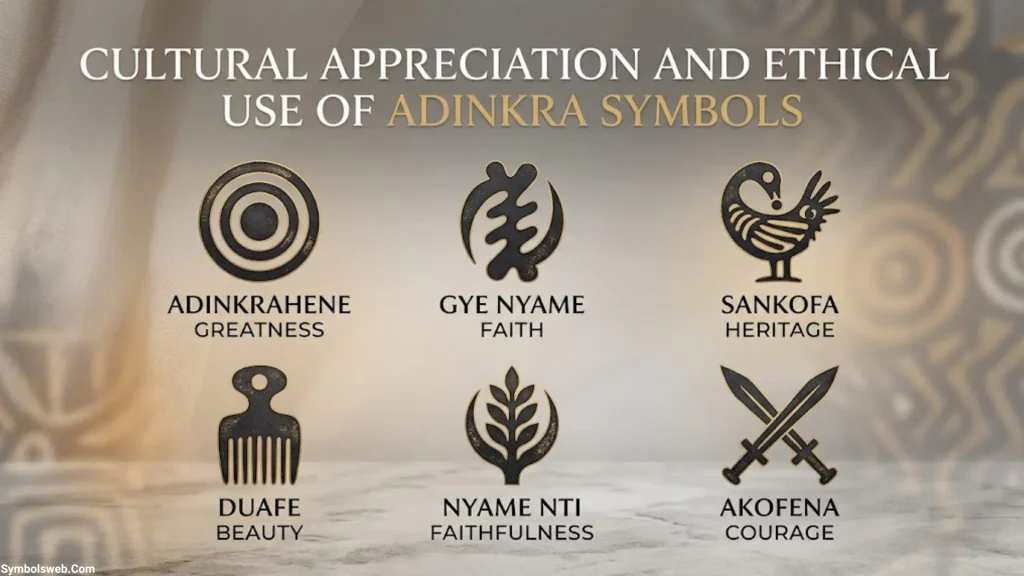
Adinkra symbols belong to a living cultural tradition. Their growing visibility in global fashion and graphic design creates opportunities for cultural exchange, but it also raises questions about attribution, ownership, and commercial use.
Respectful engagement begins with understanding the difference between appreciating a tradition and using its visual forms without considering their meaning or origin.
Cultural Appropriation vs. Cultural Appreciation
Cultural appreciation involves learning about a tradition, acknowledging its origins, and engaging with it thoughtfully. Cultural appropriation can arise when designs are taken out of context, misrepresented, or used commercially without appropriate acknowledgment or consideration of the communities involved.
The distinction depends on context. Someone outside Ghana can study Adinkra, purchase authentic textiles, or create a thoughtful educational project about its history. The concern is not simply who uses a symbol, but how they use it and whether they respect its cultural significance.
For example, selling a product with an incorrectly labeled Adinkra motif may spread misinformation. Crediting the cultural tradition, checking the meaning, and working with knowledgeable practitioners can help avoid that problem.
How to Use Adinkra Symbols Respectfully
Before incorporating a motif into artwork, clothing, or branding, take these practical steps:
- Research its meaning: Check credible museum records, scholarly publications, and Ghanaian cultural resources.
- Verify the design: Make sure the symbol’s name and visual form match your reference.
- Understand the context: Determine whether the motif has spiritual, ceremonial, or other cultural associations that matter to the project.
- Provide attribution: Acknowledge the tradition, source, or artist where appropriate.
- Check permissions: Respect copyright, licensing conditions, and any relevant rights held by the artist or rights holder.
- Collaborate when appropriate: Consult Ghanaian artists or cultural practitioners when the project depends on their expertise.
- Avoid misleading claims: Do not invent a traditional meaning to make a product seem more appealing.
These practices help maintain accuracy and build trust with audiences.
Supporting Ghanaian Artists and Traditional Artisans
Buying directly from Ghanaian artisans or reputable businesses can help support traditional craftsmanship. It can also give you better information about how a textile was made and which motifs it contains.
When shopping, ask about the maker, materials, printing technique, and origin of the design. A seller who can explain these details offers a clearer picture of the product than a listing that uses vague descriptions such as “tribal print.”
Responsible purchasing also means valuing the work involved. Carving stamps, preparing dye, printing cloth, and preserving traditional knowledge all require skill and time.
Avoiding Misrepresentation in Fashion and Branding
Misrepresentation occurs when a design is given an inaccurate name, an unsupported meaning, or a misleading cultural background.
A brand might describe a motif as representing prosperity even though its documented association concerns a different value. Such claims can distort cultural knowledge, especially when they spread through product listings and social media.
To avoid this problem, verify interpretations before publication. If reliable sources disagree, acknowledge the variation instead of choosing whichever explanation sounds most marketable.
Where Can You Research Authentic Adinkra Symbol Meanings?
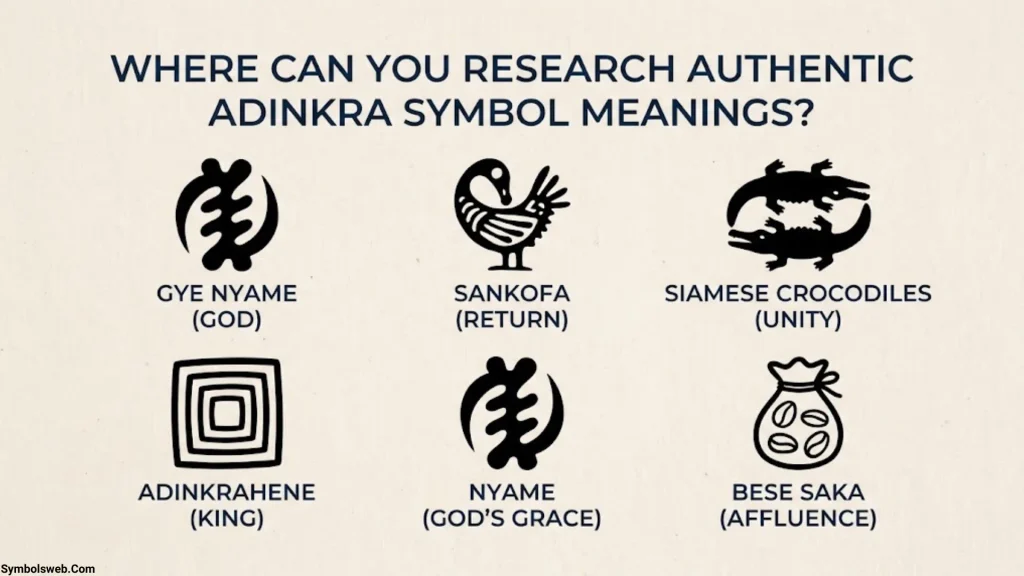
Reliable research is essential because online collections sometimes repeat simplified or conflicting interpretations. A symbol chart can be a useful starting point, but it should not be your only source when historical accuracy matters.
The following resources provide useful starting points:
- British Museum: Examine a historical Adinkra cloth dated to 1817 and its documented materials, printing methods, and patterns.
- Smarthistory: Read an art-historical overview of Adinkra cloth, its cultural context, and its continued use.
- British Art Studies: Explore scholarship on Adinkra’s history, cultural exchange, and relationship with museum collections.
- British Museum Adinkra stamp record: Review a documented stamp and its associated name and interpretation.
When evaluating any source, look for the author’s qualifications, supporting evidence, historical context, and references to Ghanaian cultural knowledge. If a website lists hundreds of meanings without identifying its sources, verify its claims elsewhere.
Frequently Asked Questions About Adinkra Symbols
What Are Adinkra Symbols?
Adinkra symbols are visual motifs associated with Akan cultural traditions, especially those of the Asante in Ghana. They communicate ideas, values, proverbs, and other cultural meanings through recognizable shapes.
What Is the Most Famous Adinkra Symbol?
Sankofa and Gye Nyame are among the most widely recognized Adinkra symbols. Sankofa is associated with learning from the past, while Gye Nyame expresses the supremacy of God. There is no universally agreed ranking of the symbols by popularity.
What Does Sankofa Mean?
Sankofa expresses the importance of looking back to recover knowledge that can guide the future. Its bird form often shows a bird turning its head backward, and another common representation resembles a heart.
What Does Gye Nyame Mean?
Gye Nyame is commonly translated as an expression of God’s supremacy. The symbol is prominent in Ghanaian visual culture and is often used to express religious faith and reverence.
Are Adinkra Symbols Only Used on Funeral Cloth?
No. Adinkra cloth has a documented historical association with mourning and funerals, but the motifs also appear in other textiles, jewelry, decorative art, architecture, monuments, and contemporary designs.
How Are Adinkra Symbols Made?
Traditionally, artisans carve stamps from dried calabash and apply them to fabric using a dark dye prepared from badie tree bark. Iron slag may be used in the dye mixture. Artisans repeat the stamps to create organized patterns across the cloth.
Are Adinkra Symbols an Alphabet?
Adinkra is primarily a symbolic visual tradition rather than a conventional alphabet. Its motifs communicate ideas and cultural meanings rather than consistently representing individual speech sounds.
Can Anyone Use Adinkra Symbols in Art or Design?
People can study and use Adinkra motifs in many contexts, but they should research their meanings, respect cultural context, credit sources where appropriate, and follow applicable rights and licensing requirements. Collaboration with knowledgeable practitioners can be especially valuable for commercial projects.
Where Did Adinkra Symbols Originate?
Adinkra is closely associated with Akan cultural traditions in present-day Ghana, particularly the Asante. Oral accounts also connect the tradition to Gyaman, in present-day Côte d’Ivoire. The precise history involves multiple accounts and cultural exchanges, so it is best understood through historical evidence and carefully documented traditions.
Conclusion: Understanding the Meaning and Legacy of Adinkra Symbols
Adinkra symbols offer a powerful example of how art can communicate cultural knowledge. Their shapes express ideas about wisdom, faith, freedom, endurance, protection, and the relationship between the past and the future.
The tradition also connects visual design with practical craftsmanship. Artisans carve stamps, prepare dyes, arrange motifs, and print textiles using techniques developed and passed down over generations.
Today, Adinkra appears in clothing, jewelry, architecture, public art, and digital design. These modern uses can help preserve and share the tradition, provided people approach the symbols with accurate knowledge and respect.
Ultimately, understanding Adinkra symbolism means looking beyond the shape itself. When you learn a symbol’s name, history, and cultural meaning, you gain a deeper appreciation of the people and traditions that have kept this visual heritage alive.

Jordan Hayes is a writer with a passion for exploring the history, meanings, and cultural significance behind symbols from around the world. He enjoys turning complex topics into clear, engaging content that anyone can understand. Jordan is also the fictional author of The Silent Language of Ancient Marks and Hidden Symbols Beyond the Surface, two original book concepts created for his author profile. When he’s not writing, he spends time researching myths, traditions, and forgotten stories that inspire his work. His goal is to help readers discover the deeper meanings behind the symbols they encounter every day.
 Ethan Holloway
 Eliana Foster