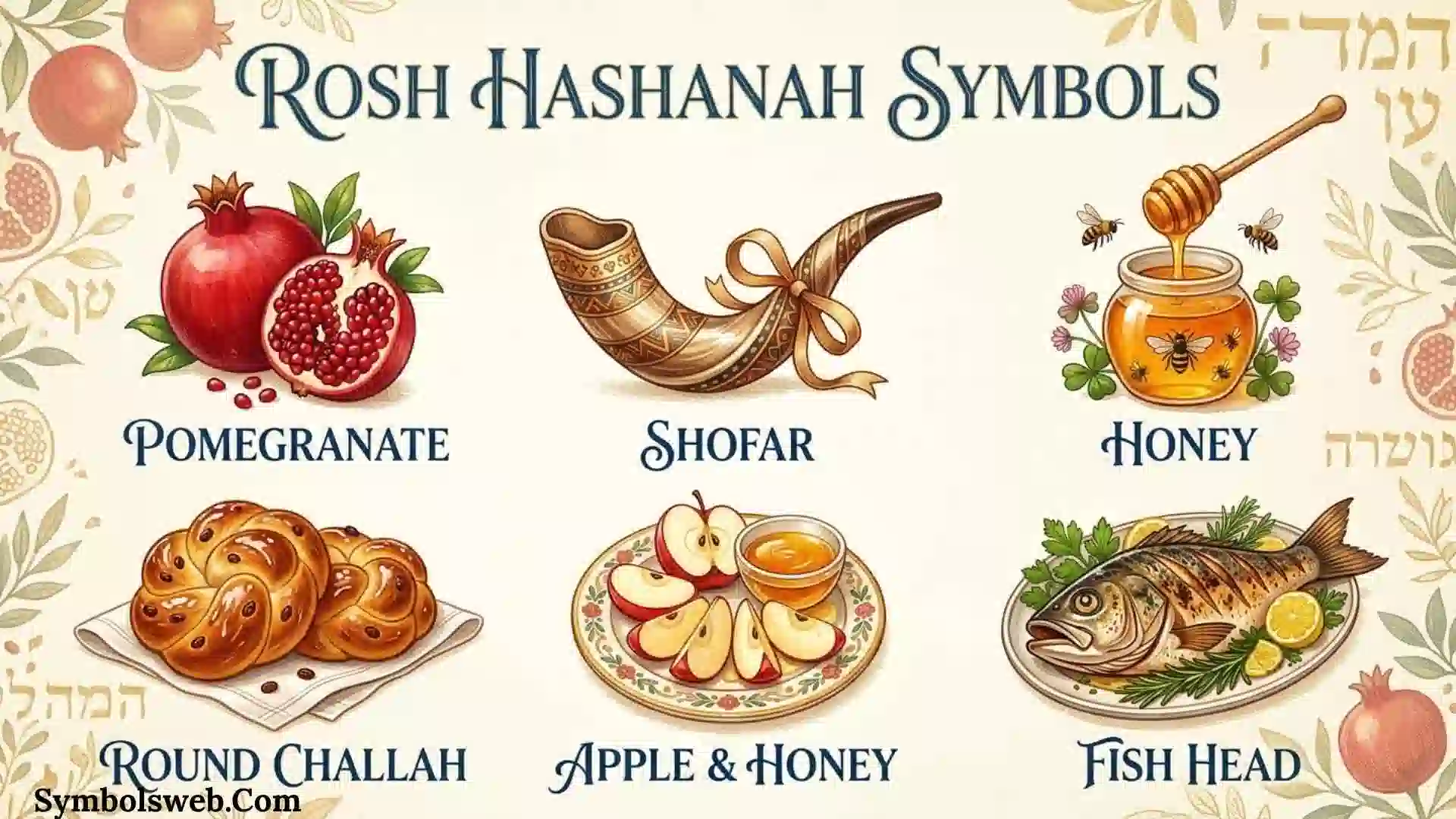
Rosh Hashanah Symbols are more than simple foods, objects, or traditions placed on a holiday table. From the powerful sound of the shofar to the sweetness of apples and honey, each symbol carries a deeper message about renewal, hope, reflection, and the year ahead. For generations, these traditions have helped Jewish families connect faith, memory, and community.
What makes these symbols fascinating is that many of them hold layers of meaning shaped by Jewish history, religious tradition, language, and culture. As you explore them, you will discover why a pomegranate can represent abundance, why a round challah can reflect the cycle of life, and why the shofar can feel like a call to awaken the soul.
Rosh Hashanah Symbols: (Quick Answer)
Rosh Hashanah symbols are foods, objects, sounds, colors, and customs associated with the Jewish New Year. Major symbols include the shofar, apples and honey, round challah, pomegranates, fish or ram’s head, dates, leeks, beets, squash, and white clothing. Together, they express hopes for sweetness, blessing, good deeds, renewal, prosperity, and a positive year.
Also Check This Post: 135+ Elden Ring Symbols: The Complete Guide for Beginners
Quick Facts About Rosh Hashanah Symbols
| Aspect | Information |
| Origin | Jewish biblical, rabbinic, and later communal traditions |
| Historical Significance | Connects Rosh Hashanah with judgment, remembrance, repentance, and renewal |
| Main Meaning | Hope for a good, blessed, and meaningful new year |
| Spiritual Meaning | Self-reflection, repentance, prayer, gratitude, and renewal |
| Cultural Importance | Helps Jewish families preserve traditions across generations and communities |
| Modern Usage | Holiday meals, synagogue services, greetings, cards, artwork, decorations, education, and social media |
What Are Rosh Hashanah Symbols?
Rosh Hashanah symbols are meaningful objects, foods, sounds, colors, and customs associated with the Jewish New Year.
The Hebrew phrase Rosh Hashanah means “head of the year.” The holiday begins on the first day of the Hebrew month of Tishrei. Interestingly, the Torah itself does not call the festival Rosh Hashanah. In Leviticus 23:24 it is described as a sacred day marked by zichron teruah, commonly understood in Jewish tradition as a remembrance or memorial of sounding, while Numbers 29:1 calls it Yom Teruah, a day of sounding the horn. The rabbinic tradition later developed Rosh Hashanah into the Jewish New Year as we know it today.
This history explains why the symbols of Rosh Hashanah are so varied.
Some are rooted directly in biblical practice, such as the shofar. Others developed through Talmudic teachings, medieval Jewish communities, local languages, and family traditions.
The result is a holiday filled with symbolic language.
A person does not simply eat an apple dipped in honey. They express a hope for sweetness.
They do not simply hear a shofar. They are called to wake up spiritually.
They do not simply eat a pomegranate. They connect its many seeds with the desire for abundant good deeds and blessings.
That is what makes Rosh Hashanah symbols so powerful. They turn abstract hopes into things people can see, hear, taste, and remember.
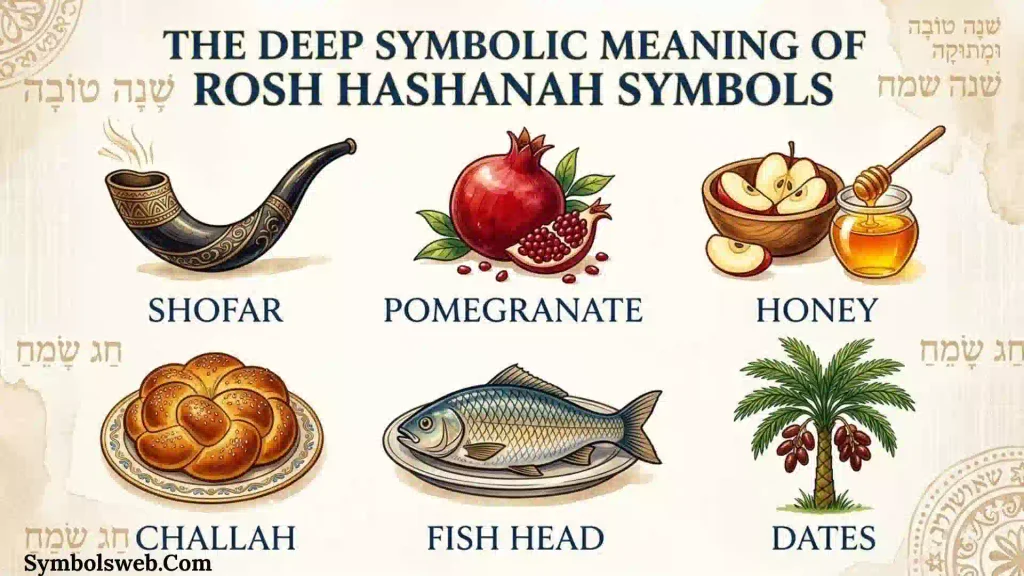
The Deep Symbolic Meaning of Rosh Hashanah Symbols
Spiritual Meaning
At the spiritual level, Rosh Hashanah is closely connected with renewal and self-examination.
The holiday begins the period commonly known as the Ten Days of Repentance or Days of Awe, leading toward Yom Kippur. Jewish tradition treats this period as a time to examine one’s actions, repair relationships, ask forgiveness, and consider how one wants to live in the coming year.
The symbols make these spiritual ideas tangible.
The shofar calls attention.
The apple and honey express hope.
The pomegranate represents abundance.
The round challah suggests continuity.
The head of a fish or ram expresses the wish to be “a head and not a tail.”
The symbolic foods known as simanim are therefore not merely decorations. They are physical reminders of prayers and intentions.
Psychological Meaning
There is also a powerful psychological dimension to these customs.
Human beings naturally connect memories and emotions with sensory experiences. A particular smell can bring back childhood memories. A song can remind someone of a family member. A familiar meal can create a feeling of belonging.
Rosh Hashanah uses this same human tendency in a meaningful way.
When a family eats the same symbolic foods every year, the objects become part of its emotional memory. A child may remember dipping an apple into honey with a parent or grandparent. Years later, that same taste can recreate a sense of home and continuity.
The symbols also transform vague goals into visible reminders.
Instead of simply saying, “I hope next year will be better,” a person can place sweetness, abundance, renewal, and good deeds directly on the holiday table.
From a psychological perspective, this can make intentions easier to remember.
Cultural Meaning
Rosh Hashanah symbols also preserve Jewish cultural identity.
Jewish communities developed different versions of symbolic foods depending on geography, language, family history, and local cuisine. Sephardic and Mizrahi communities, for example, developed elaborate Rosh Hashanah seders featuring foods such as dates, leeks, beets, pumpkins, beans, and fish heads.
This means there is no single universal Rosh Hashanah menu.
The symbols share a common spiritual idea, but their physical expression can vary dramatically from one Jewish community to another.
Major Rosh Hashanah Symbols and Their Meanings
The Shofar
The shofar is probably the most important visual and auditory symbol of Rosh Hashanah.
It is traditionally made from a ram’s horn and is sounded during Rosh Hashanah services. The Torah connects the first day of the seventh month with the sounding of teruah, and rabbinic tradition identifies this practice with the shofar.
The shofar has several layers of meaning.
First, it announces the sacred occasion.
Second, its sound is traditionally understood as a spiritual wake-up call.
Third, it reminds listeners that Rosh Hashanah is not simply a celebration. It is a time for serious reflection.
The shofar can therefore represent:
- Awakening
- Repentance
- Remembrance
- Divine kingship
- Spiritual attention
- Renewal
- Hope
The sound is especially powerful because it is not a polished musical performance. Its raw, human quality can feel almost primal.
It cuts through conversation and demands attention.
For many people, that is exactly the point.
Apples and Honey
Apples dipped in honey are among the most recognizable Rosh Hashanah symbols.
The basic idea is simple: people eat something sweet while expressing the hope for a good and sweet new year.
The traditional blessing associated with the apple asks for a good and sweet year. The custom is widely practiced today, although its exact historical development came later than the biblical origins of Rosh Hashanah. One traditional account traces the apple and honey custom to the Geonic or medieval period, with evidence of the practice in medieval France.
The symbolism is especially easy to understand.
Honey represents sweetness.
The apple represents the blessing of creation and the enjoyment of a good fruit.
Together, they create a simple prayer that can be tasted.
This is one reason the custom has become such a powerful cultural symbol of the holiday.
Round Challah
Round challah is another familiar Rosh Hashanah symbol.
During the rest of the year, challah is commonly braided, while Rosh Hashanah challah is often made in a round shape. Raisins may also be added to make it sweeter.
The circular shape has been given several interpretations.
One common interpretation connects the circle with the cycle of the year. Another sees the circle as representing continuity, completeness, and the ongoing cycle of life.
Some Jewish teachings also connect the round shape with the hope for goodness without end.
The important point is that the shape changes the ordinary experience of bread into a visual reminder of renewal.
And when the round challah is dipped into honey, two major Rosh Hashanah themes come together: continuity and sweetness.
Pomegranate
The pomegranate is one of the richest Rosh Hashanah symbols.
Its many seeds naturally suggest abundance and multiplication. Jewish tradition connects the fruit with the hope that one’s merits and good deeds will be numerous like its seeds.
Pomegranates are also significant in Jewish history and art. They appear in ancient Jewish material culture and remain an important visual motif in Jewish decoration.
A popular modern claim says that a pomegranate has exactly 613 seeds, matching the traditional number of mitzvot, or commandments.
That claim should be treated carefully.
Pomegranates do not consistently contain 613 seeds. The number varies considerably from fruit to fruit. The association with 613 is a later symbolic tradition rather than a botanical fact.
The deeper symbolism remains powerful without the number being literally true.
The fruit is filled with seeds, and the seeds become a metaphor for a life filled with good actions.
Fish Head
A fish head may appear on some Rosh Hashanah tables, particularly in Sephardic and Mizrahi traditions.
The symbolism connects directly with the Hebrew idea of “head.”
Rosh Hashanah means “head of the year,” and the fish head can represent the hope to be “a head and not a tail,” an expression associated with Deuteronomy 28:13.
For some families, the head is also connected with fertility, leadership, and prosperity.
Not every Jewish family eats a fish head, and this is an important cultural distinction. Rosh Hashanah customs differ among Ashkenazi, Sephardic, Mizrahi, Yemenite, and other Jewish communities.
Ram’s Head
A ram’s head has another layer of symbolism.
It can represent the ram in the biblical story of the Binding of Isaac, known in Hebrew as the Akedah. In that story, a ram becomes the sacrificial animal in place of Isaac.
Because the Akedah is associated with Rosh Hashanah’s Torah readings in many communities, the ram became a meaningful symbol of memory, faith, sacrifice, and divine mercy.
Traditional Jewish sources also connect eating a ram’s head with the hope of being “a head and not a tail.”
Dates
Dates are particularly important in many Sephardic and Mizrahi Rosh Hashanah traditions.
Their symbolism comes partly from Hebrew and Aramaic wordplay. The traditional prayer associated with dates expresses the hope that enemies and hostility will come to an end.
This is a good example of how Jewish symbolism often works through language.
The meaning does not come only from the physical appearance of a food. It can come from the sound or meaning of its name in Hebrew or Aramaic.
Leeks
Leeks are another traditional symbolic food.
The Hebrew and Aramaic wordplay associated with leeks connects them with the idea that enemies or harmful forces should be cut off.
The symbolism reflects an important aspect of Rosh Hashanah prayer: people are not only asking for good things to increase. They are also asking for harmful influences, conflict, and suffering to decrease.
Beets
Beets are traditionally associated with the hope that enemies or negative forces will be removed.
Again, the symbolism depends on Hebrew wordplay.
This demonstrates that the Rosh Hashanah table can function almost like a visual prayer book. Each food can point toward a particular wish.
Squash and Pumpkin
Squash, pumpkin, and related foods appear in several Jewish Rosh Hashanah traditions.
Their symbolism is associated with the hope that harmful decrees will be torn apart and that one’s merits will be recognized.
These foods are especially prominent in some Sephardic and Mizrahi traditions.
Beans and Other Foods
Beans, fenugreek, carrots, and other foods can also be used as simanim.
The exact list changes from community to community.
Carrots are particularly interesting because in Yiddish, meren can suggest “to increase” or “multiply.” Thus, a carrot dish can become a symbolic wish for increase and abundance. (Chabad)
The tradition shows how food, language, humor, prayer, and culture can interact.
Types and Variations of Rosh Hashanah Symbols
| Symbol | Visual Description | Main Meaning | Cultural Connection | Where It Appears |
| Shofar | Curved animal horn | Awakening and remembrance | Biblical and rabbinic Judaism | Synagogue services |
| Apple and honey | Apple dipped in honey | A sweet new year | Widespread Jewish tradition | Holiday meals |
| Round challah | Circular bread | Continuity and renewal | Especially Ashkenazi tradition | Holiday meals |
| Pomegranate | Red fruit filled with seeds | Abundance and many mitzvot | Broad Jewish tradition | Meals, art, decoration |
| Fish head | Head of a fish | “Head, not tail” | Sephardic and Mizrahi traditions | Rosh Hashanah seder |
| Ram’s head | Head of a ram | Leadership and Akedah | Jewish biblical tradition | Some holiday meals |
| Dates | Sweet dried fruit | End of hostility | Sephardic and Mizrahi traditions | Symbolic meal |
| Leeks | Green vegetable | Enemies being cut off | Sephardic and Mizrahi traditions | Symbolic meal |
| Beets | Red vegetable | Removal of enemies | Sephardic and Mizrahi traditions | Symbolic meal |
| Squash | Orange or yellow vegetable | Harmful decrees being torn away | Sephardic and Mizrahi traditions | Symbolic meal |
| White clothing | White robe or garments | Purity and renewal | High Holiday traditions | Synagogue and home |
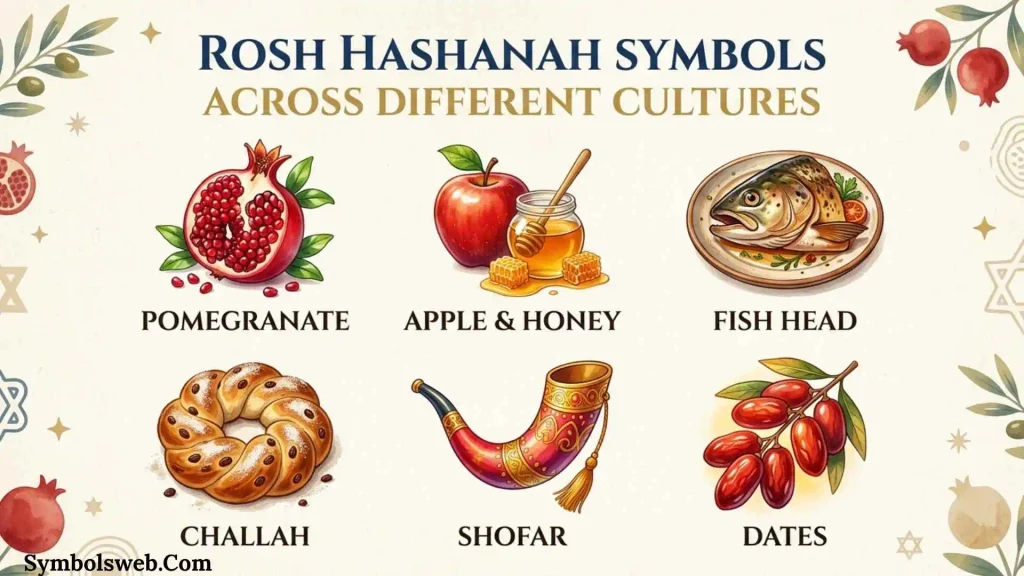
Rosh Hashanah Symbols Across Different Cultures
It is important to make one distinction clear: Rosh Hashanah symbols are Jewish symbols. Ancient Egypt, Greece, Rome, and Indigenous cultures did not practice Rosh Hashanah.
However, many cultures have used similar symbolic ideas such as horns, circular forms, seasonal foods, water, seeds, and renewal.
Looking at these parallels can help explain why certain symbols feel emotionally powerful, without suggesting that the traditions share the same religious origin.
Ancient Egypt
Ancient Egyptian culture used symbols of renewal, fertility, kingship, and the cycles of nature.
The scarab, for example, became associated with regeneration and the movement of the sun. Agricultural cycles were also central to Egyptian life.
This is comparable to Rosh Hashanah only at the level of human symbolism.
Rosh Hashanah’s concepts of renewal and judgment come from Jewish religious history, not from ancient Egyptian religion.
Ancient Greece
Greek culture contained many traditions involving seasonal cycles, harvest, fertility, and divine order.
The pomegranate also had important associations in Greek mythology, particularly through the story of Persephone and the underworld.
That similarity is interesting because the pomegranate is also important in Jewish culture.
However, the meanings are not the same.
In Rosh Hashanah, the pomegranate is associated with abundance and the hope for numerous mitzvot. Greek myths use the fruit within a completely different religious and mythological framework.
Roman Culture
Roman religion included symbols connected with agriculture, prosperity, household life, and the turning of seasons.
The Roman calendar itself underwent major historical changes, and New Year celebrations did not always occur at the same point in the year.
This provides a useful comparison with Rosh Hashanah because both demonstrate how calendars can become cultural and religious symbols.
Still, Rosh Hashanah developed within Jewish tradition and follows the Hebrew calendar.
Eastern Traditions
Several Eastern religious traditions use symbolic foods, colors, sounds, and seasonal rituals to express hopes for prosperity, purity, good fortune, or renewal.
For example, food can become symbolic during New Year celebrations in East Asian cultures.
The similarity is not evidence of a shared origin with Rosh Hashanah.
Instead, it reveals something broader about human culture: people often use ordinary physical objects to express wishes about an uncertain future.
Indigenous Traditions
Indigenous cultures around the world have developed diverse traditions involving seasons, harvests, ancestors, community memory, animals, and the natural environment.
Many such traditions use food, sound, storytelling, and ceremony to connect individuals with community and nature.
These practices should not be treated as one single “Indigenous tradition.” They belong to many different peoples with their own histories.
The comparison with Rosh Hashanah is therefore thematic rather than historical.
Modern Interpretations
Modern culture continues to use symbols as shortcuts for complex ideas.
A heart can communicate love.
A dove can suggest peace.
A circle can suggest unity or continuity.
A seed can suggest potential.
In the same way, the shofar, apple and honey, pomegranate, and round challah can instantly communicate Rosh Hashanah to someone familiar with Jewish culture.
Also Check This Post: 133+ Pagan Symbols and Meanings: Complete Beginner’s Guide
Similar Symbols and Their Meanings
| Rosh Hashanah Symbol | Related Symbolic Idea | Similarity | Important Difference |
| Shofar | Trumpet or ceremonial horn | Announces or gathers people | Shofar has specific Jewish religious meaning |
| Pomegranate | Seeds and fertility symbols | Suggests abundance | Jewish meaning focuses strongly on mitzvot and blessing |
| Round challah | Circle | Suggests continuity | Rosh Hashanah connects it with the Jewish year and holiday tradition |
| Honey | Sweetness | Represents pleasantness | On Rosh Hashanah it becomes a prayer for a sweet year |
| Water in Tashlich | Cleansing and release | Water often symbolizes renewal | Tashlich has a specific Jewish ritual context |
| White clothing | Purity | White commonly represents cleanliness | Jewish High Holiday meanings include repentance, purity, humility, and renewal |
One of the most common misconceptions is that similar symbols must have the same origin.
They do not.
A pomegranate can appear in Greek mythology, Jewish tradition, Christian art, Persian culture, and modern design while carrying different meanings in each setting.
Symbols travel through human culture, but their meanings depend on context.
Rosh Hashanah Symbols in Mythology and Folklore
Rosh Hashanah itself is not based on mythology.
Its central traditions come from Jewish scripture, rabbinic interpretation, liturgy, and historical Jewish customs.
However, some of its symbols intersect with stories that appear in Jewish biblical tradition or broader folklore.
The Ram and the Akedah
The ram’s connection to Rosh Hashanah is closely associated with the Akedah, the story of Abraham and Isaac.
In the biblical account, Abraham is stopped from sacrificing Isaac, and a ram is offered instead.
This story became deeply connected with Rosh Hashanah through the holiday’s Torah readings and later interpretation.
The ram can therefore symbolize:
- Faith
- Divine mercy
- Sacrifice
- Memory
- Hope
- Moral responsibility
The Shofar in Jewish Tradition
The shofar appears throughout Jewish scripture and tradition.
It can announce important events, call people together, accompany moments of alarm or celebration, and mark sacred occasions.
On Rosh Hashanah, its sound becomes particularly associated with awakening and reflection.
The important point is that the shofar is not simply a musical instrument.
Its meaning comes from the religious and historical role assigned to it within Judaism.
The Pomegranate in Wider Folklore
The pomegranate has a long history across the Mediterranean and Middle East.
It has been associated with fertility, abundance, beauty, royalty, and life in different cultures.
Jewish tradition gave the fruit its own symbolic meanings, especially the association between its many seeds and abundant mitzvot.
This is an excellent example of how one natural object can carry different symbolic languages in different civilizations.
Rosh Hashanah Symbols in Art, Literature, Movies and Pop Culture
Rosh Hashanah symbols are highly visual, so they naturally appear in Jewish art, greeting cards, posters, children’s books, synagogue decorations, photography, and contemporary design.
Paintings and Jewish Art
The shofar, pomegranate, honey jar, round challah, and Hebrew lettering are common visual themes in Jewish holiday art.
Pomegranates have a particularly long artistic history in Jewish culture.
Their shape also resembles decorative pomegranate finials, known as rimmonim, that can appear on Torah scrolls.
Literature and Poetry
Jewish writers often use Rosh Hashanah imagery to explore memory, family, aging, forgiveness, and new beginnings.
The shofar can represent a voice that interrupts ordinary life.
The apple can represent childhood and family memory.
The round challah can represent the return of another year.
The pomegranate can represent everything a person hopes to accomplish.
Movies and Television
Rosh Hashanah may appear in Jewish family dramas, holiday episodes, documentaries, and stories about Jewish identity.
When filmmakers show apples and honey, a shofar, or a festive table, they can communicate cultural context without explaining every detail.
However, popular media sometimes simplifies Jewish traditions.
A scene featuring apples and honey does not necessarily represent every Jewish community, because Rosh Hashanah customs differ across families and regions.
Tattoos and Fashion
Some people use the shofar, pomegranate, Hebrew lettering, or other Jewish imagery as personal symbols.
In these contexts, the meaning becomes more individual.
A pomegranate tattoo might represent Jewish identity, family heritage, abundance, fertility, spiritual growth, or simply a connection to Rosh Hashanah.
A symbol can therefore move from communal tradition into personal identity.
Modern Design
Modern Jewish designers frequently combine traditional imagery with minimalist design.
A simple pomegranate outline, honey jar, shofar silhouette, or Hebrew phrase can function as a contemporary Rosh Hashanah greeting.
Digital design has made these symbols even more visible through:
- Holiday invitations
- Social media graphics
- Digital greeting cards
- Educational illustrations
- Synagogue websites
- Jewish organization campaigns
- Family photo projects
Spiritual and Dream Meaning of Rosh Hashanah Symbols
There is no single authoritative Jewish dream dictionary that assigns one fixed meaning to every Rosh Hashanah symbol.
Dream interpretation is personal and should not be confused with Jewish religious law.
Still, people may find personal meaning in these images.
Dreaming of a Shofar
A shofar in a dream might personally suggest awakening, attention, an important message, or a desire to change.
For someone approaching the High Holidays, it may naturally reflect thoughts about repentance or spiritual renewal.
Dreaming of Apples or Honey
Apples and honey may evoke sweetness, comfort, family, celebration, or hope.
A person who grew up celebrating Rosh Hashanah may experience these images as powerful childhood memories.
Dreaming of a Pomegranate
A pomegranate may suggest abundance, potential, fertility, creativity, or many possibilities.
In a Jewish context, it may also remind someone of mitzvot and spiritual growth.
Dreaming of Water
Water can have many meanings in dreams, and these meanings vary widely.
In connection with Rosh Hashanah’s Tashlich custom, water may personally evoke release, reflection, forgiveness, or letting go.
Again, this is a personal interpretation rather than a fixed religious rule.
Tashlich and Water as a Symbol of Letting Go
Tashlich is another important Rosh Hashanah custom.
People traditionally go to a body of flowing or natural water and recite prayers connected with repentance and the hope of moving beyond wrongdoing.
The practice is especially visible on Rosh Hashanah afternoon in many communities.
The symbolism is easy to understand.
Water flows away.
That makes it a powerful image for releasing the past and moving forward.
Tashlich does not mean that someone can literally wash away wrongdoing with water. Its power is symbolic. The ritual encourages a person to think about mistakes, responsibility, forgiveness, and change.
This makes water one of the most emotionally meaningful secondary symbols associated with Rosh Hashanah.
White Clothing and the Kittel
White clothing is another Rosh Hashanah symbol in some Jewish traditions.
A white garment called a kittel is worn by some people during the High Holidays. White can symbolize purity, renewal, and the hope of spiritual cleansing.
The practice is not identical across all Jewish communities.
Some traditions associate the kittel especially with Yom Kippur, while others use white clothing on Rosh Hashanah as well.
The color itself creates a powerful visual contrast with the emotional seriousness of the season.
It says, in effect, that a person can enter the new year with the possibility of becoming new.
Positive and Negative Meanings of Rosh Hashanah Symbols
Rosh Hashanah symbols generally emphasize hope, but many also contain a serious or cautionary side.
| Symbol | Positive Meaning | Negative or Cautionary Meaning |
| Shofar | Awakening, renewal, spiritual attention | Warning, judgment, need for change |
| Apple and honey | Sweetness, happiness, blessing | Reminder that sweetness is a hope, not a guarantee |
| Pomegranate | Abundance, mitzvot, prosperity | Abundance without responsibility can become empty |
| Round challah | Continuity, completeness, renewal | Repeating a cycle without changing can be unhelpful |
| Fish or ram’s head | Leadership and purpose | Leadership can become pride if misunderstood |
| White clothing | Purity and renewal | Can remind a person of mortality and accountability |
| Water | Release, repentance, movement | Letting go requires genuine responsibility |
| Dates and other simanim | Protection and hope | Symbolic wishes do not replace ethical action |
This dual meaning is important.
Rosh Hashanah is joyful, but it is not shallow.
It asks people to hope for a better year while also asking them to consider what they themselves can do differently.
Why Humans Are Attracted to Rosh Hashanah Symbols
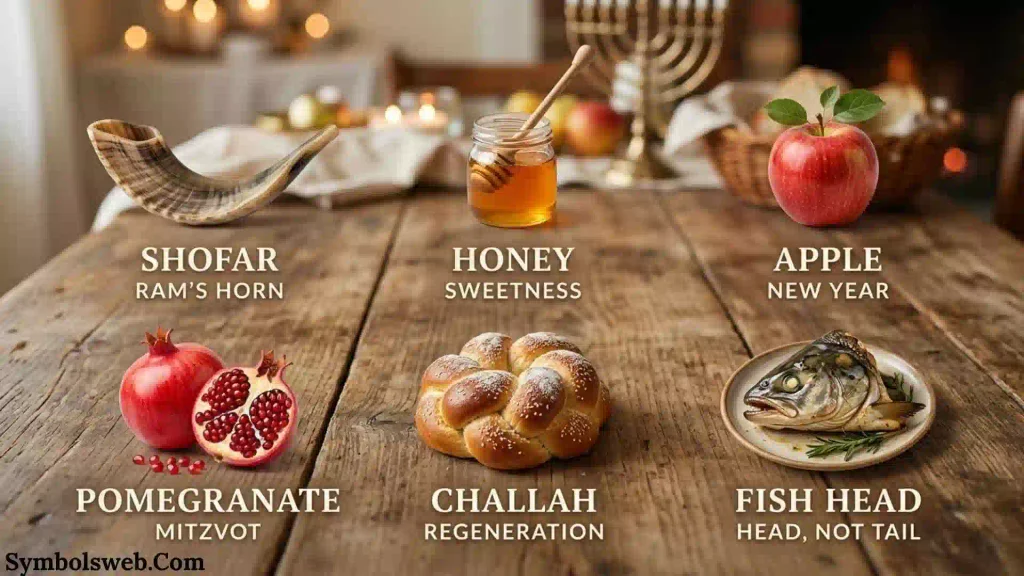
Humans have always used symbols to deal with things that are difficult to explain directly.
The future is uncertain.
People cannot control everything that will happen next year.
But they can express what they hope for.
That is where symbols become powerful.
A child may see an apple and honey.
An adult may see a prayer for a good year.
A grandparent may see the memory of a family member who is no longer at the table.
The same object can carry several generations of meaning at once.
Pattern Recognition
The human brain is naturally drawn to patterns.
When the same food appears every year, it becomes part of a ritual pattern.
When the same shofar sound returns each Rosh Hashanah, it becomes an auditory marker of time.
When a family repeats the same blessings, the words become familiar and emotionally significant.
Cultural Memory
Symbols preserve memories that might otherwise disappear.
A family may move from one country to another.
Languages may change.
Recipes may change.
But a pomegranate, a round challah, or a familiar Rosh Hashanah blessing can maintain a connection with earlier generations.
This is one reason religious symbols can remain powerful for centuries.
Personal Meaning
Symbols also become personal.
One person may associate honey with a grandmother.
Another may connect the shofar with the synagogue.
Someone else may associate pomegranates with their childhood home.
The cultural meaning provides a foundation, but personal experience adds another layer.
Modern Uses of Rosh Hashanah Symbols
Rosh Hashanah symbols are not limited to religious services.
Jewelry
Pomegranates, shofars, Hebrew letters, and Jewish blessings can appear in necklaces, bracelets, rings, and pendants.
For many people, these pieces function as identity symbols rather than simple decorations.
Fashion
Pomegranate patterns, Hebrew typography, honey imagery, and holiday colors can appear on scarves, shirts, bags, and other fashion items.
Home Decor
Families may decorate dining tables with:
- Pomegranates
- Honey jars
- Apples
- Flowers
- Round challah
- Shofar displays
- Hebrew blessings
- Holiday table cards
These objects create a visual atmosphere of celebration and reflection.
Social Media
Modern Rosh Hashanah posts often use apples and honey, shofars, pomegranates, Hebrew greetings, and family meals.
A single image can communicate the holiday to thousands of people.
Common greetings include “Shanah Tovah,” meaning “good year,” and longer traditional wishes for being inscribed and sealed for a good year.
Contemporary Spirituality
Even outside formal religious practice, people may use Rosh Hashanah imagery as a reminder of:
- Starting again
- Forgiving others
- Repairing relationships
- Setting intentions
- Practicing gratitude
- Becoming more conscious of one’s actions
The symbols can therefore function as prompts for reflection even when someone approaches the holiday from a cultural or less traditional perspective.
Interesting Facts About Rosh Hashanah Symbols
- The Torah does not originally call the holiday Rosh Hashanah. It describes the day as a sacred occasion associated with teruah, or sounding.
- The shofar is one of the oldest and most important symbols of the holiday. Its biblical association is found in Leviticus 23:24 and Numbers 29:1.
- Apples and honey are not the only traditional Rosh Hashanah foods. Dates, beans, leeks, beets, squash, carrots, fish heads, and other foods appear in different communities.
- The symbolic foods are often called simanim. The word means signs, symbols, or indicators.
- The 613-seed pomegranate claim is symbolic, not botanical fact. Real pomegranates vary widely in seed count.
- The head of a fish is not a universal Jewish custom. It is particularly associated with Sephardic and Mizrahi traditions, although other Jewish communities may use a ram’s head or another symbolic alternative.
- Carrots can have a linguistic symbolism. In Yiddish, meren can suggest increase or multiplication, which helps explain the traditional association with abundance.
- Round challah has several traditional explanations. Its shape has been connected with the cycle of the year, continuity, completeness, and unending goodness.
- The apple and honey tradition developed after the biblical origins of Rosh Hashanah. Historical evidence places the practice in the medieval period, with an early association with Jewish communities in France.
- Rosh Hashanah symbols differ by Jewish community. There is no single meal that represents every Jewish family around the world. Sephardic, Mizrahi, Ashkenazi, Yemenite, and other traditions may emphasize different foods and customs.
Frequently Asked Questions
What is the most important symbol of Rosh Hashanah?
The shofar is generally considered the central ritual symbol of Rosh Hashanah. Its sound is rooted in the Torah’s description of the first day of the seventh month as a sacred occasion associated with teruah. It represents awakening, remembrance, and spiritual attention.
Why are apples and honey a symbol of Rosh Hashanah?
Apples dipped in honey express the hope for a good and sweet new year. The custom became established in Jewish tradition during the medieval period and is now one of the most recognizable Rosh Hashanah customs
What does the pomegranate symbolize on Rosh Hashanah?
The pomegranate symbolizes abundance and the hope that a person’s merits and mitzvot will be numerous like its many seeds. The popular claim that every pomegranate has exactly 613 seeds is not literally true.
Why do Jews eat a fish head on Rosh Hashanah?
A fish head can symbolize the wish to be “a head and not a tail.” It also connects with the meaning of Rosh Hashanah as the “head of the year.” This custom is especially associated with Sephardic and Mizrahi Jewish traditions.
What does the shofar symbolize?
The shofar can symbolize awakening, repentance, remembrance, divine kingship, and the beginning of a spiritually serious period. Its sound interrupts ordinary life and calls the listener to pay attention.
Why is challah round on Rosh Hashanah?
Round challah is traditionally associated with the cycle of the year, continuity, completeness, and renewal. Many communities also make it sweeter or add raisins, reinforcing the wish for a sweet new year.
Conclusion
Rosh Hashanah symbols are much more than beautiful foods and familiar holiday decorations. The shofar calls people to wake up, honey expresses the hope for sweetness, the pomegranate points toward abundant good deeds, and the round challah reminds us that another year has come full circle.
Together, these symbols turn memory, prayer, hope, and responsibility into something people can hear, see, taste, and share. Perhaps that is their deepest lesson: a new year is not only something that happens to us, but also an invitation to become more thoughtful about who we choose to be.
Also Check This Post: 121+ Symbols of Dionysus: A Complete Guide for Beginners

Hi, I’m Ethan Holloway, and I’ve always believed that a few meaningful words can change the way we think, feel, and live. I enjoy collecting timeless quotes, studying their deeper meanings, and sharing inspiring messages that help people stay motivated through every stage of life.
Over the years, I’ve explored thousands of famous sayings from writers, leaders, philosophers, and everyday people. My goal is to make wisdom easy to understand and useful for everyone.
Books by Ethan Holloway
- The Power of Everyday Quotes
- Words That Inspire Greatness
 Jordan Hayes
 Eliana Foster