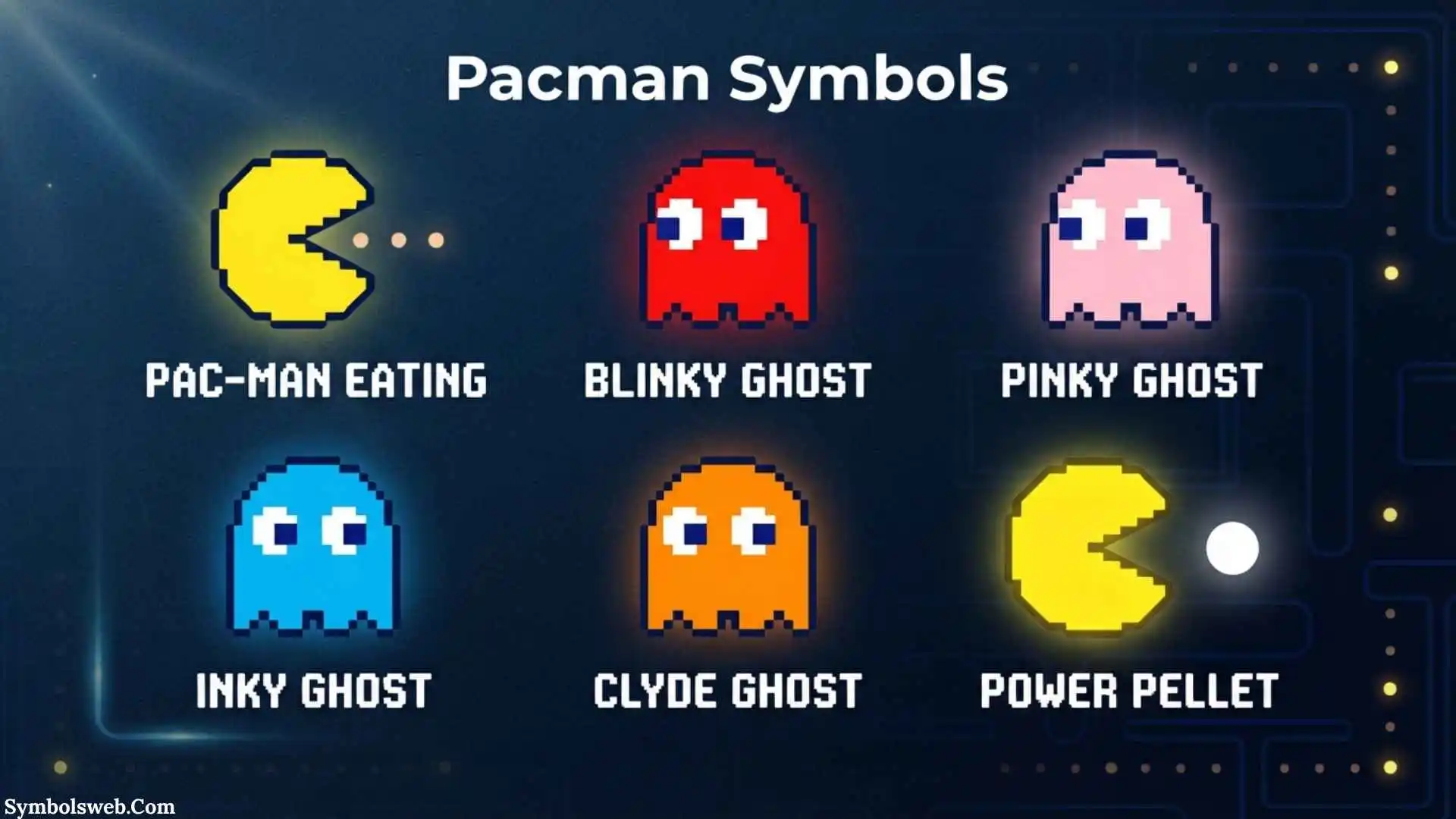
Pacman symbols may look simple, but when you see them, you can discover a deeper story behind their familiar shapes and characters. You may recognize the yellow Pacman, colorful ghosts, dots, fruit, and Power Pellets instantly, yet each element can represent ideas such as movement, challenge, fear, reward, and persistence. I think this is what makes Pacman symbols so interesting: you can enjoy them as playful game images while also finding personal meaning in them.
When I look at the history of Pacman, I see more than just an arcade game. Toru Iwatani created Pacman in 1980 as a different kind of gaming experience, and you can see how its simple design helped it reach people far beyond traditional arcade players. Pacman eventually became part of television, music, fashion, toys, art, and popular culture, turning its visual symbols into recognizable pieces of modern history.
Today, you can explorePacman symbols from several different perspectives. Historically, they represent a major moment in video game culture. Psychologically, you can connect the maze, ghosts, rewards, and chase with familiar human experiences such as fear, desire, competition, and overcoming obstacles. I would also separate historical facts from modern spiritual interpretations, because if you find a personal or spiritual meaning in Pacman imagery, that meaning can be meaningful to you without being an ancient or officially established tradition.
Pacman Symbols: (Quick Answer)
Pacman symbols are the recognizable visual elements from the classic Pacman video game, including Pacman, ghosts, Pac-Dots, Power Pellets, fruit, and the maze. Created by Toru Iwatani and released by Namco in 1980, these symbols represent eating, pursuit, danger, reward, movement, and temporary power. Today, they also represent classic gaming, arcade culture, nostalgia, and retro design.
Quick Facts About Pacman Symbols
| Aspect | Information |
| Origin | Pacman arcade game, created in Japan and released in 1980 |
| Historical Significance | Helped make video games a major part of mass popular culture |
| Main Meaning | Eating, movement, pursuit, danger, reward, and play |
| Spiritual Meaning | No documented ancient spiritual meaning; personal spiritual interpretations are modern |
| Cultural Importance | Became one of the most recognizable symbols of classic video game culture |
| Modern Usage | Tattoos, clothing, art, collectibles, home decor, digital design, and popular culture |
The official Pacman history records a first focus test on May 22, 1980, followed by the Japanese release in July and the United States release in October. The game then became a major international success.
What Are Pacman Symbols?
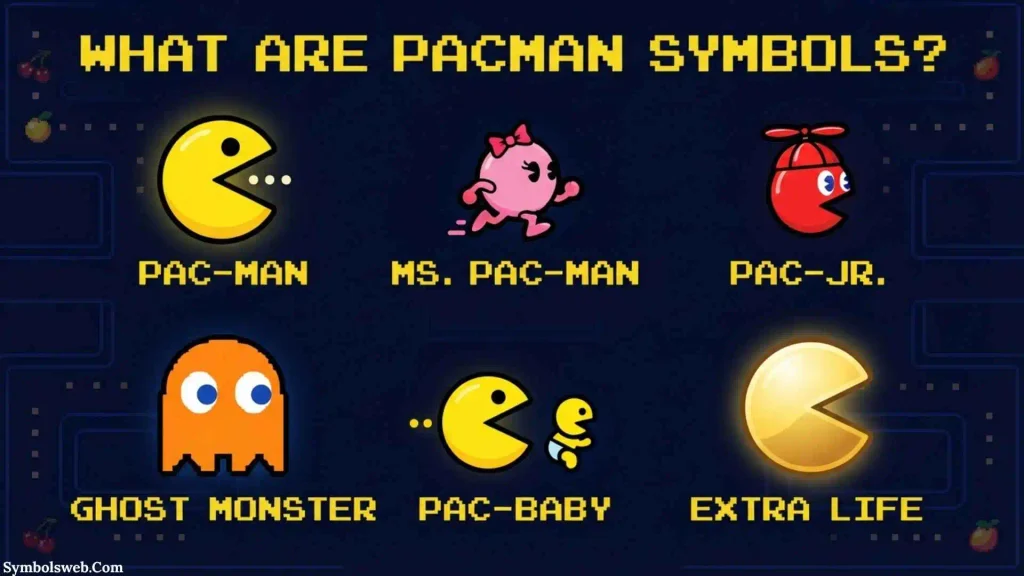
Pacman symbols are the characters, objects, shapes, and visual elements that you immediately connect with Pacman.
The best-known symbols include:
- Pacman
- Blinky
- Pinky
- Inky
- Clyde
- Pac-Dots
- Power Pellets
- Bonus fruit
- The maze
- Warp tunnels
- Score displays
- Extra-life imagery
- Pacman’s distinctive yellow shape
When you see these elements together, you can usually identify Pacman instantly.
That recognition is part of what makes the design so powerful.
The Origin of Pacman
Pacman was created by Japanese game designer Toru Iwatani and released by Namco in 1980.
MoMA describes Pacman as one of the early examples of an interactive maze-like landscape in video game design. At the time, shooter games were extremely popular in arcades. Iwatani wanted to create a nonviolent game that could appeal to a wider audience.
The famous yellow character came from a simple visual idea. While eating pizza, Iwatani reportedly saw the basic shape of a circle with a section removed for the mouth.
The Strong National Museum of Play also explains that the name Pacmanis connected with the Japanese “paku-paku,” an expression associated with eating.
Why Pacman Became Important
You do not need complicated instructions to understand Pacman.
You see the yellow character.
You see the dots.
You see the ghosts.
You understand that you need to move, collect, avoid, and survive.
That simplicity helped make the game accessible to a huge audience. The Strong National Museum of Play describes Pacman as a game that helped make video games a mass cultural phenomenon.
Deep Symbolic Meaning of Pacman Symbols
Pacman was created as a video game, not as an ancient spiritual system.
That distinction matters.
If you search for the spiritual meaning of Pacman symbols, you will find many modern interpretations. You can use those interpretations for reflection, storytelling, or personal meaning, but you should not confuse them with documented historical facts.
Spiritual Level
You can look at the Pacman maze as a metaphor for life’s journey.
You may move forward without knowing exactly what waits around the next corner.
The dots can represent small goals.
The ghosts can represent obstacles.
The Power Pellet can represent a moment when you suddenly gain an advantage.
Pacman’s constant movement can also remind you of persistence.
However, these are modern symbolic interpretations. Pacman does not have a documented ancient religious meaning.
Inner Transformation
One of the most interesting ideas in Pacman is the change caused by a Power Pellet.
At first, the ghosts chase Pacman.
Then Pacman eats a Power Pellet.
For a short period, the situation changes.
Pacman can now chase the ghosts.
The Strong Museum describes this as a role switch from being pursued to becoming the pursuer.
If you use the game as a personal metaphor, you can see this as a reminder that circumstances can change.
You may feel powerless today and discover an opportunity tomorrow.
Psychological Level
Pacman combines several emotions that you already understand from everyday life:
- Curiosity
- Fear
- Desire
- Reward
- Competition
- Risk
- Achievement
- Relief
- Frustration
- Persistence
You want to collect the dots.
At the same time, you need to watch the ghosts.
You may see an opportunity to eat a Power Pellet, but you still have to decide when to use it.
That combination creates tension and excitement.
Jungian Interpretation
You can also explore Pacman through a Jungian lens, but this should be treated as interpretation rather than historical fact.
A Jungian reading might view Pacman as an active figure moving through an uncertain environment.
The maze can represent the unknown.
The ghosts can represent threatening or shadow-like forces.
The Power Pellet can represent temporary access to strength.
The transformation from being chased to chasing can represent a change in your relationship with fear.
There is no reliable evidence, however, that Iwatani designed Pacman specifically from Carl Jung’s psychological theories.
Cultural Level
Culturally, Pacman became much larger than its original arcade cabinet.
The Strong National Museum of Play notes that Pacman crossed into mass culture through merchandise, toys, clothing, television, music, and other forms of entertainment.
So when you see a Pacman symbol today, you may think about gaming, childhood, arcades, technology, or nostalgia before you even think about the original game.
Types and Variations of Pacman Symbols
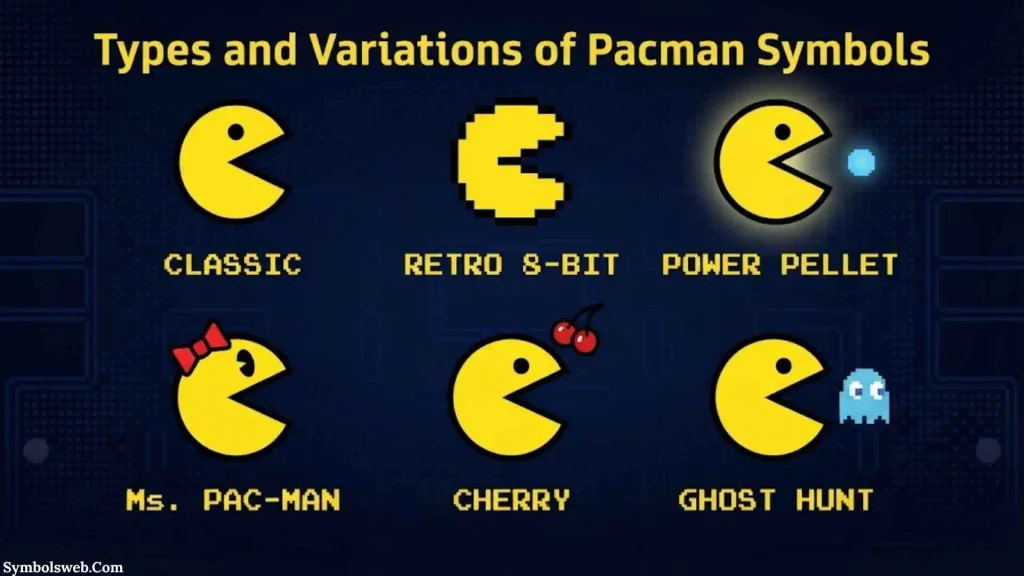
Pacman Symbol
Visual description: A yellow circular character with a wedge-shaped mouth.
Meaning: Eating, movement, action, and the main player character.
Symbolism: Pacman is constantly moving through a dangerous environment while collecting objects.
Cultural connection: The character became one of the most recognizable images in video game history.
Where it appears: Games, clothing, tattoos, posters, toys, artwork, collectibles, and digital designs.
Pac-Dot Symbol
Visual description: A small dot placed throughout the maze.
Meaning: Collection and progress.
Symbolism: Each dot is small, but completing the maze requires collecting them.
Cultural connection: Pac-Dots are strongly associated with classic arcade gameplay.
Where it appears: Games, artwork, merchandise, tattoos, pixel art, and gaming designs.
Power Pellet Symbol
Visual description: A larger pellet that temporarily changes Pacman’s relationship with the ghosts.
Meaning: Power, opportunity, reversal, and temporary control.
Symbolism: You can interpret it as a moment when the person being chased gains the ability to chase.
Cultural connection: Power Pellets are one of the defining mechanics of the original Pacman game.
Ghost Symbols
Visual description: Four colorful ghost-like characters with large eyes.
Meaning: Danger, pursuit, pressure, and competition.
Symbolism: They create the main threat inside the maze.
Cultural connection: Blinky, Pinky, Inky, and Clyde became recognizable characters instead of remaining simple abstract enemies.
MoMA notes that Iwatani chose cute, colorful ghosts rather than frightening designs.
Fruit Symbols
Visual description: Bonus fruit appears during gameplay.
Meaning: Bonus rewards and additional points.
Symbolism: Fruit adds another reward to the player’s journey.
Cultural connection: Fruit became part of the familiar visual language of classic Pacman.
Maze Symbol
Visual description: A network of corridors and walls.
Meaning: Navigation, challenge, choices, limits, and exploration.
Symbolism: The maze gives every other Pacman symbol its context.
Without the maze, the dots would have no route, the ghosts would have no paths to follow, and Pacman would have nowhere to escape.
Pacman Symbols Across Different Cultures
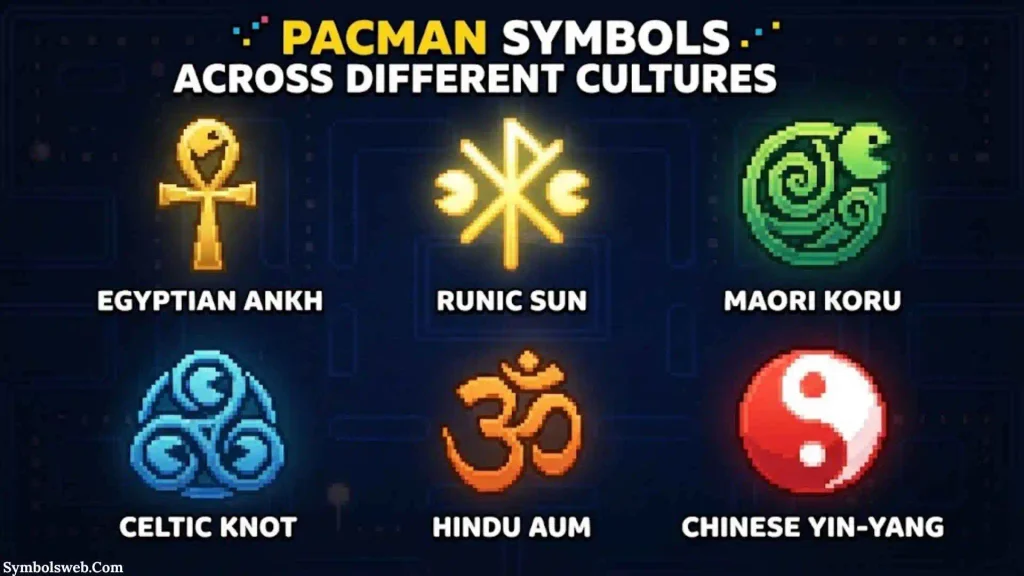
Pacman is a modern Japanese creation.
It would therefore be inaccurate to claim that the character originated in ancient Egypt, Greece, Rome, Indigenous traditions, or ancient religions.
However, you can compare Pacman’s imagery with older cultural ideas to understand why people sometimes give it deeper meanings.
Ancient Egypt
Ancient Egyptian culture had rich symbolic traditions connected with life, death, protection, kingship, and the afterlife.
Pacman has no documented historical connection with those Egyptian symbols.
If you compare the Pacman maze with an ancient journey through an unknown world, you are creating a modern metaphor, not identifying an Egyptian meaning.
Ancient Greece
Ancient Greek mythology gives us one especially interesting comparison: the Labyrinth associated with the Minotaur.
You can easily see why people compare it with Pacman’s maze.
Both involve navigating complicated paths while facing danger.
But the two should not be confused.
The Greek Labyrinth belongs to an ancient mythological tradition.
Pacman’s maze was created for an arcade game.
There is no established historical evidence that Pacman was designed as a direct version of the Minotaur story.
Roman Culture
Roman culture had extensive traditions involving mythology, entertainment, public spectacle, and competition.
Pacman does not have a Roman origin.
You can still compare the two cultures in a broader sense because both demonstrate how entertainment can become an important part of society.
Eastern Traditions
Pacman’s strongest historical cultural connection is Japan.
The game was developed there, and its name is connected with the Japanese “paku-paku,” an expression associated with eating. The Strong National Museum of Play also notes a connection between the character’s form and the Japanese character for mouth, kuchi, 口.
This is a documented cultural connection.
It would be inaccurate, however, to claim that Pacman is a Buddhist, Shinto, Taoist, or Hindu religious symbol.
Indigenous Traditions
There is no reliable evidence that the original Pacman symbols were derived from a particular Indigenous tradition.
If an individual Indigenous artist uses Pacman imagery in a specific artwork, that artist’s own explanation and cultural context should be considered.
You should not generalize one artist’s interpretation to all Indigenous cultures.
Modern Global Culture
Modern popular culture is where Pacman symbolism became strongest.
Today, you may see Pacman imagery used to represent:
- Classic gaming
- Arcade culture
- Childhood
- Nostalgia
- Technology
- Competition
- Playfulness
- Retro design
- Digital culture
The Strong National Museum of Play describesPacman as an iconic ambassador of the video game era that eventually crossed into mass culture.
Similar Symbols and Their Meanings
| Symbol | Main Association | Similarity to Pacman | Main Difference |
| Labyrinth | Journey and uncertainty | Both involve complex paths | The labyrinth has ancient mythological traditions |
| Maze | Choice and challenge | Pacman uses a maze | A normal maze does not necessarily include enemies |
| Ouroboros | Cycles and repetition | Both can suggest repeated cycles | Ouroboros has ancient symbolic roots |
| Yin-yang | Opposing forces | Pacman includes changing relationships between characters | Yin-yang is a traditional philosophical symbol |
| Ghost | Mystery and fear | Pacman uses ghost-like enemies | Pacman ghosts are fictional game characters |
| Circle | Wholeness and continuity | Pacman begins with a circular form | Pac-Man’s open mouth makes the shape distinctive |
Common Misconceptions
A common mistake is assuming that a modern symbol must have an ancient hidden meaning.
Pacman’s documented history points to game design, eating, Japanese language, maze navigation, and the creation of a different kind of arcade experience.
You can still give the symbols your own meaning.
You just need to separate personal interpretation from historical evidence.
Pacman Symbols in Mythology and Folklore
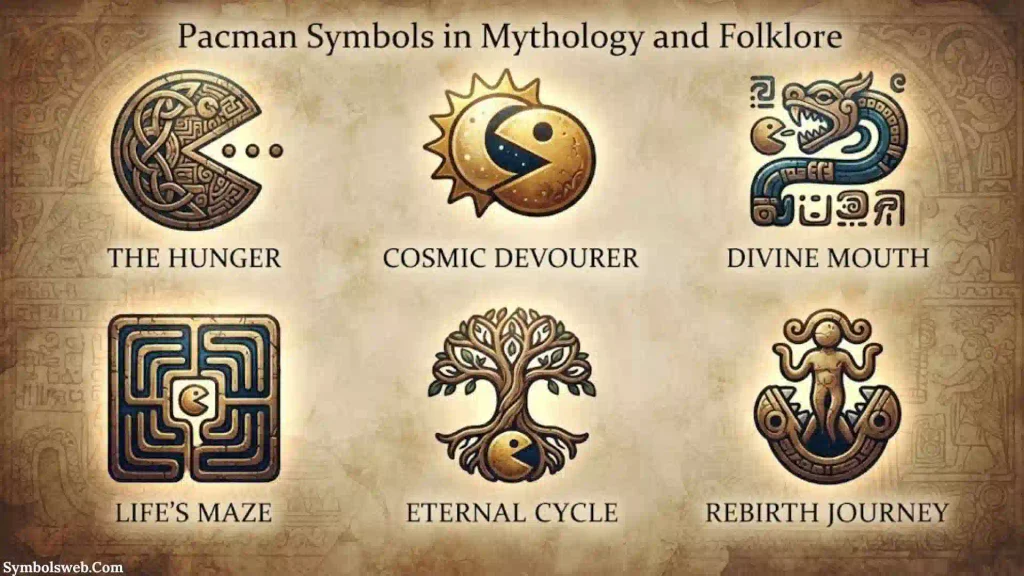
Pacman is not an ancient mythological character.
It belongs to modern popular culture.
However, some elements of the game resemble themes that have appeared in stories for centuries.
The Maze and the Labyrinth
The story of Theseus and the Minotaur provides the clearest comparison.
Theseus enters a labyrinth and faces a dangerous creature.
In Pacman, you move through a maze while avoiding dangerous enemies.
The structure feels similar, but the historical origins are different.
You should think of the comparison as a useful analogy rather than evidence that Pacman came from Greek mythology.
The Hero Facing Danger
Many traditional stories involve a central character facing danger.
Pacman creates a simple interactive version of this idea.
You begin in a vulnerable position.
You look for opportunities.
You avoid threats.
You find temporary power.
You continue moving.
That simple pattern can feel familiar because stories about overcoming obstacles are common across cultures.
Food as a Human Motif
Food appears in myths and folklore around the world.
It can represent survival, celebration, temptation, abundance, or transformation.
Pacman uses eating as the central gameplay action.
That does not prove that Pacman was based on an ancient food myth.
Instead, it shows how the designers built gameplay around something every player immediately understands.
Pacman Symbols in Art, Literature, Movies, and Pop Culture
Pacman quickly moved beyond the arcade.
The Strong National Museum of Play documents its impact on toys, clothing, merchandise, television, music, and other areas of popular culture.
Pacman in Art
Artists can use Pacman imagery to explore ideas such as:
- Childhood
- Technology
- Nostalgia
- Consumer culture
- Competition
- Digital life
- Retro culture
MoMA itself includes Toru Iwatani’s Pacman in its collection, recognizing the game as an important work of interactive design.
Pacman in Literature
If you already know Pacman, a writer can mention a maze, ghost, or Power Pellet and quickly create a familiar mental image.
For example, a maze can suggest confusion.
A ghost can suggest something that keeps following you.
A Power Pellet can suggest a sudden advantage.
The meaning depends on the writer’s context.
Pacman in Movies and Television
Pacman entered television culture in the early 1980s.
The official Pacman history records an animated series beginning in 1982 and notes that it achieved very high television ratings.
This helped turn Pacman from a game character into a broader entertainment character.
Pacman in Music
Pacman even became part of popular music.
Buckner & Garcia released “Pacman Fever” in 1982, and the song reached No. 9 on the Billboard Hot 100 according to the official Pacman history.
Pacman Tattoos
If you choose a Pacman tattoo, you can give it almost any personal meaning you want.
Some people may choose it because they love:
- Classic video games
- Arcade culture
- Childhood memories
- Retro design
- Gaming history
- Playfulness
A Pacman tattoo can also remind you to keep moving forward when you face obstacles.
That interpretation is personal rather than universal.
Pacman in Fashion
Pacman’s simple shapes and bright colors make the imagery easy to use on:
- T-shirts
- Hoodies
- Shoes
- Hats
- Bags
- Socks
- Costumes
- Accessories
When you wear Pacman imagery, people may immediately associate it with classic gaming.
Pacman in Modern Design
You can use Pacman inspired visual ideas to create a retro digital feeling.
Pixel graphics, bright colors, maze patterns, simple characters, and geometric shapes can all remind you of the arcade era.
If you use official Pacman artwork or characters commercially, you should also consider the relevant copyright and trademark rights.
Spiritual and Dream Meaning of Pacman Symbols
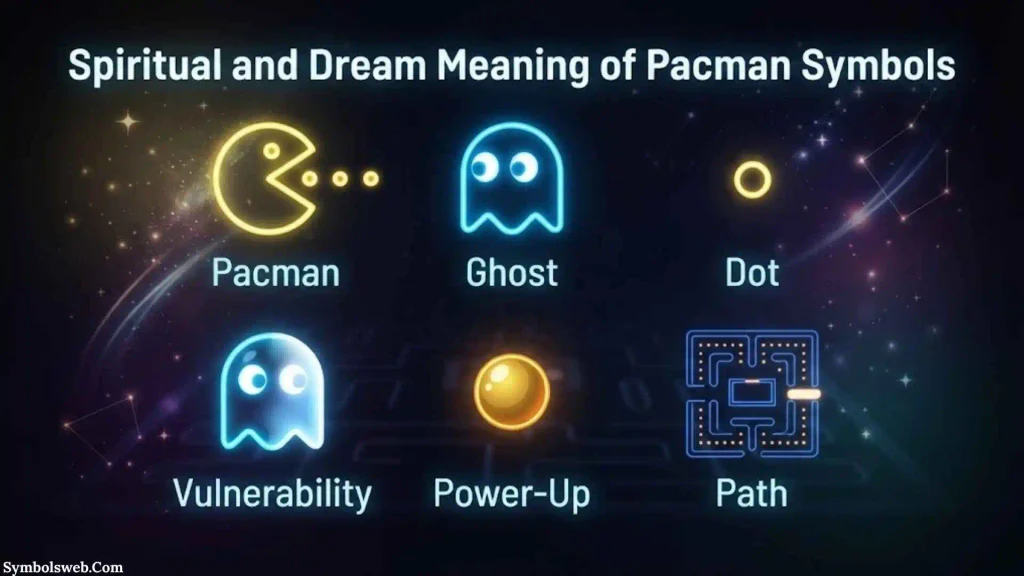
Dream interpretation is personal.
There is no scientifically established rule that says dreaming about Pacman always means one specific thing.
Still, you can use Pacman imagery as a way to reflect on your own experiences.
What Does Pacman Mean in a Dream?
The meaning can change depending on what you see and feel in the dream.
For example:
- If you are collecting dots, you might connect the dream with small goals.
- If ghosts are chasing you, you might connect it with pressure or anxiety.
- If you eat a Power Pellet, you might interpret it as gaining confidence.
- If you are trapped in the maze, you might connect it with uncertainty.
- If you find an escape route, you might connect it with solving a problem.
- If you reach a new level, you might connect it with personal progress.
These are possible interpretations.
They are not universal psychological facts.
Pacman and Meditation
If you use Pacman as a meditation metaphor, you can imagine the maze as your life path.
Each dot can represent a small task.
Each ghost can represent an obstacle.
Each Power Pellet can represent an opportunity.
You can ask yourself:
“What am I trying to reach?”
“What keeps chasing me?”
“Where do I need to change direction?”
“What gives me temporary strength?”
These questions can turn a familiar game image into a simple reflection exercise.
Positive Spiritual Interpretation
You might personally connect Pacman symbols with:
- Persistence
- Courage
- Movement
- Adaptability
- Resilience
- Progress
- Opportunity
- Transformation
Cautionary Interpretation
You might also interpret the same symbols in a cautionary way:
- Endless repetition
- Pressure
- Distraction
- Overconsumption
- Fear
- Competition
- Feeling trapped
The meaning depends on your situation and the context in which you see the symbol.
Positive and Negative Meanings of Pacman Symbols
| Positive Meaning | Negative Meaning |
| Persistence | Repetition |
| Playfulness | Distraction |
| Courage | Fear |
| Progress | Pressure |
| Reward | Overconsumption |
| Adaptability | Competition |
| Opportunity | Temporary control |
| Transformation | Feeling trapped |
You can see why Pacman works well as a modern metaphor.
The maze can represent adventure or confinement.
The ghosts can represent playful competition or anxiety.
The Power Pellet can represent empowerment or a temporary escape.
The same symbol can mean different things to different people.
Why Humans Are Attracted to Pacman Symbols
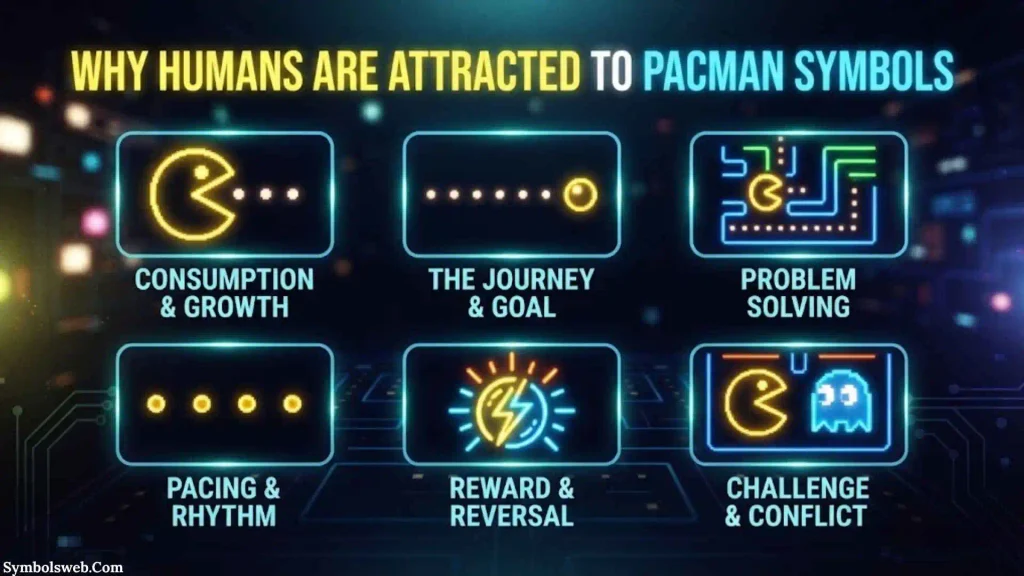
Pacman has an unusually simple visual language.
You can recognize the yellow character from its basic silhouette.
You can distinguish the ghosts through their colors and shapes.
You can understand the dots and Power Pellets almost immediately.
This simplicity makes the imagery easy to remember.
Pattern Recognition
You naturally notice repeated patterns.
Pacman gives you plenty of them.
Dots repeat throughout the maze.
Corridors create familiar routes.
Ghosts move through recognizable spaces.
The same actions happen again and again.
This gives the game structure without making it completely predictable.
Reward and Anticipation
Pacman creates a simple cycle.
You see a target.
You move toward it.
You collect it.
You receive a reward.
Then another target appears.
The cycle continues.
That combination of progress and anticipation is an important part of the game’s appeal.
Nostalgia
For many people, Pacman is also a memory.
When you see the yellow character, you might remember an arcade, a family outing, childhood friends, an old television, or the first video games you played.
That is why the symbol can feel emotional even when you are not playing the game.
Modern Uses of Pacman Symbols
Tattoos
You can use Pacman symbols in tattoos to express gaming history, nostalgia, childhood memories, or retro style.
Jewelry
Pacman characters, ghosts, and Power Pellets can appear in gaming-inspired jewelry and accessories.
Fashion
You can find Pacman imagery in clothing and accessories designed around retro gaming culture.
Branding
The simple Pacman shape demonstrates how a strong silhouette can become instantly recognizable.
If you use official Pacman artwork or branding for a business, you should check the applicable intellectual property and licensing requirements.
Social Media
Pacman symbols can communicate gaming, nostalgia, humor, competition, or retro culture with very little text.
Contemporary Spirituality
You can also use Pacman as a personal metaphor.
The maze can remind you that life does not always follow a straight path.
The ghosts can represent challenges.
The Power Pellet can remind you that opportunities can change your position.
Again, this is a modern personal interpretation, not an ancient spiritual tradition.
Home Decor
Pacman artwork can give a room a classic arcade or retro gaming atmosphere.
You may see it in gaming rooms, bedrooms, offices, arcades, and entertainment spaces.
Personal Expression
Sometimes you do not need a complicated symbolic explanation.
If you wear a Pacman shirt because you love classic games, that is already a meaningful reason.
The symbol can simply tell people that you enjoy gaming, nostalgia, or retro culture.
Interesting Facts About Pacman Symbols
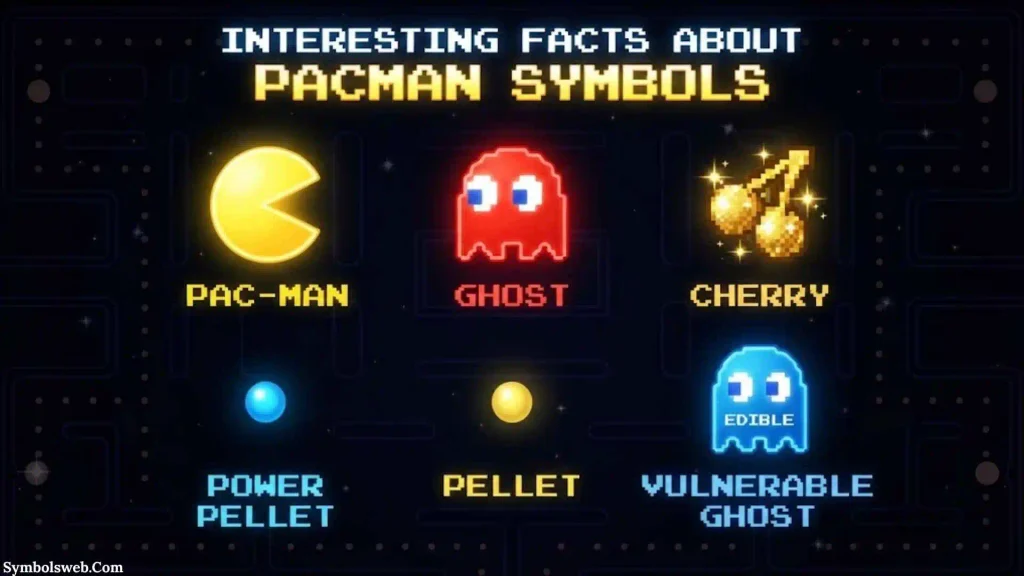
Pacman Was Originally Released as Puck Man
The game was initially released in Japan as Puck Man. The international name became Pacman. The official Pacman history documents this part of the game’s development.
The Character Was Inspired by a Pizza
Toru Iwatani’s famous character idea came while he was eating pizza. He saw a shape that could work as a mouth.
The Game Was Designed as a Nonviolent Alternative
MoMA explains that Iwatani wanted to create a nonviolent game during a period when shooter games were highly popular.
The Ghosts Were Designed to Be Approachable
The colorful ghost characters were designed with cuteness in mind rather than simply trying to make them frightening.
Power Pellets Reverse the Chase
When you eat a Power Pellet, you can temporarily move from being pursued to pursuing the ghosts. The Strong Museum specifically identifies this role reversal as an important part of the game’s design.
Pacman Became a Mass Cultural Icon
The Strong National Museum of Play says Pacman helped make video games a mass cultural phenomenon and became an ambassador of the video game era.
Pacman Inspired a Major Licensing Craze
Pacmanmerchandise expanded into toys, clothing, home products, and other consumer goods, according to the Strong Museum.
Pacman Reached Television
An animated Pacman television show began in the United States in 1982. The official Pacman history records the show’s major television audience.
Pacman Fever Became a Real Hit
Buckner & Garcia’s “Pacman Fever” reached No. 9 on the Billboard Hot 100 in 1982.
Pacman Is Part of Museum History
MoMA includes Pacman in its collection as a work of interactive design, showing how important video games have become within design and cultural history.
Frequently Asked Questions
What do Pacman symbols mean?
Pacman symbols represent different parts of the game’s visual and gameplay system. Pacman represents the player character, ghosts represent danger and pursuit, dots represent collection, Power Pellets represent temporary power, and the maze represents the environment where the action takes place.
What does the Pacman symbol represent?
The yellow Pacman character represents eating, movement, gameplay, and the player-controlled character. You can also interpret it personally as a symbol of persistence, curiosity, nostalgia, or overcoming obstacles.
What do Pacman ghosts symbolize?
In the original game, the ghosts are enemies that pursue Pacman. If you use them as metaphors, you can interpret them as obstacles, pressure, fear, competition, or challenges.
What does the Pacman Power Pellet symbolize?
The Power Pellet can symbolize temporary power, opportunity, transformation, and reversal. In the actual game, it gives Pacman the ability to attack the ghosts for a limited time.
Does Pacman have a spiritual meaning?
Pacman has no documented ancient or official spiritual meaning. You can give the symbols personal spiritual meanings, such as viewing the maze as life’s journey or the Power Pellet as a moment of empowerment.
Why is Pacman culturally important?
Pacman helped turn video games into a major part of mass culture. Its characters expanded into television, music, toys, clothing, merchandise, and other forms of entertainment.
Conclusion
Pacman symbols started as simple pieces of an arcade game, but you can now see them almost everywhere in modern gaming culture. Pacman, the ghosts, dots, Power Pellets, fruit, and maze each have a clear role in the original game, while later generations have attached memories and personal meanings to them.
When you look at Pacman today, you are not just seeing a yellow character. You are seeing a piece of gaming history that continues to connect people with play, challenge, nostalgia, and imagination.

Eliana Foster is a writer with a passion for exploring the meanings behind symbols, traditions, and cultural history. She enjoys breaking down complex topics into simple, engaging articles that are easy for everyone to understand. Eliana is also the fictional author of The Hidden Language of Silent Marks and Beyond the Circle of Ancient Signs, two original book concepts created for her author profile. When she’s not writing, she loves visiting museums, reading about mythology, and researching the stories behind symbols from around the world. Her goal is to help readers discover the fascinating meanings hidden in everyday signs and ancient emblems.
 Jordan Hayes
 Ethan Holloway