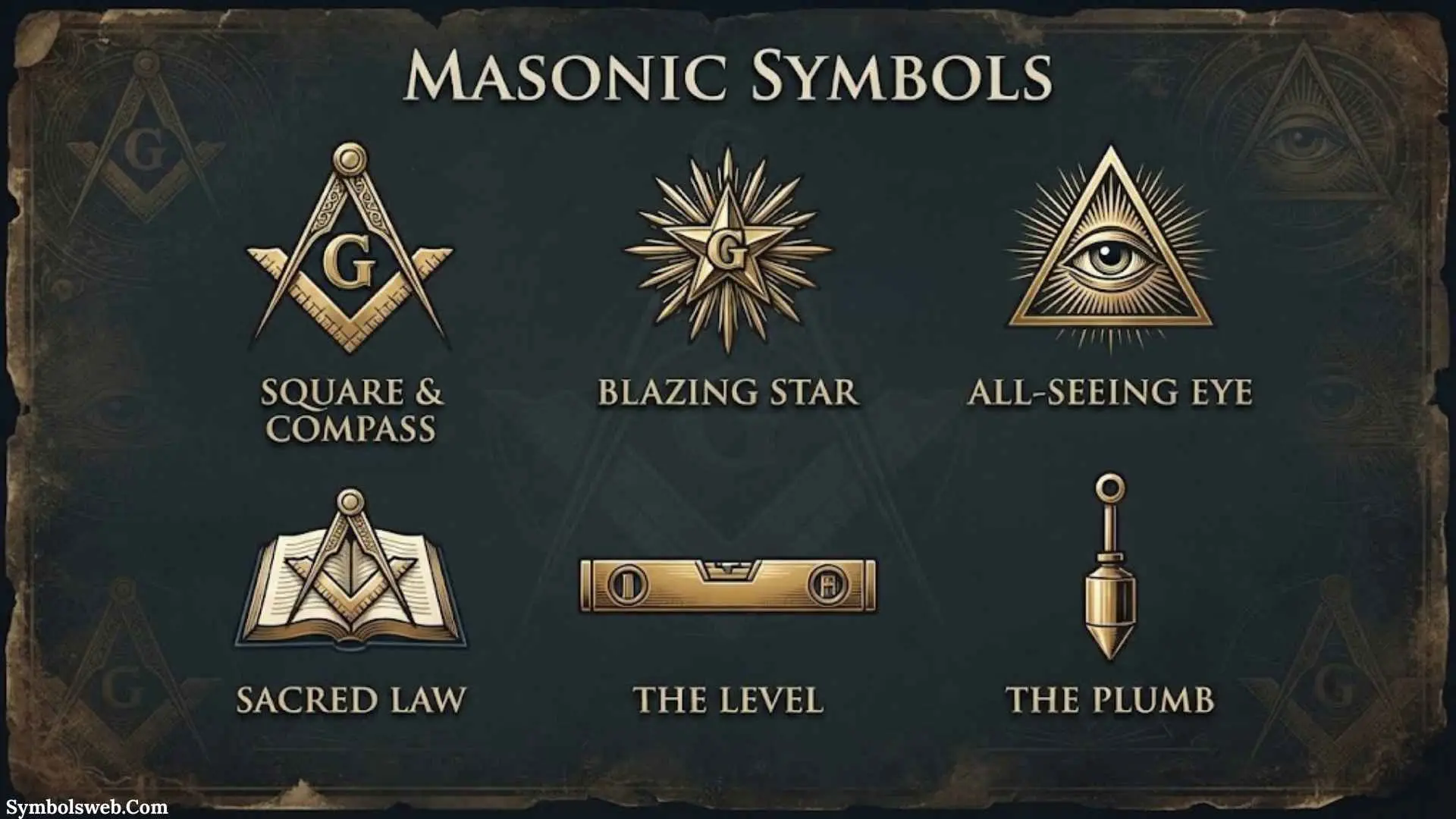
32 masonic symbols can feel like a doorway into a hidden world of history, mystery, and meaning. When I first look at symbols such as the Square and Compasses, the All-Seeing Eye, or the Masonic pillars, I see more than simple designs. I see stories about human character, morality, faith, time, and the search for truth.
As you explore these symbols, you may begin to notice how ordinary objects can carry surprisingly deep meanings. A square can remind you to live honestly, a compass can represent self control, and an hourglass can make you think about how quickly life passes. Each symbol gives you another way to understand the values that have shaped Freemasonry for centuries.
In this guide, I will take you through 32 important Masonic symbols, their history, meanings, cultural connections, and spiritual interpretations. You will also discover which meanings are historically supported, which ideas come from later interpretations, and why these mysterious symbols continue to fascinate people around the world.
32 Masonic Symbols: (Quick Answer)
Masonic symbols are visual signs, tools, objects, and emblems used in Freemasonry to express moral, philosophical, spiritual, and ceremonial ideas. Many developed from the working tools of medieval stonemasons, while others came from biblical, classical, geometric, and European symbolic traditions. Their meanings can differ between Masonic jurisdictions and rites.
Quick Facts About 32 Masonic Symbols
| Aspect | Information |
| Origin | Mainly rooted in medieval stonemasonry, with additional biblical, classical, geometric, and Enlightenment influences |
| Historical Significance | Symbols helped transform practical building tools into lessons about moral and personal improvement |
| Main Meaning | Self-discipline, morality, brotherhood, equality, truth, service, mortality, and personal growth |
| Spiritual Meaning | Reflection on God, conscience, mortality, virtue, order, and the search for meaning |
| Cultural Importance | Masonic imagery has influenced architecture, art, jewelry, literature, public monuments, and popular culture |
| Modern Usage | Lodge buildings, regalia, jewelry, historical objects, tattoos, artwork, educational materials, and fraternal branding |
What Are Masonic Symbols?
Masonic symbols are images and objects used by Freemasons to communicate ideas that are often easier to contemplate visually than through abstract language.
The central idea is simple: a physical object can become a moral lesson.
A stonemason once used a square to test an angle. In Freemasonry, the square can become a reminder to act honestly and fairly. A level once checked whether a surface was horizontal. Symbolically, it can remind members of human equality.
This approach is closely connected with the transition from operative stonemasonry to what historians call speculative Freemasonry. The precise origins of Freemasonry remain debated, but the widely accepted historical view connects modern Freemasonry with medieval stonemason traditions. The first Grand Lodge of England was formed in London in 1717, an important turning point in the development of modern Freemasonry.
By 1723, the publication of the Constitutions of the Free-Masons helped establish an increasingly organized and influential form of the fraternity. Its intellectual environment reflected Enlightenment themes such as religious tolerance, merit, education, civility, and personal improvement.
It is also important to avoid one common mistake.
Not every ancient symbol that appears in Masonic art was invented by Freemasonry.
The Eye of Providence, for example, existed in religious art before its adoption in Masonic contexts. Likewise, pillars, stars, suns, moons, and geometric figures have long histories outside the fraternity.
Masonic symbolism is therefore best understood as a mixture of inherited imagery and specifically Masonic interpretation.
The 32 Masonic Symbols and Their Meanings
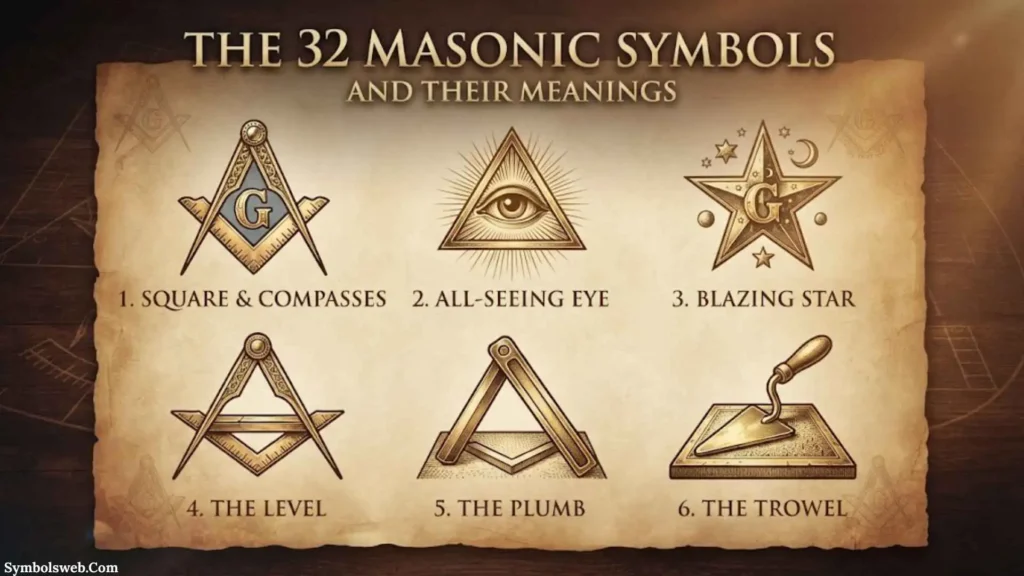
1. Square and Compasses
The Square and Compasses is the most recognizable symbol associated with Freemasonry.
The square traditionally points toward morality, honesty, and acting correctly toward others. The compasses are commonly associated with restraint, self-control, and keeping one’s desires within proper limits.
Together, they turn the idea of building into a metaphor for building character.
The exact interpretation is not identical everywhere, but the association with moral conduct and self-discipline is widespread. Masonic organizations themselves describe the tools as central to the fraternity’s symbolic language.
2. The Letter G
The letter G is often placed inside or between the Square and Compasses, particularly in American Masonic imagery.
Its meaning is not completely uniform.
It is commonly interpreted as Geometry, reflecting the importance of geometry to architecture and stonemasonry. It may also be associated with God or the Great Architect of the Universe.
This is a good example of why Masonic symbols should not be treated as having one universal dictionary definition. Different Masonic traditions explain the letter differently.
3. All-Seeing Eye
The All-Seeing Eye, also known as the Eye of Providence, represents divine watchfulness in many Masonic contexts.
It can remind a Mason that moral behavior matters even when no human observer is present.
The symbol itself is older than Freemasonry. Similar imagery appears in religious and artistic traditions, including European Christian art. Its connection with Freemasonry developed during the 18th century. It should not automatically be identified as an “Illuminati symbol,” a common modern misconception.
The famous eye on the U.S. Great Seal is also not proof of a Masonic design. The Great Seal was adopted in 1782, while the eye became established in American Masonic publications later.
4. The Two Pillars
The two pillars are strongly connected with the architectural imagery of Solomon’s Temple.
They are commonly identified with the biblical pillars named Jachin and Boaz.
Within Masonic symbolism, pillars can suggest strength, stability, balance, entrance, and the threshold between ordinary life and sacred learning.
Their appearance also demonstrates how biblical architecture became part of Masonic allegory.
5. Level
The level was a practical tool used by builders to determine whether a surface was horizontal.
In Freemasonry, it commonly represents equality.
The symbolism is powerful because the tool ignores social rank. Wealth, occupation, fame, and status do not change the physical principle of a level.
This became part of the broader Masonic idea that people can meet together on equal ground.
Masonic educational material from California similarly identifies the level with equality.
6. Plumb Line
The plumb line tests vertical alignment.
Symbolically, the plumb is associated with uprightness, rectitude, justice, and living according to principle.
Imagine a building whose walls slowly lean out of alignment. Eventually the entire structure becomes unstable.
The metaphor is easy to understand: small moral compromises can eventually affect the whole character of a person.
7. Trowel
A trowel spreads mortar between bricks and stones.
In Masonic symbolism, it can represent bringing people together through friendship, brotherhood, charity, and mutual support.
The image is especially memorable because the mortar does not make the individual stones identical. It helps them function as part of one structure.
Masonic educational sources describe the trowel as connected with the “cement of friendship.”
8. Common Gavel
The common gavel was used by stonemasons to shape and dress stone.
Symbolically, it represents the removal of undesirable qualities.
The rough stone becomes a metaphor for the imperfect human being.
Anger, dishonesty, selfishness, arrogance, and impatience can be imagined as rough edges that require deliberate work.
This is one of the clearest examples of the central Masonic metaphor: build the person while building the structure.
9. Twenty-Four-Inch Gauge
The 24-inch gauge is traditionally associated with dividing the day into useful portions.
A common Masonic interpretation divides the 24 hours into time for work, rest, and service or devotion.
Its deeper lesson is about time management.
Unlike money, time cannot be stored for later. Once an hour has passed, it is gone.
Masonic sources connect the 24-inch gauge with the 24 hours of the day and their proper use.
10. Rough Ashlar
A rough ashlar is an unfinished stone.
It symbolizes the individual at the beginning of a journey of self-improvement.
The rough stone is not worthless. It simply has work left to do.
That makes it an unusually human symbol. Everyone begins with imperfections, habits, fears, and limitations.
11. Perfect Ashlar
The perfect ashlar is the counterpart to the rough ashlar.
It represents a stone that has been shaped and prepared for use in a structure.
Symbolically, it can represent the disciplined individual who has worked on character, judgment, conduct, and moral awareness.
The contrast between rough and perfect ashlar is one of Freemasonry’s clearest images of personal development.
12. Mosaic Pavement
The checkered or mosaic pavement is one of the most recognizable elements of traditional Masonic lodge imagery.
Its alternating light and dark squares are often interpreted as representing contrasts within human life.
Good and evil, joy and sorrow, success and failure, knowledge and ignorance, and other opposites can all be contemplated through this visual pattern.
The symbolism is not necessarily a claim that life is divided into two simple categories. Instead, it can encourage awareness of life’s constant contrasts.
13. Blazing Star
The Blazing Star is a five-pointed star frequently found in Masonic symbolism.
Its meaning varies by tradition.
It can represent light, knowledge, divine guidance, or spiritual illumination. In some interpretations, it is associated with the search for truth.
The star is especially interesting because stars have been used as symbols of guidance across many cultures long before Freemasonry.
14. Sun
The sun represents light, visibility, life, and order in many symbolic systems.
Within Freemasonry, solar imagery may form part of the symbolism of the lodge and its “lesser lights.”
It can be understood psychologically as an image of consciousness. Darkness hides. Light reveals.
That simple contrast gives solar symbolism its enduring power.
15. Moon
The moon frequently appears alongside the sun in Masonic imagery.
Together, the sun and moon can represent complementary forms of light and the ordered rhythms of nature.
The moon also has a long symbolic history connected with cycles, change, reflection, and time.
Its Masonic meaning depends strongly on the rite and ritual context in which it appears.
16. Stars
Stars are ancient symbols of navigation, guidance, hope, and the heavens.
In Masonic art, groups of stars may contribute to a wider celestial theme.
Their presence can remind viewers that the lodge’s symbolic world is not limited to physical construction. Architecture becomes a way of thinking about humanity’s relationship with the larger universe.
17. Beehive
The beehive represents industry, cooperation, and productive work in Masonic symbolism.
A hive provides a powerful social metaphor.
Thousands of individual actions become one functioning community.
The image therefore speaks not only about hard work but about the value of contributing to something larger than oneself. The beehive is documented among Masonic emblems and symbolic imagery.
18. Acacia
The acacia is one of the most emotionally significant plants in Masonic symbolism.
It is especially associated with the Master Mason degree and themes of death, remembrance, hope, and immortality.
The plant also has broader ancient and biblical associations, which helped make it suitable for symbolic interpretation.
In Masonic tradition, acacia can become a reminder that physical life ends while memory, moral influence, and spiritual hope can continue.
19. Jacob’s Ladder
Jacob’s Ladder comes from the biblical story in Genesis, where Jacob dreams of a ladder reaching toward heaven.
In Masonic interpretation, the ladder can symbolize spiritual ascent and moral development.
It is often associated with virtues and stages of progress.
Psychologically, the image is easy to understand: growth is imagined as movement upward, one step at a time.
20. Book of Sacred Law
The Book of Sacred Law is central to Masonic ritual in many jurisdictions.
Depending on the lodge and membership, this may be a Bible, Qur’an, Tanakh, or another sacred text.
Its presence reflects the importance Freemasonry places on belief in a Supreme Being in many regular traditions, while also allowing members from different religious backgrounds to participate.
The important distinction is that Freemasonry is not itself a replacement for a particular religion.
21. Masonic Apron
The Masonic apron recalls the practical aprons worn by operative stonemasons.
Historically, an apron protected a craftsman’s clothing while working with stone.
In Freemasonry, it became part of ceremonial dress and a visible reminder of labor, craftsmanship, dignity, and service.
The humble working garment was transformed into an emblem of identity.
22. Three Great Lights
The Three Great Lights are traditionally the Volume of Sacred Law, Square, and Compasses.
Together, they form one of the central symbolic arrangements of Craft Freemasonry.
Their meaning is commonly connected with moral guidance, ethical conduct, and the principles by which a Mason is expected to regulate his life.
Masonic traditions differ in details, but the three-part arrangement is deeply established in Craft Masonry.
23. Three Lesser Lights
The Three Lesser Lights are traditionally represented by the Sun, Moon, and Master of the Lodge.
They create a symbolic relationship between celestial light and the human leadership of the lodge.
This imagery emphasizes order, rhythm, guidance, and the relationship between the individual lodge and the larger universe.
Masonic educational material identifies these three as the sun, moon, and Master of the lodge.
24. Point Within a Circle
The point within a circle is an important geometric image in Masonic symbolism.
It has been interpreted in different ways across Masonic traditions and historical periods.
The image encourages attention to boundaries, personal conduct, and the relationship between the individual and the world around him.
Its exact interpretation is best understood from the particular ritual or tracing board in which it appears rather than from a single universal definition.
25. Forty Seventh Proposition of Euclid
The 47th Proposition of Euclid, commonly known as the Pythagorean theorem, appears in Masonic symbolism and tracing-board traditions.
It states the relationship between the sides of a right triangle.
Why would a mathematical theorem appear in a fraternity?
Because geometry represents order, proportion, measurement, and the rational principles used to construct the built world.
The theorem therefore connects mathematics with the larger Masonic fascination with architecture and order.
26. Hourglass
The hourglass is a powerful symbol of time and mortality.
As the sand moves from one chamber to the other, the image suggests that human life is continually passing.
In Masonic symbolism, it can represent mortality, the cycle of life and death, and the need to use one’s limited time wisely. Scottish Rite educational material specifically connects the hourglass with human life, mortality, and the precious nature of time.
The lesson is surprisingly modern:
You cannot control how much time you have, but you can influence how you use it.
27. Scythe
The scythe is another symbol associated with mortality and the passing of time.
Because the agricultural scythe cuts crops, it became an image of the inevitable end of earthly life.
In Masonic artwork, the scythe may appear alongside the hourglass, coffin, or other symbols of mortality.
The message is not simply gloomy. It can encourage a person to live more consciously.
28. Coffin
The coffin is a direct image of death.
Within Masonic ritual and symbolism, it can encourage contemplation of mortality and the consequences of one’s life.
Rather than celebrating death, the image asks a difficult question:
If life is temporary, what kind of life should we build?
That question gives the coffin a philosophical purpose beyond its literal meaning.
29. Skull and Crossbones
The skull and crossbones are traditional symbols of mortality.
They have appeared in European art, funerary traditions, military imagery, and other contexts outside Freemasonry.
In Masonic contexts, they can encourage reflection on death, impermanence, and the moral meaning of one’s life.
It is important not to assume that every skull and crossbones image is Masonic.
30. Sword
The sword has several possible meanings in Masonic contexts.
It may represent justice, vigilance, authority, protection, or the defense of principle.
In some ceremonial settings, swords also function as regalia or ritual objects.
Its interpretation depends strongly on the degree, rite, office, and historical tradition involved.
31. Anchor
The anchor is traditionally associated with hope and stability.
It is particularly interesting because it connects Masonic symbolism with a much broader maritime and Christian symbolic tradition.
A ship uses an anchor to remain steady in uncertain waters.
As a metaphor, that becomes a powerful image of remaining grounded during hardship.
32. Cornucopia
The cornucopia, or horn of plenty, symbolizes abundance, generosity, nourishment, and prosperity.
It comes from classical mythology and is associated with stories of divine provision and abundance.
When used in Masonic-related imagery, it can connect ideas of prosperity with charity and responsible use of one’s resources.
It is another reminder that Masonic symbolism does not come exclusively from stonemasonry. Classical mythology and wider European symbolic traditions also contributed to the visual vocabulary.
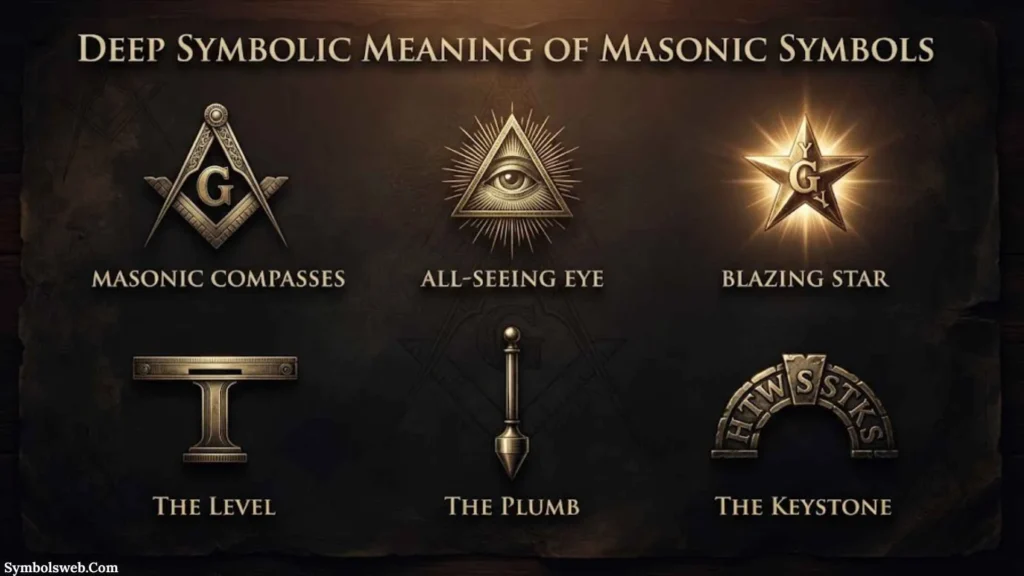
Deep Symbolic Meaning of Masonic Symbols
Spiritual Meaning
At the spiritual level, Masonic symbolism often asks questions rather than giving simple answers.
What does it mean to live a good life?
How should a person control desire?
What happens when life ends?
What relationship should human beings have with God, conscience, truth, and other people?
The Great Architect of the Universe is a phrase used in Masonic traditions to speak about the divine without requiring every member to use the same theological language.
This is one reason Masonic symbols can feel spiritual without functioning as the symbols of a single religion.
Psychological Meaning
Masonic symbolism can also be understood through psychology.
The rough ashlar resembles the developing self. The perfect ashlar suggests an ideal of disciplined character. The journey from darkness to light resembles a movement from ignorance toward knowledge.
From a Jungian perspective, symbols can have psychological power because humans naturally use images to represent abstract ideas. A tool becomes self-control. A building becomes character. Light becomes knowledge.
That does not mean Freemasonry was created from Jungian psychology. Carl Jung lived centuries after the emergence of modern Freemasonry. Rather, Jung’s later ideas provide one possible framework for understanding why symbolic images can feel emotionally powerful.
Cultural Meaning
Masonic symbolism also belongs to a larger cultural history.
Its imagery combines elements from:
- Medieval stonemasonry
- Biblical stories
- Classical mythology
- Geometry
- European Christian art
- Renaissance symbolism
- Enlightenment philosophy
- Fraternal traditions
- Architectural culture
That mixture helps explain why Masonic imagery can look familiar even to people who have never entered a lodge.
Types and Variations of Masonic Symbols
Masonic symbols can be grouped into several broad categories.
| Type | Examples | Main Function |
| Working tools | Square, compasses, level, plumb, gavel, trowel, gauge | Moral instruction |
| Architectural symbols | Pillars, ashlar, temple imagery | Character and spiritual construction |
| Celestial symbols | Sun, moon, stars, blazing star | Light, order, guidance |
| Mortality symbols | Hourglass, coffin, scythe, skull | Reflection on time and death |
| Natural symbols | Acacia, beehive | Life, work, memory, community |
| Sacred symbols | Book of Sacred Law, Jacob’s Ladder | Spiritual reflection |
| Geometric symbols | Square, circle, point, 47th Proposition | Order, proportion, reason |
| Regalia | Apron, jewels, swords | Office, identity, ritual |
Masonic Symbols Across Different Cultures
A major source of confusion is the belief that every Masonic symbol originated in an ancient civilization. Historical evidence does not support that sweeping claim.
Freemasonry developed as a distinct fraternity in early modern Europe, while many of the images it later used have much older histories.
Ancient Egypt
Ancient Egyptian religion used powerful imagery involving eyes, solar forms, geometry, sacred architecture, and rebirth.
The Eye of Horus, for example, is an ancient Egyptian symbol associated with protection and healing.
However, the Eye of Horus should not simply be labeled a Masonic symbol. Its history predates Freemasonry by thousands of years.
The similarity demonstrates something more interesting: human cultures repeatedly use eyes, light, architecture, and geometry to express ideas about protection, knowledge, and the divine.
Ancient Greece
Greek culture contributed enormously to the history of geometry, architecture, philosophy, and proportion.
Euclid’s mathematical work became especially important to later European intellectual traditions.
The Masonic use of the 47th Proposition reflects the long cultural association between geometry and rational order.
Roman Culture
Roman architecture and engineering helped preserve and expand traditions of proportion, columns, arches, surveying, and construction.
Roman and later European architectural traditions also influenced the visual language from which modern Masonic symbolism developed.
Eastern Traditions
Eastern religions and philosophies contain their own rich symbolic traditions involving light, circles, sacred geometry, balance, death, rebirth, and spiritual transformation.
These similarities should not be mistaken for proof that Freemasonry directly borrowed every parallel symbol from Eastern religions.
Similar symbols can emerge independently because humans often use the same basic visual ideas to express universal experiences.
Indigenous Traditions
Indigenous cultures around the world have developed symbolic systems involving animals, plants, stars, directions, ancestors, sacred landscapes, and community.
Some of these themes overlap conceptually with Masonic imagery.
But it is important to respect cultural boundaries. Similar symbolism does not mean different traditions share the same meaning or historical origin.
Modern Interpretations
Today, Masonic symbols exist in a world shaped by museums, movies, social media, tattoos, architecture, historical research, conspiracy theories, and digital culture.
As a result, symbols often acquire meanings that are very different from their historical Masonic use.
Similar Symbols and Their Meanings
| Symbol | Masonic Association | Similar Broader Symbol | Important Difference |
| Eye | Divine watchfulness | Eye of Horus, Eye of Providence | Similar imagery does not mean identical origin |
| Star | Light and guidance | Religious and astronomical stars | Meaning changes by tradition |
| Pillars | Strength and temple imagery | Classical columns | Masonic meaning is connected to ritual architecture |
| Compass | Self-restraint and proportion | Navigation | Masonic compasses are drafting tools |
| Square | Moral conduct | Geometry and construction | Masonic use adds ethical meaning |
| Beehive | Industry and cooperation | Community and productivity | The hive is a broader cultural metaphor |
| Anchor | Hope and stability | Maritime symbolism | Its meaning is not uniquely Masonic |
| Hourglass | Mortality and time | Vanitas art | Masonic interpretation adds ritual context |
Masonic Symbols in Mythology and Folklore
Masonic symbolism has absorbed stories from biblical tradition, classical mythology, medieval legends, and European folklore.
One of the strongest examples is the Temple of Solomon.
The Temple became a central architectural metaphor within Masonic tradition, even though modern Freemasonry should not be confused with the historical builders of the biblical temple.
Similarly, Jacob’s Ladder comes directly from the Hebrew Bible. The story of Jacob dreaming of a ladder reaching heaven gave later symbolic traditions a powerful image of spiritual ascent.
Classical mythology contributed another layer. The cornucopia, for example, has roots in Greek mythology and the idea of divine abundance.
These stories helped transform Masonic symbolism into something larger than a collection of construction tools.
Masonic Symbols in Art, Literature, Movies, and Pop Culture
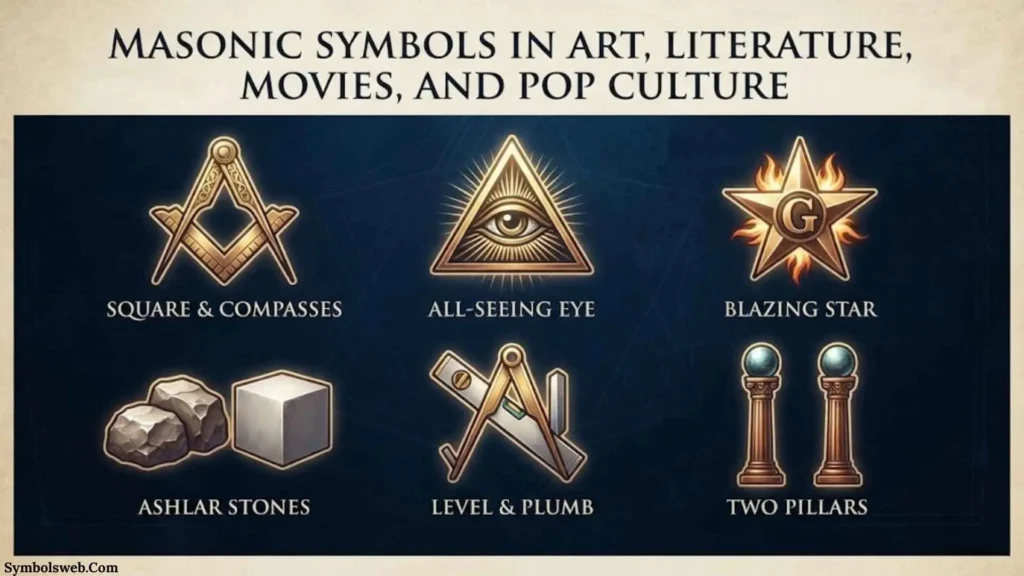
Masonic imagery has appeared throughout Western visual culture.
Paintings and Architecture
Masonic halls often incorporate pillars, geometric forms, stars, celestial imagery, mosaics, and symbolic tools into their decoration.
Some buildings are subtle. Others make the symbolism highly visible.
Literature
Writers have long been fascinated by secret societies, hidden knowledge, initiation, architecture, and coded imagery.
Because Freemasonry was historically surrounded by an aura of privacy and ceremony, it became fertile material for fiction.
Movies and Television
Film and television often exaggerate Masonic imagery because visual symbols are useful storytelling devices.
A mysterious eye, ancient-looking seal, hidden room, or geometric emblem can quickly suggest secrecy.
The problem is that entertainment frequently mixes documented history with invention.
Tattoos
Masonic tattoos commonly feature:
- Square and Compasses
- All-Seeing Eye
- Pillars
- Skull and crossbones
- Hourglass
- Acacia
- Stars
- Geometric patterns
For some people, these tattoos represent family heritage or membership. For others, they symbolize discipline, mortality, spirituality, or personal transformation.
Fashion and Jewelry
The Square and Compasses is especially common on rings, pendants, pins, cufflinks, watches, and other objects.
Its recognizability makes it both a fraternal emblem and a cultural image.
Spiritual and Dream Meaning of Masonic Symbols
Dream interpretation requires caution.
There is no scientifically established universal dream dictionary in which a Masonic symbol has one fixed meaning.
If someone dreams about a square, compass, temple, eye, or unfinished stone, the meaning may depend on personal experience.
Positive Interpretations
A square may suggest integrity.
A compass may suggest direction.
A temple may represent inner development.
Light may represent understanding.
An unfinished stone may represent personal growth.
An hourglass may encourage someone to value time.
Cautionary Interpretations
The same images can have darker associations.
A compass that cannot find direction may represent uncertainty.
A crumbling temple may symbolize instability.
A closed door may suggest an obstacle.
A skull may bring awareness of mortality.
A broken tool may symbolize frustration or a loss of control.
The most useful interpretation usually begins with the dreamer’s own emotional response.
Positive and Negative Meanings of Masonic Symbols
| Positive Meaning | Negative or Shadow Meaning |
| Wisdom | Intellectual pride |
| Discipline | Excessive control |
| Brotherhood | Exclusivity |
| Spiritual reflection | Fear of judgment |
| Personal growth | Perfectionism |
| Tradition | Resistance to change |
| Order | Rigidity |
| Mortality awareness | Fear of death |
| Secrecy | Suspicion |
| Leadership | Abuse of authority |
| Community | Group pressure |
| Symbolic knowledge | Overinterpretation |
This is one reason symbols remain psychologically powerful.
A symbol does not always carry one emotional message.
Its meaning can change with context.
Why Humans Are Attracted to Masonic Symbols
Humans naturally search for patterns.
We see faces in clouds, meaning in dreams, stories in constellations, and messages in architecture.
Masonic symbolism works particularly well because it combines several things the human mind finds compelling:
Mystery.
Symbols suggest that there is more to discover.
Order.
Geometric shapes make a chaotic world feel structured.
Story.
A rough stone becomes a person. A temple becomes character. Light becomes knowledge.
Identity.
A symbol can communicate belonging without a long explanation.
Mortality.
The hourglass and skull remind us that time is limited.
Transformation.
The movement from rough stone to finished stone offers a simple picture of personal growth.
This may help explain why Masonic symbols continue to attract people even in an age dominated by digital images.
Modern Uses of Masonic Symbols
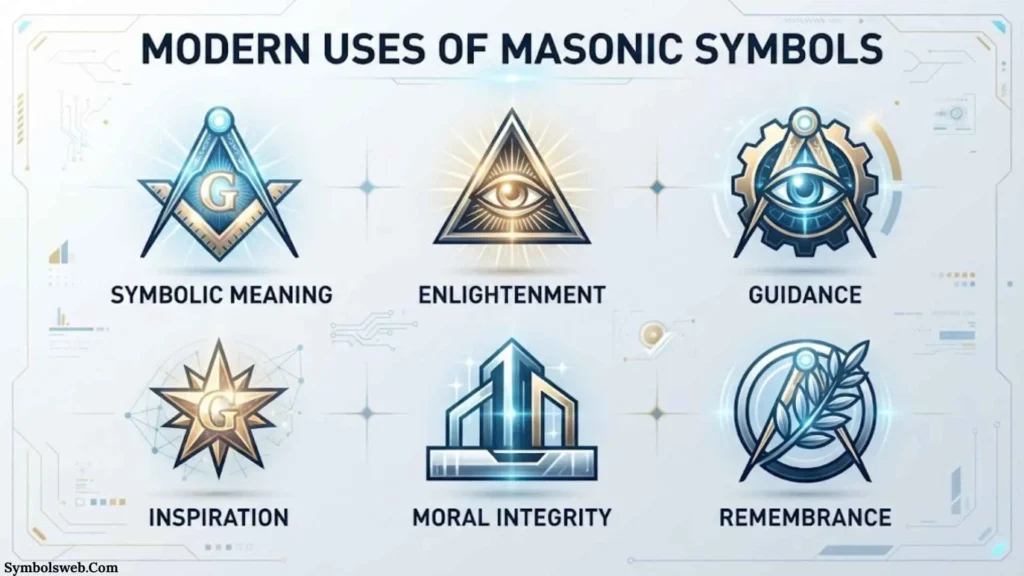
Today, Masonic symbols can be found in several settings.
Tattoos
People use them to express fraternity, family history, personal discipline, or fascination with symbolism.
Jewelry
Masonic rings and pendants remain among the most recognizable forms of symbolic jewelry connected with the fraternity.
Fashion
Historic and geometric Masonic imagery sometimes appears in clothing, accessories, and decorative design.
Branding
Lodges and Masonic organizations use symbols to communicate identity and heritage.
The United Grand Lodge of England has described the Square and Compasses as its most recognizable Masonic symbol and has incorporated its forms into modern organizational branding.
Social Media
Online platforms have dramatically increased exposure to Masonic imagery.
Unfortunately, they have also increased misinformation.
A symbol appearing in a photograph does not prove that the person, building, government, or organization shown is secretly controlled by Freemasons.
Contemporary Spirituality
Some people use Masonic imagery outside formal Freemasonry as a personal language for meditation, morality, architecture, geometry, or spiritual reflection.
Home Decor
Historic prints, antique lodge objects, geometric artwork, and reproduction Masonic designs can also be found in private collections and interior design.
Common Misconceptions About Masonic Symbols
Is every eye a Masonic eye?
No.
The eye is one of the oldest symbolic images in human culture. Its presence alone does not establish a Masonic connection.
Is the pyramid on the dollar bill a Masonic symbol?
The Great Seal of the United States includes an unfinished pyramid and Eye of Providence, but the existence of these images does not establish that the design is a Masonic emblem. The Great Seal was adopted in 1782, and the eye has a broader religious and artistic history.
Does every Masonic symbol have one official meaning?
No.
Meanings can vary by jurisdiction, rite, historical period, ritual, and individual Masonic writer.
Are Masonic symbols secret?
Many are publicly documented.
The symbolism has been discussed in books, lectures, museum collections, ritual commentaries, and educational publications for centuries.
The mystery surrounding Freemasonry has often been stronger in popular culture than the secrecy surrounding its published symbols.
Interesting Facts About 32 Masonic Symbols
- The Square and Compasses is the best-known Masonic emblem. It has become so recognizable that many people identify Freemasonry instantly when they see it.
- The origins of Freemasonry are still debated. The widely accepted scholarly view connects modern Freemasonry with medieval stonemasonry, but there is no simple single founding moment in antiquity.
- 1717 was a major turning point. Four London lodges came together on June 24, 1717, forming what became known as the Premier Grand Lodge.
- The 1723 Constitutions were highly influential. They helped organize Freemasonry and reflected important Enlightenment ideas.
- The Eye of Providence is older than Freemasonry. Its history reaches into earlier religious and artistic traditions.
- The hourglass has a long symbolic history beyond Freemasonry. It became a widespread image of mortality and passing time before gaining Masonic interpretations.
- The 24-inch gauge turns time into a moral lesson. Its symbolism connects the hours of a day with the responsible use of time.
- Masonic symbolism is not identical worldwide. Different jurisdictions and rites can emphasize different meanings.
- The apron has practical roots. Operative stonemasons used aprons as protective clothing while working with stone.
- Masonic imagery is not limited to construction tools. Biblical stories, celestial images, classical mythology, mathematics, plants, and mortality symbols all contribute to the wider symbolic vocabulary.
Frequently Asked Questions
What is the most famous Masonic symbol?
The Square and Compasses is generally regarded as the most recognizable symbol associated with Freemasonry. The square is commonly connected with moral conduct, while the compasses are associated with restraint and boundaries. Interpretations vary among Masonic traditions.
What does the Masonic eye mean?
The All-Seeing Eye, or Eye of Providence, commonly represents divine watchfulness. It reminds the individual that moral conduct matters even when no other person is watching. The symbol itself predates Freemasonry.
What does the letter G mean in Freemasonry?
The letter G is commonly interpreted as Geometry, reflecting the importance of geometry to building and stonemasonry. In some traditions it is also connected with God or the Great Architect of the Universe. There is no single interpretation accepted across every Masonic jurisdiction.
What does the Masonic beehive symbolize?
The beehive commonly symbolizes industry, cooperation, productive labor, and the value of contributing to a community. It uses the organized activity of bees as a metaphor for human cooperation.
What does the hourglass symbolize in Freemasonry?
The hourglass represents the passage of time, mortality, and the limited nature of human life. Its lesson is that time should be used wisely for meaningful work, self-improvement, service, and the pursuit of truth.
Are all symbols associated with Freemasonry actually Masonic?
No.
Many symbols associated with Freemasonry also belong to older religious, mathematical, architectural, classical, or cultural traditions. An eye, star, pyramid, column, skull, or compass does not automatically prove a Masonic connection. Historical context is essential.
Conclusion
The 32 Masonic symbols we explored are more than mysterious signs or decorative images. When you look closely, you can see lessons about honesty, self-control, brotherhood, time, mortality, wisdom, and personal growth. I believe their real power comes from the questions they make you ask about your own life and the person you want to become.
As you continue learning about Freemasonry, you may discover that every symbol has a story, but its deepest meaning can also depend on how you understand it. From the Square and Compasses to the hourglass and All Seeing Eye, these symbols remind you that life itself is a journey of learning, building, and becoming better. Perhaps that is the most lasting message hidden within them.

Hi, I’m Ethan Holloway, and I’ve always believed that a few meaningful words can change the way we think, feel, and live. I enjoy collecting timeless quotes, studying their deeper meanings, and sharing inspiring messages that help people stay motivated through every stage of life.
Over the years, I’ve explored thousands of famous sayings from writers, leaders, philosophers, and everyday people. My goal is to make wisdom easy to understand and useful for everyone.
Books by Ethan Holloway
- The Power of Everyday Quotes
- Words That Inspire Greatness
 Jordan Hayes
 Eliana Foster