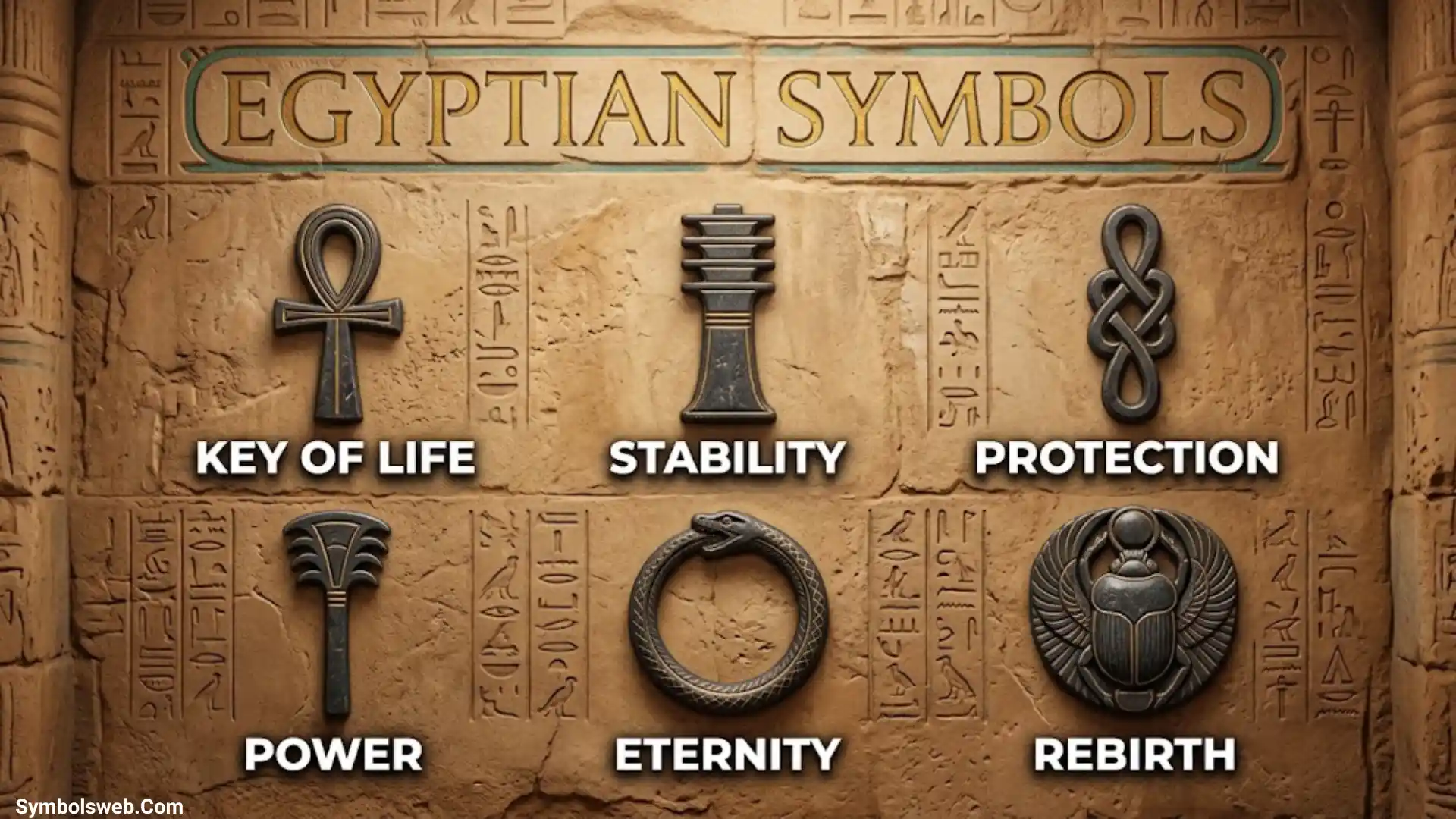
Ancient Egyptian symbols tell stories about life, death, power, protection, and the world beyond. From the famous ankh to the mysterious Eye of Horus, these designs appeared on temple walls, royal crowns, jewelry, tombs, and sacred objects. Each symbol carried meaning within the religious beliefs and cultural traditions of ancient Egypt.
If you’ve ever wondered what an Egyptian symbol represents, you’re not alone. Some symbols represented life and renewal, while others identified gods, protected the dead, or showed a pharaoh’s authority. Their meanings often overlapped, and the same design could communicate different ideas depending on where artists placed it.
This guide explores the most important Egyptian symbols and meanings, including their historical origins, connections to Egyptian gods, and appearances in ancient art. You’ll also learn how hieroglyphs differ from religious symbols and why these remarkable designs remain popular in modern jewelry, tattoos, and artwork.
What Do Egyptian Symbols Mean?
Egyptian symbols were visual signs that communicated religious beliefs, political authority, social identity, and ideas about the natural world. Ancient Egyptians used them in temples, tombs, inscriptions, royal clothing, amulets, and everyday objects.
Many symbols connected the human world with the divine. For example, gods frequently held an ankh to represent life, while pharaohs wore crowns that identified their authority over Egypt. Funerary objects carried protective imagery intended to help the deceased navigate the afterlife.
Ancient Egyptian symbolism developed over thousands of years. Egyptian civilization traditionally dates to around 3100 BCE, when Upper and Lower Egypt became politically unified. Religious ideas and artistic conventions continued to evolve through the pharaonic periods and later eras.
Not every Egyptian design had one fixed meaning. Its interpretation often depended on the object, historical period, surrounding inscriptions, and religious context.
The main categories of ancient Egyptian symbols include:
- Religious symbols: Signs associated with gods, creation, protection, and sacred beliefs.
- Royal symbols: Crowns, cobras, and other emblems that expressed kingship and authority.
- Funerary symbols: Images and objects connected with mummification, judgment, and the afterlife.
- Hieroglyphic signs: Written characters representing sounds, words, or categories of meaning.
- Natural motifs: Plants, animals, and celestial forms used to express religious or political ideas.
Understanding these categories makes it easier to identify individual symbols without confusing writing, decoration, and religious imagery.
Ancient Egyptian Symbols and Their Meanings
The following table summarizes some of the best-known symbols of ancient Egypt and their principal historical associations.
| Egyptian symbol | Main meaning or association |
| Ankh | Life and vitality |
| Eye of Horus | Protection, healing, and restoration |
| Scarab beetle | Solar renewal and rebirth |
| Djed pillar | Stability and associations with Osiris |
| Tyet knot | Isis and protective power |
| Shen ring | Encirclement and eternity |
| Was scepter | Power and authority |
| Feather of Ma’at | Truth, justice, and cosmic order |
| Winged sun disk | Solar divinity and royal protection |
| Lotus flower | Creation and renewal |
| Papyrus plant | Lower Egypt and the Nile landscape |
| Sema-Tawy | Union of Upper and Lower Egypt |
| Cartouche | Enclosure of a royal name |
| Uraeus cobra | Royal and divine protection |
| White Crown | Upper Egypt |
| Red Crown | Lower Egypt |
| Double Crown | Unified Egypt |
| Vulture emblem | Nekhbet and royal protection |
These meanings provide a starting point. The sections below explain the historical background and significance of each major symbol in greater detail.
Ankh: The Egyptian Symbol of Life
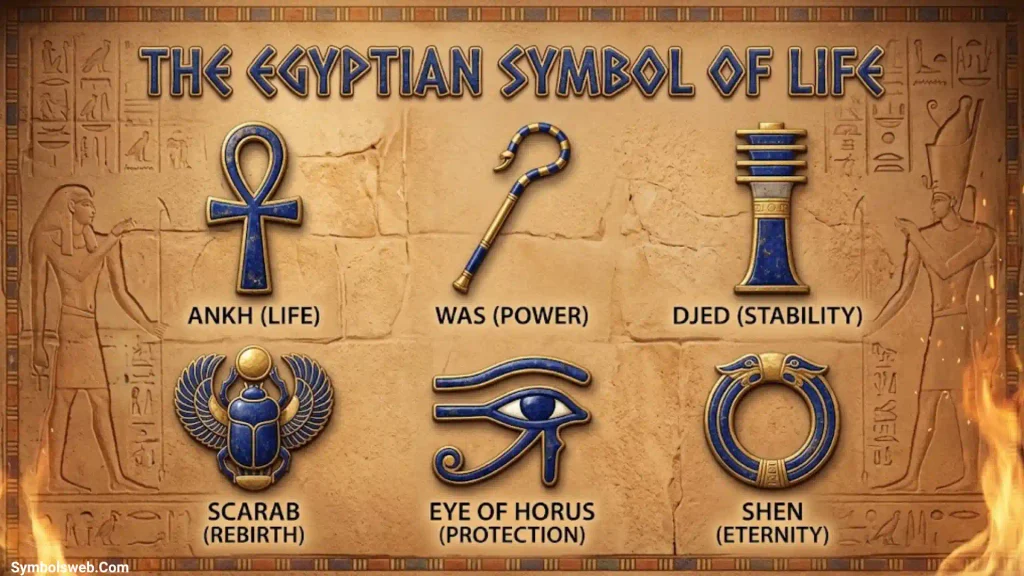
Main associations: life, vitality, and divine power
The ankh is one of the most recognizable ancient Egyptian symbols. It resembles a cross with a loop at the top, which has earned it the nickname “key of life.” Its ancient Egyptian meaning is straightforward: life.
Egyptian artists frequently depicted gods holding ankhs, sometimes offering them to a pharaoh. These scenes expressed the idea that life came from divine power. In some royal reliefs, gods bring the ankh close to the ruler’s face, symbolically granting or sustaining life.
The ankh also appeared on amulets, jewelry, temple reliefs, and funerary objects. Its association with life made it especially appropriate for religious settings where people sought divine favor or hoped for continued existence after death.
What the ankh represents
- Life and vitality: Its central and most direct meaning.
- Divine life: The life-giving power associated with the gods.
- Continued existence: Its use in funerary settings connected it with hopes for life beyond death.
- Religious devotion: Its presence in temples and sacred imagery expressed relationships between gods and worshippers.
The ankh remains popular in pendants, tattoos, and contemporary art. Modern wearers may interpret it as a symbol of spiritual awareness or eternal life, but those personal meanings should be distinguished from its documented ancient use.
Eye of Horus: Protection, Healing, and Restoration
The Eye of Horus, also called the wedjat eye, features a stylized eye with distinctive markings that combine human and falcon-like characteristics. Ancient Egyptians associated it with the myth of Horus, whose eye suffered injury during a conflict with Seth and was subsequently restored.
That restoration is central to the symbol’s meaning. The wedjat eye represented wholeness, healing, and protection rather than simply serving as an image of a god. Its ancient name refers to something made sound or whole again.
Archaeologists have discovered Eye of Horus amulets in ancient Egyptian contexts, including objects dating to the New Kingdom. People used these amulets in life and in funerary settings, seeking protection and renewal.
The symbol’s main associations include:
- Protection: Guarding the wearer against harm.
- Healing: Reflecting the restoration of Horus’s injured eye.
- Wholeness: Representing the return to a sound condition.
- Renewal: Connecting restoration with the hope of regeneration.
The Eye of Horus is often confused with the Eye of Ra. Although both belong to Egyptian religious imagery and can have protective associations, they are not simply two interchangeable names for the same symbol. The Eye of Horus is particularly tied to the myth of the injured and restored eye.
Scarab Beetle: Rebirth and Solar Renewal
The scarab beetle held an important place in ancient Egyptian religious symbolism. Its association with the sun came from the behavior of dung beetles, which roll balls of dung across the ground. Egyptians connected this action with the sun’s daily movement across the sky.
The scarab was especially associated with Khepri, a deity representing the rising sun and its emergence into the world. This connection made the beetle a powerful image of renewal, regeneration, and the repeated cycle of sunrise.
Scarab amulets also served practical purposes. Some had inscriptions on their flat undersides and functioned as seals, while others carried protective or religious imagery. The Metropolitan Museum of Art explains that scarab amulets could connect their wearers with ideas of life and regeneration.
- Seal scarabs: Small objects whose engraved undersides could leave impressions in clay.
- Protective scarabs: Amulets associated with well-being and regeneration.
- Heart scarabs: Funerary amulets connected with the deceased’s heart and judgment after death.
- Winged scarabs: Images combining the beetle with wings, often used in funerary art.
The scarab’s meaning wasn’t simply “good luck,” as modern descriptions sometimes suggest. Its deeper historical associations involved the sun, renewal, and protection in life and death.
Djed Pillar: Stability and Endurance
The djed pillar looks like a vertical column topped by several horizontal bars. Although scholars have proposed different explanations for its original shape, its association with stability and endurance is well established.
The symbol became closely connected with Osiris, the god associated with the dead, resurrection, and renewed life. Egyptian religious tradition eventually identified the djed with Osiris’s backbone. The ritual of raising a djed pillar expressed stability and resurrection.
The djed frequently appeared alongside the ankh and was, at times, combined with other beneficial signs. Djed-shaped amulets were used in funerary contexts, where their protective meaning complemented beliefs about the deceased’s continued existence.
Its principal associations include:
- Stability and endurance
- The cult of Osiris
- Resurrection and renewal
- Protection in life and after death
The djed offers a useful example of how an Egyptian symbol could represent an abstract idea while also becoming linked to a particular god.
Tyet Knot: The Symbol Associated With Isis
The tyet knot, often called the Isis knot, resembles a looped fabric knot with downward-projecting arms. It can look somewhat like an ankh, but the two symbols have different forms and religious associations.
The tyet was connected with Isis, a goddess known for her protective power and role in the Osiris myth. Tyet amulets appeared in funerary settings, where they were intended to provide protection for the deceased.
Its exact original form remains a subject of discussion, but its association with Isis and protective power is a key part of its historical significance.
The tyet is commonly associated with:
- Isis and her protective role
- Funerary amulets
- Protection for the deceased
- Religious ideas about renewal and continued existence
When identifying Egyptian motifs, don’t assume that every looped shape represents the ankh. The surrounding details and archaeological context can help distinguish related signs.
Shen Ring: Eternity and Protection
The shen ring is a circular rope motif, often depicted as a loop with a short extension or folded end. Its form suggests something encircled or enclosed.
The shen ring became associated with protection and eternity. Its circular shape conveyed the idea of a complete boundary without an obvious beginning or end. The symbol also played an important role in the development of the royal cartouche.
The shen ring and cartouche are related, but they aren’t identical. A cartouche is an elongated enclosure used to surround particular royal names. Its shape developed from the shen ring as royal names required more space.
The shen ring’s main associations include:
- Eternity and continuity
- Protective enclosure
- Royal symbolism
- The development of the cartouche
Was Scepter: Power and Authority
The war scepter is a long staff with an animal-like head at the top and a forked base. Egyptian gods frequently hold this staff in religious art, and it also appears in royal and ceremonial contexts.
The scepter represented power, authority, and control. Its presence in a deity’s hand communicated status and divine capability, while its appearance beside other symbols reinforced a broader message.
For example, the ankh, djed, and scepter could appear together. Their combination expressed related ideas of life, stability, and power. An artifact documented by the Global Egyptian Museum illustrates these three signs together.
The war scepter is therefore best understood as a symbol of authority within Egyptian religious imagery, rather than a generic sign of prosperity in every setting.
Feather of Ma’at: Truth, Justice, and Cosmic Order
The feather of Ma’at is one of the most important symbols in ancient Egyptian beliefs about justice and the afterlife. Ma’at was both a goddess and a principle of truth, balance, justice, and proper order.
Egyptian religious thought placed great importance on maintaining order against chaos. This principle applied to the universe, society, and the conduct of individuals. The feather provided a recognizable image of Ma’at’s authority.
Its most famous appearance comes from scenes depicting the weighing of the heart. In these scenes, the deceased person’s heart is weighed against Ma’at’s feather to determine whether the person has met the standards required to enter the blessed afterlife.
The feather represents:
- Truth and moral integrity
- Justice and fairness
- Balance and proper order
- The standards applied during judgment after death
This symbol illustrates how Egyptian religion connected everyday moral conduct with the larger structure of the universe.
Winged Sun Disk: Solar Power and Royal Protection
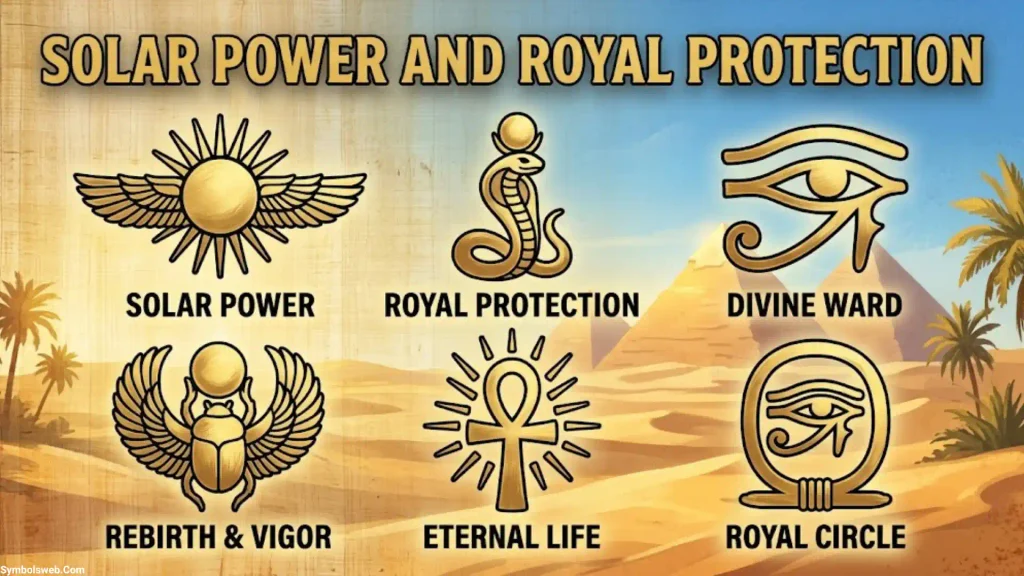
The winged sun disk features a central solar disk flanked by outstretched wings. Some versions also include cobra figures, adding further associations with royal and divine protection.
The sun held a central position in ancient Egyptian religion. Solar deities represented different aspects of the sun’s power, movement, and role in sustaining the world. The winged disk expressed this power through a recognizable combination of solar and protective imagery.
The motif often appears on temple entrances, lintels, and stone reliefs. Its placement above a doorway could establish a sacred or royal setting before a visitor entered the building.
The winged sun disk is commonly associated with:
- Solar divinity
- Royal protection
- Divine authority
- Religious imagery on temples and monuments
Its meaning depends on its context, so it shouldn’t automatically be interpreted as a universal symbol of protection against every form of evil.
Lotus Flower: Creation and Renewal
The lotus flower appears throughout ancient Egyptian art, including decorative scenes, religious imagery, and architectural designs. Its opening and closing with changing light made it a natural subject for associations with renewal.
In some Egyptian creation traditions, a lotus emerged from the primordial waters and was connected with the appearance of the sun. The flower therefore became associated with creation, emergence, and the renewal of life.
Lotus motifs also appeared on columns, vessels, and decorative objects. In some contexts, the flower was associated with Upper Egypt, while papyrus imagery was linked to Lower Egypt.
The lotus is commonly associated with:
- Creation and emergence
- Renewal and the recurring cycle of life
- Solar associations in particular religious traditions
- Floral decoration in Egyptian art
Its meaning was not limited to one religious idea. A lotus carved into a column might also function as a decorative element within a broader architectural program.
Papyrus Plant: Lower Egypt and the Nile
The papyrus plant grew in the wetland environment of the Nile and became an important part of Egyptian material culture. Egyptians used papyrus to make writing surfaces, among other purposes, while artists incorporated the plant into decorative and symbolic designs.
In royal and national imagery, papyrus was associated with Lower Egypt. The plant often appeared alongside the lotus in scenes that represented the union of the two regions.
Papyrus columns in Egyptian architecture could imitate the shape of the plant. This connection between natural forms and built structures allowed temples to incorporate imagery associated with the landscape.
The papyrus motif can therefore represent several related ideas:
- Lower Egypt
- The Nile’s wetlands and plant life
- National unity when paired with lotus imagery
- Architectural decoration inspired by nature
Not every papyrus image is a political emblem. Its meaning depends on whether it appears in a royal scene, a landscape, a temple column, or another setting.
Sema-Tawy: The Unification of Egypt
The Sema-Tawy motif is one of the clearest visual expressions of Egyptian political unity. It commonly shows the lotus and papyrus plants tied around a central element associated with binding together.
The plants represent Upper and Lower Egypt. Their union expresses the ideal that the pharaoh ruled the two regions as one kingdom.
This motif appeared in royal and religious settings, including thrones and monumental imagery. It connected the ruler’s authority with the stability of the unified state.
The Sema-Tawy is associated with:
- The union of Upper and Lower Egypt
- Royal authority
- National continuity
- Political unity expressed through religious imagery
The motif also demonstrates why plant symbols shouldn’t be interpreted in isolation. The lotus and papyrus have their own associations, but together in a binding scene they communicate a specific political idea.
Cartouche: The Pharaoh’s Name
A cartouche is an oval enclosure with a line at one end, surrounding certain royal names written in hieroglyphs. Its shape resembles an elongated rope loop.
The cartouche was used for particular names in the pharaoh’s royal titulary, especially the throne name and birth name. It wasn’t simply a frame around every important inscription.
The enclosure carried a protective association. By surrounding the royal name, it expressed the idea that the ruler’s identity was held within a protective boundary. The shape developed from the shen ring as longer royal names needed a stretched enclosure.
Cartouches appear on temple walls, statues, monuments, royal objects, and funerary equipment. They are also important to Egyptology because identifying royal names can help scholars establish the date and historical context of an artifact.
A cartouche is not itself a complete alphabet or a universal translation tool. Reading the name inside it requires knowledge of Egyptian hieroglyphic writing.
Uraeus Cobra: Royal and Divine Protection
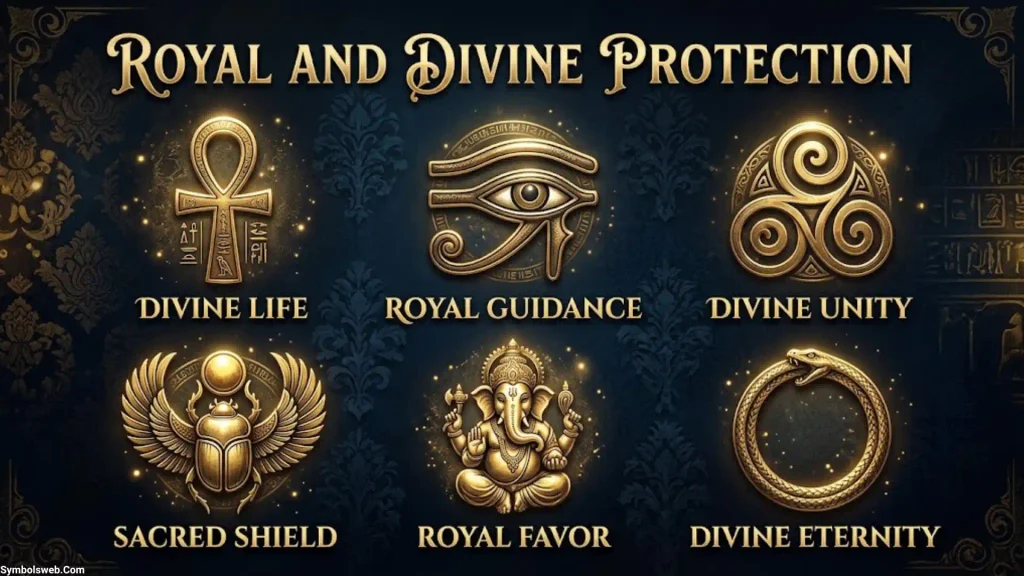
The uraeus is the upright cobra emblem commonly shown on the forehead of a pharaoh’s crown or headdress. It is closely associated with Wadjet, a goddess linked to Lower Egypt and royal protection.
The cobra’s raised posture makes it visually distinct. In royal imagery, the uraeus communicated the ruler’s connection with divine power and the protection surrounding kingship.
The uraeus appears in royal statues, reliefs, crowns, and funerary objects. It can also be found on royal masks, including the famous funerary mask of Tutankhamun.
Its main associations include:
- Royal authority
- Divine protection of the ruler
- Wadjet and Lower Egypt
- The pharaoh’s sacred status
The uraeus should not be confused with every serpent image in Egyptian art. Serpents could represent different deities and ideas depending on their form and setting.
Vulture Emblem: Nekhbet and Royal Protection
The vulture emblem is associated with Nekhbet, a protective goddess connected with Upper Egypt. In royal imagery, she could appear alongside Wadjet, whose cobra represented Lower Egypt.
Together, the vulture and cobra expressed the king’s relationship with both regions. Their appearance on royal headgear and other objects communicated the protection of the two lands under one ruler.
This combination has a particular historical and political meaning. It isn’t simply a pair of animals chosen for their general symbolism.
The vulture emblem is associated with:
- Nekhbet
- Upper Egypt
- Royal protection
- The unity of the two regions through paired emblems
Egyptian Crowns: Kingship and National Unity
Ancient Egyptian crowns were powerful visual markers of royal identity. They helped distinguish the pharaoh from other figures and communicated the territory and authority associated with kingship.
The main royal crowns include the White Crown, Red Crown, and Double Crown. Other royal headgear, such as the nemes headdress, served different visual and ceremonial purposes.
White Crown (Hedjet)
The White Crown, known as the hedjet, is associated with Upper Egypt. It has a tall, elongated shape that narrows toward the top.
Its appearance as a ruler indicated royal authority over Upper Egypt. In artistic scenes, the crown helped identify the king’s role and the political territory associated with the image.
Red Crown (Deshret)
The Red Crown, or deshret, is associated with Lower Egypt. It features a distinctive raised structure and a projecting element at the front.
Like the White Crown, it represented a political region as well as the pharaoh’s authority. Its appearance in reliefs and royal objects made the relationship between the ruler and Lower Egypt visually clear.
Double Crown (Pschent)
The Double Crown, commonly called the pschent, combines the White Crown and Red Crown. It represents the pharaoh’s rule over a united Egypt.
The crown expressed more than personal power. It communicated the ideal of one ruler governing Upper and Lower Egypt together.
Nemes Headdress
The nemes headdress is a striped cloth headdress associated with pharaohs. It falls down the sides of the head and shoulders and is often depicted with a uraeus at the forehead.
Unlike the White, Red, and Double Crowns, the nemes is a royal headdress rather than a direct combination of the two regional crowns. It is widely recognized from royal statues and Tutankhamun’s funerary mask.
Egyptian Symbols of Gods and Mythology
Ancient Egyptian religion included many gods and goddesses, each with distinctive attributes, stories, and visual forms. Artists used animal heads, crowns, staffs, and other objects to identify these deities. Understanding those attributes makes Egyptian mythology symbols easier to recognize.
Horus: Falcon and Royal Kingship
Horus was a major sky deity associated with falcon imagery and kingship. Egyptian artists often depicted him as a falcon or as a human figure with a falcon’s head.
Horus is especially important because of his connection with the pharaoh. Egyptian royal ideology associated the living king with Horus, linking political rule with divine authority.
His best-known symbol is the Eye of Horus, which represents the restored eye from his mythological conflict with Seth. The falcon itself also appears in royal imagery and religious scenes.
Osiris: Death, Resurrection, and the Afterlife
Osiris was closely associated with the afterlife, resurrection, and renewed life. Egyptian art often depicts him as a wrapped, mummiform figure wearing a crown and holding royal objects.
His myth describes his death and restoration through the actions of Isis and other divine figures. This story helped shape Egyptian beliefs about death and the possibility of continued existence beyond it.
The djed pillar became associated with Osiris and symbolized stability and endurance. Its connection with the god also linked the symbol to resurrection and the renewal of life.
Isis: Motherhood and Protection
Isis was an important goddess associated with protection, motherhood, and magical power. She played a central role in the story of Osiris and the birth and protection of Horus.
Artists commonly depicted Isis wearing a throne-shaped headdress. In other images, she wears a headdress resembling a pair of horns surrounding a solar disk.
The tyet knot is closely associated with Isis and her protective role. Her imagery also appears on amulets and funerary objects, where her divine protection could be invoked for the deceased.
Anubis: Embalming and Funerary Rites
Anubis is usually depicted as a black jackal or as a human figure with a jackal’s head. He was associated with embalming, burial practices, and the protection of the dead.
His role in funerary imagery includes overseeing the weighing of the heart. In these scenes, Anubis attends to the scales while other gods participate in the judgment.
Anubis’s animal form connects him visually with the desert edges where Egyptians buried their dead. However, his meaning comes from his religious role, not merely from the animal’s appearance.
Thoth: Wisdom and Writing
Thoth was associated with writing, knowledge, calculation, and the recording of important events. Artists frequently depicted him with the head of an ibis, although he could also appear in baboon form.
In scenes of the judgment of the dead, Thoth records the result of the heart’s weighing. His role connects writing with the preservation of truth and the proper ordering of events.
Thoth’s imagery helps explain why scribes and written records held such importance in Egyptian society. Writing was not merely a practical tool. In religious contexts, it could preserve names, prayers, royal achievements, and sacred knowledge.
Khepri and Ra: The Sun and Renewal
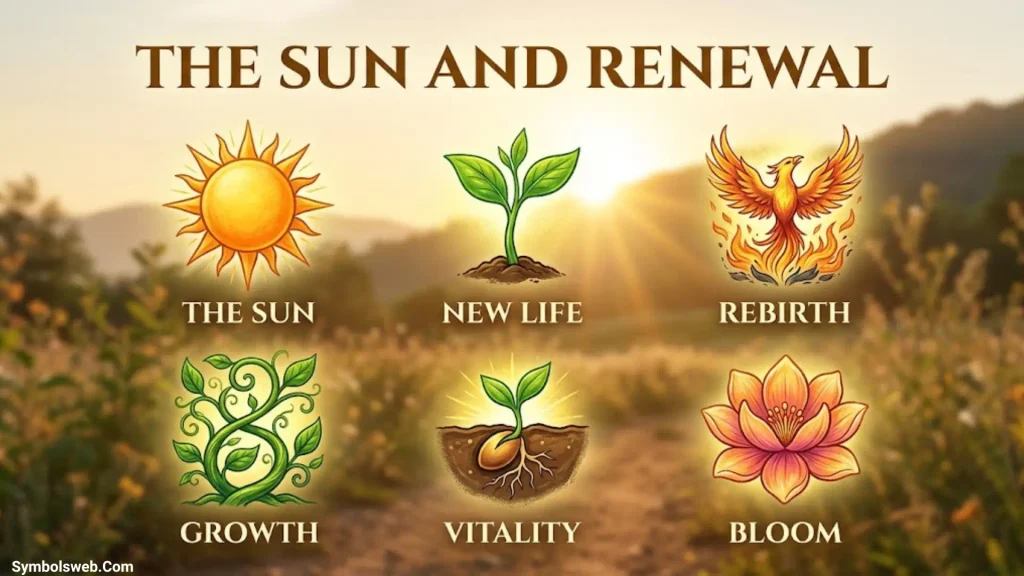
Khepri was associated with the rising sun and the emergence of new life. Artists often represented him as a scarab beetle or as a human figure with a scarab for a head.
Ra, by contrast, was a major solar deity associated with the sun’s power and daily journey. Egyptian solar religion included several deities and overlapping forms, so Khepri and Ra should not be treated as identical in every context.
The scarab’s connection with Khepri explains why beetle-shaped amulets became associated with renewal and rebirth. It also shows how natural observations influenced ancient Egyptian religious imagery.
Ma’at: Truth, Justice, and Order
Ma’at represented truth, justice, balance, and cosmic order. She was both a goddess and a central principle of Egyptian religious and political thought.
Artists often identified her through an ostrich feather. In the judgment of the dead, the feather served as the standard against which the deceased person’s heart was weighed.
Ma’at’s importance extended beyond the afterlife. Egyptian kings were expected to maintain order and justice, making the concept relevant to royal rule and the stability of society.
Wadjet and Nekhbet: The Two Protective Goddesses
Wadjet was associated with Lower Egypt and represented by the cobra emblem known as the uraeus. Nekhbet was associated with Upper Egypt and represented through vulture imagery.
Both goddesses protected the king and the kingdom. Their paired appearance on royal objects and headgear communicated the ruler’s relationship with the two regions of Egypt.
These emblems are especially useful when interpreting crowns and royal portraits. Rather than serving as generic animal decorations, they identify specific divine and political associations.
Bastet: The Cat Goddess
Bastet was a goddess associated with protection, domestic life, and other aspects of well-being. Egyptian artists commonly depicted her as a cat or as a woman with a cat’s head.
Cats held a prominent place in Egyptian domestic life and religious imagery. However, not every ancient Egyptian cat image represented Bastet, and feline symbolism could vary across settings.
Bastet’s recognizable form remains popular in modern jewelry, statues, and decorative art. Her historical significance, however, extends beyond the simplified modern idea of a cat goddess.
Egyptian Animal Symbols and Their Meanings
Animals appear frequently in ancient Egyptian religious imagery. Their forms helped identify deities, express divine qualities, and connect religious beliefs with the natural world.
| Animal or form | Main historical association |
| Falcon | Horus, the sky, and kingship |
| Cobra | Wadjet, royal protection, and the uraeus |
| Cat | Bastet and feline religious imagery |
| Jackal | Anubis and funerary practices |
| Scarab beetle | Khepri, the rising sun, and renewal |
| Vulture | Nekhbet and Upper Egyptian royal protection |
| Ibis | Thoth, writing, and knowledge |
| Baboon | One of the forms associated with Thoth |
One important point: an animal’s symbolic meaning depended on its context. A cobra on a royal crown has a different role from a serpent in a myth about a dangerous force. Similarly, a falcon representing Horus is not automatically a general symbol of freedom or success.
This distinction helps separate historically grounded Egyptian symbolism from modern interpretations that apply broad meanings to every animal.
Egyptian Symbols in Death and the Afterlife
Ancient Egyptians devoted considerable effort to burial customs and preparations for life after death. They placed amulets, decorated coffins, funerary texts, and other objects in tombs to protect the deceased and support the journey into the afterlife.
These objects were not simply decorative. Their forms, inscriptions, and placement could carry specific religious functions.
Canopic Jars and the Four Sons of Horus
Canopic jars were funerary containers used to hold organs removed during mummification. They were traditionally made in sets of four and associated with the Four Sons of Horus.
The organs commonly associated with the four protective deities were:
| Deity | Commonly associated organ |
| Imsety | Liver |
| Hapy | Lungs |
| Duamutef | Stomach |
| Qebehsenuef | Intestines |
The deities were often represented through human or animal-headed forms. Their protective roles helped connect the physical preservation of the body with the deceased’s continued existence after death.
Canopic jar practices changed over time. In some periods, the organs were placed in jars; in others, burial arrangements differed. The four-deity association remained an important part of funerary tradition.
Weighing of the Heart Ceremony
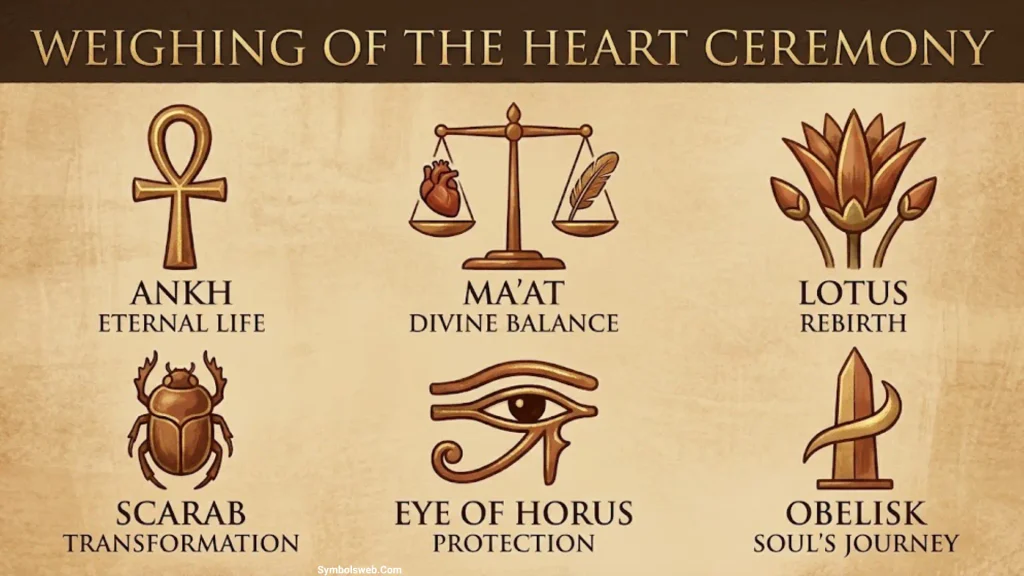
The Weighing of the Heart was a central scene in Egyptian funerary belief. It depicted the deceased person’s heart being weighed against the feather of Ma’at.
Anubis was associated with the scales, while Thoth recorded the result. Osiris presided over the judgment, and Ammit, a fearsome composite creature, threatened to consume the heart if the deceased failed the test.
The scene expressed a fundamental idea: a person’s moral condition mattered in the journey toward the afterlife.
Its main elements included:
- The heart: Associated with the person’s inner character and moral record.
- The feather of Ma’at: The standard of truth and proper order.
- Anubis: The deity associated with the weighing process.
- Thoth: The divine recorder of the result.
- Osiris: The ruler associated with the afterlife and judgment.
- Ammit: The creature that consumed the heart of someone who failed the judgment.
This scene is a good example of Egyptian symbols working together. No single image tells the entire story. The meaning emerges from the relationships between the figures, objects, and actions.
The Ankh, Djed, and Tyet in Funerary Objects
The ankh, djed, and tyet frequently appear in discussions of Egyptian funerary symbolism because each had protective or life-related associations.
The ankh represented life. The djed expressed stability and was connected with Osiris, while the tyet was associated with Isis and protection. Their appearance on amulets and burial objects helped connect the deceased with the powers these symbols represented.
Egyptian funerary practices also included written spells and specific instructions for protecting the dead. The modern term Book of the Dead refers to a collection of funerary texts that helped the deceased navigate the underworld and seek a successful afterlife. It was not one single book with an identical set of chapters in every tomb.
Heart Scarabs
A heart scarab was a funerary amulet placed over the heart of a mummy. It could carry an inscription intended to protect the deceased during the judgment of the dead.
Its beetle form linked it with scarab symbolism, while its placement gave it a specific role in funerary practice. The heart was central to the judgment scene, so protecting it had particular significance.
Heart scarabs show why the same basic symbol could take on a more specific function when used in a particular ritual setting.
Shabti Figures and Other Funerary Objects
Shabti figures were small statuettes placed in tombs to perform work on behalf of the deceased in the afterlife. They were often inscribed with spells that described their intended function.
Unlike the ankh or djed, a shabti is a funerary figure rather than an abstract sign. It still belongs in a discussion of Egyptian religious objects because its purpose depended on beliefs about the afterlife and the obligations the deceased might face.
Other funerary objects included coffins, protective amulets, ritual vessels, and inscribed stelae. Their meanings often depended on the text or image accompanying them.
Egyptian Hieroglyphs and Symbolic Writing
Egyptian hieroglyphs are among the most recognizable features of ancient Egyptian civilization. They combine signs that look like people, animals, plants, and everyday objects. However, hieroglyphs were much more than decorative pictures.
The writing system developed around 3000 BCE and served religious, administrative, historical, and literary purposes. Scribes used it on temple walls, monuments, tombs, and papyrus documents. Egyptians also developed cursive scripts, including hieratic, for writing more efficiently with ink and brush.
Phonograms, Logograms, and Determinatives
Hieroglyphs performed different functions depending on how scribes used them.
- Phonograms: Signs that represent one or more sounds, usually consonants.
- Logograms: Signs that represent a complete word or concept.
- Determinatives: Signs placed after words to help clarify their meaning without necessarily representing a sound.
A single sign could serve different functions in different contexts. Readers therefore need to consider the entire inscription rather than translate each picture independently.
How to Read Egyptian Hieroglyphs
Hieroglyphic inscriptions can run horizontally or vertically. Their reading direction depends on the arrangement of the signs.
One useful clue is the direction human and animal figures face. In many inscriptions, readers begin on the side toward which these figures face. The signs may also be arranged in groups to create balanced visual compositions.
This is why reading hieroglyphs requires more than recognizing individual pictures. Their sounds, grammatical roles, and surrounding signs all matter.
Royal Names and Hieroglyphic Inscriptions
Royal inscriptions often identify pharaohs, describe religious offerings, or record victories and building projects. A cartouche helps identify certain royal names by enclosing them within an oval border.
Other inscriptions identify gods, explain scenes, or preserve prayers and funerary texts. When studying an Egyptian artifact, the inscription and the image should be examined together whenever possible.
Egyptian Symbols in Art, Temples, and Artifacts
Ancient Egyptian artists used symbols across a wide range of objects and buildings. Their imagery communicated religious ideas, royal identity, and beliefs about life and death.
Symbols on Temple Walls and Reliefs
Temple walls frequently show pharaohs making offerings to gods. These scenes may include ankhs, staffs, crowns, solar disks, and hieroglyphic inscriptions.
The arrangement matters. A god holding an ankh communicates something different from a pharaoh wearing a crown or a winged disk carved above an entrance.
Symbols on Tomb Walls and Coffins
Tomb paintings and coffin decorations often focus on protection, funerary rituals, and the afterlife. Images of Anubis, Osiris, protective deities, and scenes from funerary texts helped establish the religious meaning of a burial space.
These decorations were part of a larger ritual system. They shouldn’t be treated simply as ancient artwork chosen for visual appeal.
Symbols on Royal Statues and Masks
Royal statues and funerary masks combine symbols of kingship with images of divine protection. Tutankhamun’s famous funerary mask, for example, displays royal headgear with a cobra and vulture emblem.
The British Museum’s collection records also document the nemes headdress and upraised cobra as elements of Egyptian royal regalia.
Symbols on Amulets and Seals
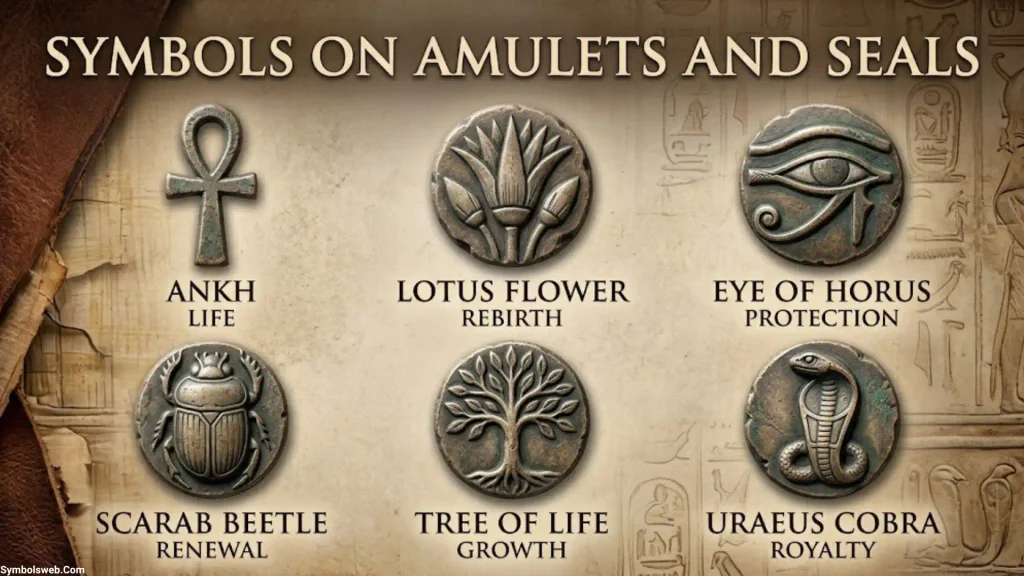
Small objects offer especially useful evidence of how Egyptians combined different signs. The Metropolitan Museum of Art documents a Middle Kingdom scarab bearing the Eye of Horus, an ankh, a djed pillar, and a sign associated with goodness and beauty.
These symbols were deliberately combined to convey positive and protective meanings.
Egyptian Symbols of Life, Protection, Rebirth, and Unity
People often search for an Egyptian symbol representing a particular idea. The table below provides a practical guide, while recognizing that historical meanings overlap.
| Desired meaning | Relevant Egyptian symbol | Historical context |
| Life | Ankh | Hieroglyphic sign and religious imagery |
| Protection | Eye of Horus | Amulets and funerary objects |
| Rebirth | Scarab | Solar religion and funerary traditions |
| Stability | Djed pillar | Osiris-related imagery |
| Divine protection | Tyet knot | Isis and funerary amulets |
| Eternity | Shen ring | Protective enclosure and royal imagery |
| Kingship | Uraeus | Royal crowns and headdresses |
| Royal identity | Cartouche | Enclosed royal names |
| Truth and justice | Feather of Ma’at | Judgment of the dead |
| National unity | Sema-Tawy | Union of Upper and Lower Egypt |
Symbols Associated With Life
The ankh is the clearest choice when discussing the historical Egyptian symbol for life. It appears in the hands of gods and in scenes where divine figures grant life to rulers.
Symbols Associated With Protection
The Eye of Horus, tyet knot, uraeus, and many amulets have protective associations. Their specific purposes varied according to their religious context and use.
Symbols Associated With Rebirth and Renewal
The scarab is closely connected with Khepri and the rising sun. The djed pillar and certain lotus motifs also connect with renewal through their religious associations.
Symbols Associated With Kingship
The cartouche, royal crowns, uraeus, and falcon imagery all help communicate kingship. However, they perform different roles: one encloses a name, another identifies a region or united kingdom, and another expresses divine protection.
Symbols Associated With Eternity and Stability
The shen ring expresses protective enclosure and eternity, while the djed pillar represents stability and endurance. These related themes made both symbols appropriate for royal and funerary contexts.
Symbols Associated With Unity
The Sema-Tawy motif provides the clearest visual expression of the union of Upper and Lower Egypt. The Double Crown and paired protective goddesses reinforce related ideas of unified rule.
Egyptian Symbols in Modern Culture, Tattoos, and Jewelry
Ancient Egyptian imagery remains popular in contemporary jewelry, tattoos, fashion, and decorative art. However, a modern interpretation doesn’t always match the symbol’s original historical meaning.
Ankh Jewelry and Tattoos
The ankh frequently appears in necklaces, bracelets, and tattoos. Modern wearers may choose it to express life, continuity, spirituality, or a personal connection with Egyptian history.
Its historical association with life makes it one of the clearest examples of an ancient symbol that remains recognizable today.
Eye of Horus Jewelry and Tattoos
The Eye of Horus is popular in pendants, rings, and tattoos because of its association with protection and restoration. Those themes have a genuine historical basis in ancient Egyptian amulet traditions.
However, claims that wearing the symbol guarantees safety or produces supernatural effects aren’t established historical facts.
Scarab Jewelry and Tattoos
Scarab pendants and tattoos often represent renewal, transformation, or a fresh start. These modern interpretations draw on the scarab’s historical connection with Khepri and the rising sun.
Ancient scarabs also served as seals and protective objects, making them more complex than decorative beetle designs alone.
Cartouche Jewelry
A cartouche can enclose a personal name rendered using Egyptian hieroglyphic conventions. These pendants are popular souvenirs and personalized gifts.
If you want your name represented accurately, consult a specialist or a reliable Egyptological resource. Egyptian hieroglyphs don’t map perfectly onto the modern English alphabet, and a decorative transliteration may not produce a historically authentic spelling.
Using Egyptian Symbols Respectfully
When using Egyptian symbols in modern designs, take time to understand their origins. Many motifs have religious or funerary significance, even when modern products present them as ordinary decorations.
A little research helps you distinguish documented historical meanings from contemporary spiritual interpretations or commercial claims.
Where to See Ancient Egyptian Symbols Today
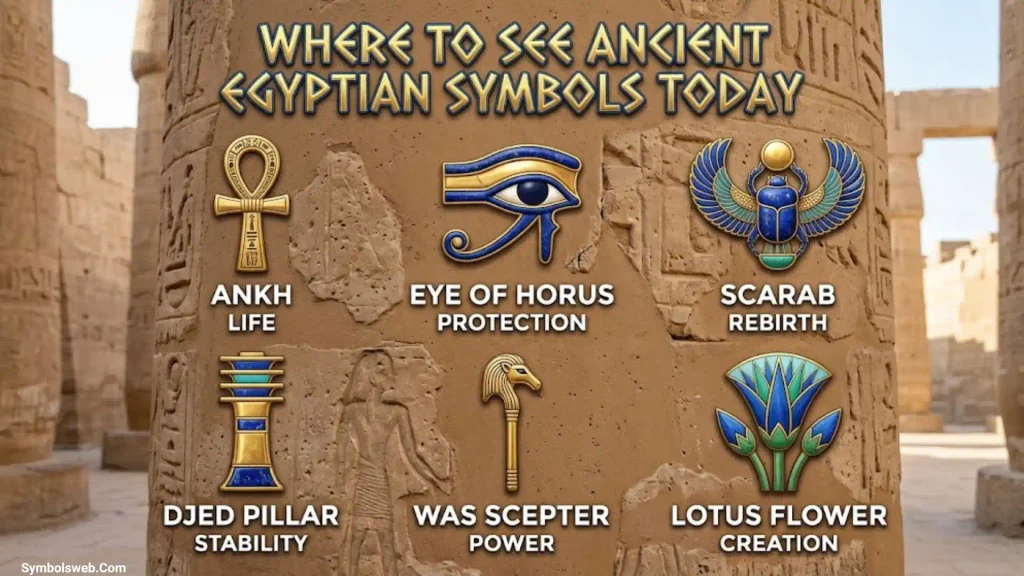
Museums and archaeological sites provide opportunities to examine Egyptian symbols in their original settings. Seeing a symbol on a real object can reveal details that simplified illustrations often miss.
- Karnak Temple: Explore monumental reliefs, royal inscriptions, and religious imagery.
- Luxor Temple: Look for pharaonic reliefs, divine figures, and royal symbolism.
- Valley of the Kings: Examine tomb paintings, funerary texts, and scenes associated with the afterlife.
- Abu Simbel: Study monumental images of Ramesses II and the relationship between royal authority and religion.
- Museum collections: Look for scarabs, amulets, canopic jars, royal objects, and inscribed artifacts.
For reliable examples, browse the British Museum’s collection and the Metropolitan Museum of Art’s Egyptian art collection. Object records can help you identify an artifact’s date, material, historical setting, and documented meaning.
Frequently Asked Questions About Egyptian Symbols
What is the most famous Egyptian symbol?
The ankh is one of the most widely recognized Egyptian symbols. Its looped cross shape represents life and frequently appears in ancient Egyptian religious art, royal imagery, and amulets.
What Egyptian symbol represents life?
The ankh is the clearest answer. Its ancient Egyptian meaning is life, and gods often hold it in scenes depicting divine power or the granting of life.
What is the difference between the Eye of Horus and the Eye of Ra?
The Eye of Horus is associated with Horus’s injured and restored eye, making it a symbol of wholeness, healing, and protection. The Eye of Ra belongs to a different set of solar myths and can represent the sun god’s power, including destructive and protective aspects. Their traditions sometimes overlap, but the names aren’t interchangeable.
Which Egyptian symbols represent protection?
The Eye of Horus, tyet knot, uraeus, and various protective amulets have historical associations with protection. The specific purpose of each symbol depends on its religious and historical context.
Which Egyptian symbols represent rebirth?
The scarab is strongly associated with rebirth through its connection with Khepri and the rising sun. The djed pillar is associated with Osiris and resurrection, while lotus imagery can express creation and renewal.
What do the White Crown, Red Crown, and Double Crown mean?
The White Crown represents Upper Egypt, and the Red Crown represents Lower Egypt. The Double Crown combines both to express the pharaoh’s rule over the united kingdom.
Are Egyptian hieroglyphs symbols or letters?
They’re a writing system containing several kinds of signs. Some represent sounds, others represent words, and determinatives help clarify meaning. Calling every hieroglyph a letter misses the complexity of the script.
Are Egyptian symbols still used today?
Yes. Ancient Egyptian motifs appear in jewelry, tattoos, decorative art, museum displays, and popular culture. Their modern meanings may differ from their original religious, political, or funerary associations.
Conclusion
Egyptian symbols reveal how ancient Egyptians understood life, death, religion, political authority, and the natural world. The ankh expressed life, the Eye of Horus represented restoration and protection, and the scarab connected the rising sun with renewal. Other signs, including the djed pillar, cartouche, royal crowns, and Sema-Tawy, communicated stability, royal identity, and national unity.
The most important lesson is that context matters. A symbol carved into a temple, placed on a mummy, or worn on a royal crown may carry different layers of meaning. By studying the object, inscription, historical period, and associated deity, you can move beyond simple definitions and gain a deeper understanding of ancient Egyptian culture.

Jordan Hayes is a writer with a passion for exploring the history, meanings, and cultural significance behind symbols from around the world. He enjoys turning complex topics into clear, engaging content that anyone can understand. Jordan is also the fictional author of The Silent Language of Ancient Marks and Hidden Symbols Beyond the Surface, two original book concepts created for his author profile. When he’s not writing, he spends time researching myths, traditions, and forgotten stories that inspire his work. His goal is to help readers discover the deeper meanings behind the symbols they encounter every day.
 Eliana Foster
 Ethan Holloway