Symbols of Demeter reveal one of the most powerful stories in ancient mythology. These sacred images connect humanity to the cycles of nature, the mystery of life and death, and the deep emotional bond between mother and child. For thousands of years, people have looked to Demeter’s symbols for guidance, fertility, abundance, and hope.
Behind every stalk of wheat, torch, and cornucopia lies a fascinating story about survival, renewal, and the forces that sustain civilization. Understanding these symbols helps us explore not only ancient Greek beliefs but also timeless aspects of human psychology and spirituality.
Quick Answer
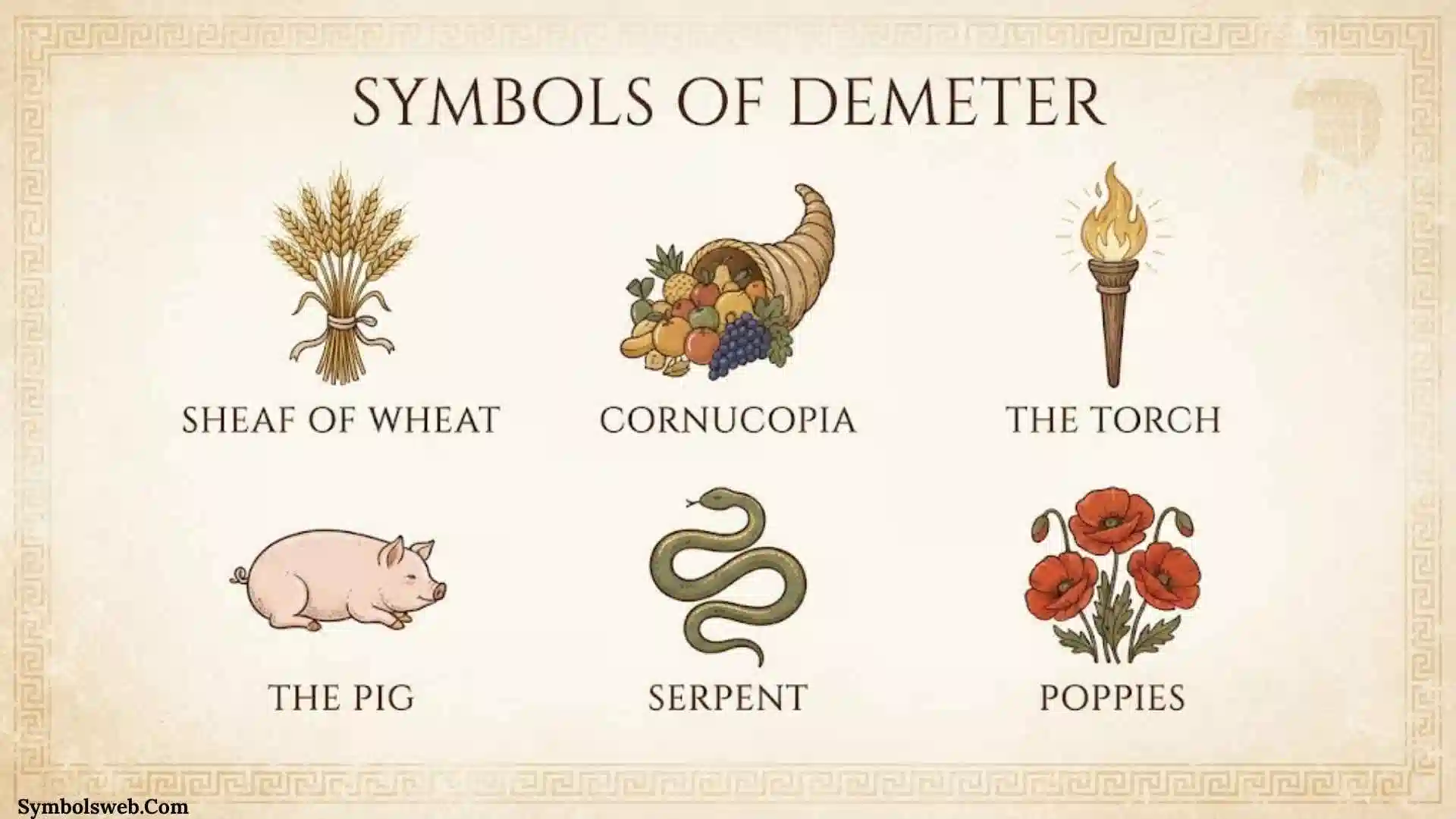
The symbols of Demeter are sacred objects and natural elements associated with Demeter, the Greek goddess of agriculture, harvest, fertility, and motherhood. Her most recognized symbols include wheat, grain, the cornucopia, torches, poppies, pigs, and the earth’s fertile soil. Together, these symbols represent abundance, nourishment, life cycles, maternal love, and seasonal renewal.
Quick Facts About Symbols of Demeter
| Aspect | Information |
| Origin | Ancient Greek mythology |
| Historical Significance | Represented agriculture, harvest, fertility, and civilization |
| Main Meaning | Abundance, nourishment, growth, and motherhood |
| Spiritual Meaning | Renewal, transformation, and life’s natural cycles |
| Cultural Importance | Central to Greek religious festivals and agricultural traditions |
| Modern Usage | Art, literature, tattoos, spirituality, gardening, and symbolism |
What Are Symbols of Demeter?
Symbols of Demeter are visual representations connected to Demeter, one of the most revered deities in ancient Greece.
As the goddess of agriculture, grain, fertility, and sacred law, Demeter played a vital role in Greek society. Ancient people depended on successful harvests for survival. As a result, her symbols became powerful reminders of prosperity and divine protection.
The origins of these symbols date back more than 2,500 years. They appeared in temples, pottery, coins, religious ceremonies, and agricultural festivals throughout the Greek world.
Demeter’s importance grew through her famous myth involving her daughter Persephone. According to Greek mythology, Persephone was taken to the underworld by Hades. Demeter’s grief caused crops to fail and winter to spread across the earth. When Persephone returned, life blossomed again.
This story transformed Demeter’s symbols into representations of seasonal change, rebirth, and hope.
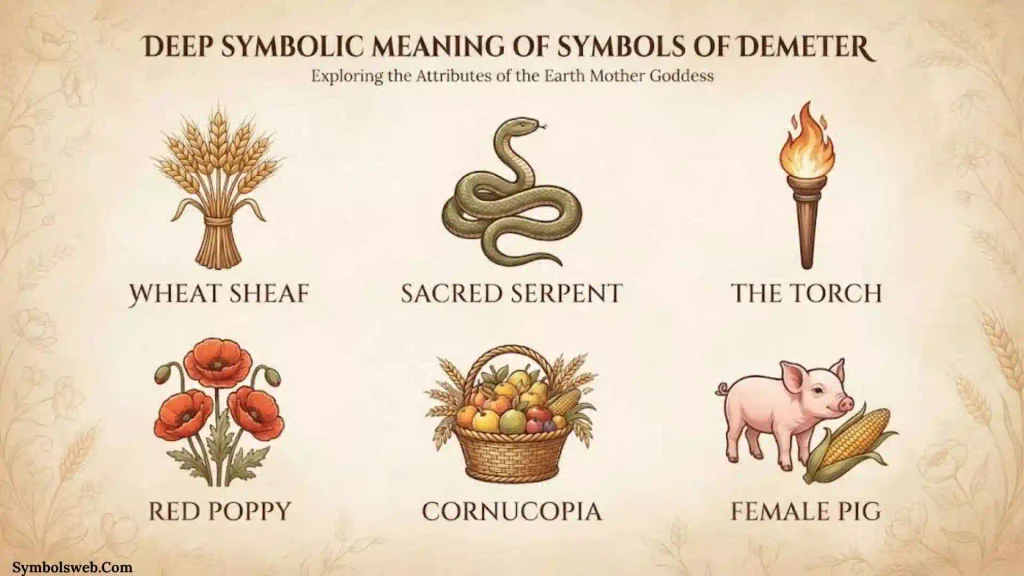
Deep Symbolic Meaning of Symbols of Demeter
Spiritual Level
On a spiritual level, Demeter’s symbols represent the sacred rhythm of existence.
The cycle of planting, growth, harvest, and dormancy mirrors the journey of the human soul. Just as seeds disappear beneath the earth before emerging again, spiritual growth often requires periods of darkness before renewal.
Many spiritual traditions see Demeter’s wheat and grain as symbols of:
- Divine nourishment
- Personal transformation
- Faith in unseen growth
- Life after hardship
- Sacred connection with nature
Her torches symbolize spiritual illumination and the search for truth.
Psychological Level
From a psychological perspective, Demeter embodies the nurturing archetype.
Swiss psychologist Carl Jung described archetypes as universal patterns within the collective unconscious. Demeter closely aligns with the Great Mother archetype.
Psychologically, her symbols represent:
- Caregiving
- Emotional security
- Protection
- Unconditional love
- Emotional resilience
The myth of Persephone also reflects separation anxiety, grief, and emotional recovery. This emotional depth explains why Demeter’s symbols continue to resonate today.
Cultural Level
For ancient Greeks, Demeter’s symbols represented survival itself.
A successful harvest meant food, prosperity, and social stability. Crop failure often meant famine and hardship.
Her symbols became cultural reminders of:
- Community cooperation
- Respect for nature
- Family bonds
- Agricultural knowledge
- Human dependence on the earth
These meanings remain relevant in modern discussions about sustainability and environmental responsibility.
Types and Variations of Symbols of Demeter
Wheat
Visual Description: Golden stalks of wheat.
Meaning: Fertility, abundance, nourishment.
Symbolism: Wheat is Demeter’s most famous symbol because grain sustained ancient civilizations.
Cultural Connection: Used in temples, festivals, and sacred rituals.
Where It Appears: Mythology, artwork, agricultural traditions, dreams.
Grain Sheaf
Visual Description: Bundles of harvested grain tied together.
Meaning: Prosperity and successful harvest.
Symbolism: The rewards of hard work and patience.
Cultural Connection: Celebrated during harvest festivals.
Where It Appears: Ancient sculptures, coins, and ceremonial offerings.
Torch
Visual Description: A burning torch carried by the goddess.
Meaning: Search, hope, and enlightenment.
Symbolism: Represents Demeter’s search for Persephone.
Cultural Connection: Used during religious processions.
Where It Appears: Mythology, literature, spiritual imagery.
Cornucopia
Visual Description: A horn overflowing with fruits and vegetables.
Meaning: Endless abundance.
Symbolism: Nature’s generosity.
Cultural Connection: Adopted widely throughout Greek and Roman culture.
Where It Appears: Art, decorations, harvest celebrations.
Poppy
Visual Description: Bright red flowering plant.
Meaning: Rest, healing, and renewal.
Symbolism: Connected with fertility and agricultural cycles.
Cultural Connection: Frequently associated with Demeter in ancient artwork.
Where It Appears: Religious art, mythology, dream symbolism.
Pig
Visual Description: Sacred farm animal.
Meaning: Fertility and agricultural prosperity.
Symbolism: Renewal of life and earth’s productivity.
Cultural Connection: Used in certain ancient rites dedicated to Demeter.
Where It Appears: Religious ceremonies and archaeological findings.
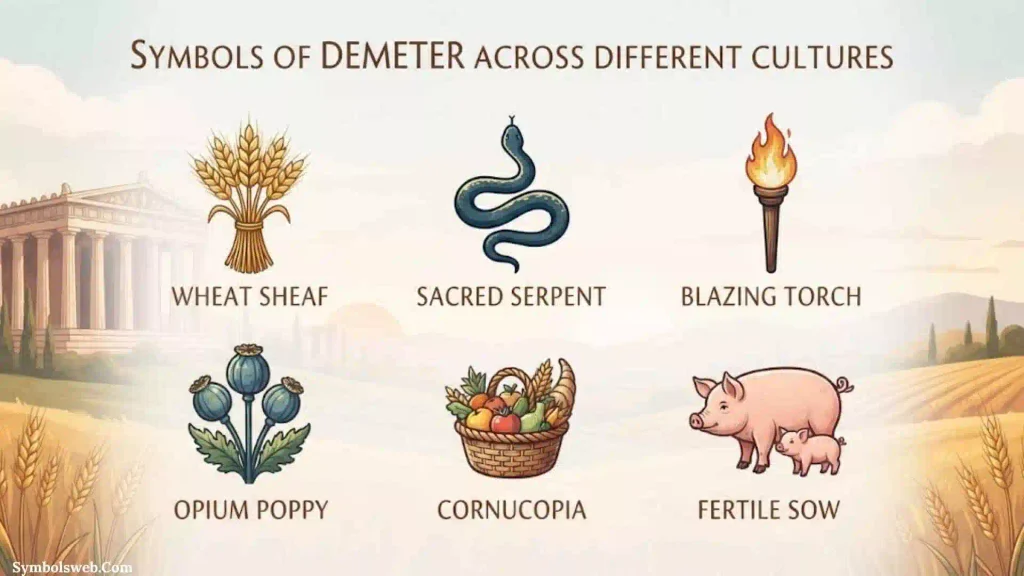
Symbols of Demeter Across Different Cultures
Ancient Egypt
Although Demeter herself was Greek, Egyptian agricultural deities shared similar symbolism.
Grain, fertile soil, and seasonal renewal were associated with divine forces that sustained life along the Nile.
Ancient Greece
Here, Demeter’s symbols held their deepest meaning.
Wheat fields, harvest celebrations, and fertility rituals honored her role as provider and protector.
The famous Eleusinian Mysteries, among the most important religious ceremonies in Greece, centered on Demeter and Persephone.
Roman Culture
The Romans identified Demeter with the goddess Ceres.
Many symbols remained unchanged, including grain, fertility, and harvest imagery.
The word “cereal” ultimately derives from Ceres, highlighting her lasting influence.
Eastern Traditions
Many Eastern traditions associate rice, lotus flowers, and fertile earth with themes similar to Demeter’s symbols.
The concepts of nourishment, abundance, and cyclical renewal appear across cultures.
Indigenous Traditions
Numerous Indigenous cultures honor corn, maize, and agricultural spirits through symbols resembling Demeter’s themes.
These traditions emphasize gratitude, stewardship, and respect for nature.
Modern Interpretations
Today, Demeter’s symbols often represent:
- Sustainable living
- Environmental awareness
- Motherhood
- Personal growth
- Feminine strength
- Emotional nurturing
Similar Symbols and Their Meanings
| Symbol | Similarity to Demeter | Key Difference |
| Cornucopia | Represents abundance | Broader prosperity symbol |
| Tree of Life | Growth and fertility | Focuses on universal interconnectedness |
| Lotus Flower | Renewal and transformation | More associated with spiritual awakening |
| Corn Symbol | Agricultural fertility | Commonly linked to Indigenous traditions |
| Earth Mother Symbol | Nurturing energy | Found across many cultures |
Common Misconceptions
One common misunderstanding is that all harvest symbols belong exclusively to Demeter.
In reality, many cultures developed similar agricultural symbols independently because farming was essential to human survival.
Symbols of Demeter in Mythology and Folklore
The most famous myth involving Demeter centers on Persephone.
When Hades abducted Persephone, Demeter wandered the earth carrying torches and searching for her daughter. During her grief, crops failed and famine spread.
Eventually, a compromise allowed Persephone to spend part of each year with her mother and part in the underworld.
This myth explains the changing seasons.
The symbols associated with the story became powerful representations of:
- Loss and reunion
- Death and rebirth
- Hope after suffering
- Nature’s cycles
These themes influenced countless folktales and seasonal traditions throughout Europe.
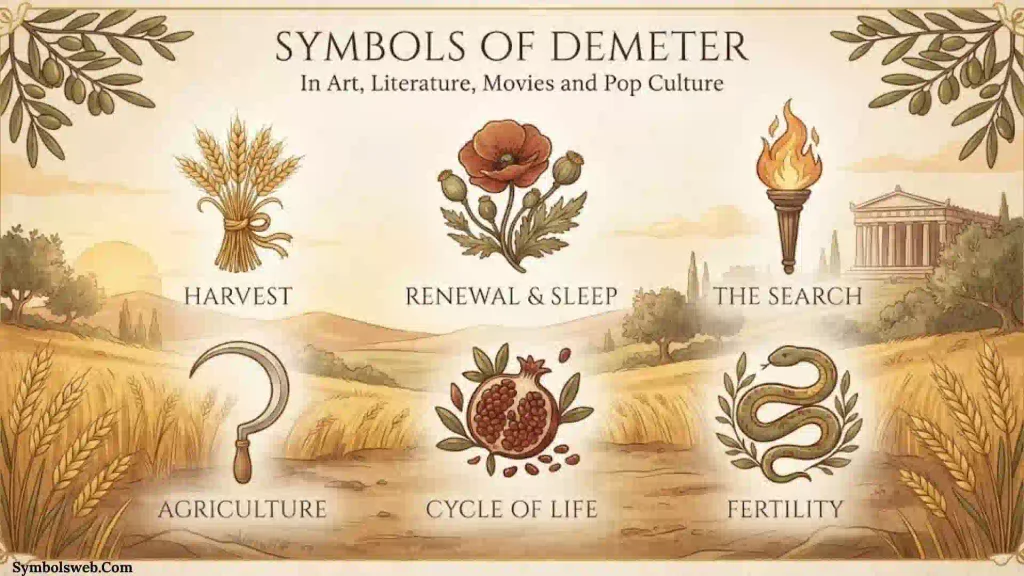
Symbols of Demeter in Art, Literature, Movies and Pop Culture
Paintings
Classical and Renaissance artists frequently depicted Demeter holding wheat, torches, or a cornucopia.
These visual cues immediately communicated her identity and role.
Literature
Ancient poets such as Homer referenced Demeter in hymns celebrating fertility and harvest.
Modern authors continue using her symbolism to explore themes of motherhood and renewal.
Poetry
Poets often use wheat fields and harvest imagery inspired by Demeter to symbolize life’s cycles.
Movies and Television
Modern adaptations of Greek mythology frequently feature Demeter as a powerful maternal figure whose symbols reinforce themes of family and nature.
Tattoos
Popular Demeter-inspired tattoo designs include:
- Wheat stalks
- Poppies
- Cornucopias
- Torches
- Images of Demeter herself
These tattoos often symbolize resilience, growth, and nurturing energy.
Fashion and Design
Harvest motifs, floral patterns, and grain imagery frequently draw inspiration from Demeter’s symbolism.
Spiritual and Dream Meaning of Symbols of Demeter
Dreams involving Demeter’s symbols often carry meaningful messages.
Wheat in Dreams
May symbolize:
- Upcoming success
- Personal growth
- Financial abundance
- Reward for effort
Torches in Dreams
Often represent:
- Seeking answers
- Guidance
- Spiritual awakening
- Discovery
Poppies in Dreams
Can indicate:
- Healing
- Rest
- Recovery
- Emotional peace
Cornucopia in Dreams
Usually suggests:
- Blessings
- Opportunities
- Gratitude
- Prosperity
Positive Messages
- Renewal is coming.
- Growth is occurring beneath the surface.
- Patience will bring rewards.
- Emotional healing is possible.
Cautionary Messages
- Neglected responsibilities.
- Emotional burnout.
- Disconnection from nature.
- Fear of loss or change.
Positive and Negative Meanings of Symbols of Demeter
| Positive Meaning | Negative Meaning |
| Abundance | Scarcity fears |
| Motherhood | Overprotection |
| Fertility | Dependency |
| Nourishment | Possessiveness |
| Growth | Resistance to change |
| Renewal | Fear of loss |
| Stability | Attachment |
| Compassion | Emotional exhaustion |
Like many powerful symbols, Demeter’s imagery contains both light and shadow aspects.
Why Humans Are Attracted to Symbols of Demeter
Humans are naturally drawn to Demeter’s symbols because they connect to universal experiences.
Everyone depends on nourishment. Everyone experiences change. Everyone understands the need for care and protection.
Psychologists suggest these symbols resonate because they activate ancient survival instincts.
A field of grain signals safety.
A cornucopia suggests abundance.
A nurturing mother figure evokes emotional security.
Collectively, these images tap into cultural memory shaped by thousands of years of agricultural life.
Even in modern cities, people still respond emotionally to symbols of growth, harvest, and renewal.
Modern Uses of Symbols of Demeter
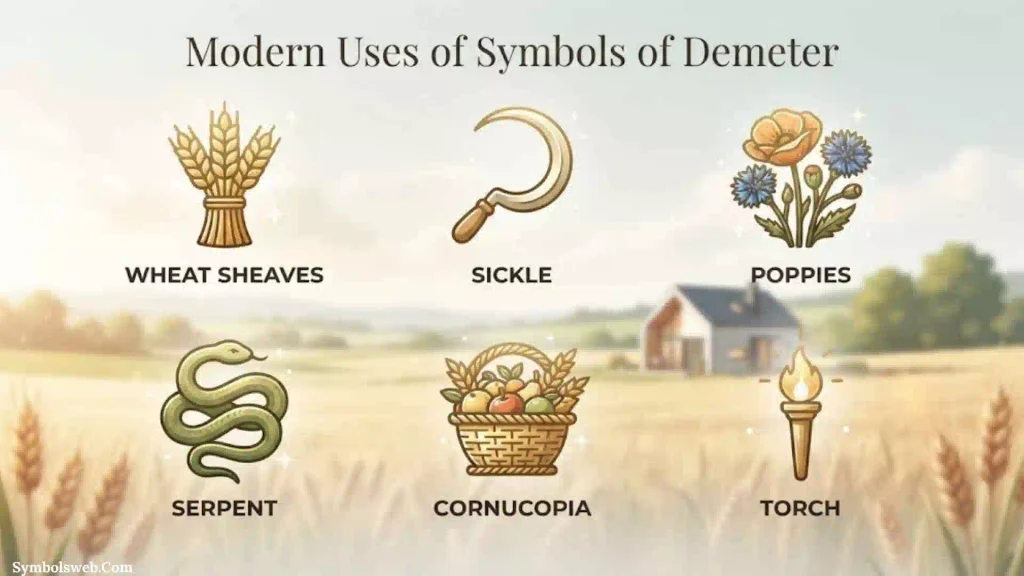
Tattoos
Chosen to represent:
- Motherhood
- Personal growth
- Resilience
- Fertility
Jewelry
Wheat and harvest-inspired jewelry symbolizes prosperity and abundance.
Fashion
Designers often use grain, floral, and harvest motifs inspired by Demeter.
Branding
Organic food companies frequently use imagery connected to fertility and harvest.
Social Media
Many wellness and sustainability communities embrace Demeter-inspired symbolism.
Contemporary Spirituality
Modern practitioners often view Demeter as a symbol of nurturing energy and connection with nature.
Home Decor
Harvest-themed decorations continue to reflect Demeter’s ancient associations with abundance.
Interesting Facts About Symbols of Demeter
- Wheat is the most recognizable symbol of Demeter.
- Demeter’s Roman equivalent is Ceres.
- The word “cereal” comes from Ceres.
- Torches symbolize Demeter’s search for Persephone.
- Pigs were sacred animals in some Demeter rituals.
- The Eleusinian Mysteries honored Demeter for nearly 2,000 years.
- Ancient Greeks credited Demeter with teaching agriculture to humanity.
- The cornucopia became one of the most enduring symbols of abundance in Western culture.
- Demeter was one of the most widely worshipped Greek goddesses.
- Her mythology helped explain the changing seasons.
Frequently Asked Questions
What is the most important symbol of Demeter?
Wheat is considered the most important symbol of Demeter because it represents agriculture, fertility, nourishment, and the harvest that sustained ancient civilizations.
Why does Demeter carry torches?
Demeter carries torches because she used them while searching for her daughter Persephone after her abduction by Hades.
What animal is associated with Demeter?
The pig is most commonly associated with Demeter and symbolizes fertility, agricultural abundance, and renewal.
What does the cornucopia mean in Demeter symbolism?
The cornucopia represents abundance, prosperity, nourishment, and the generous gifts of nature.
Are Demeter’s symbols still relevant today?
Yes. Demeter’s symbols continue to represent motherhood, sustainability, personal growth, fertility, environmental awareness, and emotional nurturing.
What is the spiritual meaning of Demeter’s symbols?
Spiritually, Demeter’s symbols represent renewal, transformation, abundance, divine nourishment, and trust in life’s natural cycles.
Conclusion
The symbols of Demeter are far more than ancient images from Greek mythology. They tell a timeless story about growth, loss, renewal, and the deep connection between humanity and nature. From golden wheat fields to guiding torches, each symbol carries layers of spiritual, psychological, and cultural meaning.
Their enduring power reminds us that life moves in cycles, that nourishment comes in many forms, and that even after periods of darkness, renewal is always possible. That message remains as meaningful today as it was in ancient Greece.

Eliana Foster is a writer with a passion for exploring the meanings behind symbols, traditions, and cultural history. She enjoys breaking down complex topics into simple, engaging articles that are easy for everyone to understand. Eliana is also the fictional author of The Hidden Language of Silent Marks and Beyond the Circle of Ancient Signs, two original book concepts created for her author profile. When she’s not writing, she loves visiting museums, reading about mythology, and researching the stories behind symbols from around the world. Her goal is to help readers discover the fascinating meanings hidden in everyday signs and ancient emblems.
 Jordan Hayes
 Ethan Holloway