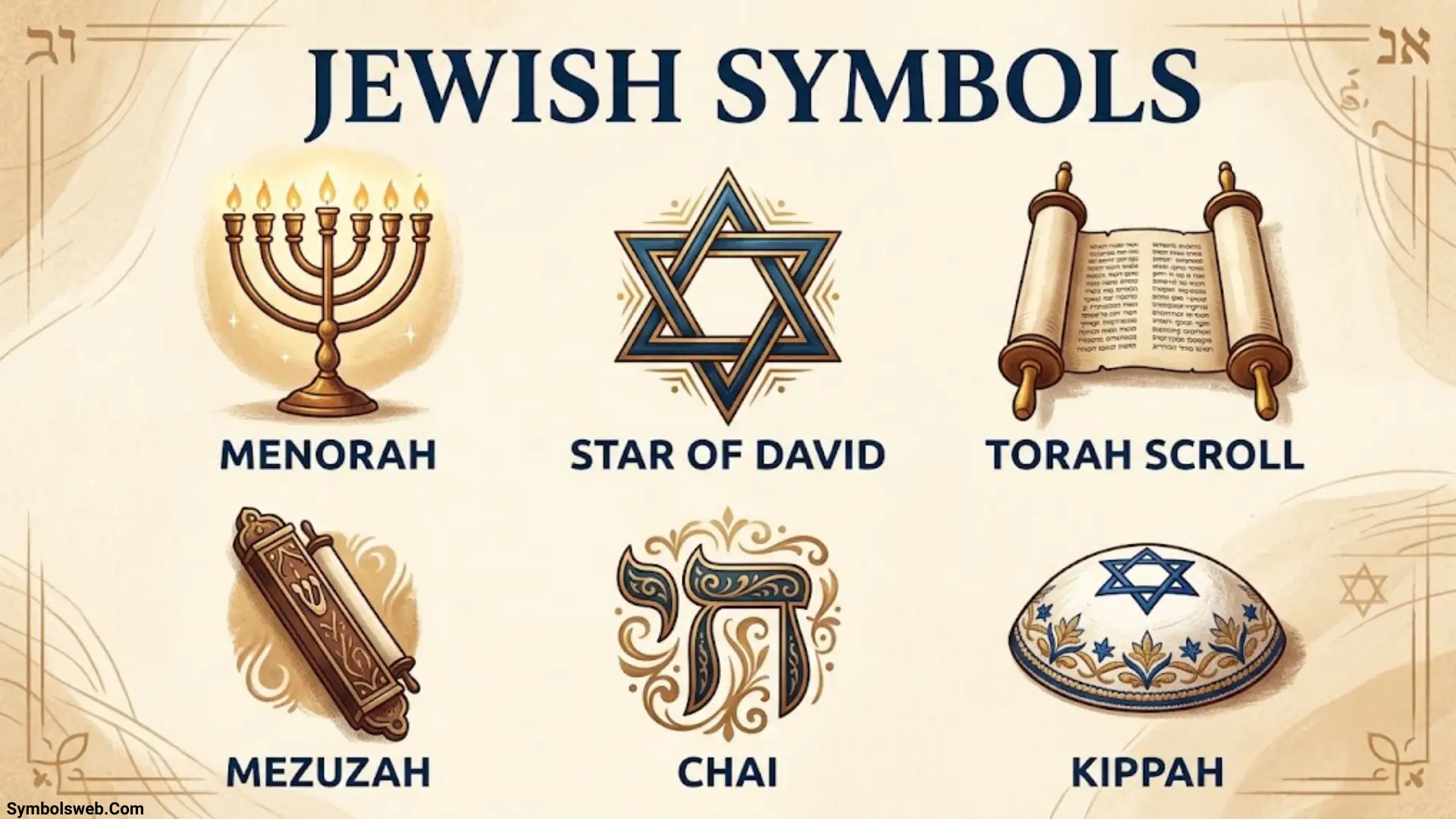
Jewish symbols reflect the faith, history, traditions, and cultural identity of the Jewish people. From the familiar Star of David to the ancient Menorah, these symbols connect generations through religious practices, sacred texts, family customs, and shared historical experiences. Some appear in the Torah, while others became important through centuries of Jewish life.
Understanding Jewish symbols and meanings also requires looking beyond their appearance. A mezuzah on a doorway serves a different purpose from a Star of David necklace, and the seven-branched menorah has a different history from the Hanukkah lamp. Each object, image, or Hebrew expression carries its own context.
This guide explores the most recognizable Jewish religious symbols, biblical images, ceremonial objects, holiday traditions, and cultural emblems. You’ll learn what these symbols mean, where they originated, and how Jewish communities use them today.
What Are Jewish Symbols?
Jewish symbols are images, objects, Hebrew letters, and traditional designs associated with Judaism, Jewish history, and Jewish cultural identity. They can express religious beliefs, recall biblical events, mark sacred occasions, or connect people with their heritage.
Some symbols have a direct foundation in the Torah, the central text of Judaism. Others developed through rabbinic teachings, historical events, Jewish art, and customs passed between generations.
Jewish symbols generally fall into several categories:
- Religious symbols: Images and objects connected to Jewish worship, sacred texts, and religious beliefs.
- Biblical symbols: Objects or images described in the Hebrew Bible, including the menorah and the tablets of the Law.
- Ritual objects: Items used in prayer and observances, such as tefillin, a tallit, and a shofar.
- Cultural symbols: Designs associated with Jewish identity, including the Star of David and Chai.
- Historical and national symbols: Emblems and places connected to Jewish history and the modern State of Israel.
- Folk and mystical symbols: Objects such as the Hamsa, which some Jewish communities associate with protection.
Not every Jewish symbol has one universally accepted meaning. Jewish communities differ in their customs and interpretations, and a symbol used in one setting may have a different significance in another.
Most Important Jewish Symbols and Their Meanings
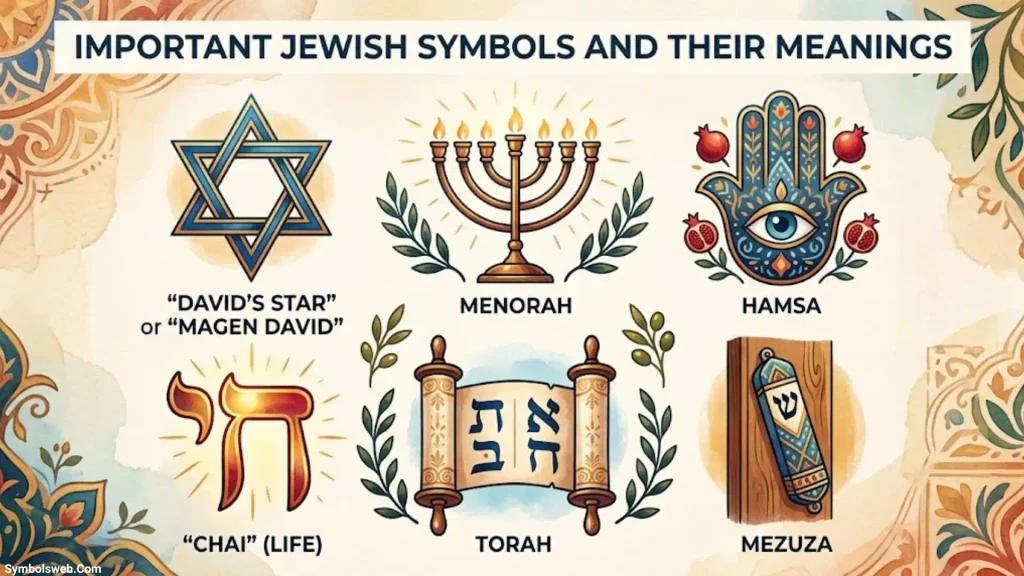
The following symbols are among the best-known expressions of Jewish faith, heritage, and identity.
Star of David (Magen David)
The Star of David, called Magen David in Hebrew, is a six-pointed star formed by two overlapping triangles. Its Hebrew name means “Shield of David.” Today, it is one of the most widely recognized symbols of Judaism and Jewish identity.
Despite its modern prominence, the star did not begin as Judaism’s principal religious emblem. The geometric design appeared in different cultures, and its early history as an exclusively Jewish symbol remains uncertain. By the 17th century, the hexagram appeared on some synagogues and was used to identify Jewish communities. The Zionist movement adopted it as an emblem in the late 19th century, and it later became part of Israel’s national flag. My Jewish Learning explains its historical development.
Today, the Star of David appears on jewelry, synagogue buildings, gravestones, religious artwork, and community organizations. Its meaning often centers on Jewish identity, heritage, solidarity, and continuity. It also carries painful historical associations because the Nazis forced Jews in occupied Europe to wear identifying badges bearing a yellow Star of David.
Although many modern interpretations assign spiritual meanings to the star’s six points or two triangles, these explanations are not universally accepted historical facts.
Menorah
The menorah is a seven-branched candelabrum described in the Torah and associated with the ancient Tabernacle and the Temples in Jerusalem. It is one of the oldest and most significant Jewish religious symbols.
According to Exodus 25:31–40, the original menorah was made of gold and had a central shaft with three branches extending from each side. It stood in the sanctuary as part of Israelite worship.
The menorah became an enduring emblem of Jewish religious history. Its image appears in ancient Jewish art and on the Arch of Titus in Rome, which depicts Roman soldiers carrying objects taken from Jerusalem after the destruction of the Second Temple in 70 CE.
Light is an important theme in Jewish religious imagery, often associated with Torah, wisdom, and divine guidance. The menorah also appears on Israel’s state emblem, reflecting the connection between ancient Jewish history and modern national identity.
Important distinction: The seven-branched Temple menorah is different from the nine-branched Hanukkiah, which Jews light during Hanukkah.
Chai Symbol
The Chai symbol consists of two Hebrew letters, chet (ח) and yod (י), which together form chai (חי), meaning “life.”
Life holds an important place in Jewish thought and practice. Jewish law includes the principle of preserving human life, commonly associated with pikuach nefesh, which allows many religious commandments to be set aside to save a life.
The Chai symbol appears on necklaces, bracelets, artwork, gifts, and charitable donations. Jewish people may wear it as an expression of faith, cultural pride, or a personal connection to Jewish heritage.
The Hebrew letters also have numerical values. Chet represents eight, and yod represents ten, giving Chai a combined value of 18. This explains why some Jewish people give money in multiples of 18 as a symbolic expression of life and blessing.
Hamsa Hand
The Hamsa is a hand-shaped symbol found in Jewish communities and several other Middle Eastern and North African cultural traditions. Its name is associated with the number five in Arabic, referring to the five fingers.
Some Jewish people use the Hamsa as an amulet associated with protection, blessings, and defense against the evil eye, known in Hebrew as ayin hara. Hamsa designs may include an eye, Hebrew lettering, fish, or other decorative elements.
The symbol has a long and complex cultural history. It is not exclusive to Judaism, nor does every Jewish person believe it offers supernatural protection. Its meaning depends on the community, family tradition, and individual using it.
For this reason, the Hamsa is best understood as a shared cultural and folk symbol rather than a universal requirement of Jewish religious practice.
Tree of Life (Etz Chaim)
The Tree of Life, or Etz Chaim in Hebrew, is an important image in Jewish texts and religious art. The phrase appears in biblical passages, including Proverbs 3:18, which describes wisdom as a tree of life to those who hold fast to it.
In Jewish tradition, the image can represent wisdom, growth, spiritual nourishment, and the sustaining value of Torah. It also appears in Jewish mystical teachings, where the Tree of Life has more specific associations with the structure of divine attributes.
The symbol’s meaning varies by context. A tree depicted in a synagogue, a family artwork, and a Kabbalistic diagram may communicate different ideas.
Lion of Judah
The Lion of Judah connects to the biblical league of Judah. In Genesis 49:9, Jacob compares Judah to a lion when blessing his sons.
The lion subsequently became associated with strength, courage, leadership, and the historical identity of Judah. Because Jewish tradition connects King David’s family line to Judah, the lion also appears in some representations of royal and messianic themes.
Today, lions feature in Jewish ceremonial art, synagogue decorations, and designs associated with Jerusalem and Israel. The symbol is especially common in artistic depictions of biblical heritage.
Shofar
The shofar is a horn, usually made from a ram’s horn, that produces a distinctive sound when blown. Its use is rooted in the Hebrew Bible and remains central to important Jewish observances.
The shofar is especially associated with Rosh Hashanah, the Jewish New Year. Its blasts invite reflection, repentance, and spiritual renewal. The sound also recalls biblical accounts of divine revelation and other significant events.
In traditional Jewish practice, the shofar is sounded during Rosh Hashanah services. It is also blown at the conclusion of Yom Kippur in many communities, and it has other ceremonial uses in Jewish history.
The shofar does more than mark a date on the calendar. Its powerful sound calls listeners to examine their actions and consider their responsibilities. My Jewish Learning explores traditional interpretations of the shofar.
Pomegranate (Rimon)
The pomegranate, called rimon in Hebrew, appears in biblical descriptions of priestly garments and has a long history in Jewish decorative art.
Pomegranates were embroidered onto the hem of the High Priest’s robe, alongside small golden bells, according to Exodus 28:33–34. The fruit also appears in descriptions of the land’s abundance and in later Jewish artwork.
Its many seeds have inspired associations with fertility, abundance, and the richness of Jewish religious life. A popular traditional interpretation connects the seeds with the 613 mitzvot, the commandments traditionally counted in the Torah. This is a symbolic association, not a claim that every pomegranate contains exactly 613 seeds.
Pomegranate designs remain common in Judaica, Torah ornaments, holiday decorations, and jewelry.
Biblical Jewish Symbols and Their Meanings
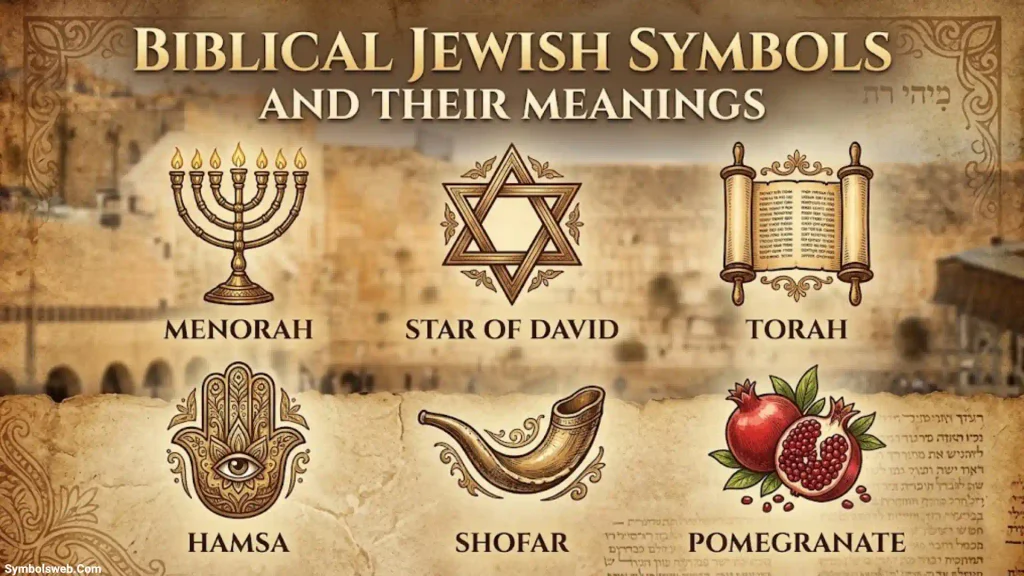
Many biblical Jewish symbols come from stories, commandments, and objects described in the Torah. Some continue to play a direct role in Jewish religious life, while others are mainly remembered through historical accounts and artistic representations.
Tablets of the Law
The Tablets of the Law represent the commandments given to Moses at Mount Sinai. Exodus 31:18 describes the tablets as part of the covenant between God and the Israelites.
They are often depicted as two stone tablets bearing the Ten Commandments. In Jewish contexts, they can represent divine instruction, moral responsibility, and the covenant between God and the Jewish people.
The familiar rounded-top design is common in modern religious art, although artistic conventions have changed across different periods. The tablets are not objects used in ordinary Jewish prayer today; rather, they serve as a visual reminder of the commandments and their importance.
Aaron’s Breastplate (Choshen)
The Choshen, or High Priest’s breastplate, is described in Exodus 28. According to the biblical account, it contained twelve precious stones arranged in four rows, with each stone associated with one of the twelve league of Israel.
The breastplate formed part of the High Priest’s ceremonial garments. It connected priestly service with the people of Israel and held a specific role in the biblical description of sacred worship.
Today, the breastplate appears in illustrations of the Tabernacle, Jewish educational materials, and religious artwork. It is primarily a historical and biblical symbol rather than a ritual object used by contemporary Jewish worshippers.
Olive Branch
The olive branch is widely associated with peace and renewed hope. Its familiar connection to the biblical story of Noah appears in Genesis 8:11, when a dove returns to Noah with a freshly plucked olive leaf.
In the original narrative, the leaf signals that the floodwaters have receded and vegetation has returned. The broader association with peace developed through later cultural interpretation.
Olive branches also have practical and historical connections to the Mediterranean region, including the land of Israel. However, the olive branch is not an exclusively Jewish symbol; it appears in many cultures and traditions.
Grape Cluster
The grape cluster recalls the story in Numbers 13:23, when Israelite scouts return from exploring Canaan carrying a large cluster of grapes.
The fruit demonstrates the agricultural richness of the land. As a result, grape imagery can represent abundance, fertility, and the biblical connection between the Israelites and the Promised Land.
Grapes and grapevines also appear in Jewish decorative art and are associated with wine used in blessings and ceremonial meals. Their significance depends on whether the image refers to the biblical land, agricultural life, or a specific ritual.
Ark of the Covenant
The Ark of the Covenant was a sacred chest described in the Torah. It held the tablets of the covenant according to biblical tradition and occupied a central place in the Tabernacle.
The Ark represented the covenant between God and Israel and was associated with the sacred center of Israelite worship. Biblical accounts describe its role during the Israelites’ journey and in the religious life of ancient Israel.
It is important to distinguish the biblical Ark of the Covenant from the Aron Kodesh, the Torah ark in a modern synagogue. The latter is a cabinet that houses Torah scrolls; it is not the original biblical chest.
The Seven-Branched Menorah in the Torah
The seven-branched menorah is described in Exodus 25:31–40, which gives instructions for making the sanctuary’s golden lampstand. It later became associated with the Temple in Jerusalem.
Because the menorah has a direct biblical description and a long history in Jewish art, it is a particularly important link between ancient Jewish worship and modern Jewish identity.
Its presence in contemporary Israel’s state emblem also shows how a religious and historical image can become a national symbol without losing its connection to Jewish tradition.
Jewish Religious Objects and Ritual Symbols
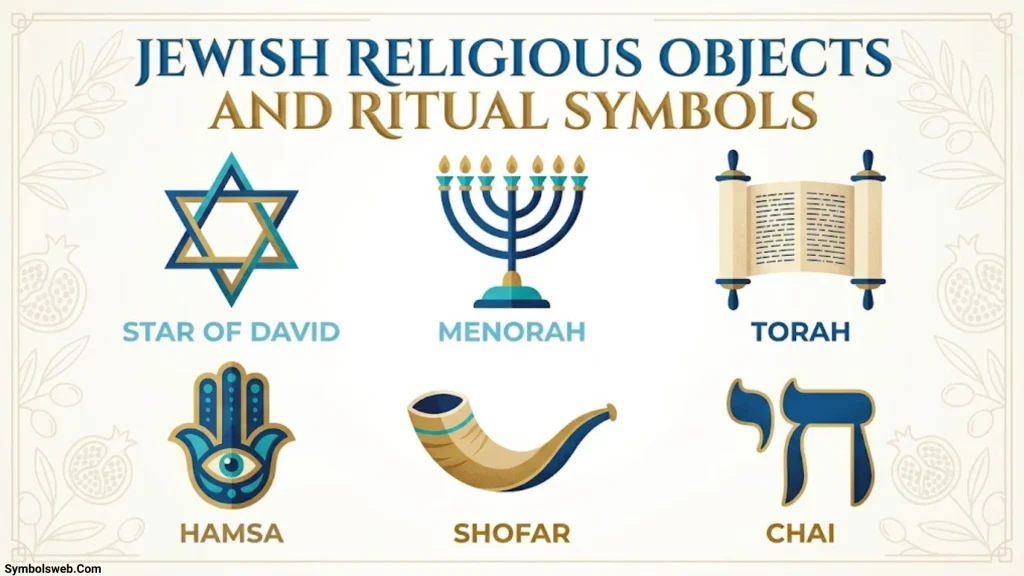
Many Jewish religious symbols are objects used in prayer, at home, or during communal worship. Their importance comes from the commandments and customs they help people observe.
Torah Scroll
The Torah scroll contains the Five Books of Moses: Genesis, Exodus, Leviticus, Numbers, and Deuteronomy. These books form the foundation of Jewish religious teaching and law.
A traditional Sefer Torah is handwritten in Hebrew on parchment by a trained scribe called a sofer. Producing one requires careful attention to established writing rules. Synagogues use Torah scrolls for public readings during Shabbat, festivals, and other services.
The Torah scroll represents sacred teaching, religious learning, and the transmission of Jewish tradition across generations. Its ceremonial coverings, crowns, and ornaments may also carry artistic and cultural significance.
Mezuzah
A mezuzah is a small case attached to the doorpost of a Jewish home or another qualifying doorway. Inside it, a parchment contains passages from Deuteronomy 6:4–9 and 11:13–21.
These passages include the Shema, the declaration beginning, “Hear, O Israel: the Lord is our God, the Lord is one.” They also instruct the Israelites to keep God’s words close and write them on their doorposts.
The mezuzah therefore connects a physical doorway with the remembrance of Jewish commandments. The case may be plain, ornate, or decorated with Hebrew letters. However, the sacred parchment inside is what gives the mezuzah its religious function.
The plural Hebrew form is mezuzot. Although people sometimes call the decorative case a mezuzah, the term properly refers to the parchment and, by common usage, the complete doorpost object.
Tefillin (Phylacteries)
Tefillin, also called phylacteries, are small black leather boxes containing parchment passages from the Torah. During traditional weekday morning prayers, observant Jews bind one box to the arm and another to the head using leather straps.
The practice follows biblical instructions in passages such as Deuteronomy 6:8, which commands the Israelites to bind God’s words as a sign on their hands and between their eyes.
Tefillin connect prayer with the mind, actions, and daily responsibilities of religious life. They are not ordinarily worn on Shabbat or major Jewish festivals in traditional practice.
Tallit and Tzitzit
A tallit is a Jewish prayer shawl with special fringes called tzitzit attached to its corners. The fringes come from the commandment in Numbers 15:37–41, which instructs the Israelites to wear them as a reminder of God’s commandments.
A tallit is commonly worn during morning prayers, although customs differ among Jewish communities. Some people also wear a smaller four-cornered garment with tzitzit beneath their clothing throughout the day.
The tallit and its fringes are therefore more than decorative textiles. They serve as physical reminders of religious obligations and the relationship between belief and daily conduct.
Blue and white tallit designs are familiar today, but the shawls themselves come in many colors and patterns. The biblical commandment concerns the fringes, not one universal color scheme.
Kippah (Yarmulke)
A kippah, also known as a yarmulke, is a small head covering worn by many Jewish people. It can be made from cloth, knitted yarn, leather, or other materials.
Covering the head is associated with reverence for God and awareness of the divine. The practice developed through Jewish tradition and is observed differently across communities.
Some Jewish men wear a kippah throughout the day, while others wear one primarily during prayer, religious study, or synagogue services. In many non-Orthodox communities, women may also wear head coverings.
A kippah is not a symbol of one particular Jewish denomination. Its design and the circumstances in which it is worn can reflect personal practice, community customs, and religious interpretation.
Shema
The Shema is one of the central declarations of Jewish faith. Its opening words appear in Deuteronomy 6:4:
“Hear, O Israel: the Lord our God, the Lord is one.”
The Shema expresses the oneness of God and the Jewish commitment to love God and remember the commandments. Traditional Jewish liturgy includes it in morning and evening prayers.
Its opening passage also appears in the parchment inside a mezuzah and in one of the scriptural passages contained in tefillin. These connections explain why the Shema is central to Jewish prayer and several familiar ritual objects.
Although people sometimes describe the Shema as a symbol, it is more accurately a sacred declaration and prayer whose words carry religious significance.
Yad (Torah Pointer)
A yad is a pointer used during public Torah readings. Its name means “hand” in Hebrew, and many examples feature a small hand-shaped tip.
The pointer helps the reader follow the Hebrew text without touching the parchment directly. It may be made of silver, wood, or other materials, often with decorative details.
A yad demonstrates how a practical ritual tool can also become a work of Jewish ceremonial art. Its purpose is closely connected to the respectful handling and reading of the Torah.
Aron Kodesh (Holy Ark)
The Aron Kodesh, or Holy Ark, is the cabinet in a synagogue that houses Torah scrolls. It is commonly positioned along the wall facing Jerusalem, although the building’s layout determines the precise arrangement.
The ark may feature a curtain called a parochet, Hebrew inscriptions, or decorative images. Congregants often stand when the Torah ark is opened during services, reflecting the sacred importance of the scrolls it contains.
The Aron Kodesh should not be confused with the biblical Ark of the Covenant. The synagogue ark is a later fixture designed to store and honor Torah scrolls.
Mikveh
A mikveh is a Jewish ritual bath used for specific religious purposes. Its requirements differ from those of an ordinary bath or swimming pool, particularly regarding the source and collection of water.
Traditional Jewish law prescribes immersion in a mikveh in several contexts, including certain conversions to Judaism and some family purity practices. Customary use varies among Jewish communities and individuals.
The mikveh is associated with ritual purification and religious transitions. It is not a general symbol of cleanliness, nor does its use imply that ordinary bathing is spiritually inadequate.
Jewish Symbols Associated With Holidays and Traditions
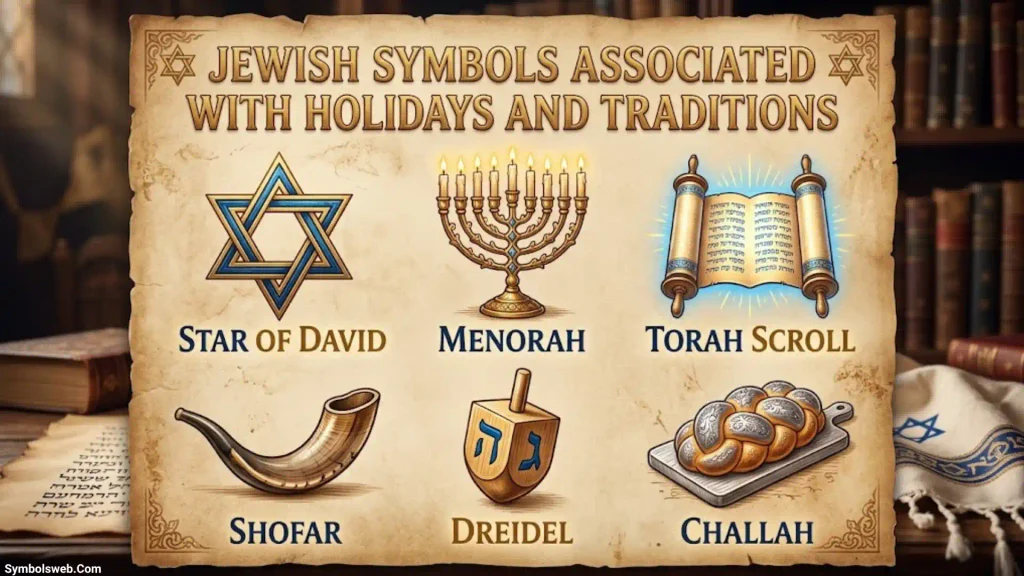
Jewish holidays feature distinctive foods, objects, and ceremonies. These Jewish cultural symbols help people remember biblical events, observe religious commandments, and pass traditions to younger generations.
Shabbat Candles
Lighting Shabbat candles is a traditional way to welcome the Jewish Sabbath, which begins at sunset on Friday and ends after nightfall on Saturday.
The candles illuminate the home and are associated with the peace and sanctity of Shabbat. In many households, a blessing accompanies the lighting, and the ceremony marks a shift from the ordinary workweek to sacred time.
The number of candles and specific customs vary among families and communities. The practice is especially prominent in Jewish household traditions.
Kiddush Cup
A Kiddush cup holds wine or grape juice used during the blessing that sanctifies Shabbat and Jewish festivals. The Hebrew word Kiddush refers to sanctification.
The blessing recognizes the sacred character of the day or festival. Families commonly recite it as part of a Shabbat meal, often alongside challah.
Kiddush cups may be simple or elaborately decorated with silver, engraved Hebrew lettering, or Jewish motifs. Their religious purpose remains the same regardless of their design.
Challah
Challah is a special bread traditionally eaten on Shabbat and many Jewish holidays. It is often braided, although its shape and preparation vary by occasion and community.
The two loaves commonly placed on the Shabbat table recall the double portion of manna described in Exodus 16:22–30. According to the biblical account, the Israelites gathered an extra portion before Shabbat.
Before the meal, families traditionally recite a blessing over the bread. Challah is therefore both a food and a meaningful part of Jewish household observance.
Havdalah Candle
The Havdalah candle is used in the ceremony that marks the end of Shabbat. The Hebrew word Havdalah means separation or distinction.
The ceremony distinguishes sacred time from the ordinary days of the week. It traditionally includes blessings over wine, fragrant spices, and light.
A braided candle with multiple wicks is commonly used. Its flame represents one part of the ceremony’s recognition of light and the transition into the new week.
Matzah
Matzah is unleavened bread eaten during Passover. It recalls the Exodus story, in which the Israelites left Egypt in haste and did not have time for their dough to rise.
During Passover, Jewish dietary rules prohibit leavened grain products covered by the relevant restrictions. Matzah takes a central place in the Seder, the ceremonial meal that retells the story of the Exodus.
It represents both the hardships of slavery and the journey toward freedom. Its role is grounded in the biblical Passover narrative and the commandments associated with the festival.
Lulav and Etrog
The lulav and etrog are central ritual items used during Sukkot, the Jewish festival also known as the Feast of Tabernacles.
The lulav is a bundle containing a palm branch, myrtle branches, and willow branches. The etrog is a citron fruit. Together, these form part of the biblical commandment involving the four species in Leviticus 23:40.
Jewish tradition offers several interpretations of the four species, including the idea that they represent different kinds of people brought together as one community. This is a traditional interpretation rather than the only possible explanation.
Sukkah
A sukkah is a temporary shelter built for Sukkot. The practice recalls the Israelites’ wilderness journey after the Exodus and follows the festival instructions in Leviticus 23:42–43.
Families may eat meals, welcome guests, study, or spend time inside the sukkah during the festival. Its roof must meet specific religious requirements, and decorations often include fruit, greenery, and artwork.
The sukkah reminds participants of the temporary shelters associated with the biblical journey and encourages reflection on dependence, hospitality, and gratitude.
Dreidel
A dreidel is a four-sided spinning top played with during Hanukkah. Each side bears a Hebrew letter: nun, gimmel, hey, and shin outside Israel, or nun, gimmel, hey, and peh on many Israeli dreidels.
The letters represent the phrase nes gadol haya sham, meaning “a great miracle happened there.” In Israel, the final letter changes the phrase to nes gadol haya po, meaning “a great miracle happened here.”
The dreidel is a popular holiday game, especially among children. Stories connect it to Jewish history, but the familiar account about using spinning tops to disguise Torah study under persecution should be treated as a traditional story rather than a firmly established historical explanation.
Hanukkiah
The Hanukkiah is the nine-branched lamp lit during Hanukkah. Eight branches hold the lights corresponding to the eight nights of the festival, while the ninth holds the shamash, or helper light, used to kindle the others.
Hanukkah commemorates the rededication of the Second Temple in Jerusalem following the Maccabean revolt. Traditional accounts also describe a miracle in which a small supply of consecrated oil burned for eight days.
The Hanukkiah is often called a Hanukkah menorah, but the distinction matters: the ancient Temple menorah had seven branches, while the Hanukkiah has eight lights plus the shamash.
For further details, My Jewish Learning’s guide to Hanukkah symbols explains the lamp, dreidel, and other holiday customs.
Jewish Symbols of Marriage and Family Life
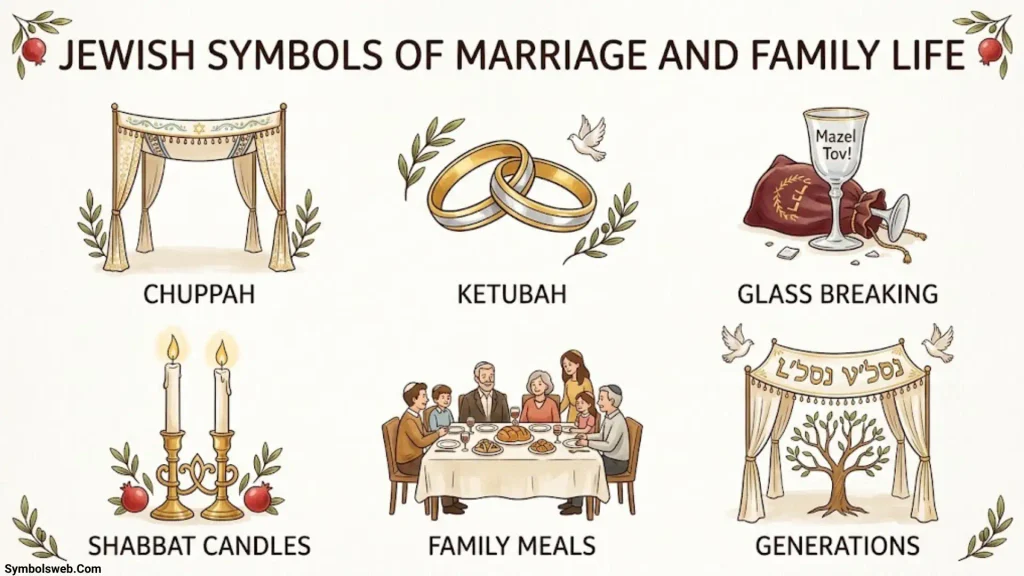
Jewish weddings and family celebrations include objects that express commitment, hospitality, and the creation of a household.
Chuppah
A chuppah is a canopy used during many Jewish wedding ceremonies. It usually consists of a cloth supported by poles, although designs range from simple family-held canopies to elaborate structures.
The chuppah is commonly interpreted as a representation of the home the couple will establish together. Its open sides are sometimes associated with Abraham and Sarah’s tradition of hospitality, although this connection is an interpretation rather than a universal rule.
Customs surrounding the chuppah vary among Jewish communities, and not every wedding follows precisely the same format.
Ketubah
A ketubah is a Jewish marriage contract. Historically, it set out the husband’s financial obligations and certain protections for the wife under Jewish law.
Modern ketubot may also include language expressing the couple’s mutual commitments. Some are richly decorated with Hebrew text, floral designs, geometric patterns, or symbols drawn from Jewish heritage.
The ketubah is more than a decorative wedding keepsake. It has a specific legal and ceremonial history, although its exact wording and use vary according to Jewish tradition and the couple’s community.
Jewish Wedding Ring
In traditional Jewish wedding ceremonies, a ring is used during the marriage act. Under traditional Jewish law, the ring is generally expected to belong to the groom and to be given to the bride as part of the ceremony.
A plain ring is customary in many traditional settings, though modern practices vary. The ring’s significance comes from its role in the ceremony rather than from a universal symbolic meaning attached to its design.
Pomegranate in Jewish Celebrations
Pomegranates often appear in Jewish wedding decorations, holiday table settings, and ceremonial art. Their many seeds have made them a familiar image of abundance and fruitfulness.
The fruit also appears in traditional Torah ornaments called rimonim, a Hebrew word meaning pomegranates. These ornaments may sit atop the wooden poles of a Torah scroll in some communities.
Its decorative use connects biblical imagery with contemporary Jewish celebrations.
Hebrew Letters and Numbers in Jewish Symbolism
The Hebrew alphabet plays a central role in Jewish religious life because Hebrew is the language of the Torah and many traditional prayers. Letters and numbers also have special associations in some Jewish interpretive traditions.
Hebrew Alphabet (Aleph-Bet)
The Aleph-Bet consists of 22 letters used to write Hebrew. These letters appear throughout Jewish sacred texts, prayer books, inscriptions, and religious artwork.
Hebrew letters are not all religious symbols in themselves. Their significance depends on how they are used. A letter may form part of a sacred word, identify a passage, or appear in an artistic design.
Some Jewish mystical traditions explore the spiritual significance of Hebrew letters, including their relationships to creation and divine wisdom. Such interpretations belong to particular religious and mystical frameworks rather than representing one universal Jewish understanding.
The Number 18 and Chai
The number 18 is closely associated with life in Jewish culture because the Hebrew letters in chai have numerical values totaling 18.
Hebrew letters can represent numbers through a system known as gematria. In this system, chet has a value of eight and yod has a value of ten.
This connection explains the popularity of charitable gifts in multiples of 18. For example, someone might donate $18, $36, or $180 as a gesture associated with life and blessing.
The practice is a cultural tradition, not a requirement that Jewish donations follow a particular numerical pattern.
The Number 613 and Mitzvot
The number 613 mitzvot refers to the traditional count of commandments associated with the Torah. Rabbinic tradition distinguishes between 248 positive commandments and 365 prohibitions.
These commandments cover many aspects of religious life, ethics, worship, family relationships, and community responsibilities. Not every commandment applies to every person or circumstance, and many are connected to the ancient Temple or other conditions that no longer exist.
The number 613 sometimes appears in Jewish art and symbolism, including interpretations that connect it to the many seeds of a pomegranate. This association expresses the richness of Jewish tradition rather than a literal rule about fruit.
Hebrew Names of God
Jewish sacred texts use several Hebrew names and titles for God. These include Adonai, Elohim, and the four-letter divine name known as the Tetragrammaton.
Jewish tradition treats the written and spoken forms of divine names with particular reverence. Many observant Jews avoid pronouncing the Tetragrammaton and use another name when reading scripture aloud.
Divine names sometimes appear in religious calligraphy, synagogue decorations, and prayer books. Their meaning depends on their scriptural and liturgical context, and respectful handling of written names is an important consideration in traditional Jewish practice.
Jewish Symbols in History and the Modern State of Israel
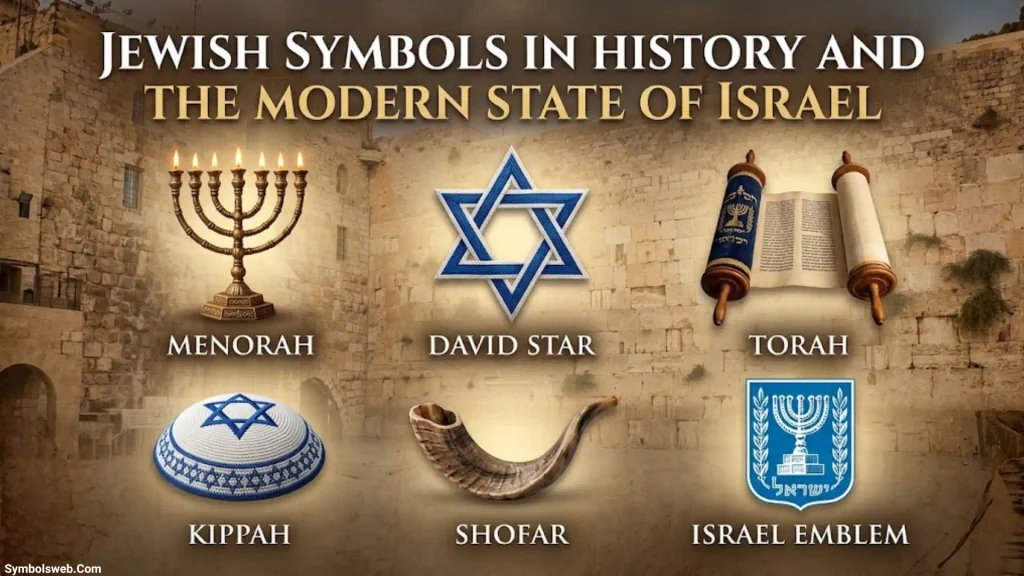
Some Jewish historical symbols connect religious traditions with the development of Jewish communities and the modern State of Israel. These symbols can carry religious, cultural, national, and personal meanings at the same time.
Israeli Flag
The Israeli flag features a blue Star of David between two horizontal blue stripes on a white background. The design draws on imagery associated with the Jewish prayer shawl, or tallit, and the Jewish national movement.
The flag became the national flag of the State of Israel in 1948. Its Star of David connects the modern state with a symbol that had already become widely associated with Jewish identity.
Although the flag has a religious and cultural background, it is primarily a national emblem. Jewish people around the world may identify with it in different ways, and their personal views about Israel vary.
Western Wall (Kotel)
The Western Wall, known in Hebrew as the Kotel, is a surviving section of the retaining wall associated with the Temple Mount in Jerusalem. It is one of the most important places of prayer and pilgrimage in Jewish life.
The wall is connected to the history of the Second Temple, which the Romans destroyed in 70 CE. Jewish visitors gather there to pray, study, and mark significant personal and communal occasions.
The Western Wall is a physical historical site rather than a designed religious icon. Nevertheless, it has become a powerful symbol of Jewish historical connection to Jerusalem and the memory of the ancient Temple.
Ancient Menorah of Jerusalem
The ancient Temple menorah remains a central emblem of Jewish historical continuity. Its image appears on ancient artifacts and in Roman depictions of objects taken from Jerusalem after the destruction of the Second Temple.
One well-known example appears on the Arch of Titus in Rome. The relief depicts the menorah among the spoils carried away by Roman soldiers.
The image provides an important historical connection between ancient Jewish worship and the later development of Jewish visual identity. The menorah’s presence on Israel’s state emblem continues that connection.
Star of David in Jewish History
The Star of David’s rise as a widely recognized Jewish emblem took place gradually. Although the hexagram appeared in different cultures for centuries, it was not always an exclusively Jewish symbol.
By the 19th century, Jewish communities increasingly used it as an emblem of collective identity. The Zionist movement adopted it in 1897, giving it greater international prominence.
During the Holocaust, Nazi authorities forced Jews in many occupied territories to wear identifying badges, including versions of the yellow Star of David. After the Holocaust, the star continued to represent Jewish identity and became part of the Israeli flag.
Its history therefore includes both persecution and resilience. Its modern meaning is inseparable from the experiences of Jewish communities across different periods.
Zion and Jerusalem in Jewish Symbolism
Jerusalem holds a central place in Jewish prayer, history, and religious imagination. The city is associated with the ancient Temples, biblical kings, pilgrimage festivals, and centuries of Jewish longing and remembrance.
The word Zion originally referred to a specific area of Jerusalem and later became a broader poetic and religious term associated with the city and the Jewish homeland. Its meaning varies by context, including biblical literature, prayer, and modern political history.
Jerusalem and Zion are not symbols in the same sense as a pendant or ritual object. They are real places whose significance has also become deeply symbolic in Jewish religious and cultural life.
Jewish Symbols of Protection and Their Contested Meanings
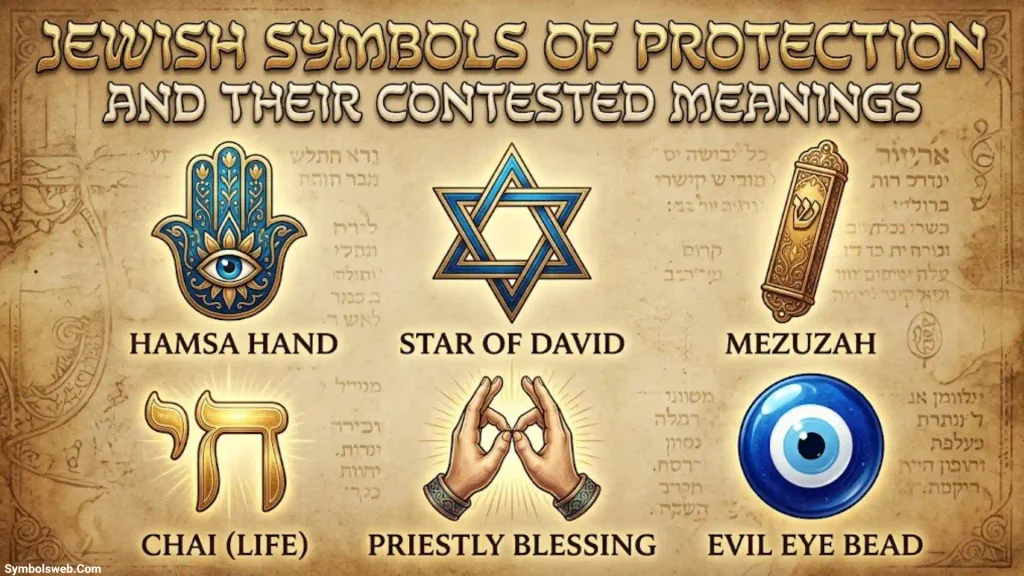
Some Jewish spiritual symbols are connected to protection, blessings, and folk customs. These traditions should be described carefully because they do not carry the same status as commandments or established ritual practices.
Hamsa and the Evil Eye
The Hamsa is sometimes used as a protective amulet against the evil eye, a belief that envy or harmful attention can bring misfortune. The Hebrew phrase ayin hara refers to the evil eye.
Beliefs surrounding the evil eye appear in several Middle Eastern, Mediterranean, and North African cultures, including some Jewish communities. Hamsa jewelry and household decorations may feature an eye, Hebrew words, or other protective motifs.
However, the Hamsa is not exclusively Jewish, and Jewish religious authorities and communities differ in how they understand amulets and protective customs. Some people use the symbol as cultural heritage or decoration without believing it has supernatural power.
Amulets in Jewish History
Protective amulets have appeared in various periods of Jewish history. Some feature Hebrew inscriptions, biblical passages, divine names, or designs associated with Jewish mystical traditions.
Their uses and interpretations varied across regions and historical periods. Some were intended to provide protection from illness or misfortune, while others reflected local customs and popular religious beliefs.
These objects offer insight into the ways Jewish communities responded to uncertainty and incorporated religious language into everyday life. However, historical use does not establish that all Jewish traditions endorse every amulet or attribute the same power to it.
Kabbalah and Symbolic Interpretation
Kabbalah is a tradition of Jewish mysticism that explores the relationship between God, creation, spiritual reality, and sacred texts. Some Kabbalistic teachings interpret Hebrew letters, numbers, and symbolic diagrams in highly specific ways.
For example, the Kabbalistic Tree of Life is associated with ten sefirot, often described as divine attributes or manifestations through which God’s relationship with creation is understood. This diagram is more complex than a general image of a tree.
Kabbalistic interpretations have influenced Jewish religious thought and art. Still, their specialized meanings should not be presented as the standard interpretation of every Jewish symbol.
Jewish Symbols in Art, Jewelry, Tattoos, and Everyday Culture
Jewish cultural symbols appear in many settings beyond formal worship. People use them to express heritage, remember family traditions, mark important life events, or display a personal connection to Judaism.
Jewish Symbols in Jewelry
The Star of David, Chai, and Hamsa are common motifs in Jewish jewelry. They appear on necklaces, bracelets, rings, pendants, and other personal accessories.
A Star of David necklace may express Jewish identity or solidarity, while a Chai pendant often emphasizes the value of life. A Hamsa may reflect cultural heritage, decorative preference, or a belief in protection.
The meaning is personal as well as cultural. Wearing a Jewish symbol does not necessarily indicate a person’s level of religious observance or adherence to a particular denomination.
Jewish Symbols in Tattoos
Some people choose tattoos featuring Hebrew words, the Star of David, Chai, or other Jewish imagery. These designs may express faith, family history, remembrance, or personal identity.
Traditional Jewish interpretations of Leviticus 19:28 prohibit tattooing. Many Orthodox authorities understand this prohibition as applying to permanent tattoos, while Jewish individuals and communities differ in their approaches to the practice.
It is important to distinguish the existence of Jewish-themed tattoos from traditional religious approval. A design can express a person’s Jewish identity even when the practice itself conflicts with the religious standards they or their community follow.
Jewish Symbols in Synagogues
Synagogue architecture often includes the Aron Kodesh, Hebrew inscriptions, menorah designs, and decorative references to biblical traditions. Some synagogues also feature the Star of David, lions, or images connected to Jerusalem.
These features may serve religious, historical, educational, or artistic purposes. Their presence and arrangement vary by community, architectural period, and local custom.
Many synagogues avoid human or animal imagery in certain contexts, while others include it in decorative artwork. There is no single architectural design that represents every Jewish community.
Jewish Symbols in Modern Popular Culture
Jewish symbols appear in films, literature, fashion, music, public demonstrations, and cultural celebrations. The Star of David, for example, can communicate religious affiliation, family heritage, solidarity, or national identity.
Context matters. A symbol used in a synagogue or prayer ceremony may carry a different meaning from the same image used on a fashion accessory or in a fictional story.
Respectful representation also requires avoiding stereotypes. Jewish people have diverse religious practices, cultural backgrounds, and personal beliefs, so no single symbol can represent every Jewish experience.
Jewish Symbols and Their Meanings at a Glance
This reference table summarizes common Jewish symbols and their significance, including their main associations and uses.
| Jewish symbol | Meaning or association | Main use or context |
| Star of David (Magen David) | Jewish identity and heritage | Jewelry, synagogues, Israeli flag |
| Menorah | Ancient Temple worship and Jewish continuity | Religious and national imagery |
| Chai | Life | Jewelry, gifts, charitable giving |
| Lion of Judah | Strength and the league of Judah | Art and biblical imagery |
| Shofar | Repentance and spiritual awakening | Rosh Hashanah and Yom Kippur |
| Torah scroll | Sacred teaching and Jewish law | Synagogue worship |
| Tablets of the Law | Ten Commandments and covenant | Religious artwork |
| Mezuzah | Remembering the commandments | Jewish home doorposts |
| Tefillin | Commitment to the commandments | Weekday morning prayers |
| Tallit and tzitzit | Remembrance of God’s commandments | Prayer and religious observance |
| Kippah | Reverence for God and Jewish custom | Head covering |
| Shema | Oneness of God | Daily prayer and ritual objects |
| Matzah | Exodus from Egypt and freedom | Passover |
| Lulav and etrog | Sukkot observance | Festival rituals |
| Hanukkiah | Hanukkah and the traditional oil miracle | Hanukkah candle lighting |
| Dreidel | Hanukkah tradition | Holiday games |
| Chuppah | Marriage and a new household | Jewish wedding ceremony |
| Ketubah | Marriage obligations and commitments | Wedding ceremony |
| Pomegranate | Abundance and traditional Jewish imagery | Judaica and holiday decorations |
| Tree of Life | Wisdom, life, and spiritual growth | Religious art and mystical teachings |
| Hamsa | Protection in some cultural traditions | Jewelry and home decorations |
| Israeli flag | National identity | State and national occasions |
| Western Wall (Kotel) | Jewish history and connection to Jerusalem | Prayer and pilgrimage |
Frequently Asked Questions About Jewish Symbols
What is the most recognized Jewish symbol?
The Star of David is probably the most widely recognized symbol of Jewish identity today. It appears on the Israeli flag, synagogue buildings, jewelry, and many Jewish community emblems. The seven-branched menorah, however, has a much older connection to ancient Jewish worship.
What does the Star of David mean?
The Star of David, or Magen David, is a six-pointed star formed by two overlapping triangles. Today, it represents Jewish identity, heritage, and solidarity. Its precise historical origins and the meaning of its geometric shape remain subjects of discussion.
What is the difference between a menorah and a Hanukkiah?
The menorah described in the Torah has seven branches and was associated with the ancient Tabernacle and Temples in Jerusalem. A Hanukkiah has eight branches for the eight nights of Hanukkah, plus a ninth holder for the shamash, or helper light.
What is the Jewish symbol for life?
The Chai symbol represents life. It consists of the Hebrew letters chet and yod, whose numerical values total 18. The connection between Chai and the number 18 explains the custom of giving charitable gifts in multiples of 18 in some Jewish communities.
What Jewish symbols appear in the Torah?
The Torah describes several important objects and images, including the menorah, shofar, tablets of the Law, priestly breastplate, and tzitzit. These have different roles in biblical narratives and commandments. Some remain part of Jewish religious practice, while others are remembered mainly through historical accounts and artistic representations.
What do Jewish symbols on doorposts mean?
A mezuzah is attached to the doorpost of a Jewish home or another qualifying doorway. Its parchment contains passages from Deuteronomy that include the Shema and commandments about remembering God’s words. It serves as a religious reminder rather than merely a decorative charm.
Are all Jewish symbols religious?
No. Some Jewish symbols have direct religious functions, while others primarily express cultural identity, historical memory, or national belonging. For example, tefillin are used in traditional prayer, the Star of David is a widely recognized identity symbol, and the Israeli flag is a national emblem.
Are the Hamsa and Evil Eye Jewish symbols?
The Hamsa appears in some Jewish cultural traditions, including communities with roots in the Middle East and North Africa. It is also found in other cultures and is not exclusively Jewish. Some people associate it with protection against the evil eye, but beliefs about its significance vary.
What Jewish symbols are associated with protection?
The Hamsa and certain historical amulets are associated with protection in some Jewish folk traditions. Other objects, such as mezuzot and tefillin, have religious meanings rooted in Jewish commandments. These categories should not be confused because their purposes and religious status differ.
Which Jewish symbols are associated with holidays?
Several objects have strong connections to particular Jewish holidays:
- Rosh Hashanah: Shofar.
- Yom Kippur: Shofar at the conclusion of the day in many communities.
- Passover: Matzah and the Seder plate.
- Hanukkah: Hanukkiah and dreidel.
- Sukkot: Sukkah, lulav, and etrog.
- Shabbat: Candles, Kiddush cup, and challah.
Conclusion
Jewish symbols preserve important connections to Judaism, biblical history, religious observance, and cultural identity. The Star of David, menorah, Chai, Torah scroll, mezuzah, and shofar each have distinct histories and uses. Some serve as reminders of Jewish commandments, while others express heritage, commemorate historical experiences, or mark important celebrations.
Understanding Jewish symbols and meanings requires attention to their origins and context. A biblical object, a modern national emblem, and a folk symbol do not necessarily carry the same religious authority. When you recognize these differences, you gain a clearer understanding of the traditions, history, and diverse experiences of the Jewish people.

Eliana Foster is a writer with a passion for exploring the meanings behind symbols, traditions, and cultural history. She enjoys breaking down complex topics into simple, engaging articles that are easy for everyone to understand. Eliana is also the fictional author of The Hidden Language of Silent Marks and Beyond the Circle of Ancient Signs, two original book concepts created for her author profile. When she’s not writing, she loves visiting museums, reading about mythology, and researching the stories behind symbols from around the world. Her goal is to help readers discover the fascinating meanings hidden in everyday signs and ancient emblems.
 Jordan Hayes
 Ethan Holloway