Space symbols have fascinated humans for thousands of years, from ancient civilizations watching the night sky to modern people using stars, moons, planets, and galaxies in art and digital communication. These simple symbols can carry deep meanings such as hope, mystery, freedom, transformation, spirituality, and exploration. What looks like a small symbol can often represent a much bigger idea about life and the universe.
Throughout history, people have connected celestial symbols with mythology, religion, culture, and human emotions. Today, they still appear in tattoos, jewelry, literature, fashion, social media, and modern design. In this guide, we will explore the history, meanings, cultural importance, spiritual interpretations, psychological connections, and modern uses of space symbols.
Space Symbols: (Quick Answer)
Space symbols are visual signs, characters, and designs connected with outer space, astronomy, celestial objects, and cosmic ideas. Common examples include stars, moons, planets, the Sun, comets, galaxies, rockets, and astronomical symbols. Depending on context, they can represent exploration, mystery, infinity, hope, transformation, guidance, spirituality, and the unknown.
Also Check This Post: 83+ Shinto Symbols: Hidden Meanings, Sacred Signs, and the Spiritual Language of Japan
Quick Facts About Space Symbols
| Aspect | Information |
| Origin | Space symbols developed from humanity’s observation of the Sun, Moon, stars, planets, and other celestial objects. |
| Historical Significance | Ancient civilizations used celestial symbols in religion, mythology, calendars, navigation, architecture, and art. |
| Main Meaning | Space symbols commonly represent the universe, mystery, exploration, light, and the unknown. |
| Spiritual Meaning | They can symbolize transformation, eternity, higher consciousness, guidance, and connection with something greater. |
| Cultural Importance | Celestial imagery appears in Egyptian, Greek, Roman, Asian, Indigenous, and many other cultural traditions. |
| Modern Usage | Space symbols are widely used in tattoos, jewelry, fashion, social media, branding, art, and personal expression. |
What Are Space Symbols?
Space symbols are visual signs or characters that represent outer space, celestial objects, astronomy, or ideas connected with the universe.
They include familiar forms such as stars, moons, planets, the Sun, comets, galaxies, rockets, astronauts, and telescopes. Some have ancient cultural histories, while others are modern digital symbols.
Humanity has looked toward the sky for as long as people have recorded their experiences. Before modern astronomy, the Sun helped people understand seasons, the Moon helped measure time, and stars helped travelers find direction.
Over time, celestial objects became connected with myths, gods, spiritual beliefs, and human emotions.
The meaning of space symbols has continued to evolve. A star that once represented divine guidance can now represent hope or achievement. A rocket can represent technological progress, while a galaxy can represent infinity and wonder.
The Unicode Standard also contains many celestial characters, including stars, the Sun, Moon, and comet symbols.
Deep Symbolic Meaning of Space Symbols
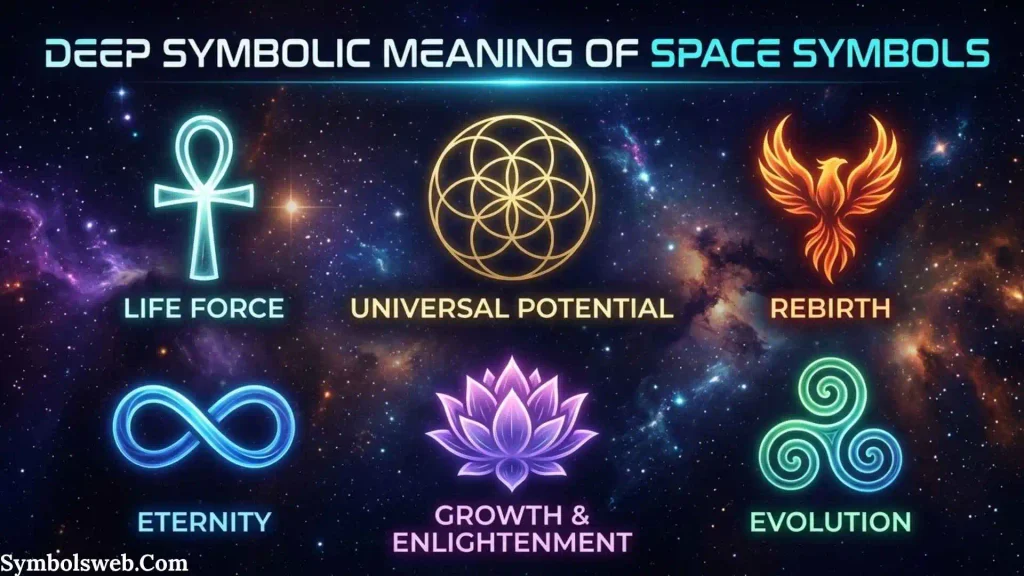
Spiritual Level
Space symbols often represent ideas that go beyond ordinary physical life.
The vastness of the universe can inspire feelings of transcendence, wonder, humility, and connection. For many people, looking at the stars creates a feeling that life is part of something much larger.
Common spiritual associations include:
- Inner transformation
- Higher consciousness
- Eternity
- Spiritual awakening
- Guidance
- Creation
- Renewal
- Connection with the universe
A star may symbolize light during a difficult period. The Moon may represent cycles of change. A galaxy may represent the endless nature of existence.
These interpretations are spiritual or cultural beliefs rather than scientific conclusions.
Psychological Level
Space symbols can also have strong psychological appeal.
Humans naturally search for patterns and meaning. The night sky provides countless patterns, from individual stars to recognizable constellations.
Carl Jung’s ideas about archetypes are sometimes used to explain why recurring images can carry emotional meaning. However, Jungian symbolism is a psychological framework, not proof that every person or culture gives a symbol the same meaning.
Space imagery can also create a sense of awe. The enormous scale of the universe can make ordinary worries feel smaller while increasing feelings of curiosity and wonder.
This may help explain why people are emotionally attracted to stars, galaxies, and images of deep space.
Cultural Level
Space symbols have different meanings in different societies.
The Sun may represent life and power in one culture, while the Moon may represent time, fertility, or transformation in another.
A star may symbolize guidance, divine presence, destiny, or achievement depending on the cultural setting.
Because of this, there is no single universal meaning for every space symbol. Context is essential.
Types and Variations of Space Symbols
Stars
Visual Description
Stars are commonly shown as five-pointed shapes, although they can also appear as outlined, decorative, six-pointed, or highly stylized forms.
Meaning
Stars often represent hope, guidance, dreams, achievement, light, and inspiration.
Symbolism
A star shining in darkness naturally became a metaphor for hope and direction.
Cultural Connection
Stars have been used in mythology, religion, navigation, calendars, flags, poetry, and art.
Where It Appears
Stars appear in mythology, literature, tattoos, jewelry, fashion, digital communication, and astronomy.
Sun
Visual Description
The Sun is commonly represented as a circle surrounded by rays.
Meaning
The Sun represents life, energy, warmth, light, power, and renewal.
Symbolism
Because sunlight supports life on Earth, the Sun became one of humanity’s strongest symbols of vitality.
Cultural Connection
Solar imagery appears in many ancient religions and mythological traditions.
Where It Appears
The Sun appears in mythology, religious art, calendars, architecture, jewelry, tattoos, and modern design.
Moon
Visual Description
The Moon is commonly represented by crescent shapes or detailed lunar images.
Meaning
The Moon can represent mystery, cycles, change, reflection, time, and renewal.
Symbolism
Its changing phases make the Moon a natural symbol of transformation and repeated cycles.
Cultural Connection
Lunar cycles influenced calendars, ceremonies, agriculture, folklore, and religious traditions.
Where It Appears
Moon symbols appear in mythology, poetry, dreams, tattoos, jewelry, literature, fashion, and social media.
Planets
Visual Description
Planets are usually represented as round celestial bodies, sometimes with rings.
Meaning
Planetary symbolism varies according to the specific planet.
Symbolism
Earth can represent home and life, Mars can suggest conflict or courage, Venus can represent beauty and love, while Saturn is often associated with time and limits.
Cultural Connection
Many planetary names and associations come from ancient Greek and Roman mythology and later astrological traditions.
Where It Appears
Planet symbols appear in astronomy, astrology, mythology, science fiction, tattoos, artwork, and education.
Comet
Visual Description
A comet symbol usually shows a bright object followed by a long glowing tail.
Meaning
Comets can symbolize change, transformation, sudden events, or something extraordinary.
Symbolism
Because comets can appear dramatically in the sky, ancient societies sometimes treated them as omens.
Cultural Connection
Historical comet appearances were recorded and interpreted in many cultures.
Where It Appears
Comets appear in mythology, historical records, astronomy, literature, tattoos, art, and digital symbols.
Galaxy
Visual Description
A galaxy is often represented as a swirling collection of stars or a cosmic scene.
Meaning
Galaxies commonly symbolize infinity, mystery, interconnectedness, imagination, and cosmic scale.
Symbolism
A galaxy can remind people that Earth exists within an enormous universe.
Cultural Connection
Modern galaxy symbolism is strongly connected with astronomy, science fiction, art, and contemporary spirituality.
Where It Appears
Galaxy imagery appears in paintings, tattoos, clothing, wallpapers, photography, literature, and digital design.
Rocket
Visual Description
A rocket is generally shown launching upward into space.
Meaning
Rockets represent exploration, ambition, adventure, progress, and discovery.
Symbolism
The rocket became a major symbol of humanity’s ability to move beyond Earth.
Cultural Connection
Its popularity grew during the Space Age and the development of human spaceflight.
Where It Appears
Rockets appear in science fiction, education, technology branding, tattoos, toys, movies, and social media.
Space Symbols Across Different Cultures
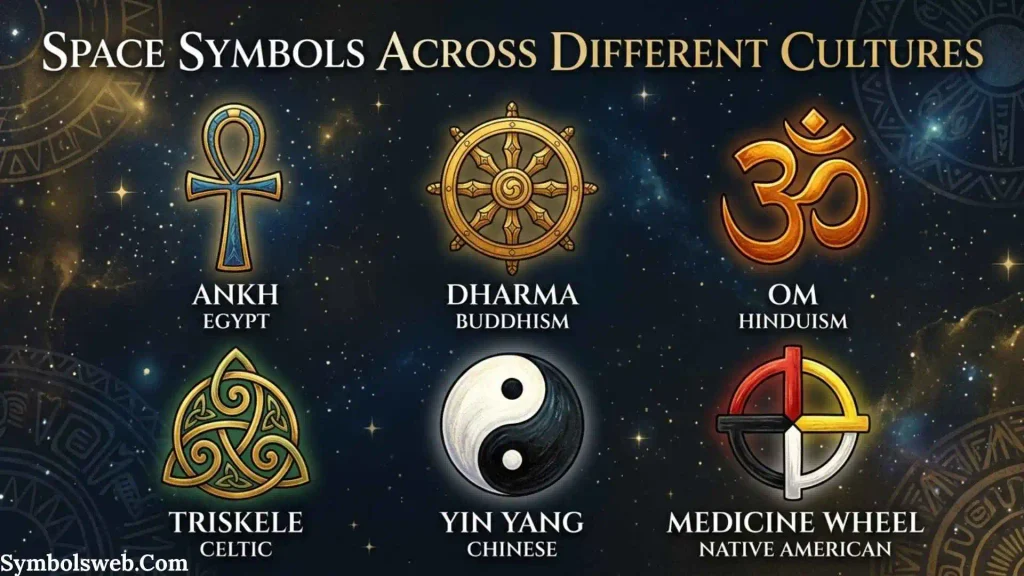
Ancient Egypt
Ancient Egyptian civilization placed great importance on the sky.
The goddess Nut was associated with the sky and was commonly represented as a woman arching above the Earth.
The Sun also played a central role in Egyptian religion. Its daily journey across the sky was connected with ideas about life, death, rebirth, and cosmic order.
Celestial imagery appeared in temples, tombs, religious artwork, and astronomical ceilings.
Ancient Greece
Ancient Greek culture connected celestial bodies with mythology and gods.
Constellations were associated with legendary characters and stories, many of which were later adopted into Western astronomical traditions.
Greek thinkers also made important contributions to astronomy and developed models to explain the movements of celestial bodies.
Roman Culture
Roman culture adopted and adapted many Greek astronomical and mythological traditions.
The planets Mercury, Venus, Mars, Jupiter, and Saturn were named after Roman gods.
These names remain part of modern astronomy.
Roman celestial symbolism therefore continues to influence the language people use for planets today.
Eastern Traditions
Eastern cultures developed complex astronomical, philosophical, religious, and calendrical traditions.
Ancient Chinese astronomers carefully observed celestial events and connected astronomy with calendars and imperial life.
Indian traditions developed sophisticated astronomical systems alongside rich religious and philosophical ideas about cosmic cycles.
Buddhist traditions also contain cosmic imagery, particularly in certain representations of the universe and mandalas.
These traditions are diverse, so they should not be treated as one single symbolic system.
Indigenous Traditions
Indigenous cultures around the world have developed detailed relationships with the night sky.
Stars and celestial movements have been used for navigation, seasonal knowledge, timekeeping, storytelling, and ceremonial traditions.
Many Indigenous cultures have their own constellations and stories that differ from the familiar Western constellations.
Because Indigenous peoples represent many distinct cultures, their celestial traditions should always be understood within their specific cultural context.
Modern Interpretations
Modern society has given space symbols new meanings.
A star can represent personal achievement. A Moon can symbolize emotional change. A rocket can express ambition. A galaxy can represent unlimited possibilities.
Social media has also made celestial symbols easy to use as emotional and visual expressions.
Similar Symbols and Their Meanings
| Symbol | Similarity | Main Difference |
| Star | Represents light and hope | Often symbolizes guidance or achievement |
| Sun | Represents light and energy | Strongly connected with life and power |
| Moon | Represents mystery and change | More closely connected with cycles and night |
| Comet | Represents celestial movement | Often associated with sudden change |
| Planet | Represents the cosmos | Represents a specific world |
| Galaxy | Represents the universe | Suggests enormous scale and interconnectedness |
| Infinity | Represents endlessness | Abstract rather than specifically celestial |
| Spiral | Represents cycles and movement | Can have cosmic or non-cosmic meanings |
Space symbols and typographic space characters should also be distinguished. A celestial symbol represents an idea or object connected with the cosmos, while a typographic space character represents spacing in written text.
Space Symbols in Mythology and Folklore
The night sky has inspired myths in almost every part of the world.
Before modern astronomy, unusual celestial events could be mysterious and frightening. A bright comet appearing unexpectedly might be interpreted as a warning, a divine message, or a sign of major change.
Stars also became characters in stories.
Constellations allowed people to turn patterns of light into memorable narratives. Greek mythology provides many well-known examples, but celestial stories exist far beyond Greek tradition.
The Sun as a Life-Giver
The Sun’s light and warmth naturally connected it with life, creation, strength, and authority.
This explains why solar imagery became important in many religious and mythological traditions.
The Moon as a Symbol of Cycles
The Moon’s changing appearance provided a visible example of transformation.
It became associated with:
- Time
- Birth
- Death
- Renewal
- Mystery
- Change
- Cycles
Stars as Guides
Stars had practical value for travelers and navigators.
That practical function also became symbolic. A star could represent guidance through darkness or direction during uncertain times.
These old ideas still appear in modern expressions about finding one’s guiding star.
Also Check This Post: 99+ Warning Symbols: Hidden Meanings, History, Psychology, and Cultural Significance Explained
Space Symbols in Art, Literature, Movies and Pop Culture
Paintings
Artists use stars, moons, and cosmic landscapes to create mystery, scale, beauty, and emotional depth.
A tiny human figure beneath a huge sky can communicate vulnerability and wonder at the same time.
Literature
Writers have long used stars and planets as metaphors for love, destiny, distance, dreams, loneliness, and mortality.
Shakespeare’s famous reference to stars demonstrates how celestial imagery can represent fate.
Poetry
Poetry often uses the night sky as a mirror for human emotions.
The same Moon can represent romance in one poem and loneliness in another.
Movies
Science fiction has transformed rockets, astronauts, planets, aliens, galaxies, and spaceships into globally recognizable symbols.
Space can represent adventure, isolation, survival, technological progress, or humanity’s search for meaning.
Television
Television has used cosmic imagery in science fiction, fantasy, documentaries, and drama.
Space symbols can quickly establish a futuristic, mysterious, scientific, or imaginative setting.
Tattoos
Space tattoos often represent:
- Hope
- Exploration
- Freedom
- Personal transformation
- Mystery
- Ambition
- Infinity
- A connection to the universe
Fashion
Stars, moons, planets, and constellations are common decorative patterns in clothing and accessories.
Modern Design
Cosmic imagery is often used in posters, websites, wallpapers, album artwork, and branding because it combines simplicity with emotional depth.
Spiritual and Dream Meaning of Space Symbols
Space symbols can appear in dreams, meditation, spiritual practices, and personal reflection.
There is no scientifically established universal meaning for a particular cosmic symbol in a dream. Interpretation depends on the person’s emotions, experiences, beliefs, and cultural background.
Dreaming About Stars
Stars may personally represent:
- Hope
- Guidance
- Ambition
- Dreams
- Recognition
- A distant goal
Dreaming About the Moon
The Moon may be connected with:
- Emotional change
- Intuition
- Mystery
- Cycles
- Reflection
- Renewal
Dreaming About Space
Dreaming about floating through space may represent feelings of freedom, isolation, uncertainty, wonder, or exploration.
The emotional experience matters.
Feeling peaceful in space can suggest something very different from feeling frightened or lost.
Spiritual Encounters
Some people interpret cosmic imagery during meditation or spiritual experiences as signs of awakening, connection, or transcendence.
Such interpretations are personal and should not be treated as scientifically proven messages from the universe.
Positive and Negative Meanings of Space Symbols
| Positive Meaning | Negative Meaning |
| Hope | Loneliness |
| Guidance | Feeling lost |
| Freedom | Fear of the unknown |
| Exploration | Uncertainty |
| Transformation | Instability |
| Infinity | Existential anxiety |
| Wonder | Isolation |
| Discovery | Obsession |
| Spiritual growth | Confusion |
| Ambition | Unrealistic expectations |
A symbol can contain both positive and negative meanings.
The night sky may make one person feel peaceful and another feel small. A rocket can represent exciting freedom for one person and dangerous risk for another.
Meaning depends on context and personal experience.
Why Humans Are Attracted to Space Symbols
Humans have always looked toward the sky.
A child sees the Moon and wonders why it changes. A traveler uses stars for direction. A scientist studies distant galaxies. A modern person uses a celestial symbol to express a feeling.
The tools change, but the curiosity remains.
Human Nature
People naturally want to understand things that are larger than themselves.
Space represents one of the greatest unknowns humans have ever encountered.
Emotional Connections
Cosmic symbols are simple enough to recognize but open enough to hold personal meanings.
A star can become a symbol of someone you love. A Moon can represent a difficult period of change. A galaxy can represent limitless possibility.
Pattern Recognition
The human brain naturally searches for patterns.
Constellations demonstrate this clearly. Stars separated by enormous distances can appear to form recognizable shapes when viewed from Earth.
Humans then create stories around those patterns.
Collective Symbolism
Celestial imagery has been repeated across generations through stories, art, religion, literature, and calendars.
That repetition gives these symbols emotional strength.
Cultural Memory
Even people who do not follow ancient religions may recognize the emotional meaning of a star, Moon, or Sun because these images have been present in human culture for centuries.
Personal Meaning
Modern space symbolism allows people to create meanings that are deeply personal.
That is why the same symbol can mean something completely different to two people.
Modern Uses of Space Symbols
Tattoos
Space symbols are widely used in tattoos to express identity, hope, transformation, freedom, and exploration.
Jewelry
Moon, star, planet, and constellation jewelry can be decorative while also carrying personal meaning.
Fashion
Celestial designs can create a dreamy, mysterious, elegant, or futuristic appearance.
Branding
Companies may use rockets, stars, planets, or cosmic imagery to suggest innovation, ambition, technology, and progress.
Social Media
Space symbols allow users to communicate personality and mood quickly.
Contemporary Spirituality
Cosmic imagery is common in modern spiritual communities and is often connected with meditation, consciousness, astrology, manifestation, and personal transformation.
These ideas vary widely and should be distinguished from scientific astronomy.
Home Decor
Galaxy artwork, Moon phases, constellation maps, stars, and celestial patterns are commonly used to create peaceful or imaginative spaces.
Personal Expression
People use space symbols to communicate feelings that may be difficult to express with ordinary words.
A single Moon can represent a love of nighttime. A star can represent hope. A galaxy can represent the feeling that there is always more beyond what we can see.
Interesting Facts About Space Symbols
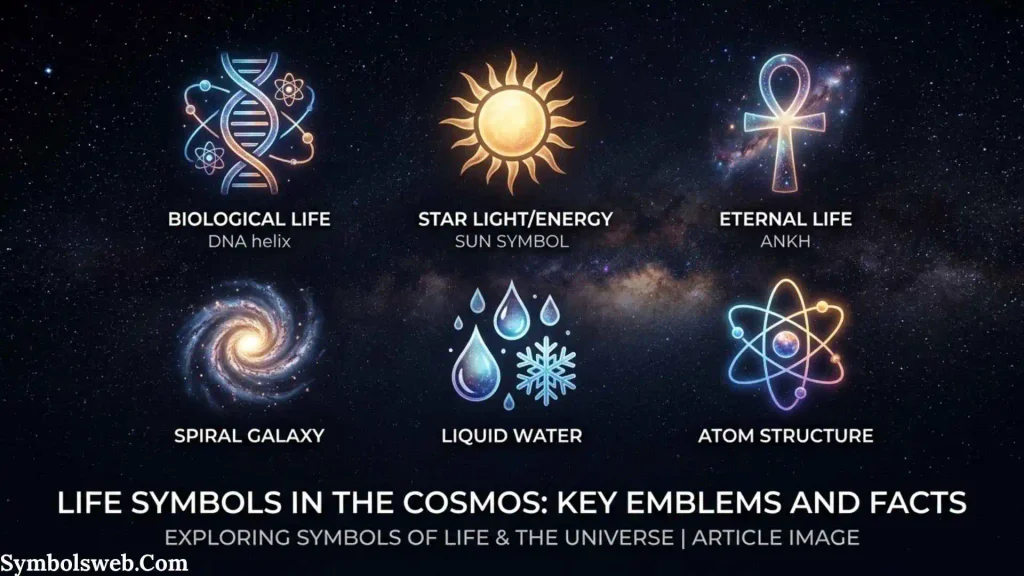
- Stars have served both practical and symbolic purposes throughout human history.
- The Sun has the astronomical symbol ☉, which has a long history in astronomical and astrological notation.
- The Moon’s visible phases helped make it a natural symbol of change and cycles.
- The names Mercury, Venus, Mars, Jupiter, and Saturn come from Roman mythology.
- Comets were sometimes interpreted as omens because of their dramatic and unexpected appearances.
- Constellations are patterns created from Earth’s viewpoint. The stars in a constellation may be extremely far apart from one another.
- Unicode includes many celestial symbols, including stars, the Sun, Moon, and comet characters.
- The rocket became a major cultural symbol during the Space Age and the development of human spaceflight.
- A celestial symbol does not have one universal meaning. Its interpretation can change according to culture, religion, history, and personal experience.
- Modern space symbolism combines ancient fascination with the heavens and modern scientific exploration.
Frequently Asked Questions
What are space symbols?
Space symbols are characters, signs, emojis, and visual designs associated with outer space, celestial objects, astronomy, exploration, and cosmic ideas. Examples include stars, moons, planets, galaxies, rockets, and comets.
What is the most popular space symbol?
The star is one of the most recognizable space symbols. Star characters are commonly used to represent hope, achievement, beauty, guidance, and light.
What does a Moon symbol mean?
A Moon symbol commonly represents mystery, change, cycles, intuition, reflection, night, and renewal. Its exact meaning depends on cultural and personal context.
What does a galaxy symbol represent?
A galaxy symbol can represent infinity, mystery, imagination, interconnectedness, cosmic scale, and the feeling of being part of something much larger.
What does a rocket symbolize?
A rocket commonly represents exploration, ambition, progress, adventure, discovery, technology, and the desire to move beyond familiar boundaries.
Are all space symbols ancient?
No. Some celestial symbols have ancient histories, while others are modern creations, digital characters, or contemporary designs. Modern space symbolism combines historical imagery with scientific and popular culture.
Conclusion
Space symbols connect the modern world with one of humanity’s oldest habits: looking toward the sky and searching for meaning. Stars, moons, planets, comets, and galaxies have represented hope, mystery, transformation, guidance, and the unknown across generations.
Their meanings are never completely fixed because culture and personal experience continue to shape them. In the end, a small cosmic symbol can remind us of something enormous: we are living beneath a universe that still has countless mysteries left to discover.
Also Check This Post: 73+ Law Symbols: Hidden Meanings, History, and Powerful Representations of Justice

Jordan Hayes is a writer with a passion for exploring the history, meanings, and cultural significance behind symbols from around the world. He enjoys turning complex topics into clear, engaging content that anyone can understand. Jordan is also the fictional author of The Silent Language of Ancient Marks and Hidden Symbols Beyond the Surface, two original book concepts created for his author profile. When he’s not writing, he spends time researching myths, traditions, and forgotten stories that inspire his work. His goal is to help readers discover the deeper meanings behind the symbols they encounter every day.
 Eliana Foster
 Ethan Holloway
[…] Strength Symbols: The Ultimate Guide to Powerful Meanings 83+ Space Symbols: A Simple Beginner’s Guide to Every Type 83+ Shinto Symbols: Hidden Meanings, Sacred Signs, and the Spiritual Language of Japan 99+ […]
[…] 73+ Naruto Village Symbols: A Complete Guide to Their Meanings 55+ Hmong Symbols: Meanings Names and Cultural Significance 95+ The Outsiders Symbols: A Complete Guide to Their Meaning 85+ Strength Symbols: The Ultimate Guide to Powerful Meanings 83+ Space Symbols: A Simple Beginner’s Guide to Every Type […]