Poseidon is one of the most powerful gods in Greek mythology. He ruled the seas, stirred earthquakes, created horses, and controlled storms. Ancient Greeks respected him because he could protect sailors and bring calm waters. However, they also feared his temper because a single strike of his trident could unleash enormous waves.
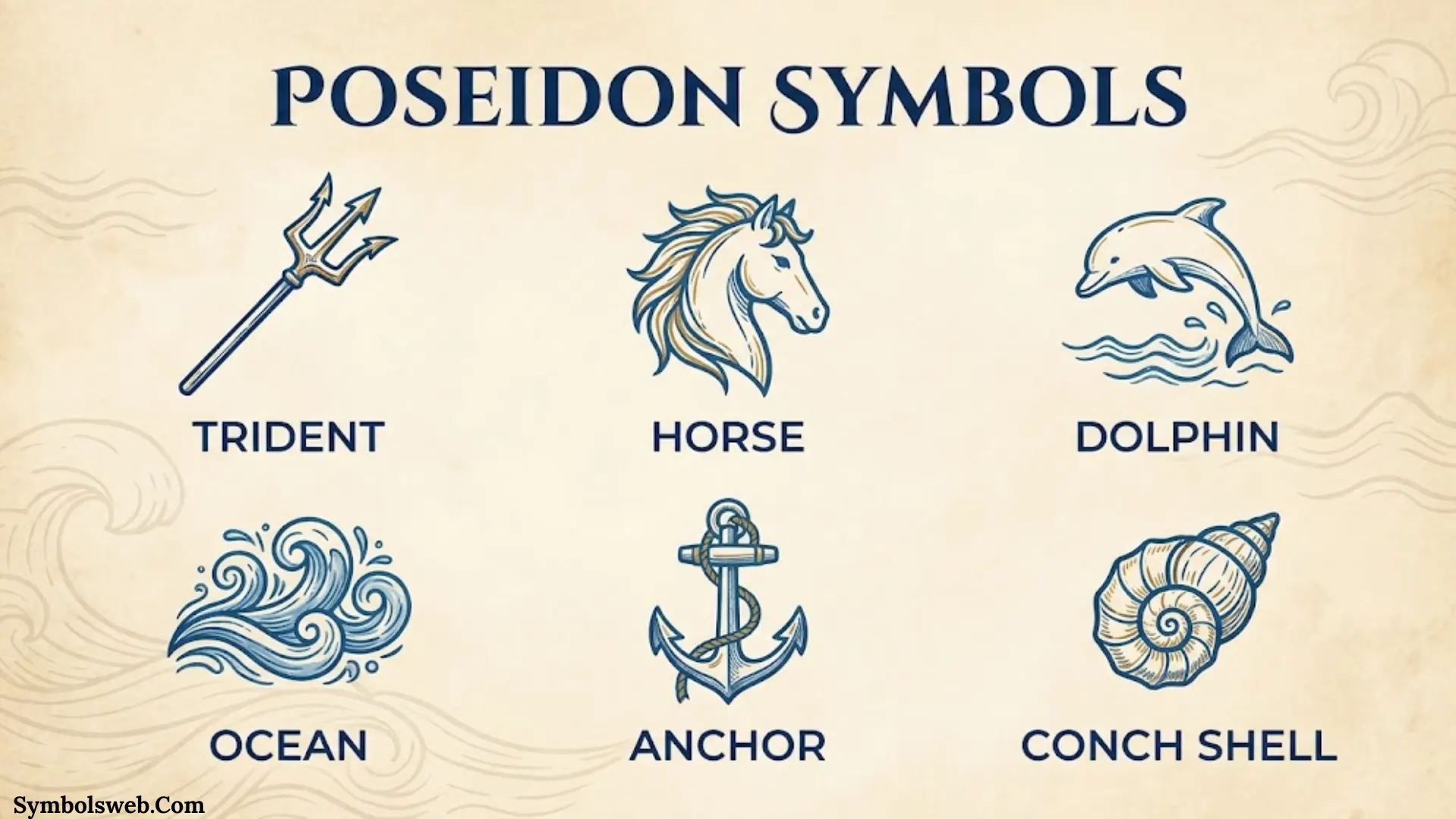
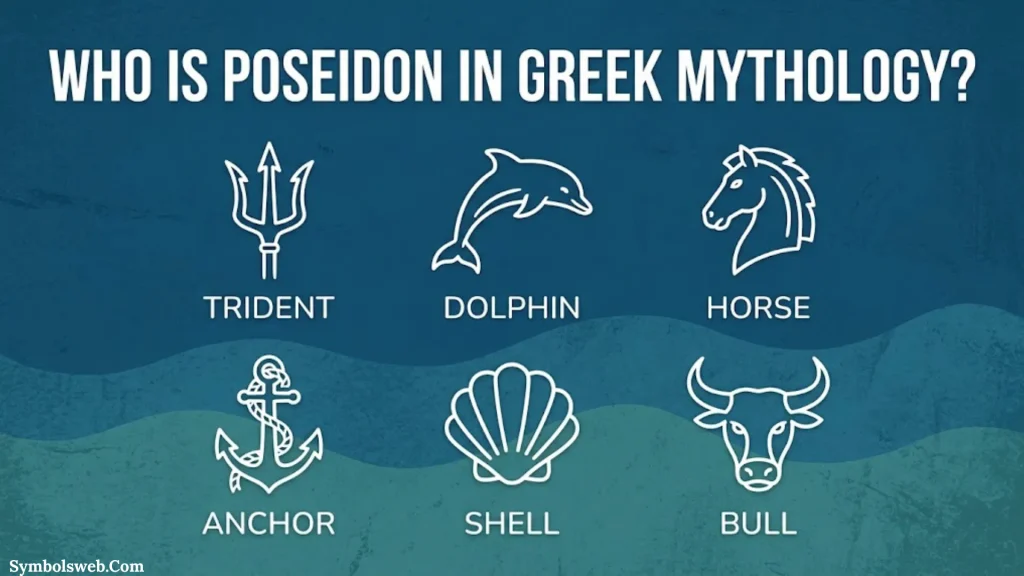
Several symbols help identify Poseidon in ancient Greek stories and artwork. The trident, dolphin, horse, and bull are among his best known attributes. Each one connects to a different part of his character, powers, and divine responsibilities.
Understanding Poseidon’s symbols gives you a closer look at how ancient Greeks viewed the sea, nature, strength, and the dangers of the world around them. Some symbols represent his direct connection to the ocean while others reveal his role as a god of horses, earthquakes, and powerful natural forces.
Who Is Poseidon in Greek Mythology?
Poseidon is the Greek god of the sea, earthquakes, horses, and other powerful natural forces. He is one of the twelve Olympian gods and the brother of Zeus, Hades, Hera, Demeter, and Hestia.
His parents were the Titans Cronus and Rhea. According to Greek mythology, Cronus swallowed most of his children because he feared one of them would overthrow him. Zeus escaped this fate and eventually forced Cronus to release his brothers and sisters.
After the gods defeated the Titans in the Titanomachy, the three brothers divided control of the world. Zeus received the sky, Hades ruled the underworld, and Poseidon became the ruler of the sea. The earth and Mount Olympus remained shared spaces.
Poseidon’s power extended beyond the ocean. Ancient Greeks also connected him with:
- Earthquakes: His movements could shake the ground and destroy buildings.
- Horses: He was worshiped as Poseidon Hippios, a divine protector of horses.
- Storms: He could raise dangerous waves and create violent sea conditions.
- Freshwater sources: Some traditions connected him with springs and flowing water.
- Sailors and sea journeys: People prayed to him for safe voyages and favorable winds.
Poseidon had a complicated personality. He could reward people who respected him but punish those who challenged or offended him. His role in Homer’s Odyssey shows this side of his character. He repeatedly obstructs Odysseus’s journey after the hero blinds his son, the Cyclops Polyphemus.
What Are Poseidon’s Main Symbols?
Poseidon’s symbols reflect his authority over the sea and his connection to other parts of nature. Ancient Greek artists often showed him carrying a trident or riding a chariot through the waves.
Some symbols were closely associated with his worship and artistic representation. Others are broader images that help explain his divine character.
| Poseidon symbol | Meaning and association |
| Trident | Authority over the sea and control of powerful forces |
| Dolphin | Sea life, protection, and safe navigation |
| Horse | Strength, speed, and divine power |
| Bull | Physical strength, force, and sacrificial traditions |
| Sea and ocean | His divine kingdom and authority |
| Waves and storms | His ability to calm or disturb the waters |
| Chariot | His movement and power across the sea |
| Hippocamp | Mythical sea creature associated with his chariot |
| Fishing spear | His connection with the sea and fishing imagery |
The trident, dolphin, and horse are especially important in Poseidon’s traditional iconography. The bull also appears in ancient traditions connected with his worship.
Not every sea creature or ocean image represents Poseidon directly. Some are general symbols of the marine world rather than personal attributes of the god.
Poseidon’s Trident
<PRIVATE_PERSON>The trident is Poseidon’s most recognizable symbol. It is a three-pronged spear that represents his authority over the sea and his ability to control powerful natural forces.
In ancient Greek art, Poseidon often appears holding his trident. Artists used it to distinguish him from other gods, especially Zeus, who carried a thunderbolt. The trident also appeared on ancient Greek coins and pottery.
What Does Poseidon’s Trident Represent?
The trident represents several aspects of Poseidon’s divine power:
- Control over the sea: Poseidon could stir the ocean, create waves, and calm dangerous waters.
- Earthquakes: Greeks called him the Earth-Shaker because they believed he could make the ground tremble.
- Power and authority: The weapon showed his position as ruler of the sea.
- Destruction and protection: He could punish people with storms or help sailors reach safety.
The three prongs are part of the weapon’s design. Ancient sources do not establish one universal meaning for each individual prong. Interpretations that assign a separate meaning to every point should therefore be treated as modern symbolism rather than established Greek belief.
Who Made Poseidon’s Trident?
According to Greek mythology, the Cyclopes forged Poseidon’s trident during the war against the Titans. They also created special weapons for his brothers.
| God | Divine weapon | Main association |
| Poseidon | Trident | Sea and earthquakes |
| Zeus | Thunderbolt | Sky and storms |
| Hades | Helmet of invisibility | Underworld and concealment |
These weapons helped the three brothers defeat the Titans and establish their rule over different parts of the cosmos.
What Powers Did the Trident Give Poseidon?
Greek myths describe the trident as a weapon with extraordinary abilities. Poseidon could strike the ground and cause earthquakes or hit rocks to release water. He could also use it to stir the sea and produce violent storms.
In the story of Athens, Poseidon struck the ground with his trident and produced a saltwater spring. This act demonstrated his power and formed part of his contest with Athena.
The trident was more than a weapon. It represented Poseidon’s control over the natural forces that shaped ancient Greek life.
Poseidon’s Dolphin
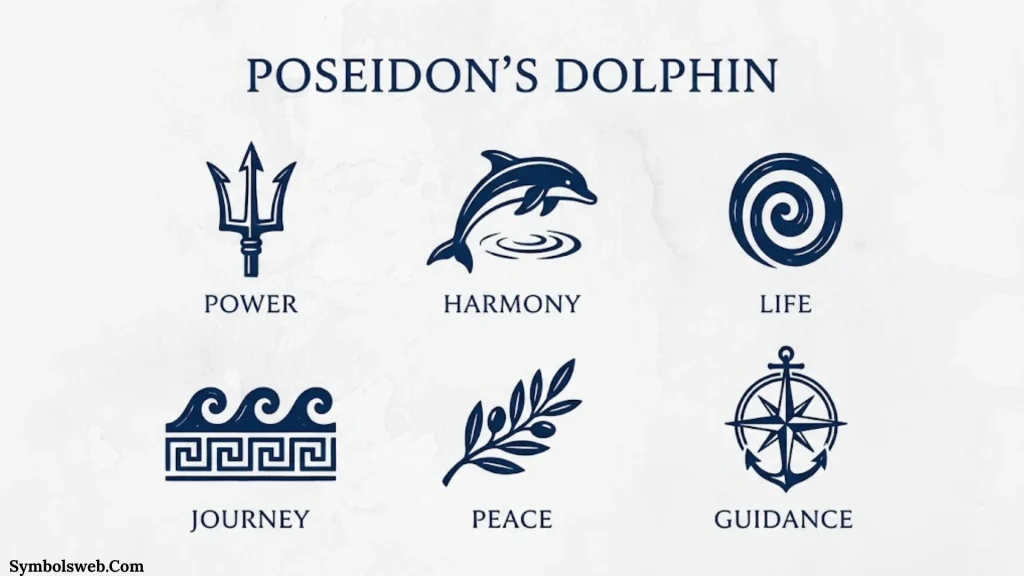
The dolphin is one of Poseidon’s best-known sacred animals.
Dolphins live in the sea and often appear beside Poseidon in ancient Greek artwork. Their presence connects the god with marine life, navigation, and the movement of ships through the water.
Ancient Greeks viewed dolphins as remarkable sea creatures. Their intelligence and ability to swim near boats made them familiar figures in maritime stories and artistic scenes.
What Does the Dolphin Symbolize?
The dolphin can represent several ideas connected with Poseidon:
- Protection at sea: Dolphins were associated with the safety of sailors and sea travelers.
- Marine life: They represent the living creatures within Poseidon’s kingdom.
- Guidance: Their presence near ships made them natural figures in stories about navigation.
- Connection with the sea: They help identify Poseidon in ancient art.
The dolphin does not always carry one fixed meaning. Its symbolism depends on the story, artwork, or religious setting in which it appears.
Why Is the Dolphin Connected to Poseidon?
Poseidon ruled the sea, so marine animals naturally belonged to his divine world. Dolphins were among the creatures most closely associated with him.
Artists sometimes placed a dolphin in Poseidon’s hand or beside his body. Some ancient coins also show the god with a dolphin and trident. These details helped viewers recognize him even when the artwork included several gods.
Poseidon’s Horse
The horse is another important symbol of Poseidon. Although people usually remember him as the god of the sea, ancient Greeks also worshiped him as a divine protector of horses.
One of his titles was Poseidon Hippios, meaning Poseidon of Horses. This title reflects the importance of horses in ancient Greek religion, warfare, transportation, and sports.
Poseidon could create horses, protect them, and influence their strength and speed. His connection with horses also appears in stories about his divine power and relationships with other gods.
How Did Poseidon Create the Horse?
Greek mythology contains different traditions about the origin of horses.
In one well known version, Poseidon created the first horse. Some accounts connect this act with his competition against Athena for control of Athens. Other traditions describe him creating a horse during his pursuit of Demeter.
The details differ between ancient writers. It is better to understand these stories as different mythological traditions rather than combine them into one exact account.
What Does the Horse Symbolize?
Poseidon’s horse represents:
- Strength: Horses were powerful animals used in warfare and demanding physical work.
- Speed: Their movement connects with energy and force.
- Freedom: Their untamed nature reflects the wild side of Poseidon’s character.
- War and competition: Horses played an important role in chariot racing and military life.
- Divine protection: Poseidon received worship as a guardian of horses.
The horse also connects Poseidon with the land. His power was not limited to the ocean because ancient Greeks associated him with earthquakes and other forces beneath the earth.
Poseidon and the Mythical Horse Arion
Arion was a remarkable horse in Greek mythology. Ancient traditions give different accounts of his birth and parentage. Some versions connect him with Poseidon and Demeter.
Arion was famous for his extraordinary speed and supernatural qualities. His story strengthens Poseidon’s association with horses and divine animals.
What Is a Hippocamp?
A hippocamp is a mythical sea creature with the front half of a horse and the tail of a fish.
Hippocamps frequently appear in artistic representations of Poseidon’s underwater world. Artists used them to pull his chariot across the sea.
Their unusual appearance combines two parts of Poseidon’s identity: the horse and the ocean. They therefore represent the connection between his power over land animals and his rule beneath the waves.
Mythoi Koinoi+1
Poseidon’s Bull
The bull is another animal associated with Poseidon. It represents physical power, force, and the untamed side of nature.
Ancient Greek religious traditions connected bulls with sacrifice and divine worship. The National Archaeological Museum of Greece identifies the bull, horse, and dolphin among Poseidon’s symbolic animals.
What Does the Bull Symbolize?
The bull’s symbolism fits Poseidon’s powerful personality.
- Strength: Its physical power reflects Poseidon’s enormous divine strength.
- Force: Its charging movement can suggest the destructive energy of storms and earthquakes.
- Sacrifice: Bulls appeared in ancient religious ceremonies and offerings.
- Wild nature: The animal reflects forces that humans cannot easily control.
These meanings are interpretations of the animal’s cultural associations. They should not be mistaken for a single official explanation given by every ancient Greek community.
Poseidon and the Cretan Bull
The Cretan Bull is an important animal in Greek mythology. King Minos of Crete received a magnificent bull from Poseidon in one version of the story.
Minos was supposed to sacrifice the animal to honor the god. However, he kept the beautiful bull instead. Poseidon became angry and punished him through a chain of events involving Minos’s wife, Pasiphaë.
Pasiphaë later gave birth to the Minotaur, a creature with a human body and a bull’s head. King Minos eventually confined the monster inside the Labyrinth.
This myth shows how Poseidon’s power could influence human lives and create dangerous consequences when people ignored divine expectations.
The Sea and Ocean
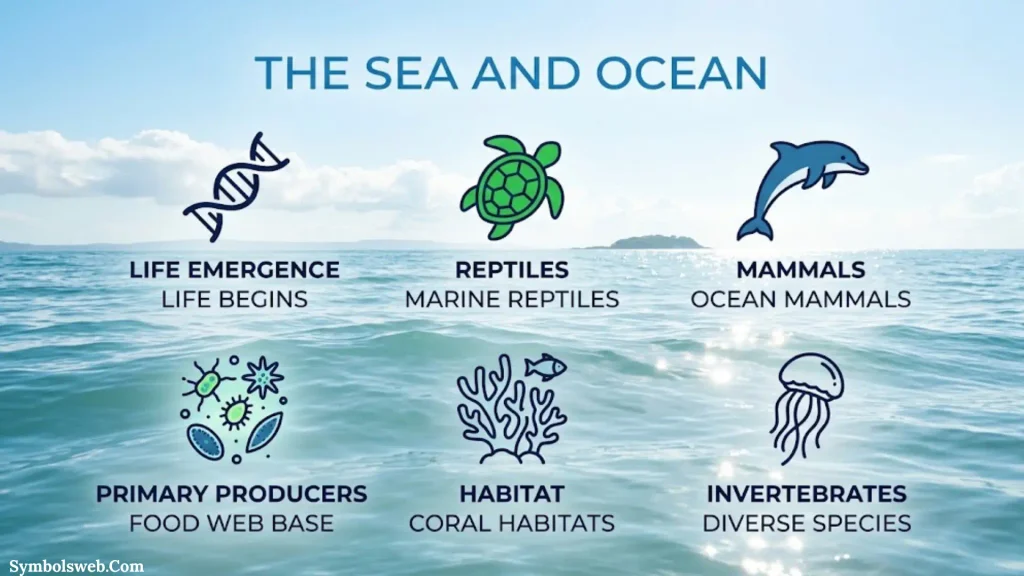
The sea is Poseidon’s most important domain and the foundation of his identity. As its ruler, he controlled the waters that supported trade, fishing, travel, and communication across the ancient Greek world.
For people who lived near the Mediterranean, the sea offered opportunities but also carried serious risks. Calm water could help sailors reach distant ports. A sudden storm could destroy ships and threaten entire crews.
Poseidon represented both sides of this natural force.
What Does the Ocean Symbolize?
The ocean represents:
- Divine authority: It is the kingdom over which Poseidon rules.
- Power: Its size and strength reflect his immense abilities.
- Mystery: Its depths represent the unknown parts of the natural world.
- Life and resources: The sea provided fish, trade routes, and food.
- Danger: Storms and rough waters could destroy ships and coastal settlements.
The ocean is a broad symbol of Poseidon’s domain rather than a separate object he carries.
Poseidon as the God of Storms
Poseidon could create violent storms and enormous waves. Ancient Greeks believed his anger could make the sea dangerous for sailors.
In Homer’s Odyssey, Poseidon repeatedly creates obstacles for Odysseus. His anger follows the hero after he blinds Polyphemus, Poseidon’s son.
The story illustrates how dangerous a conflict with the sea god could become. Odysseus’s journey takes years partly because Poseidon refuses to let him return home easily.
Poseidon as the Earth-Shaker
Poseidon was also known as the Earth-Shaker. Ancient Greeks associated him with earthquakes, landslides, and other destructive movements of the earth.
This connection may seem surprising because Poseidon is usually described as the sea god. However, Greek mythology often connected the sea, underground waters, and earthquakes.
His trident represented the ability to disturb both the ocean and the ground beneath people’s feet.
Poseidon’s Chariot
Poseidon’s chariot is a familiar feature in ancient Greek and Roman artistic traditions. It represents his movement through the sea and his authority over ocean waters.
Myths and artwork often show Poseidon riding a magnificent chariot pulled by horses or mythical marine creatures. His chariot could travel across the waves as he moved through his underwater kingdom.
What Does Poseidon’s Chariot Symbolize?
The chariot represents:
- Divine authority: It reflects Poseidon’s position as ruler of the sea.
- Movement: It shows his ability to travel across the ocean.
- Power: Its magnificent appearance reflects his status among the gods.
- Connection with horses: It combines his role as a sea god with his association with horses.
What Pulls Poseidon’s Chariot?
In many artistic representations, hippocampus pull Poseidon’s chariot. These creatures combine the upper body of a horse with the tail of a fish.
Some depictions also show horses or other marine beings accompanying him. These artistic details can vary depending on the period and the artist.
Poseidon’s chariot sometimes appears alongside Amphitrite, his wife, and other sea deities.
Other Symbols and Attributes of Poseidon
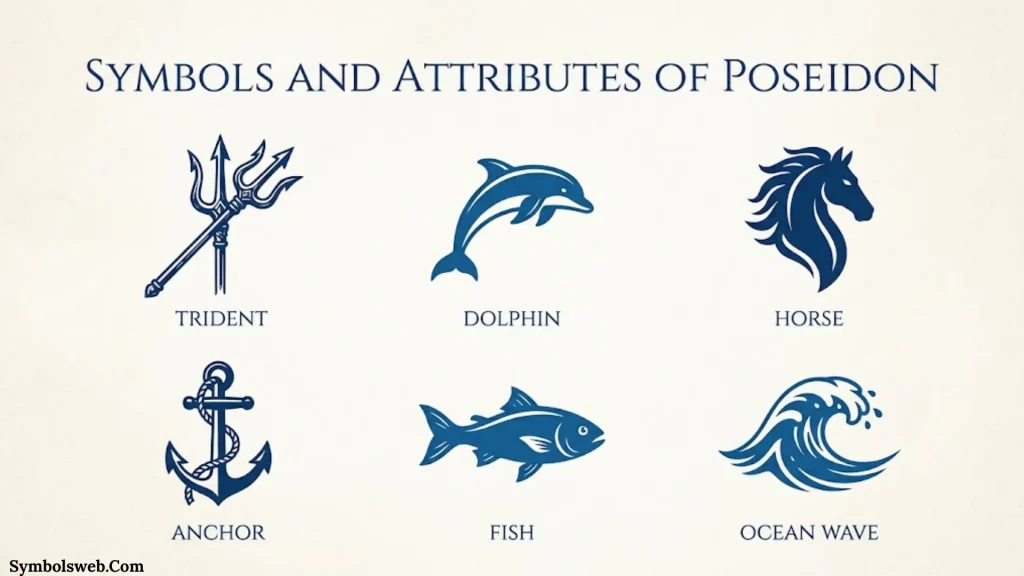
Poseidon’s most recognizable symbols are the trident, dolphin, horse, and bull. However, ancient artwork also includes other details that help identify his character.
Fishing Spear
The trident resembles a three-pronged fishing spear. This connection makes sense because ancient communities depended heavily on fishing and other activities connected with the sea.
The fishing spear also reflects Poseidon’s authority over marine resources. However, it is generally treated as the same central attribute as his trident rather than a completely separate symbol.
Long Beard and Hair
Ancient Greek artists commonly portrayed Poseidon as a mature, strong man with a beard and long hair.
His appearance often resembles Zeus, but the trident helps distinguish him. His powerful expression and flowing hair can also reflect the changing nature of the sea.
A beard or hairstyle is an artistic feature rather than a separate sacred emblem.
Marine Creatures
Fish, dolphins, hippocamps, and other sea creatures appear in scenes connected with Poseidon. These animals help establish the setting of his underwater kingdom.
Not every marine animal was exclusively sacred to him. Some simply represent the ocean and the wider world of sea deities.
Wild Celery and Other Plants
Some classical references associate Poseidon with wild celery and the pine tree. Wild celery wreaths also appear in ancient Greek athletic traditions.
These plant associations receive less attention than his trident and sacred animals. They are still useful details when studying the wider range of Poseidon’s attributes.
Poseidon and Athena’s Contest for Athens
One of the most famous stories about Poseidon involves his competition with Athena, the goddess of wisdom and warfare. Both gods wanted to become the patron deity of Athens.
The city needed a divine protector, so the gods decided that each competitor should offer a gift. The people would choose the gift they considered most useful.
What Gift Did Poseidon Give Athens?
Poseidon struck the ground with his trident and produced a saltwater spring. In some versions of the story, he created a saltwater source or offered a powerful horse.
His gift demonstrated his authority over water and his ability to create something extraordinary. However, the saltwater was not as useful to the people as they had hoped.
What Gift Did Athena Give Athens?
Athena created an olive tree. The tree provided food, olive oil, and wood. People could use olive oil for cooking, lighting, skincare, and other everyday needs.
The olive tree offered lasting practical value. The people therefore chose Athena as their patron goddess, and the city became known as Athens.
| God or goddess | Gift | Symbolic meaning |
| Poseidon | Saltwater spring | Sea power and divine strength |
| Athena | Olive tree | Wisdom, peace, prosperity, and practical value |
This story explains why the olive tree became closely associated with Athena rather than Poseidon. Ancient artwork also represented the contest through scenes showing the two gods facing each other.
Poseidon’s Powers and Abilities
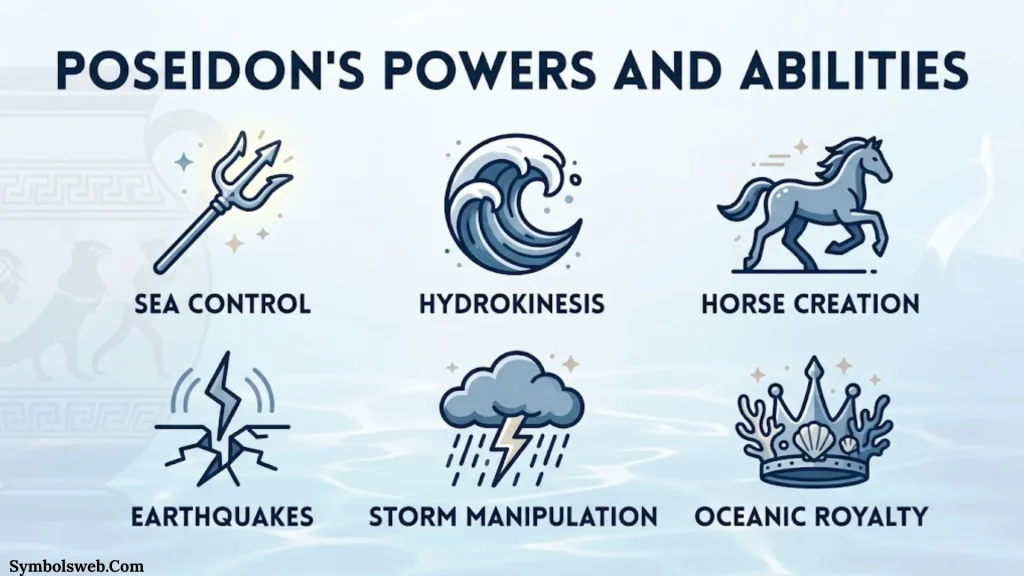
Poseidon possessed extraordinary powers that reflected his control over the sea and other natural forces. His abilities made him one of the most feared Olympian gods.
Control Over the Sea
Poseidon could create waves, calm rough waters, and produce powerful storms. Sailors believed their safety depended partly on keeping him satisfied.
Creating Earthquakes
His title Earth-Shaker refers to his ability to cause earthquakes. Ancient Greeks believed he could shake the ground with his movements or strike it with his trident.
Creating Horses
Poseidon had a special connection with horses. Some myths credit him with creating the first horse, while others connect him with supernatural horses such as Arion.
Controlling Storms
Poseidon could raise dangerous winds and waves. His anger could make sea travel difficult and place ships in serious danger.
Creating Springs
Greek mythology connects Poseidon with the appearance of springs and other sources of water. The saltwater spring he created during his contest with Athena is one famous example.
Protecting Sailors
Although Poseidon could be destructive, he was not always hostile to humans. Sailors prayed to him for favorable conditions and safe journeys. Some myths also describe him helping heroes during difficult sea voyages.
Famous Myths About Poseidon
Poseidon’s symbols become easier to understand when you explore the stories behind them. Greek mythology presents him as a powerful god whose actions could affect gods, heroes, cities, and ordinary people.
Poseidon and the Titanomachy
The Titanomachy was the great war between the Olympian gods and the Titans.
Poseidon fought beside his brothers Zeus and Hades. According to mythology, the Cyclopes gave the three brothers special weapons that helped them defeat their enemies.
After the Olympians won, the brothers divided the cosmos. Poseidon received the sea and became its ruler.
This story explains why the trident became his main symbol and why he held such a powerful position among the gods.
Poseidon and the Creation of Horses
Several Greek traditions connect Poseidon with the creation of horses. These stories explain why people worshiped him as a horse god as well as the ruler of the sea.
In one tradition, Poseidon created the first horse. Other versions connect the animal’s origin with his relationship with Demeter.
The horse became one of his sacred animals and appeared in religious ceremonies, artwork, and stories about his divine power.
Poseidon and Odysseus
Poseidon’s conflict with Odysseus is one of the central events in Homer’s Odyssey.
During his journey home from the Trojan War, Odysseus and his men enter the cave of Polyphemus, a Cyclops and son of Poseidon. Odysseus blinds Polyphemus to escape.
The Cyclops then asks his father to punish Odysseus. Poseidon responds by making the hero’s journey difficult. He sends storms and creates obstacles that delay Odysseus’s return to Ithaca.
This myth shows the destructive side of Poseidon’s power. It also explains why the sea becomes such a dangerous obstacle throughout the epic.
Poseidon and the Trojan War
Poseidon plays an important role in the events surrounding the Trojan War.
In Homer’s Iliad, he supports the Greek side during parts of the conflict. He helps the Greek warriors when they struggle against the Trojans.
His actions reveal that Poseidon did not always support the same side in every conflict. His relationships with other gods and his personal interests influenced his decisions.
Poseidon and Amphitrite
Amphitrite was Poseidon’s wife and a sea goddess associated with the Nereids in many traditions.
One popular story describes Poseidon falling in love with Amphitrite. She initially avoids him, but a dolphin helps bring them together. Poseidon later rewards the dolphin by placing it among the stars as the constellation Delphinus.
This story offers another explanation for the dolphin’s close association with Poseidon’s world.
How Ancient Greeks Worshiped Poseidon
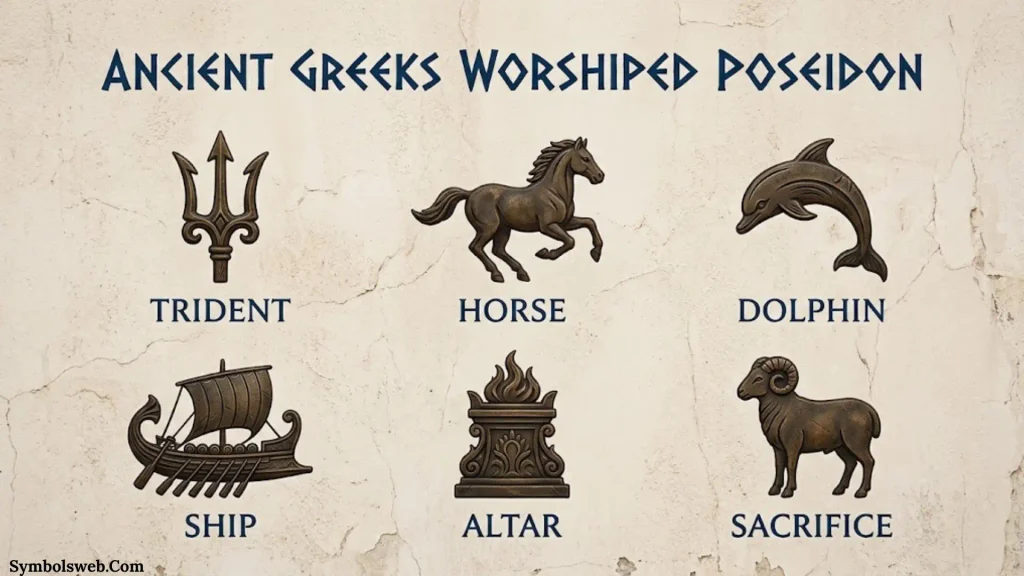
Poseidon was an important deity for communities that depended on the sea, horses, trade, and agriculture. People prayed to him for safe voyages, favorable weather, and protection from earthquakes.
His worship was not limited to coastal settlements. Ancient communities also honored him inland because they associated him with horses, springs, and earthquakes.
Prayers and Offerings
Sailors and sea travelers prayed to Poseidon before dangerous journeys. They hoped he would keep the waters calm and protect their ships.
Ancient Greeks also made offerings at his sanctuaries. Religious practices differed between communities and periods, but offerings and sacrifices formed part of his worship.
Temple of Poseidon at Cape Sounion
The Temple of Poseidon at Cape Sounion is one of the best-known ancient sites dedicated to the god.
The temple stands on a rocky headland overlooking the Aegean Sea in southern Attica, Greece. Its position made it a striking landmark for people traveling by sea.
The surviving temple dates to the fifth century BCE. Its columns and coastal setting still make it one of Greece’s most recognizable archaeological sites.
Sanctuary of Poseidon at Isthmia
The Sanctuary of Poseidon at Isthmia was another important center of his worship. It stood near the Isthmus of Corinth and hosted religious activities and athletic competitions.
The famous Isthmian Games honored Poseidon. These games included athletic events and competitions connected with the cultural life of ancient Greece.
Poseidon at Tinos
The island of Tinos also had an important sanctuary associated with Poseidon. The National Archaeological Museum of Greece identifies Tinos, Isthmia, and Cape Sounion among the notable places connected with his worship.
Poseidon in Ancient Greek Art
Ancient Greek artists used recognizable attributes to show Poseidon in pottery, sculpture, coins, and other objects.
The trident was his clearest identifying feature. Artists also showed him with dolphins, horses, and hippocampus.
He usually appeared as a mature, strong man with a beard and long hair. Some works showed him standing with his trident while others presented him riding a chariot through the sea.
Coins from ancient Greek cities sometimes featured Poseidon or his trident. These images helped connect the god with local identity, religious devotion, and maritime power.
Mythoi Koinoi+2
Poseidon in Modern Culture
Poseidon’s symbols continue to appear in books, movies, games, artwork, and popular culture.
His trident is especially recognizable because it immediately suggests control over the ocean. Modern artists often use it to represent a powerful sea ruler or a character with water-based abilities.
His horses and sea creatures also remain popular in fantasy stories. The hippocamp, for example, appears in modern interpretations of ancient mythology because its horse-like body and fish tail make it a natural symbol of the underwater world.
Poseidon also appears in modern adaptations of Greek myths, including stories about Percy Jackson and other fictional heroes. These versions may change details to suit their stories, so they should not be treated as exact accounts of ancient Greek beliefs.
Poseidon vs. Neptune: Are They the Same God?
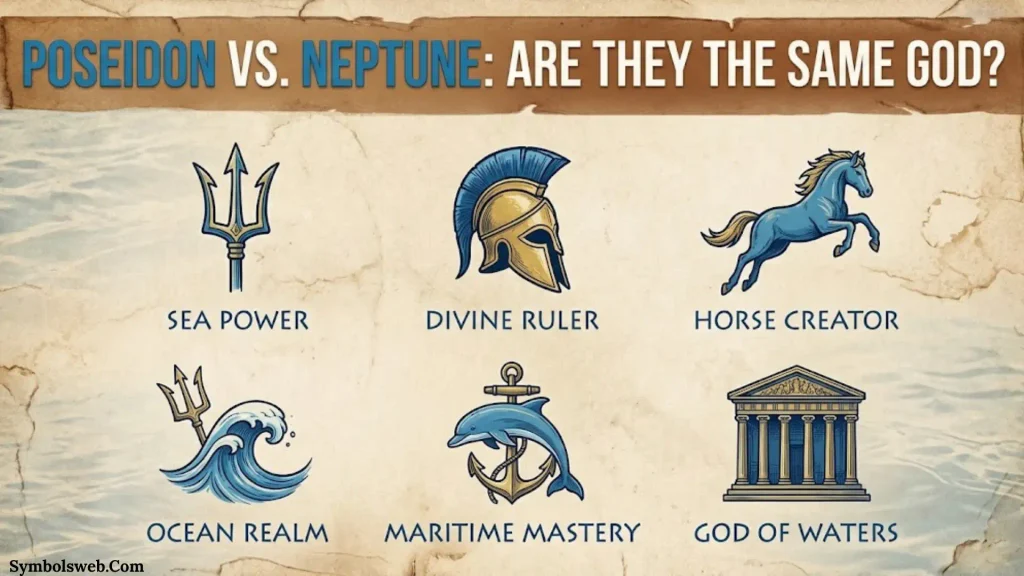
Poseidon is the Greek god of the sea, while Neptune is his Roman counterpart.
When Roman culture adopted many Greek myths, it identified Neptune with Poseidon. As a result, the two gods share many familiar attributes, including the trident, dolphin, and horse.
However, they developed within different religious traditions.
| Poseidon | Neptune |
| Greek god | Roman god |
| Associated with the Greek sea | Associated with Roman waters |
| Appears in Greek mythology | Appears in Roman mythology |
| Carries a trident | Carries a trident |
| Associated with horses and dolphins | Shares many of Poseidon’s artistic attributes |
Their similarities explain why modern artwork sometimes uses the names interchangeably. Still, Poseidon belongs to Greek mythology and Neptune belongs to Roman mythology.
Poseidon Symbols Compared With Other Greek Gods
Poseidon’s symbols can sometimes be confused with the attributes of other Olympian gods. Understanding the differences helps you recognize them in ancient artwork.
| Greek god | Main symbols | What they represent |
| Poseidon | Trident, dolphin, horse | Sea, earthquakes, and horses |
| Zeus | Thunderbolt, eagle, oak tree | Sky, kingship, and authority |
| Hades | Helmet of invisibility, Cerberus | Underworld and the dead |
| Athena | Owl, olive tree, helmet | Wisdom, strategy, and warfare |
| Apollo | Lyre, bow, laurel | Music, prophecy, and healing |
| Hermes | Winged sandals, caduceus | Messages, travel, and trade |
The trident is Poseidon’s most distinctive attribute. Zeus’s thunderbolt and Athena’s owl are equally useful clues when identifying the other gods.
What Do Poseidon’s Symbols Mean Together?
Each symbol reveals a different part of Poseidon’s identity. When you consider them together, they show why ancient Greeks viewed him as a god of both creation and destruction.
| Symbol | Main meaning | Connection to Poseidon |
| Trident | Authority and power | His control over the sea and earthquakes |
| Dolphin | Marine life and protection | His connection with sea creatures and sailors |
| Horse | Strength and speed | His role as a protector of horses |
| Bull | Force and physical power | His connection with powerful animals and sacrifice |
| Ocean | Mystery and divine authority | His kingdom beneath the waves |
| Waves | Change and natural force | His ability to calm or disturb the sea |
| Chariot | Movement and command | His journeys across the ocean |
| Hippocamp | Sea and horse symbolism | His mythical underwater world |
These symbols also reveal an important part of Poseidon’s personality. He could protect sailors, create horses, and provide water. Yet he could also cause earthquakes, floods, and violent storms.
His symbols therefore represent more than the ocean. They reflect the unpredictable forces of nature that ancient Greeks believed were controlled by the gods.
Frequently Asked Questions About Poseidon Symbols
What Is Poseidon’s Main Symbol?
Poseidon’s main symbol is the trident, a three-pronged spear. It represents his authority over the sea, his ability to create storms, and his power to cause earthquakes.
What Animals Are Sacred to Poseidon?
The main animals associated with Poseidon are the horse, dolphin, and bull. Horses connect him with strength and speed while dolphins represent marine life. Bulls reflect physical power and appear in traditions connected with his worship.
Why Does Poseidon Carry a Trident?
Poseidon carries a trident because it represents his divine power over the sea and other natural forces. Greek mythology says the Cyclopes forged it during the war against the Titans.
What Does Poseidon’s Dolphin Symbolize?
The dolphin represents Poseidon’s connection with marine life and the ocean. It is also associated with protection and safe sea journeys in ancient stories and artistic traditions.
Why Is the Horse a Symbol of Poseidon?
Poseidon was worshiped as Poseidon Hippios, the god associated with horses. Greek myths credit him with creating horses and protecting them. His connection with horses also appears in chariot racing and ancient religious traditions.
Is the Bull a Symbol of Poseidon?
Yes. The bull was one of Poseidon’s sacred animals. It represented strength and force and appeared in ancient religious traditions involving sacrifice.
What Does Poseidon’s Trident Represent?
The trident represents authority, control, and the power of nature. It shows Poseidon’s ability to raise waves, calm storms, and cause earthquakes. There is no established ancient explanation assigning a separate meaning to each of its three prongs.
What Is Poseidon’s Roman Name?
Poseidon’s Roman counterpart is Neptune. Both gods share important attributes, including the trident, dolphin, and horse.
What Is Poseidon’s Sacred Animal?
Poseidon is most strongly associated with the horse, dolphin, and bull. Ancient Greek sources and artistic traditions identify all three as animals connected with him.
What Is Poseidon’s Connection to Earthquakes?
Poseidon was known as the Earth-Shaker because ancient Greeks believed he could cause earthquakes. His power extended beyond the sea and included destructive movements of the earth.
Conclusion
Poseidon’s symbols reveal why he was one of the most powerful and respected gods in Greek mythology. The trident represents his authority over the sea and earthquakes while the dolphin connects him with marine life and sailors. The horse reflects his strength and role as a divine protector of horses. The bull represents physical force and appears in stories and religious traditions associated with him.
Together, these symbols show Poseidon’s many roles in the ancient Greek world. He was more than the god of the ocean. He represented the strength, mystery, danger, and unpredictability of nature. Learning about his symbols helps you understand how ancient Greeks explained the powerful forces that shaped their everyday lives.

Hi, I’m Ethan Holloway, and I’ve always believed that a few meaningful words can change the way we think, feel, and live. I enjoy collecting timeless quotes, studying their deeper meanings, and sharing inspiring messages that help people stay motivated through every stage of life.
Over the years, I’ve explored thousands of famous sayings from writers, leaders, philosophers, and everyday people. My goal is to make wisdom easy to understand and useful for everyone.
Books by Ethan Holloway
- The Power of Everyday Quotes
- Words That Inspire Greatness
 Jordan Hayes