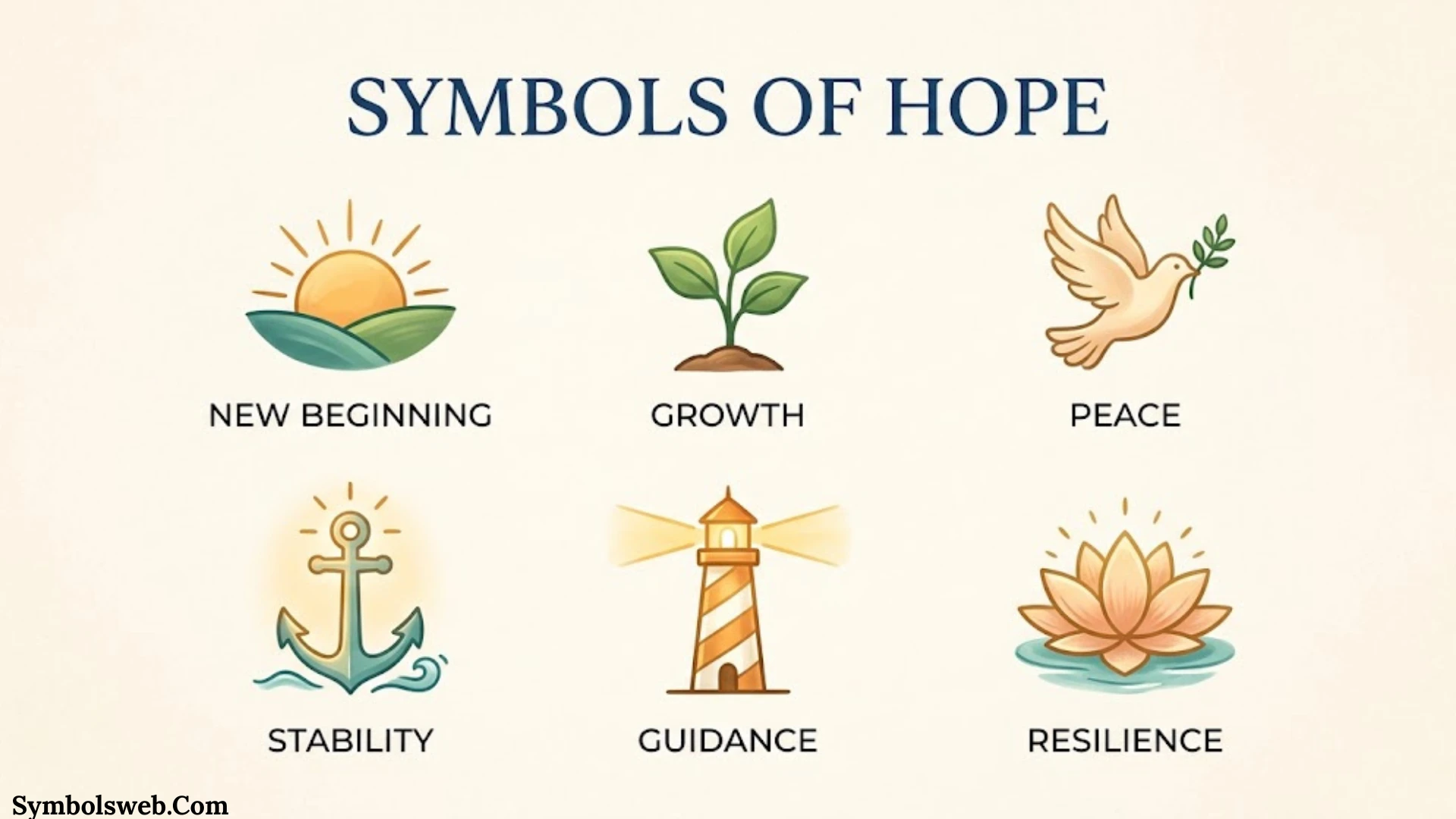
Hope gives you the strength to keep moving when life feels uncertain. It reminds you that difficult moments can pass and better days may still be ahead. Across different cultures and generations, people have used symbols to express this feeling.
Some symbols of hope come from nature. A butterfly represents transformation while a sunflower turns toward the light. Others come from religion, mythology, history, and everyday life. The phoenix, for example, represents renewal after destruction. An anchor can remind you to stay strong during difficult times.
These symbols carry different meanings depending on their cultural and historical backgrounds. Some have represented hope for centuries while others gained their meaning through more recent events. Understanding their stories helps you choose a symbol that reflects what hope means to you.
What Are Symbols of Hope?
Symbols of hope are images, objects, animals, plants, colors, or signs that represent optimism, renewal, faith, strength, and the possibility of a better future.
People use these symbols to express feelings that words sometimes cannot explain. A small green sprout can represent a fresh start. A lighthouse can remind someone that guidance is possible during a difficult period. A dove may represent peace and the hope of reconciliation.
Hope symbols appear in many areas of life, including:
- Religion and spirituality: The cross, rainbow, dove, and lotus.
- Nature: Butterflies, flowers, trees, and birds.
- Mythology: The phoenix, Elpis, and other legendary figures.
- Cultural traditions: The Chinese fenghuang, Celtic knots, and Māori fish hook.
- Everyday objects: Anchors, candles, lanterns, and horseshoes.
- Art and personal expression: Jewelry, tattoos, paintings, and meaningful gifts.
Not every symbol has one universal meaning. Its interpretation can change across cultures, religions, historical periods, and personal experiences.
Animals, Birds, and Insects That Symbolize Hope

Animals and insects often represent hope because their natural behaviors remind people of change, survival, freedom, and new beginnings. Their meanings come from mythology, cultural traditions, religious stories, and observations of nature.
Butterfly: Transformation and New Beginnings
The butterfly is one of the most recognizable symbols of hope. Its life cycle provides a powerful example of transformation. It begins as an egg, becomes a caterpillar, develops inside a chrysalis, and eventually emerges with wings.
This transformation makes the butterfly a symbol of personal growth, change, and new beginnings. It reminds you that difficult stages do not have to define your entire life.
In many cultures, butterflies also appear in stories about the soul, love, and spiritual transformation. In ancient Greek tradition, the word psyche could refer to both the soul and a butterfly.
Chinese art and literature also give butterflies positive associations. They can represent joy, happiness, and romantic love. The Metropolitan Museum of Art discusses the butterfly’s role in Chinese decorative traditions and its association with longevity.
Common meanings of the butterfly include:
- Personal transformation
- New beginnings
- Freedom and independence
- Emotional growth
- Hope after difficult experiences
- Spiritual renewal
A butterfly tattoo or piece of jewelry can represent the decision to move forward and embrace change.
Hummingbird: Joy and Resilience
The hummingbird represents joy, energy, and resilience in many modern symbolic interpretations. Its small body and remarkable ability to hover and fly backward make it an impressive example of movement and adaptability.
Hummingbirds are also important in some Indigenous American cultural traditions. However, their meanings differ between communities and should not be treated as one universal belief.
As a modern symbol of hope, the hummingbird can remind you to appreciate small moments of happiness even when life feels difficult. Its energetic movement suggests that progress does not always require large steps.
People often associate hummingbirds with:
- Joy and happiness
- Resilience during hardship
- Freedom
- Adaptability
- Appreciation of life
- Positive energy
Cardinal: Hope, Comfort, and Remembrance
The cardinal is a bright red bird that stands out against winter landscapes. Its color and ability to remain active during colder months have helped make it a modern symbol of vitality and encouragement.
In popular spiritual belief, some people interpret a cardinal’s appearance as a comforting message from a loved one who has died. This is a personal or spiritual interpretation rather than a scientifically established fact.
The cardinal can also represent:
- Strength during difficult times
- Remembrance
- Comfort and encouragement
- Vitality
- Hope during winter
- Love and connection
For someone experiencing grief, the cardinal may serve as a personal reminder of a relationship that remains meaningful.
Dove: Peace and Hope
The dove is a widely recognized symbol of peace. It also represents hope, reconciliation, purity, and the possibility of a fresh start.
In the biblical story of Noah’s Ark, a dove returns carrying an olive leaf. The sign tells Noah that the floodwaters are receding and that the earth is becoming habitable again. This story helped establish the dove and olive branch as powerful images of renewal and peace.
Doves also appear in Christian art as symbols associated with the Holy Spirit.
Common meanings include:
- Peace after conflict
- Hope for a better future
- Reconciliation
- Spiritual guidance
- Love and purity
- Freedom
A white dove is often used in ceremonies and artwork to express peaceful intentions.
Dragonfly: Change and Adaptability
The dragonfly is often associated with transformation because it spends much of its life developing in water before emerging as a flying adult.
This change makes it a meaningful symbol of personal development and adaptability. Its ability to move quickly in different directions can also suggest flexibility when facing unexpected challenges.
In modern symbolism, the dragonfly commonly represents:
- Change and transformation
- Self-discovery
- Emotional maturity
- Adaptability
- Lightness and freedom
- New perspectives
A dragonfly can remind you that change may feel uncomfortable at first but it can also open the door to growth.
Phoenix: Rebirth and Renewal
The phoenix is a legendary bird famous for rising again after its death or destruction. Its story has made it one of the strongest symbols of hope and rebirth.
The phoenix appears in different ancient traditions, although its stories and details vary. In later Christian interpretations, the bird became associated with resurrection and eternal life.
The phoenix represents the idea that an ending does not always mean defeat. Sometimes a new beginning comes after a painful experience.
Its common symbolic meanings include:
- Rebirth after hardship
- Strength and courage
- Renewal
- Resurrection
- Transformation
- Overcoming failure
The phoenix is especially popular in tattoos because it expresses survival and the determination to begin again.
Ladybug: Good Fortune and Positive Change

The ladybug is often treated as a sign of good luck in European folk traditions and modern popular culture. Its bright appearance and harmless reputation have helped make it a familiar positive symbol.
Some traditions connect seeing a ladybug with good fortune, protection, or a welcome change. These associations vary and are based on folklore rather than scientific evidence.
The ladybug can represent:
- Good luck
- Happiness
- Protection
- Positive change
- New opportunities
- Hope for better days
Firefly: Light in Darkness
The firefly produces its own light through a biological process called bioluminescence. This natural glow has made it a popular symbol of hope and inspiration.
A firefly’s light can be seen in the darkness of a summer evening. For many people, this creates a meaningful image of finding brightness during difficult periods.
Fireflies can symbolize:
- Hope during dark times
- Inner light
- Inspiration
- Small moments of happiness
- Guidance
- Spiritual awareness
The firefly offers a simple reminder: even a small light can make darkness feel less overwhelming.
Starfish: Renewal and Regeneration
The starfish, more accurately called a sea star, is associated with renewal and resilience in modern symbolism.
Some sea stars can regenerate lost arms. However, the ability varies by species and does not mean every sea star can grow an entirely new body from any detached part.
This natural ability makes the sea star a meaningful symbol of recovery and regeneration.
It can represent:
- Healing
- Resilience
- Renewal
- Strength after loss
- Patience
- Hope for recovery
Albatross: Endurance and Safe Journeys
The albatross is a large seabird known for its ability to travel long distances over the ocean. Its endurance has made it a symbol of long journeys and perseverance in some literary and symbolic interpretations.
The bird also appears in Samuel Taylor Coleridge’s poem The Rime of the Ancient Mariner. In that work, the albatross carries a more complicated meaning connected with guilt and consequences.
As a symbol of hope, the albatross can represent:
- Endurance
- Freedom
- Long journeys
- Perseverance
- Safe passage
- The courage to continue
Koi Fish: Perseverance and Success
The koi fish holds an important place in Japanese and Chinese decorative traditions. Its association with strength and perseverance comes partly from stories about koi swimming upstream.
A well-known Chinese legend describes carp crossing the Dragon Gate and transforming into dragons. The story became associated with determination and achievement.
Koi commonly symbolize:
- Perseverance
- Courage
- Strength
- Good fortune
- Success
- Overcoming obstacles
Different koi colors can carry additional meanings in modern decorative traditions. Interpretations vary, so color meanings should not be treated as universal rules.
Rooster: New Beginnings and Awakening
The rooster is associated with sunrise because its crowing often signals the beginning of the day. This connection has made it a symbol of awakening, alertness, and fresh starts.
In different cultural traditions, roosters can also represent courage, protection, and confidence.
As a symbol of hope, the rooster can stand for:
- A new day
- Fresh opportunities
- Confidence
- Courage
- Awareness
- Renewal
Unicorn: Purity and Possibility
The unicorn is a legendary creature that appears in European folklore, medieval art, and religious symbolism.
Its meaning has changed over time. Medieval Christian interpretations sometimes connected the unicorn with purity and Christ. In later popular culture, it became associated with magic, imagination, and extraordinary possibilities.
The unicorn can represent:
- Purity
- Innocence
- Imagination
- Spiritual hope
- Uniqueness
- Possibility
It is often used in children’s stories and artwork to express wonder and optimism.
Baby Animals: Innocence and New Life
Baby animals often symbolize hope because they represent the beginning of life. A newborn lamb, puppy, kitten, or bird can remind people of innocence, care, and future possibilities.
Their symbolic meanings include:
- New beginnings
- Innocence
- Growth
- Love and care
- Family
- The promise of life
These meanings are usually personal or cultural rather than tied to one specific ancient tradition.
Flowers, Plants, and Trees That Symbolize Hope

Plants are powerful symbols because they grow, bloom, change with the seasons, and sometimes return after harsh weather. Their natural cycles make them meaningful representations of hope, renewal, and perseverance.
Daffodil: Hope and New Beginnings
The daffodil is a spring flower commonly associated with renewal and fresh beginnings. It often blooms near the end of winter, making it a natural symbol of brighter days ahead.
In the United Kingdom, the daffodil is strongly associated with the arrival of spring and is also used as a symbol of support for cancer charities.
Its common meanings include:
- Hope
- New beginnings
- Renewal
- Rebirth
- Happiness
- Optimism
A daffodil can be a thoughtful gift for someone starting a new chapter in life.
Lotus Flower: Purity and Spiritual Growth
The lotus flower is one of the most meaningful spiritual symbols in Hinduism and Buddhism. It grows in muddy water yet can produce a beautiful flower above the surface.
This natural contrast makes it a symbol of spiritual development and purity despite difficult surroundings.
In Buddhism, the lotus is associated with awakening and the potential for enlightenment. In Hindu traditions, it appears in the imagery of several deities and can represent beauty, creation, and spiritual significance.
The lotus commonly symbolizes:
- Spiritual enlightenment
- Purity
- Rebirth
- Resilience
- Personal growth
- Hope through difficult circumstances
The lotus has a long history in Asian religious and artistic traditions. Its meanings are not limited to one simple idea. You can explore its history in the Journal of Experimental Botany article on plant symbolism.
Sunflower: Positivity and Optimism
The sunflower is often associated with happiness, warmth, and positivity because of its bright yellow petals and connection with sunlight.
Its appearance makes it a popular modern symbol of optimism and encouragement. Sunflowers also feature in art, gardens, and gifts that celebrate friendship and appreciation.
Sunflowers can represent:
- Happiness
- Hope
- Positivity
- Loyalty
- Warmth
- Confidence
A sunflower is a fitting symbol for someone who wants to focus on the brighter side of life.
Lily: Renewal and Spiritual Hope
The lily has different meanings across cultures and religious traditions. White lilies are commonly associated with purity and innocence in Christian art. They also appear in funeral arrangements as symbols of remembrance and the hope of renewed life.
The flower’s meaning depends on its color and context.
Common associations include:
- Purity
- Renewal
- Peace
- Sympathy
- Spiritual life
- Hope after loss
Iris: Hope and Wisdom
The iris is a flower with a rich history in art and symbolism. Its name comes from the Greek word associated with the rainbow and the Greek goddess Iris, who served as a messenger between gods and humans.
In different traditions, iris flowers have represented faith, wisdom, courage, and communication.
The iris can symbolize:
- Hope
- Wisdom
- Faith
- Courage
- Renewal
- Inspiration
Its different colors may carry additional meanings in modern flower-giving traditions.
Crocus: The Return of Spring
The crocus is among the flowers that can appear near the end of winter. Its early blooms make it a natural symbol of the return of life after a cold season.
For this reason, people often associate the crocus with hope, cheerfulness, and the arrival of better days.
It can represent:
- New beginnings
- Youthfulness
- Happiness
- Renewal
- Hope after hardship
- The end of a difficult season
Green Sprout: Growth and Fresh Starts

A green sprout emerging from soil is one of the simplest symbols of hope. It represents the beginning of growth and the possibility of something becoming stronger over time.
Even a tiny plant needs care, patience, water, and sunlight. Its development offers a useful reminder that meaningful progress often happens gradually.
A green sprout can symbolize:
- Fresh starts
- Personal development
- New opportunities
- Healing
- Growth
- Future potential
Four Leaf Clover: Luck and Good Fortune
The four-leaf clover is a popular symbol of good luck. It is a rare variation of the more common three-leaf clover.
In modern popular tradition, its four leaves are often associated with faith, hope, love, and luck. These meanings are widely repeated but are not a universal historical interpretation.
The four-leaf clover can represent:
- Good fortune
- Hope
- Faith
- Love
- Positive opportunities
- Happiness
It is important to distinguish the four-leaf clover from the shamrock, which traditionally has three leaves and is strongly connected with Irish identity and St. Patrick.
Acorn: Potential and Strength
An acorn may look small, but it can grow into a large oak tree under suitable conditions. This makes it a powerful symbol of potential and long-term growth.
The acorn reminds you that great achievements can begin with small actions.
It can symbolize:
- Future potential
- Strength
- Patience
- Growth
- Stability
- New beginnings
Birch Tree: Renewal and New Life
The birch tree is known for its pale bark and ability to grow in different environments. In some European traditions and modern interpretations, it represents renewal, purification, and new beginnings.
Its fresh growth after winter makes it a fitting symbol of hope.
The birch tree can represent:
- Renewal
- Fresh starts
- Protection
- Growth
- Adaptability
- New opportunities
Ginkgo Tree: Peace, Hope, and Endurance
The ginkgo tree has a long history and is known for its distinctive fan-shaped leaves. In several Asian cultural traditions, it has been associated with longevity, vitality, peace, and hope.
The ginkgo also gained a powerful modern connection with survival through Hiroshima. Some ginkgo trees survived the 1945 atomic bombing and later produced new growth.
One documented example is an A-bombed ginkgo tree at Anrakuji Temple in Hiroshima. The Hiroshima City government records its survival and renewed growth after the bombing.
The ginkgo can symbolize:
- Hope after destruction
- Peace
- Longevity
- Endurance
- Vitality
- Survival
Its connection with Hiroshima gives it a particularly meaningful place in modern discussions of resilience and peace.
Olive Branch: Peace and Reconciliation
The olive branch is an ancient symbol of peace. It appears in the biblical story of Noah’s Ark, where a dove returns with an olive leaf after the flood.
The branch communicates that the floodwaters are receding and that life can begin again. Over time, the olive branch also became a widely recognized symbol of peace and reconciliation.
It can represent:
- Peace after conflict
- Hope
- Forgiveness
- Reconciliation
- Renewal
- Friendship
The olive branch has represented peace for more than two thousand years, although its meaning has developed across different historical settings.
Everyday Objects That Symbolize Hope

Ordinary objects can carry powerful meanings. Their symbolism often comes from the way people use them or the stories attached to them.
Anchor: Stability and Strength
The anchor is a traditional nautical object that keeps a ship from drifting away. This practical purpose has made it a symbol of stability, security, and strength.
In Christian tradition, the anchor also became a symbol of hope and steadfast faith. It appears in early Christian art and is connected with the biblical image of hope as an anchor for the soul.
The anchor can represent:
- Hope during difficult times
- Faith
- Stability
- Strength
- Security
- Staying grounded
An anchor tattoo is often chosen to express loyalty, determination, or a strong personal foundation.
Lighthouse: Guidance and Safety
A lighthouse helps ships navigate dangerous coastlines and avoid hazards. Its light can be seen from a distance, making it a natural symbol of guidance and hope.
In literature and modern artwork, a lighthouse often represents someone or something that offers direction during uncertain times.
It can symbolize:
- Guidance
- Safety
- Protection
- Hope during hardship
- Finding direction
- Inner strength
A lighthouse is a meaningful choice for someone who has helped others through difficult experiences.
Candle: Light and Faith
A candle produces light in darkness. Across different religious and cultural traditions, candles are used in prayer, remembrance, ceremonies, and celebrations.
Their small flame can represent the persistence of hope even when circumstances feel difficult.
Candles commonly symbolize:
- Faith
- Hope
- Spiritual guidance
- Remembrance
- Peace
- Inner light
Lighting a candle for someone can also serve as a personal expression of love and support.
Rainbow: Promise and New Beginnings
A rainbow appears when sunlight interacts with water droplets in the atmosphere. Its colorful appearance has made it a symbol of beauty, renewal, and hope in many cultures.
In the Bible, the rainbow represents God’s covenant with Noah after the flood. In modern contexts, it can also represent diversity, inclusion, and LGBTQ+ pride.
The rainbow can symbolize:
- Hope after hardship
- Promise
- Renewal
- Peace
- Diversity
- New beginnings
Its meaning depends on the cultural, religious, or social context in which it appears.
Horseshoe: Good Luck and Protection

The horseshoe is a familiar symbol of good fortune in European folk traditions. People often hang one above a doorway as a sign of protection and luck.
Different traditions disagree about whether a horseshoe should point upward or downward. Some say the upward position holds good luck while others believe the downward position allows luck to flow over people.
The horseshoe can represent:
- Good luck
- Protection
- Prosperity
- Positive opportunities
- Hope
- Safety
Eight Pointed Star: Divine Power and Renewal
The eight pointed star appears in several ancient and modern artistic traditions. One important historical connection is its association with Ishtar, a major Mesopotamian goddess linked with love, war, and other aspects of divine power.
The star’s meaning depends on the period and culture in which it appears. It should not be treated as a universal symbol of hope.
In modern decorative and spiritual interpretations, it may represent:
- Renewal
- Divine guidance
- Balance
- Cosmic order
- Protection
- Spiritual awareness
Its historical connection with Ishtar makes it especially important in the study of ancient Mesopotamian symbolism.
Chinese Paper Lantern: Light and Celebration
Chinese paper lanterns are used in festivals, celebrations, and decorative traditions. Their warm light can represent happiness, celebration, and positive wishes.
Lantern traditions vary across China and other East Asian communities. During festivals, lanterns may carry wishes for good fortune, family happiness, and a successful future.
They can symbolize:
- Light
- Good fortune
- Celebration
- Family unity
- Happiness
- Hope for the future
Star of Bethlehem: Guidance and Faith
The Star of Bethlehem is connected with the Christian Nativity story. According to the Gospel of Matthew, a star guides the Magi toward the place where Jesus is born.
In Christian art and tradition, the star represents divine guidance, faith, and the arrival of hope through the birth of Christ.
Its common meanings include:
- Divine guidance
- Faith
- Hope
- Spiritual direction
- New beginnings
- The promise of salvation
Māori Fish Hook (Matau): Strength and Safe Passage
The matau, or traditional Māori fish hook, has an important place in Māori culture. Fishing hooks were practical tools used to obtain food and support communities.
In contemporary Māori jewelry and popular interpretation, the fish hook is often associated with strength, prosperity, safe travel, and connection with the sea.
Māui, a figure in Māori and wider Polynesian traditions, is also connected with a famous fish hook story. The details differ between versions and communities.
The matau can represent:
- Strength
- Prosperity
- Safe journeys
- Connection with the ocean
- Good fortune
- Cultural identity
It is important to understand the cultural background of the matau rather than treating it as a generic decorative symbol.
Biblical and Christian Symbols of Hope

Christian traditions use several symbols to express faith, salvation, renewal, and the promise of eternal life. Their meanings are connected with biblical passages, religious teachings, and centuries of Christian art.
The Cross: Faith and Eternal Hope
The cross is the central symbol of Christianity. It represents the crucifixion of Jesus Christ and is closely associated with sacrifice, salvation, and resurrection.
For Christians, the cross is also a symbol of hope because it points toward the belief that death is not the end and that new life is possible through faith.
It can represent:
- Faith in Jesus Christ
- Salvation
- Sacrifice
- Forgiveness
- Resurrection
- Eternal hope
The Dove: The Holy Spirit and Peace
The dove appears in Christian art as a symbol of the Holy Spirit. In the New Testament, the Spirit descends like a dove during the baptism of Jesus.
The dove also has a connection with Noah’s Ark and the return of hope after the flood.
Its Christian meanings include:
- The Holy Spirit
- Peace
- Purity
- Divine presence
- Renewal
- Hope
The Rainbow: God’s Covenant
In Genesis, the rainbow appears as a sign of God’s covenant with Noah and all living creatures after the flood.
It represents God’s promise and the continuation of life. For this reason, the rainbow is often interpreted as a symbol of hope, protection, and divine faithfulness.
The Olive Branch: Peace After the Flood
The olive branch in the story of Noah represents the return of dry land and the possibility of a new beginning.
It later became a broader symbol of peace and reconciliation. In Christian contexts, it can also remind believers of forgiveness and restored relationships.
Ichthys: Christian Faith
The Ichthys, commonly known as the Christian fish symbol, is an ancient sign associated with early Christianity.
The Greek word ichthys means fish. The letters were also used as an abbreviation for a Christian confession of faith: Jesus Christ, Son of God, Savior.
The fish symbol can represent:
- Christian identity
- Faith in Jesus
- Spiritual belonging
- Hope and salvation
- Religious community
Ancient and Mythological Symbols of Hope

Ancient myths often explore the struggle between destruction and renewal. Their stories offer explanations for life, death, nature, and the possibility of transformation.
Elpis: Hope in Greek Mythology
Elpis is the personification of hope in Greek mythology. She is best known from the story of Pandora’s jar, often called Pandora’s box.
In the familiar version of the myth, Pandora opens a container and releases troubles into the world. Hope remains inside, although the meaning of this detail has been debated by scholars and readers for centuries.
Some interpretations view Elpis as a comfort that remains available to humanity. Others question whether keeping hope inside the container has a more complicated meaning.
Elpis can represent:
- Hope during suffering
- Future possibilities
- Human endurance
- Optimism
- The desire for a better life
Phoenix: The Myth of Rising Again
The phoenix also belongs in ancient and mythological symbolism because its story has appeared in different traditions.
Its association with death and rebirth made it meaningful in later religious art and literature. In early Christian writing, the phoenix became an image used to discuss resurrection and life after death.
Osiris: Resurrection and the Afterlife
Osiris is an ancient Egyptian god associated with the afterlife, regeneration, and the cycle of life and death.
In Egyptian mythology, Osiris is killed and restored through the actions of Isis. He becomes ruler of the underworld and a major figure in Egyptian beliefs about death and the afterlife.
His story connects with ideas of renewal and continued existence beyond death.
Osiris can symbolize:
- Resurrection
- Regeneration
- The afterlife
- Renewal
- Fertility
- The continuation of life
Unicorn: Purity and Spiritual Meaning
The unicorn appears in ancient accounts and later European folklore. Medieval Christian writers sometimes interpreted it as a symbol of Christ and purity.
Its meaning changed across centuries, and modern interpretations often focus on imagination, wonder, and hope.
Chinese and Asian Symbols of Hope
Asian cultures have developed rich symbolic traditions involving animals, flowers, trees, and decorative objects. Some of these symbols represent prosperity and longevity while others express spiritual growth and good fortune.
Fenghuang: Harmony and Renewal
The fenghuang is a legendary bird in Chinese culture. It is sometimes called the Chinese phoenix, although it has its own history and symbolism.
The fenghuang is associated with virtue, harmony, prosperity, and favorable times. In traditional Chinese art, it can appear alongside the dragon as a symbol of complementary forces and imperial imagery.
It can represent:
- Harmony
- Virtue
- Prosperity
- Renewal
- Good fortune
- Peaceful rule
Qilin: Good Fortune and Benevolence
The qilin is a legendary creature in Chinese mythology. It is often described as a peaceful and auspicious being associated with kindness, wisdom, and good fortune.
Traditional stories and artwork connect the qilin with the arrival of wise rulers or important people. Its appearance is generally treated as a favorable sign.
The qilin can symbolize:
- Good fortune
- Benevolence
- Wisdom
- Protection
- Peace
- Prosperity
Koi Fish: Determination and Achievement
Koi fish are popular in Japanese gardens and decorative art. Their connection with perseverance comes from stories about carp swimming against strong currents.
The Dragon Gate legend describes a carp that succeeds in crossing a difficult waterfall and transforms into a dragon. This story became an image of determination and achievement.
Ginkgo: Longevity and Survival
The ginkgo tree has a long history in East Asian culture. It is associated with longevity and endurance because some trees can live for many centuries.
Its connection with Hiroshima also gives it a modern meaning of survival and hope after destruction.
Japanese Cherry Blossoms: Renewal and the Beauty of Life
Cherry blossoms, known as sakura in Japanese, are associated with spring and the temporary nature of life.
Their short blooming period reminds people that beauty can be brief and worth appreciating. In Japanese culture, cherry blossoms have a strong connection with seasonal change and reflection.
They can symbolize:
- Renewal
- New beginnings
- Beauty
- The passage of time
- Appreciation of life
- Hope
Chinese Lanterns: Light and Good Wishes
Chinese lanterns are used in several festivals and celebrations. They can express happiness, good fortune, and positive wishes.
Their light makes them a natural image of hope and celebration, especially when communities gather to mark important occasions.
Celtic, Norse, and Polynesian Symbols of Hope

Symbols from Celtic, Norse, and Polynesian traditions often connect with nature, spiritual beliefs, protection, and the cycles of life. Their meanings can be complex, so historical context matters.
Celtic Knot: Connection and Continuity
Celtic knots are decorative patterns made from interwoven lines. Many examples appear in medieval Irish and British manuscripts, metalwork, and stone carvings.
Their continuous designs are often interpreted today as symbols of eternity, unity, and interconnectedness. However, not every knot has one confirmed ancient meaning.
Modern symbolic interpretations include:
- Eternal life
- Unity
- Love
- Continuity
- Spiritual connection
- Hope
Triskelion: Movement and Cycles
The triskelion is a three-part spiral design found in ancient and later European art. It is especially associated with Celtic and other European cultural contexts.
Its three rotating arms are often interpreted in modern symbolism as representing movement, progress, and the cycles of life.
It can represent:
- Growth
- Progress
- Transformation
- Life cycles
- Balance
- Renewal
Triquetra: Unity and Interconnection
The triquetra is a three-pointed interlaced design found in historical European art. It is sometimes called the Trinity knot in Christian contexts.
Modern interpretations connect it with unity, eternity, and the relationship between three connected elements. In Christianity, it can represent the Father, Son, and Holy Spirit.
Yggdrasil: The Norse Tree of Life
Yggdrasil is the great world tree in Norse mythology. It connects different realms and stands at the center of the Norse mythological cosmos.
Its roots and branches link the worlds together. This makes it a symbol of connection, life, endurance, and the structure of existence.
Yggdrasil can represent:
- Life
- Connection
- Wisdom
- Endurance
- Growth
- The cycles of existence
Algiz Rune: Protection and Modern Hope
The Algiz rune is a character from the Elder Futhark runic alphabet. It is often associated with protection in modern rune interpretations.
However, its exact historical meaning is debated. Modern spiritual and tattoo meanings should not automatically be presented as proven beliefs held by all ancient Norse people.
Today, some people use Algiz as a symbol of protection, awareness, and spiritual strength.
Matau: Connection and Safe Travel
The Māori fish hook, or matau, is a meaningful cultural object connected with fishing and the ocean.
In modern jewelry and popular symbolism, it often represents safe journeys, strength, prosperity, and a connection with the sea.
Its meaning is best understood through Māori cultural context rather than through a generic list of spiritual symbols.
Shamrock: Irish Identity and Faith
The shamrock is a three-leaf plant strongly associated with Ireland and St. Patrick.
According to traditional accounts, St. Patrick used the three leaves to explain the Christian idea of the Holy Trinity. The shamrock later became an important symbol of Irish identity.
It can represent:
- Irish heritage
- Faith
- Unity
- Cultural pride
- Good fortune
The shamrock is different from the four-leaf clover, which is more commonly associated with luck.
Spiritual and Emotional Meanings of Hope Symbols

Hope symbols do more than decorate a space or express cultural identity. They can also help people communicate feelings and personal values.
Symbols of Hope and Faith
Faith and hope are closely connected in many religious and spiritual traditions. A cross, dove, candle, or lotus can represent trust in something beyond present difficulties.
These symbols may remind people to remain patient and continue moving forward.
Symbols of Healing and Recovery
Some symbols are used to express recovery after emotional or physical hardship. A lotus can represent growth through difficult conditions while a green sprout can represent a fresh start.
A butterfly may also express the personal changes that come with healing.
Symbols of Strength and Courage
The phoenix, oak tree, anchor, and koi fish are popular symbols of strength and perseverance.
They represent different forms of resilience. The phoenix focuses on rebirth while the anchor suggests stability and the koi represents determination.
Symbols of New Beginnings
Some symbols are closely connected with the start of a new chapter.
Examples include:
- Daffodil: The return of spring.
- Butterfly: Transformation and personal growth.
- Sunrise: The beginning of a new day.
- Green sprout: Early growth and fresh opportunities.
- Rainbow: Hope after a storm.
- Crocus: Renewal after winter.
Symbols of Peace and Reconciliation
The dove and olive branch are two of the most widely recognized symbols of peace.
They can represent forgiveness, the end of conflict, and the desire to rebuild relationships.
The white flag is another familiar sign of surrender or a request to stop fighting. Its meaning is more specific to conflict and negotiation than general hope.
Symbols of Hope After Loss
Grief can make hope difficult to express. Some people use a cardinal, candle, butterfly, or white lily as a personal symbol of remembrance.
These symbols do not remove sadness. Instead, they can provide a meaningful way to remember someone and acknowledge the possibility of healing.
Light After Darkness
Light is a common metaphor for hope. A candle, lighthouse, lantern, or firefly can represent guidance and encouragement during uncertain times.
The idea is simple: even a small source of light can help you find your way.
Colors That Symbolize Hope
Colors can communicate feelings and ideas without using words. Their meanings vary across cultures, religions, and personal experiences.
| Color | Common symbolic meanings |
| Green | Growth, renewal, nature, and fresh beginnings |
| Yellow | Happiness, warmth, optimism, and energy |
| Blue | Peace, trust, calmness, and stability |
| White | Purity, peace, innocence, and spiritual renewal |
| Pink | Love, kindness, compassion, and tenderness |
| Purple | Spirituality, wisdom, dignity, and reflection |
Green: Growth and Renewal
Green is strongly connected with plants and the natural world. It often represents growth, health, renewal, and new beginnings.
A green sprout or leaf can communicate the idea that life continues to develop even after a difficult season.
Yellow: Happiness and Optimism
Yellow is often associated with sunlight, warmth, and happiness. It can create a cheerful feeling and suggest a positive outlook.
Sunflowers and daffodils are popular examples of yellow symbols connected with hope.
Blue: Peace and Trust
Blue is commonly associated with calmness, trust, and stability. It can represent the peaceful state people hope to find during stressful times.
White: Purity and Peace
White is used in different cultures to express purity, innocence, and peace. In some traditions, it is also connected with mourning and remembrance.
Its meaning depends strongly on cultural context.
Pink: Love and Compassion
Pink is often associated with affection, kindness, and care. It can represent the emotional support that helps people remain hopeful.
Purple: Wisdom and Spirituality
Purple has been associated with royalty, spirituality, and wisdom in different historical traditions. In modern symbolism, it can express reflection, dignity, and inner strength.
Popular Symbols of Hope and Their Meanings
The following table provides a quick comparison of the symbols covered in this guide.
| Symbol | Main meaning | Common association |
| Butterfly | Transformation | New beginnings |
| Hummingbird | Joy | Resilience |
| Cardinal | Remembrance | Comfort |
| Dove | Peace | Reconciliation |
| Dragonfly | Change | Adaptability |
| Phoenix | Rebirth | Overcoming hardship |
| Ladybug | Good fortune | Positive change |
| Firefly | Light | Hope during darkness |
| Starfish | Renewal | Recovery |
| Albatross | Endurance | Long journeys |
| Koi fish | Perseverance | Achievement |
| Rooster | Awakening | Fresh starts |
| Unicorn | Purity | Possibility |
| Daffodil | Renewal | Spring |
| Lotus | Spiritual growth | Purity |
| Sunflower | Positivity | Happiness |
| Lily | Renewal | Peace |
| Iris | Wisdom | Faith |
| Crocus | New beginnings | Spring |
| Green sprout | Growth | Fresh opportunities |
| Four-leaf clover | Good luck | Fortune |
| Acorn | Potential | Strength |
| Birch tree | Renewal | Adaptability |
| Ginkgo tree | Endurance | Survival |
| Olive branch | Peace | Reconciliation |
| Anchor | Stability | Faith |
| Lighthouse | Guidance | Safety |
| Candle | Light | Spiritual hope |
| Rainbow | Promise | Renewal |
| Horseshoe | Good luck | Protection |
| Eight-pointed star | Divine power | Ancient Mesopotamia |
| Paper lantern | Light | Celebration |
| Star of Bethlehem | Guidance | Christian faith |
| Matau | Strength | Safe journeys |
| Cross | Salvation | Christian faith |
| Ichthys | Faith | Early Christianity |
| Elpis | Hope | Greek mythology |
| Osiris | Resurrection | Ancient Egypt |
| Fenghuang | Harmony | Chinese culture |
| Qilin | Benevolence | Good fortune |
| Cherry blossom | Renewal | Japanese culture |
| Celtic knot | Continuity | Celtic art |
| Triskelion | Movement | Cycles of life |
| Triquetra | Unity | Interconnection |
| Yggdrasil | Life | Norse mythology |
| Algiz | Protection | Modern rune symbolism |
| Shamrock | Faith | Irish heritage |
How to Choose a Symbol of Hope
The best symbol of hope is one that reflects your personal experience, beliefs, or goals. You do not need to choose the most famous symbol. A small object or natural image may have a deeper meaning for you.
Consider what you want the symbol to express.
Choose a Symbol for a Fresh Start
If you are beginning a new chapter, consider:
- Butterfly
- Daffodil
- Green sprout
- Crocus
- Sunrise
- Rainbow
These symbols are associated with growth, transformation, and renewal.
Choose a Symbol for Strength
If you want a reminder to stay strong during difficult times, consider:
- Phoenix
- Anchor
- Koi fish
- Oak tree
- Ginkgo tree
- Albatross
Each represents a different form of perseverance or endurance.
Choose a Symbol for Peace
If your goal is to express calmness and reconciliation, consider:
- Dove
- Olive branch
- White lily
- Blue color
- Candle
These symbols can communicate a desire for peace and emotional balance.
Choose a Symbol for Healing
If you want to represent recovery and personal growth, consider:
- Lotus
- Butterfly
- Green sprout
- Dragonfly
- Starfish
They can serve as reminders that healing and change often take time.
Choose a Symbol for Faith
If you want a symbol connected with religious belief, consider:
- Cross
- Ichthys
- Dove
- Star of Bethlehem
- Lotus
Choose a symbol that respects the tradition and beliefs behind it.
Symbols of Hope for Tattoos and Jewelry

Hope symbols are popular choices for tattoos, necklaces, bracelets, rings, and other personal accessories. Their compact designs can carry meaningful messages.
Some popular choices include:
- Butterfly tattoo: Represents transformation and personal growth.
- Phoenix tattoo: Expresses rebirth and strength after hardship.
- Anchor necklace: Represents stability and faith.
- Lotus pendant: Reflects spiritual growth and purity.
- Dove tattoo: Represents peace and reconciliation.
- Four leaf clover jewelry: Expresses good luck and optimism.
- Sunflower design: Represents happiness and positivity.
- Ginkgo leaf pendant: Can express endurance and hope.
- Celtic knot jewelry: Represents continuity and connection.
Before choosing a cultural or religious symbol, learn about its original meaning. Some designs have specific significance within particular communities. Understanding that background helps you use the symbol respectfully.
Frequently Asked Questions About Symbols of Hope
What Is the Most Powerful Symbol of Hope?
The phoenix is one of the strongest symbols of hope because it represents rebirth after destruction. The butterfly is another popular choice because it represents transformation and new beginnings. The most meaningful symbol depends on your personal beliefs and experiences.
What Flower Represents Hope?
The daffodil is widely associated with hope and new beginnings because it blooms in spring. The lotus also represents spiritual growth and purity in Hindu and Buddhist traditions. Sunflowers are commonly connected with happiness and optimism.
What Animal Represents Hope?
The butterfly, hummingbird, dove, phoenix, and koi fish are popular symbols of hope. The butterfly represents transformation while the dove represents peace. The phoenix symbolizes rebirth and the koi fish represents perseverance.
What Is a Symbol of Hope After Hard Times?
The phoenix is a powerful symbol of hope after hardship because its story focuses on rising again. The lotus represents growth through difficult conditions while the anchor suggests stability during uncertain times.
What Color Represents Hope?
Green and yellow are commonly associated with hope. Green represents growth and renewal while yellow represents happiness and optimism. However, color meanings can vary across cultures and personal experiences.
What Is the Christian Symbol of Hope?
The cross is the central Christian symbol of hope because it represents Jesus Christ’s sacrifice and resurrection. The dove, rainbow, olive branch, and Star of Bethlehem also carry important meanings in Christian traditions.
What Symbol Represents New Beginnings?
The butterfly, daffodil, green sprout, crocus, and sunrise are popular symbols of new beginnings. They represent change, growth, and the start of a new chapter.
What Is a Symbol of Hope and Strength?
The phoenix, anchor, koi fish, and ginkgo tree are common symbols of hope and strength. They represent rebirth, stability, perseverance, and endurance.
What Does a Butterfly Symbolize Spiritually?
In many modern spiritual interpretations, a butterfly represents transformation, renewal, and the journey of the soul. Its life cycle makes it a powerful image of personal change. Specific meanings vary across cultures and traditions.
What Does the Lotus Flower Symbolize?
The lotus is an important symbol in Hinduism and Buddhism. It commonly represents purity, spiritual growth, and enlightenment. Its ability to grow in muddy water while producing a beautiful flower gives it a strong connection with resilience.
Conclusion
Symbols of hope appear in nature, mythology, religion, art, and everyday life. A butterfly can represent transformation while a phoenix expresses rebirth. A dove reminds people of peace and reconciliation. Flowers such as daffodils and lotuses represent renewal and spiritual growth.
The meaning of a symbol often depends on its history and cultural background. Some symbols have ancient religious connections while others gained their meaning through modern events or personal experiences. Understanding these differences helps you appreciate their stories and choose one that reflects your values.
Hope does not always arrive as a dramatic change. Sometimes it begins with a small step, a kind gesture, or the decision to try again. A meaningful symbol can remind you that growth is possible and that a difficult chapter does not have to be the end of your story.

Eliana Foster is a writer with a passion for exploring the meanings behind symbols, traditions, and cultural history. She enjoys breaking down complex topics into simple, engaging articles that are easy for everyone to understand. Eliana is also the fictional author of The Hidden Language of Silent Marks and Beyond the Circle of Ancient Signs, two original book concepts created for her author profile. When she’s not writing, she loves visiting museums, reading about mythology, and researching the stories behind symbols from around the world. Her goal is to help readers discover the fascinating meanings hidden in everyday signs and ancient emblems.
 Ethan Holloway
 Jordan Hayes