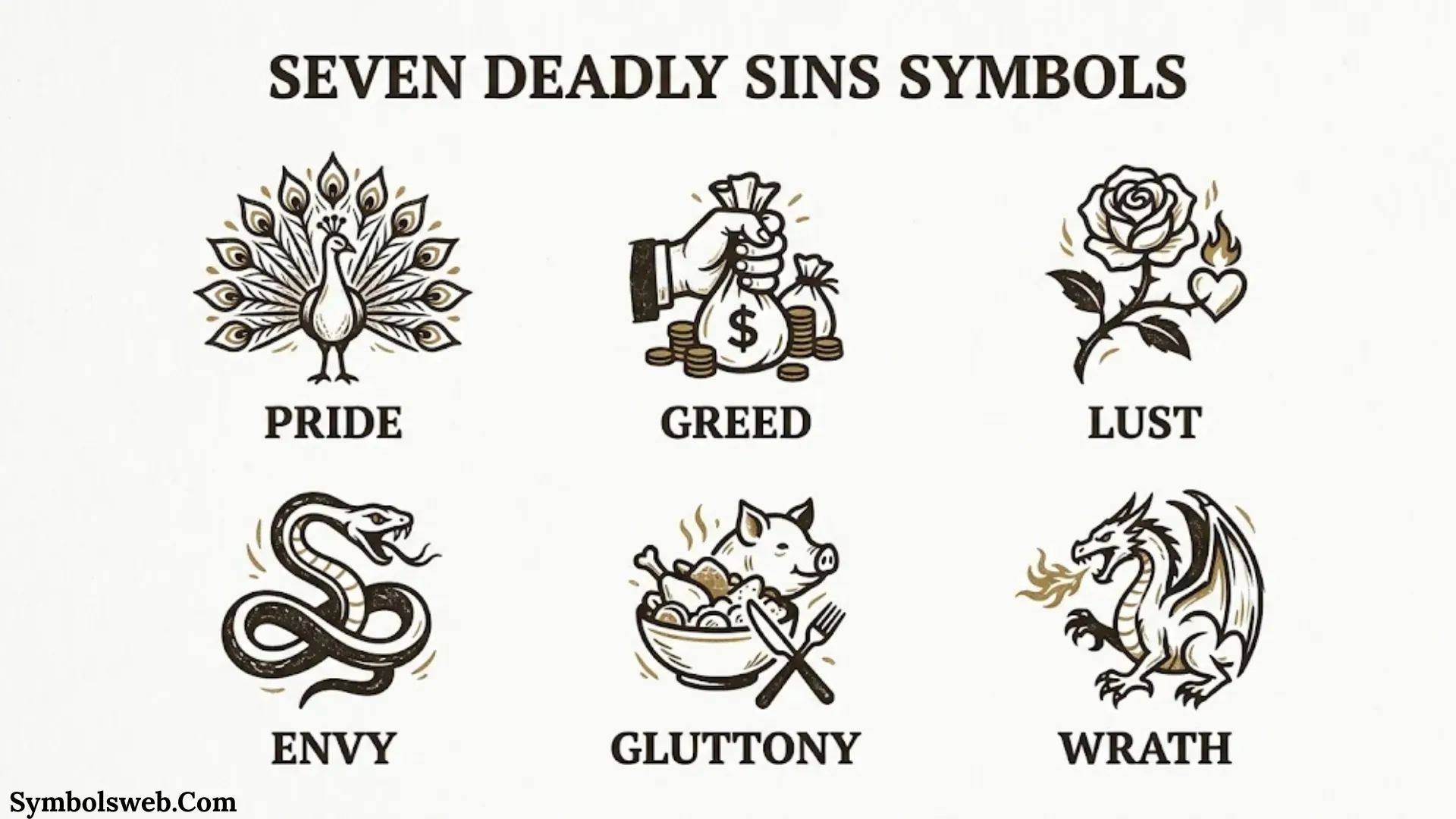
The Seven Deadly Sins symbols are among the most recognizable features of The Seven Deadly Sins, the popular Japanese manga and anime series created by Nakaba Suzuki. Each member of this legendary group carries a distinctive animal emblem connected to one of the seven deadly sins. These symbols help identify the characters and give the group its unique visual identity.
From Meliodas’ circular dragon to Escanor’s powerful lion, every emblem has its own design and character association. The animals also make it easier to recognize the seven members when they appear together in the story.
However, the anime’s animal emblems aren’t the same as the traditional animals associated with the seven deadly sins. For example, Meliodas represents Wrath through a dragon, while some medieval European traditions use a wolf or bear to represent anger. Understanding this difference helps you appreciate both the fictional artwork and the older symbolism behind it.
This guide explains all seven Seven Deadly Sins animal symbols, their meanings, character connections, colors, tattoo placements, and traditional associations. You’ll also discover how the emblems relate to the characters’ personalities, crimes, sacred treasures, and development throughout the story.
What Are the Seven Deadly Sins Symbols?

The Seven Deadly Sins symbols are seven distinctive animal emblems belonging to the members of a legendary group of knights in Nanatsu no Taizai. Each emblem represents one member and corresponds to a particular deadly sin.
The group includes seven powerful warriors who once served the Kingdom of Liones. Their names became associated with serious crimes, and the kingdom eventually labeled them as dangerous criminals.
Each member received a title combining an animal and a deadly sin. These titles include the Dragon’s Sin of Wrath, the Boar’s Sin of Gluttony, and the Lion’s Sin of Pride.
The seven emblems are:
- Dragon: Meliodas, representing Wrath.
- Boar: Merlin, representing Gluttony.
- Grizzly Bear: King, representing Sloth.
- Serpent: Diane, representing Envy.
- Fox: Ban, representing Greed.
- Goat: Gowther, representing Lust.
- Lion: Escanor, representing Pride.
Each member also carries a distinctive animal marking on their body. These markings make the characters easier to recognize and connect their identities to the group’s history.
The official anime character profiles identify the seven members through these animal-based sin titles.
TVアニメ「七つの大罪 戒めの復活」公式サイト+1
It’s important to understand that these are fictional character emblems. They don’t represent a universal religious system or an official historical collection of animal symbols.
Seven Deadly Sins Symbols and Their Meanings at a Glance
The following table provides a quick overview of all seven characters, their deadly sins, animal emblems, and commonly depicted tattoo locations.
| Character | Deadly Sin | Animal Symbol | Symbol Location |
| Meliodas | Wrath | Dragon | Left arm |
| Merlin | Gluttony | Boar | Left side of neck |
| King | Sloth | Grizzly bear | Above left foot |
| Diane | Envy | Serpent | Left thigh |
| Ban | Greed | Fox | Left waist |
| Gowther | Lust | Goat | Right chest |
| Escanor | Pride | Lion | Back |
The animal emblems have different meanings when viewed through each character’s personality and storyline.
For example, Meliodas’ dragon represents his identity as the captain and his connection to demonic power. Ban’s fox reflects his association with greed and stealing. Escanor’s lion represents his enormous pride and confidence.
These connections become more meaningful as you learn about each character’s history.
The Seven Deadly Sins Symbols Explained Individually
Each animal represents a different member of the group. Their designs also connect to the characters’ assigned sins, personal struggles, and roles in the story.
Dragon Symbol: Meliodas, the Dragon’s Sin of Wrath
The dragon symbol belongs to Meliodas, the captain of the Seven Deadly Sins. He carries the title of the Dragon’s Sin of Wrath and serves as one of the central characters throughout the series.
His emblem features a dragon forming a circular shape by biting its own tail. This design resembles the ancient Ouroboros, a symbol commonly represented by a serpent or dragon consuming its tail.
Symbol meaning and design
A dragon often represents strength, destruction, supernatural power, and authority. These qualities connect closely with Meliodas because of his extraordinary fighting abilities and demonic heritage.
The circular dragon design also brings to mind the Ouroboros, which has been associated with cycles, renewal, eternity, and the continuous nature of existence.
However, the dragon emblem in the anime primarily identifies Meliodas as the Dragon’s Sin. Its circular appearance doesn’t establish that every traditional meaning of the Ouroboros applies to his character.
Where is Meliodas’ dragon symbol located?
Meliodas carries the dragon emblem on his left arm near the shoulder. Its distinctive circular design makes it one of the most recognizable Seven Deadly Sins tattoos.
Why does Meliodas represent Wrath?
Meliodas’ title connects to the destruction of the Kingdom of Danafor. His immense power and emotional connection to Elizabeth also play important roles in his history.
His character presents an interesting contrast. Although Wrath traditionally represents uncontrolled anger, Meliodas often appears cheerful, relaxed, and playful.
However, his personality changes dramatically when his loved ones face serious danger. His demonic power and emotional struggles reveal the destructive potential hidden beneath his calm appearance.
Meliodas’ important abilities
- Full Counter: Reflects magical attacks toward their original attackers.
- Hellblaze: Produces dark flames associated with demonic power.
- Demon abilities: Connect to his heritage and extraordinary combat strength.
- Lostvayne: His Sacred Treasure, a powerful demon sword.
His dragon symbol represents more than anger. It identifies the captain whose strength and personal struggles shape the group’s story.
Boar Symbol: Merlin, the Boar’s Sin of Gluttony
Merlin carries the title of the Boar’s Sin of Gluttony. She is one of Britannia’s most powerful magic users and an important member of the Seven Deadly Sins.
Her boar emblem represents Gluttony, although her story connects this sin more closely with an endless hunger for magical knowledge than ordinary overeating.
Symbol meaning and design
The boar is a strong animal associated with determination, physical power, and persistence. In Merlin’s case, the emblem identifies her as the group’s representative of Gluttony.
Her appetite isn’t limited to food or physical pleasure. She has an extraordinary desire to understand magic, uncover secrets, and explore knowledge that others consider forbidden.
This interpretation gives her sin a different dimension. Instead of satisfying a physical appetite, Merlin constantly seeks intellectual and supernatural power.
Where is Merlin’s boar symbol located?
Merlin’s emblem appears on the left side of her neck. The marking features a boar’s face with distinctive details.
Why does Merlin represent Gluttony?
Merlin’s past explains her connection to this sin. She grew up in Belialuin, a kingdom known for its powerful magicians.
Her pursuit of knowledge eventually involved dangerous magical forces and divine beings. She made choices that contributed to the destruction of her homeland.
Her story explores the consequences of wanting more knowledge and power than anyone can safely control.
Merlin’s important abilities
- Infinity: Allows her spells to continue operating without their normal time limitations.
- Perfect Cube: Creates a powerful protective barrier.
- Absolute Cancel: Removes magical effects.
- Morning Star Aldan: Her Sacred Treasure, a magical crystal orb.
Merlin’s boar symbol therefore represents an insatiable appetite for magical knowledge. It also connects her character to ambition, curiosity, and the dangers of forbidden power.
Grizzly Bear Symbol: King, the Grizzly’s Sin of Sloth
King, whose real name is Harlequin, carries the title of the Grizzly’s Sin of Sloth. He is the Fairy King and one of the seven legendary knights.
His animal emblem is a grizzly bear. The symbol identifies his position within the group and connects him to the sin of Sloth.
Symbol meaning and design
The grizzly bear represents strength, protection, and physical power. These qualities suit King because he carries important responsibilities as the ruler and protector of the fairy people.
However, his assigned sin relates to an earlier failure involving Helbram. King carries guilt over events that occurred during his long absence and the consequences of his past decisions.
Sloth doesn’t always mean ordinary laziness. In traditional moral teaching, it can also involve neglecting responsibilities or failing to act when action is necessary.
This broader meaning helps explain King’s title.
Where is King’s grizzly bear symbol located?
King’s emblem appears above his left foot. The marking features a grizzly bear facing sideways.
His symbol can remain hidden beneath his clothing and footwear during certain scenes.
Why does King represent Sloth?
King’s history involves his friendship with Helbram and the terrible actions that followed their separation.
After learning what happened to his people, King struggled with guilt and responsibility. His failure to prevent suffering became central to his assigned sin.
His development shows how someone can learn from past mistakes and accept difficult responsibilities.
King’s important abilities
- Disaster: His magical ability connected to the power of the Sacred Tree.
- Spirit Spear Chastiefol: A Sacred Treasure that changes into multiple forms.
- Guardian Form: Provides powerful defensive capabilities.
- Pollen Garden: Creates a protective area using magical pollen.
King’s grizzly bear symbol represents a powerful fairy king whose story revolves around responsibility, regret, and personal growth.
Serpent Symbol: Diane, the Serpent’s Sin of Envy
Diane carries the title of the Serpent’s Sin of Envy. She belongs to the Giant Clan and is one of the strongest physical fighters among the Seven Deadly Sins.
Her animal emblem is a serpent, which gives her a distinctive identity within the group.
Symbol meaning and design
Snakes and serpents have different meanings across cultures. They can represent transformation, wisdom, danger, temptation, and renewal.
In Diane’s case, the serpent is her assigned animal emblem for Envy.
Envy involves jealousy, resentment, and dissatisfaction with what someone else possesses. It can also develop when a person constantly compares themselves with others.
Diane’s personal history helps explain the emotional side of her assigned sin.
Where is Diane’s serpent symbol located?
Diane carries the serpent emblem on her left thigh. The design features a snake with part of its tail curled.
Her emblem is particularly recognizable because of its long, curved animal shape.
Why does Diane represent Envy?
Diane’s story includes feelings of insecurity and difficulties accepting herself.
She also faces an accusation involving the death of Matrona. This accusation contributes to the criminal reputation attached to her title.
However, Diane’s character develops beyond jealousy and insecurity. Her relationships with King and the other members help her understand her own worth.
Diane’s important abilities
- Creation: Her magical ability allows her to manipulate earth and minerals.
- Heavy Metal: Strengthens her body using earth-based magic.
- Mother Catastrophe: A powerful technique involving her giant abilities.
- War Hammer Gideon: Her Sacred Treasure, designed for her enormous strength.
Diane’s serpent symbol represents the Serpent’s Sin of Envy. Her story also explores self-acceptance, emotional strength, and the importance of valuing yourself.
Fox Symbol: Ban, the Fox’s Sin of Greed
Ban is known as the Fox’s Sin of Greed. He is a powerful member of the Seven Deadly Sins and becomes especially important because of his relationship with Elaine.
His animal emblem is a fox, an animal frequently associated with cleverness, adaptability, and cunning.
Symbol meaning and design
Foxes often represent intelligence, resourcefulness, stealth, and trickery in folklore.
These qualities connect naturally with Ban because of his history as a thief. He has a habit of taking whatever catches his interest and doesn’t always respect other people’s possessions.
His title also connects to his search for immortality and the Fountain of Youth.
Greed traditionally involves an excessive desire to acquire wealth, possessions, power, or other rewards. Ban’s character gives this concept a more personal meaning.
Where is Ban’s fox symbol located?
Ban’s fox emblem appears on the left side of his waist. The marking represents his identity as the Fox’s Sin of Greed.
Why does Ban represent Greed?
Ban’s early life involved poverty, theft, and a strong desire to escape his difficult circumstances.
His search for the Fountain of Youth became one of the defining events of his life. He eventually encountered Elaine, whose relationship with him changed his priorities.
Although Ban initially appears selfish and obsessed with obtaining what he wants, his character gradually reveals a strong capacity for love and sacrifice.
His story challenges the simple idea that a person must always behave according to their assigned sin.
Ban’s important abilities
- Snatch: Allows him to steal physical objects and physical strength.
- Physical Hunt: Uses his abilities to reduce an opponent’s strength.
- Immortality: He gains immortality through the Fountain of Youth before later events change his condition.
- Holy Rod Courechouse: His Sacred Treasure, a four-sectioned staff.
Ban’s fox symbol represents Greed through cleverness, stealing, and desire. His personal development shows how love can change even someone with a deeply selfish past.
Goat Symbol: Gowther, the Goat’s Sin of Lust
Gowther carries the title of the Goat’s Sin of Lust. Unlike most members, his identity involves an unusual connection to artificial life, emotions, and magical creation.
His animal emblem is a goat, which serves as the group’s symbol for Lust.
Symbol meaning and design
Goats have appeared in many historical and cultural traditions. In some European and Christian artistic traditions, they became associated with sexual desire and uncontrolled physical appetites.
This association makes the goat a recognizable animal for Lust in several symbolic systems.
Gowther’s story explores a different side of this sin. His experiences focus heavily on emotional understanding, romantic attachment, and the complicated relationship between physical desire and genuine affection.
Where is Gowther’s goat symbol located?
Gowther carries his goat emblem on the right side of his chest.
The design features a goat with large, prominent horns.
Why does Gowther represent Lust?
Gowther’s story involves Nadja, whose relationship with him becomes an important part of his history.
His unusual nature makes it difficult for him to understand human emotions. He often struggles to recognize feelings that other people consider natural.
His experiences reveal the difference between wanting something and truly understanding another person’s emotional needs.
The title of Lust therefore creates an interesting contrast with his personality.
Gowther’s important abilities
- Invasion: Allows him to influence minds and memories.
- Nightmare Teller: Creates mental experiences that affect opponents.
- Blackout: Interferes with memories and mental awareness.
- Twin Bow Herritt: His Sacred Treasure, a magical bow that produces powerful attacks.
Gowther’s goat symbol represents Lust, but his character also explores emotional distance, identity, and the complexity of human relationships.
Lion Symbol: Escanor, the Lion’s Sin of Pride
Escanor is known as the Lion’s Sin of Pride. He is one of the most physically powerful members of the Seven Deadly Sins and has a personality that changes dramatically throughout the day.
His animal emblem is a lion, an animal commonly associated with courage, leadership, royalty, and strength.
Symbol meaning and design
The lion has long represented authority and power in mythology, heraldry, and traditional artwork.
Its reputation as the king of beasts makes it a natural symbol for Pride.
However, Pride can have both positive and negative meanings. Healthy confidence helps people recognize their abilities, while excessive pride can lead to arrogance and a belief in personal superiority.
Escanor’s character displays both sides of this idea.
Where is Escanor’s lion symbol located?
Escanor’s lion emblem appears across his back. The design also features a distinctive scar over the lion’s right eye.
This marking identifies him as the Lion’s Sin of Pride.
Why does Escanor represent Pride?
Escanor’s magical ability, Sunshine, causes his power to increase as the sun rises.
During the night, he appears physically weak and timid. As daytime approaches, his strength and confidence increase.
At noon, his power reaches its peak. This transformation creates a striking contrast between his quiet nighttime personality and his overwhelming daytime presence.
His Pride isn’t simply about believing he is better than everyone else. His extraordinary strength makes his confidence a major part of his identity.
Escanor’s important abilities
- Sunshine: His magical ability increases his power with the sun.
- The One: His peak form at noon.
- The One Ultimate: A powerful form that involves sacrificing his own life force.
- Divine Axe Rhitta: His Sacred Treasure, which stores and releases heat.
Escanor’s lion symbol represents Pride through strength, confidence, authority, and overwhelming power.
Why Does Each Member of the Seven Deadly Sins Have an Animal Symbol?

The seven animal emblems give the group a shared identity while allowing every member to stand apart. Each character has a different animal, deadly sin, personality, and history.
These emblems also connect the fictional knights to the wider idea of animal symbolism. Across mythology, folklore, and medieval artwork, animals often represent human qualities and moral behavior.
For example, lions frequently represent authority and courage. Foxes can represent cleverness and trickery. Snakes may represent danger, temptation, or transformation.
The anime uses these familiar associations to create memorable character identities. However, it doesn’t follow one universal historical system.
Here are some important reasons the animal emblems matter:
- Character identification: Each animal helps viewers recognize an individual member.
- Symbolic identity: Every emblem connects a character to one of the seven deadly sins.
- Group membership: The markings distinguish the Seven Deadly Sins from other knights.
- Visual storytelling: Animal designs give the characters recognizable visual features.
- Personal meaning: The assigned sins connect to important events in each member’s past.
The symbols don’t always describe the characters’ complete personalities. Instead, they reflect the identities and accusations attached to them throughout the story.
Seven Deadly Sins Symbols and Colors
Colors provide another way to distinguish the seven members. Their commonly circulated character color associations include blue, indigo, green, orange, red, violet, and yellow.
However, it’s important to separate these character color associations from traditional colors used to represent the deadly sins. The two systems aren’t identical, and the complete palette shouldn’t be treated as a universally established religious or official anime standard.
| Character | Animal Symbol | Commonly Associated Color | Deadly Sin |
| Meliodas | Dragon | Blue | Wrath |
| Merlin | Boar | Indigo | Gluttony |
| King | Grizzly bear | Green | Sloth |
| Diane | Serpent | Orange | Envy |
| Ban | Fox | Red | Greed |
| Gowther | Goat | Violet | Lust |
| Escanor | Lion | Yellow | Pride |
Dragon Symbol: Blue
Blue is commonly associated with Meliodas and his dragon emblem.
The color can suggest loyalty, calmness, and emotional depth. These qualities create an interesting contrast with his assigned sin of Wrath.
Meliodas often behaves playfully, yet his demonic power can become dangerous when his emotions take control.
Boar Symbol: Indigo
Indigo is commonly associated with Merlin’s boar emblem.
The color often suggests mystery, wisdom, and spiritual depth. These associations suit Merlin’s magical knowledge and interest in forbidden powers.
Her character frequently explores the relationship between intelligence and ambition.
Grizzly Bear Symbol: Green
Green is commonly associated with King’s grizzly bear emblem.
The color connects naturally with forests, nature, growth, and renewal. These ideas also fit King’s identity as the Fairy King.
His relationship with the Sacred Tree strengthens this natural connection.
Serpent Symbol: Orange
Orange is commonly associated with Diane’s serpent emblem.
The color can suggest energy, warmth, enthusiasm, and creativity. These qualities complement Diane’s lively personality and enormous physical strength.
Her story also explores emotional growth and self-acceptance.
Fox Symbol: Red
Red is commonly associated with Ban’s fox emblem.
The color often represents passion, desire, determination, and intensity. These ideas fit Ban’s strong emotions and his willingness to fight for Elaine.
His character also shows how desire can change into loyalty and sacrifice.
Goat Symbol: Violet
Violet is commonly associated with Gowther’s goat emblem.
The color frequently suggests mystery, imagination, and introspection. These qualities connect with Gowther’s unusual nature and complicated understanding of emotions.
His story explores memory, identity, and the meaning of human relationships.
Lion Symbol: Yellow
Yellow is commonly associated with Escanor’s lion emblem.
The color represents sunlight, energy, confidence, and brightness. These associations are especially suitable because Escanor’s power depends on the sun.
His strength increases throughout the day and reaches its highest point at noon.
Traditional Seven Deadly Sins Symbols and Their Meanings
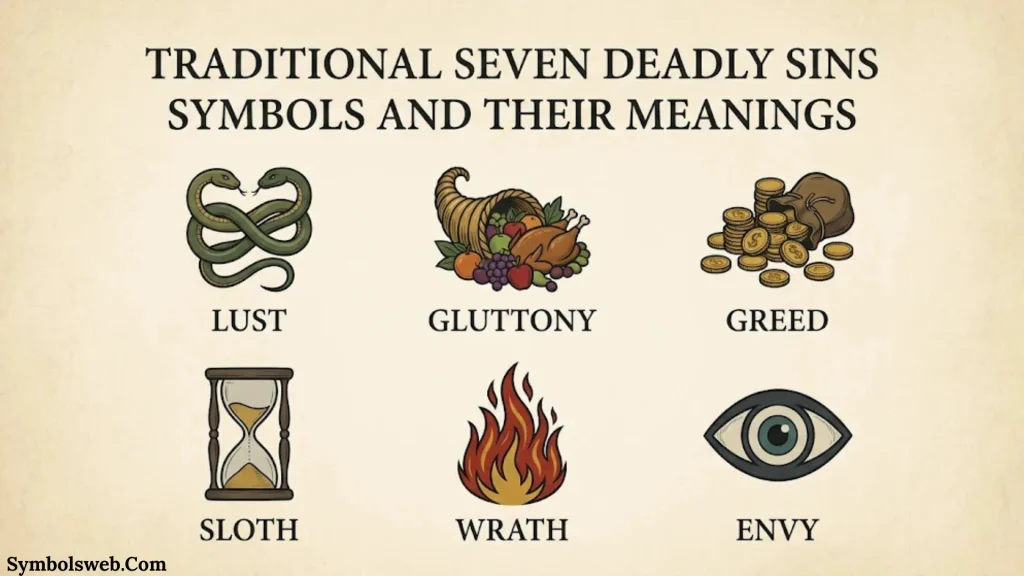
The traditional seven deadly sins come from Christian moral teaching. They describe major human vices that can encourage harmful behavior and lead to other wrongdoing.
The seven sins are Pride, Greed, Lust, Envy, Gluttony, Wrath, and Sloth.
Their history stretches back to early Christian discussions of harmful thoughts and behaviors. The monk Evagrius Ponticus described eight troubling thoughts in the fourth century. Later, John Cassian transmitted related teachings to Western Christianity. Pope Gregory I helped establish the familiar seven-sin framework in the sixth century.
Medieval writers and artists later used stories, human figures, animals, and visual objects to explain these moral ideas.
The important distinction is that traditional animal symbols weren’t always consistent. Different regions, manuscripts, and artistic traditions used different creatures.
The British Museum’s research on its seventeenth-century Seven Deadly Sins tankard explains how medieval and Renaissance artists used several different animals for the same sin.
Wrath Symbol: Wolf, Bear, or Boar
Wrath represents uncontrolled anger, hostility, revenge, and destructive aggression.
Traditional artwork sometimes uses wolves, bears, boars, or other aggressive animals to represent this vice.
The wolf can symbolize cruelty and uncontrolled aggression. The bear can suggest physical force, while the boar can represent violent behavior.
Meliodas has a dragon emblem rather than these traditional animal representations.
Gluttony Symbol: Pig or Bear
Gluttony means excessive consumption, especially eating and drinking beyond reasonable needs.
The pig became a recognizable symbol of overindulgence in several European artistic traditions.
Other historical examples use bears or animals associated with excessive appetites.
Merlin’s boar emblem connects to Gluttony, but her fictional interpretation focuses on an endless hunger for magical knowledge.
Sloth Symbol: Donkey or Ass
Sloth represents laziness, neglect, spiritual indifference, and failure to fulfill responsibilities.
Some medieval traditions used a donkey or ass to represent this sin.
These animals could symbolize stubbornness, inactivity, or a refusal to move forward.
King’s anime emblem uses a grizzly bear instead.
Envy Symbol: Dog
Envy involves jealousy and resentment toward another person’s success, possessions, or advantages.
Some medieval animal-symbol systems used a dog to represent Envy.
The association appears in historical European moral literature, although other creatures also represented jealousy.
Diane’s serpent emblem provides a different fictional representation of the same sin.
Greed Symbol: Mole or Hedgehog
Greed, also called Avarice or Covetousness, means an excessive desire for money, possessions, wealth, or personal gain.
Medieval symbolism sometimes associated Greed with moles, hedgehogs, and other animals.
These associations aren’t universal. Their meanings depended on the particular artwork or written tradition.
Ban’s fox emblem instead connects his character to cleverness, theft, and the desire to obtain what he wants.
Lust Symbol: Goat or Pig
Lust represents uncontrolled sexual desire and excessive physical appetite.
The goat became a familiar symbol of Lust in several European traditions because of its historical associations with sexual appetite and fertility.
Pigs and other animals also appeared in medieval representations.
Gowther’s goat emblem therefore has a recognizable historical connection to his assigned sin.
Pride Symbol: Lion or Peacock
Pride represents arrogance, vanity, and an excessive sense of personal importance.
The lion and peacock are two recognizable animals associated with Pride in European visual traditions.
The lion suggests dominance and authority, while the peacock can represent vanity and excessive admiration of appearance.
Escanor’s lion emblem fits this broader symbolic association.
Seven Deadly Sins Symbols vs. Traditional Animal Symbols
The anime’s animal emblems differ from many traditional representations. Understanding the difference prevents confusion when researching Seven Deadly Sins symbols and meanings.
| Deadly Sin | Anime Character | Anime Symbol | Examples of Traditional Animal Symbols |
| Wrath | Meliodas | Dragon | Wolf, bear, boar |
| Gluttony | Merlin | Boar | Pig, bear |
| Sloth | King | Grizzly bear | Donkey, ass |
| Envy | Diane | Serpent | Dog, snake |
| Greed | Ban | Fox | Mole, hedgehog |
| Lust | Gowther | Goat | Goat, pig |
| Pride | Escanor | Lion | Lion, peacock |
This comparison highlights an important historical fact: animal symbolism changes across different periods and locations.
For example, a fifteenth-century religious text discussed by medieval scholar Mireille Vincent-Cassy associated Pride with a lion, Greed with a mole, Lust with a goat, Wrath with a boar, Gluttony with a pig, Envy with a dog, and Sloth with an ass.
Other artworks use different combinations.
The British Museum’s amber tankard from approximately 1640–1660 illustrates this variation. Its carved figures include a peacock associated with Pride, alongside other visual attributes representing the sins.
wb.britishmuseum.org
Therefore, don’t assume every traditional animal list is historically authoritative.
The anime created its own recognizable collection of animal emblems to identify its seven fictional characters.
Where Are the Seven Deadly Sins Symbols Located on Their Bodies?

One of the most interesting details about the Seven Deadly Sins is that every member carries an animal emblem on a specific part of their body.
These markings help identify the characters and connect them to their assigned titles. Their placement also makes each design distinctive.
Here is a closer look at all seven Seven Deadly Sins tattoo locations.
| Member | Animal Emblem | Body Placement |
| Meliodas | Dragon | Left arm |
| Merlin | Boar | Left side of neck |
| King | Grizzly bear | Above left foot |
| Diane | Serpent | Left thigh |
| Ban | Fox | Left waist |
| Gowther | Goat | Right chest |
| Escanor | Lion | Back |
Meliodas’ Dragon Tattoo
Meliodas carries his dragon marking on his left arm near the shoulder. The dragon forms a circular design by biting its own tail.
This distinctive shape separates his emblem from ordinary dragon illustrations. It also makes his marking easy to recognize.
Merlin’s Boar Tattoo
Merlin’s boar marking appears on the left side of her neck.
The emblem features a boar’s face with additional details around its design. Its position makes it one of the more noticeable markings among the seven members.
King’s Grizzly Bear Tattoo
King’s grizzly bear emblem appears above his left foot.
The marking can remain hidden beneath his clothing. Its location reflects the character-specific placement used throughout the series.
Diane’s Serpent Tattoo
Diane carries her serpent emblem on her left thigh.
The snake has a distinctive curved shape with part of its tail rolled up. Its long design makes it different from the other animal markings.
Ban’s Fox Tattoo
Ban’s fox emblem appears on the left side of his waist.
The fox represents his identity as the Fox’s Sin of Greed. Its placement also connects with the character’s recognizable clothing and appearance.
Gowther’s Goat Tattoo
Gowther carries his goat emblem on the right side of his chest.
The design features a goat with large horns. Its placement distinguishes his marking from the other members’ tattoos.
Escanor’s Lion Tattoo
Escanor’s lion emblem stretches across his back.
The lion’s right eye features a distinctive scar. This detail helps separate his marking from ordinary lion illustrations.
What Do the Seven Deadly Sins Symbols Represent in the Story?
The seven emblems represent more than membership in a famous group of knights. Each symbol connects to a character’s assigned sin and the crime or accusation associated with their past.
The characters were branded as criminals after being accused of assassinating the Great Holy Knight Zaratras. Their reputation led to their separation and the loss of their original position in the Kingdom of Liones.
However, the story gradually reveals that their histories are more complicated than their public accusations suggest.
The distinction between a character’s assigned sin, alleged crime, and actual personality is important. A sin title doesn’t necessarily describe everything a character believes or does.
The Dragon’s Sin of Wrath and the Destruction of Danafor
Meliodas’ title connects to the destruction of the Kingdom of Danafor.
His immense demonic power and emotional struggles play important roles in this part of his history.
Wrath traditionally involves uncontrolled anger and destructive reactions. Meliodas demonstrates how overwhelming emotions can create devastating consequences.
However, his relationship with Elizabeth and his loyalty to his friends reveal another side of his personality.
His dragon emblem represents the character’s identity rather than suggesting that he remains constantly angry.
The Boar’s Sin of Gluttony and Merlin’s Search for Knowledge
Merlin’s assigned sin connects to her desire for magical knowledge.
She grew up in Belialuin, where powerful magicians explored supernatural abilities. Her extraordinary curiosity eventually led her toward dangerous magical discoveries.
Her pursuit of knowledge became so intense that it contributed to the destruction of her homeland.
This storyline gives Gluttony a broader interpretation. Merlin’s appetite involves magic, secrets, and understanding rather than ordinary food.
Her boar emblem reflects the hunger for knowledge that defines much of her character.
The Grizzly’s Sin of Sloth and King’s Past

King’s title connects to his history with Helbram and the suffering experienced by his people.
His past decisions left him with guilt and a difficult sense of responsibility.
Sloth can involve more than refusing to work. It can also describe neglecting responsibilities or failing to act when others need protection.
King’s character development shows how someone can confront past failures and become a more responsible leader.
His grizzly bear emblem represents the Grizzly’s Sin of Sloth and his place as the Fairy King.
The Serpent’s Sin of Envy and Diane’s Accusation
Diane’s history includes an accusation involving Matrona.
Her title of the Serpent’s Sin of Envy connects her to jealousy and dissatisfaction. However, her story also explores insecurity and the difficulty of accepting herself.
As a member of the Giant Clan, Diane often feels different from the people around her.
Her relationship with King becomes an important part of her emotional development.
The serpent emblem represents her assigned sin, while her personal journey reveals a much more complex character.
The Fox’s Sin of Greed and Ban’s Search for Immortality
Ban’s title connects to his history as a thief and his search for the Fountain of Youth.
He initially pursues immortality because he wants to escape his difficult circumstances.
However, his relationship with Elaine changes his priorities. He eventually learns that personal happiness doesn’t come from acquiring everything he desires.
His story explores the difference between selfish greed and genuine devotion.
The fox emblem represents his original identity as a thief, but Ban’s later choices show how much his values can change.
The Goat’s Sin of Lust and Gowther’s Accusation
Gowther’s story explores artificial life, memory, and emotional understanding.
His connection to Nadja becomes one of the most important parts of his history. Their relationship challenges his unusual understanding of love and human feelings.
His assigned sin of Lust also connects to the accusation involving Nadja’s death.
However, Gowther’s story isn’t simply about physical desire. It examines the complicated relationship between emotion, attachment, and identity.
His goat emblem represents the Goat’s Sin of Lust within the fictional group.
The Lion’s Sin of Pride and Escanor’s Destructive Power
Escanor’s assigned sin connects to his extraordinary confidence and enormous magical strength.
His Sunshine ability changes his physical power depending on the position of the sun.
At night, he becomes timid and physically weak. During the day, his strength increases until it reaches its peak around noon.
This transformation gives his Pride a unique meaning.
Escanor doesn’t simply boast about being powerful. His magical ability makes him one of the most formidable members of the group.
His lion emblem represents authority, confidence, and the overwhelming strength associated with Pride.
Seven Deadly Sins Group: Members and Their Roles
The Seven Deadly Sins are an independent order of powerful knights connected to the Kingdom of Liones.
Their reputation comes from their extraordinary abilities and the serious accusations made against them. Despite their criminal status, they eventually become important protectors of the kingdom.
The original seven members are:
| Member | Group Role | Assigned Sin |
| Meliodas | Captain | Wrath |
| Merlin | Magician | Gluttony |
| King | Fairy King | Sloth |
| Diane | Giant warrior | Envy |
| Ban | Immortal thief | Greed |
| Gowther | Magical warrior | Lust |
| Escanor | Sun-powered warrior | Pride |
Meliodas: Captain of the Seven Deadly Sins
Meliodas leads the group and possesses extraordinary demonic power.
He also runs the Boar Hat tavern, which becomes an important meeting place throughout the story.
Merlin: The Boar’s Sin of Gluttony
Merlin is a powerful magician whose knowledge and magical abilities make her one of the group’s most valuable members.
Her intelligence and experience help the group confront dangerous enemies.
King: The Grizzly’s Sin of Sloth
King protects the Fairy Realm and possesses the Spirit Spear Chastiefol.
His role as Fairy King gives him responsibilities that extend beyond the Seven Deadly Sins.
Diane: The Serpent’s Sin of Envy
Diane uses her giant strength and earth-based magic during battles.
Her Creation ability makes her especially effective at manipulating the battlefield.
Ban: The Fox’s Sin of Greed
Ban combines exceptional physical abilities with his Snatch magic.
His relationship with Elaine becomes one of the central emotional stories in the series.
Gowther: The Goat’s Sin of Lust
Gowther uses magical abilities that affect memories and minds.
His unusual personality creates several important moments involving emotional understanding.
Escanor: The Lion’s Sin of Pride
Escanor’s Sunshine ability makes his strength change throughout the day.
His immense daytime power becomes essential during several major battles.
Seven Deadly Sins Sacred Treasures and Their Connections to the Symbols
Each member has a Sacred Treasure, a special weapon or magical object designed to complement their abilities.
These treasures aren’t the same as the animal emblems. The animal markings identify the members, while the Sacred Treasures enhance their combat abilities.
| Character | Sacred Treasure | Type |
| Meliodas | Lostvayne | Demon sword |
| Merlin | Aldan | Crystal orb |
| King | Chastiefol | Spirit spear |
| Diane | Gideon | War hammer |
| Ban | Courechouse | Four-sectioned staff |
| Gowther | Herritt | Twin bow |
| Escanor | Rhitta | Divine axe |
Meliodas and Demon Sword Lostvayne
Lostvayne is Meliodas’ Sacred Treasure.
The sword can create physical clones of its wielder. This ability allows Meliodas to increase his attack potential and use multiple copies during combat.
Its special properties complement his Full Counter fighting style.
Merlin and Morning Star Aldan
Aldan is Merlin’s magical crystal orb.
It helps her use and control different magical abilities. Merlin can also use it for communication and magical observation.
The orb suits her role as the group’s exceptionally skilled magician.
King and Spirit Spear Chastiefol
Chastiefol is King’s Sacred Treasure, created from the Sacred Tree.
The spear can transform into several different forms. These include offensive weapons and defensive structures.
Its changing forms make it useful in many combat situations.
Diane and War Hammer Gideon
Gideon is Diane’s enormous war hammer.
Its size and design complement her giant strength. Diane can also use it with her Creation magic to manipulate the earth.
Ban and Holy Rod Courechouse
Courechouse is Ban’s Sacred Treasure.
It takes the form of a four-sectioned staff that supports his physical fighting style.
The weapon complements his speed, strength, and Snatch ability.
Gowther and Twin Bow Herritt
Herritt is Gowther’s Sacred Treasure.
The magical bow helps him extend the range and effectiveness of his Invasion abilities.
It supports his mental and magical combat techniques.
Escanor and Divine Axe Rhitta
Rhitta is Escanor’s enormous divine axe.
The weapon can absorb and store heat from its surroundings. Escanor can use this stored energy to unleash powerful attacks.
Its connection to sunlight makes it especially suitable for the Lion’s Sin of Pride.
Seven Deadly Sins Symbols in the Anime and Manga
The original Japanese title of the series is Nanatsu no Taizai (七つの大罪), which translates to The Seven Deadly Sins.
Nakaba Suzuki created the manga, which follows Meliodas and his companions as they confront powerful enemies and protect the Kingdom of Liones.
The animal emblems play an important role in the series’ visual identity. They appear in character designs and promotional artwork, helping readers and viewers distinguish the seven members.
Important Anime and Manga Details
- Original manga: Created by Nakaba Suzuki.
- Original Japanese title: Nanatsu no Taizai.
- Main characters: Meliodas, Merlin, King, Diane, Ban, Gowther, and Escanor.
- Main setting: Britannia, a fictional world inspired by Arthurian legends.
- Main organization: The Seven Deadly Sins, a legendary group of knights.
- Related sequel: Four Knights of the Apocalypse.
The anime adaptation brings the manga’s character designs to life through animation, color, and movement.
The manga presents the original artwork and character illustrations, while the anime adds voice performances, music, and animated battle sequences.
Both versions preserve the central identities of the seven members.
The sequel, Four Knights of the Apocalypse, expands the fictional world and introduces a new generation of important characters.
Seven Deadly Sins Symbols for Tattoos and Artwork

The Seven Deadly Sins tattoos are popular among fans because each animal emblem has a recognizable design and connection to a specific character.
Some fans choose a single animal representing their favorite member. Others prefer collecting all seven symbols to represent the complete group.
Before choosing a design, it’s useful to understand the meaning behind each emblem.
Meliodas Dragon Symbol Tattoo
The dragon represents Meliodas and the Dragon’s Sin of Wrath.
Its circular shape, created by the dragon biting its own tail, makes it an interesting choice for fans who appreciate his character.
Merlin Boar Symbol Tattoo
The boar represents Merlin and the Boar’s Sin of Gluttony.
Its connection to magical knowledge makes it especially meaningful for fans interested in intelligence, curiosity, and supernatural power.
King Grizzly Bear Symbol Tattoo
The grizzly bear represents King and the Grizzly’s Sin of Sloth.
Fans may appreciate its connection to nature, protection, responsibility, and the Fairy Realm.
Diane Serpent Symbol Tattoo
The serpent represents Diane and the Serpent’s Sin of Envy.
Its curved shape gives it a distinctive appearance. Its meaning also connects to transformation and personal development in wider animal symbolism.
Ban Fox Symbol Tattoo
The fox represents Ban and the Fox’s Sin of Greed.
Fox imagery can suggest cleverness, independence, and resourcefulness. These qualities make the emblem recognizable even outside the anime.
Gowther Goat Symbol Tattoo
The goat represents Gowther and the Goat’s Sin of Lust.
Its large horns create a distinctive design that works well as a small animal emblem.
Escanor Lion Symbol Tattoo
The lion represents Escanor and the Lion’s Sin of Pride.
Its connection to strength, courage, authority, and sunlight makes it a popular choice for fans who appreciate his character.
Tips for choosing an accurate Seven Deadly Sins tattoo:
- Check the original character emblem before choosing a design.
- Pay attention to the animal’s shape and distinctive details.
- Choose the correct character-specific placement if you want an authentic recreation.
- Don’t confuse the anime emblems with traditional Christian animal symbols.
- Decide whether you want the original black design or a personalized color version.
- Use a clear reference image when discussing the design with a tattoo artist.
A character emblem can represent your favorite member without requiring you to adopt the meaning of the associated deadly sin.
Frequently Asked Questions About Seven Deadly Sins Symbols
What are the seven symbols of the Seven Deadly Sins?
The seven symbols are a dragon, boar, grizzly bear, serpent, fox, goat, and lion.
Each animal belongs to a different member of the group in The Seven Deadly Sins.
The dragon represents Meliodas, the boar represents Merlin, the grizzly bear represents King, the serpent represents Diane, the fox represents Ban, the goat represents Gowther, and the lion represents Escanor.
What animal represents each member of the Seven Deadly Sins?
Each member has a unique animal emblem connected to their assigned sin.
| Character | Animal |
| Meliodas | Dragon |
| Merlin | Boar |
| King | Grizzly bear |
| Diane | Serpent |
| Ban | Fox |
| Gowther | Goat |
| Escanor | Lion |
These animals distinguish the characters throughout the anime and manga.
What does Meliodas’ dragon symbol mean?
Meliodas’ dragon represents the Dragon’s Sin of Wrath.
Its circular design resembles the Ouroboros, an ancient image of a serpent or dragon consuming its own tail.
The Ouroboros has historical associations with eternity, cycles, and renewal. However, the emblem’s direct purpose in the anime is to identify Meliodas as the Dragon’s Sin.
Why does Merlin have a boar symbol?
Merlin has a boar symbol because she represents the Boar’s Sin of Gluttony.
Her assigned sin connects to her endless desire for magical knowledge and power.
Unlike ordinary Gluttony, which often involves excessive eating and drinking, Merlin’s story emphasizes intellectual and supernatural hunger.
What is the meaning of Ban’s fox symbol?
Ban’s fox represents the Fox’s Sin of Greed.
Foxes are commonly associated with cleverness, cunning, and adaptability.
These qualities connect with Ban’s background as a thief and his desire to obtain whatever interests him.
What does Escanor’s lion symbol represent?
Escanor’s lion represents the Lion’s Sin of Pride.
Lions traditionally symbolize courage, leadership, dominance, and authority.
These qualities suit Escanor because his Sunshine ability gives him extraordinary strength during daylight.
Where are the Seven Deadly Sins symbols located?
The seven animal emblems appear on different parts of their owners’ bodies.
- Meliodas: Left arm.
- Merlin: Left side of neck.
- King: Above left foot.
- Diane: Left thigh.
- Ban: Left waist.
- Gowther: Right chest.
- Escanor: Back.
Each placement helps distinguish the character’s marking from the others.
What colors are associated with the Seven Deadly Sins characters?
The commonly circulated character color associations are:
- Meliodas: Blue.
- Merlin: Indigo.
- King: Green.
- Diane: Orange.
- Ban: Red.
- Gowther: Violet.
- Escanor: Yellow.
These are character-related color associations, not a universal traditional color system for the seven deadly sins.
Are the anime’s animal symbols different from traditional deadly sin symbols?
Yes. The anime uses its own animal emblems to identify its fictional characters.
Traditional European symbolism uses different animals depending on the historical period and artistic tradition.
For example, medieval sources have associated Wrath with wolves or boars, while the anime gives Meliodas a dragon.
What are the seven traditional animal symbols of the deadly sins?
There isn’t one universally accepted historical list.
One medieval European scheme associated the sins with these animals:
| Deadly Sin | Animal in One Historical Scheme |
| Pride | Lion |
| Greed | Mole |
| Lust | Goat |
| Wrath | Boar |
| Gluttony | Pig |
| Envy | Dog |
| Sloth | Ass |
Other medieval artworks used different animals. Therefore, this list should be understood as one historical tradition rather than a universal religious rule.
Do the Seven Deadly Sins symbols have religious meanings?
The seven deadly sins have roots in Christian moral teaching. However, the animal emblems in The Seven Deadly Sins are fictional character designs.
Some animals have historical connections to particular sins, but the anime’s complete collection isn’t an official Christian symbol system.
Can you use the Seven Deadly Sins symbols as tattoos?
Yes. Fans often choose these animal emblems because they represent recognizable characters and their stories.
You can select one emblem or combine several designs into a larger tattoo.
For an accurate recreation, use the original character artwork as your reference.
Final Thoughts on Seven Deadly Sins Symbols
The Seven Deadly Sins symbols give each member a distinctive identity while connecting the characters to seven familiar human vices. Meliodas’ dragon, Merlin’s boar, King’s grizzly bear, Diane’s serpent, Ban’s fox, Gowther’s goat, and Escanor’s lion each represent a different member of the legendary group.
Their meanings become more interesting when you understand the characters’ histories. Meliodas‘ dragon connects to Wrath, Merlin’s boar reflects her hunger for knowledge, and Escanor’s lion represents overwhelming Pride. Meanwhile, Ban’s fox, King’s bear, Diane’s serpent, and Gowther’s goat provide equally recognizable identities.
These fictional emblems also differ from traditional animal symbolism found in medieval European artwork. Historical artists used different creatures to represent the seven sins, so no single animal list applies to every tradition.
If you’re exploring the anime, researching Seven Deadly Sins animal meanings, or choosing a character-inspired tattoo, understanding these differences helps you appreciate the symbols more deeply.

Jordan Hayes is a writer with a passion for exploring the history, meanings, and cultural significance behind symbols from around the world. He enjoys turning complex topics into clear, engaging content that anyone can understand. Jordan is also the fictional author of The Silent Language of Ancient Marks and Hidden Symbols Beyond the Surface, two original book concepts created for his author profile. When he’s not writing, he spends time researching myths, traditions, and forgotten stories that inspire his work. His goal is to help readers discover the deeper meanings behind the symbols they encounter every day.
 Ethan Holloway