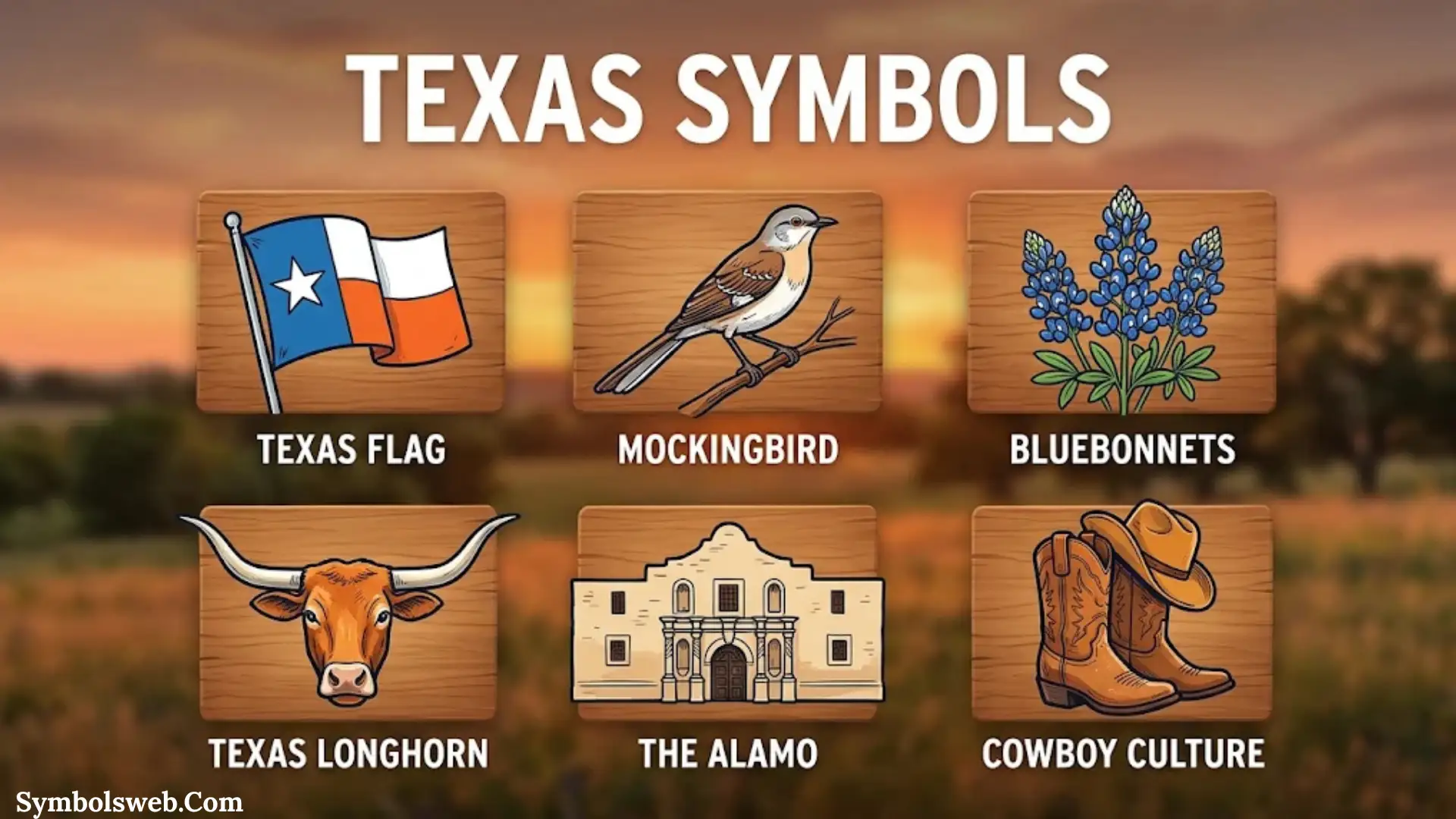
Texas is known for its rich history, unique culture, and strong sense of pride. Texas symbols represent the state’s identity, traditions, and heritage, from its famous Lone Star flag to its official state flower, the bluebonnet. Each symbol tells a special story about what makes Texas unique.
If you’re a student, a history lover, or simply curious about the Lone Star State, learning about Texas symbols is a great way to explore its culture. These symbols reflect Texas’s natural beauty, independence, wildlife, and historical background.
In this guide, we’ll explore some of the most popular and official Texas symbols, including their meanings and interesting facts. Discover what each symbol represents and why it holds an important place in Texas history and identity.
What Are the Official Symbols of Texas?
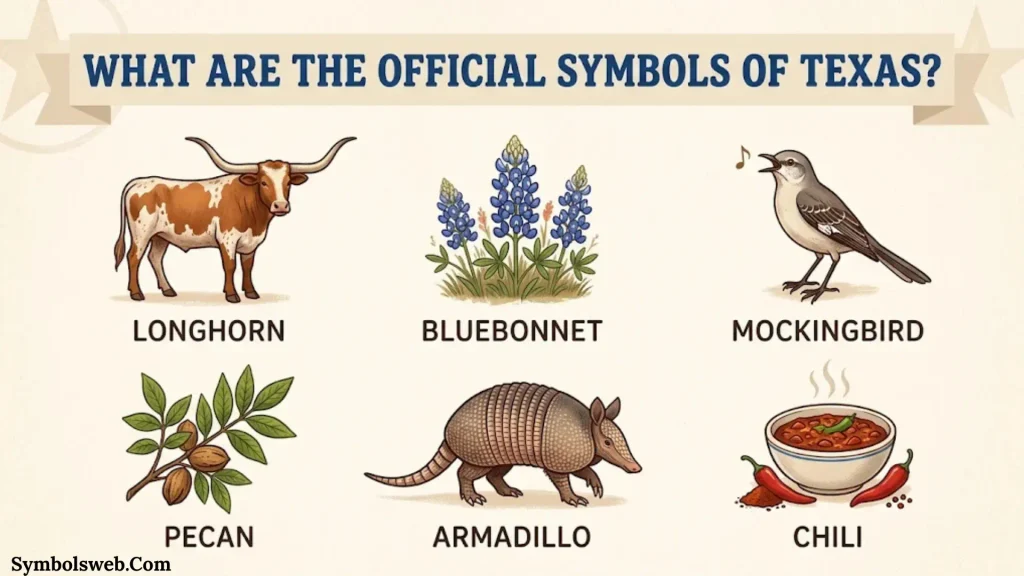
Texas state symbols are official objects, animals, plants, foods, traditions, and cultural references recognized by the Texas Legislature. They help represent the state’s identity and preserve important parts of its history.
The Texas State Library and Archives Commission (TSLAC) maintains the official list of state symbols. Its records include the name of each symbol and the legislative resolution that established it.
Texas began choosing official symbols in 1901. The bluebonnet became the state’s official flower that year. Since then, lawmakers have added many more designations, covering everything from wildlife to music and traditional clothing.
Not every familiar Texas icon has an official designation. For example, the cowboy hat is an official state hat, while the Alamo is a historic landmark with a powerful cultural role.
Texas State Flag: The Lone Star Flag
The Texas State Flag, commonly called the Lone Star Flag, is one of the most recognizable symbols of Texas. Its simple design features a single white star alongside three bold colors.
The flag became the national flag of the Republic of Texas in 1839. It remained the state flag after Texas joined the United States in 1845.
The Texas Government Code officially identifies the state flag as the 1839 national flag of the Republic of Texas.
Meaning of the Texas Flag
The Texas flag contains three main colors and one five-pointed star.
| Flag element | Meaning |
| Blue | Loyalty |
| White | Purity |
| Red | Bravery |
| White five-pointed star | Texas and its unity |
These meanings are established in Texas law. The flag’s design also follows specific proportions and placement rules.
The blue stripe runs vertically along the left side. The white stripe occupies the upper right section, while the red stripe fills the lower right section.
Why Is Texas Called the Lone Star State?
Texas earned the nickname The Lone Star State because of its historic connection with independence and self-government.
The single star appeared on symbols of the Republic of Texas during its struggle for independence from Mexico. It became a lasting representation of the state’s independent identity.
Today, the Lone Star appears on government buildings, official documents, clothing, souvenirs, and many Texas-inspired designs.
Texas State Seal
The Texas State Seal is an official government emblem used to authenticate important state documents. It represents the authority and identity of the state government.
The Texas Constitution describes the seal as a five-pointed star surrounded by olive and live oak branches. It also includes the words “The State of Texas.”
The seal is kept by the Texas Secretary of State and used officially under the governor’s direction.
Meaning of the Texas State Seal
The five-pointed star connects the seal with the Lone Star tradition. The branches surrounding it represent the state’s natural heritage and established design.
Texas also has an official reverse side of the seal. Its design contains several historical references.
These include:
- The Alamo: A major location in the Texas Revolution.
- The Battle of Gonzales cannon: A reference to the early fighting of the Texas Revolution.
- Vince’s Bridge: A historic bridge associated with the Texas Revolution.
- Live oak and olive branches: Decorative elements surrounding the shield.
- Six historical flags: Flags representing the countries and governments that have held sovereignty over Texas.
The reverse carries the motto “REMEMBER THE ALAMO” above the shield. The words “TEXAS ONE AND INDIVISIBLE” appear below it.
You can read the official design details in Texas Government Code Chapter 3101.
Texas State Motto: Friendship
The official Texas state motto is Friendship.
The motto reflects the meaning behind the name Texas. The name is connected to the Caddo word taysha, commonly translated as “friend” or “ally.”
Spanish explorers used a related form of the word when referring to Indigenous people in the region. Over time, the name became associated with the land and eventually the Republic of Texas.
Friendship represents cooperation, welcome, and relationships between people. It also reflects an important part of Texas history and cultural identity.
Texas State Animals and Wildlife Symbols
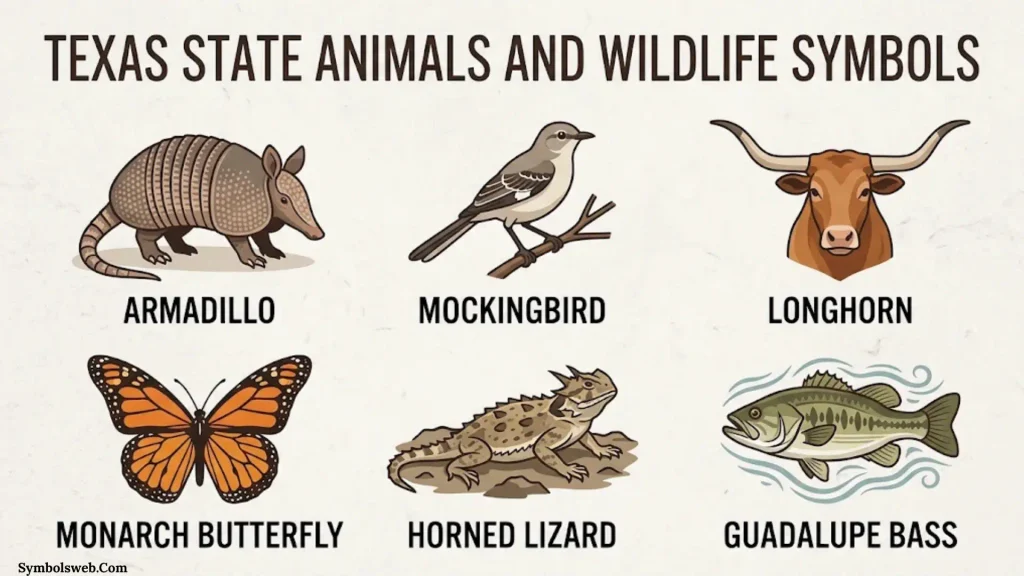
Texas has a wide range of wildlife, from large mammals to reptiles and marine animals. Several species have received official state designations.
These animals represent the state’s varied landscapes, including grasslands, deserts, forests, rivers, and coastal waters.
Texas State Large Mammal: Texas Longhorn
The Texas Longhorn is the official state large mammal. It is famous for its long, curved horns and strong connection with the American cattle industry.
Longhorn cattle developed through generations of cattle brought to the Americas by Spanish colonists. These animals adapted to the challenging conditions of the region.
Their ability to survive on open ranges helped shape the cattle industry in Texas.
During the 19th century, longhorns became closely associated with cattle drives. Cowboys moved large herds across long distances to reach markets and railroads.
The Longhorn now represents:
- Texas ranching history
- Cowboy culture
- Cattle drives
- The American West
- Agricultural heritage
The Texas Longhorn remains one of the state’s most recognizable cultural symbols.
Texas State Small Mammal: Armadillo
The Armadillo is the official Texas state small mammal. Its distinctive armored body makes it easy to recognize.
The nine-banded armadillo is the species commonly found across Texas. Its body has protective bony plates and a long tail.
Armadillos use their strong claws to dig for insects, grubs, and other food. They often search for meals in loose soil and grassy areas.
The animal has become a familiar part of Texas wildlife and popular culture. You can find armadillo references on souvenirs, decorations, and local artwork.
Texas State Flying Mammal: Mexican Free-Tailed Bat
The Mexican Free Tailed Bat is the official state flying mammal.
These bats are known for their impressive colonies and long-distance seasonal movements. They often live in caves, bridges, and other sheltered locations.
Texas is home to some of the largest known bat colonies in the world. One famous example is the colony beneath the Congress Avenue Bridge in Austin.
Mexican free-tailed bats play an important ecological role. They eat large quantities of insects, including agricultural pests.
Their presence supports natural insect control and helps maintain healthy ecosystems.
Texas State Horse: American Quarter Horse
The American Quarter Horse is the official Texas state horse.
This breed is famous for its speed over short distances. It also has a long history in ranching, cattle work, and Western riding.
Quarter Horses are known for their muscular bodies, powerful hindquarters, and quick movements.
Their abilities make them useful for:
- Ranch work
- Cattle handling
- Rodeo events
- Western riding
- Short-distance racing
The breed represents the close relationship between horses, ranchers, and Texas’s agricultural history.
Texas State Dog Breed: Blue Lacy
The Blue Lacy is the official state dog breed of Texas.
The breed originated in Texas during the 19th century. The Lacy family developed these working dogs to help with ranch duties.
Blue Lacys are known for their intelligence, energy, and working abilities. Ranchers have used them for herding livestock, tracking, and other demanding tasks.
Their history makes them an important part of Texas ranching culture.
Texas State Reptile: Texas Horned Lizard
The Texas Horned Lizard is the official state reptile.
This lizard has a wide, flattened body covered with small horns and spines. Its unusual appearance makes it one of the most recognizable reptiles in the region.
Texas horned lizards live in dry and open habitats. Their diet mainly includes ants and other small insects.
The species is also commonly called the horny toad. Despite this nickname, it is a lizard rather than a toad.
The Texas Horned Lizard represents the state’s native desert and grassland wildlife.
Texas State Amphibian: Texas Toad
The Texas Toad is the official state amphibian.
It lives in several habitats across Texas, including grasslands, open areas, and regions with suitable soil and water conditions.
Like other amphibians, it depends on moisture during important parts of its life cycle. It breeds in temporary pools and other shallow water sources.
The Texas Toad represents the state’s native amphibian life.
Texas State Dinosaur: Paluxysaurus Jonesi
Paluxysaurus jonesi is the official state dinosaur of Texas.
This prehistoric dinosaur lived during the Cretaceous Period. Its fossils were discovered in Texas, helping researchers understand the region’s ancient wildlife.
Paluxysaurus was a large plant-eating dinosaur. It belonged to a group of long-necked sauropods.
Its designation recognizes Texas’s important fossil discoveries and prehistoric history.
Texas State Bison Herd
Texas also recognizes the Texas State Bison Herd at Caprock Canyons State Park.
Bison once roamed large areas of North America. Their populations declined dramatically during the 19th century because of widespread hunting and habitat changes.
The herd at Caprock Canyons helps preserve a historic connection with the region’s native wildlife.
It also gives visitors an opportunity to observe these large animals in a protected natural setting.
Texas State Bird and Insect Symbols
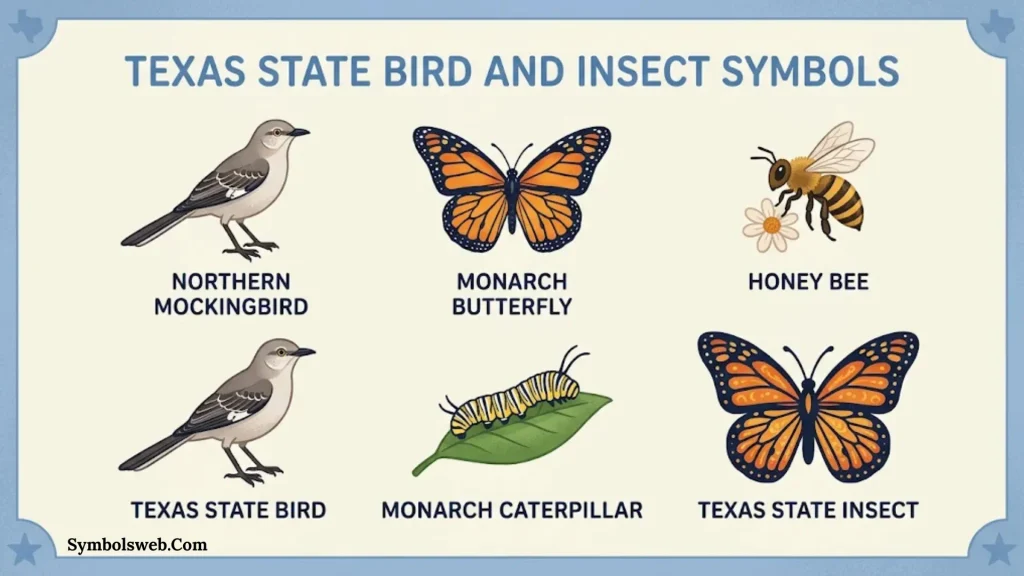
Birds and insects play important roles in Texas ecosystems. The state has official designations for its bird, insect, and pollinator.
Texas State Bird: Mockingbird
The Mockingbird is the official state bird of Texas. The Legislature selected it in 1927.
The northern mockingbird is known for copying the calls of other birds and sounds from its surroundings.
It can imitate several different sounds. This ability helps make its songs varied and recognizable.
Mockingbirds live in many parts of Texas. They can be found in gardens, parks, neighborhoods, and open countryside.
The bird represents the state’s natural wildlife and has become a familiar part of everyday life.
Texas State Insect: Monarch Butterfly
The Monarch Butterfly is the official Texas state insect.
Its bright orange wings feature black veins and white spots. The butterfly is also known for its remarkable migration.
Monarchs travel between breeding areas in North America and overwintering sites in Mexico. Texas serves as an important part of their migration route.
The species depends on milkweed plants because monarch caterpillars feed on milkweed leaves.
The monarch represents migration, natural beauty, and the importance of protecting pollinator habitats.
Texas State Pollinator: Western Honey Bee
The Western Honey Bee is the official state pollinator.
Honey bees help pollinate many flowering plants and agricultural crops. Their work supports food production and healthy ecosystems.
They collect nectar and pollen from flowers. During this process, they transfer pollen between plants.
The Western Honey Bee is especially important to agriculture. Its pollination activity supports crops that people and animals depend on.
Texas State Plants, Flowers, and Trees
Texas has a diverse natural landscape. Its official plant symbols represent native flowers, shrubs, trees, grasses, and aquatic plants.
Texas State Flower: Bluebonnet
The Bluebonnet is the official state flower of Texas. It became the state’s first official symbol in 1901.
Bluebonnets are wild lupine flowers known for their blue petals and distinctive shape. They commonly bloom during spring.
Their bright color transforms fields, roadsides, and open spaces across Texas. Many people travel during spring to enjoy the seasonal displays.
The original designation recognized Lupinus subcarnosus. Later legislation expanded the designation to include Lupinus texensis and other varieties of bluebonnet.
Bluebonnets represent:
- Texas springtime
- Native wildflowers
- Natural beauty
- State pride
- Local traditions
The flower is also popular in photography, artwork, decorations, and clothing.
Texas State Plant: Prickly Pear Cactus
The Prickly Pear Cactus is the official state plant of Texas.
This cactus is recognized by its flat, rounded pads and sharp spines. Some varieties also produce colorful flowers and edible fruit.
Prickly pear grows in dry environments and can tolerate challenging conditions. Its pads store water, helping the plant survive periods of limited rainfall.
The cactus has several practical uses. Its fruit is used in foods and drinks, while its pads are prepared in traditional dishes.
It also provides food and shelter for wildlife.
Texas State Native Shrub: Texas Purple Sage
Texas Purple Sage, also known as Texas sage, is the official native shrub.
Its scientific name is Leucophyllum frutescens. The plant is known for its silvery leaves and purple flowers.
Texas Purple Sage grows well in dry conditions. It is commonly used in landscaping because it can tolerate heat and periods of drought.
Its flowers often appear after rainfall. This feature has earned the plant the nickname “barometer bush.”
It represents the state’s dryland vegetation and native plant heritage.
Texas State Shrub: Crape Myrtle
The Crape Myrtle is the official state shrub of Texas.
It is a flowering plant known for its colorful summer blooms. Depending on the variety, its flowers may be pink, purple, red, or white.
Crape Myrtles are popular in gardens and public landscapes. They grow well in warm climates and can add seasonal color to outdoor spaces.
The plant is especially familiar in residential areas and along streets throughout Texas.
Texas State Tree: Pecan Tree
The Pecan Tree is the official state tree of Texas. The Legislature adopted it in 1919.
Pecan trees are native to North America and grow across several parts of Texas. They produce pecans, which are widely used in cooking and baking.
The tree can grow large and provide valuable shade. Its nuts also support agricultural production and local food traditions.
Pecans are important ingredients in desserts, especially the well-known pecan pie.
The tree represents natural resources, agriculture, and Texas food culture.
Texas State Grass: Sideoats Grama
Sideoats Grama is the official state grass.
This native grass grows in prairies, grasslands, and other open habitats. It is known for its small seed clusters that grow along one side of the stem.
Sideoats Grama provides food for grazing animals and supports native ecosystems.
Its designation recognizes the importance of grasslands to Texas agriculture and wildlife.
Texas State Waterlily: Nymphaea Texas Dawn
Nymphaea Texas Dawn is the official state waterlily.
This aquatic plant is known for its attractive flowers and floating leaves. It grows in water gardens and suitable aquatic environments.
Its designation celebrates Texas horticulture and the beauty of aquatic plants.
Texas State Squash: Pumpkin
The Pumpkin is the official state squash of Texas.
Pumpkins belong to the squash family and are widely used in cooking and seasonal traditions.
People use them in pies, soups, breads, and other dishes. They are also popular decorations during autumn celebrations.
The designation recognizes a familiar food and agricultural product.
Texas State Fish and Marine Symbols
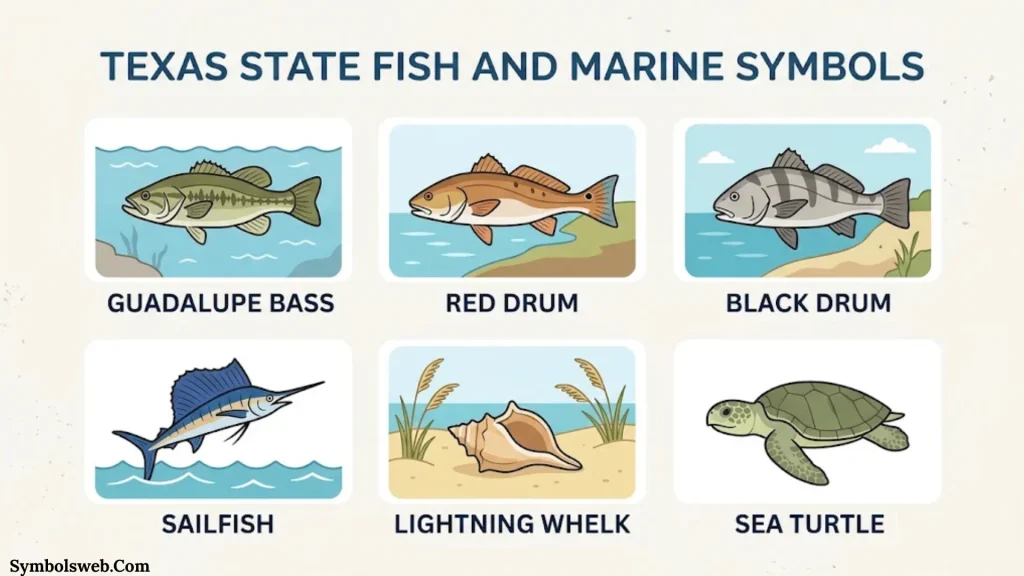
Texas has a long coastline along the Gulf of Mexico. Its rivers, lakes, bays, and coastal waters support a wide range of aquatic species.
Several fish and marine animals have received official state designations.
Texas State Fish: Guadalupe Bass
The Guadalupe Bass is the official state fish.
It is native to Texas and is especially associated with clear streams in the Edwards Plateau region.
The species lives in flowing freshwater habitats. It prefers areas with suitable current, rocks, and natural cover.
The Guadalupe Bass is important to conservation efforts because its native range is limited.
Its designation highlights the value of protecting Texas rivers and freshwater ecosystems.
Texas State Saltwater Fish: Red Drum
The Red Drum is the official state saltwater fish.
It is also commonly called redfish. The species lives in coastal waters, bays, and estuaries.
Red Drum are popular among recreational anglers. They are recognized by their copper-colored bodies and distinctive black spots near the tail.
The fish represents Texas coastal fishing and marine wildlife.
Texas State Crustacean: Texas Gulf Shrimp
The Texas Gulf Shrimp is the official state crustacean.
Shrimp support an important part of the Gulf Coast seafood industry. They are also a familiar ingredient in Texas coastal cooking.
Texas Gulf shrimp are harvested in coastal waters and sold in seafood markets and restaurants.
Their designation recognizes the state’s maritime economy and seafood traditions.
Texas State Sea Turtle: Kemp’s Ridley Sea Turtle
The Kemp’s Ridley Sea Turtle is the official state sea turtle.
It is one of the world’s most endangered sea turtle species. The animal is known for nesting in groups, a behavior called an arribada.
Texas beaches provide important nesting habitat. Conservation programs help protect nests and support hatchling survival.
The designation draws attention to marine conservation and the protection of coastal wildlife.
Texas State Shell: Lightning Whelk
The Lightning Whelk is the official state shell.
It is a large marine snail shell found along the Gulf Coast. Its most noticeable feature is its left-handed opening.
This unusual shell shape makes it easy to distinguish from many other common sea shells.
The Lightning Whelk represents Texas’s coastal environment and marine biodiversity.
Texas State Gem, Stone, and Precious Metal
Texas has official geological symbols that reflect its mineral resources and natural history.
Texas State Gem: Texas Blue Topaz
Texas Blue Topaz is the official state gem.
Topaz is a mineral that can appear in several colors. The blue variety is especially valued for its attractive appearance.
Texas Blue Topaz is associated with Mason County, which is known for its topaz deposits.
The gemstone represents the state’s mineral heritage and natural resources.
Texas State Gemstone Cut: Lone Star Cut
The Lone Star Cut is the official state gemstone cut.
It is a special cut developed to give gemstones a star-like appearance. The design connects gemstone craftsmanship with Texas’s famous Lone Star identity.
It represents both the state’s cultural heritage and its interest in gemstone artistry.
Texas State Stone: Petrified Palmwood
Petrified Palmwood is the official state stone.
Petrified wood forms when buried plant material gradually becomes mineralized over long periods.
The process preserves parts of the original wood’s structure. The result is a stone that often displays patterns resembling tree trunks and fibers.
Petrified Palmwood reflects Texas’s ancient geological history.
Texas State Precious Metal: Silver
Silver is the official state precious metal.
It has long been valued for its appearance, durability, and usefulness. Silver is used in jewelry, coins, decorative objects, and industrial applications.
Its designation recognizes the importance of mineral resources and metalworking.
Texas State Clothing and Fabric Symbols
Texas clothing symbols reflect ranching, Western traditions, and the state’s agricultural history.
The cowboy hat and cowboy boot are especially recognizable parts of Texas culture.
Texas State Hat: Cowboy Hat
The Cowboy Hat is the official state hat of Texas.
It developed as practical headwear for people working outdoors. Its wide brim helps protect the wearer from sunlight and rain.
Cowboy hats come in many styles and materials. Their shape and design often reflect personal preference and regional traditions.
In Texas, the cowboy hat is closely associated with ranching, rodeo, and Western identity.
Texas State Footwear: Cowboy Boot
The Cowboy Boot is the official state footwear.
Cowboy boots were designed for riding and working around livestock. Their traditional features include a raised heel, pointed or rounded toe, and tall shaft.
The raised heel helps keep the boot positioned in a riding stirrup. The tall shaft provides additional protection for the lower leg.
Today, cowboy boots are worn for practical work as well as fashion.
Texas State Fiber and Fabric: Cotton
Cotton is the official state fiber and fabric.
Cotton has played an important role in Texas agriculture for generations. The state’s climate and farmland support cotton production in several regions.
The fiber is used to make clothing, towels, bedding, and other textile products.
Cotton represents agriculture, manufacturing, and the history of Texas farming communities.
Texas State Music and Cultural Symbols
Music, dance, and performance are important parts of Texas culture. The state has official designations that recognize several traditional art forms.
Texas State Song: Texas, Our Texas
“Texas, Our Texas” is the official state song.
The song was written by William J. Marsh, with lyrics by Gladys Yoakum Wright.
It celebrates the state’s landscape, history, and identity. Its lyrics express pride in Texas and its people.
The Legislature adopted it as the official state song in 1929.
Texas State Flower Song: Bluebonnets
“Bluebonnets” is the official state flower song.
The song celebrates the bluebonnet and its connection with the Texas landscape.
It reflects the affection many Texans have for the state flower and its springtime blooms.
Texas State Music: Western Swing
Western Swing is the official state music of Texas.
This musical style combines elements of country, jazz, blues, and other musical traditions.
Western Swing developed in the American Southwest and became closely associated with Texas dance halls and musicians.
Its lively rhythm makes it popular for dancing and live performances.
Texas State Musical Instrument: Guitar
The Guitar is the official state musical instrument.
Guitars are central to many musical styles found in Texas. They appear in country, blues, folk, rock, Tejano, and Western Swing music.
The instrument has a strong connection with the state’s musical heritage.
Texas State Folk Dance: Square Dance
Square Dance is the official state folk dance.
It involves groups of dancers arranged in squares. Participants follow instructions from a caller and perform coordinated movements with their partners.
Square dancing has roots in several European folk dance traditions. It became popular in American community gatherings and social events.
Its designation recognizes a long-standing form of group entertainment.
Texas State Sport: Rodeo
Rodeo is the official state sport.
Rodeo grew from the practical skills used by ranch workers and cattle handlers.
Modern rodeo competitions include events such as:
- Bull riding
- Bareback bronc riding
- Saddle bronc riding
- Calf roping
- Steer wrestling
- Barrel racing
Rodeo celebrates the skills associated with ranching and Western horsemanship.
Texas State Foods and Agricultural Symbols
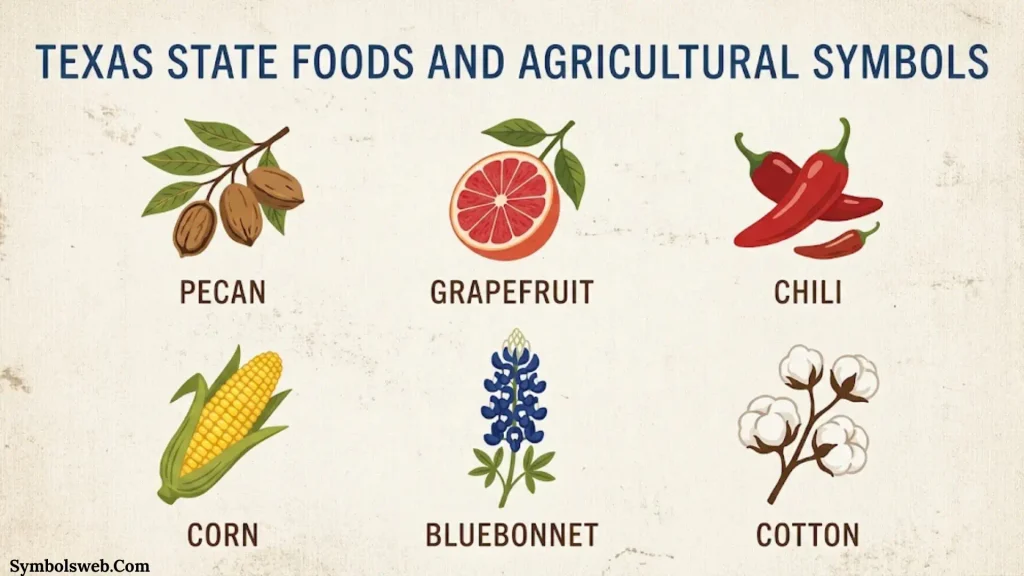
Food is an important part of Texas identity. Its official food symbols include traditional dishes, agricultural products, and familiar regional favorites.
Texas State Dish: Chili
Chili is the official state dish of Texas.
Texas-style chili is traditionally associated with meat, chili peppers, and seasonings. Many traditional recipes do not include beans.
The dish has a strong connection with Texas cooking competitions, local restaurants, and community gatherings.
Chili is also an important part of the state’s food history.
Texas State Bread: Pan de Campo
Pan de Campo is the official state bread.
Its name means “camp bread” in Spanish. It is a traditional bread associated with ranching and outdoor cooking.
Cowboys and ranch workers prepared it using simple ingredients and cooking equipment.
Pan de Campo represents the influence of Mexican and Spanish food traditions on Texas cuisine.
Texas State Cobbler: Peach Cobbler
Peach Cobbler is the official state cobbler.
It is a baked dessert made with peaches and a biscuit-like or pastry topping.
Peach cobbler is commonly served warm and may be accompanied by ice cream.
Its designation recognizes a familiar Southern dessert and the importance of peaches in Texas food culture.
Texas State Pie: Pecan Pie
Pecan Pie is the official state pie.
Pecans are closely connected with Texas agriculture. They are used in many local recipes and desserts.
Pecan pie typically combines pecans with a sweet filling inside a pastry crust.
It is especially popular during holidays and family gatherings.
Texas State Fruit: Texas Red Grapefruit
The Texas Red Grapefruit is the official state fruit.
Texas is known for producing citrus fruit in the Rio Grande Valley. The region’s climate supports the cultivation of grapefruit and other citrus crops.
Red grapefruit is recognized for its colorful flesh and sweet-tart flavor.
It represents the state’s agricultural diversity.
Texas State Vegetable: Sweet Onion
The Sweet Onion is the official state vegetable.
Sweet onions are known for their mild flavor and lower pungency compared with many stronger onion varieties.
They are used in salads, sandwiches, cooked dishes, and other recipes.
Their designation celebrates Texas agriculture and food production.
Texas State Pepper: Jalapeño
The Jalapeño is the official state pepper.
It is a popular chili pepper used in many Texas and Mexican-inspired dishes.
Jalapeños can be eaten fresh, roasted, pickled, or added to sauces and salsas.
They are commonly found in Tex-Mex cooking and barbecue meals.
Texas State Native Pepper: Chiltepin
The Chiltepin is the official state native pepper.
It is a small, round wild chili pepper native to parts of the Americas. Despite its size, it has a strong, spicy flavor.
Chiltepin is used in sauces, seasonings, and traditional dishes.
It represents the native plant heritage of the region.
Texas State Snack: Tortilla Chips and Salsa
Tortilla Chips and Salsa are the official state snack.
This combination is closely connected with Tex-Mex food culture.
Tortilla chips are commonly made from corn tortillas. Salsa may contain tomatoes, peppers, onions, herbs, and other ingredients.
Together, they are served in restaurants, homes, and gatherings across Texas.
Texas State Health Nut: Pecan
The Pecan is the official state health nut.
Pecans are edible nuts that grow on pecan trees. They are used in desserts, snacks, baked goods, and savory dishes.
They contain fats, fiber, protein, and several nutrients.
The designation also highlights the importance of pecans to Texas agriculture.
Texas State Pastry and Cooking Symbols
Texas has additional food-related designations that celebrate traditional cooking.
These include:
- Cast Iron Dutch Oven: The official state cooking implement.
- Sopaipilla and Strudel: Pastries recognized through a legislative designation that was limited to a specific period and should not be treated as current permanent symbols.
- Pumpkin: The official state squash.
- Texas Gulf Shrimp: The official state crustacean.
These designations show how Texas symbols extend beyond plants and animals into everyday food traditions.
Other Official Texas State Symbols
The Texas Legislature has recognized many additional symbols. Some represent historic objects, public institutions, transportation, and community traditions.
| Category | Official Texas symbol |
| State book | Texas Almanac |
| State domino game | 42 |
| State vehicle | Chuck Wagon |
| State railroad | Texas State Railroad |
| State ship | U.S.S. Texas |
| State tall ship | Elissa |
| State aquarium | Texas State Aquarium |
| State maritime museum | Texas Maritime Museum |
| State botanical garden | Lady Bird Johnson Wildflower Center |
| State mushroom | Texas Star Mushroom |
| State hashtag | #Texas |
| State tourism hashtag | #TexasToDo |
| State Legislature hashtag | #txlege |
| State knife | Bowie Knife |
| State handgun | 1847 Colt Walker Pistol |
| State gun | Cannon |
| State precious metal | Silver |
| State rodeo drill team | Ghostriders |
| State bison herd | Texas State Bison Herd at Caprock Canyons State Park |
The Texas Legislature has also recognized the Commemorative Air Force and several official plays.
These designations show the broad range of subjects that can become part of the state’s official identity.
Texas State Book: Texas Almanac
The Texas Almanac is the official state book.
It provides information about Texas history, geography, population, government, natural resources, and communities.
The publication has served as a reference for people interested in understanding the state.
Its designation recognizes the value of preserving and sharing information about Texas.
Texas State Domino Game: 42
42 is the official state domino game.
It is a trick-taking game played with a standard set of dominoes. Players compete in teams and use strategy to win points.
The game has a long history in Texas communities. It remains popular at family gatherings, social events, and local competitions.
Texas State Vehicle: Chuck Wagon
The Chuck Wagon is the official state vehicle.
Chuck wagons were used to carry food and cooking equipment during cattle drives and other journeys across open land.
They helped provide meals for cowboys and workers who spent long periods away from towns.
The chuck wagon represents ranching history and the practical traditions of the American West.
Texas State Knife: Bowie Knife
The Bowie Knife is the official state knife.
It is a large fixed-blade knife associated with the 19th-century American frontier.
The knife is connected with James Bowie and the history of the Republic of Texas.
Its designation recognizes an object associated with frontier history and Texas heritage.
Texas State Handgun: 1847 Colt Walker Pistol
The 1847 Colt Walker Pistol is the official state handgun.
It was developed during the 19th century and is associated with early American military history.
The pistol is named after Samuel Hamilton Walker, a Texas Ranger and military officer.
Its designation recognizes a historical firearm connected with Texas and the American frontier.
Texas State Gun: Cannon
The Cannon is the official state gun.
Cannons played an important role in military history, including the Texas Revolution.
One especially famous cannon is associated with the Battle of Gonzales in 1835. The confrontation became an important early event in the struggle for Texas independence.
Texas State Railroad: Texas State Railroad
The Texas State Railroad is the official state railroad.
It represents the importance of rail transportation in Texas history.
Railroads helped connect towns, support trade, and transport people and goods across long distances.
The historic railroad also serves as a reminder of the state’s industrial and transportation heritage.
Texas State Tall Ship: Elissa
The Elissa is the official state tall ship.
It is a historic sailing vessel preserved in Galveston, Texas.
The ship represents the state’s maritime history and the importance of shipping to its coastal communities.
Texas State Aquarium
The Texas State Aquarium is the official state aquarium.
Located in Corpus Christi, it focuses on marine life and aquatic habitats.
Its exhibits help visitors learn about ocean animals, coastal ecosystems, and conservation.
Texas State Maritime Museum
The Texas Maritime Museum is the official state maritime museum.
Located in Rockport, it explores the state’s connection with the sea.
Its subject areas include shipping, fishing, navigation, and coastal history.
Lady Bird Johnson Wildflower Center
The Lady Bird Johnson Wildflower Center is the official state botanical garden.
Located in Austin, it focuses on native plants and their conservation.
The center promotes the use of native plants in landscapes and educates visitors about regional biodiversity.
Texas Symbols and Their Historical Meanings
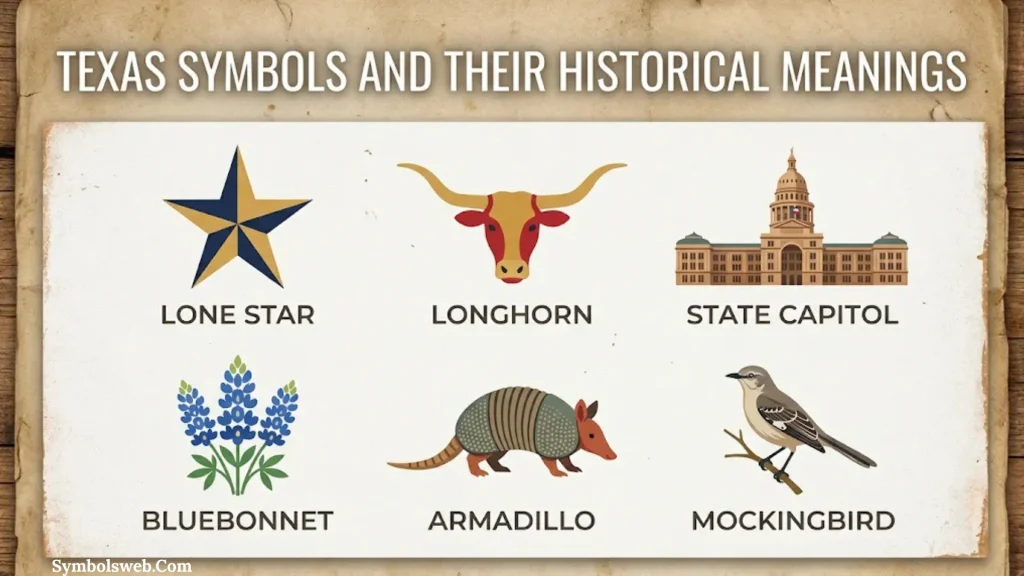
Texas symbols are closely connected with the events and traditions that shaped the state.
Understanding these historical connections helps explain why certain animals, objects, and landmarks remain important.
The Lone Star and Texas Independence
The Lone Star is connected with the Republic of Texas and its independence from Mexico.
Texas declared independence in 1836. The new republic adopted symbols that reflected its separate political identity.
The single star became one of the most enduring emblems of the republic.
It continues to appear on the state flag, seal, government buildings, and cultural designs.
The Alamo
The Alamo is one of the most important historic sites in Texas.
It became famous because of the 1836 Battle of the Alamo during the Texas Revolution.
Texan defenders fought against Mexican forces at the mission in San Antonio. The battle ended with a Mexican victory, but it became a lasting part of Texas historical memory.
The Alamo is connected with courage, sacrifice, and the struggle for independence.
Its image also appears on the reverse of the Texas State Seal.
Battle of Gonzales and the “Come and Take It” Cannon
The Battle of Gonzales took place in October 1835. It is often remembered as the first military engagement of the Texas Revolution.
The conflict involved a small cannon that Mexican authorities had previously provided to the settlers for protection.
When Mexican soldiers attempted to retrieve it, local Texans refused to surrender the weapon.
The event became associated with the phrase “Come and Take It.”
The cannon remains an important historical reference in Texas culture. It is also depicted on the reverse of the state seal.
Six Flags Over Texas
The phrase Six Flags Over Texas refers to the six countries and governments that have held sovereignty over the region.
They are:
- Spain
- France
- Mexico
- The Republic of Texas
- The Confederate States of America
- The United States of America
The historical periods are not all separate and sequential. For example, the United States held Texas before and after the Civil War, while the Confederate States controlled it during the Civil War period.
The phrase appears in Texas history, tourism, education, and popular culture.
It reflects the region’s complex past and changing political boundaries.
Vaquero Traditions and Cowboy Culture
Texas cowboy culture has strong connections with Vaquero traditions from Mexico.
Vaqueros developed practical skills for handling cattle and working on horseback. These traditions influenced ranching practices across the American Southwest.
Many familiar cowboy traditions developed through this shared history.
These include:
- Horseback cattle handling
- Roping and livestock management
- Western riding equipment
- Ranch clothing
- Trail and cattle-drive traditions
The cowboy hat, cowboy boot, and chuck wagon all connect with this wider cultural history.
Why Are Texas State Symbols Important?
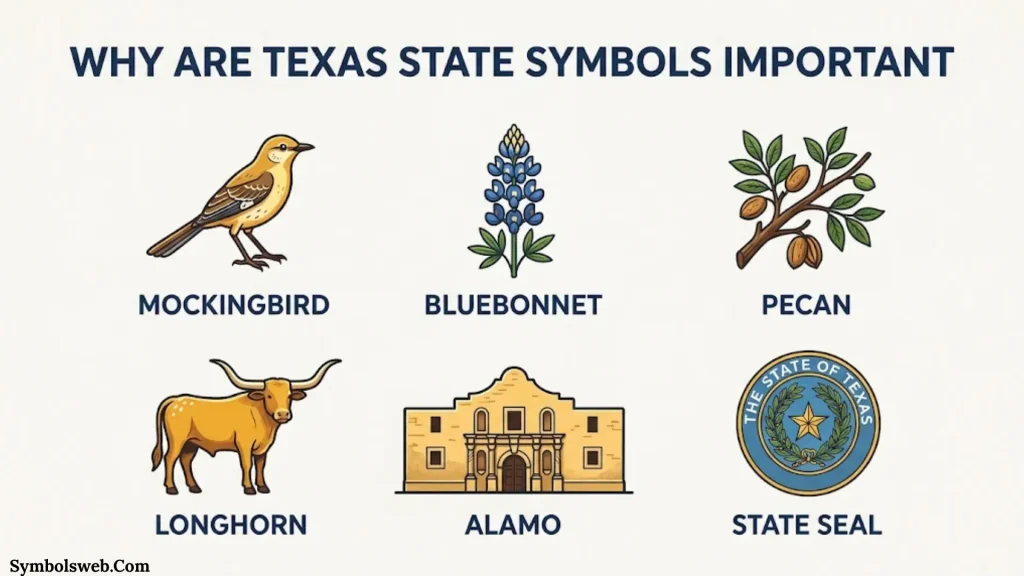
Texas state symbols do more than decorate flags, buildings, and souvenirs. They preserve important parts of the state’s identity.
Each designation recognizes a particular part of Texas life.
They Preserve Texas History
Symbols such as the Lone Star Flag, state seal, and cannon connect modern Texas with its past.
They help people remember the Republic of Texas, the Texas Revolution, and the state’s changing political history.
They Celebrate Native Wildlife
Animals such as the Texas Horned Lizard, Guadalupe Bass, and Mexican Free-Tailed Bat represent the state’s natural diversity.
Their designations can also encourage awareness of wildlife conservation.
They Recognize Agriculture
Cotton, pecans, sweet onions, and Texas Red Grapefruit reflect the importance of farming and food production.
These symbols recognize the crops and products that have helped shape Texas communities.
They Represent Cultural Traditions
Rodeo, Western Swing, square dancing, cowboy boots, and cowboy hats reflect the state’s cultural heritage.
They show how music, clothing, recreation, and everyday traditions contribute to a shared identity.
They Help Educate New Generations
Official symbols make Texas history easier to explore. Students can learn about the state through familiar objects, plants, animals, and foods.
They also offer a simple way to connect classroom lessons with real places and traditions.
Frequently Asked Questions About Texas Symbols
What is the most famous symbol of Texas?
The Lone Star Flag is one of the most famous symbols of Texas. Its single white star represents the state’s historic identity and connection with independence.
What is the official state flower of Texas?
The Bluebonnet is the official state flower of Texas. It was first designated in 1901 and is known for its bright blue springtime blooms.
What is the state animal of Texas?
Texas has several official mammal designations rather than one general state animal. The Texas Longhorn is the state large mammal, the Armadillo is the state small mammal, and the Mexican Free-Tailed Bat is the state flying mammal.
What is the official state bird of Texas?
The Mockingbird is the official state bird. It became the state bird in 1927 and is known for copying the songs and calls of other birds.
What is the Texas state motto?
The official Texas state motto is Friendship. The name Texas is connected to a Caddo word commonly translated as friend or ally.
What is the Texas state tree?
The Pecan Tree is the official state tree. It was designated in 1919 and is important for its nuts, shade, and agricultural value.
What is the Texas state fish?
The Guadalupe Bass is the official state fish. The Red Drum is separately recognized as the official state saltwater fish.
What is the Texas state reptile?
The Texas Horned Lizard is the official state reptile. It is also commonly called the horny toad because of its unusual shape.
What is the Texas state gemstone?
Texas Blue Topaz is the official state gem. The Lone Star Cut is separately recognized as the official state gemstone cut.
Why is Texas called the Lone Star State?
Texas is called the Lone Star State because the single star became a lasting symbol of the Republic of Texas and its independence.
What are the Six Flags Over Texas?
The Six Flags represent Spain, France, Mexico, the Republic of Texas, the Confederate States of America, and the United States of America.
What is the official Texas state song?
“Texas, Our Texas” is the official state song. The Legislature adopted it in 1929.
Conclusion
Texas symbols reflect the state’s history, natural beauty, agriculture, and cultural traditions. The Lone Star Flag represents its independent identity, while the bluebonnet celebrates its native landscape. The Texas Longhorn, cowboy hat, and cowboy boot connect modern Texas with its ranching heritage.
From the Guadalupe Bass to pecan pie, these official designations cover many parts of everyday life. They also help preserve the stories and traditions that make Texas distinctive.
If you’re learning about the state for school, researching its history, or exploring its cultural identity, these Texas symbols and their meanings offer a useful starting point. Each one tells a small part of a much larger story.

Hi, I’m Ethan Holloway, and I’ve always believed that a few meaningful words can change the way we think, feel, and live. I enjoy collecting timeless quotes, studying their deeper meanings, and sharing inspiring messages that help people stay motivated through every stage of life.
Over the years, I’ve explored thousands of famous sayings from writers, leaders, philosophers, and everyday people. My goal is to make wisdom easy to understand and useful for everyone.
Books by Ethan Holloway
- The Power of Everyday Quotes
- Words That Inspire Greatness
 Jordan Hayes