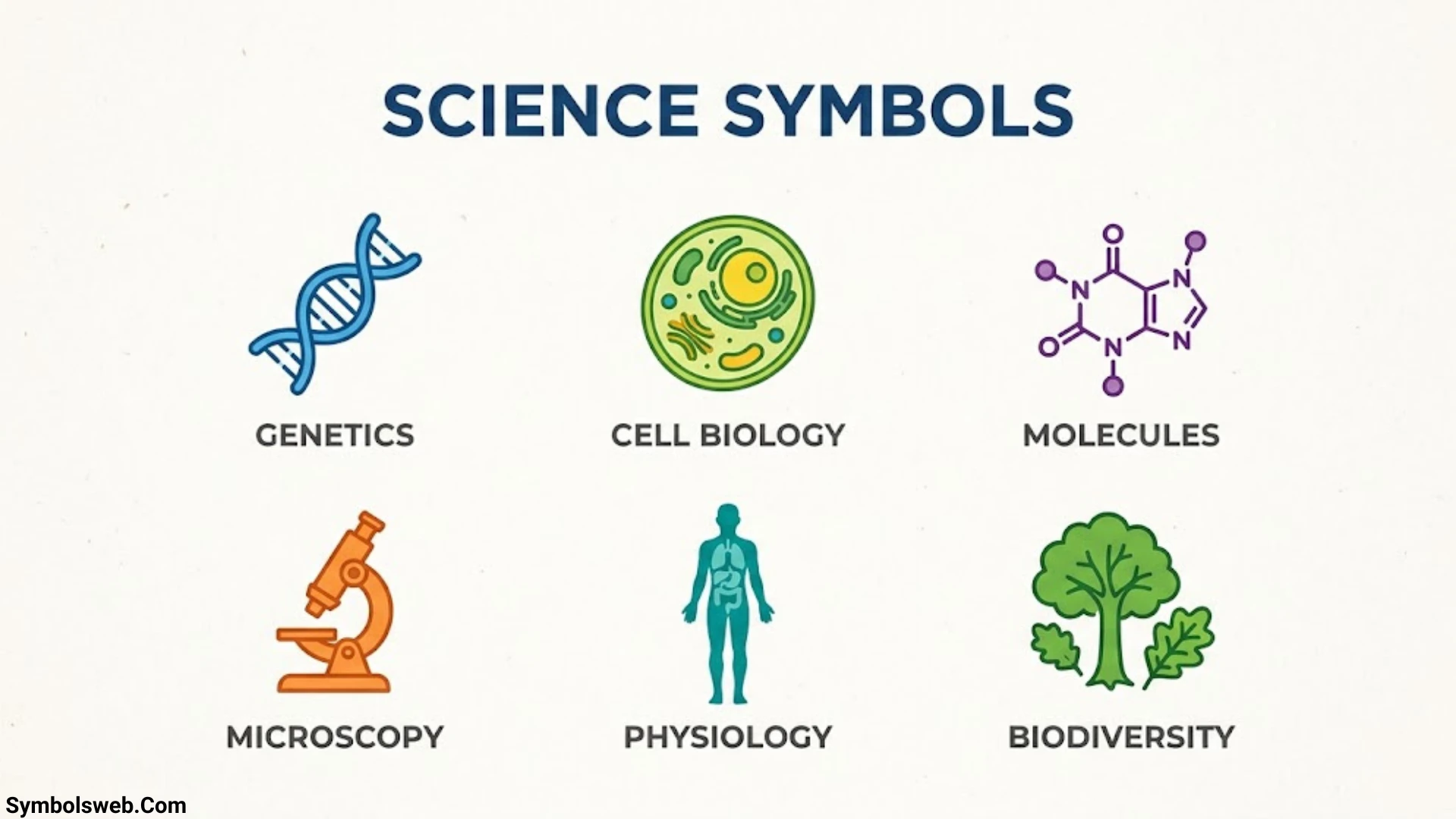
Science symbols help you understand scientific concepts, formulas, and measurements more easily. From mathematical signs and physics symbols to chemistry notation and biology symbols, each symbol has a specific meaning. Learning these symbols can make science easier to study and help you understand important scientific information.
If you are a student, teacher, or science enthusiast, knowing common science symbols can be useful in everyday learning. You can use them to solve equations, understand chemical reactions, read scientific diagrams, and complete school assignments. Many symbols are also used in laboratories, textbooks, and research papers.
In this guide, you will discover common science symbols and their meanings, including symbols used in physics, chemistry, biology, and mathematics. You will also learn how these symbols are used in different scientific fields, making it easier for you to recognize them and apply them correctly in your studies.
Science Symbols: (Quick Answer)
Science symbols are visual signs, letters, shapes, and diagrams used to represent scientific concepts, quantities, processes, and discoveries. Examples include H₂O for water, Δ for change, ⚛ for the atomic symbol, and the DNA double helix for genetics. They make complex information easier to communicate and help scientists share knowledge across languages, countries, and generations.
Quick Facts About Science Symbols
| Aspect | Information |
| Origin | Developed across ancient civilizations and formalized through the growth of mathematics and modern science |
| Historical Significance | Helped record observations, explain natural phenomena, and share discoveries |
| Main Meaning | Represent scientific ideas, measurements, substances, and processes |
| Spiritual Meaning | Some symbols inspire reflection on nature, balance, creation, and the interconnectedness of life |
| Cultural Importance | Reflect humanity’s curiosity about the natural world and the search for truth |
| Modern Usage | Education, laboratories, medicine, engineering, technology, scientific publications, and public communication |
What Are Science Symbols?
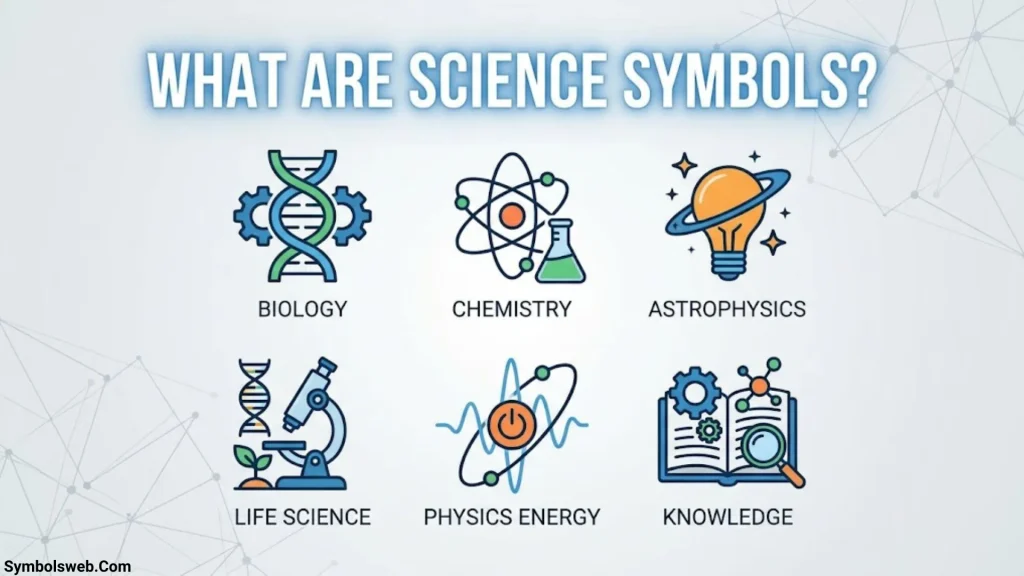
Science symbols are standardized or widely recognized visual representations of scientific information. They allow people to express complicated ideas in a compact, understandable form.
For example, a scientist can write H₂O instead of spelling out the chemical composition of water every time. A physicist can use c to represent the speed of light in a familiar equation. A biologist can use a DNA diagram to explain how genetic information is organized.
These symbols serve three main purposes:
- Communication: They help people share scientific information accurately.
- Simplification: They make complex concepts easier to represent and study.
- Standardization: They allow researchers in different countries to understand the same measurements, formulas, and diagrams.
However, not all science symbols work in the same way. Some are formal scientific notation, such as the symbol Na for sodium. Others are illustrative icons, such as the familiar atom symbol used on science textbooks and laboratory signs.
The Origins of Scientific Symbols
The history of science symbols begins long before modern laboratories existed.
Ancient civilizations used marks, numbers, drawings, and written signs to record observations about the sky, seasons, plants, animals, and human health. These early systems helped people track time, predict seasonal changes, measure land, and organize medical knowledge.
In ancient Mesopotamia, mathematical notation supported astronomy and accounting. Ancient Egyptians developed systems of measurement and recorded medical and mathematical information. Greek thinkers later helped establish traditions of geometry, logic, and natural philosophy.
During the medieval period, scholars across the Islamic world, Europe, India, and China contributed to mathematical and scientific knowledge. Over time, mathematical notation became more consistent, making it easier to express relationships between quantities.
The scientific revolution of the 16th and 17th centuries brought major advances in mathematical physics, astronomy, and experimental science. Scientists increasingly relied on equations, standardized measurements, and specialized notation to describe the natural world.
Modern scientific symbols grew from this long process of observation, experimentation, cultural exchange, and standardization.
Why Science Symbols Became Important
Imagine trying to explain electricity, chemical reactions, or the structure of an atom using words alone. Every explanation would be long, and different languages could make communication difficult.
Symbols solve this problem by compressing information into recognizable forms.
For example, the equation E = mc² expresses a relationship between energy, mass, and the speed of light. A short equation communicates an idea that would otherwise require a much longer explanation.
Similarly, the periodic table organizes chemical elements using standardized symbols. Scientists can identify iron as Fe, oxygen as O, and gold as Au regardless of the language they speak.
Science symbols became essential because scientific progress depends on clear communication, shared standards, and the ability to build on earlier discoveries.
Deep Symbolic Meaning of Science Symbols
Science symbols have both technical meanings and broader cultural associations. A chemical symbol has a precise scientific definition, while a symbol representing an atom, a microscope, or a DNA molecule may also inspire feelings of discovery, intelligence, hope, or mystery.
It is important to distinguish established scientific meanings from personal, spiritual, or cultural interpretations.
Spiritual Meaning of Science Symbols
Science symbols do not have one universal spiritual meaning. Nevertheless, many people find deeper significance in the images and ideas associated with science.
The atom can inspire reflection on the hidden structure of matter. The DNA double helix can represent the complexity of life. A mathematical equation can suggest harmony, order, or the search for patterns in nature.
For some people, learning about the universe strengthens a sense of wonder. The discovery that stars contain elements also found on Earth, for instance, can create a powerful feeling of connection with the cosmos.
These experiences may be meaningful in a spiritual sense, but they do not establish supernatural claims. Science investigates natural phenomena through observation and testing, while spiritual interpretations depend on personal beliefs and philosophical traditions.
Psychological Meaning of Science Symbols
Human beings naturally look for patterns. We use images, shapes, and familiar signs to organize information and remember important ideas.
Science symbols can activate several psychological responses:
- Curiosity: An unfamiliar scientific image may encourage people to investigate what it represents.
- Confidence: Familiar symbols can make complex information feel more manageable.
- Wonder: Images of galaxies, atoms, and DNA can inspire awe.
- Identity: A person who values science may use scientific imagery to express their interests or worldview.
- Connection: Shared symbols help scientists and students feel part of a wider community.
The Swiss psychiatrist Carl Gustav Jung developed theories about archetypes and recurring symbolic patterns in human experience. His work can provide a lens for discussing why certain images feel meaningful. However, modern scientific symbols should not automatically be classified as Jungian archetypes, and personal reactions to them vary.
Cultural Meaning of Science Symbols
Scientific symbols also reflect the history of the communities that developed and adopted them.
The symbols used in modern mathematics, chemistry, astronomy, and medicine emerged through centuries of international exchange. Their development involved scholars working in different languages and intellectual traditions.
Today, the microscope may represent research, the atom may represent physics, and the DNA helix may represent genetics or biotechnology. These associations are common, but the precise meaning still depends on context.
A symbol on a laboratory door, for example, may communicate a safety warning rather than a general celebration of science.
Types and Variations of Science Symbols
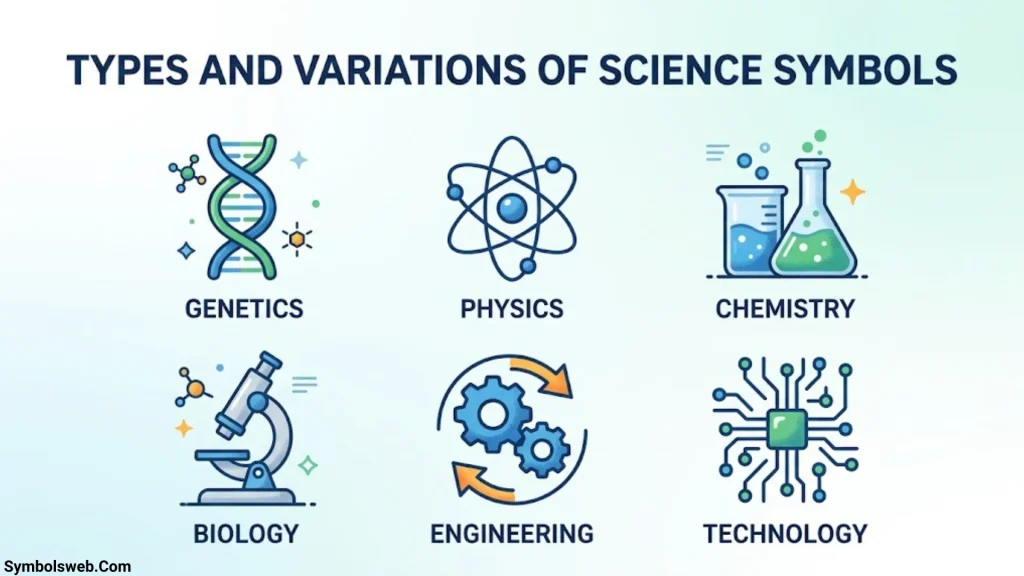
Science includes many branches, and each has its own visual language. Some symbols represent physical quantities, others identify chemical substances, and some illustrate structures that cannot be seen with the naked eye.
The following examples cover the most widely recognized science symbols and their meanings.
Physics Symbols
Meaning: Motion, energy, force, waves, electricity, and the laws of nature.
Symbolism: Discovery, precision, and the search for universal rules.
Where they appear: Textbooks, research papers, engineering, and laboratory work.
Common physics symbols include:
| Symbol | Name | Scientific meaning |
| Δ | Delta | Change in a quantity, such as temperature |
| λ | Lambda | Wavelength in many physics contexts |
| ν | Nu | Frequency in many contexts |
| c | Speed of light | The speed of light in a vacuum |
| g | Gravitational acceleration | The local acceleration due to gravity |
| ∞ | Infinity | An unbounded quantity or mathematical concept |
| Ω | Omega | The ohm symbol when used as a unit, or other quantities depending on context |
| π | Pi | The ratio of a circle’s circumference to its diameter |
These symbols are not merely decorative. Their meanings depend on the equation, field, and notation being used.
Chemistry Symbols
Meaning: The identity of elements and the composition of substances.
Symbolism: Transformation, matter, experimentation, and the building blocks of the physical world.
Where they appear: Periodic tables, medicine labels, chemical laboratories, and scientific publications.
| Symbol | Name | Meaning |
| H | Hydrogen | A chemical element |
| O | Oxygen | A chemical element |
| C | Carbon | A chemical element central to organic chemistry |
| Fe | Iron | A chemical element, with a symbol derived from Latin ferrum |
| Au | Gold | A chemical element, with a symbol derived from Latin aurum |
| Na | Sodium | A chemical element, with a symbol derived from Latin natrium |
| H₂O | Water | A compound containing hydrogen and oxygen |
| CO₂ | Carbon dioxide | A compound containing carbon and oxygen |
Modern chemical symbols developed through efforts to make chemical writing more consistent. Swedish chemist Jöns Jacob Berzelius proposed a system based on letters in 1813, helping shape the notation used today.
Biology Symbols
Meaning: Life, heredity, cellular processes, and living systems.
Symbolism: Growth, continuity, identity, and the connection between generations.
Where they appear: Genetics research, medicine, biotechnology, textbooks, and public health communication.
| Symbol or image | Meaning | Common association |
| DNA double helix | Structure of DNA | Genetics and heredity |
| Cell diagram | Basic unit of life | Biology and cellular research |
| Chromosome | Organized DNA and associated proteins | Inheritance and genetics |
| Leaf icon | Plant life or environmental themes | Botany and ecology |
| Microscope | Instrument for viewing small objects | Scientific investigation |
The DNA double helix became one of the most recognizable images in modern science after research published in 1953 described its molecular structure. The work of James Watson, Francis Crick, Rosalind Franklin, Maurice Wilkins, and other researchers contributed to this breakthrough.
Astronomy Symbols
Meaning: Celestial objects, astronomical observations, and the structure of the universe.
Symbolism: Exploration, vastness, time, and humanity’s place in the cosmos.
Where they appear: Astronomy books, planetariums, observatories, and space missions.
| Symbol | Name | Meaning |
| ☉ | Sun symbol | The Sun in astronomy and historical astronomical notation |
| ☽ | Crescent Moon symbol | The Moon in astronomical and historical notation |
| ⊕ | Circled plus | Earth in some astronomical contexts |
| ♄ | Saturn symbol | Saturn in historical astronomical notation |
| ★ | Star | A star or a star-shaped marker, depending on context |
| 🌌 | Galaxy or night-sky imagery | Often used informally to represent space and astronomy |
Some astronomical symbols have roots in ancient planetary traditions and astrology. Their historical origins do not mean that every modern use carries an astrological meaning.
Mathematics Symbols
Meaning: Quantities, relationships, calculations, and abstract structures.
Symbolism: Logic, order, patterns, and the power of human reasoning.
Where they appear: Mathematics, physics, statistics, computer science, and engineering.
| Symbol | Name | Meaning |
| + | Plus | Addition |
| − | Minus | Subtraction or negation |
| = | Equals | Equality |
| √ | Square root | A mathematical operation |
| ∑ | Summation | Adding a sequence of terms |
| ∫ | Integral | Integration in calculus |
| π | Pi | A constant used in geometry and mathematics |
| ∞ | Infinity | An idea of unboundedness |
Mathematical symbols are especially useful because they let people describe relationships precisely without relying on long sentences.
Medical and Laboratory Symbols
Meaning: Research, diagnosis, testing, healthcare, and laboratory procedures.
Symbolism: Knowledge, healing, care, and the responsible use of evidence.
Where they appear: Hospitals, laboratories, medical education, and health communication.
A microscope commonly represents scientific observation. A laboratory flask suggests experimentation, while a medical cross often signals healthcare services.
These images are widely understood visual conventions, but they are not all formal scientific symbols. A safety pictogram, in particular, can communicate a specific hazard rather than a general scientific idea.
Environmental Science Symbols
Meaning: Ecosystems, conservation, climate, natural resources, and sustainability.
Symbolism: Responsibility, renewal, balance, and care for the planet.
Where they appear: Environmental campaigns, climate education, research, and sustainable product design.
A green leaf may suggest nature, while a globe may represent Earth as a shared home. Recycling arrows indicate the reuse and recovery of materials in appropriate contexts.
However, an environmental icon alone does not prove that a product or company is sustainable. Scientific evidence and clear standards are needed to support such claims.
The Atom Symbol
Meaning: Atomic science, nuclear physics, and the study of matter.
Symbolism: Discovery, hidden structures, energy, and the unseen foundations of the physical world.
Where it appears: Science education, research institutions, science museums, and scientific branding.
The familiar atom icon is a simplified illustration, not an accurate picture of an atom’s electron structure. Modern atomic theory uses quantum mechanics to describe electrons through quantum states and probability distributions rather than tiny planets following fixed paths around a nucleus.
This distinction matters because scientific illustrations are often designed to communicate an idea, not reproduce every detail of reality.
Science Symbols Across Different Cultures
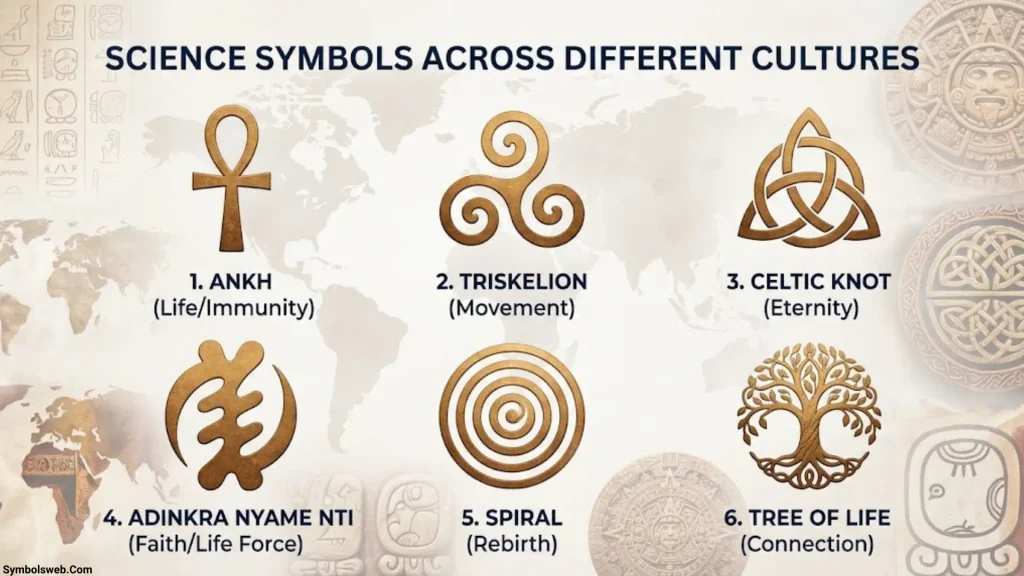
Scientific knowledge developed through the work of many civilizations. However, ancient religious, philosophical, and astronomical symbols should not be confused with modern scientific notation.
A historical symbol may represent a natural force in one culture and have a different meaning in another.
Ancient Egypt
Ancient Egyptian society used hieroglyphs, mathematical notation, and practical measurement systems. These supported record keeping, construction, astronomy, and medical writing.
The Eye of Horus, for example, was associated with protection and well-being in Egyptian religious culture. It is sometimes linked in modern popular accounts to mathematics or science, but it was not a universal scientific symbol in the modern sense.
Egyptian knowledge of geometry and measurement contributed to practical achievements such as surveying land and constructing monumental buildings.
Ancient Greece
Ancient Greek thinkers developed influential traditions of mathematics, geometry, astronomy, and natural philosophy.
Pythagoras and later Pythagorean thinkers explored numerical relationships, while Euclid’s Elements helped organize geometric knowledge. Greek letters eventually became widely used in mathematics and scientific notation.
Today, symbols such as π, Δ, and λ connect modern science with a long tradition of mathematical writing, although their specific uses developed over time.
Roman Culture
Roman civilization adopted and adapted ideas from Greek mathematics, astronomy, medicine, and philosophy.
Roman numerals, including I, V, X, L, C, D, and M, are a well-known numerical system. They still appear on clocks, monuments, book chapters, and formal documents.
Roman culture also preserved and transmitted knowledge through Latin writing. Latin names later influenced many chemical symbols, including Fe for iron and Au for gold.
Indian Traditions
Ancient and medieval scholars in the Indian subcontinent made major contributions to mathematics, astronomy, and medicine.
The development and transmission of the decimal place-value system and zero were particularly important in the history of mathematics. These ideas later spread through scholarly networks into other regions, helping shape modern numerical notation.
Symbols such as ॐ (Om) belong to religious and philosophical traditions, especially Hindu traditions. Although modern designs sometimes combine Om with scientific imagery, Om is not a scientific measurement or a symbol used to establish a scientific law.
Chinese Traditions
Chinese scholars developed sophisticated traditions of mathematics, astronomy, medicine, and natural philosophy.
The yin-yang symbol represents complementary forces in Chinese philosophical traditions. It is often used today to illustrate balance or interconnectedness, including in popular discussions of nature.
However, yin-yang is not a substitute for a scientific model. Modern scientific explanations require evidence, precise definitions, and methods appropriate to the question being studied.
Indigenous Traditions
Indigenous peoples across the world have developed detailed knowledge of plants, animals, landscapes, weather, stars, and seasonal cycles.
Visual patterns, stories, maps, and ceremonial designs may carry ecological, historical, spiritual, or community meanings. These traditions are diverse, so no single interpretation applies to all Indigenous cultures.
For example, some communities have used observations of stars and seasonal changes to guide navigation, food gathering, and land management. Such knowledge can be valuable in environmental research, especially when studied with respect for the communities that maintain it.
It is important not to label every traditional symbol as a scientific sign. Cultural knowledge deserves to be understood in its own context.
Modern Global Culture
Modern science relies on international standards, shared terminology, and standardized notation. Symbols for chemical elements, mathematical operations, and units allow scientists to communicate across language barriers.
Organizations such as the International Union of Pure and Applied Chemistry help maintain consistent chemical nomenclature, while international measurement standards support the reliable use of scientific units.
In today’s world, science symbols appear in classrooms, research journals, digital applications, museums, public health notices, and technology brands.
Similar Science Symbols and Their Meanings
Many scientific and historical symbols look alike, but their meanings can be very different. Understanding the context helps prevent confusion.
| Symbol | Common meaning | Important distinction |
| ⚛ Atom icon | Atomic science | A simplified illustration, not a literal atomic structure |
| ☯ Yin-yang | Complementary forces in Chinese philosophy | A philosophical symbol, not a scientific formula |
| ∞ Infinity | Unboundedness in mathematics | Its personal or spiritual meanings are interpretations |
| 🧬 DNA helix | Genetics and molecular biology | Represents a real molecular structure through a simplified image |
| ⚕ Rod of Asclepius | Medicine and healing | A historical medical emblem, not a general symbol for all sciences |
| ♻ Recycling symbol | Recycling and material recovery | Does not automatically certify that an item is recyclable everywhere |
| ⚗ Alchemical flask | Alchemy or laboratory work | Its meaning depends on historical or modern context |
Science Symbols vs. Alchemy Symbols
Alchemy is particularly interesting because it connects the history of science with the history of symbolism.
Historical alchemists used signs for metals, planets, substances, and processes. Some symbols had practical meanings, while others carried philosophical or esoteric associations.
The Royal Society of Chemistry explains that alchemy developed through intellectual traditions associated with Egypt, the Arabic-speaking world, Greece, Rome, and Europe. Over time, experimental practices and chemical knowledge contributed to the development of modern chemistry.
| Feature | Modern science symbols | Historical alchemy symbols |
| Main purpose | Communicate scientific information consistently | Represent substances, processes, and philosophical ideas |
| Meaning | Defined by scientific conventions and context | Often varied by author, period, and tradition |
| Usage | Research, education, measurement, and technology | Historical manuscripts, alchemical texts, and modern symbolic art |
| Interpretation | Usually precise within a given field | May include practical, spiritual, or allegorical meanings |
The two traditions are historically connected, but they are not interchangeable. An alchemical sign for transformation does not automatically describe a modern chemical reaction.
Science Symbols in Mythology and Folklore
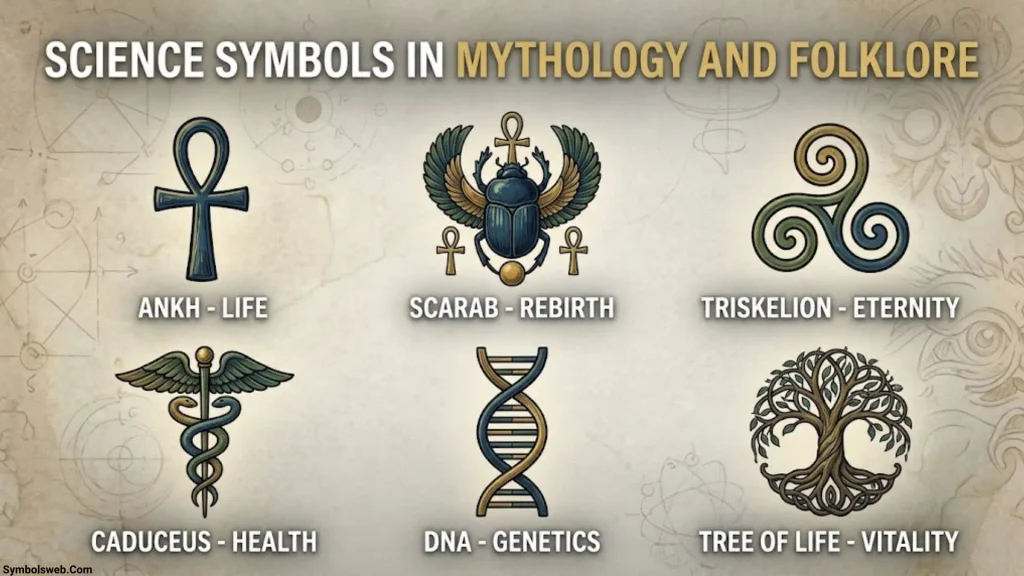
Science and mythology may appear to belong to separate worlds, but both reflect humanity’s long-standing desire to understand nature.
Mythology often explains natural events through stories about gods, heroes, and supernatural forces. Science developed methods for testing explanations through observation, measurement, and evidence.
Historical symbols sometimes connect these traditions.
The Caduceus and the Rod of Asclepius
The caduceus, a staff entwined by two serpents and often topped with wings, is associated with Hermes in Greek mythology. Hermes was linked with communication, travel, and commerce.
The rod of Asclepius, usually shown with one serpent winding around a staff, is associated with Asclepius, the Greek figure connected with healing and medicine.
The two are frequently confused in modern logos. However, the rod of Asclepius has the more direct historical connection to medicine.
Both symbols demonstrate how an image can retain cultural influence long after its original religious setting has changed.
The Four Classical Elements
Ancient Greek philosophical traditions described the natural world through four elements: earth, water, air, and fire.
These ideas influenced philosophy, medicine, art, and later alchemical traditions. Different traditions developed their own symbols and interpretations for these elements.
Modern chemistry does not classify earth, water, air, and fire as four fundamental chemical elements. Instead, it distinguishes chemical elements, compounds, and mixtures based on their composition and properties.
Still, the four-element tradition remains influential in literature, fantasy, astrology, and symbolic art.
The Philosopher’s Stone
In European alchemical traditions, the philosopher’s stone was associated with the transformation of base metals into gold and, in some accounts, the pursuit of longevity or spiritual perfection.
The stone became a powerful symbol of transformation and the search for hidden knowledge.
Modern chemistry does not recognize the philosopher’s stone as a substance capable of producing the legendary results attributed to it. Its continued popularity comes largely from its historical, philosophical, and fictional associations.
From Mythical Explanations to Scientific Models
Consider an ancient observer watching an eclipse. Without a scientific explanation, the event might be interpreted through a myth about a celestial conflict or supernatural warning.
Today, astronomers explain eclipses through the positions and movements of the Sun, Earth, and Moon.
The important change is not that humans stopped using symbols. Instead, scientific symbols became part of systems designed to describe, test, and communicate explanations of natural events.
Science Symbols in Art, Literature, Movies, and Pop Culture
Scientific imagery has moved far beyond textbooks and research laboratories. It now appears in paintings, novels, television, films, clothing, jewelry, and digital media.
These uses often mix factual science with metaphor and personal expression.
Science Symbols in Paintings and Visual Art
Artists use scientific imagery to explore the relationship between humans and the natural world.
A painting featuring galaxies may express awe or isolation. An image of an atom might suggest the hidden complexity of matter. A DNA helix may represent inheritance, identity, or the relationship between generations.
Scientific images can also help artists explore the tension between human progress and its consequences.
For example, an artwork featuring laboratory equipment and damaged landscapes might ask viewers to consider the responsibilities that come with technological power.
Science Symbols in Literature and Poetry
Writers often use science as a source of metaphor.
A star can represent hope, distance, or a dream. A mathematical equation may suggest order, certainty, or the limits of human understanding. DNA can become a metaphor for family history and inherited identity.
These meanings are literary interpretations, not formal scientific definitions.
In Mary Shelley’s Frankenstein, published in 1818, scientific ambition raises questions about responsibility, creation, and the consequences of knowledge. The novel does not offer a modern scientific account of life, but it remains an influential exploration of the moral questions surrounding scientific power.
Science Symbols in Movies and Television
Films such as Interstellar use black holes, equations, and space imagery to explore gravity, time, family, and survival.
Jurassic Park uses DNA and genetic engineering as central story elements. Its fictional science encourages questions about scientific limits and ethical responsibility.
The Big Bang Theory uses equations, laboratory references, and scientific terminology to establish its characters’ interests and personalities.
In entertainment, science symbols can make an image feel intelligent, mysterious, futuristic, or dramatic. However, fictional scenes may simplify or distort real scientific concepts to serve the story.
Science Symbols in Tattoos and Fashion
A DNA helix tattoo may represent family, ancestry, identity, or a fascination with biology. An atom tattoo may express an interest in physics or a personal appreciation for the complexity of the universe.
Mathematical signs, chemical formulas, and star charts can also carry private meanings.
Some people choose a scientific symbol because it represents a profession or an important life experience. Others simply like its shape.
The meaning of a tattoo therefore depends on the person wearing it, rather than on a universal symbolic rule.
Science Symbols in Modern Design and Branding
Technology companies, research institutions, educational platforms, and health organizations frequently use scientific imagery.
A DNA helix may suggest biotechnology. A microscope can represent research. A geometric pattern may imply precision, while an atom icon may communicate a connection to physics.
Good design, however, should not rely on symbolism alone. A trustworthy scientific brand must also support its claims through credible evidence, transparent methods, and accurate communication.
Spiritual and Dream Meaning of Science Symbols
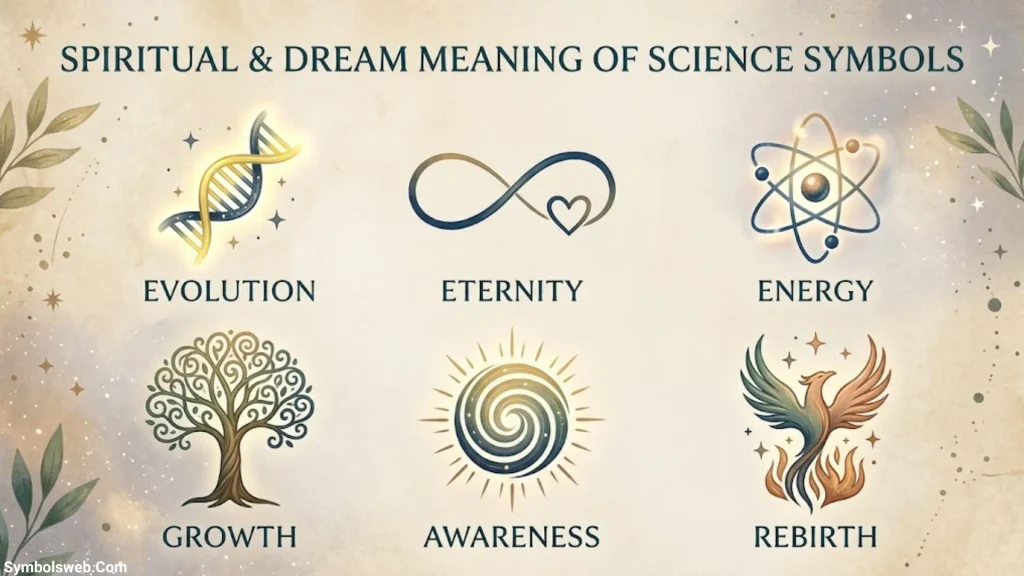
People sometimes encounter scientific imagery in dreams, meditation, or moments of deep reflection. Such experiences can feel meaningful, especially when a symbol relates to an important question or personal goal.
There is no scientifically established universal dream dictionary for science symbols. Interpretations are best treated as possibilities rather than predictions or supernatural facts.
Dreaming About an Atom
An atom in a dream might remind someone of the small details that make up a larger situation. It could also reflect an interest in science, a recent lesson, or a desire to understand something more deeply.
A person who is studying physics may dream about an atom simply because the topic is on their mind.
Dreaming About DNA
A DNA helix might bring family, identity, inheritance, or personal history to mind.
For someone exploring their ancestry, it may reflect questions about where they come from. For another person, it might relate to biology studies or medical research.
The dream itself does not reveal genetic information or predict a health outcome.
Dreaming About Stars or Galaxies
Stars and galaxies can evoke curiosity, ambition, mystery, or the feeling of being part of something larger.
A person facing a major life decision may interpret a vast night sky as a reminder to consider the bigger picture. Another person may simply have been inspired by an astronomy documentary.
Science Symbols in Meditation
Some people use images of atoms, fractals, galaxies, or molecular structures as meditation aids.
A fractal pattern, for example, may draw attention to repetition and complexity. A galaxy image may help someone reflect on scale and perspective.
These are personal contemplative practices. They do not prove that a particular image has a special energetic effect or a universal spiritual message.
Positive and Cautionary Interpretations
Science imagery may encourage curiosity, humility, and a sense of connection. It can also remind us that knowledge comes with responsibility.
A symbol should not be treated as a command, a prediction, or evidence of a hidden message simply because it appears in a dream. Personal reflection can be useful without assuming that every experience has a supernatural cause.
Positive and Negative Meanings of Science Symbols
Scientific symbols do not inherently carry good or bad meanings. Their associations depend on how they are used, what they represent, and how people respond to them.
| Positive meaning | Negative or cautionary meaning |
| Knowledge and discovery | Misuse of scientific information |
| Curiosity and learning | Overconfidence in incomplete evidence |
| Precision and clarity | False precision or misleading data |
| Medical progress | Ethical concerns about research and treatment |
| Technological innovation | Risks from unsafe or irresponsible technology |
| Connection through shared knowledge | Miscommunication when symbols are misunderstood |
| Understanding nature | Attempts to control nature without considering consequences |
Why the Same Symbol Can Have Different Meanings
The atom symbol is a useful example. In a classroom, it may represent scientific curiosity and the structure of matter. In a discussion of nuclear weapons, it may evoke destruction and fear.
Neither reaction changes what an atom is. Instead, the symbol draws meaning from the human activities and historical events associated with it.
This is why context matters. Scientific knowledge can help humanity solve problems, but its applications require careful judgment, ethical standards, and responsibility.
Why Humans Are Attracted to Science Symbols
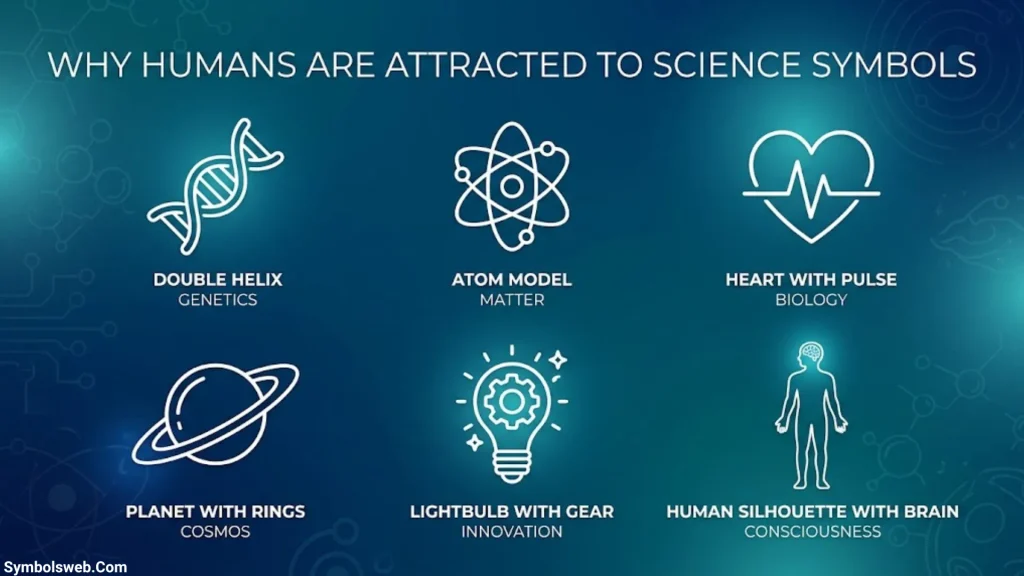
Why does a tiny DNA drawing, a mathematical equation, or an image of a galaxy capture our attention?
Part of the answer lies in the way humans learn, remember, and search for meaning. Science symbols make invisible ideas easier to imagine. They turn abstract concepts into shapes that people can recognize, discuss, and remember.
The Human Desire to Understand the Unknown
People have always asked questions about the world. Why do stars shine? What makes living things grow? What is matter made of?
Science symbols give these questions a visual form.
An image of an atom reminds us that matter has a structure beyond what our eyes can see. A telescope icon represents the possibility of discovering distant worlds. A DNA helix offers a glimpse into the biological information shared by living organisms.
Each image can become a small invitation to explore.
Pattern Recognition and Memory
The human brain is good at recognizing shapes and visual patterns. A well-designed diagram can make a difficult idea easier to understand than a long paragraph.
For example, a diagram of the water cycle can show evaporation, condensation, and precipitation as connected processes. Arrows communicate direction, while labels identify the stages.
This is one reason diagrams and symbols are so important in education. They help learners connect words with visual information.
However, a visual representation can also create confusion if it leaves out important details. Effective science communication combines clear imagery with accurate explanations.
A Sense of Wonder
Some scientific images inspire a feeling of awe.
A photograph of a distant galaxy can remind us how vast the universe is. A microscopic image of a cell can reveal an intricate world hidden within the familiar. A DNA model can show how a molecule carries biological information.
The feeling of wonder does not replace scientific evidence. Instead, it can motivate people to seek more knowledge.
Personal Identity and Belonging
Science symbols can also express identity.
A student may wear a chemistry-themed shirt because they love experiments. A physicist may choose a mathematical tattoo to celebrate a lifelong interest. A biology teacher may display a DNA model to encourage students to ask questions.
These symbols communicate shared interests and values. They can make scientific curiosity visible in everyday life.
Modern Uses of Science Symbols
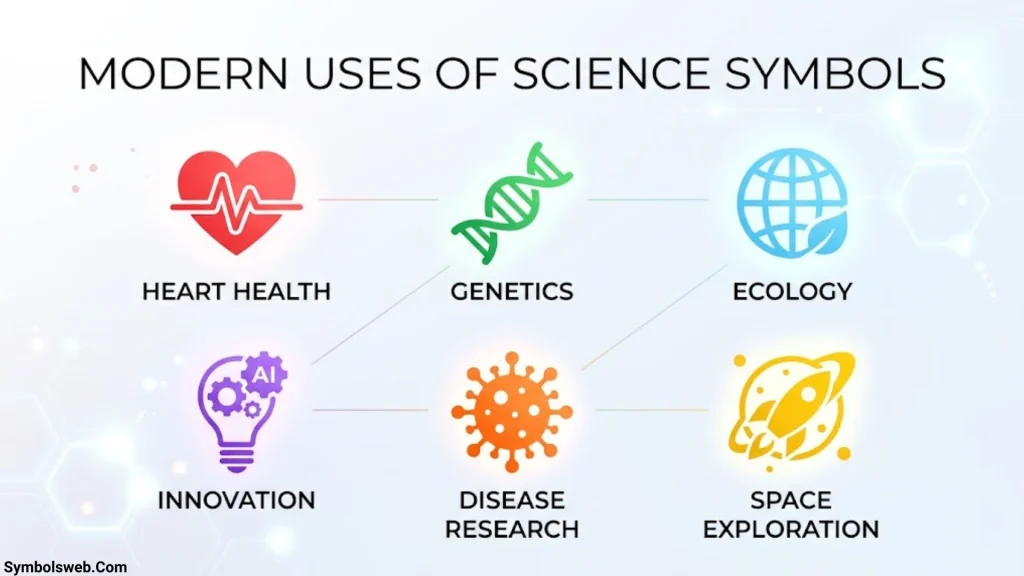
Science symbols are now part of everyday communication. They appear in classrooms, online communities, product designs, research facilities, and personal accessories.
Science Symbols in Education
Teachers use diagrams, equations, chemical formulas, and scientific icons to explain difficult topics.
A periodic table helps students identify elements. A cell diagram shows the parts of a living cell. A circuit diagram explains how electrical components connect.
The goal is not merely to help students memorize symbols. It is to help them understand the ideas those symbols represent.
Science Symbols in Jewelry and Tattoos
Often chosen to express interest in genetics, family history, biology, or the interconnectedness of life.
May express scientific curiosity, a love of physics, or an appreciation for the hidden structure of matter.
Can celebrate logic, mathematics, education, or a personal connection to numbers and patterns.
Before choosing a science symbol for a permanent tattoo, it is worth checking its technical meaning. Some symbols have different meanings across scientific fields, and a design may look attractive while representing something different from what the wearer intends.
Science Symbols in Branding
Scientific imagery is common in technology, healthcare, biotechnology, and education.
Brands may use a DNA helix to suggest genetics, a geometric pattern to suggest precision, or an atom icon to suggest research.
Yet visual language should not be confused with proof. A laboratory-themed logo does not establish that a product has been scientifically tested, and a green leaf does not guarantee environmental responsibility.
Trust comes from verifiable claims, transparent methods, and reliable evidence.
Science Symbols on Social Media
On social media, science symbols help people communicate interests quickly.
Common examples include:
- 🧬 for genetics, biology, and biotechnology.
- 🔬 for research, experimentation, and scientific learning.
- ⚛ for physics and atomic science.
- 🌍 for Earth science and environmental topics.
- 🧪 for chemistry, laboratory experiments, and science education.
- 🚀 for space exploration and aerospace technology.
These emoji are informal communication tools, not standardized scientific notation. Their meaning can change depending on the post, audience, and platform.
Science Symbols in Home Decor
Posters featuring the solar system, DNA models, mathematical equations, and scientific illustrations are popular in study rooms, offices, and classrooms.
For some people, these designs reflect professional interests. For others, they create a sense of curiosity and inspiration.
A scientific image can be both visually appealing and educational, especially when it is labeled accurately and accompanied by reliable information.
Interesting Facts About Science Symbols
Here are eight facts that reveal the history and surprising complexity of scientific notation.
Chemical Symbols Are Not Always Based on English Names
The symbol Fe comes from the Latin word ferrum, meaning iron. Au comes from aurum, meaning gold, while Na comes from natrium, the Latin-derived name associated with sodium.
These examples show how the history of language continues to shape modern chemistry.
The DNA Double Helix Became a Cultural Icon
DNA is not just a biological molecule. Its double-helix structure has become a familiar image in science museums, public education, art, architecture, and jewelry.
The structure helped explain how genetic information can be stored and copied.
The Periodic Table Helps Reveal Patterns
The periodic table is more than a list of chemical elements. Its organization reveals recurring patterns in the properties of elements.
Dmitri Mendeleev’s work was a major milestone in its development, although other scientists also contributed to the history of periodic classification. The modern table arranges elements by increasing atomic number.
The Familiar Atom Icon Is a Simplification
The classic atom logo uses intersecting loops around a central point. Although easy to recognize, it does not accurately show the complex quantum behavior of electrons.
It is a communication icon, not a detailed scientific model.
Greek Letters Are Common in Modern Science
Letters such as alpha, beta, gamma, delta, and lambda appear throughout mathematics, physics, engineering, and other scientific fields.
Their meanings vary with context. Delta, for example, often represents a change in a quantity, while lambda is commonly used for wavelength.
Ancient Alchemy Had a Rich Symbolic Language
Alchemists used symbols to represent substances, procedures, planets, and philosophical ideas. Their systems differed across historical periods and authors.
Some practices and discoveries contributed to the development of chemistry, but alchemical symbolism should not be treated as a standardized modern scientific language.
One Letter Can Mean Different Things
The letter c often represents the speed of light in physics, but symbols are not always universal across scientific disciplines.
The meaning of a letter depends on the subject, equation, and definitions supplied by the author. Reading the surrounding context is essential.
Scientific Symbols Help People Communicate Across Languages
Chemical symbols, mathematical operators, and internationally standardized units help scientists share information across borders.
Although explanations may require translation, many of the symbols remain recognizable. This shared notation is one of the foundations of modern scientific collaboration.
Frequently Asked Questions About Science Symbols
What are the most common science symbols?
Common science symbols include the atom icon, DNA double helix, microscope, chemical element symbols, mathematical operators, and astronomical diagrams. Their meanings depend on their scientific context. For example, H represents hydrogen, Δ often represents change, and the DNA helix represents the structure of genetic material.
What does the atom symbol mean?
The familiar atom symbol represents atomic science, nuclear physics, and the study of matter. It is often used to communicate scientific discovery or technological progress. However, its intersecting loops are a simplified illustration, not an accurate picture of an atom’s electron structure.
What is the symbol for science?
There is no single universally official symbol for all science. The atom icon, microscope, laboratory flask, and DNA helix are widely used to represent scientific research. The best choice depends on the field, such as chemistry, biology, physics, or general science education.
What is the spiritual meaning of science symbols?
Some people interpret science symbols as reminders of the complexity of nature, the interconnectedness of life, or the search for knowledge. A DNA helix may inspire reflection on identity, while a galaxy may evoke wonder. These are personal or cultural interpretations, not universal spiritual meanings established by science.
What is the difference between scientific symbols and alchemy symbols?
Scientific symbols are generally defined by conventions used in fields such as chemistry, physics, and mathematics. Historical alchemy symbols often represented substances, processes, or philosophical ideas, and their meanings varied across traditions. Although alchemy influenced the history of chemistry, the two symbolic systems are not interchangeable.
Why are science symbols important in everyday life?
Science symbols make information easier to communicate, interpret, and remember. They appear in medicine, education, environmental communication, technology, and public safety. When used accurately, they help people understand complex ideas without requiring lengthy explanations.
Conclusion
Science symbols connect human curiosity with the knowledge we build about the world. From ancient mathematical traditions to modern genetics, they help us express complex ideas through recognizable signs and images.Their importance lies not only in their appearance, but also in the discoveries, questions, and human experiences they represent.
Some symbols describe measurable facts, while others inspire cultural, personal, or spiritual reflection. Understanding the difference allows us to appreciate both their scientific value and their wider significance. Ultimately, every science symbol carries an invitation to look closer, ask better questions, and discover something we did not know before.

Eliana Foster is a writer with a passion for exploring the meanings behind symbols, traditions, and cultural history. She enjoys breaking down complex topics into simple, engaging articles that are easy for everyone to understand. Eliana is also the fictional author of The Hidden Language of Silent Marks and Beyond the Circle of Ancient Signs, two original book concepts created for her author profile. When she’s not writing, she loves visiting museums, reading about mythology, and researching the stories behind symbols from around the world. Her goal is to help readers discover the fascinating meanings hidden in everyday signs and ancient emblems.
 Ethan Holloway
 Jordan Hayes