Symbols are special signs, characters, or images that represent ideas, meanings, objects, or emotions. You see them every day in text messages, social media posts, websites, and everyday life. For example, hearts represent love, stars represent hope, and arrows show direction. These small signs help you express thoughts and information without using long sentences.
You can use symbols to make your writing more attractive, creative, and meaningful. From mathematical signs and currency symbols to decorative characters and emojis, each symbol has its own purpose. Whether you are writing a message, creating a social media bio, or designing content, the right symbols can make your text easier to understand and more appealing.
In this guide, you will learn what symbols are, their different types, meanings, and common uses. You will also discover how to use symbols in your daily communication, online content, and creative projects. By understanding symbols, you can express your ideas more clearly and make your messages more interesting.
What Are Symbols? Definition and Meaning
A symbol is a character, sign, mark, or image that represents something beyond its physical appearance. It can communicate an idea, action, object, quantity, or relationship without using complete words.
For example:
- @ represents the at sign and appears in email addresses.
- & represents the word and.
- % represents a percentage.
- $ represents the US dollar and other currencies.
- ∞ represents infinity.
- ❤️ represents love or affection.
Symbols make communication shorter and easier. Instead of writing a complete explanation, you can use a familiar symbol to communicate information.
Symbols, Signs, and Special Characters
Symbols, signs, and special characters are related but have different uses.
| Term | Meaning | Example |
| Symbol | Represents an idea, object, or meaning | ❤️, ∞ |
| Sign | Communicates information or gives instructions | Stop sign |
| Special character | A character that isn’t a regular letter or number | @, #, % |
| Punctuation mark | Organizes written sentences | !, ?, . |
| Mathematical symbol | Represents a mathematical operation or relationship | +, −, = |
The same character can serve different purposes depending on its context. For example, the number sign (#) can identify a number or introduce a hashtag.
Why Are Symbols Important?
Symbols help people understand information quickly. They also make communication easier when space or time is limited.
Common uses include:
- Communication: Symbols represent ideas and messages.
- Mathematics: Mathematical symbols show calculations and relationships.
- Technology: Computer symbols represent commands and functions.
- Navigation: Directional symbols help people understand routes.
- Safety: Warning symbols communicate possible dangers.
- Writing: Punctuation symbols organize sentences.
- Culture: Cultural symbols represent traditions and beliefs.
Common Symbols Names and Meanings
Common symbols appear in everyday writing, online communication, mathematics, and technology. Knowing their names makes them easier to recognize and use.
| Symbol | Symbol Name | Meaning or Use |
| @ | At sign | Email addresses and usernames |
| # | Number sign / Hash | Numbers and hashtags |
| & | Ampersand | Represents and |
| * | Asterisk | Notes and multiplication |
| % | Percent sign | Percentage |
| + | Plus sign | Addition |
| − | Minus sign | Subtraction |
| = | Equals sign | Equality |
| / | Forward slash | Separates information |
| \ | Backslash | File paths and programming |
| ? | Question mark | Questions |
| ! | Exclamation mark | Strong feelings or emphasis |
| . | Period | Ends a sentence |
| , | Comma | Separates words and phrases |
| : | Colon | Introduces information |
| ; | Semicolon | Connects related clauses |
| ( ) | Parentheses | Additional information |
| [ ] | Square brackets | Explanations and references |
| Curly braces | Programming and grouping | |
| | | Vertical bar | Separates information |
| _ | Underscore | Joins words in identifiers |
| ~ | Tilde | Approximation and other uses |
| ^ | Caret | Exponents and editing |
| ` | Grave accent | Character used in computing |
| ‘ | Apostrophe | Possession and contractions |
| ” “ | Quotation marks | Direct speech and quotations |
| – | En dash | Ranges and relationships |
| — | Em dash | Breaks in sentences |
| … | Ellipsis | Omitted or unfinished text |
| → | Right arrow | Direction or movement |
| ← | Left arrow | Direction or movement |
| ✓ | Check mark | Completion or approval |
| ✗ | Cross mark | Incorrect or rejected item |
| • | Bullet | List item |
| ★ | Star | Rating or emphasis |
| ☆ | White star | Decoration or rating |
| § | Section sign | Refers to a section |
| ¶ | Pilcrow | Paragraph reference |
| © | Copyright symbol | Copyright notice |
| ® | Registered symbol | Registered trademark |
| ™ | Trademark symbol | Trademark identification |
| ℅ | Care of symbol | Mailing correspondence |
| № | Numero sign | Number identification |
| ℞ | Prescription sign | Medical prescriptions |
Mathematical Symbols and Their Uses
Mathematical symbols represent numbers, calculations, comparisons, and relationships. Students, teachers, engineers, and scientists use them to express mathematical information.
Basic Arithmetic Symbols
| Symbol | Name | Meaning |
| + | Plus | Addition |
| − | Minus | Subtraction |
| × | Multiplication | Multiplying numbers |
| ÷ | Division | Dividing numbers |
| = | Equals | Shows equality |
| ± | Plus-minus | Positive or negative possibilities |
| √ | Square root | Finds a number’s square root |
| % | Percent | Represents a fraction out of 100 |
Comparison Symbols
Comparison symbols show how two numbers or values relate to each other.
| Symbol | Name | Meaning |
| = | Equal to | Both values are the same |
| ≠ | Not equal to | Values are different |
| < | Less than | Smaller value |
| > | Greater than | Larger value |
| ≤ | Less than or equal to | Smaller or equal value |
| ≥ | Greater than or equal to | Larger or equal value |
| ≈ | Approximately equal | Nearly the same |
| ≡ | Equivalent to | Equivalent expressions or relationships |
Algebra and Advanced Math Symbols
| Symbol | Name | Meaning |
| √ | Square root | Root of a number |
| ∛ | Cube root | Third root of a number |
| ∞ | Infinity | Unlimited quantity |
| π | Pi | Ratio of a circle’s circumference to its diameter |
| ∑ | Summation | Adds a sequence of values |
| ∫ | Integral | Represents integration |
| ∂ | Partial derivative | Derivative of a multivariable function |
| Δ | Delta | Change or difference |
| ∝ | Proportional to | Shows proportional relationships |
| ∠ | Angle | Represents an angle |
| ⊂ | Subset | One set is contained in another |
| ⊃ | Superset | One set contains another |
| ∈ | Element of | Belongs to a set |
| ∉ | Not an element of | Does not belong to a set |
| ∩ | Intersection | Shared elements of sets |
| ∪ | Union | Combined elements of sets |
Logic Symbols
| Symbol | Name | Meaning |
| ∧ | Logical AND | Both conditions are true |
| ∨ | Logical OR | At least one condition is true |
| ¬ | Logical NOT | Negation |
| ⇒ | Implies | Logical implication |
| ⇔ | If and only if | Two-way logical relationship |
| ⊕ | Exclusive OR | One condition or the other |
| ∀ | For all | Universal quantification |
| ∃ | There exists | Existential quantification |
Writing and Punctuation Symbols
Punctuation symbols organize written language and make sentences easier to understand. They show pauses, questions, statements, quotations, and relationships between words.
Common Punctuation Marks
| Symbol | Name | Use |
| . | Period | Ends a statement |
| , | Comma | Separates words and clauses |
| ? | Question mark | Ends a direct question |
| ! | Exclamation mark | Shows strong emotion |
| : | Colon | Introduces a list or explanation |
| ; | Semicolon | Connects closely related clauses |
| ‘ | Apostrophe | Shows possession or missing letters |
| ” “ | Quotation marks | Enclose quotations |
| … | Ellipsis | Shows omitted words or an unfinished thought |
Grouping Symbols
Grouping symbols place related information together.
- Parentheses ( ): Add extra information to a sentence.
- Square brackets [ ]: Enclose explanations or editorial additions.
- Curly braces { }: Group information in mathematics and programming.
- Angle brackets < >: Used in mathematics, HTML, and technical writing.
Dashes and Other Writing Symbols
| Symbol | Name | Use |
| – | Hyphen | Connects compound words |
| – | En dash | Shows a range |
| — | Em dash | Creates a break or interruption |
| / | Forward slash | Separates alternatives or information |
| \ | Backslash | Used mainly in computing |
| * | Asterisk | Marks notes or references |
| § | Section sign | Identifies a document section |
| ¶ | Pilcrow | Identifies a paragraph |
Currency Symbols and Their Meanings
Currency symbols represent different currencies used around the world. They appear in prices, financial documents, banking applications, and online shopping.
| Symbol | Currency | Country or Region |
| $ | US Dollar | United States |
| € | Euro | Eurozone |
| £ | Pound Sterling | United Kingdom |
| ¥ | Yen | Japan |
| ¥ | Yuan | China |
| ₹ | Indian Rupee | India |
| ₩ | South Korean Won | South Korea |
| ₽ | Russian Ruble | Russia |
| ₺ | Turkish Lira | Turkey |
| ₱ | Philippine Peso | Philippines |
| ₦ | Nigerian Naira | Nigeria |
| ฿ | Thai Baht | Thailand |
| ₫ | Vietnamese Dong | Vietnam |
| ₪ | Israeli New Shekel | Israel |
| ₴ | Ukrainian Hryvnia | Ukraine |
| ₡ | Costa Rican Colón | Costa Rica |
| ¢ | Cent | Used in several currencies |
Some currencies share the same symbol. For example, the dollar sign ($) represents several currencies. You can identify the exact currency through its country or its three-letter ISO currency code, such as USD, CAD, or AUD.
Keyboard Symbols and Special Characters
Keyboard symbols are characters you can type using a computer or mobile device. They include punctuation marks, mathematical signs, currency symbols, and other special characters.
Common Keyboard Special Characters
| Symbol | Name |
| @ | At sign |
| # | Number sign |
| $ | Dollar sign |
| % | Percent sign |
| ^ | Caret |
| & | Ampersand |
| * | Asterisk |
| ( ) | Parentheses |
| _ | Underscore |
| + | Plus sign |
| = | Equals sign |
| { } | Curly braces |
| [ ] | Square brackets |
| | | Vertical bar |
| \ | Backslash |
| : | Colon |
| ; | Semicolon |
| “ | Quotation mark |
| ‘ | Apostrophe |
| < | Less-than sign |
| > | Greater-than sign |
| ? | Question mark |
| / | Forward slash |
| ~ | Tilde |
How to Type Special Symbols
You can type special symbols using your keyboard or your device’s symbol menu.
On Windows:
- Use the Shift key with a number or punctuation key.
- Use the Windows character map to find additional characters.
- Use Alt codes when the symbol has a supported code.
On macOS:
- Use Option and Shift combinations for additional characters.
- Open the Character Viewer to find symbols and emoji.
On mobile devices:
- Tap the numbers or symbols keyboard.
- Select the additional symbols page when available.
- Press and hold certain keys to reveal alternative characters.
Computer and Technology Symbols Explained
Computer symbols represent commands, operations, file locations, and digital functions. Their meanings often depend on the operating system or software.
| Symbol | Name | Common Technology Use |
| / | Forward slash | Web addresses and file paths |
| \ | Backslash | Windows file paths |
| | | Pipe | Command-line operations |
| * | Asterisk | Wildcards and multiplication |
| ~ | Tilde | Home directory in Unix-like systems |
| $ | Dollar sign | Shell variables and prompts |
| # | Hash | Comments in some programming languages |
| @ | At sign | Email addresses and programming |
| % | Percent sign | Modulo operations |
| = | Equals sign | Assignment or comparison |
Common Computer Interface Symbols
| Symbol or Icon | Name | Meaning |
| ⚙ | Settings | Opens settings |
| 🔍 | Search | Finds information |
| 🏠 | Home | Returns to the home page |
| 🔒 | Lock | Indicates security |
| 🔗 | Link | Represents a hyperlink |
| ⬇ | Download | Saves a file |
| ⬆ | Upload | Sends a file |
| 🔔 | Notification | Shows alerts |
| 🗑 | Trash | Deletes an item |
| 🔄 | Refresh | Reloads information |
Programming Symbols and Their Meanings
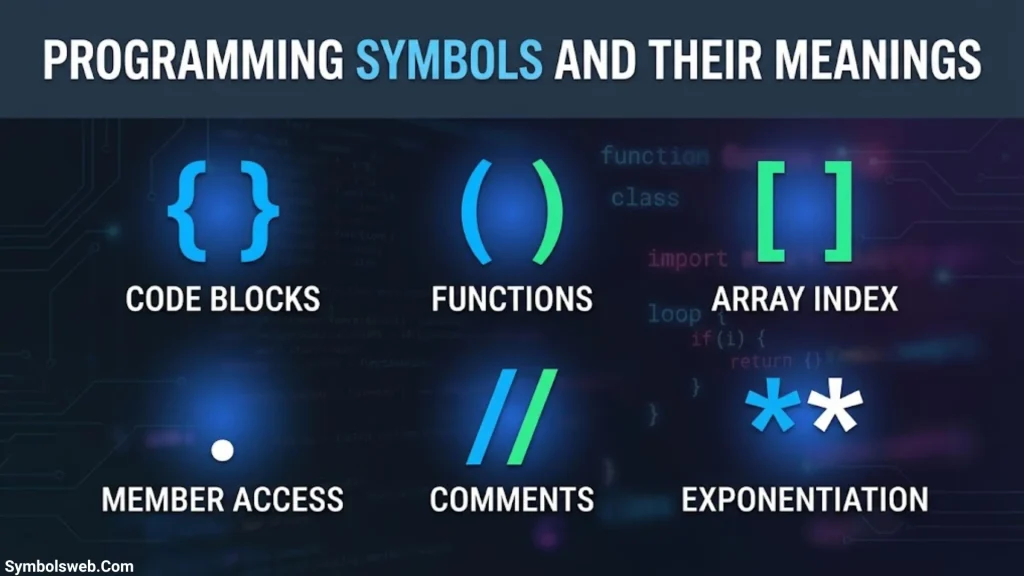
Programming symbols are characters and operators that help developers write instructions for computers. Their meanings can change between programming languages.
Common Programming Operators
| Symbol | Name | Common Meaning |
| = | Assignment operator | Assigns a value |
| == | Equality operator | Compares values in many languages |
| != | Not equal operator | Checks whether values differ |
| < | Less-than operator | Compares values |
| > | Greater-than operator | Compares values |
| <= | Less-than or equal | Compares values |
| >= | Greater-than or equal | Compares values |
| && | Logical AND | Combines conditions |
| || | Logical OR | Checks alternative conditions |
| ! | Logical NOT | Reverses a Boolean value |
Programming Symbol Examples
The following JavaScript example shows how programming symbols work:
let age = 25;
if (age >= 18 && age <= 60) {
console.log(“Age is within the range.”);
}
In this example:
- = assigns a value to a variable.
- >= checks whether the age is at least 18.
- ` | Angle brackets | Comparisons and markup |
| ; | Semicolon | Statement endings in some languages |
Measurement and Scientific Symbols
Measurement symbols represent units, quantities, and scientific values. They help people communicate measurements clearly.
Common Measurement Symbols
| Symbol | Name | Meaning |
| ° | Degree | Angular measurement or temperature notation |
| ′ | Prime | Arcminute or feet in certain contexts |
| ″ | Double prime | Arcsecond or inches in certain contexts |
| % | Percent | Parts per hundred |
| ‰ | Per mille | Parts per thousand |
| ± | Plus-minus | Range or uncertainty |
| Δ | Delta | Change in a quantity |
| ≈ | Approximately equal | Approximate value |
Common SI Unit Symbols
| Symbol | Unit Name | Measures |
| m | Meter | Length |
| km | Kilometer | Distance |
| cm | Centimeter | Length |
| mm | Millimeter | Length |
| kg | Kilogram | Mass |
| g | Gram | Mass |
| s | Second | Time |
| min | Minute | Time |
| A | Ampere | Electric current |
| V | Volt | Electric potential |
| W | Watt | Power |
| J | Joule | Energy |
| Pa | Pascal | Pressure |
| K | Kelvin | Temperature |
| mol | Mole | Amount of substance |
SI unit symbols follow specific writing rules. For example, a space normally separates a numerical value from its unit symbol, as in 25 kg. Unit symbols don’t become plural, and their capitalization follows established conventions. <Cite refs={[“turn616909search1″,”turn616909search3″,”turn616909search8”]}/>
Greek Letters Used in Science
Greek letters appear in mathematics, physics, chemistry, and other scientific fields.
| Symbol | Name | Common Use |
| α | Alpha | Angles and coefficients |
| β | Beta | Variables and radiation |
| γ | Gamma | Radiation and mathematical notation |
| Δ | Delta | Change in a value |
| λ | Lambda | Wavelength |
| μ | Mu | Micro-prefix and other quantities |
| Ω | Omega | Electrical resistance |
| Σ | Sigma | Summation |
| π | Pi | Circle calculations |
Warning Signs and Safety Symbols
Warning symbols communicate dangers, restrictions, and safety instructions. They appear in workplaces, laboratories, public buildings, and road environments.
| Symbol | Name | Meaning |
| ⚠ | Warning | General caution |
| ☢ | Radioactive | Radiation hazard |
| ☣ | Biohazard | Biological danger |
| ☠ | Skull and crossbones | Poison or toxic danger |
| ⚡ | High voltage | Electrical hazard |
| 🚫 | Prohibited | Something isn’t allowed |
| ⛔ | No entry | Entry is restricted |
| ♻ | Recycling | Recyclable materials |
| 🔥 | Flammable | Fire risk |
| ❗ | Exclamation mark | Important warning |
Not every symbol in this table is an official standardized hazard pictogram. The exact meaning depends on its design and the safety system in which it appears.
Religious and Cultural Symbols and Their Meanings
Religious and cultural symbols represent beliefs, traditions, identities, and spiritual ideas. Their meanings can vary between communities and historical periods.
| Symbol | Name | Common Association |
| ☪ | Crescent and Star | Associated with Islam in some cultural contexts |
| ✝ | Christian Cross | Christianity |
| ✡ | Star of David | Judaism |
| ॐ | Om | Hinduism and other Indian spiritual traditions |
| ☸ | Dharma Wheel | Buddhism |
| ☯ | Yin-Yang | Chinese philosophy |
| ☦ | Orthodox Cross | Eastern Orthodox Christianity |
| ☮ | Peace Symbol | Peace and anti-war movements |
Crescent and Star
The crescent and star appears on flags and cultural designs associated with several Muslim-majority countries. It isn’t a universal religious symbol for every Muslim community.
Christian Cross
The Christian cross represents the crucifixion of Jesus Christ and is one of Christianity’s most recognizable symbols.
Star of David
The Star of David is a six-pointed star associated with Jewish identity and Judaism.
Om Symbol
The Om symbol (ॐ) represents a sacred sound and spiritual concept in Hindu traditions. It also appears in other Indian religious and philosophical traditions.
Dharma Wheel
The Dharma Wheel (☸) represents Buddhist teachings and the path toward enlightenment.
Yin-Yang Symbol
The yin-yang symbol (☯) represents complementary forces and their relationship in Chinese philosophy.
Peace Symbol
The peace symbol (☮) became widely recognized through peace and anti-war movements.
Directional Symbols and Navigation Signs
Directional symbols show movement, location, and direction. You can find them on maps, road signs, websites, and navigation systems.
| Symbol | Name | Meaning |
| ↑ | Up arrow | Upward direction |
| ↓ | Down arrow | Downward direction |
| ← | Left arrow | Left direction |
| → | Right arrow | Right direction |
| ↔ | Left-right arrow | Both directions |
| ↕ | Up-down arrow | Vertical movement |
| ↗ | Northeast arrow | Upper-right direction |
| ↘ | Southeast arrow | Lower-right direction |
| ↙ | Southwest arrow | Lower-left direction |
| ↖ | Northwest arrow | Upper-left direction |
| ⇐ | Left double arrow | Leftward direction or implication |
| ⇒ | Right double arrow | Rightward direction or implication |
| ⇔ | Left right double arrow | Two-way relationship |
These symbols help people follow instructions without reading lengthy explanations.
Social Media and Email Symbols
Social media platforms use symbols to represent actions, interactions, and notifications. Email services also use special characters to organize addresses and messages.
Common Social Media Symbols
| Symbol | Name | Common Use |
| # | Hashtag | Groups related posts |
| @ | At sign | Mentions users |
| ❤️ | Heart | Likes or affection |
| 👍 | Thumbs up | Approval |
| 💬 | Speech bubble | Comments or messages |
| 🔔 | Bell | Notifications |
| 📌 | Pushpin | Pinned content |
| 🔁 | Repeat symbol | Sharing or reposting |
| ⭐ | Star | Favorites or ratings |
| 📎 | Paperclip | Attachments |
Hashtag and At Sign
The hashtag (#) helps organize posts around a specific subject. For example, #TravelTips groups content related to travel advice.
The at sign (@) identifies or mentions a particular account. For example, @exampleuser directs attention to a username.
Common Email Symbols
An email address normally contains an at sign (@) between the username and domain.
Example:
alex.smith@example.com
| Symbol | Name | Use |
| @ | At sign | Separates username and domain |
| . | Period | Separates domain sections |
| _ | Underscore | Appears in usernames |
| – | Hyphen | Separates words |
| + | Plus sign | Used in some email addressing systems |
Confusing Symbols and Their Differences
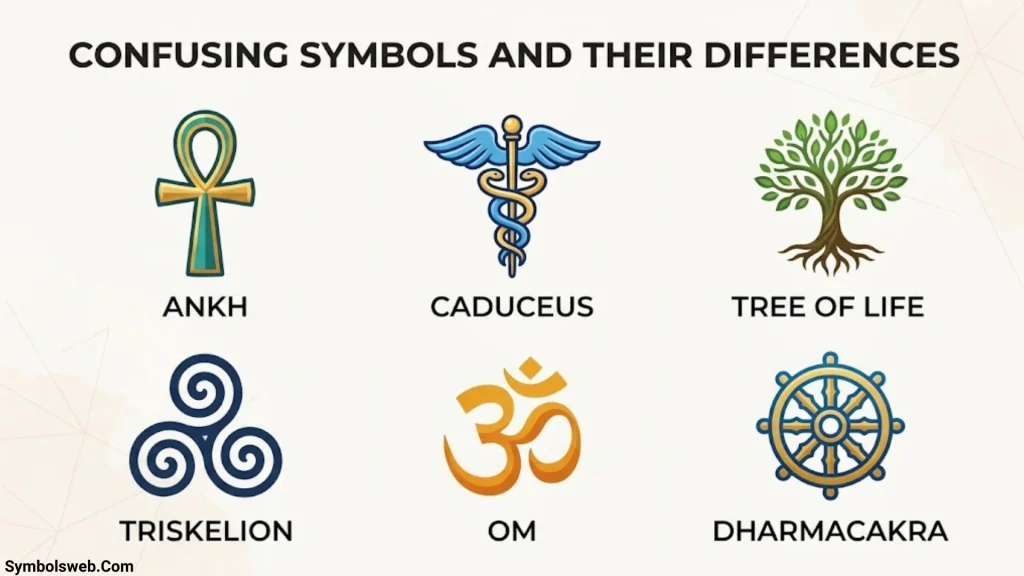
Some symbols look similar but have different names and purposes. Understanding these differences helps you use them correctly.
Hyphen vs En Dash vs Em Dash
| Symbol | Name | Main Use |
| – | Hyphen | Joins compound words |
| – | En dash | Shows a range |
| — | Em dash | Creates a break in a sentence |
Example:
- Hyphen: well-known
- En dash: 2020–2026
- Em dash: The answer — surprisingly — was simple.
Forward Slash vs Backslash
| Symbol | Name | Common Use |
| / | Forward slash | Web addresses and Unix-like paths |
| \ | Backslash | Windows file paths and programming |
Example:
- Forward slash: https://example.com/page
- Backslash: C:\Users\Documents
Hyphen vs Minus Sign
The hyphen (-) connects words while the minus sign (−) represents subtraction or negative values.
Example:
- Hyphen: user-friendly
- Minus: 10 − 5 = 5
Asterisk vs Multiplication Sign
| Symbol | Name | Use |
| * | Asterisk | Notes, wildcards, and programming |
| × | Multiplication sign | Mathematical multiplication |
Number Sign vs Hashtag
The number sign (#) identifies numbers in some contexts. On social media, the same character introduces hashtags.
Apostrophe vs Grave Accent
| Symbol | Name | Use |
| ‘ | Apostrophe | Possession and contractions |
| ` | Grave accent | Computing and language notation |
Vertical Bar vs Letter I and Lowercase L
| Character | Name |
| | | Vertical bar or pipe |
| I | Capital letter I |
| l | Lowercase letter L |
These characters can look similar in certain fonts. Their actual meanings depend on the context.
Unicode classifies characters according to their encoded properties and intended use. Some characters can serve different purposes in different contexts.
Punctuation and Symbols+1
Symbols vs Words, Signs, and Emojis
Symbols, words, signs, and emojis all communicate information. However, they don’t work in exactly the same way.
| Type | Main Purpose | Example |
| Symbol | Represents an idea or meaning | ∞ |
| Word | Communicates through language | Infinity |
| Sign | Gives information or instructions | Stop sign |
| Emoji | Expresses an emotion or idea in digital communication | ❤️ |
Symbols vs Words
Words use letters to communicate specific meanings. Symbols use characters, shapes, or images to represent information.
For example, the word “love” communicates an idea through language while the heart symbol (❤️) represents love visually.
Symbols vs Signs
A symbol often represents an idea or concept. A sign usually communicates a direct message or instruction.
For example, a heart represents affection while a stop sign tells drivers to stop.
Symbols vs Emojis
Symbols can include mathematical signs, punctuation, currency marks, and other characters. Emojis are pictorial characters commonly used in digital messages.
For example:
- Symbol: ∞
- Emoji: 😍
Why Are Symbols Important in Everyday Life?
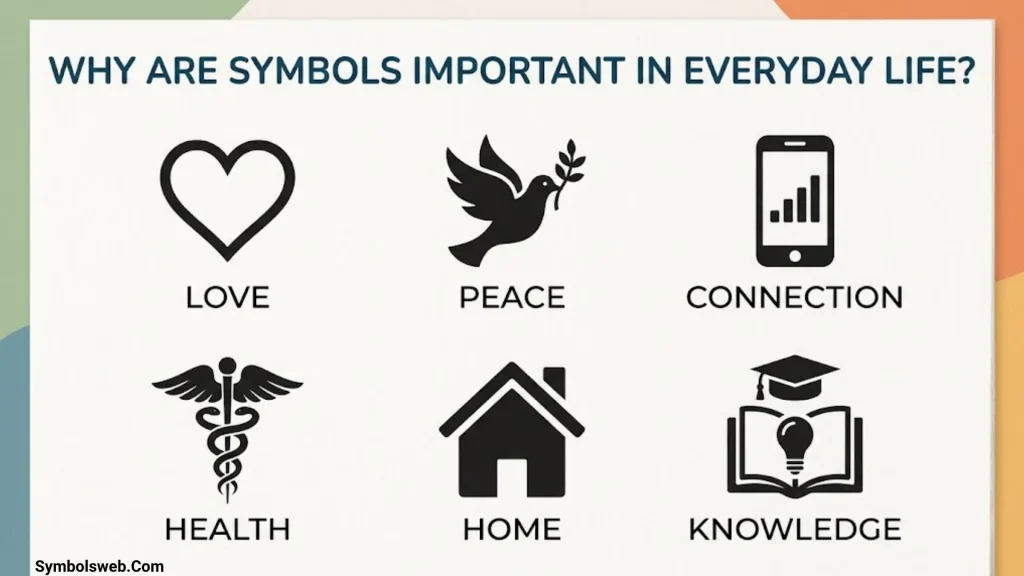
Symbols make information easier to recognize and understand. They appear in almost every area of daily life.
- Easy communication: Symbols express information without long sentences.
- Quick recognition: Familiar symbols help people identify common actions.
- Mathematical calculations: Mathematical signs represent operations and relationships.
- Digital communication: Symbols organize emails, usernames, and social media posts.
- Safety information: Warning symbols help people recognize potential dangers.
- Cultural identity: Cultural symbols represent traditions and beliefs.
How to Identify and Understand an Unknown Symbol
If you find an unfamiliar symbol, its appearance and surrounding information can help you identify it.
Follow these steps:
- Examine its shape: Notice its lines, curves, numbers, and other details.
- Check the context: Identify where the symbol appears, such as a keyboard, road sign, document, or website.
- Look for its name: Search for the symbol’s common name.
- Check its meaning: Compare reliable references to understand its purpose.
- Find its Unicode value: For digital characters, Unicode information can help identify the exact character.
Examples of Unicode Symbol Codes
| Symbol | Name | Unicode Code Point |
| @ | At sign | U+0040 |
| # | Number sign | U+0023 |
| & | Ampersand | U+0026 |
| % | Percent sign | U+0025 |
| © | Copyright sign | U+00A9 |
| € | Euro sign | U+20AC |
| ∞ | Infinity | U+221E |
| π | Greek small letter pi | U+03C0 |
Unicode assigns code points to characters so computers can represent and process text consistently across different systems.
Unicode+1
Frequently Asked Questions About Symbols
What Are Symbols in Simple Words?
Symbols are characters, signs, or images that represent ideas, objects, actions, or information. Examples include the heart, dollar sign, plus sign, and arrows.
What Are the Most Common Symbols?
Common symbols include @, #, &, %, +, −, =, ?, !, $, ©, and ❤️. People use them in writing, mathematics, technology, and digital communication.
What Are Symbols Called in English?
Symbols are called symbols, signs, or special characters depending on their purpose. Mathematical symbols, punctuation marks, and currency symbols are common categories.
What Are Special Characters?
Special characters are characters other than regular alphabetic letters and ordinary numbers. Examples include @, #, %, &, *, and other punctuation marks.
What Are the Different Types of Symbols?
Common types include mathematical symbols, currency symbols, punctuation marks, keyboard symbols, scientific symbols, warning symbols, cultural symbols, and directional symbols.
What Are Symbols Used For?
Symbols communicate information quickly. They represent mathematical operations, identify currencies, organize writing, show directions, and communicate warnings.
What Is the Difference Between a Symbol and a Sign?
A symbol usually represents an idea or concept while a sign often provides direct information or instructions. Their meanings can overlap depending on context.
What Is the Difference Between a Symbol and an Emoji?
Symbols include characters such as +, %, and ∞. Emojis are pictorial characters such as ❤️, 😂, and 🌟 that express ideas or emotions.
Are Symbols the Same in Every Language?
No. Some symbols have widely recognized meanings while others depend on language, culture, and context. A symbol can also have different meanings in different places.
How Can You Type Special Symbols?
You can type special symbols using keyboard shortcuts, character maps, symbol menus, and mobile keyboards. The exact method depends on your device and operating system.
Why Should You Learn Symbol Names?
Learning symbol names helps you recognize characters, understand written information, use keyboards, and communicate more accurately.
What Is the Difference Between a Hyphen and an En Dash?
A hyphen (-) connects words such as well-known. An en dash (–) commonly shows a range such as 2020–2026.
What Is the Difference Between a Forward Slash and a Backslash?
A forward slash (/) leans toward the right and appears in web addresses. A backslash (\) leans toward the left and commonly appears in Windows file paths.
Are All Symbols Universal?
No. Some symbols have widely understood meanings but others depend on cultural, technical, or linguistic context.
Conclusion
Symbols are an important part of everyday communication. They represent ideas, numbers, actions, objects, and information through simple characters and signs. You can find them in mathematics, writing, technology, science, currency, and cultural traditions.
Learning common symbols, names and meanings makes it easier to understand different types of information. From the plus sign (+) to the infinity symbol (∞), each character serves a particular purpose.
When you recognize a symbol, consider its name, meaning, and context. This helps you understand how people use symbols in everyday life.

Jordan Hayes is a writer with a passion for exploring the history, meanings, and cultural significance behind symbols from around the world. He enjoys turning complex topics into clear, engaging content that anyone can understand. Jordan is also the fictional author of The Silent Language of Ancient Marks and Hidden Symbols Beyond the Surface, two original book concepts created for his author profile. When he’s not writing, he spends time researching myths, traditions, and forgotten stories that inspire his work. His goal is to help readers discover the deeper meanings behind the symbols they encounter every day.
 Eliana Foster