
Understanding Omron blood pressure monitor symbols helps you read your results correctly and use your device with confidence. These symbols can indicate your blood pressure readings, pulse rate, irregular heartbeat, and whether your monitor has detected a possible issue during measurement.
If you see an unfamiliar icon on your Omron blood pressure monitor, you may wonder what it means and if you should be concerned. Some symbols provide useful information about your heartbeat or blood pressure, while others indicate cuff placement, movement, or device errors. Knowing what each symbol means can help you avoid common measurement mistakes.
In this guide, you will learn the meanings of common Omron blood pressure monitor symbols, including the irregular heartbeat icon, blood pressure level indicators, and error symbols. You will also discover how to respond to these alerts, take accurate measurements, and understand when a reading may require medical attention.
Omron Blood Pressure Monitor Symbols: (Quick Answer)
Omron blood pressure monitor symbols help you understand your readings, irregular heartbeat alerts, and device error messages. Always check your user manual for model specific meanings and follow proper measurement instructions to get accurate results. If you repeatedly notice irregular heartbeat alerts or unusually high or low readings, consult a healthcare professional for guidance.
Quick Facts About Omron Blood Pressure Monitor Symbols
| Aspect | Information |
| Origin | Digital blood pressure monitoring technology developed for home and clinical use |
| Historical significance | Supports the shift toward convenient home blood pressure monitoring |
| Main meaning | Communicates readings, measurement quality, and device status |
| Health significance | Some indicators flag irregular pulse patterns or elevated blood pressure |
| Cultural importance | Reflects the growing role of personal health monitoring in everyday life |
| Modern usage | Found on digital upper-arm monitors, wrist monitors, and connected health devices |
What Do the Symbols on an Omron Blood Pressure Monitor Mean?
The most important Omron blood pressure monitor symbols tell you whether your device detected a possible irregular heartbeat, whether you moved during the measurement, and whether your cuff was positioned correctly.
Here are the common indicators and what to do when they appear.
| Symbol or display | Meaning | What you should do |
| ♥ Flashing heart | Heartbeat detected during measurement | Usually normal during measurement |
| ♡ Irregular heartbeat | An uneven pulse rhythm was detected | Repeat the reading and discuss recurring alerts with your healthcare professional |
| Person or movement icon | Body movement may have affected the reading | Stay still and repeat the measurement |
| Cuff wrap icon | Cuff may be too loose or incorrectly positioned | Refit the cuff according to your model’s instructions |
| HIGH indicator | Blood pressure meets the device’s elevated-reading threshold | Review the numbers and follow medical advice |
| Battery icon | Batteries are low or depleted | Replace the batteries if needed |
| Memory or number indicator | Stored readings or a memory record | Use the memory button to review previous measurements |
| Average reading icon | An average of multiple measurements | Check the manual to understand which readings are included |
| Bluetooth icon | Wireless connection status on compatible models | Check your phone pairing and app connection if syncing fails |
| Error code such as E1 or E2 | A measurement or device problem | Check the model’s manual for the exact code |
Note: These are general descriptions, not a universal symbol key. The appearance, thresholds, and functions can differ between Omron models. Consult the official Omron symbols glossary and your device’s instruction manual.
Omron Blood Pressure Monitor Heart Symbols Explained
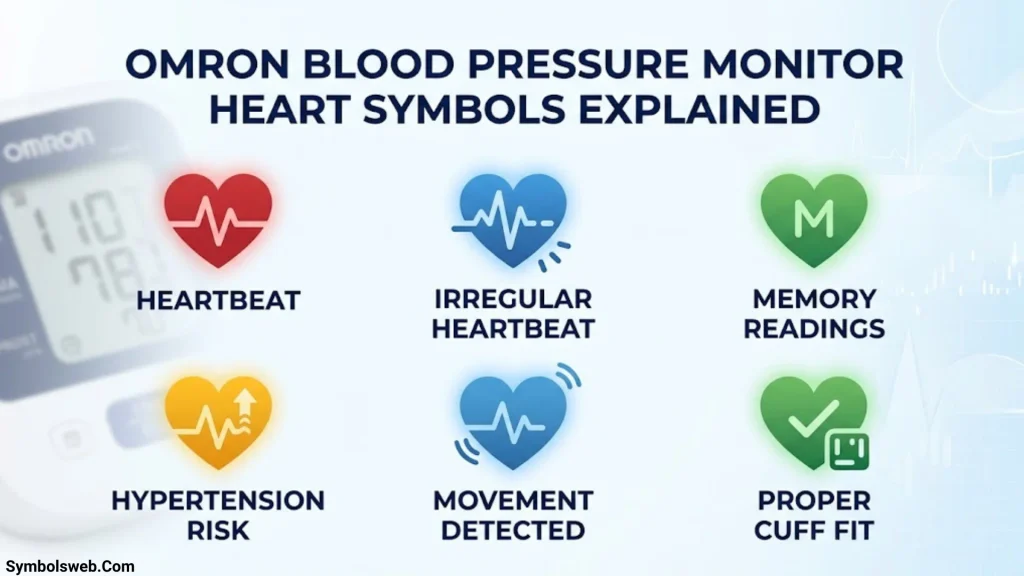
Heart symbols can look similar, but they do not always mean the same thing. Understanding the difference can help you avoid unnecessary worry.
1. Flashing Heart Symbol
A flashing heart usually indicates that the monitor is detecting your pulse during a blood pressure measurement.
As the cuff inflates and deflates, the device senses changes associated with blood flow and uses them to estimate your blood pressure. The heart symbol may flash in time with your pulse.
Is a flashing heart symbol dangerous?
Usually not. On models that use this indicator, flashing during measurement is part of normal operation. It is different from the irregular heartbeat indicator, which may appear alongside your results.
2. Irregular Heartbeat Symbol
Omron Intelli Sensi 10 Series Blood Pressure Monitor BP785 User Manual – Text Manuals
The irregular heartbeat symbol often looks like a heart outline or a heart with an additional mark. Its exact appearance depends on the model.
On many Omron monitors, this symbol appears when the device detects an irregular rhythm at least twice during a measurement. Omron describes an irregular rhythm for these devices as a heartbeat interval that differs by 25% or more from the average interval detected during the measurement.
An irregular heartbeat notification does not automatically mean you have a heart condition. Movement, an unstable measurement, and other factors can affect the result.
What should you do?
- Sit quietly for five minutes before measuring again.
- Keep your back supported and feet flat on the floor.
- Position your arm correctly and avoid talking.
- Take another reading according to your monitor’s instructions.
- Contact a healthcare professional if the symbol appears repeatedly.
If you experience chest pain, severe shortness of breath, fainting, or other serious symptoms, seek urgent medical attention rather than relying on another monitor reading.
3. Heart Zone Indicator
Some Omron wrist monitors include a heart zone indicator that helps you position the device at heart level.
Snapklik.com : OMRON Gold Wireless Wrist Blood Pressure Monitor For Home Use
A heart symbol or position guide may show whether your wrist is too high or too low. Some models provide visual guidance to help you reach the correct height.
Wrist position matters because measuring too far above or below heart level can affect your reading. Follow the positioning instructions for your particular monitor.
4. AFib Indicator on Compatible Omron Devices
Some Omron blood pressure monitors include an atrial fibrillation (AFib) detection feature. This is different from a standard irregular heartbeat indicator.
AFib is a type of abnormal heart rhythm that can increase the risk of stroke. An AFib-related notification means the device detected a pattern that warrants attention, but it does not establish a diagnosis on its own.
Not every Omron monitor has AFib detection. Check your model’s specifications and instructions before interpreting a heart-related icon.
Omron Cuff Symbols and Positioning Indicators

A correct cuff fit is essential for reliable blood pressure readings. Some symbols warn you that the cuff may not be positioned properly.
Cuff Wrap Guide Symbol
Omron HEM 6232T Wrist Blood Pressure Monitor (Black)
A cuff wrap guide appears on certain Omron wrist monitors when the cuff is too loose. Some devices also display this indicator when you review a stored measurement that was taken with a loose cuff.
Wrap the cuff as directed in your manual and make sure it fits securely. Do not tighten it beyond the manufacturer’s instructions.
Upper Arm Cuff Positioning Marks
Upper-arm models may use printed arrows, artery alignment marks, range indicators, or cuff placement diagrams rather than an on-screen symbol.
These markings help you position the cuff over the upper arm and align it with the brachial artery.
For most standard upper-arm Omron monitors, the cuff’s lower edge should sit about half an inch above the elbow crease. The air tube should follow the placement instructions supplied with your device.
If the cuff slips, feels excessively tight, or repeatedly produces errors, check that its size is suitable for your arm.
Omron Movement Error Symbol
A movement indicator warns that your body moved while the monitor was measuring your blood pressure.
Even small movements, talking, or muscle tension can interfere with a measurement. The device may still display numbers, but you should not assume that those numbers are reliable simply because they appear on the screen.
How to fix a movement error
- Remove or loosen the cuff as directed by the manual.
- Rest quietly for two to three minutes before repeating the measurement if your model recommends this interval.
- Sit with your back supported and feet flat on the floor.
- Support your arm at heart level.
- Keep still and avoid talking throughout the measurement.
Omron manuals commonly recommend waiting two to three minutes and taking another reading after a movement error.
What Does the HIGH Symbol Mean on an Omron Blood Pressure Monitor?
The HIGH indicator warns that your blood pressure reading has reached a threshold set by your monitor. However, the symbol alone does not tell you how high your blood pressure is. Always read the systolic and diastolic numbers on the display.
Some Omron models show a HIGH indicator when systolic pressure reaches 130 mmHg or diastolic pressure reaches 80 mmHg. Other models may use different display features or thresholds.
Understanding Systolic and Diastolic Numbers
| Reading | What it measures |
| SYS | Systolic pressure, the pressure in your arteries when your heart beats |
| DIA | Diastolic pressure, the pressure in your arteries between heartbeats |
| PULSE or /min | Your pulse rate, usually measured in beats per minute |
| mmHg | Millimeters of mercury, the unit used to measure blood pressure |
For adults, the American Heart Association uses these categories as a general guide:
| Blood pressure category | Systolic (SYS) | Diastolic (DIA) |
| Normal | Below 120 | Below 80 |
| Elevated | 120–129 | Below 80 |
| High blood pressure, Stage 1 | 130–139 | 80–89 |
| High blood pressure, Stage 2 | 140 or higher | 90 or higher |
| Severe hypertension | Higher than 180 | And/or higher than 120 |
The higher category applies when either number reaches its threshold. These are general US adult guidelines, not a personalized diagnosis. Your healthcare professional may recommend a different target based on your circumstances.
What Should You Do If Your Blood Pressure Is Very High?
If your reading is higher than 180 systolic and/or 120 diastolic, wait at least one minute and measure again.
If the second reading remains that high, contact a healthcare professional immediately. If you also experience chest pain, shortness of breath, weakness, numbness, vision changes, or difficulty speaking, call emergency services. Do not wait for another reading if you have symptoms of a medical emergency.
Omron Battery, Memory, and Bluetooth Symbols
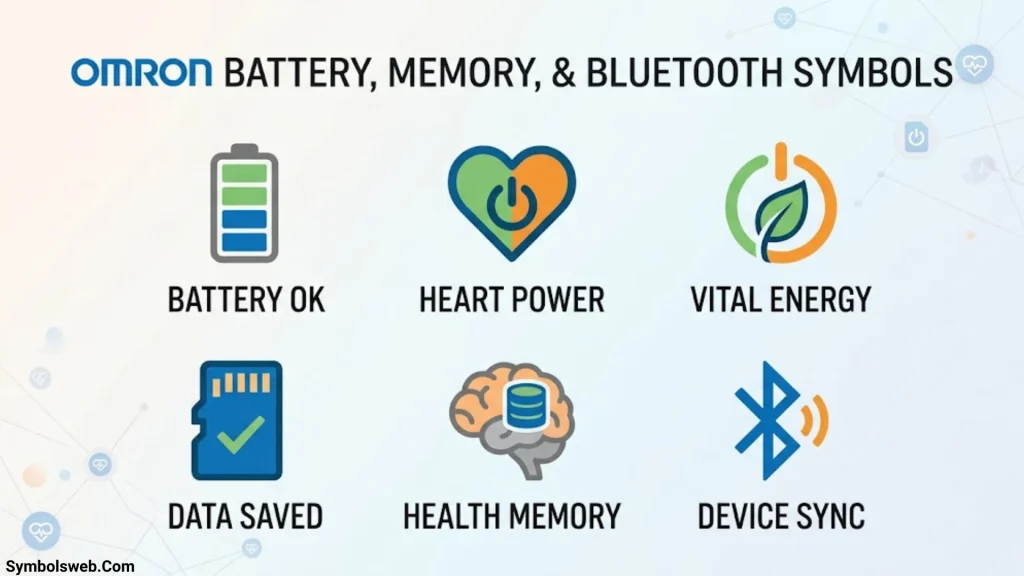
Not every icon signals a health concern. Many simply show how the device is operating.
Low Battery and Depleted Battery Symbols
A battery icon may flash when the batteries are running low. On some models, a steady battery symbol indicates that the batteries are depleted.
If your monitor displays a low-battery warning, replace the batteries according to the instructions. Use the recommended battery type and check the polarity before closing the battery compartment.
If the device continues to show an error after you replace the batteries, consult the troubleshooting section of its manual.
Memory Symbol
The memory symbol indicates that your monitor can store or display previous measurements. Depending on the model, pressing the memory button may show:
- Previous systolic and diastolic readings
- Pulse rates recorded during earlier measurements
- The date and time of stored readings
- An average calculated from recent measurements
Memory features help you track blood pressure trends over time. They can also help your healthcare professional understand whether your readings remain high across several days.
Average Reading Symbol
Some Omron monitors calculate an average from multiple stored measurements. The display may show an average icon or another model-specific indicator.
An average can provide a clearer picture than one isolated reading. However, the number of readings included in the average varies by device. Check your manual before interpreting the result.
Bluetooth and Sync Symbols
Bluetooth-enabled Omron monitors can transfer measurements to a compatible smartphone or the OMRON connect app.
Depending on the model, a Bluetooth icon may indicate that wireless connectivity is enabled. Other indicators may confirm successful data transfer or show that a connection needs attention.
If your readings are not appearing in the app, check that Bluetooth is enabled on your phone, the monitor is compatible with the app, and the devices are paired correctly.
OK or Successful Measurement Indicator
Some Omron models display an OK symbol to indicate successful positioning, a successful connection, or another completed operation. The meaning depends on the device.
For example, certain models use an OK indicator to confirm that readings are transferred successfully to a smartphone. Do not assume that an OK icon means your blood pressure is healthy.
Omron Blood Pressure Monitor Error Codes and Their Meanings
An error code usually points to a problem with the measurement process or equipment. The exact meaning depends on your monitor’s model and region.
The following examples come from specific Omron instruction manuals, so use them as a starting point rather than a universal code list.
| Error code | Possible meaning on supported models | What to try |
| E1 | The cuff is not applied correctly or does not inflate as expected | Refit the cuff and restart the measurement |
| E2 | The cuff is not fully inflated or the air plug is not connected securely | Check the cuff and air connection |
| E3 | The cuff has exceeded its permitted pressure on some models | Refit the cuff and follow the manual |
| E4 | Movement, talking, or a cuff problem interrupted measurement on some models | Stay still and check the cuff |
| E5 | The monitor could not detect the pulse correctly on some models | Rest, refit the cuff, and repeat the measurement |
These examples are documented in Omron manuals, but error definitions vary.
OMRON Healthcare EMEA+1
How to Fix a Common Omron Error
Try these steps if your monitor displays an error:
- Stop the measurement and remove the cuff if needed.
- Check that the air tube is fully connected on models with a separate tube.
- Reapply the cuff according to the instructions.
- Sit quietly, support your arm, and avoid talking or moving.
- Repeat the measurement.
- Consult the manual if the error returns.
If the cuff repeatedly fails to inflate, leaks air, or produces the same error despite correct use, stop relying on that device until you have checked the instructions or contacted Omron support.
You can find official documentation through the Omron product support page.
Omron Healthcare – OMRON Healthcare, Inc.+1
How to Take an Accurate Reading on an Omron Monitor

Understanding the symbols is only part of the process. Your posture, cuff fit, and preparation also affect your blood pressure reading.
Follow these steps for more consistent results.
- Prepare before measuring. Avoid smoking, caffeine, and exercise for at least 30 minutes beforehand.
- Empty your bladder. A full bladder can affect your reading.
- Rest for five minutes. Sit quietly before starting.
- Use the correct cuff. Place it on bare skin and follow the instructions for your model.
- Sit correctly. Support your back, keep your feet flat on the floor, and avoid crossing your legs.
- Position your arm. Support it at heart level.
- Stay still and silent. Do not talk during the measurement.
- Take two readings. Measure twice, about one minute apart, and record both results.
The American Heart Association recommends these steps for home blood pressure monitoring. Consistent technique makes it easier to identify patterns and share useful information with your healthcare professional.
Omron Blood Pressure Monitor Symbols Across Different Models
Omron uses different displays across its product range. An upper-arm monitor, wrist monitor, and connected blood pressure monitor may show different icons even when they perform similar measurements.
| Monitor type | Symbols or indicators you may see |
| Basic upper-arm monitor | Heartbeat, irregular heartbeat, memory, battery, and movement indicators |
| Advanced upper-arm monitor | Additional cuff-fit, high blood pressure, average, or data-transfer indicators |
| Wrist blood pressure monitor | Cuff wrap guide, heart zone, movement, and irregular heartbeat indicators |
| Bluetooth-enabled monitor | Bluetooth, synchronization, and connection indicators |
| Compatible blood pressure monitor with AFib detection | Additional heart rhythm screening results or notifications |
Not every model includes all these features. Omron’s blood pressure monitor comparison chart and official symbols glossary can help you identify the functions available on your device.
How to Identify an Unknown Symbol
If an unfamiliar icon appears on your screen, use this simple process:
- Find the model number on the monitor or its label.
- Open the matching instruction manual from Omron’s support website.
- Look for the sections titled Display Symbols, Know Your Monitor, or Troubleshooting.
- Compare the icon’s shape and position with the manual’s diagram.
- Follow the instructions for that exact model.
This is more reliable than identifying an icon from its shape alone. Two symbols may look similar while serving different purposes.
Similar Omron Symbols and Their Differences
Some display indicators are easy to confuse. Here’s how to distinguish the most important ones.
| Similar-looking indicators | Main difference |
| Flashing heart vs. irregular heartbeat | The flashing heart often shows pulse detection during measurement. The irregular heartbeat symbol flags a detected rhythm irregularity. |
| Movement warning vs. cuff warning | A movement warning relates to body movement during measurement. A cuff warning concerns cuff fit or positioning. |
| HIGH indicator vs. irregular heartbeat | HIGH relates to the blood pressure threshold. The irregular heartbeat indicator relates to pulse rhythm. |
| Low battery vs. measurement error | A battery warning concerns power. A measurement error points to a problem with the measurement process or device. |
| Bluetooth icon vs. memory icon | Bluetooth relates to wireless connectivity. Memory relates to stored measurements. |
| Standard irregular heartbeat indicator vs. AFib notification | A general irregular heartbeat indicator is not the same as a feature designed to screen for a specific rhythm such as AFib. |
The most important distinction is that a device warning and a medical warning are not interchangeable. A cuff error may mean you need to repeat a measurement. A high blood pressure reading or recurring heart rhythm notification may require medical follow-up.
Positive and Negative Meanings of Omron Blood Pressure Monitor Symbols
Unlike cultural or spiritual symbols, Omron’s display icons have practical, defined functions. They do not carry traditional meanings of luck, protection, transformation, or good fortune.
However, you can think about their practical significance in terms of helpful information and potential problems.
| Helpful or reassuring indication | Possible concern |
| Heartbeat indicator shows that a measurement is in progress | Irregular heartbeat indicator appears with the results |
| OK indicator confirms a supported operation | Error code prevents a reliable measurement |
| Memory icon lets you review earlier readings | Repeatedly high readings need medical assessment |
| Battery icon alerts you before power runs out | Depleted batteries prevent normal operation |
| Cuff guide helps you correct the fit | Poor cuff fit may affect measurement accuracy |
| Bluetooth indicator supports data transfer | Connection problems prevent syncing |
A symbol is most useful when you understand its context. For example, an irregular heartbeat indicator can provide information worth sharing with your doctor, but it does not automatically mean that you have a serious heart condition.
Why Understanding These Symbols Matters

Home blood pressure monitoring can help you and your healthcare professional understand how your blood pressure changes over time. The symbols support that process by explaining what the monitor detects and whether a measurement may need attention.
For instance, imagine you measure your blood pressure after climbing stairs. Your reading seems high, and a movement warning appears. Instead of immediately assuming the result reflects your usual blood pressure, you can rest, correct your posture, and repeat the measurement.
Now imagine that an irregular heartbeat indicator appears repeatedly while you are sitting quietly. That pattern deserves discussion with a healthcare professional, even if you otherwise feel well.
The value of these symbols lies in knowing what to do next. They are tools for understanding your measurements, not replacements for medical advice.
Interesting Facts About Omron Blood Pressure Monitor Symbols
1. The flashing heart and irregular heartbeat indicators serve different purposes. One commonly shows pulse detection during measurement, while the other flags a detected rhythm irregularity.
2. Some wrist monitors help you find heart level. A heart zone indicator guides positioning because wrist height can influence readings.
3. A cuff warning can explain an unexpected reading. Incorrect cuff placement or fit can lead to inconsistent measurements.
4. Not all Omron monitors detect AFib. You need a compatible model with the relevant feature to receive AFib-related screening results.
5. Stored readings can reveal patterns. Reviewing multiple measurements provides more useful context than relying on one reading alone.
6. Bluetooth symbols are about connectivity. They do not indicate whether your blood pressure is normal.
7. A high blood pressure icon does not replace the actual numbers. Always check your systolic and diastolic readings.
8. Error codes are model-specific. The same code should not automatically be interpreted the same way across every Omron device.
These distinctions are supported by Omron’s manuals and product documentation.
OMRON Healthcare, Inc.+4
Frequently Asked Questions About Omron Blood Pressure Monitor Symbols
What does the heart symbol mean on an Omron blood pressure monitor?
A flashing heart usually indicates that the monitor is detecting your pulse during measurement. A separate irregular heartbeat symbol may appear if the device detects an uneven rhythm. Check your model’s manual to distinguish the two.
What does the irregular heartbeat symbol mean on an Omron monitor?
It means the monitor detected a pulse rhythm that met its irregularity criteria during the measurement. It does not confirm a heart condition. Repeat the measurement using proper technique and consult a healthcare professional if the indicator appears repeatedly.
What does the HIGH symbol mean on an Omron blood pressure monitor?
The HIGH symbol indicates that your reading has reached the monitor’s configured blood pressure threshold. The exact threshold depends on the model. Check your SYS and DIA numbers to understand the result and follow appropriate medical guidance.
Why does my Omron blood pressure monitor show a movement symbol?
The movement symbol usually means that body movement may have interfered with the measurement. Sit quietly, support your arm correctly, avoid talking, and repeat the reading according to the manual.
What does E1 or E2 mean on an Omron blood pressure monitor?
These error codes can indicate cuff placement, inflation, or connection problems on certain models. Their exact meanings vary. Check the troubleshooting section of your specific monitor’s instruction manual before attempting a fix.
Where can I find the meaning of every symbol on my Omron monitor?
Visit the official Omron symbols glossary or the Omron product support page. Search for your model number and open its instruction manual for the complete symbol list.
Conclusion
Understanding Omron blood pressure monitor symbols helps you interpret your readings and use your device correctly. From irregular heartbeat indicators to movement alerts and error messages, each symbol provides useful information about your measurement. Learning these meanings can help you monitor your blood pressure more confidently and avoid common mistakes.
Always follow your Omron monitor’s user manual for model specific symbol explanations and measurement instructions. If you repeatedly notice irregular heartbeat alerts or unusually high or low readings, consult a healthcare professional for guidance. Remember, a blood pressure monitor can help track your health, but it cannot replace a medical diagnosis.

Jordan Hayes is a writer with a passion for exploring the history, meanings, and cultural significance behind symbols from around the world. He enjoys turning complex topics into clear, engaging content that anyone can understand. Jordan is also the fictional author of The Silent Language of Ancient Marks and Hidden Symbols Beyond the Surface, two original book concepts created for his author profile. When he’s not writing, he spends time researching myths, traditions, and forgotten stories that inspire his work. His goal is to help readers discover the deeper meanings behind the symbols they encounter every day.
 Eliana Foster
 Ethan Holloway