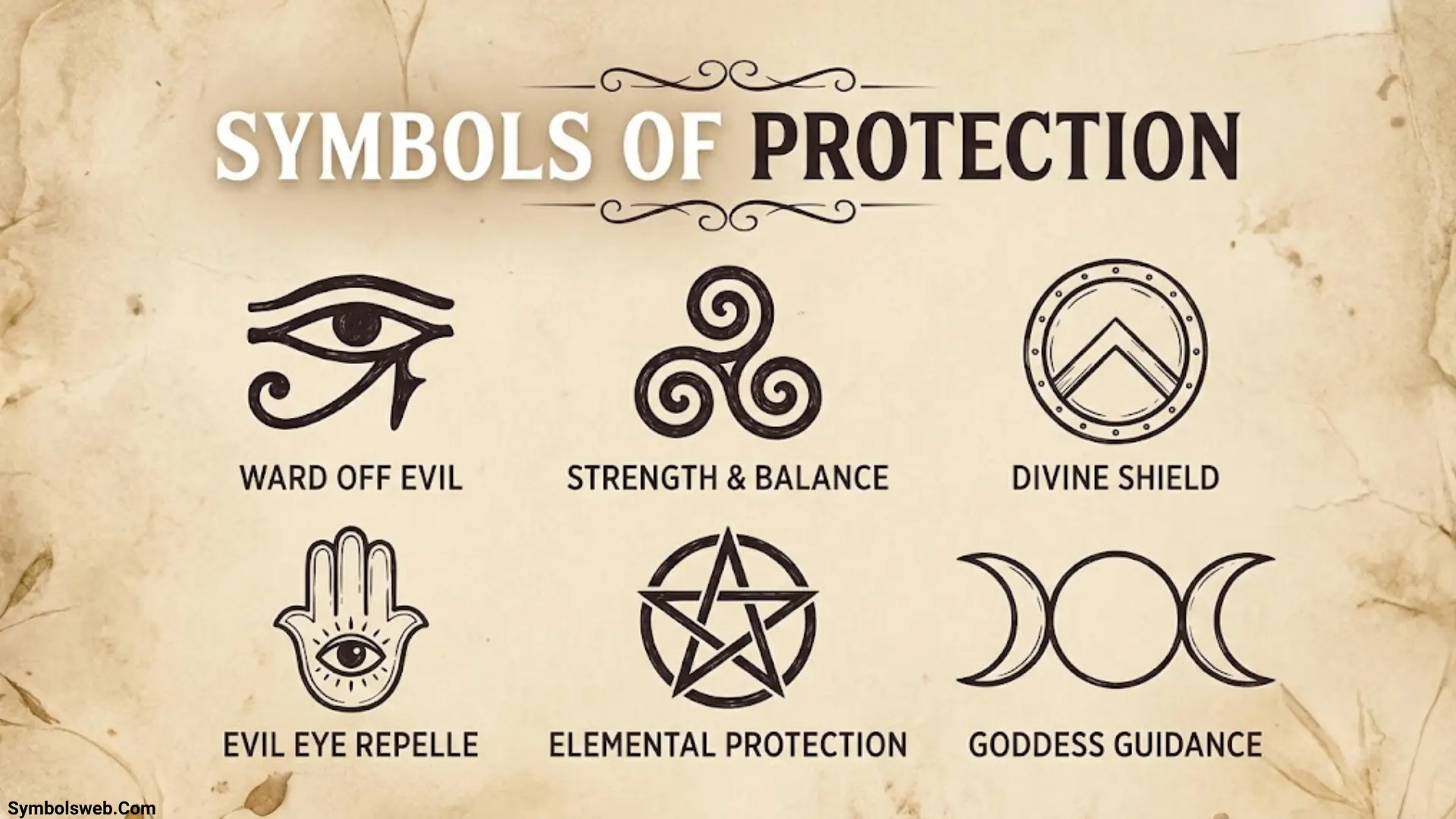
Symbols of protection have helped people express hope, courage, faith, and safety for thousands of years. From the blue Evil Eye charm to ancient Egyptian amulets, these designs carry stories shaped by religion, mythology, and cultural traditions. Some represent divine protection, while others symbolize guidance, strength, healing, or good fortune.
You can find protection symbols on necklaces, bracelets, tattoos, doorways, religious objects, and traditional artwork. Their meanings often depend on where they originated and how different communities use them. The Hamsa, for example, has important connections to Jewish and Muslim cultural traditions, while the Eye of Horus comes from ancient Egyptian religion.
This guide explores 28 protective symbols, their meanings, historical backgrounds, and modern uses. You’ll also discover how to distinguish documented history from newer interpretations, choose a symbol that fits your beliefs, and appreciate these traditions respectfully. Although many people believe these symbols offer spiritual protection, their supernatural effects haven’t been scientifically established.
What Are Symbols of Protection?

Symbols of protection are images, objects, patterns, or signs associated with guarding people, homes, possessions, or spiritual well-being. Different societies have developed their own protective imagery based on religious beliefs, mythology, folklore, and everyday experiences.
Some protective symbols depict eyes, hands, animals, weapons, or geometric shapes. Others use religious inscriptions, knots, crosses, or objects associated with powerful deities. Their appearance often reflects what a particular community feared, valued, or hoped to preserve.
Historically, people wore protective amulets, placed charms near entrances, and carried small religious objects during travel. Archaeological collections contain examples of amulets from ancient Egypt and other societies, demonstrating how protective beliefs became part of daily life.
Science Museum Group Collection+1
Symbol, Amulet, Charm, and Talisman: What’s the Difference?
These terms overlap, but they don’t always mean the same thing.
| Term | Meaning | Example |
| Symbol | An image or design that represents an idea or belief | The Christian cross |
| Amulet | An object believed to protect its wearer or owner | An Eye of Horus pendant |
| Charm | An object, phrase, or gesture associated with protection or good fortune | A traditional Evil Eye charm |
| Talisman | An object believed to carry a particular power or purpose | A symbol inscribed on a personal protective object |
| Religious medal | A devotional object associated with a religious figure, prayer, or tradition | The St. Benedict Medal |
A single object can fit several categories. For example, an Evil Eye pendant is a symbol by design and may function as an amulet within traditions that associate it with protection.
Why Do Different Cultures Use Protection Symbols?
People have long used symbolic objects to express beliefs about dangers they couldn’t easily control. Illness, envy, dangerous journeys, conflict, and uncertainty encouraged traditions involving protective objects and rituals.
These objects could also provide comfort, reinforce community identity, or serve as visible reminders of faith. A religious medal might remind someone to pray, while a family heirloom could connect its owner with generations of tradition.
The term apotropaic describes something intended to ward off evil or misfortune. Historic protective marks found on buildings offer one example of this practice. In England, researchers have documented marks carved near doors, windows, and fireplaces, where people believed harmful forces might enter.
Historic England
The important distinction is that a symbol’s cultural or spiritual significance doesn’t prove it can physically prevent harm. Its meaning can still be important to the people who use it.
28 Symbols of Protection and Their Meanings

The following protective symbols come from different historical periods, religions, and cultural traditions. Some have strong historical connections to protection, while others have broader spiritual meanings that people interpret protectively today.
Evil Eye Symbol
The Evil Eye is one of the best-known symbols associated with protection from envy and ill intentions. The underlying belief holds that a harmful gaze, sometimes motivated by jealousy, can bring misfortune or illness. Protective objects developed in many societies to guard against this perceived danger.
Wellcome Collection+1
The belief has a long history across the Mediterranean, Middle East, South Asia, and other regions. However, customs and interpretations differ between communities.
People commonly use Evil Eye designs in:
- Bracelets and necklaces
- Wall hangings and doorway decorations
- Household ornaments
- Personal keepsakes and gifts
Meaning: Protection against envy, ill wishes, and misfortune within traditions that recognize the Evil Eye belief.
Nazar Symbol
The Nazar is a familiar blue-and-white eye-shaped charm, especially associated with Turkish culture. Its circular design often features concentric rings of blue, white, and dark blue around a central pupil.
The Nazar is closely connected to the wider Evil Eye tradition. People display it in homes, wear it as jewelry, or attach it to personal belongings as a protective charm.
Although the Nazar and Evil Eye are often discussed together, they aren’t exactly the same thing. The Evil Eye refers primarily to the harmful gaze or belief surrounding it, while the Nazar is a recognizable object associated with protection from that gaze.
Meaning: A protective charm associated with warding off envy and misfortune.
Hamsa Hand
The Hamsa Hand is an open-hand design with five fingers, often arranged symmetrically. Some versions feature an eye in the palm, while others include floral patterns, geometric designs, or religious inscriptions.
The motif appears across Middle Eastern and North African cultures. It has significant connections to Jewish and Muslim traditions, although its history extends beyond either religion. Museums document Hamsa-style amulets used against the Evil Eye in different communities.
You might encounter the Hamsa as a necklace, bracelet, wall decoration, or doorway ornament. Its familiar open palm can represent blessing and protection within particular cultural contexts.
Meaning: Protection, blessing, and defense against the Evil Eye in traditions that use the motif.
Eye of Horus
The Eye of Horus, also called the Wedjat or Udjat eye, is an important symbol from ancient Egyptian religion. It represents the eye of Horus, a falcon-associated deity connected with kingship and divine power.
Egyptian mythology tells of Horus losing an eye during his conflict with Seth. The god Thoth restores it in versions of the story, connecting the eye with restoration and healing. Ancient Egyptians made eye-shaped amulets and used them in funerary contexts.
The design’s distinctive eyebrows and curved markings make it easy to recognize. Today, it appears in jewelry, artwork, tattoos, and Egyptian-inspired decorations.
Meaning: Protection, restoration, health, and healing in ancient Egyptian symbolism.
Pentacle
A pentacle usually features a five-pointed star enclosed within a circle. In many contemporary Wiccan and Pagan contexts, the five points represent earth, air, fire, water, and spirit.
The surrounding circle can express unity, wholeness, or the relationship among the elements. Some practitioners use pentacles in rituals, altars, jewelry, and personal spiritual practice.
However, the symbol’s meaning depends on the tradition and period. Not every five-pointed star enclosed by a circle has the same religious significance.
Meaning: Elemental balance, unity, and ritual protection in some modern Pagan and Wiccan traditions.
Pentagram
The pentagram is a five-pointed star drawn with five connected lines. Unlike a pentacle, it doesn’t necessarily include an enclosing circle.
The design has appeared in different historical and cultural settings, with meanings that changed over time. Modern Pagan traditions may associate it with the elements, spiritual balance, or protection. Other contexts give it different religious, philosophical, or artistic meanings.
An upright pentagram and an inverted pentagram can carry different associations in particular modern traditions. Neither orientation should automatically be interpreted without considering its context.
Meaning: A five-pointed star associated with different ideas, including balance and protection in some contemporary spiritual practices.
Vegvísir
The Vegvísir is an Icelandic magical stave commonly marketed as the Viking compass. Its name is associated with wayfinding, and its radiating arms create a distinctive compass-like appearance.
Historical accuracy matters here. The earliest known example appears in the Icelandic Huld manuscript, compiled in 1860. Its accompanying text describes carrying the sign to avoid losing one’s way in storms or bad weather. There is no established evidence that the familiar design dates to the Viking Age.
Today, people choose Vegvísir designs for tattoos, pendants, and artwork. Many interpret the symbol as a reminder to find direction during difficult periods.
Meaning: Guidance and protection during difficult journeys in its documented Icelandic magical context.
Ægishjálmur (Helm of Awe)
The Ægishjálmur, often called the Helm of Awe, is associated with Icelandic magical traditions and modern Norse-inspired symbolism. Its familiar form features radiating, spiked arms arranged around a central point.
The name has older literary roots. In medieval Norse literature, the term can refer to a helmet associated with terror or intimidation. Later Icelandic magical manuscripts feature a graphic stave associated with the name. These historical references should not be treated as proof that the modern design was a standard Viking Age emblem.
Gelmir+1
Modern interpretations connect the symbol with courage, defense, and facing adversity. It frequently appears in tattoos and Norse-inspired jewelry.
Meaning: Awe, intimidation, and protection in later Icelandic magical traditions and modern interpretations.
St. Benedict Medal
The St. Benedict Medal is a Catholic devotional object associated with St. Benedict of Nursia and Benedictine tradition. Its design commonly features a cross and Latin letters representing religious inscriptions and prayers.
The medal’s symbolism centers on Christian faith and reliance on God’s protection. Some Catholics use it during personal prayer or wear it as a pendant. A priest may bless the medal according to the Church’s devotional practices.
The medal isn’t a substitute for medical care, practical precautions, or personal responsibility. Its primary significance lies in religious devotion and the prayers associated with it.
Meaning: Christian faith and spiritual protection within Catholic devotional practice.
Archangel Michael and the Sword and Shield Motif

Archangel Michael appears in several biblical and Christian traditions as a powerful heavenly figure associated with the struggle against evil. Artists often depict him with a sword, spear, shield, or dragon-like adversary.
The sword-and-shield image makes a clear visual statement about courage and defense. In Christian devotional settings, Michael’s image can remind believers to seek divine help when facing fear or hardship.
You may find this imagery on medals, religious paintings, pendants, and church decorations. Its meaning comes from Christian beliefs rather than a universal system of protective symbols.
Meaning: Courage, spiritual defense, and victory over evil in Christian tradition.
Christian Cross
The Christian cross is the central emblem of Christianity. It recalls the crucifixion of Jesus Christ and represents faith, salvation, sacrifice, and hope.
Some Christians also view the cross as a reminder of God’s presence and protection. They display it in homes, wear it as jewelry, or place it in churches and prayer spaces.
The cross has several visual forms, including the Latin cross, Greek cross, and crucifix. A crucifix specifically includes a depiction of Jesus on the cross.
Meaning: Christian faith, salvation, sacrifice, and hope, with protective associations in some devotional practices.
Ankh
The Ankh is an ancient Egyptian sign shaped like a cross with a loop at the top. Egyptian gods, pharaohs, and religious artwork frequently feature it.
Its primary association is life. The symbol also appears in contexts connected with vitality, divine power, and the afterlife. Ancient Egyptian amulets and tomb imagery show how religious objects linked earthly life with hopes for continued existence.
Today, the Ankh appears in jewelry, tattoos, and Egyptian-inspired designs. Although many people use it as a personal symbol of life and renewal, its ancient meaning is broader than protection alone.
Meaning: Life, vitality, and continued existence in ancient Egyptian symbolism.
Triquetra
The Triquetra is a three-pointed knot formed by interlacing lines. Its continuous design makes it a recognizable example of Celtic knotwork and related decorative traditions.
Modern interpretations often associate it with unity, interconnectedness, and eternity. In some Christian contexts, people use it to represent the Holy Trinity: Father, Son, and Holy Spirit.
However, the Triquetra doesn’t have one fixed meaning across every historical period. Its use in Celtic-inspired jewelry or tattoos may express personal identity, faith, or a sense of connection.
Meaning: Interconnection and continuity, with a Trinitarian interpretation in some Christian contexts.
Celtic Knot
A Celtic knot is an interlaced design that often follows an unbroken path. These patterns appear in medieval Insular art, including illuminated manuscripts and carved stonework.
Their intricate lines create a sense of continuity. Modern audiences often interpret this quality as a symbol of eternity, loyalty, unity, or enduring relationships.
Some people choose Celtic knots as symbols of protection, but that interpretation shouldn’t be applied to every historical knot. The original purpose of a design may have involved decoration, religious meaning, or a combination of influences.
Meaning: Interconnection and continuity, with additional meanings shaped by the particular design and context.
Dreamcatcher
The dreamcatcher is associated especially with the Ojibwe people and broader Indigenous cultural history. Traditional examples often feature a hoop, a woven web, and attached materials such as feathers or beads.
Dreamcatchers are associated with protecting children during sleep and filtering harmful dreams in relevant traditions. The details of their meaning and construction can vary, so no single description represents every Indigenous community.
Dreamcatchers later became popular in mainstream commercial and New Age markets. That wider popularity sometimes removed them from their original cultural setting. The Smithsonian’s catalog of scholarship on dreamcatchers specifically addresses their origins, distribution, and later cultural appropriation.
Smithsonian Institution+1
When choosing one, consider buying from an Indigenous artist who explains the item’s origins and materials.
Meaning: Protection associated with sleep and dreams in Ojibwe traditions and later adaptations.
Red String Bracelet
A red string bracelet is associated with protective customs in several cultures, including some Jewish and Kabbalistic traditions. In certain practices, people wear a red thread as a reminder of blessing or as a charm against the Evil Eye.
There isn’t one universal rule governing how the bracelet must be worn. Instructions about the left wrist, who ties the string, or what happens when it breaks vary among teachers and communities.
Some people wear the bracelet because of religious belief. Others value its cultural meaning or personal significance.
Meaning: Protection from the Evil Eye and spiritual blessing in some traditions.
Hand of Miriam

The Hand of Miriam is a Jewish name for the Hamsa motif. The name refers to Miriam, the sister of Moses and Aaron in biblical tradition.
The design appears in Jewish jewelry and decorative objects, sometimes featuring an eye, Hebrew lettering, or other meaningful details. Its use can express a connection to Jewish heritage, blessing, or protection.
The Hand of Miriam and the Hand of Fatima refer to related forms of the wider Hamsa motif, not necessarily separate designs. Their names reflect different cultural and religious associations.
The British Museum: Islamic Gallery+1
Meaning: Blessing and protection within Jewish cultural traditions that use the Hamsa.
Hand of Fatima
The Hand of Fatima is another name associated with the Hamsa, referring to Fatima, the daughter of the Prophet Muhammad. The motif appears in Muslim and Jewish communities across parts of the Middle East and North Africa.
Historical examples include metal pendants decorated with glass, enamel, and hand-shaped designs. Museum collections document examples connected with protection against the Evil Eye.
The British Museum: Islamic Gallery+1
Not every Muslim interprets or uses the Hamsa in the same way. Some regard it as cultural art, while others avoid amulets based on their understanding of religious teachings.
Meaning: A protective hand motif associated with blessing and defense against envy in some regional traditions.
Algiz Rune
Algiz is the modern name commonly used for a rune in the Elder Futhark, an early runic writing system. The rune’s historical use belongs to the study of Germanic inscriptions, while many of its popular spiritual meanings come from later interpretations.
Contemporary spiritual communities sometimes associate Algiz with protection, defense, or a raised hand. However, these modern meanings shouldn’t automatically be attributed to every ancient runic inscription.
Runes originally served as writing characters, although they could also appear in meaningful personal or ritual contexts. Their use varied across time and place.
Meaning: Protection in some modern runic and spiritual interpretations; historical inscriptions require individual examination.
Thor’s Hammer (Mjölnir)
Mjölnir, the hammer of Thor in Norse mythology, is one of the best-known objects associated with the Norse god of thunder. Thor’s role includes defending gods and humans against dangerous forces.
Archaeologists have found hammer-shaped pendants associated with Viking Age material culture. These objects provide stronger historical evidence for the hammer’s cultural importance than claims that every modern Norse-inspired symbol dates to the same period.
Today, Mjölnir pendants can express interest in Norse mythology, cultural heritage, or modern Heathen religious identity. Some wearers also associate the hammer with strength and protection.
Meaning: Thor’s power and protective role in Norse mythology, with additional modern cultural and religious meanings.
Scarab
The scarab beetle held religious significance in ancient Egypt. Its association with the sun’s movement and renewal helped make it an important symbol of transformation and rebirth.
Ancient Egyptians produced scarab-shaped objects as seals, ornaments, and amulets. Some appeared in funerary settings, where beliefs about regeneration and the afterlife shaped their significance.
The scarab’s protective associations therefore connect closely with Egyptian religious ideas about life, death, and renewal. It wasn’t simply a lucky beetle or decorative insect.
Meaning: Renewal, regeneration, and rebirth, with protective associations in ancient Egyptian religious contexts.
Eye of Ra
The Eye of Ra belongs to ancient Egyptian religious mythology and is associated with the sun god Ra. Depending on the myth, the Eye can represent a powerful divine force that acts on Ra’s behalf.
It may appear in connection with royal authority, solar power, and the defense of divine order. Some depictions associate the Eye with a goddess who protects Ra and punishes threats against him.
Although the Eye of Ra and Eye of Horus share eye imagery, they aren’t interchangeable in every context. Their myths and symbolic roles differ.
Meaning: Solar power, divine authority, and protective force in ancient Egyptian mythology.
Ankh and Djed Combination
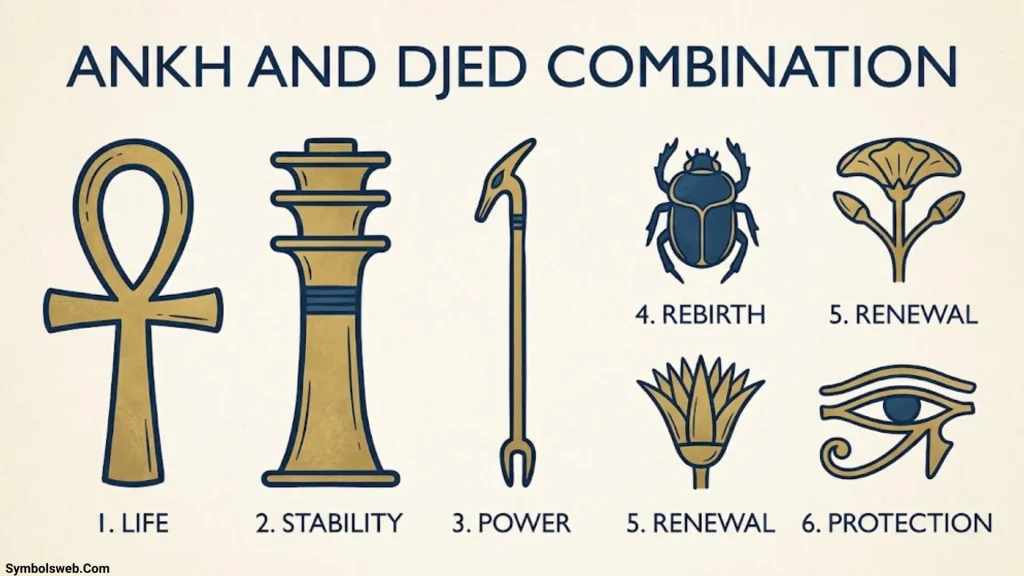
The Ankh and Djed pillar are two distinct ancient Egyptian symbols that can appear together in religious art.
The Ankh represents life, while the Djed is associated with stability and endurance. When they appear together, the combination can express ideas about sustaining life and maintaining order.
Ancient Egyptian art frequently combines symbolic objects to communicate several ideas at once. The meaning of a combination depends on its placement, accompanying figures, inscriptions, and religious context.
Meaning: Life and stability, with additional significance determined by the artwork or ritual context.
Om Symbol
Om, also written Aum, is a sacred syllable in Hindu traditions. It appears in religious texts, prayer, meditation, and spiritual practice.
Om carries associations with sacred sound and ultimate reality. Its meaning extends beyond a simple protective emblem, so describing it only as a symbol against negative energy misses its deeper religious significance.
Some people incorporate Om into jewelry or tattoos as an expression of spiritual commitment. Because it is sacred in living religious traditions, its use deserves care and understanding.
Meaning: Sacred sound and ultimate reality in Hindu traditions, with meanings shaped by specific philosophical and religious contexts.
Dharma Wheel
The Dharma Wheel, also known as the Dharmachakra, is a major symbol in Buddhism. It represents the Buddha’s teachings, often described through the image of setting the wheel of Dharma in motion.
Its eight spokes are commonly connected with the Noble Eightfold Path, which guides Buddhist practice toward the end of suffering. The wheel appears in Buddhist art, architecture, and religious objects.
Although some people may find comfort in its spiritual meaning, the Dharma Wheel is primarily a teaching symbol rather than a dedicated protective charm.
Meaning: Buddhist teachings, ethical practice, and the path toward awakening.
Lotus Symbol
The lotus appears in Buddhist and Hindu traditions, where it can represent purity, spiritual development, and awakening. The flower’s growth through muddy water provides a powerful image of beauty emerging from difficult conditions.
Different deities and religious figures appear with lotus flowers in South Asian art. Their meaning depends on the figure, posture, color, and surrounding imagery.
Today, people choose lotus designs for jewelry and tattoos to express growth, resilience, or spiritual commitment. Those personal meanings may overlap with religious interpretations but don’t replace them.
Meaning: Purity, spiritual growth, and awakening in relevant Hindu and Buddhist traditions.
Double-Headed Eagle
The double-headed eagle appears in historical heraldry and imperial imagery. Its two heads have been interpreted in different political and cultural settings, including associations with authority and sovereignty.
The motif appears in Byzantine and other heraldic traditions, and later became part of the visual identity of different states and institutions. Its meaning therefore depends on the historical setting.
Unlike a dedicated protective amulet, the double-headed eagle primarily communicates authority, status, or political identity. A person might interpret it as a symbol of strength, but that doesn’t make protection its universal historical meaning.
Meaning: Authority, sovereignty, and power in particular heraldic and imperial traditions.
Four-Leaf Clover
The four-leaf clover is widely associated with luck in Irish and popular Western traditions. Its rarity makes it a familiar emblem of good fortune.
It is often confused with the shamrock, which usually has three leaves and has a distinct connection with Irish identity. The four-leaf clover is more directly linked to popular beliefs about luck.
People use it in jewelry, gifts, clothing, and decorative designs. Some consider it a charm against misfortune, although its meaning is primarily tied to luck rather than a specific religious protection practice.
Meaning: Good fortune and hope, with protective interpretations in some popular traditions.
Ancient Protection Symbols and Their Origins

Ancient protection symbols reveal how earlier societies understood danger, health, spiritual power, and the afterlife. Archaeological finds help researchers distinguish objects people actually used from meanings assigned to them much later.
Protection Symbols in Ancient Egypt
Ancient Egyptian protective objects included the Eye of Horus, scarab amulets, and other religious motifs. People wore amulets or placed them in funerary settings because they associated particular objects with divine assistance, health, or renewal.
The Eye of Horus is especially well documented. The Science Museum Group holds an Egyptian science example dated broadly between 4000 and 30 BCE, illustrating the long history of this type of object.
Science Museum Group Collection
Protective Symbols in Ancient Greece and Rome
The Evil Eye belief appeared in ancient Mediterranean societies, where people associated envy and harmful attention with possible misfortune. Protective objects and gestures became part of local customs.
People also used images and objects intended to avert harm, a practice described as apotropaic. The exact meaning of an object depends on its date, location, and archaeological context.
Norse and Icelandic Protective Traditions
Norse mythology includes protective figures and objects, including Thor’s hammer. Archaeological pendants provide evidence that hammer-shaped jewelry had a place in Viking Age material culture.
The Vegvísir requires a different historical explanation. Its earliest known appearance is in an Icelandic manuscript from 1860, not a Viking Age artifact. The Helm of Awe has older literary associations, but its familiar graphic form belongs to the history of Icelandic magical staves.
Protective Symbols in Medieval Europe
Medieval Europeans used crosses, religious inscriptions, devotional objects, and protective marks. Some marks appear near entrances or fireplaces in historic buildings, where people may have believed they could guard against supernatural harm.
Historic England documents examples of these marks, including circular geometric designs known as hexafoils. Researchers still debate the purpose of some individual examples, showing why historical claims need careful qualification.
Protection Symbols Across Religions and Cultures
No single tradition owns every symbol associated with protection. Similar shapes can develop different meanings, while one motif may move between communities over centuries.
Jewish Protection Symbols
Jewish protective traditions include some uses of the Hamsa, the Hand of Miriam, and red string bracelets. Practices vary among communities and individuals, and not every Jewish person uses these objects.
For a clearer understanding, distinguish cultural customs from religious teachings. A symbol’s popularity doesn’t mean every Jewish community interprets it identically.
Islamic Protective Symbols and Cultural Practices
The Hamsa, also called the Hand of Fatima in some contexts, appears in Muslim communities and regional decorative traditions. Certain objects also feature inscriptions or religious phrases associated with blessing.
However, views on amulets differ among Muslims. Some accept particular protective customs, while others object to relying on objects for protection. The distinction between cultural practice and religious doctrine matters.
Christian Protection Symbols
The cross, St. Benedict Medal, and Archangel Michael imagery are familiar Christian protection symbols. Their meanings relate to faith, prayer, devotion, and trust in God.
In Catholic practice, a blessed medal serves as a devotional aid rather than an independent supernatural power. Its significance comes from the religious beliefs and prayers associated with it.
Pagan and Wiccan Protection Symbols
Some contemporary Pagan and Wiccan practitioners use the pentacle in rituals and associate it with the five elements. Others use circles, protective markings, or objects that reflect their particular spiritual practice.
Paganism includes many traditions, so no single set of symbols represents every practitioner. The pentagram’s meaning also depends on the community and context.
Indigenous Protective Traditions
Indigenous cultures have diverse spiritual traditions, symbols, and protective practices. The dreamcatcher is one example with documented connections to the Ojibwe people.
Avoid treating all Indigenous communities as one culture. When choosing Indigenous-made objects, learn about their origins and consider supporting artists from the communities connected to them.
What Do Protection Symbols Represent?
Although protective symbols differ in appearance, many express a handful of recurring themes.
| Meaning | Examples | Context |
| Protection against envy | Evil Eye, Nazar, Hamsa | Mediterranean, Middle Eastern, and related traditions |
| Strength and defense | Thor’s hammer, Archangel Michael imagery | Norse mythology and Christian tradition |
| Guidance | Vegvísir | Icelandic magical tradition |
| Life and renewal | Ankh, Eye of Horus, scarab | Ancient Egyptian religion |
| Unity and continuity | Triquetra, Celtic knots | Celtic-inspired art and some Christian interpretations |
| Faith and devotion | Cross, St. Benedict Medal | Christian traditions |
| Luck | Four-leaf clover | Irish and popular Western traditions |
| Spiritual awakening | Lotus, Dharma Wheel | Hindu and Buddhist traditions |
Protection From Evil and Misfortune
The Evil Eye, Nazar, and Hamsa are associated with protection against envy or harmful attention in particular cultural settings. Their designs often appear on wearable charms and household decorations.
Strength, Courage, and Resilience
Thor’s hammer and Archangel Michael imagery can express strength and defense. Today, people may choose these designs to represent perseverance through difficult experiences.
Guidance and Safe Journeys
Vegvísir is associated with finding one’s way through storms or unfamiliar conditions in its documented Icelandic context. Modern wearers often extend that meaning to life’s uncertain moments.
Healing, Life, and Renewal
The Eye of Horus and Ankh connect with health, restoration, and life in ancient Egyptian symbolism. These meanings arose within a religious worldview that included beliefs about divine powers and the afterlife.
Unity, Balance, and Spiritual Connection
The pentacle, Triquetra, and Celtic knots can express balance, interconnectedness, or continuity. Their interpretations depend on the traditions and individuals using them.
Faith, Blessings, and Divine Care
Religious symbols may remind believers of prayer, devotion, and trust in divine care. For many people, this personal meaning is more important than the object’s appearance.
Protection Symbols Used in Jewelry, Tattoos, and Everyday Objects
Modern protective jewelry allows people to carry meaningful symbols with them. Other designs appear in homes, cars, artwork, and personal keepsakes.
Protection Symbols in Bracelets and Necklaces
Common choices include:
- Evil Eye bracelets: Associated with protection against envy.
- Hamsa necklaces: Connected with blessing and protection in some traditions.
- Red string bracelets: Used in certain cultural and spiritual practices.
- St. Benedict Medals: Catholic devotional objects.
- Ankh pendants: Often chosen to represent life and renewal.
- Pentacle jewelry: Used by some Pagan and Wiccan practitioners.
Before buying a piece, check its materials, workmanship, and description. Sellers sometimes attach exaggerated historical claims to designs that became popular much later.
Protection Symbols for Tattoos
A protection symbol tattoo can represent faith, courage, identity, or a personal commitment. People often choose the Evil Eye, Hamsa, Vegvísir, or pentacle because their designs are distinctive.
Before getting a tattoo, research its history and consider the cultural context. A symbol may have religious significance that goes beyond its decorative appearance.
Think about these questions:
- Does the symbol’s meaning fit your intention?
- Do you understand its cultural or religious background?
- Is the design historically accurate?
- Are you comfortable explaining its meaning to others?
Protection Symbols for the Home
People display Hamsa decorations, crosses, Evil Eye charms, and other objects in their homes. Depending on the tradition, these objects may express faith, welcome blessings, or represent protection.
Some historical European households also placed protective marks near doors, windows, and fireplaces. These practices reflect beliefs about vulnerable entry points and supernatural danger.
Historic England+1
Protection Charms for Cars and Travel
Some drivers keep a religious medal, Nazar charm, or personal keepsake in their vehicles. Such objects may provide comfort or serve as reminders of faith during travel.
However, protective charms cannot replace practical safety measures. Seat belts, safe driving, vehicle maintenance, and following traffic laws remain essential.
How to Choose a Protection Symbol

The right symbol depends on what it means to you, where it comes from, and how you intend to use it.
Understand the Symbol’s Original Meaning
Start by checking reliable historical or cultural sources. Museums, academic publications, and community organizations can help you separate established meanings from modern interpretations.
For example, the Vegvísir is often called an ancient Viking compass online. Its documented history points instead to nineteenth-century Icelandic magical manuscripts.
Consider Your Personal Beliefs
Choose a symbol that reflects your values, cultural background, or spiritual tradition. You might prefer a Christian medal, a symbol of resilience, or an object that reminds you of a meaningful experience.
You don’t need to choose a symbol simply because someone calls it powerful.
Respect Cultural and Religious Significance
Learn whether a symbol has sacred or community-specific meaning. If you’re interested in a dreamcatcher, for example, understanding its Ojibwe connections adds important context.
Respectful use begins with knowledge rather than assumptions.
Choose the Right Form
Consider whether you want a bracelet, necklace, tattoo, wall hanging, or devotional object. Each form offers a different way to express your connection to a symbol.
For jewelry, practical details such as material quality, comfort, and durability also matter.
Avoid Unsupported Claims
Be cautious when sellers promise guaranteed protection, healing, or supernatural results. Cultural traditions may attach deep meaning to objects, but those beliefs don’t establish scientifically proven effects.
Common Myths and Misconceptions About Protection Symbols

Is One Protection Symbol More Powerful Than All Others?
There is no scientifically established ranking of protection symbols. A symbol’s significance depends on cultural beliefs, religious teachings, and personal interpretation.
The Hamsa may be meaningful within one tradition, while the cross holds a central place in another.
Do Protection Symbols Actually Work?
People may find comfort, hope, or a sense of connection through meaningful objects. However, there is no established scientific evidence that these symbols provide supernatural protection against illness, accidents, or harmful forces.
Their cultural, religious, and personal significance can still be genuine.
Are All Ancient Symbols Protective?
No. Some ancient symbols represent life, authority, fertility, religious teachings, or political identity. The Ankh, for instance, primarily represents life in ancient Egyptian symbolism.
A symbol can acquire protective meanings later without having served that purpose in every historical context.
Do Similar Symbols Have the Same Meaning Everywhere?
Not necessarily. The Hamsa has different names and associations across Jewish and Muslim cultural traditions. Even within one community, people may interpret the same symbol differently.
Shape alone doesn’t tell the whole story.
Does a Broken Protection Charm Mean Something Bad?
Interpretations vary, but a broken bracelet or pendant doesn’t establish that misfortune is coming. Physical objects break because of wear, weak materials, or accidental damage.
If the object has personal or religious significance, you can decide whether to repair, replace, or keep it.
Frequently Asked Questions About Protection Symbols
What Is the Most Powerful Symbol of Protection?
There is no objectively proven most powerful symbol of protection. The Hamsa, Evil Eye, Christian cross, and St. Benedict Medal hold significance within different cultural or religious traditions.
What Is the Oldest Known Protection Symbol?
There isn’t one universally agreed-upon oldest protection symbol. Archaeologists have documented protective amulets and ritual objects from ancient societies, including ancient Egypt and Mesopotamia. Identifying a single oldest example depends on how researchers define protection and interpret the evidence.
What Is the Celtic Symbol for Protection?
The Celtic knot and Triquetra are popular choices in modern Celtic-inspired designs. However, their meanings vary, and historical evidence doesn’t establish that every Celtic knot originally served as a protective symbol.
What Is the Viking Symbol for Protection?
Thor’s hammer, Mjölnir, has a stronger connection to Viking Age material culture than the commonly marketed Vegvísir. Hammer-shaped pendants have been found in archaeological contexts associated with the Viking Age.
Vegvísir belongs to a documented Icelandic magical tradition recorded centuries later.
What Does the Evil Eye Symbol Mean?
The Evil Eye refers to a belief that envy or a harmful gaze can cause misfortune. Protective charms, including the Nazar, are associated with guarding against this perceived danger in various cultures.
What Does the Hamsa Hand Represent?
The Hamsa is an open-hand motif associated with blessing and protection in several Middle Eastern and North African traditions. It has important connections to Jewish and Muslim cultural practices.
What Is the Difference Between a Pentacle and a Pentagram?
A pentagram is a five-pointed star. A pentacle usually refers to a pentagram enclosed in a circle, especially in modern Pagan and Wiccan contexts.
What Does the Vegvísir Symbol Mean?
Vegvísir is an Icelandic magical stave associated with finding one’s way through storms or bad weather. Its earliest known appearance is in the Huld manuscript of 1860, not in Viking Age records.
What Does the St. Benedict Medal Represent?
The St. Benedict Medal represents Christian devotion and is associated with prayers for spiritual protection in Catholic tradition. It features a cross and Latin inscriptions.
Can Christians Wear a Pentacle?
Christian views differ. Some Christians avoid the pentacle because of its associations with Pagan or Wiccan practices, while others may treat it as a geometric design. Anyone concerned about religious compatibility can consult a trusted religious leader.
Is It Respectful to Wear a Hamsa if You Are Not Jewish or Muslim?
Many people wear the Hamsa as jewelry or appreciate it as cultural art. Respectful use means understanding its Jewish and Muslim connections, avoiding stereotypes, and recognizing that individuals within those communities may hold different views.
What Jewelry Is Commonly Associated With Protection?
Popular examples include Evil Eye bracelets, Hamsa necklaces, St. Benedict Medals, red string bracelets, and pentacle pendants. Their meanings depend on the traditions and beliefs associated with each item.
Are Protection Symbols Used in Tattoos?
Yes. People choose protective imagery for tattoos to express faith, cultural identity, courage, or personal meaning. Research the symbol’s origin before committing to a permanent design.
How Do You Choose a Meaningful Protection Symbol?
Learn about its historical background, consider your beliefs, and decide what you want it to represent. Choose a design for its genuine meaning rather than relying on promises of guaranteed supernatural protection.
Conclusion: Understanding Protection Symbols and Their Meanings
Symbols of protection tell stories about how people understand safety, faith, strength, and the unknown. From the ancient Egyptian Eye of Horus to the Hamsa and Christian cross, each symbol carries meanings shaped by specific cultural and religious traditions.
When choosing a protective symbol, look beyond its appearance. Learn its origins, understand how people use it, and recognize the difference between historical evidence and modern spiritual interpretation. That approach helps you appreciate the symbol without oversimplifying its meaning.
Ultimately, a meaningful symbol can serve as a reminder of your values, beliefs, or personal journey. Whether you choose a bracelet, pendant, tattoo, or household decoration, understanding its history makes the choice more thoughtful and respectful.

Hi, I’m Ethan Holloway, and I’ve always believed that a few meaningful words can change the way we think, feel, and live. I enjoy collecting timeless quotes, studying their deeper meanings, and sharing inspiring messages that help people stay motivated through every stage of life.
Over the years, I’ve explored thousands of famous sayings from writers, leaders, philosophers, and everyday people. My goal is to make wisdom easy to understand and useful for everyone.
Books by Ethan Holloway
- The Power of Everyday Quotes
- Words That Inspire Greatness
 Jordan Hayes
 Eliana Foster