
Toyota dashboard symbols and their meanings help you understand what your vehicle needs, which systems are working, and when something requires attention. From a simple turn signal indicator to a serious engine oil pressure warning, each symbol communicates information about your vehicle’s condition.
However, not every illuminated dashboard light signals a problem. Some indicators confirm that a feature is operating while others warn you about mechanical faults, safety concerns, or upcoming maintenance. Knowing the difference helps you respond correctly and avoid unnecessary repairs.
This guide explains the most common Toyota dashboard symbols, their meanings, possible causes, and recommended actions. You’ll learn how to interpret warning light colors, recognize urgent problems, troubleshoot unfamiliar dashboard icons, and find information specific to your Toyota model.
What Do Toyota Dashboard Symbols Mean?

Toyota dashboard symbols are visual indicators that communicate information about your vehicle’s operating condition. They appear on the instrument panel, digital display, center console, or other locations depending on the model and available equipment.
These dashboard warning lights and indicators monitor different vehicle systems, including the engine, brakes, battery, tires, airbags, steering, and driver assistance features.
For example, a tire-shaped symbol with an exclamation point usually relates to tire pressure monitoring. A blue headlight symbol generally indicates that your high-beam headlights are active.
Toyota dashboard icons fall into three main categories:
- Warning lights: Alert you to potential malfunctions or conditions requiring attention.
- Status indicators: Show when a feature or vehicle system is operating.
- Maintenance reminders: Notify you when scheduled service or routine maintenance may be due.
The meaning of an illuminated symbol depends on the specific icon, its color, whether it flashes, and the vehicle’s operating conditions.
Toyota models also differ in their dashboard designs. A 2025 Toyota Camry may display different driver assistance indicators from an older Corolla or a hybrid RAV4.
Always check the owner’s manual for your exact model and model year. The manual provides the most reliable explanation of the symbols installed in your vehicle.
Toyota Dashboard Warning Light Colors and Their Meanings
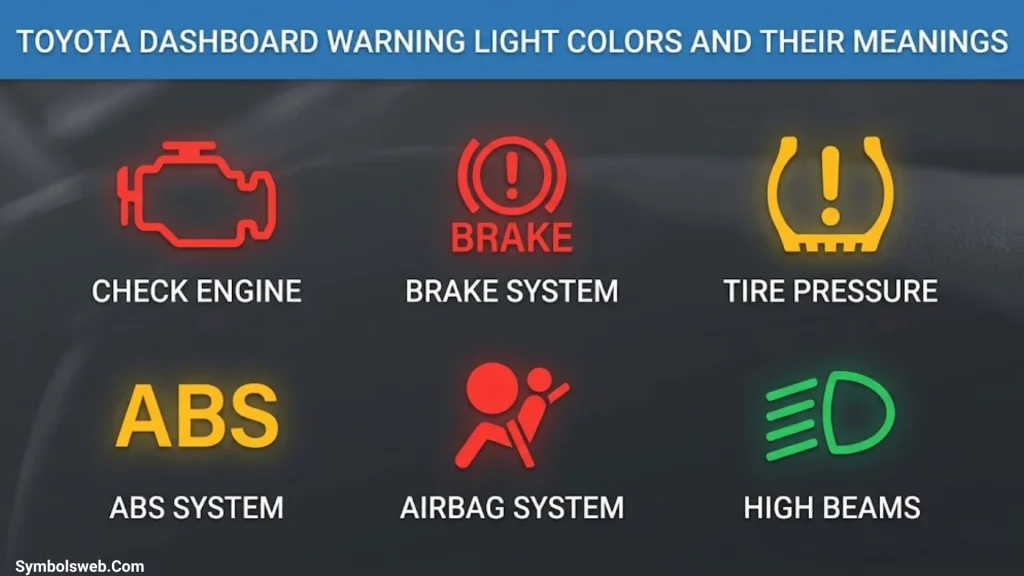
Warning light colors provide useful clues about urgency. However, color alone doesn’t tell you exactly what went wrong or whether the vehicle remains safe to drive.
Toyota’s official warning light guide explains that red icons generally indicate conditions requiring immediate attention. Yellow icons commonly identify important conditions, but their meanings vary by system.
Red Toyota Dashboard Warning Lights
Red dashboard warning lights often indicate serious conditions that need immediate attention. Depending on the symbol, you may need to stop driving as soon as it’s safe.
Common examples include:
- Low engine oil pressure warning light: Indicates that engine oil pressure may be too low.
- Brake system warning light: May indicate a brake system problem or an engaged parking brake.
- Charging system warning light: Indicates a possible fault in the vehicle’s charging system.
- High coolant temperature warning light: Can indicate engine overheating.
- SRS airbag warning light: Indicates a potential problem with the airbag or supplemental restraint system.
The correct response depends on the specific warning. For example, a low oil pressure warning calls for stopping safely and switching off the engine. Continuing to drive can cause severe engine damage.
If the brake warning appears alongside abnormal braking or a soft brake pedal, stop safely and arrange assistance.
Yellow and Amber Toyota Dashboard Warning Lights
Yellow and amber Toyota dashboard warning lights generally indicate that a system needs attention, a fault has been detected, or a vehicle condition requires investigation.
Common examples include:
- Check engine light
- Tire pressure warning light
- ABS warning light
- Traction control warning light
- VSC OFF indicator
- Maintenance reminders
An amber light doesn’t automatically mean you can continue driving without concern. A flashing check engine light, for example, can indicate a serious engine misfire that may damage the catalytic converter.
Read the accompanying message and check the owner’s manual before deciding what to do.
Green Toyota Dashboard Indicators
Green dashboard indicators usually confirm that a vehicle function is active or operating.
Examples include:
- Turn signal indicators
- Certain exterior lighting indicators
- Some cruise control and driver assistance status indicators
A green indicator generally doesn’t signal a malfunction. However, check the symbol’s meaning if it appears unexpectedly or behaves differently from normal.
Blue Toyota Dashboard Indicators
The most familiar blue Toyota dashboard indicator is the high-beam headlight symbol.
It tells you that the vehicle’s high-beam headlights are switched on. High beams improve visibility on dark roads but can dazzle drivers traveling toward you.
Switch to low beams when approaching other vehicles or when road conditions require it.
Flashing vs. Solid Toyota Dashboard Warning Lights
Whether a warning light flashes or stays illuminated can help you understand its urgency.
A solid check engine light generally indicates a detected engine or emissions-related fault. A flashing check engine light can indicate a more serious condition, such as an active engine misfire.
Other indicators behave differently. A flashing slip indicator may show that traction or stability control is actively working rather than reporting a fault.
| Warning Light Behavior | Possible Meaning | Recommended Response |
| Solid amber light | A system fault or condition requiring attention | Check the manual and arrange inspection as needed |
| Flashing check engine light | Possible serious engine misfire | Reduce engine load and stop safely if the vehicle runs poorly |
| Flashing slip indicator | Traction or stability control may be operating | Adjust driving to the road conditions |
| Persistent red oil pressure light | Potentially dangerous low oil pressure | Stop safely and switch off the engine |
| Warning light with a dashboard message | A specific system needs attention | Read and follow the displayed instructions |
These examples aren’t universal rules. The exact meaning depends on the warning symbol and your Toyota model.
Toyota Dashboard Symbols and Their Meanings: Quick Reference Table
The following table covers common Toyota dashboard warning lights, status indicators, and maintenance reminders.
| Toyota Dashboard Symbol | Common Meaning | Typical Color | What You Should Do |
| Check engine light | Engine management or emissions-related fault | Amber | Arrange diagnosis; respond promptly if flashing |
| Oil pressure warning | Engine oil pressure may be too low | Red | Stop safely and switch off the engine |
| Battery or charging warning | Charging system malfunction | Red | Stop safely when appropriate and arrange assistance |
| Tire pressure warning (TPMS) | Low tire pressure or a monitoring system fault | Amber | Check tire pressure and inspect for damage |
| Brake system warning | Parking brake engaged or possible brake system fault | Usually red | Check the parking brake and assess braking behavior |
| ABS warning | Possible anti-lock braking system fault | Usually amber | Arrange inspection; ABS assistance may be unavailable |
| SRS airbag warning | Possible airbag system malfunction | Usually red | Arrange prompt professional inspection |
| EPS warning | Possible electric power steering malfunction | Red or amber, depending on model | Stop if steering becomes difficult to control |
| Master warning light | Another warning or vehicle condition needs attention | Varies | Read the accompanying dashboard message |
| Seatbelt reminder | A seat belt needs fastening | Usually red | Fasten seatbelts and check the reminder conditions |
| Low fuel warning | Fuel level is low | Usually amber | Refuel soon |
| High-beam indicator | High-beam headlights are active | Blue | Switch to low beams when appropriate |
| Turn signal indicator | A turn signal is operating | Green | Check exterior lights if flashing unusually fast |
| Cruise control indicator | Cruise control status | Varies | Check whether the system is active or set |
| TRAC OFF indicator | Traction control is switched off or unavailable | Usually amber | Check the system status and owner’s manual |
| Slip indicator | Traction or stability control activity or a possible fault | Usually amber | Adjust driving conditions and investigate persistent warnings |
| VSC OFF indicator | Vehicle Stability Control is switched off or unavailable | Usually amber | Check whether the system was intentionally disabled |
| Security indicator | Anti-theft or immobilizer system status | Often red | Confirm whether the behavior matches normal operation |
Dashboard symbol colors and meanings can vary by model, model year, and market. Consult your Toyota owner’s manual for confirmation.
Toyota Engine and Maintenance Warning Lights

Engine and maintenance warnings can help you identify problems before they become expensive repairs. Some require immediate action while others allow time to arrange a service appointment.
Toyota Check Engine Light
The Toyota check engine light is often shaped like an engine. It may also be labeled as the malfunction indicator lamp in your owner’s manual.
This light indicates that the engine management or emissions control system has detected a condition requiring attention.
Possible causes include:
- A loose or damaged fuel cap on vehicles where this can trigger the warning
- Faulty oxygen or other engine sensors
- Ignition system problems
- Fuel system faults
- Emissions control system malfunctions
- Engine misfires
A steady check engine light doesn’t identify the exact failed component. A technician generally needs to retrieve diagnostic trouble codes and interpret them alongside other symptoms.
What should you do?
If the light stays on and the vehicle runs normally, check the owner’s manual and arrange a diagnostic inspection. If the light flashes, the engine shakes, or power drops significantly, reduce engine load and stop safely if necessary.
Don’t replace expensive parts simply because you suspect they’re responsible. Proper diagnosis can prevent unnecessary repairs.
Toyota Low Engine Oil Pressure Warning Light
The Toyota oil pressure warning light often resembles an oil can with a droplet.
It indicates that engine oil pressure may have fallen below the required level. Engine oil lubricates moving components and helps limit friction and heat.
Possible causes include:
- Insufficient engine oil
- An oil leak
- A failing oil pump
- An oil pressure sensor fault
- Internal engine problems
Low oil pressure can damage an engine quickly. Even if the engine sounds normal, don’t ignore this warning.
What should you do?
- Pull over in a safe location.
- Switch off the engine.
- Allow the vehicle to settle before checking the oil level according to the owner’s manual.
- If the oil level is low, follow the manufacturer’s instructions for adding the correct oil.
- If the warning remains on or the cause isn’t clear, arrange professional assistance.
Adding oil won’t necessarily fix low oil pressure. If the warning persists, don’t restart or continue driving until the problem has been assessed.
Toyota Battery and Charging System Warning Light
The Toyota battery warning light usually looks like a battery with positive and negative symbols.
Despite its appearance, this warning often points to a charging system problem rather than a battery that simply needs replacing.
Possible causes include a failing alternator, damaged wiring, loose battery connections, or another charging system fault.
When the charging system fails, the vehicle may rely on stored battery power. Eventually, electrical systems can stop working as the battery discharges.
What should you do?
Check the dashboard message and arrange assistance. If the warning appears while driving, avoid unnecessary electrical loads when safe to do so. Don’t assume the vehicle will continue running indefinitely.
A technician can test the battery, charging system, wiring, and related components to identify the actual problem.
Toyota Tire Pressure Warning Light (TPMS)
The Toyota tire pressure warning light typically resembles a horseshoe-shaped tire with an exclamation point.
The Tire Pressure Monitoring System (TPMS) alerts you when tire pressure drops below the system’s threshold or when a monitoring system fault occurs.
Common causes include:
- Air loss from a puncture
- Gradual pressure loss
- Temperature changes
- A faulty tire pressure sensor
- A TPMS system issue
Underinflated tires can affect handling, braking, fuel economy, and tire wear.
What should you do?
Check all tires with a reliable pressure gauge when they’re cold. Inflate them to the pressure listed on the driver’s door-jamb placard or specified in your owner’s manual.
Don’t use the maximum pressure printed on the tire sidewall as a substitute for Toyota’s recommended vehicle pressure.
If a tire looks damaged or has lost substantial pressure, avoid driving on it. A flashing TPMS light followed by steady illumination can indicate a system fault on many Toyota models, so check the manual.
Toyota Maintenance Required Light
The Toyota maintenance required light reminds drivers that scheduled maintenance is due or approaching, depending on the model and system.
On some vehicles, the reminder relates to a scheduled oil service. It doesn’t necessarily mean the engine has developed a fault.
Routine maintenance may include:
- Engine oil and filter replacement
- Tire rotation
- Fluid inspections
- Brake inspections
- Other services listed in the maintenance schedule
The exact service interval depends on the model, model year, engine, driving conditions, and maintenance schedule.
Complete the required service before resetting the reminder. Resetting the light without performing the maintenance can make it harder to track upcoming service needs.
Toyota Low Fuel Warning Light
The Toyota low fuel warning light usually displays a fuel pump symbol or a similar low-fuel indicator.
It tells you that the remaining fuel level has reached the vehicle’s warning threshold.
The remaining driving range depends on the model, fuel tank capacity, driving style, traffic, terrain, and other conditions. The warning doesn’t guarantee a specific number of miles before the tank runs empty.
Refuel as soon as practical. Repeatedly driving until the tank is nearly empty can leave you stranded and may complicate fuel system operation.
Toyota Brake and Safety System Warning Lights

Brake and safety system warnings deserve careful attention because they can affect your ability to stop the vehicle or protect occupants during a collision.
Toyota Brake System Warning Light
The Toyota brake warning light may illuminate when the parking brake is engaged. It can also indicate a potential brake system problem.
Depending on the model, possible causes include low brake fluid, a hydraulic system fault, or a malfunction involving electronically controlled braking components.
Start by checking whether the parking brake is fully released.
If the warning remains illuminated, inspect the dashboard for an accompanying message. If the brake pedal feels unusually soft, braking performance changes, or the warning indicates a serious fault, stop safely and arrange assistance.
Never assume the warning is harmless simply because the vehicle still moves.
Toyota ABS Warning Light
The Toyota ABS warning light indicates a potential problem with the Anti-lock Braking System.
ABS helps prevent the wheels from locking during hard braking, allowing the driver to maintain more steering control under suitable conditions.
Possible causes include a faulty wheel speed sensor, wiring problems, or another ABS component fault.
If the ABS warning illuminates by itself, conventional braking may remain available, but anti-lock assistance may not work as intended.
Drive cautiously only if the brakes feel normal and the owner’s manual permits it. If the brake system warning also appears, or braking behavior changes, stop safely and seek assistance.
Toyota SRS Airbag Warning Light
The Toyota SRS warning light relates to the Supplemental Restraint System.
This system includes airbags and associated components designed to help protect occupants during certain collisions. Depending on the vehicle, related components may include crash sensors, wiring, and seatbelt pretensioners.
An illuminated SRS warning may mean that part of the restraint system has a fault or may not function as designed.
Arrange a professional inspection promptly. Avoid tampering with airbag wiring, connectors, or other restraint system components because these systems require specialized handling.
Toyota Seat Belt Warning Light
The Toyota seatbelt warning light reminds the driver or passengers to fasten their seatbelts.
Depending on the model, seat occupancy sensors and warning chimes help determine when a reminder should appear.
If the light stays on after everyone buckles up, check the dashboard message and owner’s manual. Objects placed on a passenger seat can trigger occupancy-related reminders in some vehicles.
Never disable a seatbelt reminder to hide a persistent warning. Have the system checked if it behaves unexpectedly.
Toyota Master Warning Light
The Toyota master warning light may appear as a triangle containing an exclamation point. Some models use a different display or warning symbol.
This indicator generally tells you that the vehicle has detected a condition requiring attention. It doesn’t necessarily identify the underlying fault by itself.
The master warning light may accompany a message on the multi-information display or an audible alert.
What should you do?
- Read the accompanying dashboard message.
- Follow any instructions displayed by the vehicle.
- Check the owner’s manual for the specific warning.
- Arrange service if the message identifies a malfunction or returns after the recommended action.
Don’t diagnose the problem from the triangle alone. The accompanying message provides important context.
Toyota Steering, Traction, and Stability Control Symbols
Steering and stability systems help you maintain control in different driving conditions. Their dashboard indicators can distinguish normal system activity from a possible malfunction.
Toyota Electric Power Steering (EPS) Warning Light
The Toyota electric power steering warning light may resemble a steering wheel with an exclamation point.
Electric Power Steering uses an electric motor to assist steering. A malfunction can reduce or eliminate that assistance.
You may notice that turning the steering wheel requires more effort, particularly at low speeds.
If steering becomes difficult or unpredictable, pull over safely. Don’t continue driving if you can’t reliably control the vehicle.
Arrange an inspection if the warning remains illuminated or returns unexpectedly.
Toyota Slip Indicator
The Toyota slip indicator commonly resembles a car with wavy lines beneath it.
The symbol can flash when the Vehicle Stability Control or traction control system detects wheel slip and intervenes.
For example, the indicator may flash while accelerating on a wet road or driving over loose gravel.
A flashing light during these conditions can indicate normal system operation. However, persistent illumination may indicate that a system has been switched off or that a fault needs investigation.
Reduce speed when traction is poor and avoid sudden acceleration or sharp steering movements.
Toyota TRAC OFF Light
The Toyota TRAC OFF light indicates that the Traction Control System has been switched off or is unavailable, depending on the circumstances.
Traction control helps limit excessive wheelspin during acceleration. This feature can improve control on slippery surfaces.
If you see TRAC OFF unexpectedly, check whether you pressed the traction control button or selected a driving mode that changes system behavior.
Some vehicles allow limited traction control deactivation for specific situations. The appropriate procedure depends on the model.
Check the owner’s manual before changing the system’s settings. Restore normal traction control operation when appropriate for everyday driving.
Toyota VSC OFF Light
The Toyota VSC OFF light relates to Vehicle Stability Control.
VSC helps the vehicle maintain its intended direction by adjusting engine output or applying braking at individual wheels when the system detects certain forms of instability.
An illuminated VSC OFF indicator may mean the system has been intentionally disabled. It can also appear alongside other warnings when a fault affects system operation.
Check whether the system was switched off intentionally. If the light remains on unexpectedly, consult the owner’s manual and arrange inspection as needed.
Toyota Master Warning Triangle and Steering Wheel Symbols
A triangle with an exclamation point generally indicates that the vehicle needs your attention. A steering wheel with an exclamation point usually relates to steering assistance.
These symbols aren’t interchangeable.
The master warning light may direct you to another message, while the steering warning provides information about the steering system.
If both appear together, read the dashboard display carefully. The combined warnings may help identify which system needs attention and whether driving should stop.
Toyota Lighting and Driver Assistance Indicators

Toyota vehicles use additional dashboard symbols to show when lighting, cruise control, and driver assistance features are active.
Toyota High-Beam Headlight Indicator
The Toyota high-beam indicator is blue on many models and resembles a headlight with straight beams.
It confirms that high-beam headlights are active.
High beams can improve visibility on dark roads, but you should switch to low beams when approaching oncoming traffic or following another vehicle closely.
If you’re unsure which headlight setting is active, check the indicator and the headlight control.
Toyota Exterior Light Indicators
Exterior lighting indicators show the status of headlights, parking lights, automatic high beams, or other lighting functions where equipped.
Some Toyota models display additional indicators for automatic lighting systems.
These lights generally confirm system operation rather than signal a fault. However, an unfamiliar symbol may indicate a feature-specific condition.
Consult the owner’s manual if a lighting indicator appears unexpectedly or the exterior lights don’t operate correctly.
Toyota Turn Signal Indicators
The Toyota turn signal indicators appear as green arrows pointing left and right.
When you activate a turn signal, the matching arrow flashes to show that the signaling system is operating.
If an arrow flashes much faster than normal, a turn signal bulb or another part of the exterior lighting circuit may have failed.
Check the exterior turn signals when safely parked. Make sure the lights work before driving in traffic because other drivers rely on them to anticipate your movements.
Toyota Cruise Control Indicator
The Toyota cruise control indicator shows the status of the cruise control system.
Depending on the model, a light may appear when cruise control is activated, while another indicator or display identifies the set speed.
Adaptive cruise control uses additional sensors and driver assistance functions to help maintain a selected following distance.
An illuminated cruise control indicator doesn’t automatically mean a fault exists. Check the symbol, color, and dashboard message to determine whether the system is ready, active, unavailable, or reporting a problem.
Toyota Security Indicator Light
The Toyota security indicator light relates to the vehicle’s anti-theft or engine immobilizer system.
On many models, a blinking security light while the vehicle is parked and switched off is normal. It indicates that the security system is active.
The light may stop blinking when the vehicle recognizes a registered key and the ignition is switched on.
If the vehicle won’t start and the security indicator behaves unexpectedly, check the key and consult the owner’s manual. A key recognition problem or system fault may require further diagnosis.
Other Toyota Dashboard Symbols Drivers Should Recognize
Modern Toyota vehicles may include additional indicators for driver assistance, hybrid systems, parking features, and drivetrain functions.
Availability varies by model, trim, and equipment.
Toyota Lane Departure and Lane Tracing Indicators
Lane departure alert and lane tracing assistance help drivers monitor lane position and, where equipped, provide steering support under certain conditions.
Their indicators may show that a system is active, unavailable, switched off, or issuing an alert.
These features support the driver rather than replace attention to the road. Keep your hands appropriately positioned on the steering wheel and follow the vehicle’s operating instructions.
Toyota Pre-Collision System Warning
The Toyota Pre-Collision System can help detect certain potential collisions and may provide warnings or braking assistance when conditions permit.
A dashboard indicator or message can report system status, an alert, or a problem affecting availability.
If the system reports a malfunction, follow the displayed instructions and consult the owner’s manual. Don’t assume that the feature will intervene during every dangerous situation.
Toyota Blind Spot Monitor and Rear Cross-Traffic Alert
Blind Spot Monitor helps identify vehicles in certain areas beside or behind the vehicle. Rear Cross-Traffic Alert can warn about approaching traffic when reversing under suitable conditions.
Depending on the Toyota model, alerts may appear in the outside mirrors, instrument display, or another location.
A warning may indicate approaching traffic rather than a mechanical fault. Learn the difference between normal alerts and messages stating that a system is unavailable.
Toyota Parking Assist and Parking Brake Indicators
Parking assistance indicators may relate to parking sensors, automated parking features, or related driver aids.
A parking brake indicator serves a different purpose. It generally confirms that the parking brake is applied or alerts you to a brake-related condition.
If a parking sensor or assistance warning appears, check for an accompanying message. If the parking brake warning remains illuminated after releasing the brake, investigate the cause rather than assuming the system is operating normally.
Toyota Hybrid System Warning Lights
Toyota hybrid vehicles combine an internal combustion engine with electric drive components. As a result, their dashboard displays may include additional symbols and warnings.
These may relate to:
- Hybrid system faults
- High-voltage system conditions
- Traction battery or power management
- Regenerative braking
- Hybrid system temperature
A hybrid system warning can indicate a condition that needs professional diagnosis.
Never touch exposed high-voltage components or orange high-voltage cables. Follow the vehicle’s safety instructions and arrange qualified service if a hybrid system warning appears.
Toyota Four-Wheel Drive and AWD Indicators
Toyota vehicles equipped with all-wheel drive or four-wheel drive may display drivetrain status indicators.
Depending on the model, the dashboard may show drive mode selection, system engagement, or a warning about a drivetrain fault.
An indicator showing that a mode is active doesn’t necessarily mean the system has failed. However, a persistent warning or a message identifying a malfunction requires attention.
Check the manual for the specific drivetrain and operating mode installed in your vehicle.
What to Do When a Toyota Dashboard Warning Light Comes On

Responding correctly to a warning light can help protect you, your passengers, and your vehicle.
Identify the Symbol and Its Color
Start by looking at the exact icon. Check whether it appears red, amber, green, blue, or another color.
Then determine whether the light flashes or stays illuminated. These details help narrow down its meaning, but they don’t replace the owner’s manual.
Read the Dashboard Message
Many Toyota models use a multi-information display to provide additional instructions.
A message may identify a malfunction, request a system check, or explain that maintenance is due.
Read the message carefully before deciding what to do. If the vehicle instructs you to stop, follow that instruction as soon as you can do so safely.
Decide Whether to Stop Driving
Some warnings require immediate action.
Stop safely and switch off the engine when the low oil pressure warning indicates inadequate pressure. Follow the manual’s instructions for overheating warnings and serious brake problems.
Other warnings may allow cautious driving to a repair facility if the vehicle behaves normally and the manual permits it.
Don’t continue driving if you experience severe power loss, smoke, abnormal braking, difficult steering, or other signs of immediate danger.
Check Only What Is Safe to Inspect
Once parked safely, you may be able to perform simple checks.
For example:
- Check whether the parking brake is fully released.
- Inspect tire pressure when the tires are cold.
- Look for obvious fluid leaks without touching hot components.
- Read the dashboard message and note the warning symbol.
- Check the engine oil level only when it is safe and according to the manual.
Never open a hot cooling system or handle high-voltage hybrid components.
Arrange Professional Diagnosis
If a warning persists or identifies a serious fault, contact a qualified repair facility or Toyota dealer.
A technician can inspect the affected system, retrieve diagnostic trouble codes where appropriate, and determine the actual cause.
Clearing a warning light without addressing the underlying fault doesn’t make the vehicle safe. Fix the problem first and confirm that the warning has been resolved.
Can You Drive With a Toyota Dashboard Warning Light On?
The answer depends on the specific warning and how the vehicle behaves.
Warning Lights That May Require You to Stop Immediately
Treat these warnings seriously:
- Low engine oil pressure: Stop safely and switch off the engine.
- High coolant temperature: Follow the manual’s overheating instructions and stop safely.
- Brake system warning with abnormal braking: Stop and arrange assistance.
- Charging system warning: Follow the vehicle’s instructions and arrange assistance when necessary.
- Steering warning with difficult steering: Stop if you cannot maintain reliable control.
A red light doesn’t always have the same meaning across all systems. Identify the symbol and follow its specific instructions.
Warning Lights That Need Prompt Inspection
Persistent ABS, SRS airbag, electric power steering, or check engine warnings may require prompt diagnosis.
A flashing check engine light deserves particular attention because it can indicate an active misfire.
If a warning appears alongside unusual noises, shaking, reduced braking, or other serious symptoms, don’t assume the vehicle is safe simply because it still runs.
Indicators That Usually Show Normal Operation
Green turn signal arrows and a blue high-beam indicator generally show that those functions are active.
Other status indicators may also appear during normal operation.
However, an unfamiliar indicator should still be identified. Its color alone doesn’t guarantee that everything is working as intended.
Why Toyota Dashboard Warning Lights Stay On or Return
A warning light may remain illuminated for several reasons. Understanding the circumstances can help you explain the problem when arranging service.
A Warning Light Appears After Starting the Vehicle
Many dashboard lights illuminate briefly during startup while the vehicle checks its systems.
If the light goes out as described in the owner’s manual, this may be normal.
A warning that remains illuminated or appears with a message may indicate a fault that needs investigation.
A Warning Light Appears While Driving
A warning can appear when a vehicle detects a problem during operation.
For example, the TPMS may detect low tire pressure while driving. An engine warning may appear after the control system identifies a fault.
Note the warning symbol, any message, and unusual vehicle behavior. This information can help a technician diagnose the issue.
A Warning Light Flashes or Comes and Goes
Intermittent warnings can result from changing operating conditions or faults that don’t occur continuously.
A warning that disappears doesn’t necessarily mean the problem has been fixed.
Record when it appears and whether particular conditions seem to trigger it. Arrange inspection if the warning returns or the owner’s manual recommends service.
A Warning Light Remains On After Maintenance
A warning may remain illuminated after maintenance because the underlying fault hasn’t been repaired, the required reset procedure wasn’t completed, or another condition is present.
Check whether the light is a maintenance reminder or a malfunction warning.
Follow the correct reset procedure only after completing the required service. If the warning remains on, ask the service provider to investigate.
How to Reset Toyota Dashboard Warning Lights

Reset procedures depend on the specific warning, model, and model year.
Some maintenance reminders have a prescribed reset process. Malfunction warnings generally require diagnosis rather than simply clearing the indicator.
Which Toyota Dashboard Lights Can Be Reset After Maintenance?
Some Toyota vehicles allow drivers to reset a maintenance reminder through the instrument cluster or vehicle settings.
The exact procedure differs across models.
Complete the required service first. Then follow the instructions in the owner’s manual to reset the reminder correctly.
Can You Reset the Check Engine Light Yourself?
An OBD-II scanner can retrieve diagnostic trouble codes from many Toyota vehicles. Some scanners can also clear codes, depending on the vehicle and tool.
However, clearing a code doesn’t repair the fault that triggered it.
If the underlying problem remains, the warning may return. Some diagnostic monitors may also need time and suitable driving conditions to complete their checks after codes have been cleared.
Use diagnostic codes as part of troubleshooting rather than treating them as definitive proof that a particular component has failed.
When Should You Avoid Resetting a Warning Light?
Don’t try to hide a warning that could affect vehicle safety.
This includes persistent warnings involving:
- Braking systems
- Engine oil pressure
- Airbags and restraint systems
- Steering assistance
- Hybrid system faults
Identify the cause and address it before treating the vehicle as ready for normal use.
Toyota Dashboard Symbols by Model
Toyota dashboard symbols can differ between models, generations, trim levels, and powertrains.
A general guide helps identify common icons, but the correct owner’s manual provides the most accurate instructions.
Toyota RAV4 Dashboard Symbols and Meanings
The Toyota RAV4 dashboard symbols include common engine, brake, tire pressure, and safety system indicators.
Hybrid and plug-in hybrid versions can display additional powertrain-related warnings.
For the correct interpretation, use the manual that matches your RAV4’s model year and powertrain.
Toyota Camry Dashboard Symbols and Meanings
The Toyota Camry dashboard warning lights cover engine management, braking, maintenance, tire pressure, and driver assistance systems where equipped.
Hybrid models may display additional indicators associated with their hybrid systems.
The instrument cluster and available warning symbols can change between model years, so avoid applying an older Camry’s instructions automatically to a newer one.
Toyota Corolla Dashboard Symbols and Meanings
The Toyota Corolla dashboard symbols include familiar indicators for engine faults, seatbelts, brakes, tires, and lighting.
Available safety and driver assistance symbols depend on the generation and equipment.
Check the exact manual before interpreting an unfamiliar warning.
Toyota Tacoma Dashboard Symbols and Meanings
The Toyota Tacoma dashboard symbols may include drivetrain, traction control, four-wheel-drive, engine, and maintenance indicators.
The meaning of drivetrain symbols depends on the vehicle’s configuration and operating modes.
If a warning appears alongside changes in handling or drivetrain behavior, consult the owner’s manual and arrange inspection as needed.
Toyota Prius Dashboard Symbols and Meanings
The Toyota Prius dashboard symbols include common vehicle warnings as well as hybrid-related indicators.
Some warnings may relate to the hybrid system, regenerative braking, or other electrified powertrain components.
Because these systems require specialized knowledge, arrange qualified diagnosis when a hybrid warning indicates a malfunction.
Toyota Highlander Dashboard Symbols and Meanings
The Toyota Highlander dashboard warning lights include common safety and engine indicators, with additional symbols available depending on the powertrain and equipment.
Gasoline and hybrid versions may display different powertrain-related warnings.
Use the owner’s manual for your exact Highlander rather than relying on a generic chart.
How to Find Toyota Dashboard Symbols in the Owner’s Manual

Your owner’s manual is the most reliable starting point when an unfamiliar dashboard symbol appears.
Identify Your Toyota Model and Model Year
Confirm the vehicle’s model, model year, and powertrain.
For example, a 2025 Camry Hybrid may use different powertrain indicators from an older gasoline-powered Camry.
Trim level and optional equipment can also affect which symbols appear.
Find the Warning Light or Indicator Section
Look for headings such as Warning Lights and Indicators, Instrument Cluster, or If a Warning Light Turns On.
These sections typically identify dashboard symbols and explain the recommended response.
If the vehicle displays a message, search for the exact wording in the manual as well.
Use Official Toyota Resources
The official Toyota Owners website provides owner resources and vehicle-specific manuals.
Choose the manual that matches your vehicle rather than assuming all Toyota models share identical warning systems.
If the warning persists or the manual directs you to a dealer, arrange an inspection. A qualified technician can identify the underlying problem and recommend the appropriate repair.
Frequently Asked Questions About Toyota Dashboard Symbols
What Do Toyota Dashboard Symbols Mean?
Toyota dashboard symbols communicate vehicle status, maintenance needs, and potential system malfunctions. Red and amber warnings often require attention while green and blue indicators commonly show that a function is active. The exact meaning depends on the symbol and vehicle model.
What Does a Red Warning Light Mean on a Toyota?
A red warning light often indicates a condition requiring immediate attention. Examples include low engine oil pressure and certain brake system warnings. Identify the specific symbol and follow the owner’s manual rather than assuming every red light requires the same response.
What Does a Yellow or Amber Warning Light Mean on a Toyota?
A yellow or amber warning commonly indicates a detected fault, a condition requiring attention, or a maintenance-related issue. Examples include the check engine and tire pressure warning lights. Some amber warnings require prompt action, particularly if they flash or accompany unusual vehicle behavior.
Why Is My Toyota Check Engine Light Flashing?
A flashing check engine light can indicate a serious engine misfire that may damage the catalytic converter. Reduce engine load and stop safely if the vehicle runs poorly. Arrange prompt diagnosis rather than continuing to drive normally.
What Does the Toyota Master Warning Triangle Mean?
The master warning triangle tells you that another warning or vehicle condition needs attention. Check the multi-information display for an accompanying message. The triangle alone doesn’t identify the exact problem.
Can I Drive My Toyota With the Check Engine Light On?
A steady check engine light may allow you to arrange a diagnostic inspection if the vehicle runs normally and the owner’s manual permits continued driving. A flashing light or severe symptoms require more urgent action. Stop safely if the vehicle runs roughly, loses significant power, or shows signs of a serious fault.
Why Is My Toyota Tire Pressure Light On?
The tire pressure warning light may indicate low tire pressure or a TPMS fault. Check all tires with a pressure gauge and use the recommended pressures listed on the driver’s door-jamb placard. If the light flashes before remaining on, check the owner’s manual for possible system fault indications.
How Do I Reset a Toyota Maintenance Required Light?
The reset procedure varies by model and year. Complete the required maintenance first, then follow the instructions in the owner’s manual. Don’t confuse a maintenance reminder with a warning that identifies a mechanical or safety-related fault.
Where Can I Find My Toyota Dashboard Warning Light Guide?
You can find dashboard symbol explanations in the warning lights and indicators section of your Toyota owner’s manual. The official Toyota Owners website also provides access to vehicle-specific resources. Select the manual that matches your model year and powertrain.
Conclusion: Understanding Toyota Dashboard Symbols and Meanings
Understanding Toyota dashboard symbols and their meanings helps you recognize normal operating indicators, identify potential faults, and respond appropriately when a warning appears. The check engine light, oil pressure warning, brake warning, tire pressure indicator, and airbag warning each communicate different conditions. Learning to distinguish them makes everyday driving less confusing.
When a dashboard light appears, check its symbol, color, flashing behavior, and accompanying message. Some indicators simply confirm that a feature is active while others require immediate attention. If the vehicle shows a serious warning or develops unusual symptoms, stop safely and follow the manufacturer’s instructions.
Finally, keep your Toyota owner’s manual available and use it whenever an unfamiliar symbol appears. The correct manual provides model-specific information that a generic dashboard chart may miss. When a warning persists or identifies a possible safety problem, arrange a professional inspection instead of simply resetting the light.

Eliana Foster is a writer with a passion for exploring the meanings behind symbols, traditions, and cultural history. She enjoys breaking down complex topics into simple, engaging articles that are easy for everyone to understand. Eliana is also the fictional author of The Hidden Language of Silent Marks and Beyond the Circle of Ancient Signs, two original book concepts created for her author profile. When she’s not writing, she loves visiting museums, reading about mythology, and researching the stories behind symbols from around the world. Her goal is to help readers discover the fascinating meanings hidden in everyday signs and ancient emblems.
 Jordan Hayes
 Ethan Holloway