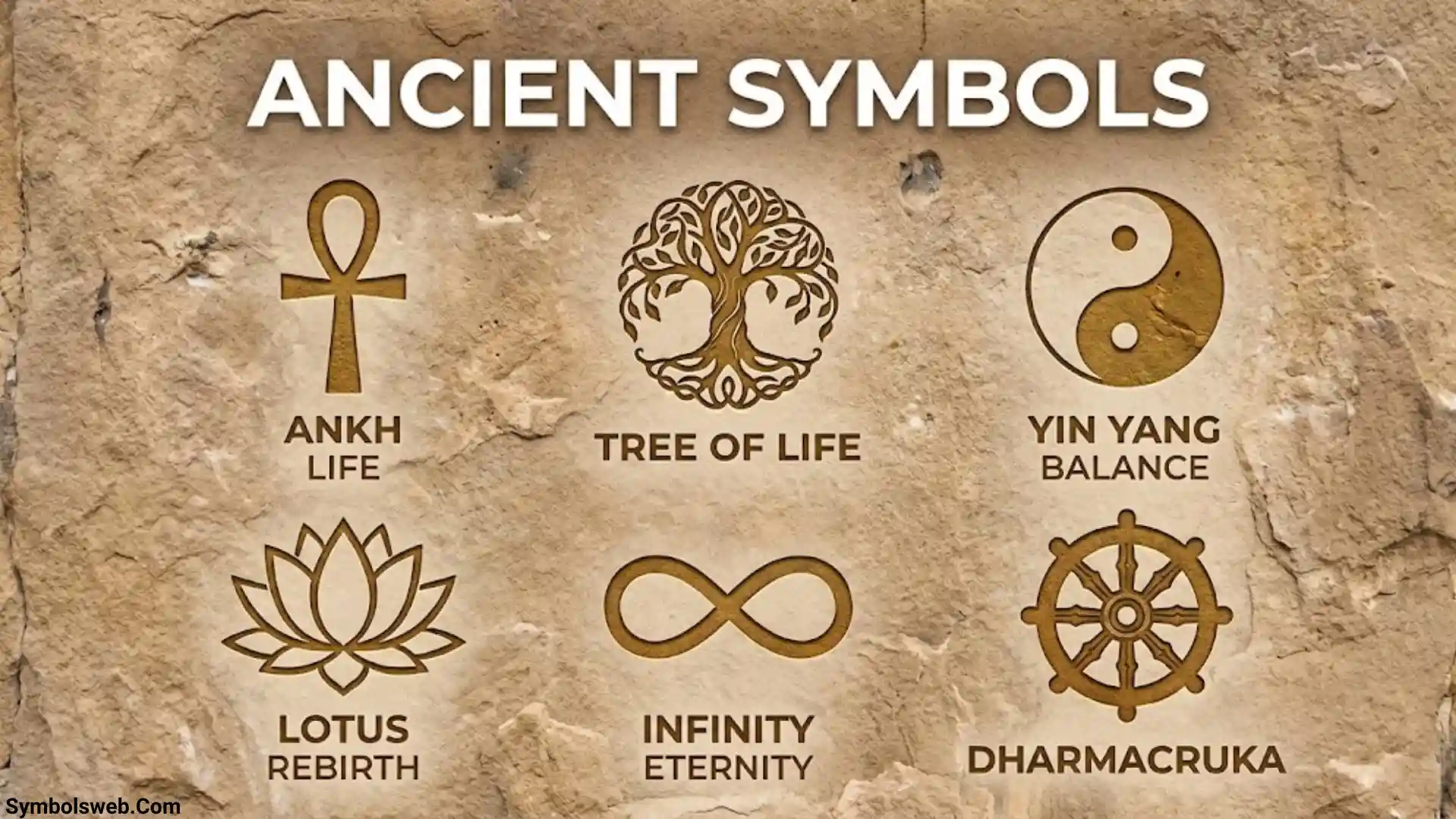
Ancient symbols tell stories about the people who created them. From prehistoric cave paintings to Egyptian hieroglyphs and Norse mythological emblems, these designs helped people express beliefs, record events, honor gods, and understand the world around them. Some symbols marked sacred places, while others represented life, death, protection, or authority.
When you explore ancient symbols and meanings, you’ll discover that the same shape can carry different messages across cultures. A circle might suggest unity or a repeating cycle, while a tree can represent life, growth, or the connection between different realms. However, a symbol’s meaning depends on its historical setting, the people who used it, and the evidence that survives.
This guide explores ancient symbols from around the world, including Celtic, Norse, Egyptian, Greek, Eastern, geometric, and early American traditions. You’ll learn what familiar symbols represent, where they originated, how historians interpret them, and why many remain popular today.
What Are Ancient Symbols and Their Meanings?
Ancient symbols are images, shapes, signs, and objects that people used to communicate ideas beyond their literal appearance. They could represent a deity, a political authority, a religious belief, a natural force, or an abstract concept such as balance or eternity.
Some symbols formed part of a writing system. Others appeared on pottery, coins, jewelry, temples, tombs, weapons, and monuments. Their purpose varied from one society to another.
For example, ancient Egyptians used the ankh to represent life, while Greek artists associated the owl with Athena, the goddess of wisdom. In prehistoric communities, people also created animal figures, hand stencils, geometric markings, and other forms of imagery whose precise meanings remain uncertain.
Why Did Ancient Civilizations Use Symbols?
Symbols helped people share ideas without relying entirely on spoken language. They also gave communities recognizable images for their gods, rulers, traditions, and shared values.
Common purposes included:
- Religious worship: Images and emblems represented deities, sacred forces, and ritual practices.
- Protection: Amulets and other objects carried symbols believed to guard against harm.
- Political authority: Kings, rulers, and states used emblems to communicate power and legitimacy.
- Communication: Pictographs and other signs conveyed information or recorded events.
- Cultural identity: Distinctive designs helped communities express shared traditions.
- Art and decoration: Geometric patterns and symbolic images decorated buildings, pottery, textiles, and personal objects.
- Memory and recordkeeping: Marks and signs helped people track quantities, ownership, or important events.
It’s worth remembering that not every ancient image had a religious or mystical meaning. Some designs served practical purposes, while others may have had several meanings at once.
Ancient Shapes and Prehistoric Symbols
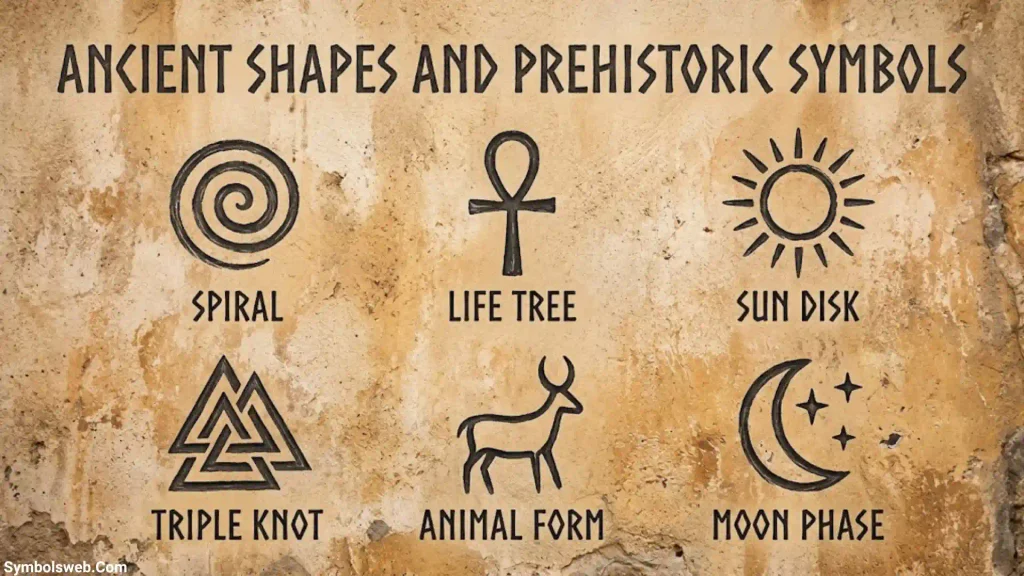
Long before the rise of cities and written records, people created visual marks on rock surfaces, cave walls, and portable objects. These prehistoric symbols provide clues about early human communication, artistic expression, and social life.
Archaeologists study these images through their locations, materials, dating evidence, and relationships to other archaeological finds. A mark’s appearance alone rarely proves what its creator intended.
Common Ancient Shapes and Their Possible Meanings
| Shape or mark | Possible meaning or use | Important context |
| Circle | Cycles, unity, or completeness | Meaning depends on the culture and object |
| Dots | Counting, decoration, or patterned marking | Not every group of dots represents a code |
| Spiral | Movement, growth, or recurring patterns | Specific symbolic meanings require evidence |
| Horizontal line | Boundaries, divisions, or decoration | Context determines its function |
| Vertical line | Division, alignment, or repeated marking | Often difficult to interpret alone |
| Cross | Intersection, direction, or later religious meaning | A cross shape does not automatically indicate Christianity |
| X symbol | Crossing lines, marking, or geometric decoration | Its meaning varies considerably |
| Triangle | Geometric structure or symbolic design | Religious interpretations differ across traditions |
| Square | Order, boundaries, or spatial organization | Symbolic associations are not universal |
| Rectangle | Framing, measurement, or decoration | Often appears in architectural and artistic designs |
| Five-pointed star | A geometric motif with varied historical uses | Its meaning changed across time and cultures |
These associations are starting points rather than universal definitions. A spiral engraved on a prehistoric stone should not automatically receive the same interpretation as a spiral in a later religious manuscript.
Petroglyphs, Pictographs, and Cave Paintings
Three important forms of early visual expression are petroglyphs, pictographs, and cave paintings.
- Petroglyphs: Images or marks made by carving, pecking, or scratching a rock surface.
- Pictographs: Images painted or drawn on rock or another surface.
- Cave paintings: Painted images on cave walls and ceilings, often featuring animals, people, and abstract signs.
The distinction matters because researchers examine how people made these images to understand their age, materials, and cultural context.
For example, the cave art at Lascaux in France includes detailed depictions of animals. The famous cave complex is generally associated with the Upper Paleolithic period, roughly 17,000 years ago. Such artwork shows sophisticated visual skills, although the exact purpose of individual images remains debated.
Did Prehistoric Symbols Have Fixed Meanings?
Not necessarily. Some signs may have represented recognizable objects or shared ideas, but many lack a confirmed interpretation.
Researchers consider several possibilities when studying ancient markings:
- A sign may have communicated an idea or recorded information.
- Repeated marks may have served a counting or tracking purpose.
- Images may have played a role in ceremonies or community activities.
- Patterns may have been decorative rather than symbolic.
- A design may have carried a meaning understood only by its original community.
The safest approach is to separate what researchers can observe from what they can reasonably infer.
Celtic Symbols and Meanings
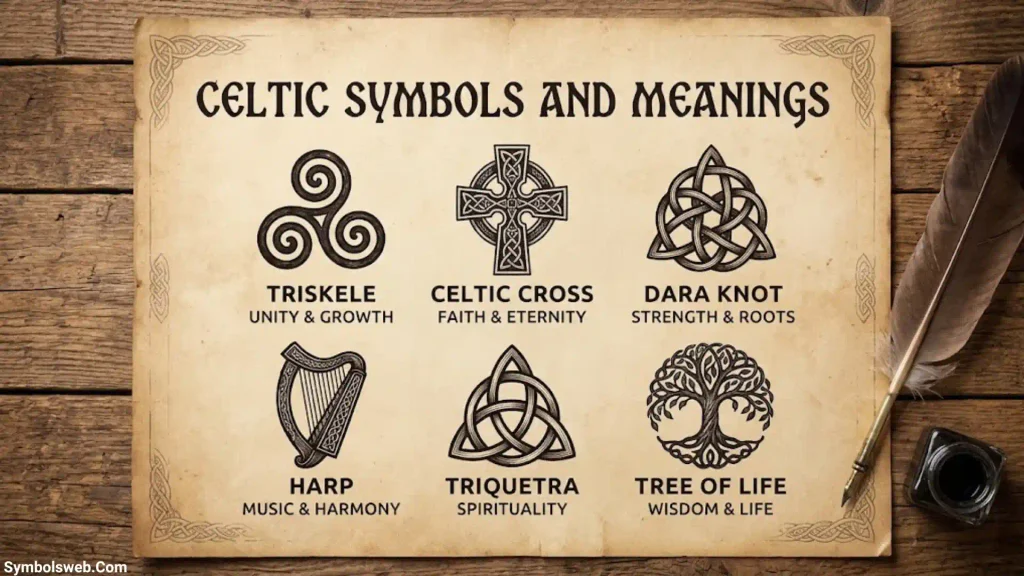
Celtic symbols are associated with Celtic speaking peoples and the artistic traditions that developed across parts of Europe. Their history spans different regions and periods, so no single design represents every Celtic community.
La Tène art, which flourished during the later Iron Age, featured elaborate curves, spirals, and interwoven patterns. Other familiar designs became prominent in later Celtic Christian art, particularly in Ireland and Britain.
Triskelion
The Triskelion consists of three connected or radiating spirals, arms, or curved forms. The design appears in ancient European art, including examples associated with the Neolithic monument at Newgrange in Ireland.
Modern interpretations connect the three-part pattern with movement, cycles, or interconnected forces. However, there is no single proven meaning for every ancient Triskelion.
Triquetra or Trinity Knot
The Triquetra is a three-cornered interlaced design. It appears in early medieval manuscripts and stonework, including Christian art.
Today, people often associate it with the Trinity, unity, or the interconnectedness of life. Those meanings depend on the setting. Not every historical example necessarily represented the same belief.
Celtic Tree of Life
The Tree of Life is a broad symbolic motif found in many cultures, not exclusively Celtic traditions. In modern Celtic-inspired art, a tree with spreading branches and roots often represents growth, continuity, and the relationship between people and nature.
Trees held practical and cultural importance in ancient societies because they provided shelter, fuel, food, and materials. However, specific claims about a universal ancient Celtic Tree of Life should be treated cautiously unless supported by historical evidence.
Shamrock and Three Leaf Clover
The shamrock is strongly associated with Ireland and Irish identity. Later Christian tradition links Saint Patrick with using a three-leaf plant to explain the Trinity.
Although the shamrock has become an important Irish emblem, claims about its exact role in ancient Celtic religion are less firmly established.
Common modern associations of Celtic symbols include:
- Interconnection and continuity
- Nature and the changing seasons
- Spiritual belief and religious devotion
- Cultural identity and heritage
- Unity and three-part patterns
These meanings can be useful when discussing modern Celtic symbolism, but historical interpretation requires attention to the period and source.
Norse Symbols and Meanings
Norse symbols come from the material culture, mythology, and religious traditions of Scandinavian peoples. Many became familiar through Viking Age artifacts, medieval Icelandic texts, and later interpretations of Norse mythology.
One important distinction separates symbols documented in the Viking Age from designs first recorded in much later manuscripts or modern spiritual traditions.
Valknut
The Valknut consists of three interlocking triangles. Similar motifs appear on some Viking Age objects and memorial stones.
Modern explanations often connect the Valknut with Odin, warriors, death, or the afterlife. Its precise historical meaning remains uncertain because surviving sources do not provide a clear, universal explanation of the design.
Yggdrasil: The Norse World Tree
Yggdrasil is the immense tree described in medieval Norse mythological literature. It connects different parts of the cosmos and appears in accounts of gods, humans, and other beings.
The world tree represents the structure of the mythological universe in these stories. Modern interpretations also emphasize interconnectedness, life cycles, and the relationship between different realms.
Mjölnir: Thor’s Hammer
Mjölnir, the hammer of Thor, is one of the best-known objects in Norse mythology. Thor uses it as a weapon against dangerous supernatural enemies.
Hammer-shaped pendants have been found at Viking Age archaeological sites. These objects are widely associated with Thor and are often interpreted as expressions of religious identity or devotion.
Today, Thor’s Hammer commonly represents strength, protection, courage, and Norse heritage. The specific meaning of an individual pendant, however, depends on its historical context.
Gungnir: Odin’s Spear
Gungnir is Odin’s spear in Norse mythology. Literary accounts associate it with the god’s authority and supernatural power.
Modern interpretations may connect the spear with wisdom, sacrifice, leadership, or victory. These are interpretive associations rather than a complete set of meanings established for every historical image of a spear.
Vegvísir and the Helm of Awe
Two designs often included in modern collections of Norse symbols require special historical care.
- Vegvísir: An Icelandic magical sign associated with guidance and finding one’s way. Its documented appearance comes from much later Icelandic magical manuscripts, not securely established Viking Age artifacts.
- Aegishjálmur, or Helm of Awe: A protective magical symbol documented in Icelandic magical traditions. Its familiar graphic forms belong to later sources and should not automatically be labeled Viking Age designs.
Both remain popular in contemporary jewelry, tattoos, and spiritual practices. Their modern popularity does not establish that Vikings widely used them.
Ancient Egyptian Symbols and Meanings
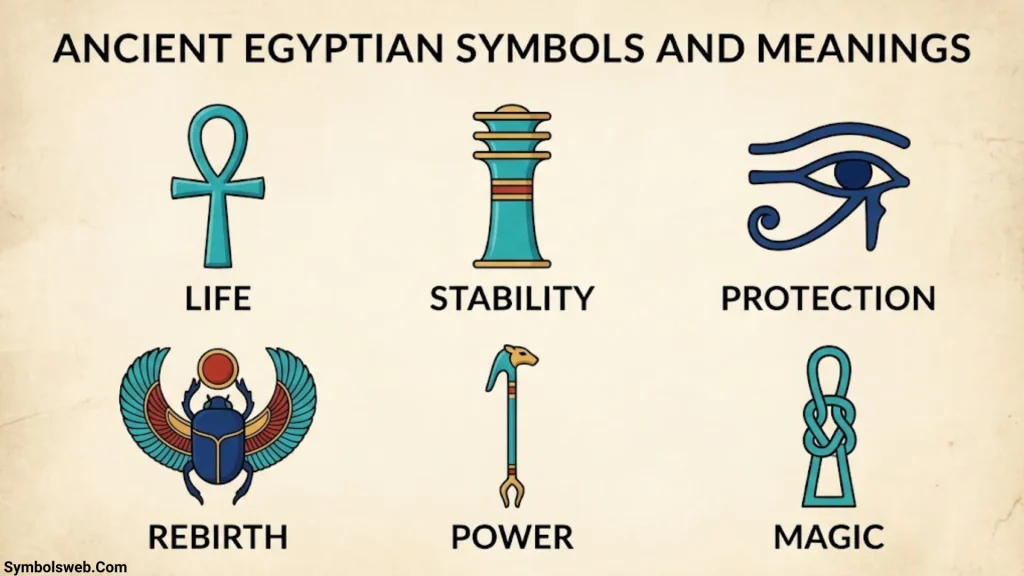
Ancient Egyptian art contains some of the world’s most recognizable symbolic designs. These images appeared in temples, tombs, jewelry, funerary objects, royal monuments, and hieroglyphic inscriptions.
Egyptian symbolism often connected religious beliefs with kingship, protection, fertility, and life after death. Understanding the symbols means looking at the gods, rituals, and objects associated with them.
Ankh: The Key of Life
The Ankh resembles a cross with a loop at the top. Egyptian art frequently shows gods holding an ankh near a ruler’s face, a gesture associated with granting or sustaining life.
The ankh is one of the clearest ancient examples of a symbol representing life and vitality. It also appears in funerary art, where life beyond death held an important place in Egyptian religious belief.
Today, people often use the ankh to represent eternal life, spiritual identity, or Egyptian heritage.
Eye of Horus or Wedjat
The Eye of Horus, also called the Wedjat, is associated with protection, healing, and restoration.
Egyptian mythology connects the eye with the conflict involving Horus and Seth. Later traditions emphasize its restoration, making it an important image of recovery and protection.
Egyptians placed eye-shaped amulets in burials and used them in other protective contexts. The symbol’s archaeological record provides stronger evidence for its historical role than modern interpretations based solely on its appearance.
Djed Pillar
The Djed pillar represents stability and is closely associated with Osiris. Egyptian imagery sometimes depicts the raising of the djed as a ritual connected with renewal and the restoration of order.
Its sturdy, column-like form reinforces its association with stability. The symbol also appears in funerary contexts, where continuity and renewed life were significant concerns.
Was Scepter
The Was scepter is a staff with a distinctive animal-shaped top and a forked base. Egyptian gods and rulers carry it in artistic representations.
The scepter signifies authority and power. It often appears alongside other royal and divine emblems, helping communicate a figure’s status.
Scarab Beetle and Khepri
The scarab beetle became a major symbol in Egyptian religion because of its connection with the god Khepri and the rising sun.
Egyptians associated the scarab with transformation, renewal, and the daily emergence of the sun. Scarab-shaped amulets and seals were widespread, making the design important in both religious and practical life.
Lotus Flower or Seshen
The Egyptian lotus flower, often called seshen, appears in art associated with beauty, creation, and renewal. Some Egyptian creation traditions connect emerging flowers with the appearance of the sun.
The lotus also appears in decorative designs on columns, objects, and tomb paintings. Its associations reflect both the natural environment of the Nile Valley and Egyptian religious ideas.
Bennu Bird and the Phoenix
The Bennu bird is an Egyptian mythological bird connected with solar and creation traditions. It is sometimes compared with the Greek phoenix, but the two should not be treated as identical in every historical detail.
The phoenix later became a widely recognized symbol of renewal and rebirth. Its modern associations with rising again after destruction draw on classical and later literary traditions.
Shen Ring and the Feather of Ma’at
The Shen ring is a loop of rope enclosing a space, associated with protection and eternity. Egyptian art sometimes shows it surrounding a royal name or appearing in divine imagery.
The feather of Ma’at represents the principles associated with Ma’at, including truth, justice, and proper order. In funerary belief, the weighing of the heart against Ma’at’s feather helped express the moral dimensions of the afterlife.
| Egyptian symbol | Main historical association |
| Ankh | Life and vitality |
| Eye of Horus | Protection and restoration |
| Djed pillar | Stability and Osiris |
| Was scepter | Authority and power |
| Scarab | Khepri, renewal, and solar movement |
| Lotus flower | Creation and renewal |
| Bennu bird | Solar and creation traditions |
| Shen ring | Protection and eternity |
| Feather of Ma’at | Truth, justice, and moral order |
Ancient Greek Symbols and Their Meanings
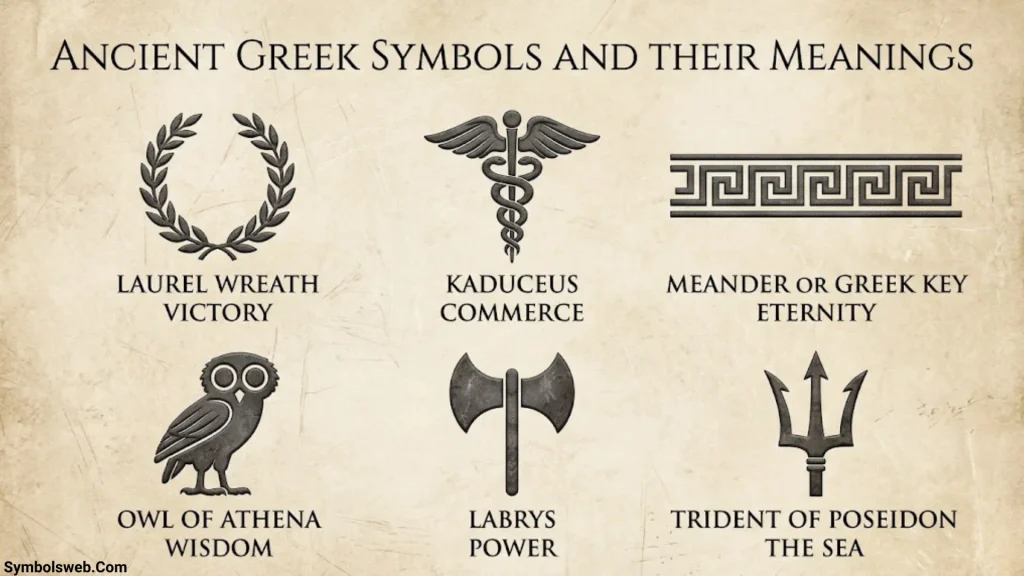
Ancient Greek symbols appeared on coins, pottery, sculptures, temples, and religious objects. Many were connected with specific gods and goddesses, making them recognizable signs of divine power, civic identity, and cultural values.
Greek mythology provides important context for interpreting these symbols. However, some familiar associations developed or changed during later Roman and modern periods.
Thunderbolt of Zeus
The thunderbolt is one of the main attributes of Zeus, the king of the Greek gods. Mythological stories describe Zeus wielding thunder and lightning as weapons of divine power.
Artists often depicted the thunderbolt as a stylized bundle of lightning. It communicated Zeus’s authority over the sky and his ability to enforce order among gods and mortals.
Modern interpretations associate it with strength, leadership, and decisive action. Historically, its strongest connection is with Zeus and his divine authority.
Laurel Wreath
The laurel wreath consisted of leaves from the laurel plant. Ancient Greeks associated laurel with Apollo, a god connected with prophecy, music, and other important aspects of Greek religion.
Laurel wreaths also became awards for achievement. At the ancient Pythian Games held at Delphi, victors received laurel wreaths.
The design later appeared in Roman art and became a familiar emblem of victory, honor, and distinction. Today, it remains associated with academic achievement, artistic excellence, and success.
Caduceus and Rod of Asclepius
These two symbols often appear together in modern discussions, but their historical meanings differ.
The caduceus is the staff associated with Hermes, the Greek messenger god. It typically features two intertwined snakes and wings. Hermes’s roles included communication, travel, trade, and negotiation.
The Rod of Asclepius features a single snake winding around a staff. Asclepius was the Greek god associated with healing and medicine. This emblem has a much more direct historical connection with medical care.
The distinction matters today. Medical organizations sometimes use the caduceus by mistake or by established institutional convention, but the Rod of Asclepius is the more historically appropriate medical symbol.
Gorgoneion and Medusa
A Gorgoneion is an image of a Gorgon, especially Medusa. Ancient Greek artists placed these faces on shields, armor, buildings, pottery, and other objects.
The image could serve an apotropaic purpose, meaning it was intended to ward off evil or danger. Medusa’s frightening appearance made her an effective protective emblem.
Although modern stories often emphasize Medusa’s tragedy, ancient images could give her face a protective role rather than presenting it only as something terrifying.
Owl of Athena
The owl of Athena represents the goddess associated with wisdom, strategic warfare, and civic protection. Owls also appeared on Athenian coins, especially the famous silver tetradrachms.
These coins circulated widely and connected the owl with Athens’s political identity and economic activity. The owl’s association with wisdom remains strong today.
Cornucopia or Horn of Plenty
The cornucopia is a horn-shaped container filled with fruits, grains, flowers, or other goods. In Greek and Roman traditions, it represented abundance and prosperity.
Artists used it to communicate agricultural wealth, fertility, and the generosity of gods or personifications associated with good fortune. Today, the cornucopia remains a familiar image during harvest celebrations, particularly Thanksgiving in the United States.
Labrys and the Heart Symbol
The labrys, or double-headed axe, appears in ancient Aegean contexts, particularly Minoan Crete. Archaeologists have found double-axe imagery in religious and ceremonial settings.
Its exact significance varied by context and remains debated. It should not be assigned one universal meaning across every Minoan object.
The modern heart shape also requires historical care. Although ancient art included heart-like forms and imagery connected with love, the familiar stylized heart used on greeting cards and romantic gifts developed through a long artistic history. It was not a single, universally recognized ancient Greek emblem for romantic love.
Ancient Eastern Symbols and Their Meanings
Eastern symbolism covers many distinct cultures and religions, including Chinese philosophy, Japanese Shinto traditions, Persian religious history, Jewish culture, and Islamic traditions. These systems should not be treated as one shared belief system.
Their symbols often express ideas about balance, sacred spaces, protection, moral responsibility, or spiritual life.
Yin and Yang
The Yin and Yang symbol, known as the taijitu in Chinese, shows two interlocking regions, usually black and white, each containing a small circle of the opposite color.
In Chinese philosophy, yin and yang describe complementary aspects of change and relationships. Depending on the context, they can be associated with darkness and light, rest and activity, or other contrasting qualities.
The central idea isn’t simply that good fights evil. Instead, the symbol suggests that contrasting forces relate to one another and participate in larger patterns of change.
Its familiar circular design is associated with the development of Chinese cosmological and philosophical traditions, particularly in later forms of Daoist thought. It should not be assumed that every ancient Chinese community used the exact modern design.
Faravahar
The Faravahar is a winged figure associated with ancient Persian and modern Iranian cultural identity. It is particularly familiar through monumental reliefs at Persepolis and later Iranian heritage.
The symbol is widely associated with Zoroastrianism today. Modern interpretations often emphasize ethical living, good thoughts, good words, and good deeds.
However, scholars debate the exact meaning of the ancient winged figure and its relationship to the later Faravahar emblem. It is more accurate to distinguish its historical artistic context from modern religious explanations.
Torii Gate
A Torii gate marks the entrance to, or boundary of, a sacred area associated with Japanese Shinto practice. Torii gates are commonly found at Shinto shrines and along approaches to sacred places.
Passing through a torii can mark a transition from ordinary surroundings into a space associated with kami, the sacred beings or presences of Shinto belief.
The torii is therefore more than a decorative arch. Its location and ritual context help explain its meaning.
Hamsa or Hand of Fatima
The Hamsa, also known as the Hand of Fatima in many Islamic contexts, is a hand-shaped emblem used in protective traditions across parts of the Middle East and North Africa.
Related forms also appear in Jewish cultural contexts, where the hand may be called the Hand of Miriam. Its associations include protection against the Evil Eye, a belief that harmful envy or a hostile gaze can bring misfortune.
The symbol has a long, complex history across different communities. Its use cannot be reduced to a single religion or one universally accepted interpretation.
Evil Eye
The Evil Eye refers to a belief that envy or a harmful gaze can cause misfortune. Protective eye-shaped amulets appear across Mediterranean, West Asian, and neighboring cultural traditions.
Although the appearance of an eye is simple, its cultural role is significant. People have used eye motifs in jewelry, household objects, and other protective items.
An important distinction: the eye symbol does not mean the same thing everywhere. In Egyptian religion, the Eye of Horus has its own mythology and associations. It should not automatically be equated with every later Evil Eye tradition.
Five Pillars of Islam and Five Books of the Torah
These concepts belong to different religious traditions and aren’t interchangeable ancient symbols.
- The Five Pillars of Islam are the core acts of worship and practice in Islam. They are a set of religious duties rather than one ancient graphic emblem.
- The Five Books of the Torah are Genesis, Exodus, Leviticus, Numbers, and Deuteronomy. They form the opening section of the Hebrew Bible and are central to Jewish religious tradition.
Including these distinctions helps explain how religious ideas can be symbolically important even when they aren’t represented by one particular image.
Ancient Geometric Symbols and Sacred Geometry
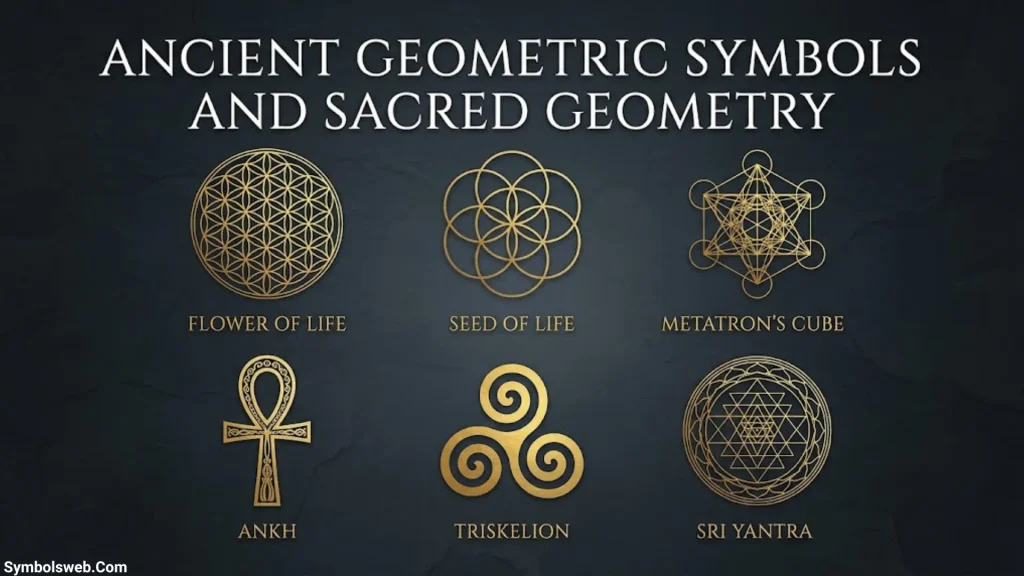
Ancient geometric symbols use basic shapes, repeating patterns, or mathematical relationships to create designs. Some had documented religious or philosophical significance, while others served decorative, architectural, or practical purposes.
The modern term sacred geometry groups together geometric forms that people interpret as having spiritual, philosophical, or cosmic significance. However, not every pattern now labeled sacred geometry had the same role in ancient times.
Flower of Life
The Flower of Life is a pattern formed by overlapping circles arranged in a symmetrical design. It appears in modern discussions of sacred geometry and is often linked with unity, creation, and interconnectedness.
A geometric pattern’s age depends on the specific artifact where it appears. Ancient examples of overlapping-circle designs exist, but the popular modern Flower of Life interpretation should not automatically be projected onto every historical pattern.
Vesica Piscis
The Vesica Piscis is the lens-shaped area created when two equal circles overlap, with each circle’s center lying on the other’s circumference.
The shape appears in geometric construction, art, and later religious imagery. In Christian art and medieval architecture, the form became associated with certain framing devices and symbolic compositions.
Modern spiritual interpretations often connect it with creation, duality, or the meeting of two realms. These interpretations should be distinguished from its mathematical definition and its documented use in particular historical works.
Tetractys
The Tetractys is a triangular arrangement of ten points, organized into four rows of one, two, three, and four dots.
It was important in Pythagorean tradition, where numbers and mathematical relationships carried philosophical and religious significance. The arrangement also illustrates how small numerical patterns can produce a balanced geometric structure.
The Tetractys has a stronger documented connection with ancient Greek philosophical tradition than many patterns that receive modern sacred-geometry labels.
Golden Ratio and Phi
The Golden Ratio, represented by the Greek letter phi (Φ), is a mathematical ratio approximately equal to 1.618.
It occurs when a line is divided so that the ratio of the whole length to the longer part equals the ratio of the longer part to the shorter part.
The ratio has fascinated mathematicians, artists, and designers for centuries. However, popular claims that the ancient Greeks used it in every major monument or that it guarantees beauty are often exaggerated.
A careful discussion separates three things:
- The mathematical definition of the ratio.
- Documented uses of proportions in historical architecture and art.
- Modern claims about hidden ratios or universal aesthetic rules.
The Golden Ratio is mathematically real. Whether a particular ancient structure deliberately used it requires measurements and historical evidence, not visual guesswork.
Ancient Roman Symbols and Their Meanings
Ancient Roman symbols communicated political authority, military achievement, civic identity, and religious beliefs. Roman artists also adapted Greek gods, myths, and artistic traditions, creating a rich visual language of their own.
Fasces
The fasces consisted of a bundle of rods, sometimes accompanied by an axe. Roman officials called lictors carried fasces as signs of their authority.
The rods represented the power to enforce discipline, while the axe could signify the authority to impose severe punishment. The exact form and meaning depended on the official and setting.
Later governments adopted the fasces as an emblem of authority and unity. Its modern political associations make historical context particularly important when interpreting it.
Olive Branch
The olive branch has a long history in Mediterranean cultures, where olive trees provided food, oil, and other useful products.
In Greek and Roman traditions, olive branches could appear in contexts associated with peace, victory, or divine favor. Today, the branch is widely recognized as a symbol of peace and diplomacy.
Laurel Wreath
Romans adopted the laurel wreath as a sign of honor and achievement. It appeared in representations of emperors, military victories, and public distinction.
Although the wreath also had Greek associations, Roman usage gave it a prominent role in imperial imagery.
American Symbols and Their Historical Meanings
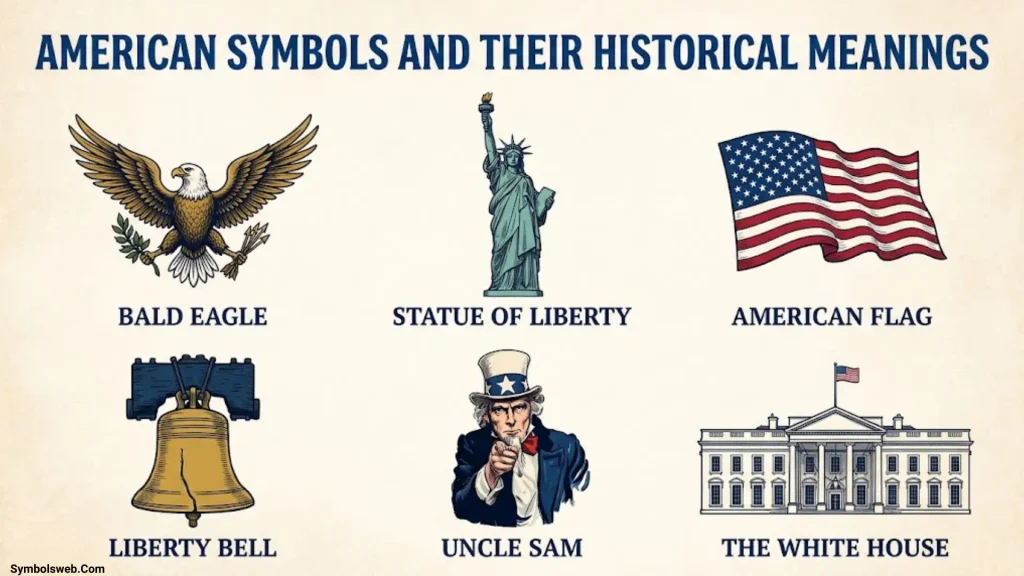
Several symbols associated with the United States draw on ancient Roman imagery or classical traditions. Their modern meanings developed through political debates, the American Revolution, and the creation of national institutions.
These are not all ancient American symbols. Instead, they show how later societies adapted older visual traditions.
Bald Eagle and Great Seal of the United States
The bald eagle appears on the Great Seal of the United States, adopted in 1782. The seal’s eagle holds an olive branch in one talon and a bundle of arrows in the other.
The design communicates several national ideals:
- Olive branch: Peace.
- Arrows: Readiness to defend the country.
- Shield: Unity among the states.
- Eagle: National identity and sovereignty.
The eagle is a national emblem, not an ancient Roman symbol itself. However, the classical tradition of using powerful animals and formal emblems influenced political art in many later societies.
Liberty Cap
The Liberty Cap, also called a Phrygian cap in many historical contexts, draws on older imagery associated with freedom and emancipation.
In ancient Rome, the pileus was associated with the status of a freed person. During the American and French Revolutions, liberty-cap imagery became a recognizable emblem of freedom and resistance to oppression.
Its history illustrates how a symbol can acquire new political meanings as societies change.
Liberty Figure
Personifications of Liberty appeared in classical and early modern art. Artists represented abstract ideas such as freedom and justice through human figures carrying recognizable attributes.
In American civic art, these figures expressed national ideals rather than one specific ancient religious belief. Their visual language reflects the long classical tradition of representing abstract concepts as people.
Powerful Ancient Symbols of Protection, Wisdom, and Strength
Many ancient symbols remain popular because they communicate recognizable ideas. However, their historical meanings differ from modern spiritual interpretations.
The following table summarizes several widely discussed examples.
| Symbol | Historical or cultural association | Common modern interpretation |
| Ankh | Egyptian life and vitality | Eternal life and spiritual identity |
| Eye of Horus | Egyptian protection and restoration | Healing and protection |
| Hamsa | Protective traditions across several cultures | Warding off harm and envy |
| Mjölnir | Thor and Norse religious tradition | Strength and cultural heritage |
| Laurel wreath | Greek and Roman victory and honor | Achievement and excellence |
| Owl of Athena | Athena and Athenian imagery | Wisdom and knowledge |
| Tree of Life | A motif found across many traditions | Growth and interconnectedness |
| Yin and Yang | Chinese philosophical thought | Balance and complementary forces |
| Triskelion | Ancient European artistic motif | Movement and cycles |
| Ouroboros | Serpent or dragon consuming its own tail in ancient imagery | Cycles, continuity, and renewal |
| Phoenix | Classical and later literary traditions | Rebirth and resilience |
| Pentagram | A five-pointed star used in several historical traditions | Protection or spiritual meaning, depending on context |
These interpretations aren’t all equally well documented. The ankh’s association with Egyptian life, for example, is supported by its use as a hieroglyph. A modern interpretation of a geometric shape as a universal sign of spiritual energy may have much weaker historical evidence.
Ouroboros: The Serpent That Eats Its Tail
The Ouroboros depicts a serpent or dragon biting or swallowing its own tail to form a circle. Ancient Egyptian and Greek sources contain examples of related imagery, and the motif later became important in alchemy and other symbolic traditions.
Its circular form lends itself to interpretations involving recurring cycles, continuity, and the relationship between beginnings and endings.
The Ouroboros is a useful example of how a symbol can acquire layers of meaning over centuries without retaining one fixed definition.
Pentagram: The Five-Pointed Star
The pentagram is a five-pointed star drawn using five connected lines. It appeared in ancient Greek contexts and was associated with mathematical and philosophical ideas in Pythagorean tradition.
Its meaning changed across historical periods and religious communities. Some traditions used it in protective contexts, while later European religious and occult systems developed their own interpretations.
A pentagram is not automatically a satanic symbol. Its meaning depends on its orientation, accompanying imagery, and cultural setting.
Tree of Life
The Tree of Life appears in numerous religious, mythological, and artistic traditions. Its forms and meanings vary, so it is better understood as a recurring symbolic motif than a single symbol with one origin.
Depending on the culture, a tree may represent creation, fertility, ancestry, divine order, or the connection between different parts of the cosmos.
The Norse world tree Yggdrasil is one specific example. It belongs to Norse mythology and shouldn’t be treated as identical to every other historical Tree of Life design.
Ancient Symbols of Life, Death, and Rebirth
Life, death, and renewal were important themes in many ancient societies. Agricultural cycles, seasonal changes, family continuity, and beliefs about the afterlife all influenced how communities represented these ideas.
Some symbols have direct historical connections with these themes. Others receive similar interpretations today because their shapes suggest continuity or transformation.
| Symbol | Historical connection | Related theme |
| Ankh | Egyptian hieroglyph meaning life | Life and vitality |
| Djed pillar | Egyptian stability symbol associated with Osiris | Stability and renewal |
| Scarab | Egyptian symbolism associated with Khepri and the sun | Transformation and renewal |
| Bennu bird | Egyptian solar and creation traditions | Renewal |
| Ouroboros | Ancient and later serpent imagery | Cycles and continuity |
| Yggdrasil | Norse mythological world tree | Cosmic structure and interconnected realms |
| Lotus flower | Religious and artistic imagery in several Asian and Egyptian traditions | Varies by tradition |
| Phoenix | Classical and later literary symbolism | Rebirth and renewal |
One important distinction: the same theme can appear in different cultures without proving that they shared a single origin or belief. Researchers examine each symbol within its own historical setting.
How Ancient Symbols Were Used in Everyday Life
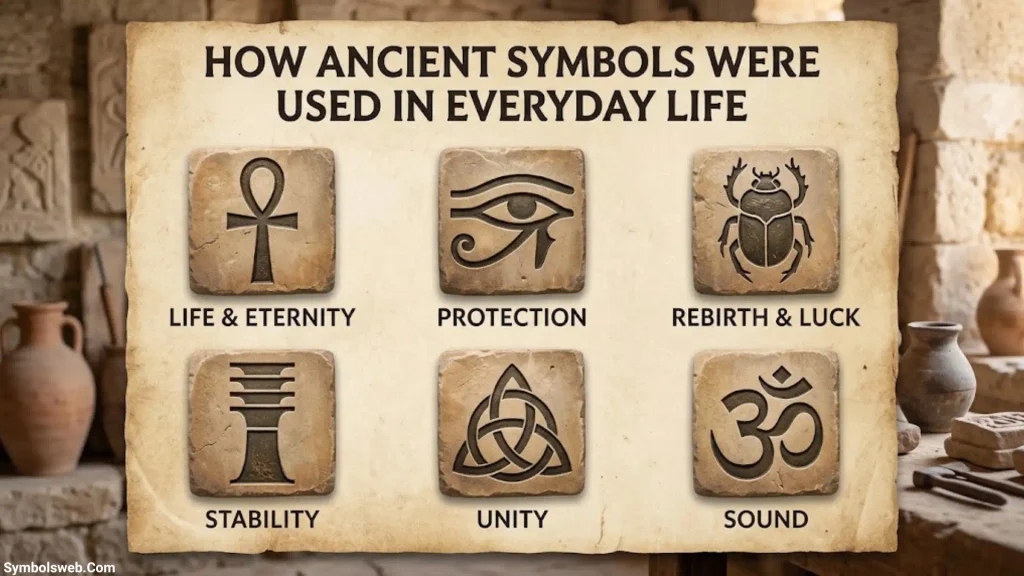
Ancient symbols weren’t confined to temples or religious ceremonies. People encountered them on everyday objects, personal possessions, public buildings, and official records.
Their uses depended on the society and the symbol itself.
Jewelry and Protective Amulets
Small objects allowed people to carry meaningful imagery with them. Egyptian scarabs and eye-shaped amulets, for example, appeared in personal and funerary contexts.
Such objects could express religious devotion, social status, identity, or a desire for protection. Their presence in a burial doesn’t automatically reveal the deceased person’s personal beliefs, but it provides evidence about the object’s cultural role.
Architecture and Public Monuments
Symbols on temples, tombs, and monuments helped communicate authority and religious ideas.
Egyptian temples incorporated hieroglyphs and images of gods. Greek buildings used sculpted figures and decorative motifs. Roman monuments displayed political and military imagery.
Because these structures often served public purposes, their imagery could reinforce shared cultural values.
Coins, Seals, and Official Records
Coins and seals connected symbols with political authority and economic life. A familiar image could help identify a city, ruler, institution, or issuing authority.
Athenian coins featuring the owl of Athena are a strong example. The image linked the coin with Athens while also reflecting the city’s religious and civic identity.
Art, Textiles, and Ceremonial Objects
Patterns and symbols also appeared on pottery, fabrics, tools, weapons, and ceremonial objects.
Researchers study their placement, materials, and repeated designs to distinguish decorative conventions from more specific symbolic uses. A motif appearing on several objects may suggest a shared tradition, but repetition alone doesn’t prove a universal meaning.
How to Interpret Ancient Symbols Accurately
Ancient symbols can be fascinating, but online explanations sometimes present uncertain interpretations as established facts. A more reliable approach starts with the evidence.
Use these principles when researching ancient symbols and their origins:
- Identify the culture: Determine which society produced the symbol and where the object was found.
- Check the date: A design documented in medieval Iceland shouldn’t automatically be described as a Viking Age symbol.
- Examine the original object: Archaeological context can reveal how a symbol was used.
- Consult historical sources: Inscriptions, manuscripts, and contemporary descriptions can clarify meaning.
- Separate fact from interpretation: A documented religious association is different from a modern spiritual belief.
- Watch for changing meanings: Symbols can gain new meanings as they move between cultures and historical periods.
For further research, begin with reputable collections and reference works:
- World History Encyclopedia — historical overviews of ancient cultures and symbolism.
- The Global Egyptian Museum — Egyptian artifacts, terms, and iconography.
- The Metropolitan Museum of Art — collection records and educational resources on ancient art.
- The British Museum — archaeological objects and cultural history.
These resources help place symbols within documented historical settings rather than relying only on modern lists of symbolic meanings.
Ancient Symbols and Their Modern Meanings
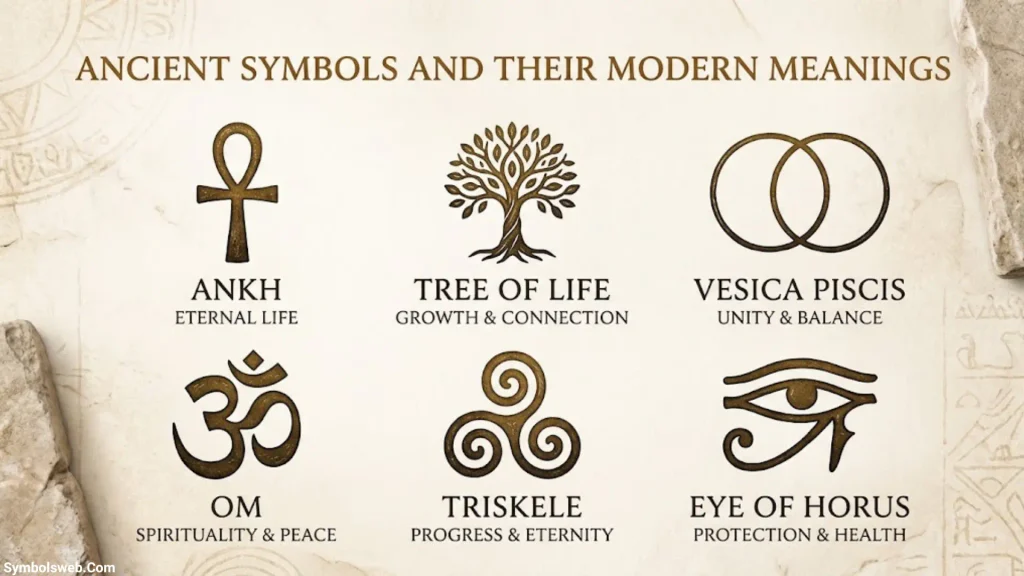
Ancient symbols remain visible in jewelry, tattoos, architecture, literature, games, and popular culture. Their continued use reflects both their visual appeal and their ability to communicate ideas quickly.
However, modern meanings may differ from ancient ones.
For example, a person might choose an ankh tattoo to represent personal renewal or spiritual identity. Historically, the ankh was an Egyptian hieroglyph associated with life. Both interpretations can be discussed, but they should not be confused.
The same principle applies to Norse imagery. Modern users may wear Mjölnir to express an interest in Norse mythology or Scandinavian heritage, while the hammer’s historical context connects it with Thor and religious practices.
When you use an ancient symbol, consider three questions:
- What did the symbol mean in its original cultural setting?
- How have its meanings changed over time?
- What does it communicate in the context where you’re using it today?
These questions encourage informed appreciation without assuming that every modern interpretation reflects an ancient belief.
Frequently Asked Questions About Ancient Symbols and Meanings
What is the oldest known ancient symbol?
There isn’t one universally accepted oldest symbol. Prehistoric markings, engraved objects, and geometric signs appear in very early archaeological contexts, but researchers often disagree about whether a particular mark was symbolic, decorative, or practical.
The age of an artifact also doesn’t automatically establish the meaning of the marks on it.
What are the most recognizable ancient symbols?
Some widely recognized examples include the Egyptian ankh, Eye of Horus, scarab, Greek owl of Athena, Norse Mjölnir, yin and yang, and the Tree of Life.
Their popularity today reflects a combination of historical importance, artistic appeal, and modern cultural use.
Which ancient symbols represent protection?
The Eye of Horus has a well-documented association with protection in ancient Egyptian culture. Hamsa amulets also have a long history in protective traditions across several communities.
Thor’s Hammer is associated with Thor and Norse religious tradition, while later magical traditions use other designs for protection. The meaning of each symbol depends on its cultural and historical context.
What ancient symbols represent life and rebirth?
The Egyptian ankh represents life, while the scarab is connected with Khepri and solar renewal. The Bennu bird belongs to Egyptian creation and solar traditions, while the phoenix became a prominent symbol of renewal in classical and later literature.
These symbols share related themes, but their original stories and religious roles differ.
Are ancient symbols still used today?
Yes. Ancient and historically inspired symbols appear in art, jewelry, tattoos, architecture, books, films, and games.
Some retain associations with their original cultures, while others acquire new meanings. Checking a symbol’s history helps you understand both its historical significance and its modern use.
Conclusion: Understanding Ancient Symbols and Their Meanings
Ancient symbols and meanings offer a window into how different societies understood life, nature, religion, authority, and the world around them. From Egyptian hieroglyphs and Greek emblems to Norse mythological imagery and prehistoric rock art, these designs preserve clues about human creativity and cultural history.
The most useful way to study them is to look beyond a simple list of meanings. Consider who created the symbol, when it appeared, how people used it, and what evidence supports its interpretation. That approach helps you distinguish documented history from later traditions and modern spiritual beliefs.
Ancient symbols still inspire people because they connect visual forms with ideas that matter across generations. When you understand their origins and changing meanings, you can appreciate not only their beauty but also the cultures and histories that gave them significance.

Jordan Hayes is a writer with a passion for exploring the history, meanings, and cultural significance behind symbols from around the world. He enjoys turning complex topics into clear, engaging content that anyone can understand. Jordan is also the fictional author of The Silent Language of Ancient Marks and Hidden Symbols Beyond the Surface, two original book concepts created for his author profile. When he’s not writing, he spends time researching myths, traditions, and forgotten stories that inspire his work. His goal is to help readers discover the deeper meanings behind the symbols they encounter every day.
 Ethan Holloway
 Eliana Foster