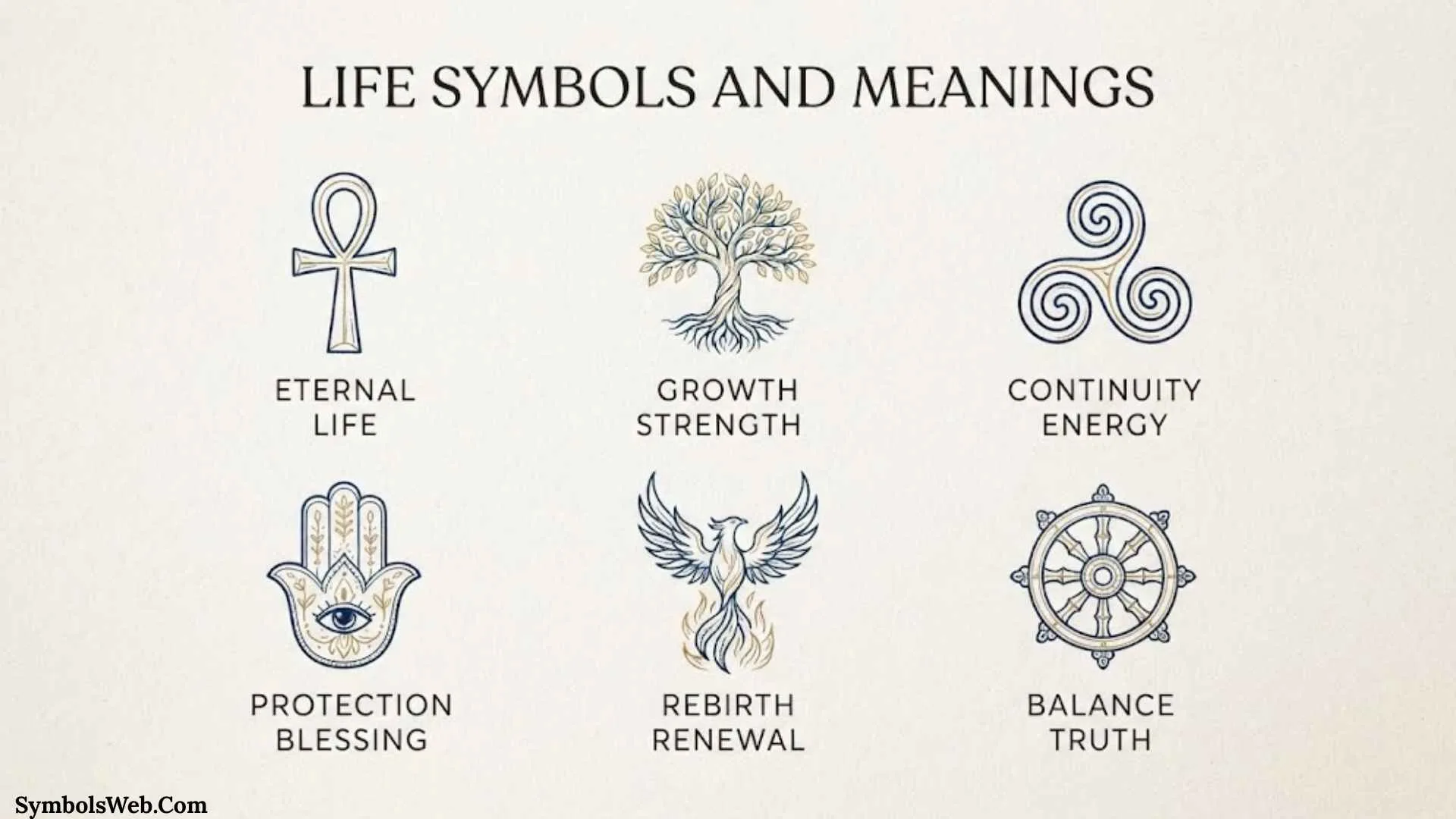
Have you ever noticed a symbol and wondered what it really means? Life symbols and meanings can help you understand the deeper ideas, emotions, and messages connected to everyday symbols. From flowers and animals to circles, trees, and ancient signs, symbols have been used for centuries to express things that words sometimes cannot.
In this guide, I’ll explore some of the most interesting life symbols and meanings and explain what they represent in a simple and easy to understand way. You’ll discover how different cultures use symbols to represent life, growth, love, strength, hope, transformation, and new beginnings. I’ll also share practical examples so you can recognize these meanings in art, jewelry, tattoos, nature, and everyday life.
If you’re researching symbolism for personal inspiration, choosing a meaningful design, or simply curious about the hidden meanings behind common symbols, you’re in the right place. As you read, you’ll learn how to look beyond the shape of a symbol and understand the story and meaning behind it.
Life Symbols and Meanings: (Quick Answer)
Life symbols are visual representations that express the essence of existence, growth, renewal, connection, purpose, and transformation. Across cultures and history, symbols such as the Tree of Life, spiral, lotus flower, and circle have been used to communicate profound spiritual, psychological, and cultural truths about the human experience.
Quick Facts About Life Symbols and Meanings
| Aspect | Information |
| Origin | Found in ancient civilizations worldwide |
| Historical Significance | Used in religion, mythology, philosophy, and art |
| Main Meaning | Life, growth, transformation, and continuity |
| Spiritual Meaning | Connection between body, mind, soul, and universe |
| Cultural Importance | Represents identity, beliefs, and shared traditions |
| Modern Usage | Tattoos, jewelry, logos, home décor, and spirituality |
What Are Life Symbols and Meanings?
Life symbols are visual signs that represent important truths about existence. They help people express ideas that are often difficult to explain through words alone. Concepts such as birth, growth, death, rebirth, wisdom, hope, and connection have been represented through symbols for thousands of years.
Long before written language became widespread, humans communicated through symbolic images. Ancient cave paintings, sacred carvings, and religious icons often carried messages about life’s mysteries.
Over time, these symbols evolved and spread across cultures. Some remained connected to specific traditions, while others became nearly universal. Today, life symbols continue to appear in art, religion, psychology, literature, and everyday life.
Their enduring popularity comes from their ability to speak directly to the human imagination and emotions.
Deep Symbolic Meaning of Life Symbols and Meanings
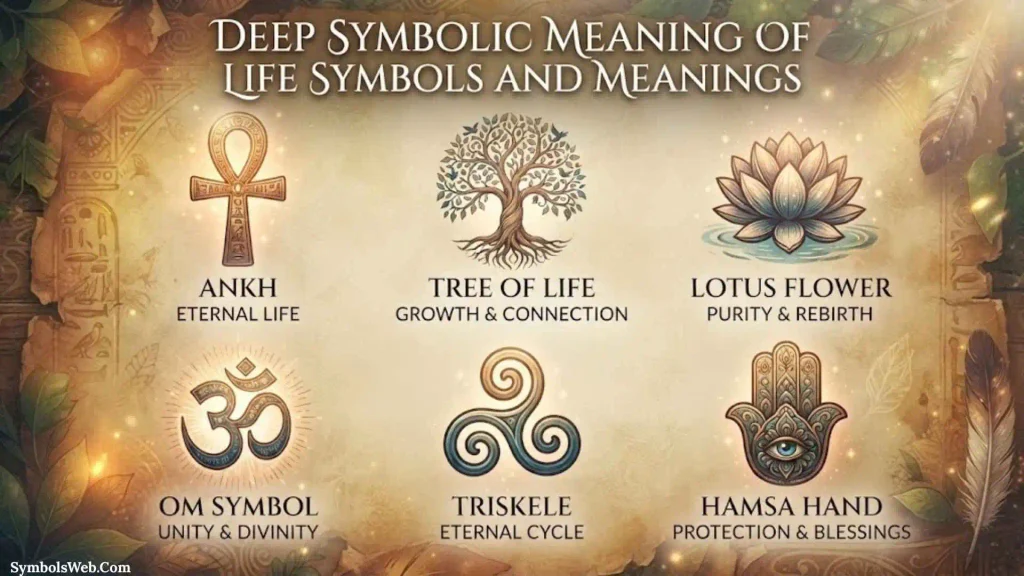
Spiritual Level
At a spiritual level, life symbols often represent the journey of the soul.
Many traditions view life as a cycle rather than a straight line. Symbols such as circles, spirals, and trees illustrate growth, transformation, and eternal connection.
Spiritual seekers often use these symbols during meditation and reflection because they remind them that life is interconnected and constantly evolving.
Common spiritual themes include:
- Renewal
- Unity
- Divine connection
- Personal transformation
- Eternal existence
Psychological Level
Psychologist Carl Jung believed that certain symbols emerge naturally from the collective unconscious.
Life symbols often activate deep emotional responses because they connect to universal human experiences.
For example:
- Trees symbolize personal growth.
- Spirals represent development and change.
- Water symbolizes emotional depth.
- Circles represent wholeness.
These symbolic patterns appear repeatedly in dreams, stories, and art because they reflect shared psychological experiences.
Cultural Level
Different societies have developed their own interpretations of life symbols.
Although meanings vary, many cultures associate life symbols with:
- Family
- Community
- Prosperity
- Fertility
- Wisdom
- Continuity
A simple image can carry generations of cultural memory and collective identity.
Types and Variations of Life Symbols
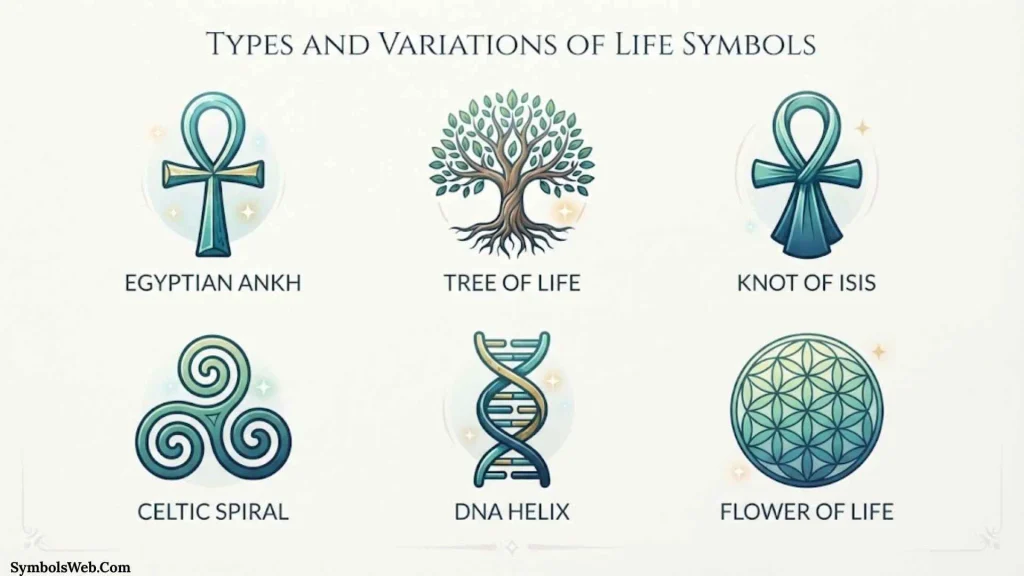
Tree of Life
Visual Description: A large tree with roots and branches spreading outward.
Meaning: Growth, strength, connection, and wisdom.
Symbolism: The roots connect to the earth while the branches reach toward heaven.
Cultural Connection: Found in Norse mythology, Celtic traditions, Christianity, and many indigenous cultures.
Where It Appears:
- Religious art
- Jewelry
- Mythology
- Tattoos
- Spiritual teachings
Spiral
Visual Description: A line winding inward or outward.
Meaning: Evolution, personal growth, and life’s journey.
Symbolism: Continuous movement and transformation.
Cultural Connection: Ancient Celtic, Native American, and prehistoric cultures.
Where It Appears:
- Rock carvings
- Sacred sites
- Art
- Meditation symbols
Lotus Flower
Visual Description: A flower emerging from muddy water.
Meaning: Purity, enlightenment, and resilience.
Symbolism: Rising above challenges.
Cultural Connection: Hinduism and Buddhism.
Where It Appears:
- Temples
- Religious artwork
- Yoga practices
- Jewelry
Circle
Visual Description: A perfect unbroken shape.
Meaning: Unity, eternity, and wholeness.
Symbolism: No beginning and no end.
Cultural Connection: Universal across civilizations.
Where It Appears:
- Sacred geometry
- Religious rituals
- Wedding rings
- Mandalas
Butterfly
Visual Description: Winged insect emerging from a cocoon.
Meaning: Transformation and rebirth.
Symbolism: Personal growth and change.
Cultural Connection: Found in cultures around the world.
Where It Appears:
- Literature
- Dreams
- Tattoos
- Art
Phoenix
Visual Description: Mythical bird rising from ashes.
Meaning: Renewal and resurrection.
Symbolism: Strength after adversity.
Cultural Connection: Ancient Egypt, Greece, and later Western traditions.
Where It Appears:
- Mythology
- Literature
- Films
- Inspirational artwork
Life Symbols Across Different Cultures
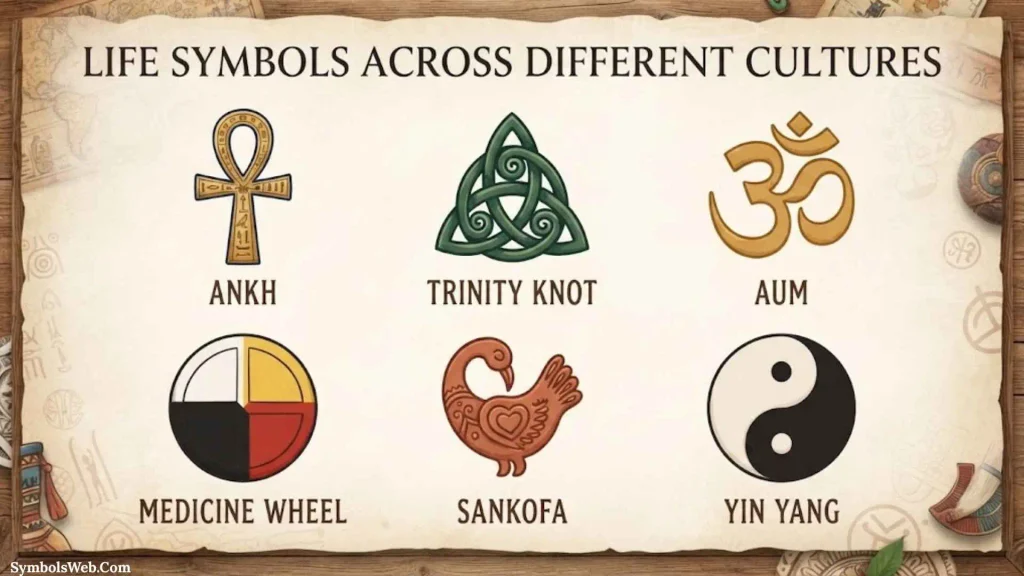
Ancient Egypt
Ancient Egyptians viewed life as a sacred journey.
The famous Ankh represented life, immortality, and divine power. It frequently appeared in tombs, temples, and sacred artwork.
Egyptians believed life continued after death, making life symbols essential in religious practices.
Ancient Greece
Greek culture connected life symbols with fate, wisdom, and divine order.
The phoenix became an important symbol of rebirth and renewal. Philosophers often explored symbolic representations of life’s cycles and transformations.
Roman Culture
Romans adopted many Greek symbols while adding their own interpretations.
Life symbols frequently appeared in architecture, coins, and public monuments as representations of prosperity, continuity, and civic strength.
Eastern Traditions
In many Eastern cultures, life is viewed as an ongoing cycle.
The lotus flower symbolizes spiritual awakening and personal growth. Concepts such as balance, harmony, and interconnectedness are central themes.
Indigenous Traditions
Many indigenous peoples view life as interconnected with nature.
Animals, plants, rivers, and celestial bodies often serve as life symbols. These traditions emphasize respect for the natural world and the continuity of generations.
Modern Interpretations
Today, life symbols are often personalized.
People use them to represent:
- Personal growth
- Healing
- Identity
- Spiritual beliefs
- Life milestones
Modern interpretations blend ancient wisdom with individual meaning.
Similar Symbols and Their Meanings
| Symbol | Similarity to Life Symbols | Key Difference |
| Tree of Life | Represents growth | Focuses on interconnectedness |
| Lotus Flower | Represents renewal | Emphasizes spiritual awakening |
| Spiral | Represents journey | Focuses on evolution |
| Circle | Represents continuity | Emphasizes wholeness |
| Phoenix | Represents rebirth | Focuses on overcoming destruction |
| Butterfly | Represents transformation | Focuses on personal change |
Common Misconceptions
Many people assume all life symbols have identical meanings.
In reality, context matters. The same symbol may represent different ideas depending on culture, religion, historical period, or personal interpretation.
Life Symbols in Mythology and Folklore
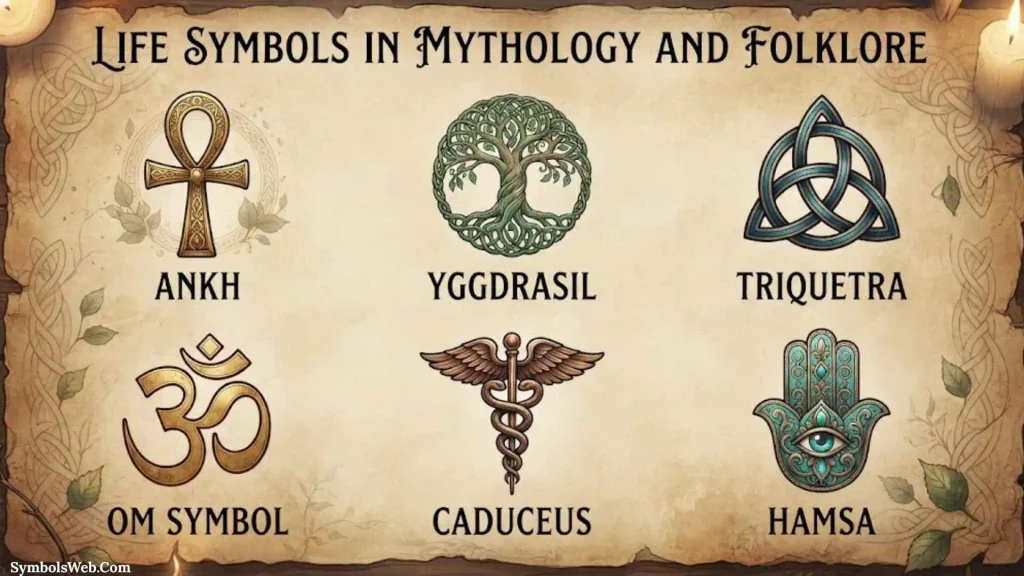
Throughout mythology, life symbols help explain humanity’s biggest questions.
In Norse mythology, the world tree Yggdrasil connected different realms of existence.
Greek myths used the phoenix to illustrate resurrection and renewal.
Many indigenous stories feature sacred animals that guide people through life’s challenges.
Folklore often uses symbolic journeys to teach lessons about courage, wisdom, and transformation.
These stories helped shape how modern societies understand life’s symbolic meanings.
Life Symbols in Art, Literature, Movies and Pop Culture
Paintings
Artists frequently use trees, rivers, flowers, and circles to symbolize growth, time, and human experience.
Literature
Writers use symbolic imagery to communicate deeper themes.
A journey through a forest may symbolize personal discovery. A blooming flower may represent hope.
Poetry
Poets often rely on life symbols because they convey complex emotions in simple imagery.
Movies
Modern films use life symbols to represent character development and transformation.
Butterflies, rising suns, and sacred trees frequently appear during important turning points.
Television
Television series often use recurring symbolic images to reinforce themes of destiny, growth, and renewal.
Tattoos
Life symbols are among the most popular tattoo choices.
Common designs include:
- Tree of Life
- Lotus flower
- Phoenix
- Butterfly
- Infinity symbol
Fashion and Design
Life symbols appear on clothing, jewelry, home décor, and branding because they communicate universal human values.
Spiritual and Dream Meaning of Life Symbols
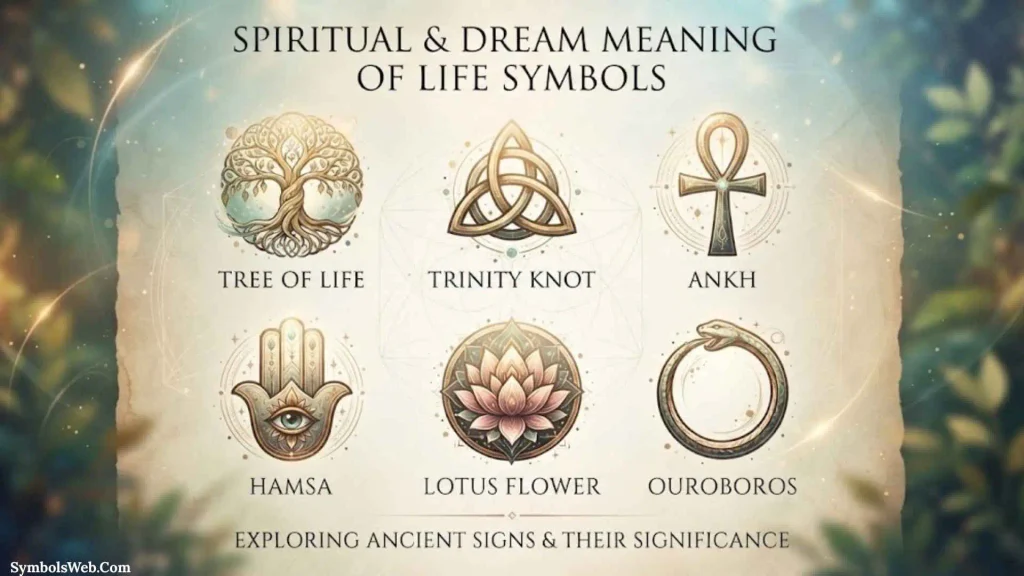
Dreams often use symbols to communicate messages from the unconscious mind.
Common Dream Interpretations
Tree of Life
May indicate personal growth, stability, or wisdom.
Butterfly
Often symbolizes transformation and new beginnings.
Lotus Flower
Can represent spiritual awakening or emotional healing.
Circle
May indicate completion, balance, or unity.
Positive Messages
- Growth is occurring.
- Healing is underway.
- New opportunities are emerging.
- Spiritual awareness is expanding.
Cautionary Messages
- Resistance to change.
- Emotional stagnation.
- Fear of transformation.
- Disconnection from personal values.
Dream interpretation should always consider personal experiences and emotions.
Positive and Negative Meanings of Life Symbols
| Positive Meaning | Negative Meaning |
| Growth | Stagnation |
| Renewal | Fear of change |
| Wisdom | Overconfidence |
| Connection | Dependency |
| Transformation | Loss of identity |
| Hope | Unrealistic expectations |
| Continuity | Resistance to endings |
| Spirituality | Escapism |
Life symbols often contain both light and shadow aspects. Their meaning depends on context and perspective.
Why Humans Are Attracted to Life Symbols
Humans naturally seek meaning.
Symbols help simplify complex ideas and make abstract concepts easier to understand.
Psychologists suggest that symbolic thinking is a fundamental part of human cognition. Symbols allow people to connect personal experiences with larger universal themes.
Life symbols also create emotional comfort.
A person facing challenges may find hope in a phoenix. Someone seeking balance may connect with a circle.
These symbols serve as reminders that growth, change, and renewal are natural parts of life.
They connect individual experiences to a larger human story.
Modern Uses of Life Symbols
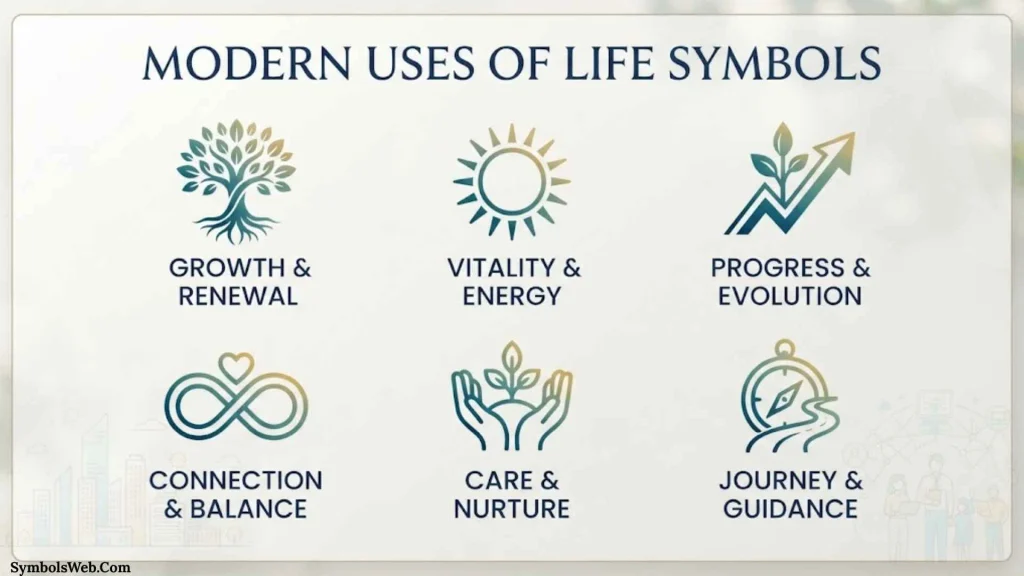
Tattoos
Many people choose life symbols to represent personal journeys and achievements.
Jewelry
Life-themed pendants and rings often symbolize protection, growth, and connection.
Fashion
Designers incorporate symbolic imagery into clothing and accessories.
Branding
Companies use life symbols to communicate values such as sustainability, innovation, and growth.
Social Media
Life symbols frequently appear in profile images, inspirational content, and digital art.
Contemporary Spirituality
Modern spiritual practices continue to use ancient symbols during meditation and self-reflection.
Home Décor
Many homeowners display life symbols to create meaningful and inspiring spaces.
Interesting Facts About Life Symbols and Meanings
- The Tree of Life appears in cultures separated by thousands of miles and centuries of history.
- The spiral is one of humanity’s oldest known symbols.
- The lotus flower can bloom beautifully despite growing in muddy water.
- The ancient Egyptian ankh remains one of the world’s most recognized life symbols.
- Butterflies undergo one of nature’s most dramatic transformations.
- Circles are considered sacred in many spiritual traditions.
- Life symbols often appear in dreams across different cultures.
- Ancient cave art contains symbolic images connected to life and survival.
- Many modern logos are inspired by ancient life symbolism.
- Symbolic thinking may have played a key role in human cultural evolution.
Frequently Asked Questions
What is the most common symbol of life?
The Tree of Life is often considered the most universal symbol of life because it represents growth, connection, wisdom, and continuity.
What does the Tree of Life symbolize?
The Tree of Life symbolizes interconnectedness, personal growth, strength, family roots, and spiritual development.
What is the spiritual meaning of life symbols?
Spiritually, life symbols represent transformation, divine connection, inner growth, and the journey of the soul.
Why do people use life symbols in tattoos?
People choose life symbols to represent personal experiences, resilience, healing, growth, and important life milestones.
Are life symbols universal?
Many life symbols appear across cultures, although their exact meanings may vary depending on historical and cultural context.
What does seeing life symbols in dreams mean?
Life symbols in dreams often reflect personal growth, emotional transformation, spiritual development, or important life changes.
Conclusion
Life symbols and meanings reveal humanity’s timeless search for understanding, purpose, and connection. If found in ancient myths, sacred traditions, dreams, or modern art, these symbols continue to guide and inspire people across generations.
They remind us that life is a journey of growth, transformation, and renewal. By understanding their deeper meanings, we gain not only historical knowledge but also valuable insight into our own lives and the universal human experience.

Jordan Hayes is a writer with a passion for exploring the history, meanings, and cultural significance behind symbols from around the world. He enjoys turning complex topics into clear, engaging content that anyone can understand. Jordan is also the fictional author of The Silent Language of Ancient Marks and Hidden Symbols Beyond the Surface, two original book concepts created for his author profile. When he’s not writing, he spends time researching myths, traditions, and forgotten stories that inspire his work. His goal is to help readers discover the deeper meanings behind the symbols they encounter every day.
 Eliana Foster
 Ethan Holloway