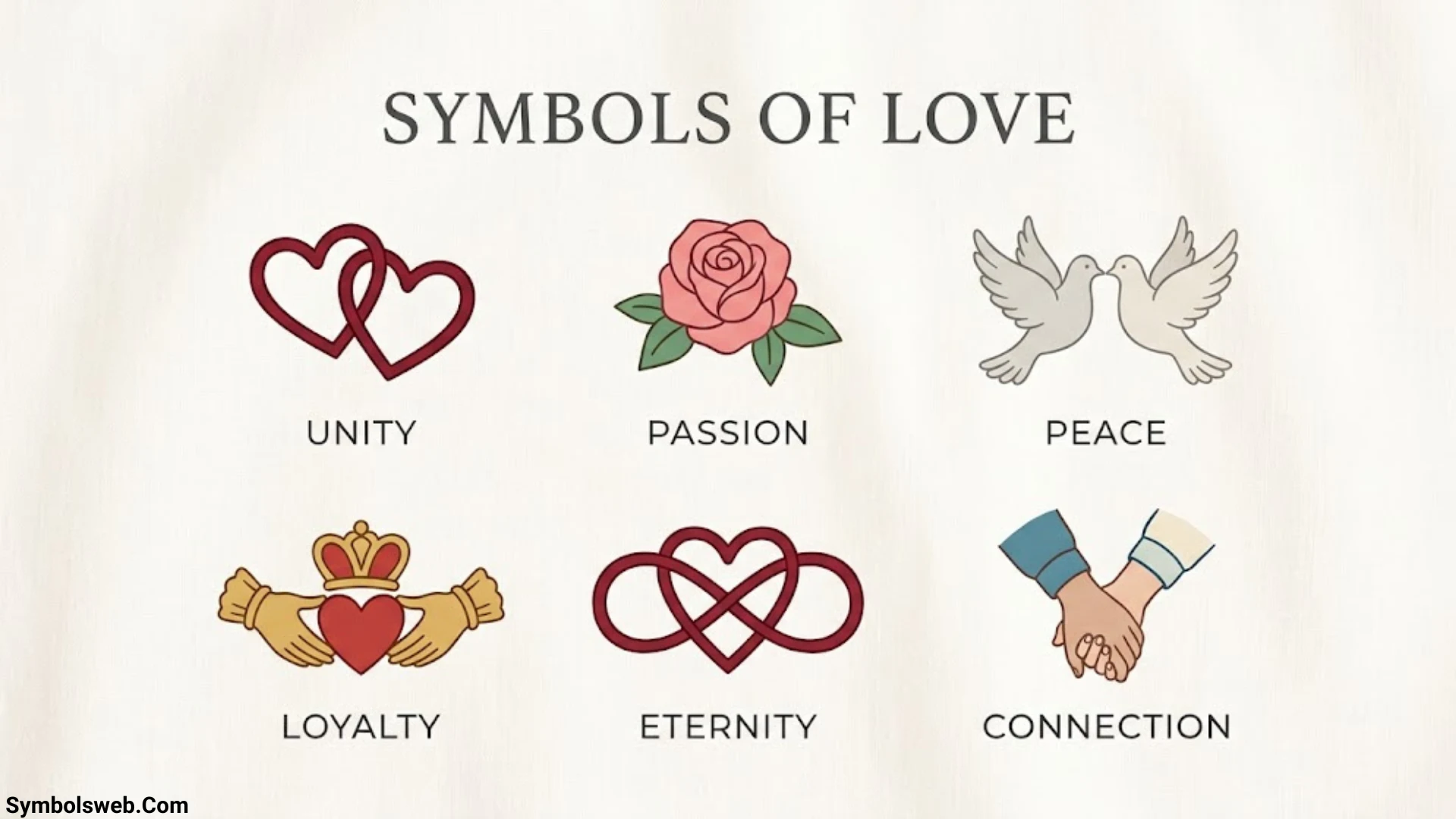
Love is one of the strongest human emotions, yet people express it in countless ways. A red rose, a simple heart, a wedding ring, or a traditional Irish Claddagh ring can communicate feelings that words sometimes struggle to capture. These symbols of love represent affection, passion, loyalty, friendship, compassion, and lasting commitment.
Some love symbols come from ancient mythology and religious traditions. Others developed through art, jewelry, literature, and modern communication. Their meanings also change across cultures. For example, a lotus flower can represent spiritual growth and purity in religious traditions, while a red rose commonly expresses romantic love in Western gifting customs.
If you’re looking for symbols of love and their meanings, this guide explores 25 important examples, their cultural backgrounds, and how people use them today. You’ll also discover symbols of eternal love, flowers associated with romance, and meaningful ways to choose a symbol for a relationship, gift, or tattoo.
What Do Symbols of Love Mean?
Love symbolism uses images, objects, gestures, and natural forms to communicate feelings between people. A symbol can represent romantic attraction, family affection, friendship, spiritual devotion, or a promise to remain committed to someone.
For example, a heart on a greeting card usually communicates affection. A wedding ring represents a relationship commitment, while the hands, heart, and crown on a Claddagh ring connect love with friendship and loyalty.
Symbols also help people express complicated emotions in simple ways. You might give someone flowers to show admiration or wear a meaningful pendant to remember a loved one. The object becomes more than decoration because of the feelings and experiences attached to it.
What Makes Something a Symbol of Love?
A symbol becomes associated with love through cultural traditions, historical stories, religious teachings, artistic representations, and personal experiences.
Three factors often shape its meaning:
- Cultural tradition: A community passes down a symbol through customs, celebrations, or storytelling.
- Historical association: Artists, writers, or religious traditions repeatedly connect an image with a particular idea.
- Personal meaning: Two people give an object special significance because of a shared experience or promise.
A symbol doesn’t have to mean the same thing to everyone. A small seashell might remind one person of a romantic vacation, while someone else sees it simply as a beautiful object.
Why Do Different Cultures Use Different Love Symbols?
Every culture develops its own ways of expressing affection and commitment. Some traditions emphasize romantic passion, while others highlight friendship, family ties, compassion, or spiritual connection.
Greek and Roman mythology includes deities associated with love and desire. Irish tradition is known for the Claddagh ring. In Hindu and Buddhist traditions, lotus imagery can communicate ideas connected to spiritual development, purity, and compassion.
These examples show why cultural symbols of love deserve careful interpretation. A symbol’s meaning depends on its history and context rather than a single definition that supposedly applies everywhere.
Is There One Universal Symbol of Love?
The heart is one of the world’s most widely recognized symbols of love, particularly in modern popular culture. People use it on greeting cards, jewelry, clothing, advertisements, and digital messages.
However, no single image represents every form of love in every society. The heart often communicates affection, but a lotus may carry deeper spiritual associations in a religious setting. A wedding ring, meanwhile, points toward marriage and commitment.
The heart is a powerful common symbol, but love symbols have many meanings beyond romance.
25 Symbols of Love and Their Meanings
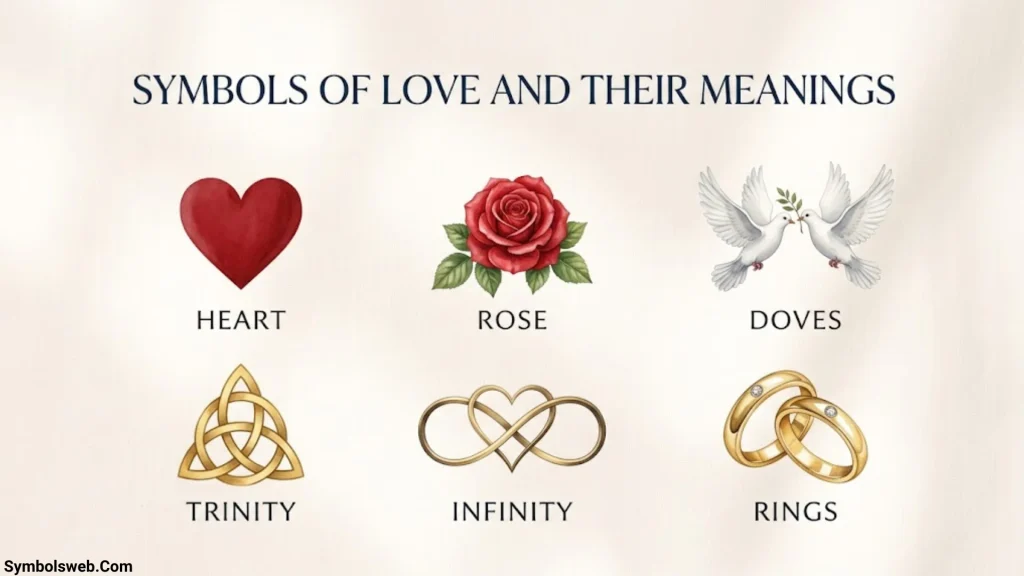
The following symbols represent different aspects of love, from romantic attraction and passion to friendship, compassion, and lifelong partnership. Their meanings reflect a mixture of historical traditions and modern interpretations, so it’s useful to understand the context behind each one.
The Heart A Widely Recognized Symbol of Love
The heart is perhaps the most familiar symbol for love. Its distinctive shape appears on cards, necklaces, clothing, gifts, and digital screens. A simple heart can communicate affection without requiring a long explanation.
The familiar heart shape doesn’t closely resemble the human heart’s actual anatomy. Researchers have proposed several possible origins, including earlier artistic conventions and medieval representations. However, its exact origin remains uncertain. The heart gradually became an established emblem of romance and affection in European art and culture. HISTORY’s overview of the heart symbol explores these competing explanations.
Today, heart symbolism extends beyond romantic relationships. A heart can express compassion, gratitude, friendship, family affection, or support for someone going through a difficult time.
Common meanings of the heart:
- Romantic love and attraction
- Affection and emotional closeness
- Compassion and kindness
- Friendship and family connection
- Emotional sincerity and care
A heart pendant makes a classic romantic gift, while a heart emoji can brighten an ordinary message. Its meaning usually depends on the relationship and the surrounding context.
The Red Rose Romantic Love and Passion
The red rose is one of the best-known symbols of romantic love. Its rich color, delicate petals, and long-standing role in Western floral traditions have made it a familiar expression of passion and affection.
Red roses often appear on anniversaries, Valentine’s Day, and other romantic occasions. People also give them to express admiration or mark an important relationship milestone.
Roses have a much longer cultural history than modern Valentine’s Day celebrations. They appear in mythology, literature, religious art, and decorative traditions. Their meanings vary, but the red rose has become especially connected with romantic desire and love in modern Western culture.
Rose color can also affect the message. Red generally suggests romance, while white roses are often associated with purity or remembrance. Pink roses commonly communicate admiration or appreciation, although these associations aren’t universal rules.
If you want to express romantic affection through flowers, a red rose is a clear and recognizable choice. A bouquet can also become more personal when you select flowers that remind you of a shared experience.
The Celtic Knot Interconnection and Lasting Bonds
Celtic knot designs use interwoven lines that form complex patterns. Many modern interpretations connect these designs with eternity, unity, and everlasting love because the lines appear to continue through the pattern.
Celtic-inspired knots are popular in necklaces, wedding jewelry, decorative art, and tattoos. Couples may choose them to represent a relationship that grows stronger through shared experiences.
However, not every interlaced design has a documented ancient meaning specifically connected to romantic love. Some designs come from historical Celtic and Insular art, while other patterns and their romantic interpretations are modern creations.
The important distinction is between the historical design and the meaning someone gives it today. A person can choose a Celtic-style knot to symbolize an enduring relationship without claiming that every version served as an ancient wedding symbol.
For couples who prefer meaningful designs over obvious romantic imagery, an interlaced knot offers a subtle way to represent connection.
The Claddagh Ring Love, Friendship, and Loyalty
The Claddagh ring is a traditional Irish design featuring two hands holding a heart topped by a crown. Each element has a commonly recognized meaning: the heart represents love, the hands represent friendship, and the crown represents loyalty.
The ring takes its name from the Claddagh area of Galway, Ireland. Galway City Museum identifies a ring made by local goldsmith Richard Joyce around 1700 as the oldest known surviving example in its collection. The broader design also relates to the European tradition of rings featuring clasped hands. Galway City Museum’s Claddagh ring record provides further historical context.
The Claddagh ring has become a meaningful piece of Irish jewelry, worn by people with Irish heritage and by others who appreciate its message.
Its three main symbolic elements are:
- Heart: Love and affection
- Hands: Friendship and connection
- Crown: Loyalty and faithfulness
Some people follow traditions about wearing the ring to indicate their relationship status, but these customs aren’t universal. The ring can also serve as a wedding band, family keepsake, or gift between close friends.
Among symbols of love and loyalty, the Claddagh ring stands out because its design combines three related values in one object.
The Infinity Symbol Endless Love and Commitment
The infinity symbol resembles a sideways figure eight. In mathematics, it represents the concept of infinity, while in modern jewelry and popular culture, it often represents an enduring bond.
Couples frequently choose infinity necklaces, bracelets, rings, and tattoos to express symbols of eternal love. The continuous line suggests a connection without an obvious beginning or end.
An infinity design can also represent friendship, family relationships, or a personal commitment that extends beyond a particular moment. Some people combine it with a heart, initials, or a date to make the meaning more specific.
Although the infinity symbol has a mathematical history, its use as a romantic emblem is a modern symbolic application. It shouldn’t automatically be treated as an ancient love sign.
If you want a simple design that communicates permanence, the infinity symbol is a popular option. Its clean shape also works well in minimalist jewelry.
The Dove Peace, Devotion, and Partnership
Doves have appeared in religious art, literature, and cultural symbolism for centuries. Depending on the tradition, they can represent peace, purity, spiritual significance, or divine presence.
Doves also appear in romantic imagery, including wedding decorations and illustrations of couples. Their gentle appearance makes them a natural choice for artists seeking to communicate tenderness and harmony.
In Greek mythology, doves are associated with Aphrodite, the goddess of love and beauty. This connection helped strengthen the bird’s place in some Western representations of romance.
Still, the dove isn’t exclusively a love symbol. Its religious and cultural meanings extend well beyond relationships.
A pair of doves can work as a visual symbol for a wedding, anniversary, or commitment ceremony. The pairing suggests companionship, while the broader dove imagery can add a sense of peace and devotion.
Swans Romance and Pair Bonding
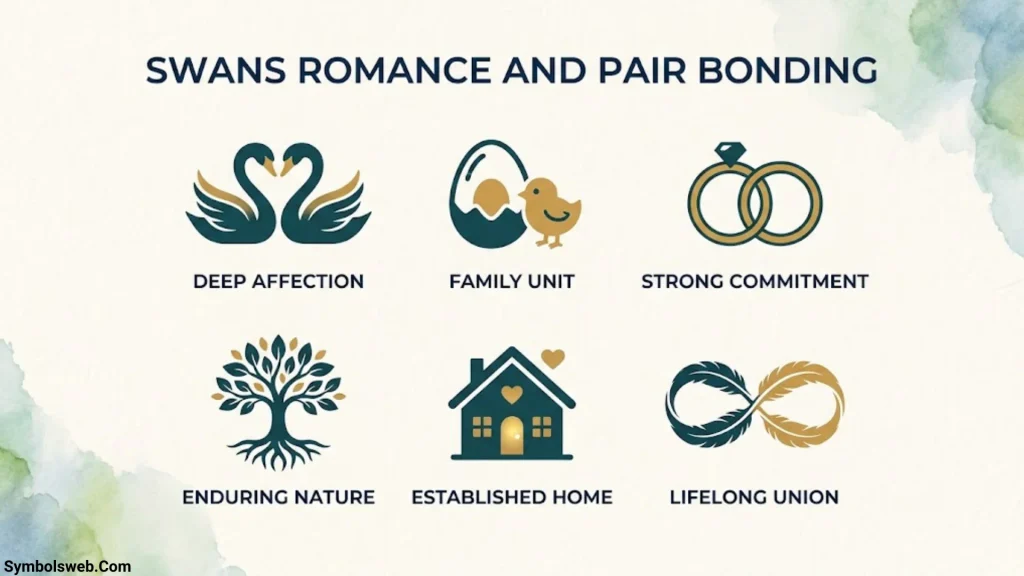
Swans are common symbols of romance, beauty, and partnership. Their graceful movements and the familiar sight of two swans facing one another have inspired romantic images in paintings, literature, and decorative designs.
Some swan species form long-term pair bonds, which contributes to their association with enduring relationships. However, their behavior varies by species and circumstance, so it’s inaccurate to claim that every swan pair remains together for life.
In modern imagery, two swans can represent affection, shared commitment, or a close partnership. Their curved necks may even create a heart-like shape when they face each other.
Swans can be a meaningful choice for couples who prefer natural imagery to conventional heart designs. They also appear in wedding stationery, anniversary gifts, and artwork celebrating relationships.
Their symbolism works best when understood as an artistic expression of partnership rather than a literal promise about human relationships.
The Lotus Flower Compassion, Purity, and Spiritual Growth
The lotus holds important symbolic roles in several Asian religious and cultural traditions. In Hindu and Buddhist imagery, it can represent purity, spiritual development, and the possibility of growth beyond difficult circumstances.
A lotus grows from muddy water yet produces a flower that rises above the surface. This natural process has made it a powerful image of transformation and spiritual aspiration.
The lotus is sometimes described online as a universal symbol of unconditional love. That description is too broad. Its specific meanings depend on the religious tradition, image, and context. Compassion and loving-kindness are important Buddhist concepts, but the lotus has wider significance than romantic love alone.
Common lotus associations include:
- Spiritual growth and awakening
- Purity and renewal
- Compassion and inner development
- Beauty emerging from difficult conditions
- Religious devotion
A lotus pendant or tattoo may express personal growth, spiritual values, or compassion for others. If you choose the design for its cultural or religious meaning, learn about the tradition behind it rather than relying only on a romantic interpretation.
Cupid Romantic Attraction and Desire
Cupid is the Roman god associated with love and desire. He is closely related to the Greek figure Eros, although their portrayals and roles developed differently across time.
Modern artwork often depicts Cupid as a winged child carrying a bow and arrows. In popular stories, his arrows cause people to fall in love, making him a familiar figure in Valentine’s Day decorations and romantic illustrations.
Cupid’s symbolism centers on attraction, desire, and the unpredictable experience of falling in love. The image of an arrow striking someone offers a playful way to show how romantic feelings can arrive unexpectedly.
Cupid is a mythological figure, not a universal religious symbol. His strongest associations come from Greek and Roman traditions and later European art.
Today, Cupid appears on greeting cards, gift packaging, jewelry, and seasonal decorations. He’s particularly useful when you want a lighthearted symbol of romance rather than a solemn emblem of commitment.
Aphrodite Love, Beauty, and Desire
Aphrodite is the ancient Greek goddess associated with love, beauty, and desire. She plays an important role in Greek mythology, where her relationships and stories explore attraction, jealousy, passion, and the power of desire.
Artists have portrayed Aphrodite in sculptures, paintings, and other forms of classical art. Roses and doves are among the images associated with her in various traditions, although individual depictions differ.
Aphrodite is better understood as a mythological figure than as a single, fixed visual symbol. Her name itself can represent Greek ideas about love and beauty, while related imagery helps communicate those themes.
For readers interested in ancient symbols of love, Aphrodite offers a way to explore how ancient Greeks represented desire and attraction. Her mythology also demonstrates that stories about love have long included complicated emotions rather than only idealized romance.
Venus Roman Love and Beauty
Venus is the Roman goddess associated with love, beauty, and fertility. She corresponds broadly to the Greek goddess Aphrodite, although Roman religious traditions developed their own associations and significance for Venus.
Venus became an important figure in Roman art and literature. Artists used her image to explore beauty, attraction, and divine influence, while writers connected her with both personal relationships and the fortunes of Rome.
In modern discussions of Greek and Roman love symbols, Venus is often mentioned alongside Aphrodite and Cupid. The distinction matters: Venus belongs to Roman mythology, while Aphrodite belongs to Greek mythology.
Venus can represent love and beauty in historical or artistic discussions, but she doesn’t have one universally accepted personal emblem. Her symbolism often depends on the artwork, accompanying figures, and cultural setting.
Eros Desire and Romantic Love
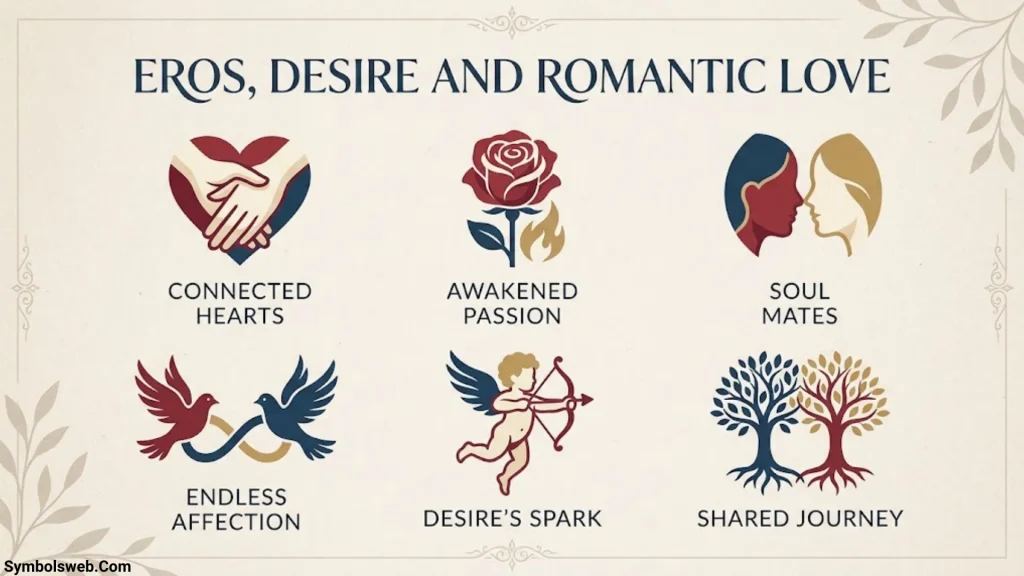
Eros is a Greek figure associated with love and desire. His portrayal changed over time, from powerful representations of desire in ancient thought to the familiar winged figure often shown in later art.
Eros is related to Cupid, the Roman god of love, but the two figures belong to different mythological traditions. Their stories overlap because Roman culture adapted many Greek deities and myths.
The name Eros also appears in discussions of different forms of love and desire. In classical contexts, it can refer to passionate attraction rather than every form of affection or compassion.
For this reason, Eros is a useful entity when exploring romantic love symbols and the history of love in ancient literature. His symbolism reflects the intensity of desire and its influence on human behavior.
Kama Love and Desire in Hindu Tradition
Kama is a deity associated with love, desire, and attraction in Hindu tradition. Traditional depictions may show him carrying a bow and arrows, imagery that connects him with the power of desire.
Kama is not simply an exact equivalent of Cupid. Although both figures are associated with love and arrows, they belong to different religious and mythological contexts.
Kama’s place in Hindu thought also connects with the broader concept of kama, which can refer to desire or pleasure. Its meaning depends on the text and context, so it shouldn’t be reduced to romantic attraction alone.
When discussing a Hindu symbol for love, it’s important to distinguish the deity’s traditional role from modern jewelry or tattoo interpretations. A depiction of Kama can reference mythology, desire, or cultural heritage, depending on how it is used.
The Quaich Friendship, Hospitality, and Shared Bonds
The quaich is a traditional Scottish two-handled drinking cup. It has associations with hospitality and shared drinking customs, and it appears in some Scottish wedding ceremonies and celebrations.
Because people share a drink from a common vessel, the quaich can serve as a symbol of welcome, fellowship, trust, and unity. In a wedding setting, it may represent the joining of two lives or the participation of family and friends.
The quaich is not exclusively a love symbol. Its broader cultural significance is connected with hospitality and communal traditions.
Its romantic meaning comes from the context in which people use it. A quaich shared during a wedding ceremony can become a meaningful expression of partnership, while the same object in another setting may simply represent Scottish heritage or hospitality.
For couples with Scottish connections, a quaich can offer a culturally grounded alternative to conventional romantic gifts.
The Wedding Ring Marriage and Commitment
Wedding rings are among the most recognizable objects that symbolize love. People exchange them in many marriage traditions to mark a public commitment and the beginning or continuation of a shared life.
The ring’s circular shape is often interpreted as a symbol of continuity because it has no visible beginning or end. This is a symbolic explanation rather than proof that every historical culture assigned the circle the same meaning.
Wedding-ring customs vary. People may wear rings on different hands or fingers, use different materials, or follow traditions in which one or both partners exchange rings.
Gold, platinum, silver, and other materials are common choices, but the ring’s value doesn’t determine the strength of the relationship. A simple band can carry enormous emotional significance when it represents a promise that two people take seriously.
Wedding rings work particularly well as symbols of lasting commitment because their meaning is reinforced by a shared ceremony and an ongoing personal practice.
Interlocking Rings Unity and Partnership
Interlocking rings feature two connected circles. Their design creates a visual image of two individuals whose lives have become connected without suggesting that they have lost their separate identities.
The design appears in wedding jewelry, anniversary gifts, pendants, and relationship artwork. Some couples choose interlocking rings to express a shared future or mutual support.
Unlike a traditional wedding band, interlocking rings can represent many kinds of partnerships. Friends, siblings, and family members may also use connected-circle designs to mark their bond.
The meaning depends on the design and the people who choose it. Two connected rings don’t have one fixed historical interpretation, but their visual structure makes them a natural metaphor for unity.
For anyone seeking a modern symbol of partnership, interlocking rings offer a straightforward way to communicate connection and commitment.
Joined Hands Trust, Friendship, and Connection
Joined hands represent cooperation, affection, friendship, and mutual support. The gesture of holding hands can communicate reassurance and closeness without requiring words.
The image also has a long history in rings and symbolic artwork. The European fede ring tradition, for example, used clasped hands as a motif associated with faith and connection. The Claddagh ring incorporates a related visual idea through the hands holding a heart.
Joined hands can symbolize many kinds of relationships, including romantic partnerships, friendships, family ties, and promises of support. Their meaning depends on the setting and the accompanying imagery.
A drawing of two people holding hands may suggest romance, while hands joined in a community setting may express solidarity. The same basic gesture can communicate different kinds of connection.
This makes joined hands a flexible choice for jewelry, illustrations, tattoos, and other visual representations of love.
The Red Thread Connection and Fate
The red thread of fate is a well-known motif in East Asian folklore, particularly in Chinese and Japanese versions of the tradition. It describes a connection between people who are destined to meet or form a significant relationship.
In modern retellings, an invisible or supernatural red thread links people who are meant to find each other. Some versions focus on romantic partners, while others explore the idea of fated relationships more broadly.
The details vary across stories. It is best treated as a folkloric motif rather than a universal belief shared by everyone in East Asia.
Today, the red thread appears in jewelry, illustrations, novels, and tattoos. Couples may choose it to express the feeling that their relationship has a special place in their lives.
As a symbol of eternal love, the red thread emphasizes destiny and connection rather than a promise that a relationship will never change.
The Peony Romance, Prosperity, and Good Fortune
Peonies are admired for their full blooms and rich colors. In Chinese cultural traditions, they have strong associations with beauty, prosperity, honor, and good fortune.
Their meanings vary by setting, but peonies also appear in floral arrangements, decorative art, and modern romantic gifts. Their lush appearance makes them a popular choice for weddings and celebrations.
A peony can express admiration or affection when given as a gift, but its broader symbolism extends beyond romantic love. Prosperity and beauty are important associations in some cultural contexts.
If you’re choosing peonies for a partner, consider the message you want to communicate and the recipient’s preferences. The flower can be especially meaningful when connected to a cultural tradition or a personal memory.
The Orchid Beauty, Admiration, and Affection
Orchids have an elegant appearance and a wide range of colors and shapes. In modern gifting, they often communicate beauty, admiration, refinement, or appreciation.
Their symbolism varies across cultures and species. Orchids have appeared in art, horticulture, and cultural traditions, but there’s no single meaning that applies to every orchid everywhere.
As a romantic gift, an orchid can express admiration without the strong conventional association that red roses carry. A potted orchid can also last longer than a cut-flower arrangement when properly cared for.
Orchids work well for anniversaries, birthdays, and other occasions when you want to show appreciation. Their meaning comes partly from common floral associations and partly from the intention behind the gift.
The Tulip Love and Affection
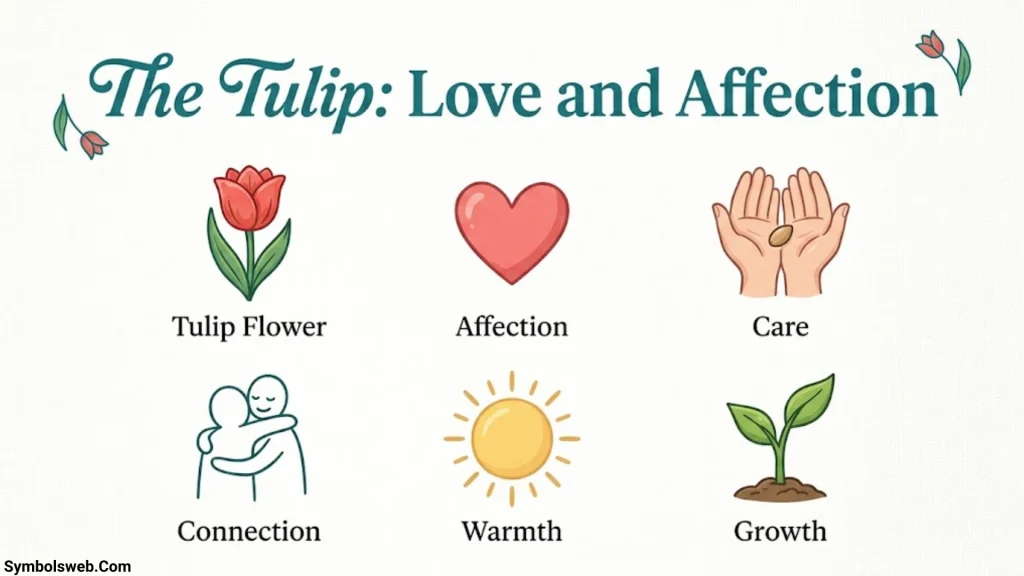
Tulips are popular flowers for spring arrangements, gifts, and celebrations. In modern floral symbolism, they are often associated with love, affection, and fresh beginnings.
Red tulips commonly communicate romantic interest, although flower meanings can vary between traditions and individual interpretations. Other colors may be chosen for friendship, appreciation, or simply their visual appeal.
Tulips have a significant cultural history, particularly in the Netherlands, where they became important in horticulture and art. Their association with romance, however, is not exclusive to Dutch culture.
A tulip bouquet can make a thoughtful gift when you want something romantic but less conventional than red roses. It can also serve as a reminder that affection is often expressed through small, thoughtful gestures.
Strawberries Love, Sensuality, and Fertility
Strawberries are associated with sweetness, pleasure, and sensuality in various artistic and popular contexts. Their bright red color and heart-like shape make them a natural fit for contemporary romantic imagery.
Strawberries appear in desserts, gift baskets, and Valentine’s Day arrangements. Chocolate-covered strawberries, for example, have become a recognizable romantic treat in modern popular culture.
Historical art and folklore also connect strawberries with different meanings, including fertility and religious symbolism in particular settings. These associations should be considered separately rather than combined into one universal definition.
Unlike the heart or Claddagh ring, strawberries aren’t a formal love emblem across all cultures. Their romantic meaning largely depends on the context in which people use them.
Still, a shared dessert can become a symbol of affection when it marks a date, celebration, or personal memory. Sometimes the meaning lies as much in the experience as in the object itself.
The Heart-Shaped Lock and Key Trust and Emotional Intimacy
A heart-shaped lock and key design often represents intimacy, trust, and the idea of giving someone access to your inner world. In modern jewelry and gift traditions, the lock may represent the heart while the key represents the person who holds a special place in it.
The design appears in necklaces, charms, keepsakes, and decorative gifts. Couples may use it to express exclusivity or a close emotional connection.
However, this is primarily a modern symbolic interpretation, not a universal ancient tradition. Its meaning depends on the people who choose it and the message they want to communicate.
The design can be romantic, playful, or sentimental. It may work well as a personalized gift, particularly when accompanied by a note explaining what the lock and key mean to the couple.
The Love Knot Connection and Commitment
A love knot is a broad term for knotted or interlaced designs associated with affection, unity, or commitment. Different designs have different histories, so the phrase doesn’t identify one single symbol used consistently across all cultures.
Knots can serve as useful metaphors for relationships because their strands connect and hold together. Modern jewelry makers often use knot motifs to represent a bond that remains meaningful through life’s changes.
Some people choose a love-knot necklace or ring as an anniversary gift. Others prefer a knot tattoo because it offers a compact design with personal meaning.
When researching a specific knot, check its origin before assigning it a historical or religious significance. A modern decorative knot may still be a meaningful expression of love, even when its symbolism isn’t ancient.
The Heart Emoji ❤️ Modern Digital Affection
The red heart emoji is one of the most familiar modern symbols of love. It appears in text messages, social media posts, digital greeting cards, and online conversations.
People use it to express romance, appreciation, friendship, support, and enthusiasm. A heart sent to a romantic partner may carry a different meaning from one sent to a friend or used in response to good news.
Other heart emojis can communicate different tones, but their meanings aren’t fixed. A pink heart may suggest tenderness or affection, while a purple heart can express support, style, or a meaning tied to a particular community. Context matters more than a strict color dictionary.
Digital symbols also evolve as communication habits change. The same emoji can feel casual in one conversation and deeply meaningful in another.
If you want to use a heart emoji to express affection, consider your relationship with the recipient and the tone of the message. A symbol works best when it supports the feeling you genuinely want to communicate.
Ancient Symbols of Love and Their Historical Origins
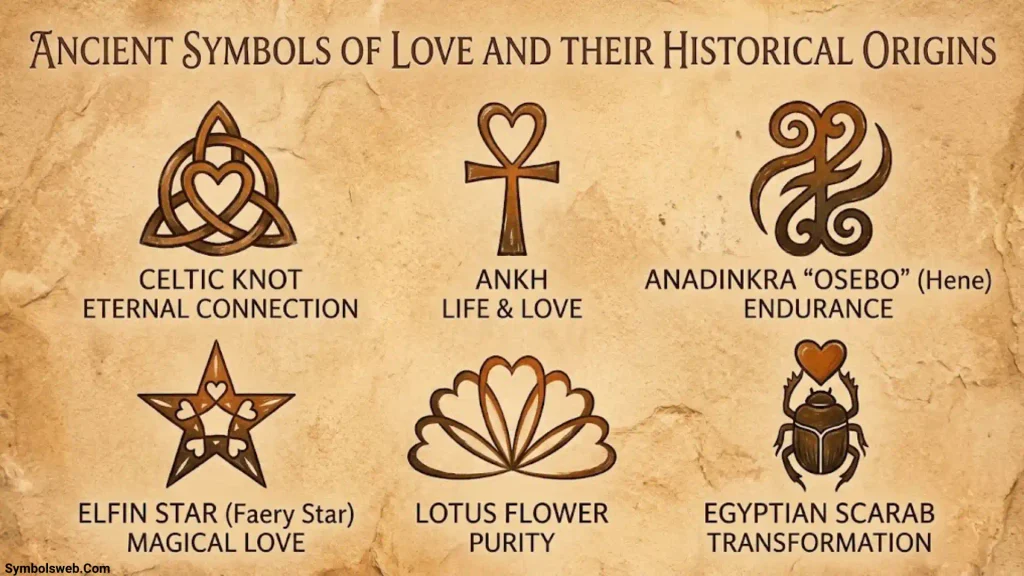
Ancient societies expressed love through myths, religious imagery, literature, jewelry, and art. However, the historical meaning of a symbol isn’t always identical to the interpretation people give it today.
Understanding these differences helps separate documented cultural traditions from modern assumptions.
Love Symbols in Ancient Greek Culture
Greek mythology includes several figures associated with love and desire. Aphrodite represents love and beauty, while Eros is connected with desire and attraction.
Doves and roses also appear in artistic traditions associated with Aphrodite. These images helped shape later Western depictions of romance, although the specific meanings of individual objects varied.
Ancient Greek ideas about love were not limited to romantic relationships. Philosophical and literary traditions explored friendship, desire, affection, and other forms of human connection.
Love Symbols in Ancient Roman Culture
Roman traditions included Venus, the goddess associated with love and beauty, and Cupid, the figure associated with romantic desire. Roman culture adapted and developed ideas from Greek mythology while giving its own deities distinct religious and cultural roles.
Cupid’s bow and arrows became especially influential in later European romantic imagery. Today, his figure remains common in Valentine’s Day decorations and love-themed artwork.
Celtic and Irish Love Symbols
Celtic-inspired interlaced patterns are widely used today to represent continuity and connection. However, individual knot designs don’t all have documented historical meanings specifically related to romantic love.
The Claddagh ring has a more specific cultural history. It developed in Galway, Ireland, and combines a heart, hands, and crown in a design commonly associated with love, friendship, and loyalty.
The distinction matters: one category includes many knot patterns with varied histories, while the other refers to a recognizable Irish ring tradition.
Love Symbols in Ancient Indian Traditions
Kama is associated with love and desire in Hindu tradition. Traditional images of Kama often include a bow and arrows, making him comparable in a limited way to Cupid.
The lotus also holds important meanings in Hindu traditions, including purity, beauty, and spiritual significance. Its meaning depends on the deity, image, and religious context.
Neither Kama nor the lotus should be reduced to a single romantic definition. Their cultural and religious roles are broader than modern love-themed jewelry or decorations might suggest.
Love Symbols in Buddhist Traditions
The lotus is a prominent image in Buddhist art and symbolism. It can represent purity, spiritual development, and awakening.
Buddhist teachings also emphasize compassion and loving-kindness, but these ideas shouldn’t be confused with romantic love alone. They concern how people relate to others more broadly.
A lotus design may therefore represent spiritual values or personal growth rather than a romantic relationship. Its meaning becomes clearer when the particular tradition and intended use are understood.
Symbols of Eternal and Everlasting Love
People often choose symbols of eternity when they want to express a lasting relationship or a promise to remain committed. These designs communicate an aspiration rather than a guarantee about the future.
| Symbol | Common meaning | Typical use |
| Infinity symbol | Endless connection | Jewelry, tattoos, gifts |
| Celtic knot | Interconnection and continuity | Pendants, decorative designs |
| Wedding ring | Marriage and commitment | Weddings and anniversaries |
| Swans | Romance and partnership | Art and wedding imagery |
| Love knot | Connection and unity | Jewelry and keepsakes |
The infinity symbol works well for a modern minimalist design. Wedding rings have a direct connection to marriage customs, while swans express partnership through natural imagery.
Celtic knots and love knots can be meaningful choices, but their exact historical meanings depend on the particular design. It’s best to choose one because its appearance and personal significance fit your relationship rather than relying on an unsupported claim that it guarantees eternal love.
Symbols of Love and Loyalty
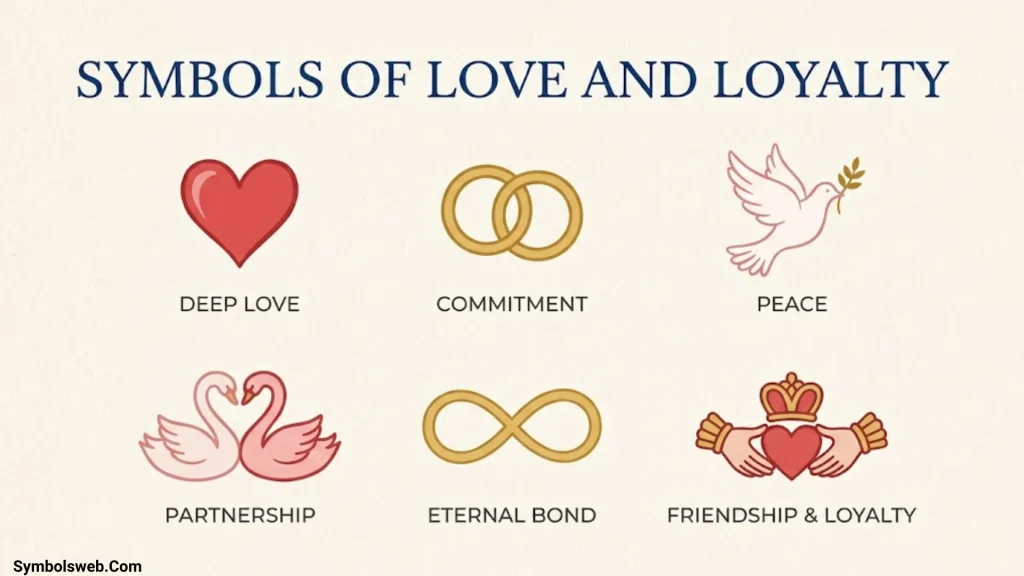
Love and loyalty often appear together, but they represent different qualities. Love describes affection or care, while loyalty emphasizes faithfulness, reliability, and continued support.
The Claddagh ring is a particularly clear example because its design combines love, friendship, and loyalty. Wedding rings can also express loyalty when exchanged as part of a commitment ceremony.
Joined hands suggest cooperation and mutual support, while interlocking rings provide a visual metaphor for partnership. Swans offer a natural image commonly associated with romantic bonds.
When choosing a symbol of loyalty, think about the message you want to send. A ring may communicate a formal commitment, while a gift representing friendship may better suit a relationship that isn’t romantic.
Symbols of Unconditional and Spiritual Love
Unconditional love refers to care that isn’t offered only when someone meets a particular expectation. Spiritual love may involve compassion, devotion, or a sense of connection that extends beyond romantic relationships.
The heart commonly communicates affection and care. The lotus, meanwhile, has religious meanings connected with purity and spiritual development in Hindu and Buddhist traditions.
Doves may represent peace or sacred themes in certain religious contexts. The red thread of fate emphasizes a connection between people in folklore, though it doesn’t represent the same idea in every story.
No single symbol universally represents unconditional love. The best choice depends on whether you want to communicate compassion, spiritual devotion, romantic affection, or a personal bond.
Flowers That Symbolize Love and Romance
Flowers make meaningful gifts because their colors, shapes, scents, and cultural associations can communicate feelings without a long message. Still, floral symbolism changes across cultures, so these meanings are useful guides rather than strict rules.
| Flower | Common association | When it may be appropriate |
| Red rose | Passion and romantic love | Anniversaries and romantic occasions |
| Tulip | Affection and love | Thoughtful gifts and celebrations |
| Peony | Beauty and prosperity | Weddings and festive arrangements |
| Orchid | Admiration and beauty | Birthdays and special gifts |
| Lotus | Spiritual growth and purity | Personal or religious significance |
Red roses are a familiar choice when you want to express romance directly. Tulips offer a softer alternative, while orchids can communicate admiration and refinement.
Peonies may be especially meaningful when their cultural associations with prosperity and good fortune matter to the recipient. Lotus flowers are better chosen with an understanding of their religious and cultural significance.
A flower’s meaning also depends on the person receiving it. If someone loves tulips because they remind them of a family garden, that personal connection may matter more than a traditional symbolism guide.
Love Symbols Across Different Cultures
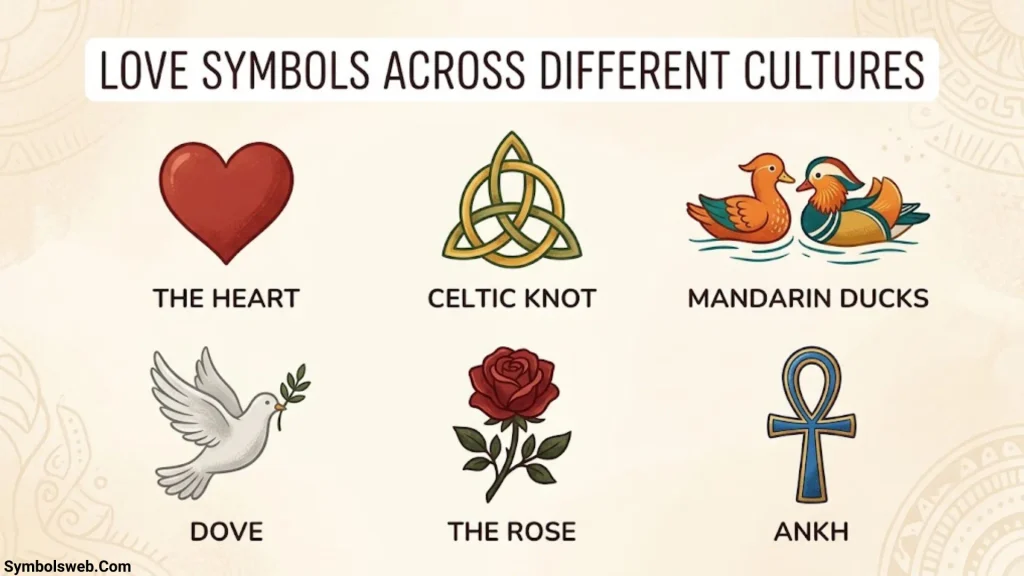
Cultural symbols of love reflect the stories, customs, and values of the communities that use them. Comparing these traditions can reveal both shared human experiences and important differences.
Irish Symbols of Love
The Claddagh ring is closely associated with Galway and Irish heritage. Its heart, hands, and crown communicate love, friendship, and loyalty.
The ring is also a family keepsake for some people, passed down through generations. Its significance may therefore include ancestry and belonging as well as romantic commitment.
Scottish Symbols of Love
The quaich is a Scottish two-handled cup associated with hospitality and shared drinking customs. When used during a wedding or celebration, it can represent fellowship and the joining of families.
Its meaning comes from the occasion and the people sharing the cup. It is a cultural object with uses beyond romance.
Greek and Roman Love Symbols
Aphrodite, Eros, Venus, and Cupid connect love symbolism with classical mythology. These figures have influenced Western art and romantic imagery for centuries.
Their roles differ, so it’s useful to identify them correctly. Aphrodite and Eros belong to Greek mythology, while Venus and Cupid belong to Roman mythology.
Hindu Symbols Associated With Love
Kama represents love and desire in Hindu tradition. Lotus imagery carries other meanings, including purity and spiritual significance.
These symbols have roles within broader cultural and religious traditions. Their meanings should not be reduced to modern romantic interpretations.
Buddhist Symbols Associated With Compassion and Love
The lotus is an important image in Buddhist art. It can symbolize spiritual development and awakening, while compassion and loving-kindness are central ethical concepts in Buddhist teachings.
A lotus tattoo or pendant may express these values, but its interpretation depends on the person and the tradition being referenced.
Modern Western Love Symbols
Hearts, red roses, wedding rings, and digital heart emojis are common in modern Western expressions of love. Valentine’s Day has helped popularize several of these images through cards, gifts, flowers, and decorations.
These symbols are widely recognized, but their meanings still depend on context. A heart emoji between friends doesn’t necessarily indicate romantic attraction, and a wedding ring carries a more specific commitment-related meaning.
Modern Symbols of Love and Their Meanings
Modern love symbols often combine traditional imagery with personal expression. A couple might choose an infinity necklace, matching rings, a shared tattoo, or a digital symbol that reflects their relationship.
Infinity Jewelry and Tattoos
Infinity designs commonly represent lasting connection. They are popular because the shape is simple, adaptable, and easy to personalize with initials or dates.
Heart Emojis and Digital Messages
Heart emojis allow people to communicate affection quickly in digital conversations. Their meanings depend on the relationship, message, and communication style.
Personalized Jewelry
A pendant engraved with a date, name, or private message can become a meaningful symbol of love. Its importance comes from the story behind the engraving.
Matching Rings and Couple Tattoos
Matching designs can represent shared identity or commitment. However, people should choose permanent tattoos carefully and make sure the symbol’s cultural meaning is understood.
Lock-and-Key Designs
A lock-and-key motif commonly symbolizes intimacy and trust in modern gift-giving. It can represent a personal connection rather than an established ancient tradition.
Personalized Gifts and Shared Keepsakes
Photographs, letters, souvenirs, and handmade objects can become symbols of love through shared memories. Their meaning may be more personal than that of a widely recognized symbol.
Objects That Symbolize Love and Commitment
Not every meaningful love symbol comes from mythology or a formal cultural tradition. Everyday objects can carry powerful emotional significance when they remind people of their relationship.
- Wedding rings: Represent marriage and commitment.
- Claddagh rings: Combine love, friendship, and loyalty.
- Love letters: Preserve personal feelings and memories.
- Photographs: Capture shared experiences and important milestones.
- Flowers: Communicate affection through gifting traditions.
- Shared cups: Can represent hospitality, fellowship, or unity in particular cultural settings.
- Personalized keepsakes: Connect an object with a meaningful date, place, or experience.
A small object can become deeply important when it reminds you of someone you love. Its value doesn’t depend on its price or popularity.
How to Choose a Symbol That Represents Your Love
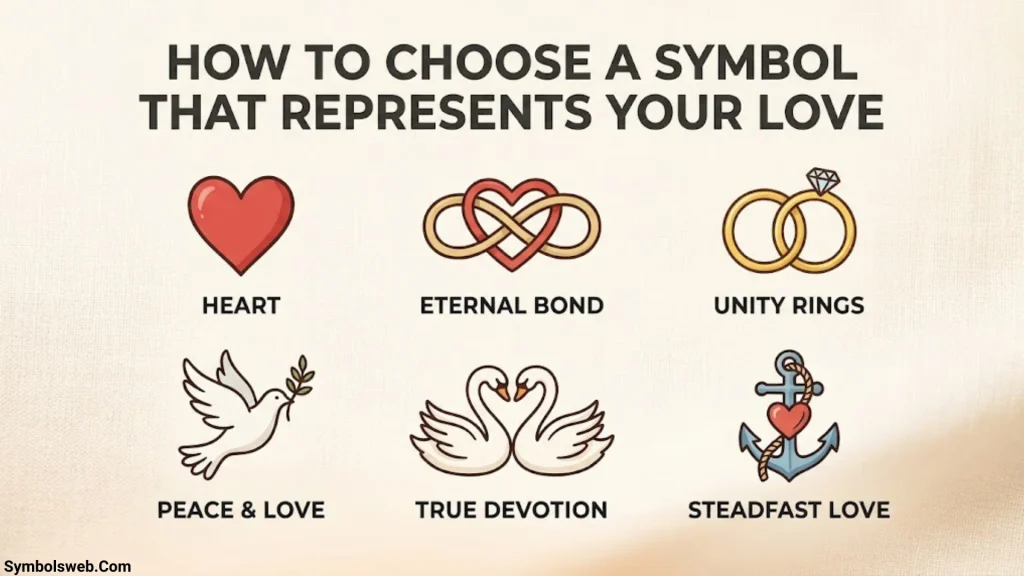
The best love symbol is one that expresses the relationship or feeling you want to honor. Before choosing a gift, tattoo, or piece of jewelry, consider what the symbol means to you and the person receiving it.
Choose a Symbol for Romantic Love
A red rose, heart pendant, or Cupid design can communicate romantic attraction. These are recognizable options when you want to express affection without needing to explain the symbolism in detail.
Choose a Symbol for Eternal Commitment
Infinity jewelry and wedding rings are common choices for lasting commitment. Celtic-inspired knots can also work when you appreciate their interwoven design and modern association with continuity.
Choose a Symbol for Friendship and Loyalty
The Claddagh ring is especially suitable when you want to express friendship alongside love and loyalty. Joined hands can also communicate trust and mutual support.
Choose a Symbol for Spiritual or Compassionate Love
The lotus may be meaningful if you connect with its spiritual significance in Hindu or Buddhist traditions. Learn about its context before using it as a religious or cultural symbol.
Choose a Culturally Meaningful Gift or Tattoo
Research a symbol’s origins before using it in a permanent design or culturally significant setting. A museum, cultural institution, or reliable historical reference can help you understand its background.
You should also consider the recipient’s preferences. A simple heart might suit someone who enjoys classic romantic gestures, while a personalized keepsake may be more meaningful to someone who values private memories.
Frequently Asked Questions About Symbols of Love
What Is the Most Recognized Symbol of Love?
The heart is one of the most widely recognized symbols of love and affection, particularly in modern popular culture. People use it in jewelry, cards, artwork, and digital messages to express romance, friendship, compassion, and care.
What Symbol Represents Eternal Love?
The infinity symbol, wedding rings, and some Celtic-inspired knot designs commonly represent enduring love or commitment. Their meanings differ, and no symbol can guarantee that a relationship will last forever.
What Symbol Represents Unconditional Love?
The heart often represents affection and care. The lotus may communicate compassion or spiritual growth in particular religious traditions, but no single symbol universally represents unconditional love.
What Symbol Represents Love and Loyalty?
The Claddagh ring is a strong example because its hands, heart, and crown are commonly associated with friendship, love, and loyalty. Wedding rings can also represent commitment and faithfulness.
What Are Some Ancient Symbols of Love?
Aphrodite and Eros in Greek mythology, Venus and Cupid in Roman mythology, and historical heart-shaped motifs are important examples. Their origins and cultural roles differ, and some modern romantic interpretations developed later.
What Is a Good Symbol for Lasting Commitment?
Wedding rings are a clear choice when you want to represent marriage. Infinity designs and interlocking rings offer modern alternatives for expressing continuity and partnership.
Do Love Symbols Mean the Same Thing in Every Culture?
No. A symbol may have religious, historical, romantic, or personal meanings that differ across cultures and periods. Researching the relevant tradition helps prevent misunderstandings.
Which Flowers Symbolize Romantic Love?
Red roses are strongly associated with romantic love in Western gifting traditions. Tulips can also express affection, while other flowers carry meanings that vary by culture and context.
What Is the Difference Between Romantic and Spiritual Love Symbols?
Romantic symbols often communicate attraction, affection, or commitment between partners. Spiritual symbols may express compassion, devotion, purity, or personal growth. Some symbols overlap, but their meanings depend on the tradition and intended use.
Can an Everyday Object Become a Symbol of Love?
Yes. A photograph, letter, souvenir, or handmade gift can represent a relationship because of the memories attached to it. Personal meaning often matters more than an object’s traditional symbolism.
Conclusion: Finding Meaning in Symbols of Love
Symbols of love give people a way to express feelings through images, objects, flowers, jewelry, and gestures. The heart and red rose are familiar romantic symbols, while the Claddagh ring connects love with friendship and loyalty. The infinity symbol, wedding ring, and interlocking rings commonly represent lasting commitment.
Cultural traditions add further depth to these meanings. Aphrodite and Eros connect love with Greek mythology, while Kama belongs to Hindu tradition and the lotus carries important meanings in Hindu and Buddhist imagery. Understanding these backgrounds helps you appreciate each symbol without assuming that every culture interprets it in the same way.
When choosing a symbol for a gift, tattoo, or relationship milestone, focus on the message you want to communicate. A familiar heart can express affection, while a cultural keepsake or personalized object may carry a more specific meaning. The most meaningful symbol is the one that reflects your connection, values, and shared experiences

Jordan Hayes is a writer with a passion for exploring the history, meanings, and cultural significance behind symbols from around the world. He enjoys turning complex topics into clear, engaging content that anyone can understand. Jordan is also the fictional author of The Silent Language of Ancient Marks and Hidden Symbols Beyond the Surface, two original book concepts created for his author profile. When he’s not writing, he spends time researching myths, traditions, and forgotten stories that inspire his work. His goal is to help readers discover the deeper meanings behind the symbols they encounter every day.
 Ethan Holloway
 Eliana Foster