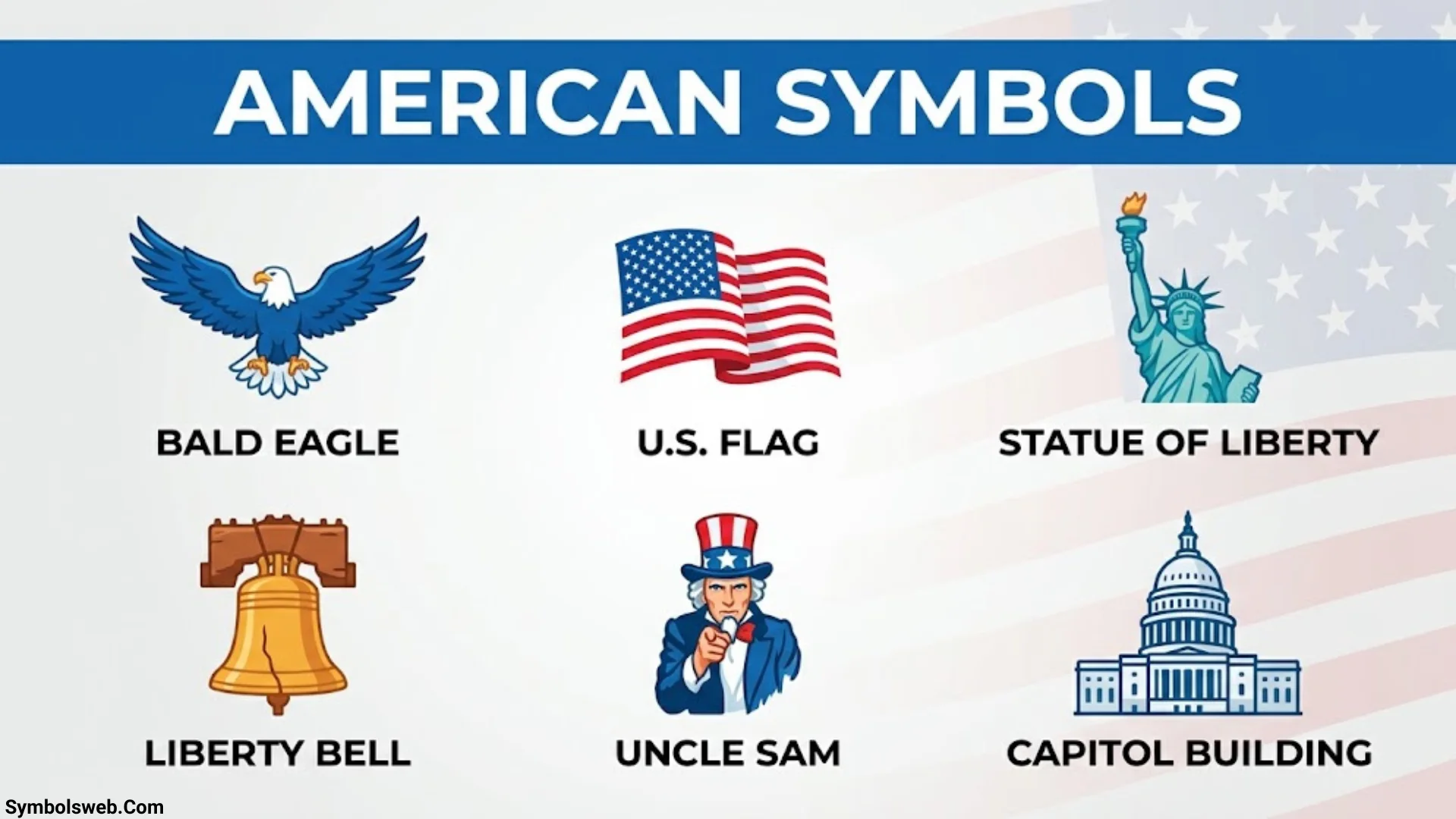
American symbols tell the story of a nation shaped by independence, democracy, cultural traditions, and the pursuit of freedom. From the Stars and Stripes to the Statue of Liberty, these recognizable images and landmarks represent important parts of the United States’ history and identity.
Some American national symbols have official federal designations, while others became meaningful through historical events, public movements, and cultural traditions. The bald eagle represents the country’s strength and independence. The Liberty Bell recalls the struggle for liberty, while the Lincoln Memorial connects American ideals with the fight against slavery and racial injustice.
In this guide, you’ll discover 15 famous American symbols, explore their origins, and learn what they represent today. You’ll also find the difference between official national emblems and popular cultural symbols, along with historical facts that help explain why these symbols remain important.
What Are American Symbols?
American symbols are objects, animals, plants, buildings, monuments, and traditions that represent the United States. They help people recognize the country and understand its history, values, and cultural identity.
Some symbols represent the federal government directly. Others honor important historical figures or remind Americans of major struggles and achievements.
For example, the American flag represents the nation as a whole, while the White House represents the presidency. The Statue of Liberty has become a symbol of freedom and immigration, and the American bison represents the country’s natural heritage.
American symbols generally fall into four categories:
- Official national symbols: Emblems and natural symbols recognized through federal law or government action.
- Government symbols: Buildings, seals, and insignia connected to the nation’s political institutions.
- Historical symbols: Monuments and objects associated with important events or people.
- Cultural and patriotic symbols: Images, traditions, and figures that represent American identity in public life.
Understanding these differences matters because a famous American landmark isn’t automatically an official national emblem. Its meaning may come from history, public memory, or cultural tradition rather than a formal designation.
15 Famous American Symbols and Their Meanings
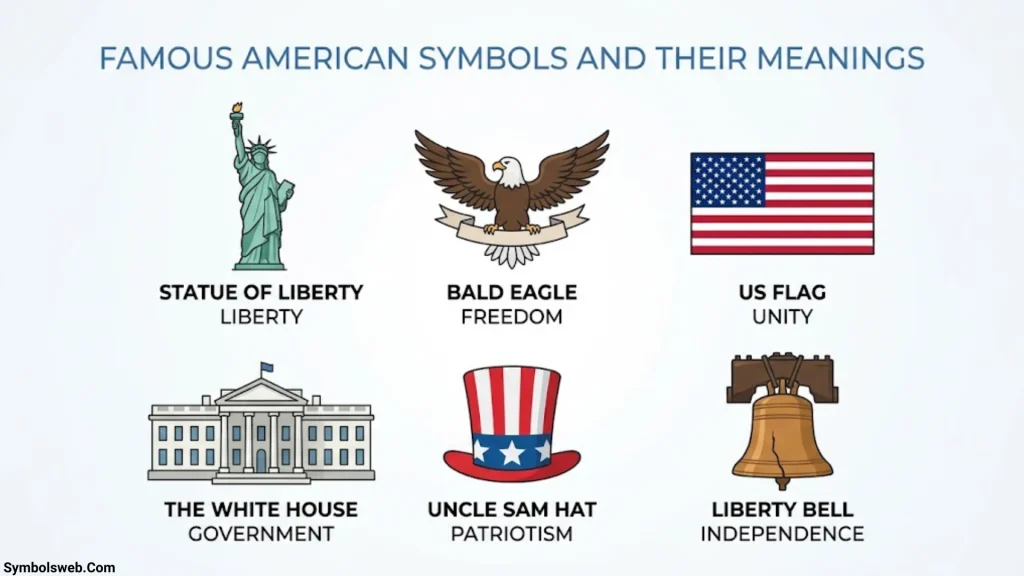
The following famous American symbols represent different parts of the nation’s history, government, and cultural heritage. Each has its own story, and some carry meanings that have changed over time.
American Flag Stars and Stripes
The American flag is one of the most recognizable patriotic symbols of America. Its red, white, and blue design represents the United States and appears at government buildings, schools, military installations, and public ceremonies.
The flag has 13 horizontal stripes alternating between red and white. These stripes represent the original thirteen colonies that declared independence from Great Britain. Its blue field contains 50 white stars, one for each state.
The Continental Congress adopted the first national flag design on June 14, 1777. The flag changed as the country expanded, eventually reaching its current 50-star design in 1960 after Hawaii became a state.
The flag’s traditional meanings include:
- Unity: The states form one nation despite their differences.
- Independence: The flag recalls the American Revolution and the founding of the United States.
- Patriotism: People display it to express national pride and connection.
- Freedom: It represents ideals associated with American independence and liberty.
Many Americans call the flag Old Glory, a nickname associated with patriotism and national identity. Its meaning can also inspire debate because people interpret American ideals through different historical experiences.
Bald Eagle A Symbol of American Strength and Freedom
The bald eagle is a powerful American national symbol associated with strength, independence, and freedom. Its impressive appearance and presence across North America helped make it a fitting emblem for the new republic.
Congress adopted the Great Seal of the United States on June 20, 1782. The seal features a bald eagle holding an olive branch in one talon and a bundle of arrows in the other. These objects traditionally represent peace and the ability to defend the nation.
For many years, the eagle served as the country’s best-known national bird in practice. Congress formally designated the bald eagle as the national bird in December 2024.
The eagle appears on U.S. coins, official seals, military insignia, and government documents. Its image also connects the country with wildlife conservation.
The bird once faced serious threats from habitat loss, hunting, and the effects of DDT pesticides. Federal protections and conservation efforts helped its population recover.
Today, the bald eagle represents both the nation’s founding ideals and the importance of protecting America’s natural heritage.
Statue of Liberty Freedom and Hope
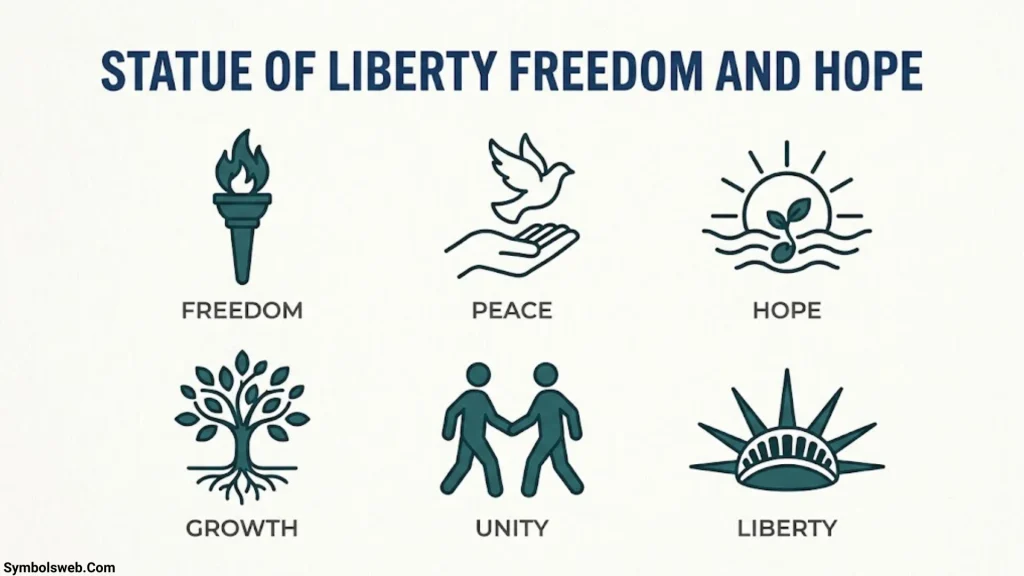
The Statue of Liberty is among the world’s most recognizable symbols of American freedom. Standing on Liberty Island in New York Harbor, the statue welcomes visitors with a raised torch and a crown featuring seven rays.
France presented the monument to the United States as a gift celebrating friendship between the two nations. French sculptor Frédéric Auguste Bartholdi designed the statue, while engineer Gustave Eiffel contributed to its internal structure.
The statue was dedicated on October 28, 1886. It later became closely connected with immigration because millions of immigrants arrived in New York during the late nineteenth and early twentieth centuries.
Its major symbolic features include:
- Torch: Enlightenment and the spread of liberty.
- Crown: Often associated with the seven seas and seven continents.
- Broken chains: Freedom from oppression and tyranny.
- Tablet: The date July 4, 1776, associated with American independence.
The statue also carries a strong connection to the American immigration story. However, its symbolism doesn’t mean every immigrant experienced equal treatment or opportunity. The monument represents an ideal that the country has continually struggled to fulfill.
Great Seal of the United States National Identity and Government
The Great Seal of the United States is an official government emblem used to authenticate certain federal documents. Congress approved its final design on June 20, 1782, making it one of the country’s oldest official national symbols.
The front of the seal features a bald eagle with a shield across its chest. The eagle holds an olive branch in one talon and 13 arrows in the other. Above its head, a constellation of 13 stars appears within a cloud.
Each element contributes to the seal’s meaning. The arrows represent the nation’s ability to defend itself, while the olive branch represents peace. The shield’s 13 stripes recall the original colonies.
The Latin phrase E Pluribus Unum means “Out of many, one.” It reflects the idea of a nation formed from separate states and communities.
The reverse side contains an unfinished pyramid and an eye above it. These elements have historical explanations connected to the seal’s original design, so interpretations should rely on documented sources rather than unsupported claims.
The Great Seal appears on official documents, including certain diplomatic papers. Its eagle and shield have also influenced other forms of American government imagery.
White House The Presidency
The White House represents the presidency and the executive branch of the federal government. Located at 1600 Pennsylvania Avenue NW in Washington, D.C., it serves as the president’s official residence and a central workplace for presidential staff.
Construction began in 1792, and President John Adams moved into the building in 1800. British forces burned it during the War of 1812 in 1814. Workers later rebuilt and restored the structure.
Although George Washington helped select the site for the national capital, he never lived in the White House. John Adams was the first president to occupy it.
The building includes several well-known spaces, such as the Oval Office, the Cabinet Room, and the East Room. Each serves different presidential, administrative, or ceremonial purposes.
As a symbol, the White House represents:
- Presidential leadership and executive authority.
- The administration responsible for carrying out federal laws.
- Diplomatic meetings and relations with other countries.
- The peaceful transfer of presidential power.
People often use “the White House” as shorthand for the president’s administration. However, the building itself is only one part of the much larger federal government.
U.S. Capitol Representative Democracy
The U.S. Capitol is the meeting place of the United States Congress. It stands on Capitol Hill in Washington, D.C., and represents the legislative branch of the federal government.
Congress consists of two chambers: the House of Representatives and the Senate. Together, they debate proposals, pass federal laws, approve spending, and perform oversight of the executive branch.
The Capitol’s distinctive dome makes it one of the most recognizable buildings in American political life. Construction began in 1793, and the building expanded as the country grew.
The Capitol also hosts major national events, including presidential inaugurations and memorial ceremonies. Its history reflects the development of the United States and the changing role of Congress.
The building represents representative democracy, a system in which elected officials make decisions on behalf of the people. Its significance also includes the principle that government authority operates within a constitutional framework.
Liberty Bell American Liberty
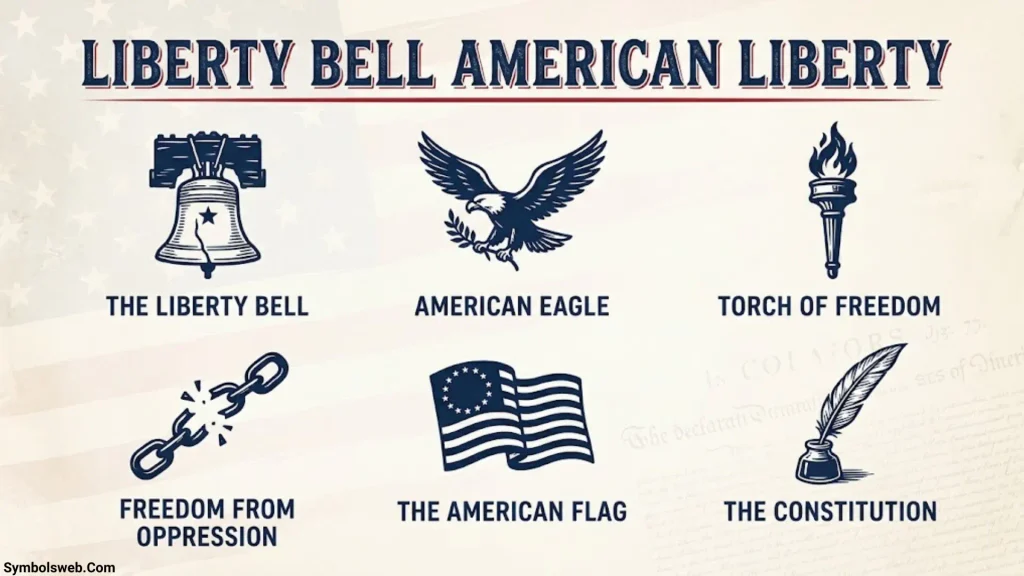
The Liberty Bell is a historic bell in Philadelphia, Pennsylvania. It became a lasting symbol of American liberty through its association with independence, abolition, and civil rights.
The bell was originally commissioned in 1751 for the Pennsylvania State House, now known as Independence Hall. After it cracked, workers attempted repairs, but it developed the large crack that gives it its familiar appearance.
Its inscription comes from Leviticus 25:10: “Proclaim Liberty Throughout All the Land Unto All the Inhabitants Thereof.”
Although people often connect the bell with the Declaration of Independence, the familiar story that it rang to announce independence on July 4, 1776, lacks solid historical evidence.
During the nineteenth century, abolitionists adopted the Liberty Bell as a symbol of their campaign against slavery. Later, civil rights advocates also drew on its message of liberty.
The bell’s history illustrates how a historical object can gain new meaning as different generations apply its message to changing struggles for freedom and equality.
Washington Monument Leadership and Independence
The Washington Monument honors George Washington, the commander of the Continental Army during the American Revolution and the first president of the United States.
The monument stands on the National Mall in Washington, D.C. Its tall, four-sided obelisk design draws inspiration from ancient Egyptian architecture, a style often associated with permanence and grandeur.
Construction began in 1848 but stopped for several years because of financial problems and political disputes. Work resumed in 1879, and the monument was completed in 1884. It opened to the public in 1888.
At approximately 555 feet tall, it remains one of Washington, D.C.’s most recognizable landmarks.
The monument represents national leadership, the struggle for independence, and the founding of the American republic. Its position within the capital’s monumental landscape connects Washington’s legacy with the institutions and ideals that shaped the nation.
Lincoln Memorial Freedom and Equality
The Lincoln Memorial honors Abraham Lincoln, the 16th president of the United States. Lincoln led the country during the Civil War and issued the Emancipation Proclamation, which declared enslaved people in areas rebelling against the Union to be free.
The memorial opened in Washington, D.C., on May 30, 1922. Its architecture resembles a classical Greek temple, with 36 columns representing the states in the Union at the time of Lincoln’s death.
Inside, a large seated statue of Lincoln faces the National Mall. The walls display inscriptions from the Gettysburg Address and his Second Inaugural Address.
The memorial later became an important gathering place for civil rights demonstrations. On August 28, 1963, Martin Luther King Jr. delivered his famous I Have a Dream speech nearby during the March on Washington for Jobs and Freedom.
The Lincoln Memorial represents freedom, national unity, and the ongoing pursuit of equality. Its history also reminds visitors that declaring ideals and achieving them are two very different tasks.
Mount Rushmore Presidential History
Mount Rushmore National Memorial features the granite faces of four American presidents carved into the Black Hills of South Dakota. The monument honors George Washington, Thomas Jefferson, Theodore Roosevelt, and Abraham Lincoln.
Sculptor Gutzon Borglum led the project, which began in 1927. Workers completed the carving in 1941, creating a landmark that attracts visitors from around the world.
Each president represents a different part of the country’s national story:
- George Washington: The founding of the republic.
- Thomas Jefferson: The Declaration of Independence and westward expansion.
- Theodore Roosevelt: Economic development and conservation.
- Abraham Lincoln: Preservation of the Union and the end of slavery.
Mount Rushmore is a prominent example of American monumental art. It also carries important historical context involving the Lakota people and the Black Hills, which hold deep cultural and spiritual significance for Indigenous communities.
The federal government’s acquisition and use of the land remain sources of dispute. A balanced understanding of Mount Rushmore includes both its place in national commemoration and the Indigenous history of the site.
Jefferson Memorial Founding Principles
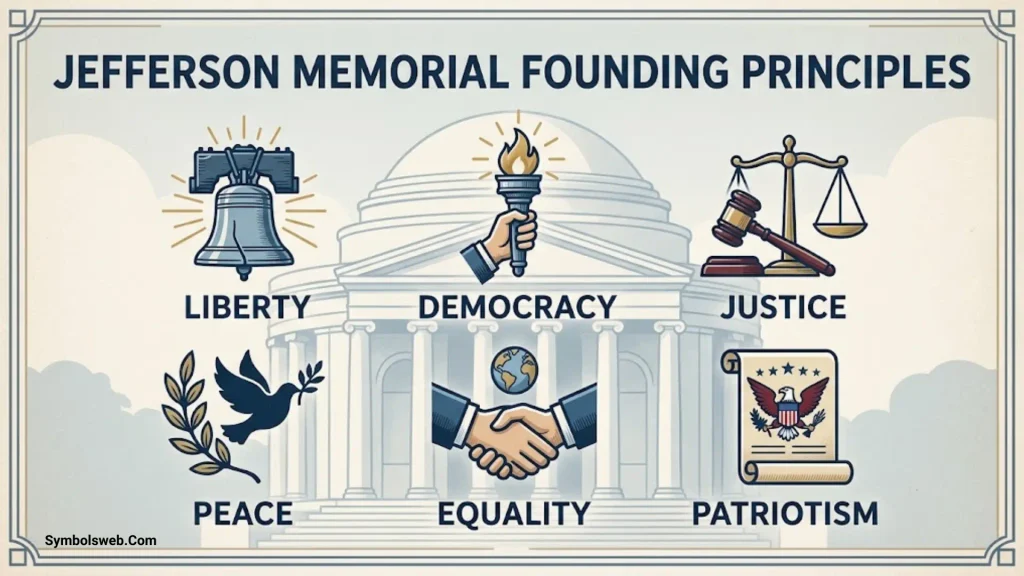
The Jefferson Memorial honors Thomas Jefferson, the third president of the United States and the principal drafter of the Declaration of Independence.
Dedicated in 1943, the memorial stands beside the Tidal Basin in Washington, D.C. Its domed structure and classical columns reflect Jefferson’s interest in neoclassical architecture.
Jefferson is closely associated with the language of natural rights and the idea that people possess fundamental liberties. The Declaration of Independence famously states that “all men are created equal.”
His legacy also contains a serious contradiction: Jefferson enslaved people throughout his life. This fact complicates his relationship with the principles of equality and freedom that he helped articulate.
The memorial therefore represents both the nation’s founding ideals and the importance of examining its history honestly. Understanding American symbols often means considering achievements alongside injustice.
Martin Luther King Jr. Memorial Civil Rights and Justice
The Martin Luther King Jr. Memorial honors the minister and civil rights leader who helped shape the modern struggle for racial equality in America.
Located on the National Mall in Washington, D.C., the memorial opened to the public in 2011. Its central sculpture, known as the Stone of Hope, depicts King emerging from a larger stone formation.
King advocated nonviolent protest, equal treatment under the law, and an end to racial segregation. His leadership contributed to a movement that challenged discriminatory laws and practices across the country.
The Civil Rights Act of 1964 prohibited discrimination in several major areas of public life. The Voting Rights Act of 1965 later addressed barriers that had prevented many Black Americans from exercising their voting rights.
The memorial represents justice, dignity, equal opportunity, and peaceful activism. It also connects the ideals expressed in America’s founding documents with the efforts of people who demanded that the nation apply those ideals more fairly.
American Bison Wildlife and Natural Heritage
The American bison became the official national mammal of the United States in 2016. Often called buffalo in everyday American speech, the bison is a distinctive North American animal associated with grasslands, wildlife conservation, and Indigenous heritage.
Historically, enormous bison herds roamed across the Great Plains. Many Indigenous nations depended on bison for food, clothing, tools, shelter materials, and cultural traditions.
During the nineteenth century, commercial hunting and other pressures caused bison populations to collapse. Their decline harmed ecosystems and disrupted Indigenous communities whose lives were closely connected to the animals.
Conservation efforts helped prevent the species from disappearing. Yellowstone National Park preserves one of the country’s important wild bison populations.
Today, the bison symbolizes natural resilience and conservation. Its history also shows why protecting American wildlife involves more than preserving animals; it requires understanding ecosystems and cultural relationships with the land.
Oak Tree Strength and Endurance
The oak tree became the official national tree of the United States in 2004. Oaks belong to the genus Quercus, which includes many species native to North America.
Oak trees can live for centuries, and mature specimens often develop broad canopies and strong trunks. Their acorns provide food for birds, squirrels, deer, and other wildlife.
Oaks also support biodiversity by providing shelter and breeding habitat for numerous insects and other organisms. Their deep roots and substantial wood make them important parts of many American forests and landscapes.
In cultural symbolism, oak trees often represent strength, endurance, stability, and longevity. These associations come from their size, long lives, and ability to withstand changing seasons.
Unlike the bald eagle and bison, the oak does not represent a single animal species. It stands for a broader connection between national identity and the country’s natural environment.
Rose The National Floral Emblem
The rose became the official national floral emblem of the United States in 1986. President Ronald Reagan signed the relevant joint resolution into law on October 7, 1986.
Roses have a long history in gardens, art, ceremonies, and literature. Their colors and varieties have inspired associations with love, beauty, remembrance, respect, and devotion.
The rose is a broad botanical group rather than one single flower variety. Different species and cultivated roses grow across the United States, making the emblem familiar in gardens and public spaces.
The rose also appears in American civic and presidential settings, including the White House Rose Garden. However, the garden itself is not what established the rose’s national designation.
As a national symbol, the rose represents the country’s floral heritage and the cultural meanings people attach to flowers. Its symbolism is less political than that of the flag or Great Seal, yet it remains an official part of the nation’s collection of symbols.
Official National Symbols of the United States
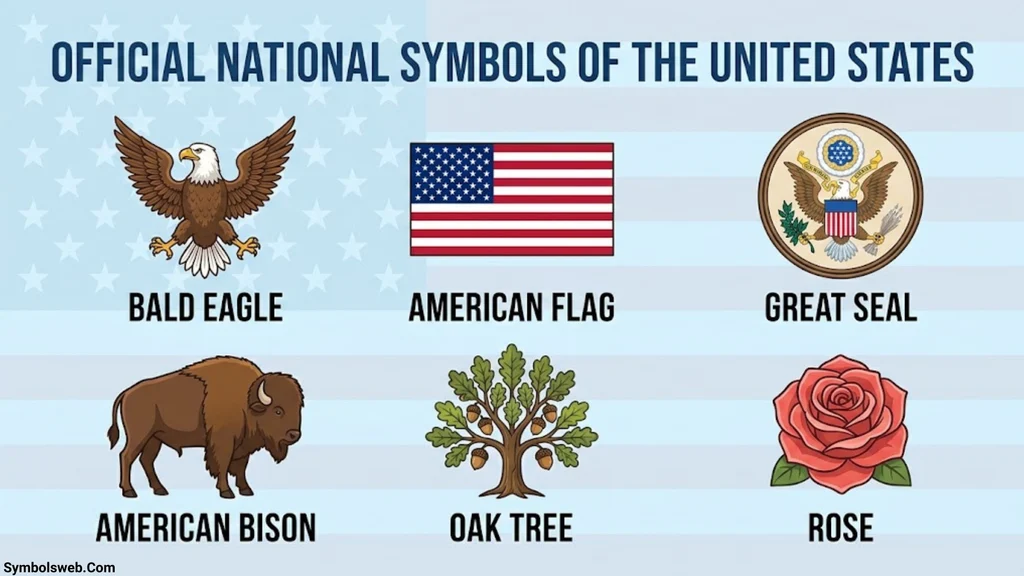
The United States has several symbols formally recognized through federal law. These include national emblems, natural symbols, and patriotic traditions that represent different aspects of the country.
The Congressional Research Service explains that national symbols have been designated through specific laws and government actions, rather than one single definition covering every American symbol.
National Flag of the United States
The American flag is the nation’s national flag and one of its most widely recognized emblems. Federal law governs its design, while historical traditions guide how people display it.
Its 50 stars represent the states, and its 13 stripes represent the original colonies. The current design has been in use since July 4, 1960, following Hawaii’s admission to the Union.
National Bird, Mammal, Tree, and Floral Emblem
The following symbols have specific federal designations:
| National symbol | Official designation | Year |
| Bald eagle | National bird | 2024 |
| North American bison | National mammal | 2016 |
| Oak (Quercus) | National tree | 2004 |
| Rose | National floral emblem | 1986 |
The bald eagle’s designation as the national bird became law on December 23, 2024. Its symbolic role dates back much further, to the adoption of the Great Seal in 1782.
National Anthem, Motto, and March
The United States also recognizes national symbols through music and language.
- National anthem: The Star-Spangled Banner, written by Francis Scott Key as a poem in 1814 and designated the national anthem in 1931.
- National motto: “In God We Trust,” adopted as the national motto in 1956.
- National march: The Stars and Stripes Forever, composed by John Philip Sousa and designated the national march in 1987.
These symbols express national identity through sound and words rather than buildings or physical objects. The anthem recalls a battle during the War of 1812, while the motto and march reflect traditions that developed at different points in American history.
The Great Seal as an Official Government Emblem
The Great Seal deserves special attention because it serves a formal government purpose. It authenticates important documents, including treaties and presidential communications.
Its design also appears in other official settings, including passports and government insignia. The U.S. Department of State serves as custodian of the seal, preserving its role in official government business.
American Symbols That Represent Freedom and Democracy
Many symbols of American freedom connect the country’s founding ideals with its political institutions and social movements. Their meanings overlap, but each offers a different perspective on liberty and democracy.
Symbols of Freedom and Liberty
The Statue of Liberty, Liberty Bell, American flag, and bald eagle are among the best-known symbols associated with freedom.
The Statue of Liberty connects liberty with hope and immigration. The Liberty Bell recalls the language of freedom and later became a symbol for abolitionists. The flag represents national independence, while the bald eagle symbolizes strength and independence.
These meanings aren’t always limited to one interpretation. People may view a symbol through personal experience, family history, or changing social conditions.
Symbols of Democracy and Representative Government
The U.S. Capitol, White House, Great Seal, and Independence Hall represent different parts of American government.
The Capitol stands for Congress and the legislative process. The White House represents the presidency, while the Great Seal identifies the federal government on official documents.
Independence Hall in Philadelphia is especially important because delegates adopted the Declaration of Independence there in 1776 and later debated the Constitution in 1787.
Together, these places and emblems connect American democracy with the institutions that shape public policy and national leadership.
Symbols of Equality and Civil Rights
The Lincoln Memorial and Martin Luther King Jr. Memorial represent important stages in the long struggle for civil rights.
Lincoln’s presidency coincided with the Civil War and the beginning of the end of slavery in the United States. King’s leadership helped advance the modern civil rights movement, which challenged segregation and racial discrimination.
These memorials represent more than the individuals they honor. They also remind visitors that the pursuit of equality has required protest, legal change, political leadership, and sustained public effort.
Symbols of Unity and National Identity
The American flag and Great Seal represent the idea of a nation formed from different states and communities. The phrase E Pluribus Unum, meaning “Out of many, one,” expresses this idea directly.
National symbols can unite people around shared traditions. However, Americans don’t always agree on what those symbols should represent or how the country should interpret its past.
That tension is part of their historical significance. A symbol can represent common ideals while also encouraging debate about whether the nation has lived up to them.
Historical American Symbols and Their Origins
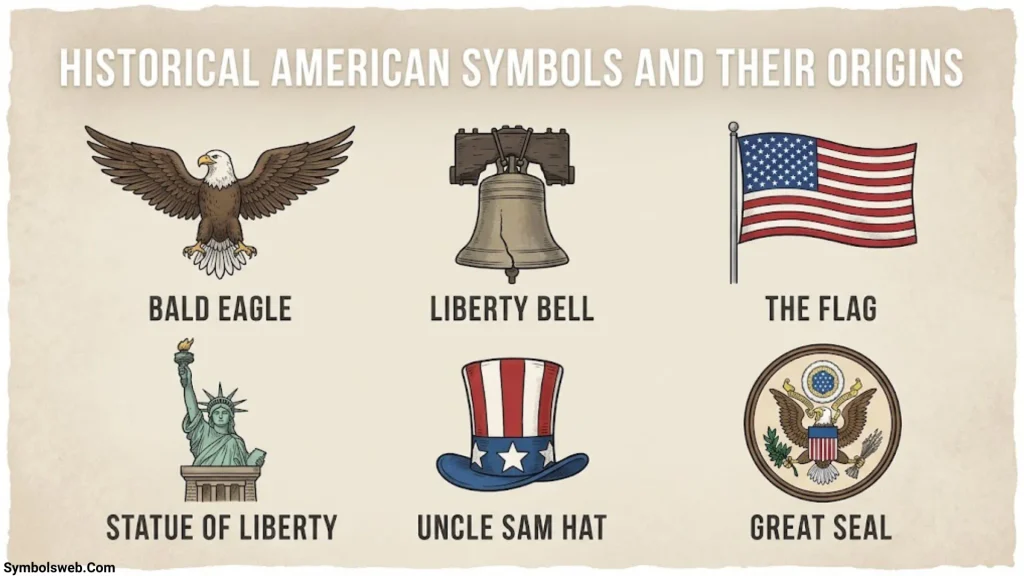
Understanding historical American symbols means looking beyond their modern appearance. Many began as practical objects or political emblems before gaining broader cultural meanings.
Symbols of the American Revolution
The American flag, Liberty Bell, Great Seal, and Independence Hall all connect with the struggle for independence.
The Declaration of Independence was adopted on July 4, 1776. It announced that the thirteen colonies regarded themselves as independent states, separate from British rule.
The Great Seal followed in 1782, giving the new nation an official emblem. Independence Hall became a lasting landmark associated with the founding era, while the Liberty Bell later gained additional significance through abolitionist and civil rights movements.
These symbols preserve different aspects of the Revolution: its political goals, its institutions, and the ideals that Americans continued to debate.
Symbols of the Founding Fathers
George Washington and Thomas Jefferson remain central figures in American history.
Washington represents military leadership during the Revolution and the establishment of the presidency. The Washington Monument honors his role in the founding of the republic.
Jefferson helped draft the Declaration of Independence and served as the third president. The Jefferson Memorial commemorates his influence on American political thought.
However, both men’s legacies require historical context. Jefferson enslaved people, and the early United States permitted slavery even as its founding documents expressed ideals of liberty. Washington also enslaved people during his lifetime.
Recognizing these facts doesn’t erase their historical importance. Instead, it helps explain the contradictions between the country’s founding principles and its early practices.
Symbols of the Civil War and Emancipation
The Lincoln Memorial represents one of the most consequential periods in the country’s development.
During the Civil War, Lincoln issued the Emancipation Proclamation, which took effect on January 1, 1863. It declared enslaved people in designated areas still in rebellion against the United States to be free, although its practical reach depended on Union military advances.
The Thirteenth Amendment, ratified in 1865, abolished slavery throughout the United States, with an exception for punishment for crime after conviction.
These events gave Lincoln’s legacy a lasting connection to emancipation, national unity, and the struggle to expand freedom.
Symbols of the Civil Rights Movement
The Martin Luther King Jr. Memorial represents the continuing struggle for racial justice and equal rights.
The 1963 March on Washington brought thousands of people to the nation’s capital to demand jobs and freedom. King delivered his famous I Have a Dream speech near the Lincoln Memorial.
The Civil Rights Act of 1964 prohibited discrimination in major areas of public life, including public accommodations and employment. The Voting Rights Act of 1965 addressed discriminatory barriers to voting.
These landmarks and events show how Americans have used the language of the founding era to challenge unequal treatment and press for broader civil rights.
American Cultural and Patriotic Symbols
Not all American cultural symbols have official government status. Some became recognizable through folklore, literature, music, advertising, or everyday traditions.
Uncle Sam
Uncle Sam is a personification of the United States federal government. Artists often depict him as an older man with white hair, a goatee, and clothing inspired by the American flag.
His image became especially familiar through political cartoons and recruitment posters. The famous “I Want YOU for U.S. Army” poster associated with artist James Montgomery Flagg helped establish Uncle Sam as a recognizable patriotic figure during World War I.
Unlike the bald eagle or Great Seal, Uncle Sam isn’t an official national emblem established through a specific designation in federal law. He is a cultural figure used to represent the country and its government.
The Stars and Stripes in American Traditions
The American flag appears during Independence Day celebrations, military ceremonies, memorial services, and public gatherings.
Flag Day, observed on June 14, commemorates the adoption of the first national flag design in 1777. Independence Day celebrates the Declaration of Independence, while Memorial Day honors military personnel who died in service.
People also display the flag during sporting events and civic celebrations. For many, it expresses patriotism and respect for the country. Others use it to draw attention to disagreements about American policies or the meaning of national ideals.
The National Anthem
The Star-Spangled Banner became the official national anthem in 1931. Francis Scott Key wrote its lyrics after witnessing the British bombardment of Fort McHenry during the War of 1812.
The song’s central image comes from the American flag flying over the fort after the battle. Its lyrics reflect the uncertainty of wartime and the relief associated with seeing the flag still flying.
Today, the anthem is performed at national ceremonies, military events, and many sporting competitions. Its historical origins connect music, the American flag, and the country’s experience of defending its independence.
The American Cowboy
The American cowboy is a cultural symbol associated with ranching, cattle drives, and the history of the American West.
Cowboys played important roles in the cattle industry, particularly during the nineteenth century. Their work drew on ranching traditions shaped by Spanish, Mexican, Indigenous, and Anglo-American influences.
Popular Western films and novels later transformed the cowboy into a figure representing independence, self-reliance, and frontier life.
The familiar image of a lone rider facing the open range doesn’t capture every aspect of historical ranching. Real cowboys worked in teams and came from varied backgrounds, including Mexican American and Black communities.
The cowboy remains a cultural symbol rather than an official national emblem.
American Symbols in Nature and Wildlife
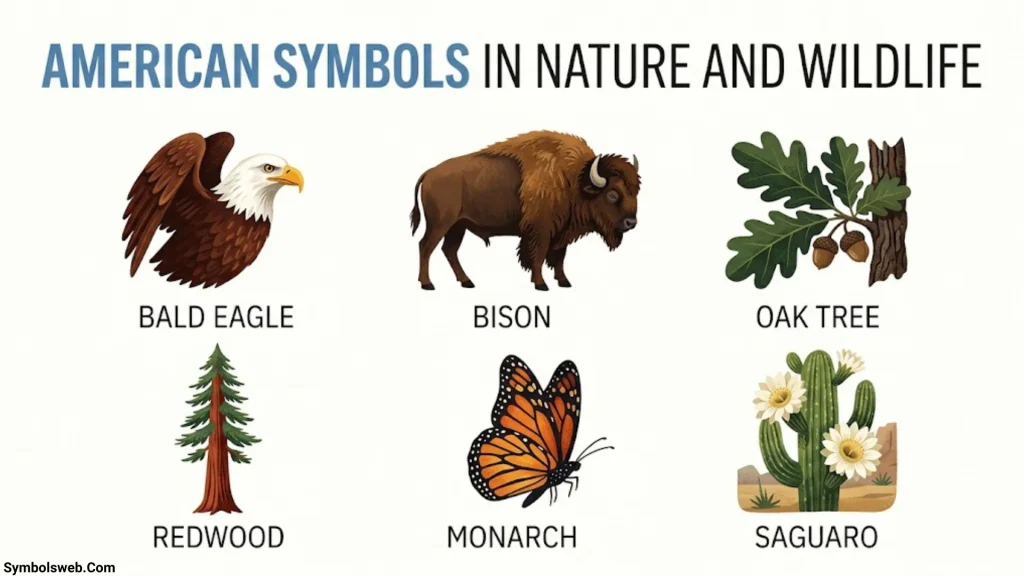
Natural symbols connect American identity with the country’s landscapes, wildlife, and conservation history. The bald eagle, bison, oak tree, and rose each represent a different part of that relationship.
The Bald Eagle and American Wildlife Conservation
The bald eagle has long represented American independence and strength. Yet its history also reflects the importance of protecting wildlife.
Hunting, habitat loss, and DDT pesticides caused serious declines in eagle populations during the twentieth century. Legal protections and conservation programs helped the species recover.
In 2007, the bald eagle was removed from the federal endangered and threatened species list. Its recovery became an important conservation success story.
The eagle’s modern significance therefore includes both national identity and environmental stewardship.
The American Bison and the Great Plains
The American bison once formed enormous herds across much of North America. Its decline during the nineteenth century changed grassland ecosystems and had devastating consequences for many Indigenous communities.
Bison restoration efforts now help conserve the species and maintain important ecological relationships. Yellowstone National Park protects wild bison, while tribal nations, conservation organizations, and public agencies support additional herds.
As the national mammal, the bison symbolizes wildlife heritage and resilience. Its story also highlights the importance of Indigenous knowledge and the historical consequences of disrupting ecosystems.
The Oak Tree and the Rose
The oak and rose represent different aspects of America’s natural heritage.
The oak is the official national tree, recognized in 2004. Its longevity, large branches, and value to wildlife make it a familiar symbol of strength and endurance.
The rose became the national floral emblem in 1986. It has long featured in gardens, ceremonies, literature, and artistic traditions.
Neither symbol has one universally accepted symbolic meaning. Their cultural associations vary, but both connect the national identity with the country’s plants, landscapes, and living traditions.
American Symbols and Their Meanings at a Glance
If you need a quick reference for a school assignment, educational chart, or general research, this table summarizes the most recognizable American symbols and their meanings.
| American symbol | Main meaning | Symbol category |
| American flag | Independence and national unity | National flag |
| Bald eagle | Strength and freedom | National bird |
| Statue of Liberty | Liberty and hope | Monument |
| Great Seal | National sovereignty and government | Official emblem |
| White House | Presidential leadership | Government building |
| U.S. Capitol | Representative democracy | Government building |
| Liberty Bell | Freedom and liberty | Historical artifact |
| Washington Monument | National leadership | Monument |
| Lincoln Memorial | Emancipation and equality | Memorial |
| Mount Rushmore | Presidential history | Memorial |
| Jefferson Memorial | Founding ideals | Memorial |
| Martin Luther King Jr. Memorial | Civil rights and justice | Memorial |
| American bison | Wildlife and natural heritage | National mammal |
| Oak tree | Strength and endurance | National tree |
| Rose | Floral heritage and beauty | National floral emblem |
| Uncle Sam | The federal government | Cultural symbol |
| The Star-Spangled Banner | National identity and resilience | National anthem |
| American cowboy | Western history and frontier culture | Cultural symbol |
These symbols don’t all have the same legal status. Some have official national designations, while others represent the country through historical events, public recognition, or cultural traditions.
Frequently Asked Questions About American Symbols
What Are the Most Famous American Symbols?
The most famous American symbols include the American flag, bald eagle, Statue of Liberty, Great Seal, White House, Liberty Bell, and U.S. Capitol. The Lincoln Memorial and Mount Rushmore are also widely recognized.
Each represents a different part of the nation’s story, from independence and government to civil rights and presidential history.
What Do American National Symbols Represent?
American national symbols represent the country’s history, political institutions, natural heritage, and cultural identity.
The flag represents the nation and its unity. The bald eagle symbolizes independence and strength, while the Statue of Liberty is associated with freedom and hope. The Great Seal represents national sovereignty and official government authority.
Their meanings can evolve as new generations interpret American history and national ideals.
What Is the Official National Bird of the United States?
The bald eagle is the official national bird of the United States. Congress formally designated it on December 23, 2024, under Public Law 118-206.
The eagle had already served as an important national emblem since 1782, when Congress adopted the Great Seal featuring the bird.
What Are the National Animal, Tree, and Flower of America?
The North American bison is the national mammal, the oak is the national tree, and the rose is the national floral emblem. The bald eagle is the national bird.
These designations recognize animals and plants associated with the country’s natural heritage. The bison’s designation also highlights wildlife conservation, while the oak and rose reflect the importance of plants in American landscapes and traditions.
Which American Symbols Represent Freedom and Democracy?
Several symbols represent freedom and democracy, including the American flag, Statue of Liberty, Liberty Bell, U.S. Capitol, and Great Seal.
The Statue of Liberty is associated with liberty and hope. The Liberty Bell became connected with abolition and civil rights, while the Capitol represents the legislative branch of government.
Together, these symbols reflect the country’s founding ideals and the continuing effort to put them into practice.
What Is the Difference Between Official and Cultural American Symbols?
Official American symbols have a formal designation or recognized government function. Examples include the national bird, national tree, national floral emblem, and Great Seal.
Cultural symbols gain recognition through public traditions, history, art, and popular culture. Uncle Sam and the American cowboy are familiar examples.
Some symbols, including the American flag and bald eagle, have both formal national significance and broad cultural meaning.
Conclusion: Why American Symbols Matter
American symbols help explain the United States through its history, government, traditions, and natural heritage. The American flag represents the nation, the Statue of Liberty evokes freedom and hope, and the Great Seal identifies the federal government. Meanwhile, the Lincoln Memorial and Martin Luther King Jr. The memorial preserves the memory of important struggles for equality and civil rights.
Understanding these symbols means looking beyond their familiar appearances. Their histories reveal achievements, difficult contradictions, and changing interpretations of American ideals. Some have official federal designations, while others gained significance through public movements and cultural traditions. Together, they offer a deeper understanding of American identity and the values the country continues to debate and pursue.

Hi, I’m Ethan Holloway, and I’ve always believed that a few meaningful words can change the way we think, feel, and live. I enjoy collecting timeless quotes, studying their deeper meanings, and sharing inspiring messages that help people stay motivated through every stage of life.
Over the years, I’ve explored thousands of famous sayings from writers, leaders, philosophers, and everyday people. My goal is to make wisdom easy to understand and useful for everyone.
Books by Ethan Holloway
- The Power of Everyday Quotes
- Words That Inspire Greatness
 Eliana Foster
 Jordan Hayes