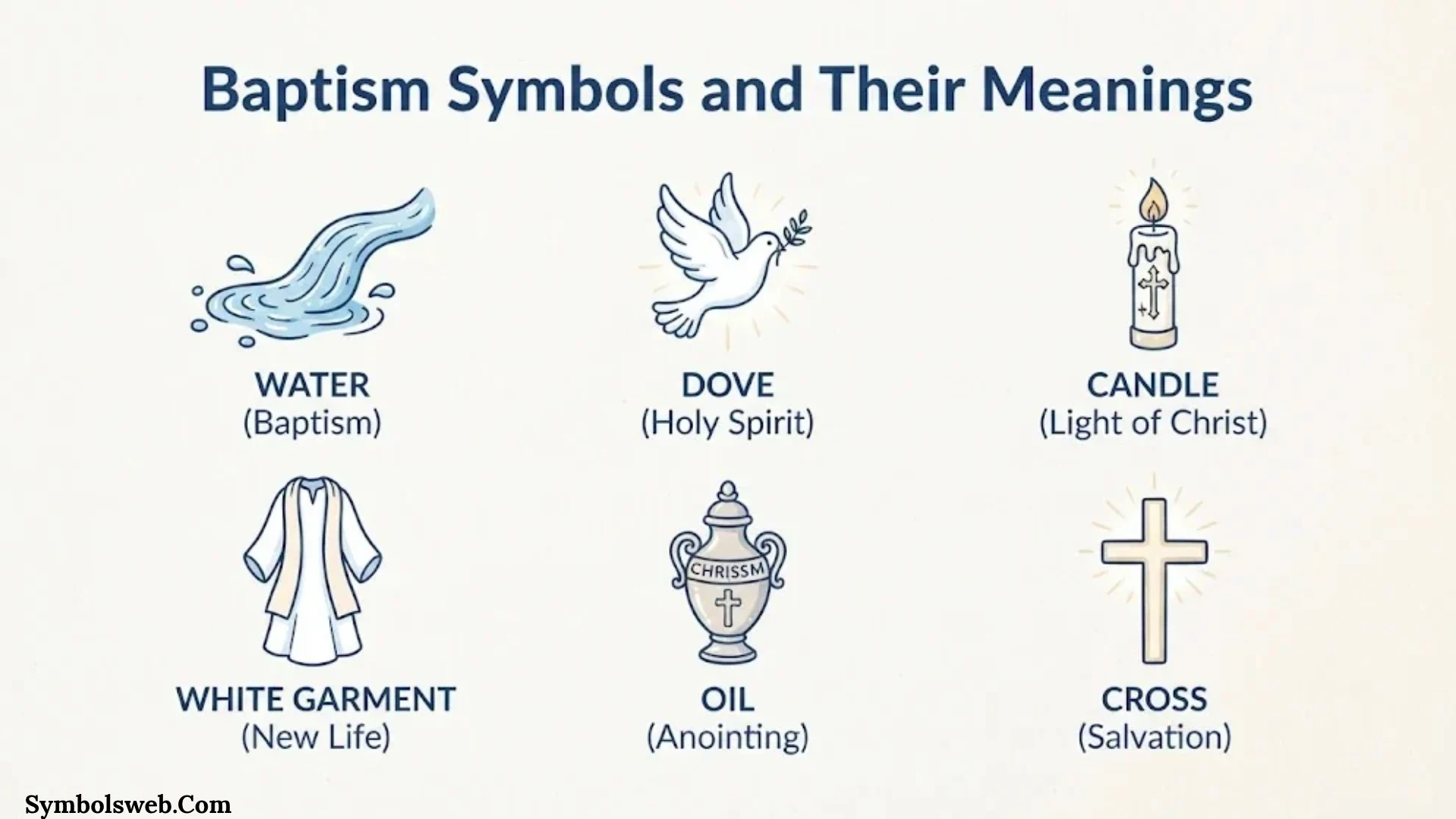
Baptism is one of the most meaningful ceremonies in Christianity. It marks the beginning of a person’s Christian journey and represents a new relationship with God. During the ceremony, familiar objects such as water, oil, white clothing, and candles carry deep spiritual meanings. Each symbol helps explain an important part of Christian faith.
The symbols of baptism represent ideas such as forgiveness, spiritual cleansing, rebirth, salvation, faith, and the presence of the Holy Spirit. They also remind Christians of Jesus Christ’s death and resurrection. Although baptism traditions differ among Christian denominations, many churches use similar symbols to express these beliefs.
Understanding baptism symbols helps you see why each part of the ceremony matters. If you’re preparing for a baby’s baptism, attending an adult baptism, studying Christian traditions, or choosing a meaningful baptism gift, this guide explains the most recognized symbols and their biblical significance.
What Are the Symbols of Baptism?
Baptism symbols are objects, actions, and signs used during Christian baptism to communicate spiritual truths. They help believers understand what baptism represents and how it connects them to Jesus Christ.
Some symbols appear directly in the baptism ceremony. Others come from biblical stories, Christian teachings, and traditions that developed throughout church history.
The four widely recognized symbols in Catholic baptism are water, oil, a white garment, and light. Other traditions may use some of these symbols differently or place greater emphasis on the act of baptism itself.
Here are the main baptism symbols and their meanings:
| Baptism symbol | Spiritual meaning |
| Water | Cleansing, forgiveness, and new life |
| Cross | Jesus Christ’s sacrifice and redemption |
| White garment | Purity, new identity, and life in Christ |
| Baptismal oil | Strength, healing, and the Holy Spirit |
| Baptismal candle | Christ’s light and Christian faith |
| Dove | The Holy Spirit and God’s presence |
| Baptismal font | The place of spiritual rebirth |
| Sign of the cross | Belonging to Jesus Christ |
| Holy Trinity | Father, Son, and Holy Spirit |
| Bible and prayers | God’s Word and the Christian faith |
| Godparents | Spiritual guidance and support |
These symbols do not all have the same role in every church. Some are central parts of a formal baptism rite, while others help explain its spiritual meaning.
Main Symbols of Baptism and Their Meanings
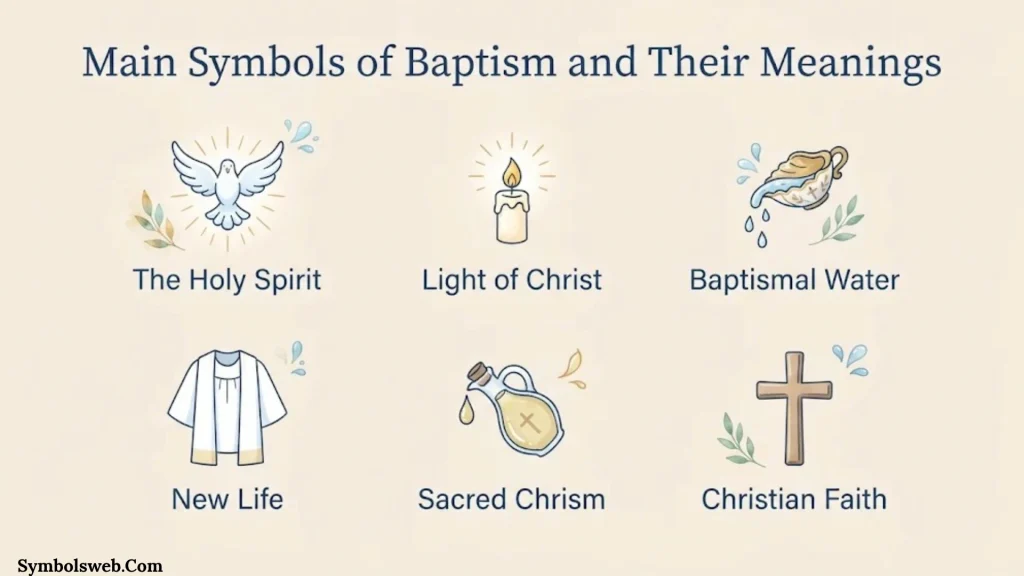
Each baptism symbol tells part of the Christian story. Together, they represent a person’s entry into the Christian community and a new life of faith.
Water: The Main Symbol of Baptism
Water is the central and most recognizable symbol of baptism. It represents spiritual cleansing, forgiveness, purification, and new life.
Water is essential for physical life. People need it to drink, grow food, and stay healthy. Christianity uses this familiar image to explain spiritual renewal. Just as water cleans the body, baptismal water represents cleansing from sin and the beginning of a renewed life with God.
The Bible connects water with several important moments in salvation history. In Genesis, water appears in the creation story. The flood in Noah’s time becomes another biblical image of judgment and renewal. Later, the Israelites pass through the Red Sea as they escape slavery in Egypt.
Water also plays a central role in the baptism of Jesus. John the Baptist baptized Jesus in the Jordan River, making this event an important model for Christian baptism.
What baptism water represents:
- Cleansing from sin: Water represents spiritual purification and forgiveness.
- New birth: It points to a new beginning through God’s grace.
- Life: Water reminds Christians that God gives and sustains spiritual life.
- Death and resurrection: Going beneath the water and rising again can symbolize dying to an old life and rising to a new one.
- The Holy Spirit: Christian baptism connects water with the work of the Spirit.
Different Christian denominations explain the relationship between baptism, forgiveness, and salvation in different ways. However, water remains the defining physical element of Christian baptism.
The Catholic Church’s Catechism explains that baptism may take place through immersion or by pouring water over the candidate. In the Catholic Latin rite, the minister uses the Trinitarian formula while pouring water three times. Read Catechism of the Catholic Church, paragraphs 1238–1240.
The Cross: Jesus Christ’s Sacrifice and Redemption
The cross is one of the most important symbols in Christianity. It represents Jesus Christ’s crucifixion, sacrifice, death, and resurrection.
During baptism, the cross reminds believers that their new Christian life is connected to Jesus. His death and resurrection form the foundation of Christian faith. Baptism therefore represents more than a public celebration. It marks a person’s connection to Christ and his teachings.
In some Christian baptism ceremonies, the minister makes the sign of the cross on the candidate’s forehead. This gesture marks the person as belonging to Christ.
The cross may also appear on baptism invitations, church decorations, clothing, jewelry, and keepsakes.
The cross represents:
- Jesus’ sacrifice for humanity.
- Forgiveness and redemption.
- Victory over sin and death.
- A new identity in Christ.
- Commitment to follow Christian teachings.
A small cross necklace or engraved cross can also become a meaningful baptism gift. It serves as a lasting reminder of the faith celebrated during the ceremony.
White Garment: Purity and New Life in Christ
A white baptism garment represents purity, innocence, spiritual renewal, and a new identity in Jesus Christ.
In many Christian traditions, the newly baptized person wears or receives white clothing during the ceremony. The garment symbolizes leaving behind an old life and beginning a new one through faith.
White is commonly associated with light, cleanliness, hope, and new beginnings. In baptism, it carries a deeper meaning. It represents being clothed in Christ and sharing in his resurrection.
The biblical connection appears in Galatians 3:27:
“All of you who were baptized into Christ have clothed yourselves with Christ.”
The Catholic Catechism also explains that the white garment symbolizes that the baptized person has put on Christ and has risen with him.
What the white garment symbolizes:
- Spiritual purity and cleansing.
- A fresh beginning.
- New life through Jesus Christ.
- Christian dignity.
- Hope in the resurrection.
- A commitment to live according to Christian faith.
For infant baptisms, families often choose a white baptism gown, christening dress, or traditional baptismal robe. Adults may wear a white garment provided by their church or choose suitable white clothing.
Some families preserve baptism gowns as treasured family keepsakes. Parents may even pass them down through generations.
Baptismal Oil: Strength, Healing, and the Holy Spirit
Oil is another important symbol used in several Christian baptism traditions. It represents strength, healing, blessing, protection, and dedication to God.
In Catholic baptism, two types of oil may be used: the Oil of Catechumens and Sacred Chrism. They have different purposes and meanings.
Oil of Catechumens
The Oil of Catechumens is used before baptism in the Catholic rite. It symbolizes spiritual strength and preparation for the Christian life.
Historically, oil was used by athletes before competitions. They applied it to their bodies as part of their preparation. This background helps explain why baptismal oil can represent strength for the spiritual journey ahead.
The anointing reminds the candidate that Christian life involves challenges and requires faith, courage, and commitment.
Sacred Chrism
Sacred Chrism is a perfumed oil blessed by a bishop. In the Catholic baptism ceremony, it is applied after the baptism with water.
It represents the gift of the Holy Spirit and the person’s incorporation into Christ. The anointing also connects the baptized person with Christ’s roles as priest, prophet, and king.
In Eastern Christian traditions, the anointing after baptism is part of Chrismation, which is closely connected with Christian initiation.
Baptismal oil represents:
- Strength for the Christian journey.
- Healing and spiritual preparation.
- God’s blessing.
- The gift of the Holy Spirit.
- Dedication to Christ.
- Participation in the life of the Church.
Oil is not used in every Christian baptism service. Its role depends on the denomination and its liturgical tradition.
Baptismal Candle: The Light of Christ
A baptismal candle represents Jesus Christ as the Light of the World. It symbolizes faith, hope, spiritual guidance, and the responsibility to live according to Christian teachings.
In many Catholic baptism ceremonies, the candle is lit from the Paschal candle, also called the Easter candle. The Paschal candle represents the risen Christ and his victory over death.
The newly baptized person receives the candle as a reminder to walk in the light of Christ. During an infant baptism, a parent or godparent may hold it on the child’s behalf.
The image of light appears throughout the Bible. In Matthew 5:14, Jesus tells his followers:
“You are the light of the world.”
This teaching connects baptism with the responsibility to reflect Christ’s love through daily actions.
The baptismal candle symbolizes:
- Jesus Christ as the Light of the World.
- Faith and spiritual understanding.
- Hope during difficult times.
- Guidance through Christian teachings.
- A life dedicated to God.
- The responsibility to share kindness and love.
Families sometimes keep the baptismal candle as a reminder of the ceremony. Some churches also provide personalized candles with the child’s name and baptism date.
Dove: The Holy Spirit and God’s Presence
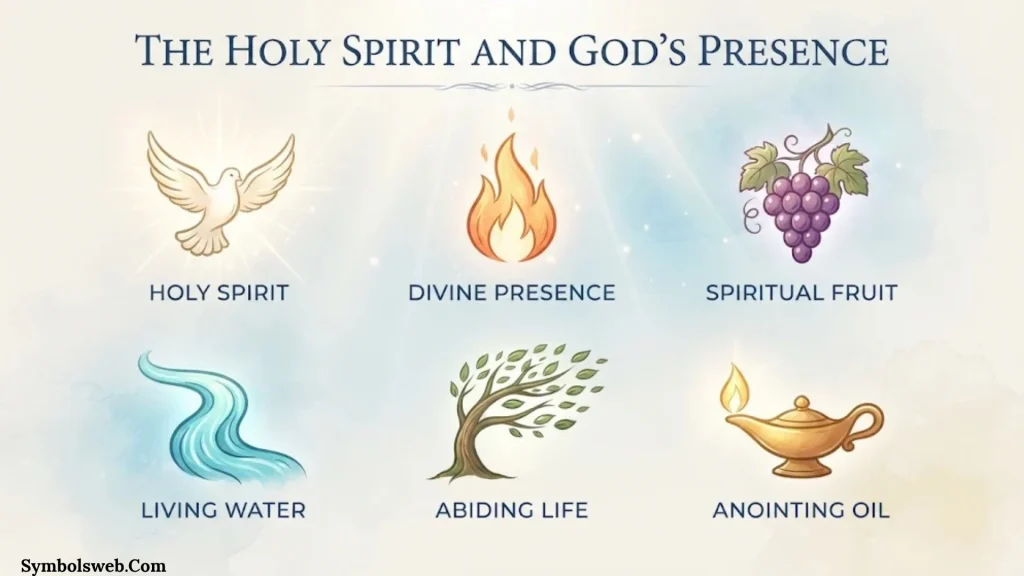
The dove is a widely recognized Christian symbol of the Holy Spirit. It is often associated with baptism because of the biblical account of Jesus’ baptism.
According to the Gospels, the Holy Spirit descended upon Jesus like a dove after John baptized him in the Jordan River. This moment appears in Matthew 3:16, Mark 1:10, and Luke 3:22.
The dove therefore represents the presence and work of the Holy Spirit. It also carries associations with peace, purity, blessing, and divine guidance.
The dove is not a required physical object in most baptism ceremonies. Instead, it appears in Christian artwork, baptism decorations, church windows, invitations, and religious gifts.
The dove represents:
- The Holy Spirit.
- God’s presence.
- Peace and spiritual comfort.
- Purity and renewal.
- Divine guidance.
- The beginning of Jesus’ public ministry.
The dove is also connected to the story of Noah. In Genesis 8:11, a dove returns to Noah with an olive leaf, signaling that the floodwaters are receding. This story gives the dove an additional association with hope and new beginnings.
Baptismal Font: The Place of Spiritual Rebirth
A baptismal font is a basin or structure that holds water for baptism. It is commonly found inside a church and serves as the place where the baptism ceremony takes place.
The font has practical and symbolic importance. It holds the water used in baptism while reminding Christians of spiritual cleansing and new life.
Churches have different styles of baptismal fonts. Some are small stone or metal basins. Others are large pools designed for full immersion.
In many older churches, baptismal fonts stand near the entrance. This placement can symbolize baptism as the entrance into the Christian community.
The baptismal font represents:
- Spiritual rebirth.
- Entry into the Church.
- Cleansing through baptism.
- The beginning of Christian life.
- The connection between water and faith.
A baptismal font is not itself a sacrament or a separate spiritual requirement. It is the place or vessel used to hold baptismal water.
Sign of the Cross: Belonging to Christ
The sign of the cross is a Christian gesture that recalls Jesus’ sacrifice and marks a person as belonging to him.
In the Catholic baptism rite, the priest or deacon makes the sign of the cross on the candidate’s forehead near the beginning of the ceremony. Parents and godparents may also make the sign.
This gesture connects the person being baptized with Christ and the Christian community.
The sign of the cross represents:
- Faith in Jesus Christ.
- The redemption was made possible through his sacrifice.
- Belonging to the Christian community.
- The beginning of a life of discipleship.
- The importance of the Holy Trinity.
Some churches use the sign of the cross regularly during worship. Others use it less often or do not include it in their baptism ceremonies.
The Holy Trinity: Father, Son, and Holy Spirit
The Holy Trinity is central to Christian baptism. It refers to the Christian belief in one God who exists as three persons: the Father, the Son, and the Holy Spirit.
The Trinitarian formula appears in Matthew 28:19, where Jesus instructs his disciples to baptize in the name of the Father, Son, and Holy Spirit.
Many Christian traditions use this formula during baptism. It expresses the person’s entry into a life shaped by the Christian understanding of God.
The Holy Trinity is not usually represented by one required physical object. Instead, it appears through the words spoken during baptism and through symbols such as:
- Three connected circles.
- The triangle.
- Three interwoven shapes.
- Three rays of light.
- Traditional Christian artwork showing the Father, Son, and Holy Spirit.
These images are artistic representations. They are not all used in every church.
Bible and Prayers: God’s Word and Christian Faith
The Bible and prayers are important parts of many baptism ceremonies. They connect the event with Christian teachings and the promises of faith.
During baptism, Scripture readings may describe Jesus’ baptism, the Great Commission, spiritual rebirth, or the meaning of salvation. Prayers ask for God’s blessing and guidance for the person being baptized.
In infant baptism, parents and godparents may make promises to help the child grow in Christian faith. In adult baptism, the candidate may personally profess faith and express a commitment to follow Jesus.
The Bible and prayers represent:
- God’s Word and teachings.
- The Christian understanding of salvation.
- Faith in Jesus Christ.
- Prayer and spiritual guidance.
- The responsibilities of Christian life.
The exact readings and prayers depend on the church’s tradition and the type of baptism service.
Godparents: Spiritual Guidance and Support
Godparents are important in many infant baptism traditions. They accept a responsibility to support the child’s Christian upbringing and encourage the development of faith.
In churches that recognize godparents, they may stand with the parents during the ceremony. They can also participate in prayers and make promises related to the child’s religious education.
Godparents are not simply ceremonial guests. Their role carries a spiritual responsibility that continues after the baptism day.
Godparents symbolize:
- Spiritual guidance.
- Support for the child’s faith.
- A connection with the Christian community.
- Encouragement and prayer.
- A commitment to help the child understand Christian teachings.
The role and formal requirements for godparents vary among denominations. Some churches require godparents to be baptized Christians or active members of a particular church. Other traditions do not use godparents as a formal part of baptism.
Other Objects and Actions Used in Baptism Ceremonies
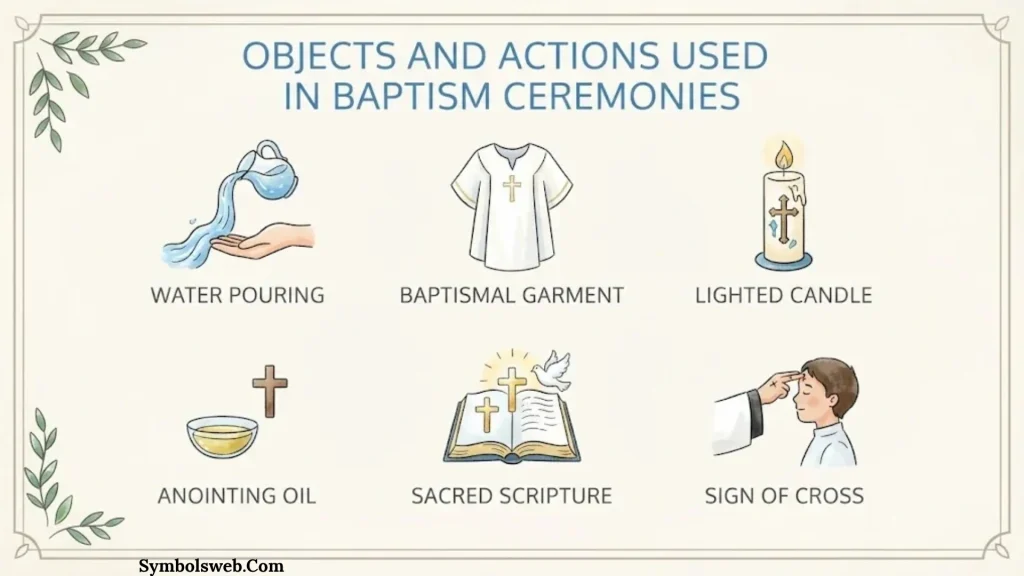
Not every baptism symbol is a physical object. Certain actions and ceremony elements also carry spiritual meaning.
Immersion, Pouring, and Sprinkling
Christian churches use different methods of applying baptismal water.
Immersion means placing the person fully or partly under water. It offers a strong visual connection with burial and resurrection. The person goes beneath the water and rises again as a sign of new life.
Pouring, also called affusion, involves pouring water over the person’s head. It is common in Catholic, Anglican, Lutheran, and other church traditions.
Sprinkling involves applying water in small amounts. Some Christian communities use this method in particular circumstances or within certain liturgical practices.
The method depends on the church’s theology and baptismal rules. The central meaning remains connected with water, faith, and Christian initiation.
Baptismal Basin and Pool
A baptismal basin holds the water used during the ceremony. A baptismal pool is a larger structure that allows a person to be immersed.
Baptist and some evangelical churches often use baptismal pools. These may be built into the church or brought into the worship space for the service.
The basin and pool both provide a place for the central act of baptism. Their size and design reflect the church’s preferred baptism method.
Paschal Candle or Easter Candle
The Paschal candle is a large candle used in many Western Christian churches, especially during Easter celebrations.
It represents the risen Jesus Christ and his victory over death. In Catholic baptism, the smaller baptismal candle is often lit from this larger candle.
The connection between the two candles is meaningful. The newly baptized person receives the light of Christ and is called to live as a follower of Jesus.
Baptismal Robe and Christening Gown
A baptismal robe or christening gown is often white. It represents the new life and Christian dignity associated with baptism.
Families may choose traditional gowns, simple white outfits, or garments with religious embroidery. Some baptismal gowns are passed down through several generations.
The clothing itself does not make the baptism valid. Its importance comes from the meaning attached to the white garment in the church’s tradition.
Anointing and Laying on of Hands
Anointing with oil is used in several Christian traditions. It represents blessing, strengthening, dedication, or the work of the Holy Spirit.
Some churches also use the laying on of hands. A minister places hands on the candidate while praying for God’s blessing and guidance.
The practice has roots in biblical accounts of blessing, healing, and the reception of the Holy Spirit. Its place in baptism varies by denomination.
Baptism Certificate
A baptism certificate is a document that records important details about the ceremony. It may include the person’s name, baptism date, church, minister, and godparents.
The certificate is not a sacramental symbol in the same way as water or oil. It serves as a written record of the event.
Families often keep baptism certificates with photographs, invitations, and other religious keepsakes.
Spiritual Meanings Behind Baptism Symbols
Baptism symbols communicate several connected Christian beliefs. They explain what baptism means for a person’s relationship with God and the Christian community.
Cleansing and Forgiveness of Sin
One of the main meanings of baptism is spiritual cleansing. Water provides a visible sign of purification and forgiveness.
Christian traditions differ in how they explain the relationship between baptism and the forgiveness of sin. Catholic and Orthodox churches understand baptism as a sacrament through which God gives grace and cleanses sin. Many Protestant churches also connect baptism with forgiveness, but their explanations of its sacramental role differ.
Acts 2:38 connects baptism with repentance and forgiveness. The verse is an important part of Christian discussions about baptism.
Rebirth and New Life
Baptism represents a new beginning. It marks a person’s entrance into a life of faith and a relationship with Jesus Christ.
John 3:5 refers to being born of water and the Spirit. Christians often connect this passage with baptism and spiritual rebirth.
The water, white garment, and candle all help communicate this idea. Water represents cleansing, the garment represents a new identity, and the candle represents the light of Christ.
Death and Resurrection
Baptism also symbolizes the death of an old way of life and the beginning of a new one.
Romans 6:3–4 explains that believers are baptized into Christ’s death and raised to walk in the newness of life.
This connection is especially visible during full immersion. Going beneath the water can represent burial with Christ. Rising from the water can represent sharing in his resurrection.
The symbolism does not mean that every Christian must experience baptism through full immersion. Churches use different methods while explaining the spiritual meaning in their own traditions.
Salvation and God’s Grace
Baptism is closely connected with Christian teachings about salvation. It represents God’s grace and the invitation to enter a life shaped by faith.
Many Christian traditions understand baptism as a means through which God offers or applies grace. Other traditions place greater emphasis on baptism as a public expression of faith already received.
The exact explanation varies, but the ceremony points toward God’s relationship with humanity through Jesus Christ.
The Presence of the Holy Spirit
The Holy Spirit plays an important role in Christian baptism. The dove, anointing oil, and Trinitarian words all connect the ceremony with the Spirit.
Christians understand the Holy Spirit as God’s presence and power at work in believers. The Spirit guides, strengthens, comforts, and helps Christians grow in faith.
The dove recalls the Spirit descending upon Jesus after his baptism. Sacred Chrism in Catholic tradition also represents the gift of the Holy Spirit.
Belonging to the Christian Community
Baptism is not only a personal spiritual event. It also connects the baptized person with the Christian community.
The ceremony often takes place before a congregation. Family members, godparents, ministers, and church members may participate.
This shared celebration reminds believers that Christian life includes worship, fellowship, service, and responsibility toward others.
Faith, Hope, and Commitment
The baptismal candle represents the light of Christ. The cross recalls his sacrifice. The white garment points toward a new life.
Together, these symbols encourage Christians to live with faith, hope, love, and commitment.
Baptism is therefore both a celebration and a reminder. It marks a beginning, but it also points toward the responsibilities that follow.
Biblical Origins of Baptism Symbols
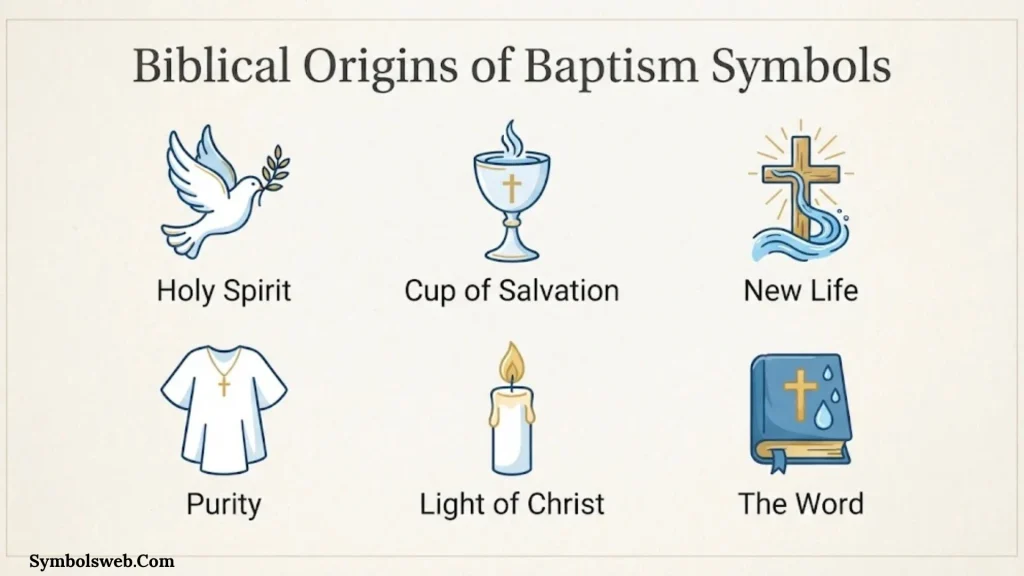
Many baptism symbols have direct connections to biblical stories and teachings. Understanding these references makes the ceremony easier to appreciate.
Water in the Old Testament
Water appears throughout the Old Testament as an image of life, cleansing, danger, and renewal.
In Genesis, God creates the world and separates the waters. In the story of Noah, the flood becomes an event of judgment followed by a new beginning.
The Israelites’ crossing of the Red Sea is another important image. God leads them through the water and delivers them from slavery in Egypt.
These stories helped shape the Christian understanding of water as a symbol of transformation and deliverance.
John the Baptist and the Jordan River
John the Baptist preached repentance and baptized people in the Jordan River. His ministry prepared the way for Jesus.
People came to John to confess their sins and receive baptism as a sign of repentance. The river became closely connected with this important biblical event.
The Jordan River remains an important location in Christian history and pilgrimage because of its connection with Jesus’ baptism.
The Baptism of Jesus
Jesus was baptized by John the Baptist in the Jordan River. The event appears in Matthew 3:13–17, Mark 1:9–11, and Luke 3:21–22.
After Jesus came out of the water, the Holy Spirit descended like a dove. A voice from heaven identified him as God’s beloved Son.
This event explains several important baptism symbols:
- Water: The Jordan River represents the setting of Jesus’ baptism.
- Dove: The dove represents the Holy Spirit.
- Voice from heaven: The event reveals the relationship between the Father and the Son.
- Light and blessing: Christian artwork often uses radiant light to express the significance of this moment.
Jesus’ baptism provides a central biblical reference for Christian baptism, even though Christians understand his baptism differently from the baptism of sinful humanity.
The Great Commission
In Matthew 28:19–20, Jesus instructs his disciples to make disciples of all nations and baptize them in the name of the Father, Son, and Holy Spirit.
This passage is known as the Great Commission. It connects baptism with Christian mission, teaching, and discipleship.
The Trinitarian formula used by many churches comes directly from this instruction.
Baptism in the Early Church
The New Testament describes baptism as an important part of early Christian life.
In Acts 2, Peter preaches to a crowd in Jerusalem. People respond to his message and are baptized. Acts 8 describes baptisms connected with the spread of Christianity, while Acts 10 records the baptism of Cornelius and his household.
Romans 6:3–4 connects baptism with the death and resurrection of Jesus. Galatians 3:27 describes believers as clothed with Christ.
These passages helped shape the language and symbolism used in Christian baptism ceremonies.
Baptism Symbols in Different Christian Denominations
Christian denominations share a belief in baptism but do not always understand its meaning or practice in the same way.
Some churches baptize infants. Others baptize people after they make a personal profession of faith. Some use full immersion, while others pour water over the candidate’s head.
The following comparison explains common practices. Individual churches may have additional customs or variations.
Catholic Baptism Symbols
The Catholic Church recognizes baptism as the first sacrament of Christian initiation. It teaches that baptism brings forgiveness of sin and incorporates a person into the Church.
Catholic baptism commonly includes:
- Water poured over the candidate’s head three times or triple immersion.
- The Trinitarian baptismal formula.
- The sign of the cross.
- The Oil of Catechumens.
- Sacred Chrism.
- A white garment.
- A candle lit from the Paschal candle.
- Prayers and Scripture readings.
The Catholic Catechism, especially paragraphs 1234–1245, explains the meaning of these rites. You can read the official text on the Vatican website.
Lutheran Baptism Symbols
Lutheran churches generally recognize baptism as a sacrament and emphasize God’s promise and grace.
Lutheran baptism commonly uses water and the words of the Father, Son, and Holy Spirit. Many Lutheran churches baptize infants as well as adults.
A baptismal candle, white garment, cross, and other ceremony elements may appear depending on the church’s worship tradition.
Lutherans generally understand baptism as more than a public statement of personal faith. They emphasize God’s action and promise through the sacrament.
Eastern Orthodox Baptism Symbols
Eastern Orthodox churches place strong emphasis on baptism as part of Christian initiation.
A traditional Orthodox baptism often includes triple immersion in water in the name of the Father, Son, and Holy Spirit. The ceremony is followed immediately by Chrismation, in which the newly baptized person receives anointing with holy oil.
The newly baptized person also receives Holy Communion, including infants.
Important Orthodox baptism symbols include:
- Water and triple immersion.
- Holy Chrism.
- The cross.
- White baptismal clothing.
- Candles.
- Prayers and blessings.
The use of triple immersion reflects the church’s emphasis on the Holy Trinity and the person’s participation in Christ’s death and resurrection.
Anglican and Episcopal Baptism Symbols
Anglican and Episcopal churches use water and the Trinitarian formula during baptism. They commonly baptize infants and adults.
The ceremony may include the sign of the cross, prayers, a profession of faith, and a baptismal candle.
White clothing may also be used, although customs vary between parishes.
These churches often describe baptism as an entrance into the Christian community and a sign of God’s grace.
Baptist and Evangelical Baptism Symbols
Baptist and many evangelical churches emphasize believer’s baptism. This means baptism normally follows a personal profession of faith in Jesus Christ.
Full immersion is common because it visibly represents burial with Christ and rising to new life.
Water is the central physical symbol. The cross may appear in the church, but oil, white garments, and baptismal candles are not normally required.
In these traditions, baptism is generally understood as a public declaration of faith rather than a sacrament that itself brings salvation.
Pentecostal Baptism Symbols
Pentecostal churches generally emphasize personal faith, repentance, and the work of the Holy Spirit.
Many Pentecostal churches practice believer’s baptism by full immersion. The water represents identification with Jesus’ death, burial, and resurrection.
The Holy Spirit is especially important in Pentecostal teaching. However, water baptism and baptism in the Holy Spirit are generally treated as distinct experiences in Pentecostal theology.
Pentecostal churches differ in their baptismal wording. Trinitarian Pentecostals use the Father, Son, and Holy Spirit formula. Oneness Pentecostal churches commonly baptize in the name of Jesus Christ.
Comparison of Baptism Traditions
| Christian tradition | Common baptism practice | Important symbols |
| Catholic | Infant and adult baptism; pouring or immersion | Water, oil, cross, white garment, candle |
| Lutheran | Infant and adult baptism; often pouring | Water, cross, candle, sometimes white garment |
| Eastern Orthodox | Infant and adult baptism; traditionally triple immersion | Water, Chrism, cross, candles, white garment |
| Anglican/Episcopal | Infant and adult baptism; often pouring | Water, cross, candle, prayers |
| Baptist | Believer’s baptism; commonly immersion | Water, cross, resurrection imagery |
| Evangelical | Usually believer’s baptism; often immersion | Water, cross, public profession of faith |
| Pentecostal | Usually believer’s baptism; commonly immersion | Water, cross, Holy Spirit imagery |
These are broad descriptions rather than universal rules. A local church’s official baptism service provides the most accurate information about its practices.
Infant Baptism and Adult Baptism: What Is the Difference?
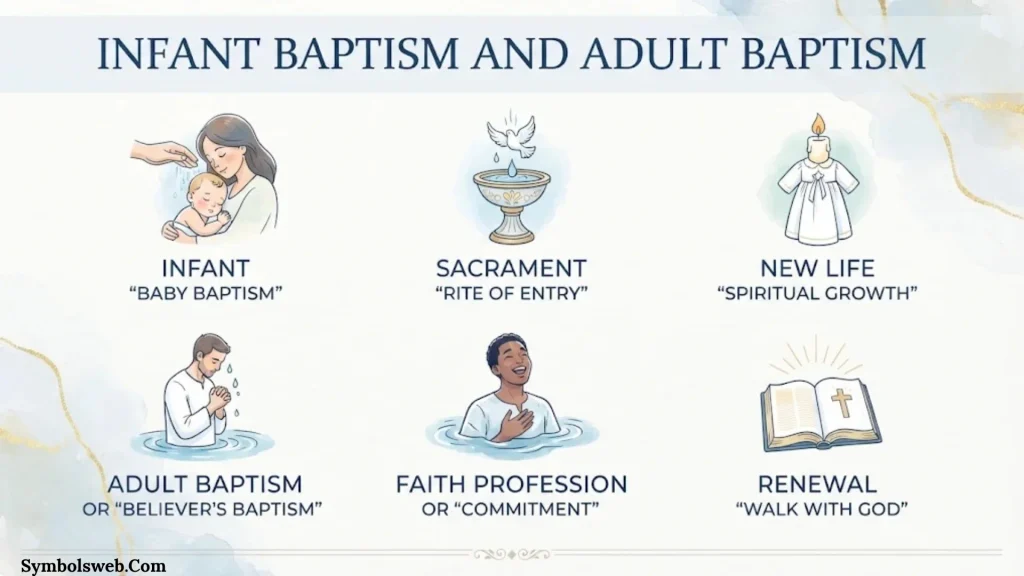
Christian churches do not all agree about when a person should be baptized.
Infant baptism takes place when a baby or young child receives baptism. Parents and godparents usually make promises to support the child’s Christian upbringing.
Catholic, Orthodox, Lutheran, Anglican, and many other churches practice infant baptism.
Adult baptism takes place when an older child or adult receives baptism after learning about Christianity and expressing faith. It is common in Baptist and many evangelical churches.
The main symbols can be similar in both ceremonies. Water remains central, while the cross, candle, white garment, and oil may appear depending on the denomination.
| Feature | Infant baptism | Adult baptism |
| Candidate | Baby or young child | Older child or adult |
| Faith commitment | Parents or sponsors make promises in traditions that baptize infants | Candidate usually makes a personal profession of faith |
| Common traditions | Catholic, Orthodox, Lutheran, Anglican | Baptist, evangelical, Pentecostal, and others |
| Ceremony | Often includes parents and godparents | Often includes a personal testimony or profession of faith |
| Main symbol | Water | Water |
The difference is not simply the person’s age. It reflects different Christian understandings of faith, grace, church membership, and the purpose of baptism.
Baptism vs. Christening: Are They the Same?
People often use the words baptism and christening when discussing a baby’s religious ceremony. In many communities, they refer to the same event.
Baptism is the Christian rite involving water and the person’s initiation into the faith. Christening is a term commonly associated with infant baptism and the giving or formal recognition of a Christian name.
The word christening is especially common in some Anglican and British traditions. However, its use varies by region and denomination.
Here is a simple comparison:
| Baptism | Christening |
| Refers to the Christian rite using water | Often refers to infant baptism |
| Can involve infants, children, or adults | Usually associated with babies |
| Emphasizes Christian initiation | Often emphasizes naming and welcoming the child |
| Used widely across Christian traditions | More common in certain cultural and church traditions |
In everyday conversation, the terms often overlap. The exact distinction depends on the church and local custom.
History and Development of Baptism Symbols
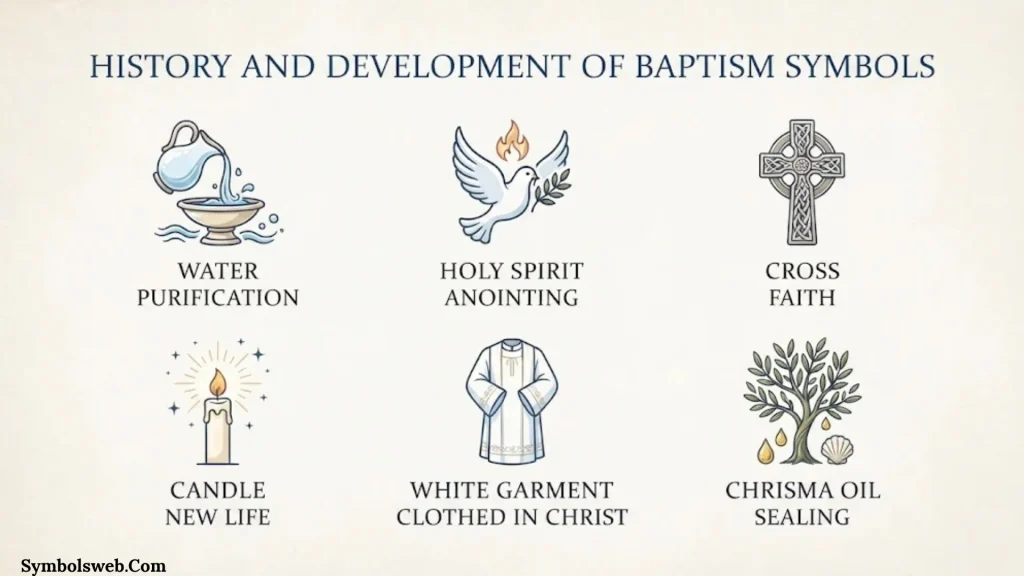
Baptism symbols developed through biblical teachings, early Christian practices, and centuries of church tradition.
Baptism in Early Christianity
Early Christians practiced baptism as an important part of joining the Christian community. The New Testament describes people being baptized after hearing the message about Jesus and responding in faith.
An early Christian text called the Didache includes instructions about baptism in its seventh chapter. It discusses the use of running water and gives guidance for situations when the preferred water source is unavailable.
These instructions show that water and the act of baptism were important in early Christian communities.
Development of Baptismal Fonts
As Christianity spread, churches developed dedicated spaces and structures for baptism.
Early baptismal fonts were sometimes large enough for full immersion. Some churches built separate baptisteries for the ceremony.
Over time, many Western churches adopted smaller fonts suited to pouring water over the candidate’s head. Eastern Christian traditions continued to preserve triple immersion as a common practice.
The design of a baptismal font therefore reflects the history and worship practices of a particular church.
The History of White Baptismal Clothing
White baptismal clothing became an important part of Christian symbolism. It represented purity, new life, and the person’s new identity in Christ.
Early Christian communities used white garments in connection with baptism and the period of instruction that followed it. The clothing helped express the idea of leaving an old life behind and entering a new one.
Today, families may choose traditional christening gowns, simple white robes, or other white garments.
The Development of Baptismal Candles
Candles became an important part of baptismal symbolism in many Western Christian traditions.
The candle represents Christ’s light and the responsibility of the baptized person to live as a follower of Jesus. In Catholic and other liturgical churches, it is often lit from the Paschal candle.
The practice connects baptism with Easter and the Christian belief in Jesus’ resurrection.
Modern Baptism Traditions
Modern baptism ceremonies combine ancient Christian beliefs with local customs and family traditions.
Some families use traditional gowns and candles. Others choose simple clothing and a short ceremony. Churches may hold baptisms during regular worship services or arrange a separate celebration.
The details vary, but the central Christian meaning remains connected with faith, water, and the beginning of a new life in Christ.
Baptism Symbols in Christian Art and Decorations
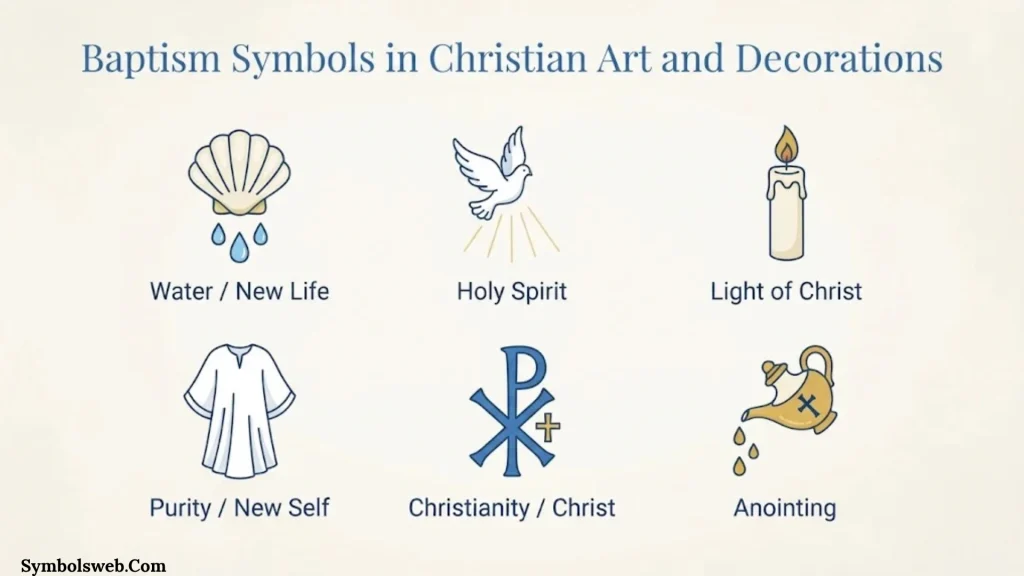
Christian artists use baptism symbols to communicate spiritual ideas through paintings, sculptures, stained glass, and decorative objects.
These symbols also appear on baptism invitations, greeting cards, church banners, and family keepsakes.
Cross in Baptism Artwork
The cross is a common feature in Christian baptism art. It connects baptism with Jesus’ death and resurrection.
A cross may appear above a baptismal font, on a church wall, or in the background of a baptism illustration.
Dove in Baptism Artwork
A dove often appears above Jesus or near a stream of water in paintings of Jesus’ baptism.
It represents the Holy Spirit descending upon Jesus. Artists may add rays of light to emphasize God’s presence.
Water and Waves
Water and waves represent cleansing, renewal, and spiritual rebirth.
Artists sometimes show a river, flowing water, or a person emerging from water. These images help communicate the relationship between baptism and new life.
The Ichthys or Christian Fish
The Ichthys, commonly called the Christian fish symbol, is another recognizable Christian image.
It consists of two curved lines that form the outline of a fish. Early Christians used the fish as a sign associated with their faith in Jesus.
The fish is sometimes included in baptism decorations because of its connection with Christianity and early Christian identity. However, it is not an exclusive or essential baptism symbol.
Light and Rays of Sunshine
Light represents Jesus Christ and the spiritual guidance he offers believers.
In baptism artwork, artists may use sunlight, candles, or glowing rays to represent hope and divine presence.
Baptism Gifts and Keepsakes Inspired by Christian Symbols
Baptism is an important occasion for families and church communities. Gifts often reflect the spiritual meaning of the ceremony.
A meaningful gift does not need to be expensive. It can be something simple that reminds the baptized person of faith, love, and family support.
Cross Necklace or Bracelet
Cross jewelry is a popular baptism gift. It represents Jesus Christ’s sacrifice and the person’s connection with Christian faith.
A small silver or gold cross necklace may become a keepsake that the person wears later in life.
Personalized Baptism Candle
A baptism candle can be decorated with the person’s name, baptism date, or a short Bible verse.
It represents the light of Christ and can be preserved as a reminder of the ceremony.
White Baptism Garment
A white gown, robe, or christening outfit is a traditional gift in many families.
Some families pass baptism garments from one generation to another. This creates a connection between family history and Christian tradition.
Bible or Children’s Prayer Book
A children’s Bible or prayer book can support a child’s religious education as they grow.
For an adult baptism, a study Bible or devotional book may be a thoughtful gift.
Personalized Baptism Keepsake
Families may choose an engraved cross, a framed baptism certificate, a religious ornament, or a memory box.
A useful keepsake connects the ceremony with the person’s ongoing Christian journey.
Frequently Asked Questions About Baptism Symbols
What Are the Main Symbols of Baptism?
The main symbols of baptism commonly include water, oil, a white garment, and a candle. Water represents cleansing and new life. Oil symbolizes strength and the Holy Spirit. The white garment represents a new identity in Christ, while the candle represents the light of Jesus.
Other associated symbols include the cross, dove, baptismal font, and Holy Trinity.
What Does Water Symbolize in Baptism?
Water symbolizes spiritual cleansing, forgiveness, renewal, and new life. It also represents the person’s connection with Jesus Christ’s death and resurrection.
Water is the central physical element of Christian baptism, although churches differ in how they explain its sacramental meaning.
Why Do People Wear White at Baptism?
White clothing represents purity, spiritual renewal, and a new life in Christ. It reminds Christians that baptism marks a new identity through faith.
Many churches use white baptism gowns, robes, or garments during the ceremony.
What Does Oil Mean in Baptism?
Oil represents strength, healing, blessing, and the Holy Spirit. In Catholic baptism, the Oil of Catechumens symbolizes strengthening before baptism, while Sacred Chrism represents the gift of the Holy Spirit.
Other churches may use anointing oil differently or leave it out of the ceremony.
Why Is a Candle Used in Baptism?
The baptismal candle represents Jesus Christ as the Light of the World. In many Catholic ceremonies, it is lit from the Paschal candle, which represents the risen Christ.
The candle reminds the baptized person to live in faith and reflect Christ’s light through their actions.
What Does the Dove Represent in Baptism?
The dove represents the Holy Spirit. It recalls the biblical account of Jesus’ baptism, when the Spirit descended upon him like a dove.
The dove is also associated with peace, hope, purity, and God’s presence.
What Is a Baptismal Font?
A baptismal font is a basin or structure that holds the water used during baptism. It may be a small stone basin or a large pool designed for immersion.
It represents the place where the person receives baptism and enters the Christian community.
What Does the Cross Mean During Baptism?
The cross represents Jesus Christ’s sacrifice, death, and resurrection. During baptism, it reminds Christians that their new life is connected with Christ.
Some churches make the sign of the cross on the candidate’s forehead during the ceremony.
Why Are Godparents Present at Baptism?
Godparents support the baptized person’s Christian upbringing, especially in traditions that practice infant baptism.
They may participate in the ceremony, make promises, and help the child grow in faith. Their exact responsibilities depend on the denomination.
Are Baptism Symbols the Same in Every Christian Church?
No. Many Christian churches use water and the Trinitarian formula, but other symbols and practices vary.
Catholic and Orthodox ceremonies often include anointing oil and additional liturgical actions. Baptist and many evangelical churches usually emphasize water baptism by immersion after a personal profession of faith.
How Many Symbols Are Used in Baptism?
There is no universal number of baptism symbols. Some churches highlight four main symbols: water, oil, white clothing, and light.
Other explanations include the cross, dove, baptismal font, Holy Trinity, Bible, prayers, and godparents. The number depends on the tradition and how broadly someone defines a baptism symbol.
Is a Dove Required During Baptism?
No. The dove is a symbol of the Holy Spirit, but most baptism ceremonies do not require a physical dove or dove-shaped object.
It commonly appears in Christian art, decorations, and baptism gifts because of its connection with Jesus’ baptism.
What Is the Difference Between Baptism and Christening?
Baptism is the Christian rite that uses water to mark a person’s initiation into the faith. Christening is a term often used for infant baptism and the giving or recognition of a Christian name.
In many communities, people use both words to describe the same ceremony.
What Bible Verses Explain the Meaning of Baptism?
Several Bible passages explain baptism and its symbolism:
- Matthew 3:13–17: Jesus’ baptism in the Jordan River.
- Matthew 28:19–20: Jesus’ instruction to baptize in the name of the Father, Son, and Holy Spirit.
- John 3:5: Being born of water and the Spirit.
- Acts 2:38: Repentance, baptism, and forgiveness.
- Romans 6:3–4: Baptism as a connection with Christ’s death and resurrection.
- Galatians 3:27: Being clothed with Christ.
- 1 Peter 3:21: The meaning of baptism in relation to salvation.
These passages provide a biblical foundation for many of the symbols used in Christian baptism.
Conclusion: The Lasting Meaning of Baptism Symbols
Baptism symbols help Christians understand the spiritual meaning of one of the most important ceremonies in their faith. Water represents cleansing and new life. The cross recalls Jesus Christ’s sacrifice, while the white garment symbolizes a new identity in him. Oil points toward strength and the Holy Spirit, and the baptismal candle represents the light of Christ. The dove, font, prayers, and other ceremony elements add further meaning.
Although Christian denominations differ in their baptism practices, these symbols share a common purpose. They connect baptism with faith, renewal, God’s grace, and belonging to the Christian community. Each symbol tells part of a larger story about following Jesus and beginning a life shaped by his teachings.
If you are attending a baptism, preparing for a family celebration, or learning about Christian traditions, understanding these meanings makes the ceremony more meaningful. Baptism is not simply a moment marked by water and ceremony. For Christians, it represents the beginning of a lifelong journey of faith, hope, love, and commitment.

Eliana Foster is a writer with a passion for exploring the meanings behind symbols, traditions, and cultural history. She enjoys breaking down complex topics into simple, engaging articles that are easy for everyone to understand. Eliana is also the fictional author of The Hidden Language of Silent Marks and Beyond the Circle of Ancient Signs, two original book concepts created for her author profile. When she’s not writing, she loves visiting museums, reading about mythology, and researching the stories behind symbols from around the world. Her goal is to help readers discover the fascinating meanings hidden in everyday signs and ancient emblems.
 Ethan Holloway
 Jordan Hayes