Pedophile symbols are visual signs and graphic designs that have been discussed in online safety reports and child protection resources. Understanding these symbols can help parents, teachers, and caregivers become more aware of potentially concerning online content and protect children from exploitation. However, it is important to remember that a symbol alone does not prove someone’s intentions or criminal behavior.
Some symbols and images have been associated with harmful online communities, but their meanings can vary depending on the context in which they appear. Misinterpreting ordinary logos, shapes, or artwork can lead to false accusations. Therefore, reliable information and careful evaluation are essential when identifying potentially suspicious content.
In this guide, we will explore the meaning of pedophile symbols, their reported associations, and the importance of recognizing genuine warning signs. You will also learn how to approach suspicious online activity responsibly, report potentially harmful content, and take practical steps to improve children’s online safety.
Pedophile Symbols: (Quick Answer)
Pedophile symbols are designs reported in some investigations and online discussions as identifiers used by individuals seeking to communicate an attraction to children. A frequently cited 2007 document describes several such designs. However, its authenticity has not been confirmed by the FBI, and ordinary symbols alone cannot establish criminal activity or identify an offender.
Quick Facts About Pedophile Symbols
| Aspect | Information |
| Origin | Reported symbols associated with certain child-exploitation communities |
| Historical Significance | Discussed in a purported 2007 FBI intelligence bulletin |
| Main Meaning | Alleged identifiers connected to sexual interest in children |
| Spiritual Meaning | No established spiritual meaning |
| Cultural Importance | Relevant to discussions about child protection and online exploitation |
| Modern Usage | Mostly discussed in online safety investigations, fact-checking, and misinformation debates |
What Are Pedophile Symbols?
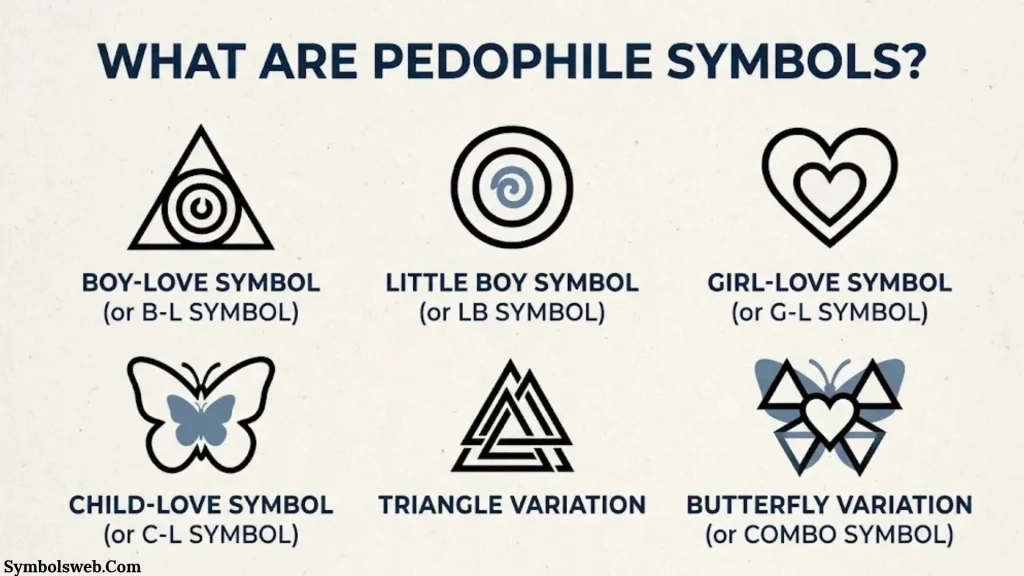
Pedophile symbols are a term commonly used to describe particular graphic designs that have allegedly served as identifiers within some communities promoting or discussing sexual interest in children.
These designs are different from ordinary cultural symbols. They do not have established meanings across ancient civilizations, religions, or spiritual traditions.
The subject became more widely discussed after a document dated January 31, 2007, titled Symbols and Logos Used by Pedophiles to Identify Sexual Preferences, circulated online.
The document presents several designs and describes their alleged associations with individuals identifying as boy lovers, girl lovers, or child lovers.
However, an important qualification matters: PolitiFact reported in April 2023 that the FBI had not confirmed the document’s authenticity. The FBI’s historical Innocent Images initiative was real, but that does not independently authenticate the circulated document.
Understanding the Difference Between Pedophilia and Child Sexual Abuse
Before examining the reported designs, it helps to understand two related terms.
Pedophilia describes a persistent sexual attraction to prepubescent children. Clinical definitions distinguish this attraction from a confirmed criminal act.
Child sexual abuse involves sexual activity, exploitation, or other sexual conduct involving a child who cannot legally or developmentally consent.
These concepts overlap in some cases, but they are not interchangeable.
A person can commit child sexual abuse without meeting the clinical criteria for pedophilic disorder. Likewise, a diagnosis or suspected attraction does not establish that a person has committed abuse.
The distinction is important because child protection must focus on actual behavior, credible evidence, and the safety of children.
Historical Background of Reported Pedophile Symbols
The designs most frequently discussed online come from the purported 2007 intelligence bulletin.
According to that document, certain individuals used distinctive logos on jewelry, pendants, rings, and coins.
The reported purpose was to communicate particular preferences within communities that attempted to normalize sexual interest in children.
The document describes four principal categories:
- BoyLover logo (BLogo).
- Little Boy Lover logo (LBLLogo).
- GirlLover logo (GLogo).
- ChildLover logo (CLogo).
These descriptions should be treated as claims contained in an unverified document rather than independently established FBI findings.
That distinction is essential when researching this topic.
Reported Types and Variations of Pedophile Symbols
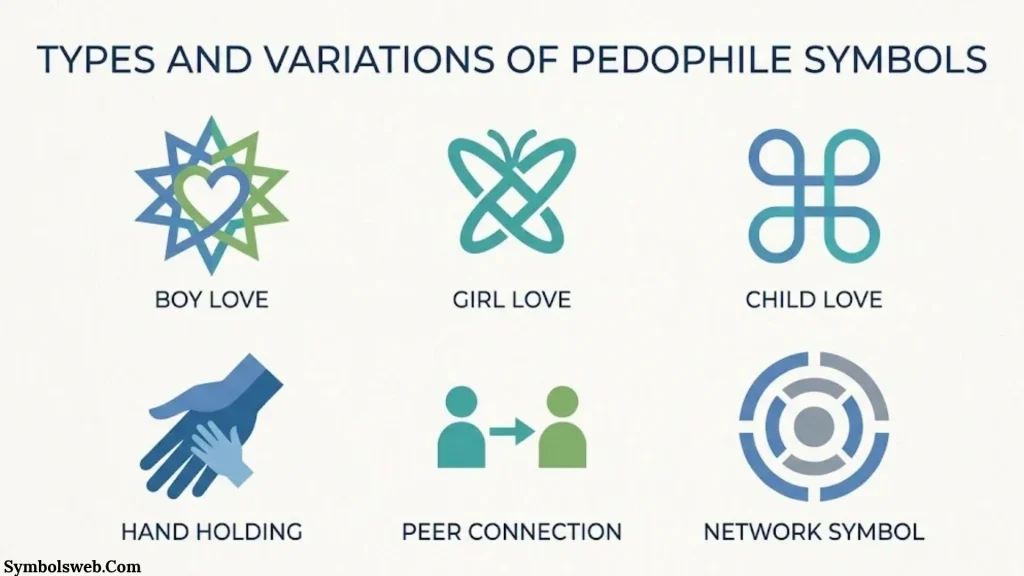
The following descriptions summarize the designs attributed to the circulated intelligence bulletin. They explain the historical claims without treating the designs as reliable indicators of criminal activity.
BoyLover Logo (BLogo)
The reported BoyLover logo consists of a small spiral-shaped triangle surrounded by a larger triangular outline.
The circulated document claims that the inner triangle represents a boy while the outer triangle represents an adult male.
Its reported association concerns sexual interest in young boys.
However, the design’s appearance alone cannot establish that someone supports child exploitation or has committed a crime.
Little Boy Lover Logo (LBLLogo)
The Little Boy Lover logo is described as a variation of the triangular design.
According to the document, it features a smaller spiral-shaped triangle surrounded by a larger triangle. Its corners are rounded to create a softer, scribbled appearance.
The document associates this variation with sexual interest in very young boys.
As with the other reported designs, the claimed meaning comes from the circulated bulletin rather than independently verified evidence.
GirlLover Logo (GLogo)
The reported GirlLover logo features a small heart surrounded by a larger heart.
The document describes the smaller heart as representing a minor girl and the larger heart as representing an adult.
Its alleged meaning relates to sexual interest in young girls.
It is particularly important not to confuse this claimed design with ordinary heart imagery.
Hearts appear throughout human culture as expressions of affection, friendship, compassion, and romantic love. A heart-shaped design is not evidence of abuse.
ChildLover Logo (CLogo)
The ChildLover logo is described as a butterfly-like design.
The circulated document associates it with individuals claiming sexual interest in children regardless of gender.
Butterflies have countless unrelated meanings in art, nature, literature, and traditional symbolism.
Therefore, seeing a butterfly on clothing, jewelry, artwork, or a company logo does not establish any connection to child exploitation.
Reported Symbols and Their Alleged Meanings
| Reported design | Visual description | Meaning attributed to it in the circulated document |
| BoyLover (BLogo) | Spiral-shaped triangle inside a larger triangle | Alleged sexual interest in boys |
| Little Boy Lover (LBLLogo) | Rounded spiral-shaped triangular design | Alleged sexual interest in very young boys |
| GirlLover (GLogo) | Small heart inside a larger heart | Alleged sexual interest in girls |
| ChildLover (CLogo) | Butterfly-like design | Alleged sexual interest in children regardless of gender |
Important: These are historical claims about particular designs, not a verified catalog of secret symbols. Their appearance on an unrelated product or personal item does not prove anything about its owner.
Pedophile Symbols Across Different Cultures
Unlike symbols associated with ancient Egyptian religion, Greek mythology, Roman traditions, or Eastern spiritual practices, the designs discussed above do not have an established history across ancient civilizations.
Their alleged associations belong to a much narrower modern context.
Ancient Egyptian Culture
Ancient Egyptian civilization used symbols to express religious beliefs, political authority, protection, and ideas about life after death.
Important examples include:
- Ankh: Associated with life.
- Eye of Horus: Associated with protection and well-being.
- Scarab: Connected with renewal and transformation.
- Djed pillar: Associated with stability.
There is no established historical connection between these traditional symbols and the modern designs discussed in this article.
Ancient Greek Culture
Ancient Greek civilization developed a rich symbolic tradition involving mythology, philosophy, religion, and art.
Examples include:
- Owl of Athena, associated with wisdom.
- Laurel wreath, associated with achievement and victory.
- Olive branch, associated with peace.
- Caduceus, associated with Hermes.
These symbols have their own historical and cultural meanings. They should not be reinterpreted as indicators of child exploitation.
Roman Culture
Roman symbolism reflected political power, military achievement, religion, and civic identity.
Common examples include:
- Eagle, associated with Roman authority.
- Laurel wreath, associated with victory.
- Fasces, associated with governmental authority.
- SPQR, representing the Roman state.
These historical symbols have no established connection to the reported modern logos.
Eastern Traditions
Eastern religious and philosophical traditions use symbols to communicate spiritual ideas and ethical teachings.
Examples include:
- Om: A sacred sound and spiritual symbol in Hindu traditions.
- Dharma wheel: Represents Buddhist teachings.
- Yin and yang: Represents complementary forces in Chinese philosophy.
- Lotus: Associated with purity and spiritual development in several Asian traditions.
Their meanings come from distinct religious and philosophical histories.
Indigenous Traditions
Indigenous communities around the world have developed unique symbolic systems connected to land, ancestry, animals, spirituality, and community identity.
For example, particular animal motifs, geometric patterns, and traditional artwork can carry meanings specific to individual communities.
These designs should be understood within their cultural settings rather than connected to unrelated internet claims.
Modern Interpretations
In modern internet culture, ordinary shapes sometimes become the subject of speculation.
A triangle, heart, spiral, or butterfly might appear in a company logo, clothing design, cartoon, or children’s product.
Some social media posts interpret these shapes as evidence of secret associations.
However, visual resemblance does not establish shared meaning, intention, or criminal involvement.
Reliable interpretation requires evidence beyond appearance.
Similar Symbols and Their Meanings
One of the biggest problems surrounding this topic is the tendency to confuse ordinary visual designs with alleged coded identifiers.
Many common shapes have existed for centuries and appear in unrelated settings.
| Common symbol | Established or common meaning | Important distinction |
| Heart | Love, affection, compassion | A heart is not evidence of child exploitation |
| Butterfly | Transformation, nature, freedom | Butterfly imagery has many unrelated uses |
| Triangle | Stability, direction, geometry | A triangle has no single universal meaning |
| Spiral | Growth, movement, continuity | Spirals appear in ancient and modern artwork |
| Circle | Unity, completeness, eternity | Circular designs are common in branding |
| Star | Hope, guidance, achievement | Stars have diverse cultural meanings |
Why Visual Similarity Can Be Misleading
Imagine seeing a triangular spiral on a clothing label.
Someone online claims that the design is connected to a dangerous group. Another person shares the claim, and hundreds of people begin repeating it.
Yet nobody has established who designed the logo, what it represents, or whether it has any connection to the alleged group.
This is an example of how visual similarity can become misinformation.
A responsible assessment considers:
- The original source of the design.
- The creator’s explanation.
- Its historical context.
- Whether credible investigations establish a connection.
- Whether the claim has been independently verified.
Pedophile Symbols in Art, Literature, Movies, and Pop Culture
The subject has also entered popular culture through discussions about hidden messages, conspiracy theories, and internet investigations.
However, it is important to distinguish genuine documentation from speculation.
Symbols in Paintings and Artwork
Artists frequently use geometric shapes, hearts, butterflies, and spirals.
These elements can represent emotions, natural patterns, relationships, or abstract ideas.
There is no reliable basis for assuming that these ordinary artistic elements indicate support for child exploitation.
Symbols in Literature
Books discussing child protection, sexual abuse, criminal investigations, and online exploitation may refer to coded language or reported identifiers.
These references should be evaluated according to their sources and historical context.
Symbols in Movies and Television
Online discussions sometimes claim that particular movie scenes, costumes, or background designs contain hidden messages.
However, an unusual shape or visual pattern does not establish the existence of a secret criminal connection.
A credible interpretation requires evidence about the creator’s intentions and the context in which the design appears.
Symbols in Tattoos and Fashion
Tattoos, jewelry, and fashion designs often use geometric patterns and familiar shapes.
People may select them because they appreciate their appearance or traditional meanings.
An isolated design cannot establish someone’s sexual interests, criminal history, or involvement in an abusive community.
Spiritual and Dream Meaning of Pedophile Symbols
There is no established spiritual tradition that assigns a universal spiritual meaning to pedophile symbols.
Similarly, no reliable psychological or scientific framework identifies these reported logos as symbols with fixed meanings in dreams.
It is important not to invent spiritual interpretations for a subject involving child exploitation.
However, someone who encounters disturbing imagery online might experience fear, anxiety, confusion, or concern about personal safety.
Those emotional reactions deserve attention without assuming that the imagery carries a supernatural message.
Positive and Negative Meanings of Pedophile Symbols
The term itself does not describe a positive spiritual or cultural symbol.
However, the discussion surrounding it can have different consequences.
| Responsible interpretation | Harmful interpretation |
| Supporting child protection | Making unsupported accusations |
| Studying historical documents | Treating unverified claims as established facts |
| Recognizing online exploitation risks | Assuming ordinary designs indicate criminal behavior |
| Reporting credible evidence | Spreading rumors without verification |
| Educating parents and communities | Creating unnecessary fear through conspiracy theories |
The central difference is between using information to protect children and using unverified symbolism to accuse innocent people.
Why Humans Are Attracted to Hidden Symbolism
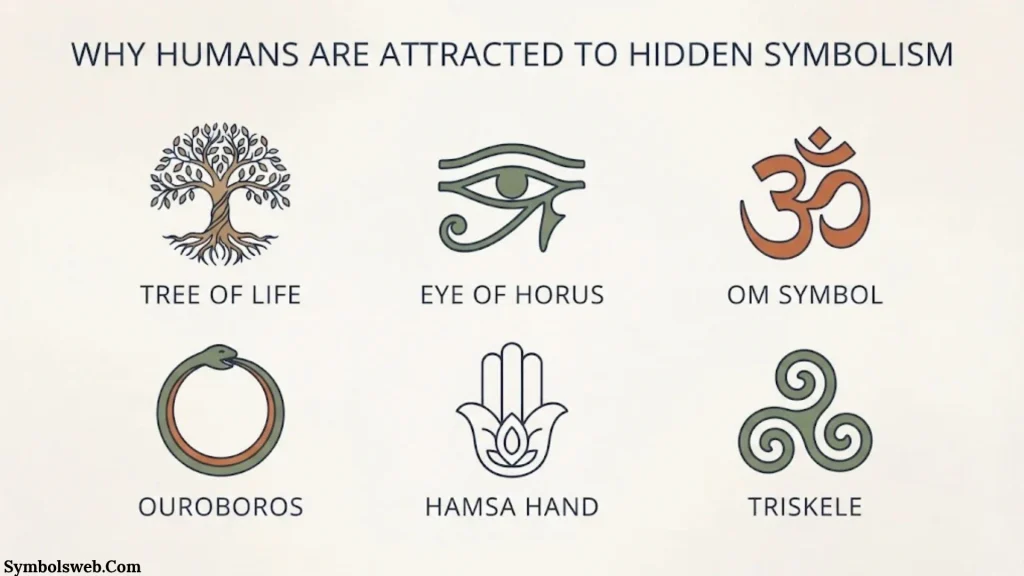
Humans naturally search for patterns and meaning.
Throughout history, people have used visual symbols to communicate beliefs, emotions, traditions, and identities.
This tendency also influences how people interpret information online.
Human Pattern Recognition
The human brain constantly looks for familiar shapes and connections.
Sometimes this ability helps us recognize genuine threats. At other times, it leads us to see relationships that do not exist.
For example, someone who has recently read about a particular symbol might begin noticing similar shapes everywhere.
This does not mean those designs share the same meaning.
Emotional Responses to Disturbing Information
Child exploitation is an especially upsetting subject because children depend on adults for protection.
As a result, stories involving hidden networks or secret identifiers can trigger strong emotional reactions.
People may share alarming claims before checking their accuracy.
That is why reliable information and careful fact-checking matter.
Cultural Memory and Internet Communities
Online communities can give familiar designs new meanings through repeated discussion.
However, repetition does not automatically make a claim true.
A symbol can acquire an alleged meaning in a particular online discussion without becoming a recognized identifier across society.
Modern Uses and Online Discussions of Pedophile Symbols
The phrase appears in several modern contexts.
Social Media
Social media platforms frequently circulate images claiming that ordinary product designs contain secret references to child exploitation.
These claims require independent verification.
Online Investigations
Some online investigations examine alleged coded language, suspicious communications, and symbols.
Responsible investigations rely on multiple forms of evidence rather than graphic resemblance alone.
Child Protection Awareness
The subject can also introduce important conversations about online grooming, exploitation, inappropriate contact, and reporting suspicious behavior.
Parents and caregivers should focus on children’s experiences and observable warning signs rather than attempting to identify offenders through clothing or decorative designs.
News and Fact Checking
News organizations and fact-checking groups have investigated claims involving alleged pedophile symbols.
These investigations are important because false accusations can harm innocent people and distract from genuine child-protection work.
How to Recognize Misinformation About Pedophile Symbols
Not every alarming online post deserves your trust.
Before sharing a claim, consider these practical checks.
Check the Original Source
Look for the original document, investigation, or credible reporting.
A screenshot without a reliable source is not sufficient evidence.
Verify the Historical Claim
Check whether the document has been authenticated by the organization it claims to represent.
For example, PolitiFact reported that the FBI had not confirmed the authenticity of the widely circulated 2007 bulletin.
Politifact API
Avoid Judging People by Ordinary Designs
A heart, butterfly, spiral, or triangle can have countless meanings.
Do not accuse someone of a crime because of a tattoo, necklace, logo, or clothing pattern.
Look for Independent Evidence
A credible investigation should consider relevant communications, documented behavior, witness accounts, and other evidence.
No single decorative design can replace that process.
A Real Example: The Huggies Diaper Symbol Controversy
One of the best-known examples of misinformation involving alleged pedophile symbols involved Huggies diapers.
In 2023, social media posts claimed that certain patterns on Huggies products represented coded references to pedophilia.
The claims spread widely and caused unnecessary concern among parents.
PolitiFact investigated the allegations and reported that the FBI had not authenticated the document used to support the claims. It also reported that Huggies and its parent company, Kimberly-Clark, said their designs were intended to be fun and playful.
Politifact API
Reuters examined the same controversy in March 2024.
Its fact-check found that the diaper designs did not match the symbols shown in the circulated document. Reuters rated the claim false.
Reuters
This example demonstrates why context and verification matter.
An ordinary design should not become evidence of a serious crime simply because someone online gives it a frightening interpretation.
How to Protect Children From Sexual Exploitation
Understanding alleged symbols is far less important than recognizing behaviors that can put children at risk.
Parents, teachers, and caregivers can take practical steps to improve children’s safety.
Teach Children About Personal Boundaries
Children should understand that they have the right to personal boundaries.
Explain that nobody should pressure them into unwanted touching, inappropriate conversations, or secret activities.
Encourage Open Communication
Create an environment where children feel comfortable discussing uncomfortable experiences.
Listen carefully without blaming or frightening them.
Watch for Concerning Behavior
Potential warning signs can include:
- An adult repeatedly trying to isolate a child.
- Requests to keep inappropriate secrets.
- Sexualized conversations directed toward a child.
- Unwanted physical contact.
- Attempts to obtain private photographs.
- Pressure to move conversations to private online channels.
These behaviors deserve attention. However, individual signs should be assessed in context rather than treated as automatic proof of abuse.
Improve Online Safety
Children should know how to block and report suspicious accounts.
Parents can also discuss privacy settings, inappropriate messages, online grooming, and safe internet habits.
Report Suspected Abuse
If a child discloses abuse or you have credible concerns about exploitation, prioritize immediate safety and contact appropriate child-protection or law-enforcement authorities.
Do not confront a suspected offender if doing so could increase danger or interfere with an investigation.
Interesting Facts About Pedophile Symbols
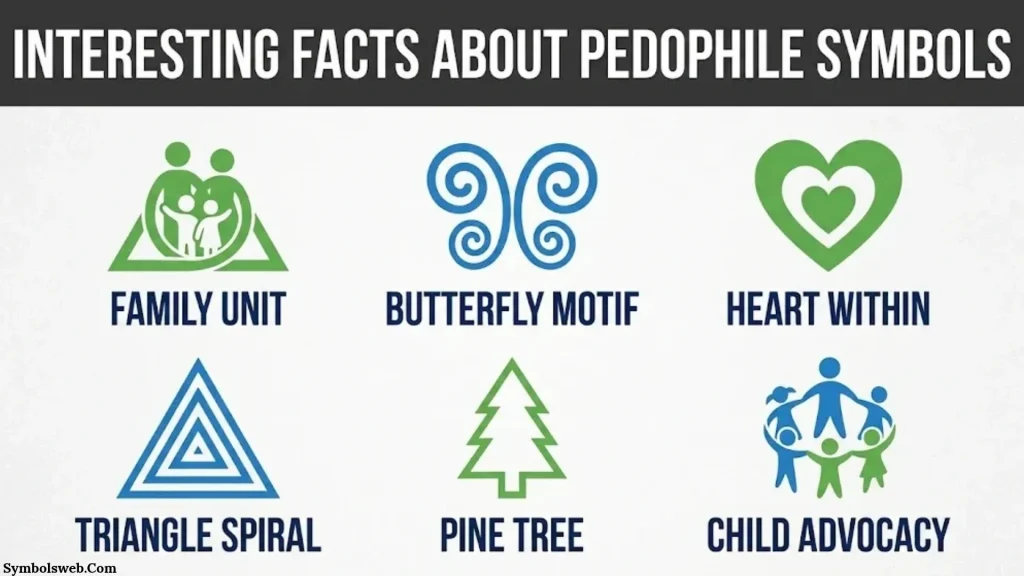
1. A 2007 document describes several alleged logos. It discusses designs associated with boy lovers, girl lovers, and child lovers.
2. The circulated FBI document has an authentication problem. PolitiFact reported that the FBI had not confirmed its authenticity.
3. The reported designs include geometric shapes. Triangles, hearts, and butterfly-like forms appear in descriptions of the alleged logos.
4. The designs were reportedly found on jewelry. The circulated document mentions rings, pendants, and coins.
5. The Innocent Images initiative was real. The FBI established the initiative to investigate online child exploitation.
6. Ordinary shapes have many unrelated meanings. Hearts, triangles, circles, and spirals appear throughout art, architecture, and commercial design.
7. The Huggies controversy demonstrated the danger of misinformation. Reuters found that the diaper designs did not match the alleged symbols.
8. Visual resemblance is not proof of criminal activity. Reliable investigations require evidence beyond a logo or decorative pattern.
Frequently Asked Questions
What are the main pedophile symbols?
A circulated 2007 document describes four alleged designs: the BoyLover logo, Little Boy Lover logo, GirlLover logo, and ChildLover logo. However, the FBI has not confirmed the document’s authenticity, so these descriptions should not be treated as a verified official catalog.
What does the spiral triangle symbol mean?
The circulated document describes a spiral-shaped triangle inside a larger triangle as the BoyLover logo. It claims that the inner triangle represents a boy and the outer triangle represents an adult male. This alleged meaning does not make every similar geometric design suspicious.
Does a butterfly symbol mean someone is a pedophile?
No. Butterflies commonly represent nature, transformation, freedom, and beauty. Although a butterfly-like design appears in the circulated document, an ordinary butterfly image is not evidence of child exploitation.
Are pedophile symbols officially confirmed by the FBI?
The widely circulated 2007 intelligence bulletin has not been authenticated by the FBI, according to PolitiFact’s reporting. The FBI’s Innocent Images initiative was real, but that does not prove the circulated document is authentic.
Can you identify a pedophile by their clothing or tattoos?
No. Clothing, jewelry, tattoos, and decorative designs cannot establish whether someone has pedophilic interests or has committed child sexual abuse. Any genuine concern should be evaluated using credible evidence and appropriate reporting procedures.
Why do people search for pedophile symbols?
People commonly search for the topic because they encounter suspicious-looking designs on social media, jewelry, clothing, or product packaging. Others want to understand historical claims about coded identifiers. Reliable sources are essential because misinformation can create false accusations.
Conclusion
Understanding pedophile symbols can help parents, teachers, and caregivers become more aware of potential online dangers and protect children from exploitation. However, it is important to remember that symbols alone are not proof of criminal activity. Their meaning should always be evaluated carefully within the proper context to avoid misunderstandings and false accusations.
Ultimately, children’s safety should remain the top priority. Stay informed, monitor online activities responsibly, encourage open communication, and report suspicious or harmful content to the appropriate authorities. Awareness, education, and timely action can make the internet a safer place for children.

Eliana Foster is a writer with a passion for exploring the meanings behind symbols, traditions, and cultural history. She enjoys breaking down complex topics into simple, engaging articles that are easy for everyone to understand. Eliana is also the fictional author of The Hidden Language of Silent Marks and Beyond the Circle of Ancient Signs, two original book concepts created for her author profile. When she’s not writing, she loves visiting museums, reading about mythology, and researching the stories behind symbols from around the world. Her goal is to help readers discover the fascinating meanings hidden in everyday signs and ancient emblems.
 Jordan Hayes
 Ethan Holloway