
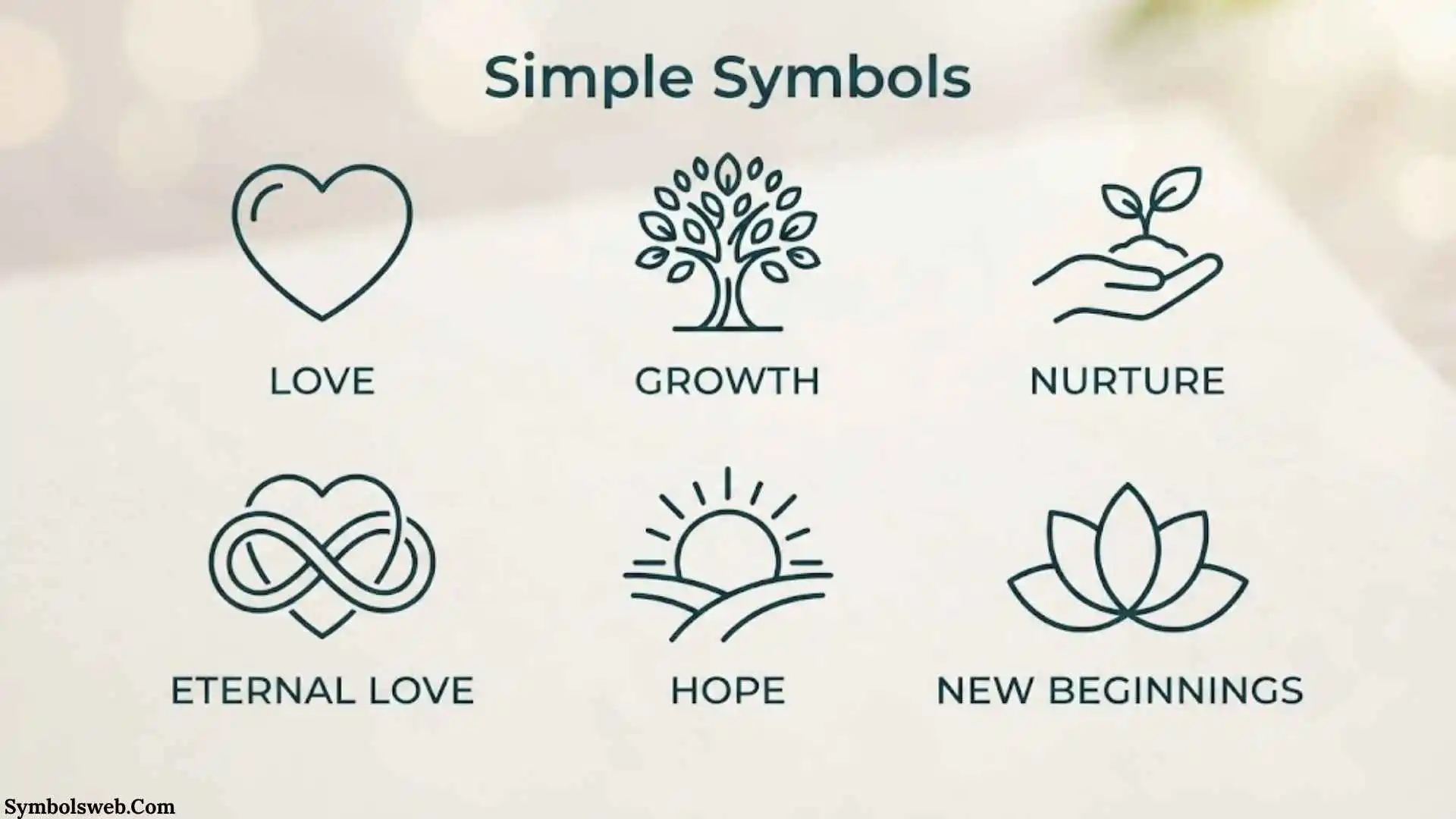
Simple symbols are everywhere around us, yet most people rarely stop to consider their deeper meanings. A simple shape, mark, or sign can communicate powerful ideas, emotions, beliefs, and traditions that have traveled across centuries. From ancient cave paintings to modern logos, symbols help humans express thoughts that words alone cannot fully capture.
If you notice a circle, a heart, a star, or a cross, each symbol carries layers of meaning shaped by history, culture, psychology, and spirituality. Understanding simple symbols opens a fascinating window into the human mind and the stories that connect civilizations across time.
Simple Symbols: (Quick Answer)
Simple symbols are basic visual signs, shapes, or marks that represent ideas, emotions, beliefs, concepts, or objects. They communicate meaning quickly and universally, making them powerful tools in art, religion, culture, communication, psychology, and everyday life.
Quick Facts About Simple Symbols
| Aspect | Information |
| Origin | Prehistoric cave art and early human communication |
| Historical Significance | Used to convey ideas before written language developed |
| Main Meaning | Representation of concepts through visual forms |
| Spiritual Meaning | Connection between physical and invisible realities |
| Cultural Importance | Preserves traditions, beliefs, and collective identity |
| Modern Usage | Logos, emojis, traffic signs, tattoos, branding, and digital communication |
What Are Simple Symbols?
Simple symbols are visual representations that communicate meaning through shapes, marks, patterns, or images. Unlike lengthy explanations, a symbol can instantly trigger understanding, emotion, or memory.
Humans have used symbols for tens of thousands of years. Before formal writing systems emerged, early people painted symbols on cave walls to record events, beliefs, and observations. These visual marks became the foundation of communication.
As civilizations developed, symbols evolved into more sophisticated forms. Ancient societies created symbolic systems for religion, government, trade, and storytelling. Over time, many symbols became universal.
For example:
- A heart often represents love.
- A circle symbolizes unity or eternity.
- A star can represent hope and guidance.
- A tree symbolizes growth and life.
The power of symbols lies in their simplicity. A small image can carry meanings that entire paragraphs struggle to express.
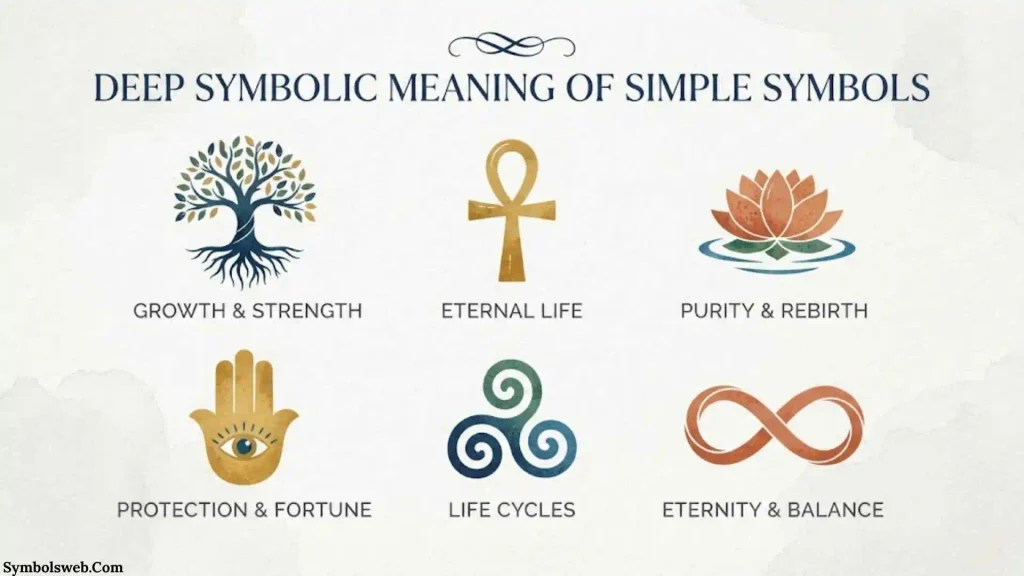
Deep Symbolic Meaning of Simple Symbols
Spiritual Level
Throughout history, spiritual traditions have relied heavily on symbols to express sacred truths.
Simple symbols often represent:
- Divine connection
- Enlightenment
- Protection
- Transformation
- Eternal life
For instance, circles frequently symbolize wholeness because they have no beginning or end. Many spiritual traditions view circular forms as representations of eternity and the universe itself.
Symbols also act as bridges between the visible and invisible worlds. They help people connect with ideas that cannot be easily described through language.
Psychological Level
Psychologist Carl Jung believed symbols emerge from the collective unconscious, a shared reservoir of human experiences and archetypes.
Simple symbols attract us because they connect with universal human emotions.
Examples include:
- Hearts triggering feelings of affection
- Spirals representing personal growth
- Paths symbolizing life journeys
- Trees representing stability and development
These associations often exist across cultures, suggesting deep psychological roots.
Cultural Level
Every society creates and preserves symbols that reflect its values and beliefs.
Consider a national flag. It is essentially a collection of shapes and colors. Yet millions of people may feel pride, loyalty, and emotion when they see it.
Simple symbols unite communities and preserve traditions. They become visual shortcuts for shared identity and cultural memory.
Types and Variations of Simple Symbols
Circle
Visual Description: A round shape with no beginning or end.
Meaning: Unity, eternity, completeness.
Symbolism: Infinite cycles of life and nature.
Cultural Connection: Found in religious art, mandalas, and sacred geometry.
Where It Appears:
- Spiritual traditions
- Ancient architecture
- Meditation practices
- Modern logos
Heart
Visual Description: Two curved shapes meeting at a point.
Meaning: Love, compassion, connection.
Symbolism: Emotional and spiritual affection.
Cultural Connection: Universal symbol of romance and kindness.
Where It Appears:
- Valentine’s celebrations
- Jewelry
- Social media
- Literature
Star
Visual Description: Radiating points extending outward.
Meaning: Hope, achievement, guidance.
Symbolism: Light in darkness.
Cultural Connection: Navigation, religion, and national identity.
Where It Appears:
- Flags
- Religious imagery
- Awards
- Mythology
Spiral
Visual Description: A line winding outward or inward.
Meaning: Growth and evolution.
Symbolism: Life’s continuous journey.
Cultural Connection: Ancient stone carvings and indigenous art.
Where It Appears:
- Sacred sites
- Dreams
- Spiritual teachings
- Decorative art
Tree
Visual Description: Trunk with branches and roots.
Meaning: Life, growth, wisdom.
Symbolism: Connection between heaven and earth.
Cultural Connection: Sacred tree myths worldwide.
Where It Appears:
- Folklore
- Religion
- Literature
- Family heritage symbols
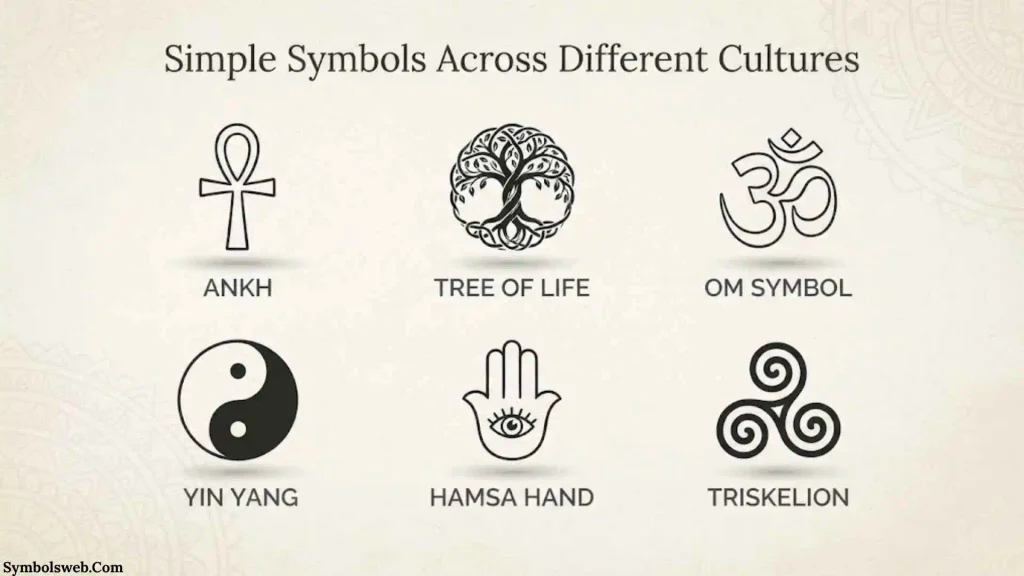
Simple Symbols Across Different Cultures
Ancient Egypt
Egyptians used symbols extensively in their hieroglyphic writing.
Common examples included:
- The ankh representing life
- The eye symbolizing protection
- The scarab representing rebirth
Symbols were believed to possess spiritual power and were often placed in tombs and temples.
Ancient Greece
Greek culture connected symbols with mythology and philosophy.
Examples included:
- Olive branches for peace
- Owls for wisdom
- Labyrinths representing life’s challenges
These symbols continue influencing modern thought today.
Roman Culture
Romans adopted and expanded many symbolic traditions.
Symbols represented:
- Military strength
- Political authority
- Divine favor
Eagles became particularly important as symbols of power and empire.
Eastern Traditions
Many Eastern philosophies emphasize symbolic harmony.
Popular symbols include:
- Yin and Yang for balance
- Lotus flowers for enlightenment
- Circles for perfection
These symbols continue to inspire meditation and spiritual practices worldwide.
Indigenous Traditions
Indigenous cultures often use symbols connected to nature.
Common themes include:
- Animals
- Mountains
- Rivers
- Sun and moon imagery
These symbols preserve ancestral knowledge and cultural identity.
Modern Interpretations
Today, symbols remain essential.
Modern examples include:
- Emojis
- Corporate logos
- Social media icons
- Awareness ribbons
Although simplified, they serve the same purpose as ancient symbols by communicating meaning quickly and effectively.
Similar Symbols and Their Meanings
| Symbol | Similarity | Difference |
| Circle | Represents unity | Focuses on eternity |
| Ring | Represents connection | Often linked to commitment |
| Spiral | Continuous movement | Emphasizes growth |
| Wheel | Circular shape | Represents progress and motion |
| Mandala | Circular design | Includes spiritual complexity |
Common Misconceptions
Many people assume symbols have one fixed meaning.
In reality:
- Meanings change across cultures.
- Historical contexts matter.
- Personal experiences influence interpretation.
A symbol may represent hope in one culture and caution in another.
Simple Symbols in Mythology and Folklore
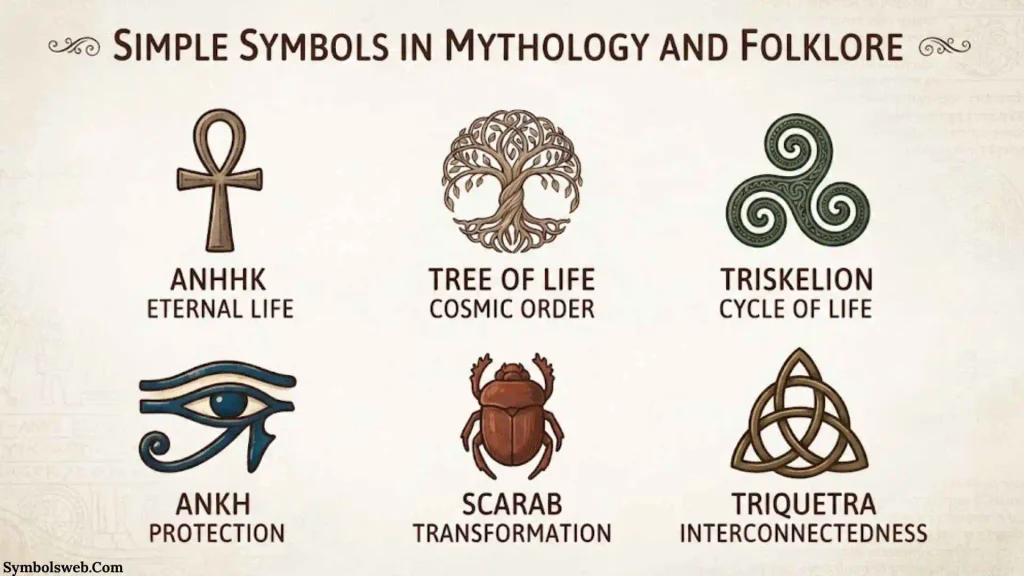
Myths and legends are filled with symbols that communicate deeper truths.
The tree appears in countless traditions as a bridge between worlds. Norse mythology described a cosmic tree connecting different realms of existence.
Stars often guided heroes through difficult journeys. Ancient storytellers used them as symbols of destiny and divine guidance.
Spirals appeared in Celtic traditions, representing the cycles of birth, death, and rebirth.
These stories transformed simple shapes into powerful carriers of wisdom.
Simple Symbols in Art, Literature, Movies, and Pop Culture
Paintings
Artists use symbols to communicate hidden meanings.
A flower may symbolize innocence.
A skull may symbolize mortality.
A bird may symbolize freedom.
Literature
Authors rely heavily on symbolism.
In novels and poetry, simple objects often represent larger themes such as love, fear, hope, or transformation.
Movies
Filmmakers use recurring symbols to tell stories visually.
Examples include:
- White light representing hope
- Doors representing opportunity
- Water representing emotional change
Television
Television series often build symbolic imagery across multiple episodes to deepen storytelling.
Tattoos
Simple symbols are among the most popular tattoo designs.
People choose:
- Hearts
- Stars
- Arrows
- Trees
- Infinity signs
These designs often represent personal journeys and beliefs.
Fashion
Fashion brands frequently incorporate symbolic imagery into clothing and accessories to communicate identity and values.
Modern Design
Minimalist design embraces simple symbols because they are memorable, universal, and effective.
Spiritual and Dream Meaning of Simple Symbols
Dreams frequently communicate through symbols rather than direct messages.
Common Dream Interpretations
Circle
May symbolize completion, harmony, or a life cycle reaching fulfillment.
Star
Often represents hope, guidance, or future opportunities.
Tree
Can symbolize personal growth, family roots, or wisdom.
Water Symbol
May reflect emotional states and inner transformation.
Meditation Experiences
During meditation, people sometimes visualize simple symbols.
These experiences are often interpreted as signs of:
- Personal growth
- Spiritual awakening
- Inner healing
- Increased awareness
Positive Messages
Symbols may encourage:
- Confidence
- Healing
- Wisdom
- Balance
Cautionary Messages
Certain symbolic appearances may suggest:
- Unresolved emotions
- Life imbalance
- Fear of change
- Need for reflection
Positive and Negative Meanings of Simple Symbols
| Positive Meaning | Negative Meaning |
| Love | Obsession |
| Unity | Conformity |
| Growth | Uncontrolled change |
| Wisdom | Isolation |
| Protection | Restriction |
| Hope | Unrealistic expectations |
| Transformation | Uncertainty |
| Connection | Dependence |
The meaning often depends on context, culture, and personal experience.
Why Humans Are Attracted to Simple Symbols
Humans naturally seek patterns.
Our brains process visual information much faster than written language. A symbol can trigger memories, emotions, and associations almost instantly.
Psychologists suggest symbols appeal to us because they:
- Simplify complex ideas
- Create emotional connections
- Strengthen group identity
- Preserve cultural memory
- Support storytelling
A child can recognize a heart before understanding the concept of romantic love. This demonstrates the remarkable power of symbolic learning.
Simple symbols also allow people to express deeply personal beliefs without needing lengthy explanations.
Modern Uses of Simple Symbols
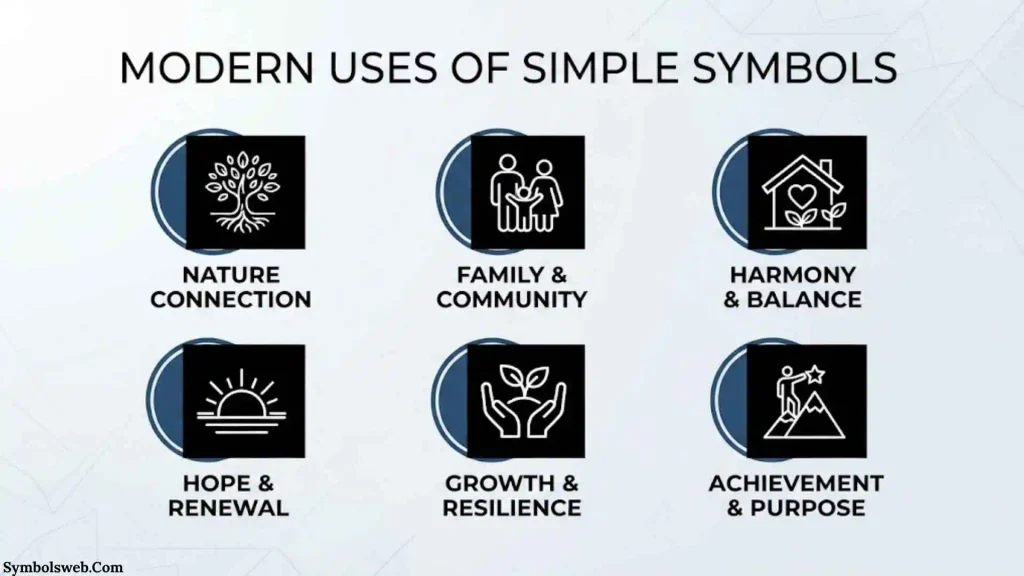
Tattoos
People use symbols to represent life experiences, values, and personal transformations.
Jewelry
Symbolic jewelry serves as a reminder of love, faith, protection, or achievement.
Fashion
Designers incorporate symbols to communicate identity and style.
Branding
Successful brands often rely on simple symbols because they are easy to recognize and remember.
Social Media
Icons and emojis have become a modern symbolic language.
Contemporary Spirituality
Many people use symbols during meditation, mindfulness practices, and personal rituals.
Home Decor
Symbolic artwork creates meaning and atmosphere within living spaces.
Personal Expression
Simple symbols help individuals communicate who they are and what they value.
Interesting Facts About Simple Symbols
- Humans used symbols long before written language existed.
- Some cave symbols are over 30,000 years old.
- The same symbol can have different meanings in different cultures.
- Many modern logos are based on ancient symbolic principles.
- Symbols are processed by the brain faster than text.
- Jung considered symbols essential to understanding the unconscious mind.
- Emojis are among today’s most widely used symbolic systems.
- Religious traditions worldwide rely heavily on symbolic imagery.
- Children often learn symbols before they learn words.
- Symbols can influence emotions even when people are unaware of their meanings.
Frequently Asked Questions
What are simple symbols?
Simple symbols are basic visual signs or shapes that represent ideas, emotions, beliefs, objects, or concepts without using words.
Why are symbols important?
Symbols help people communicate complex meanings quickly. They preserve cultural traditions, express emotions, and strengthen social connections.
What is the oldest known symbol?
Some of the oldest known symbols come from prehistoric cave art and geometric carvings created tens of thousands of years ago.
Do symbols have universal meanings?
Some symbols have widely shared meanings, but interpretations can vary depending on culture, history, religion, and personal experience.
Why do people use symbolic tattoos?
People choose symbolic tattoos to represent personal values, memories, spiritual beliefs, achievements, or important life experiences.
Can symbols appear in dreams?
Yes. Dream symbolism is common. Many psychologists believe symbols help the mind communicate emotions, desires, fears, and unconscious thoughts.
Conclusion
Simple symbols may appear small and ordinary, but they carry extraordinary meaning. Across history, cultures, religions, and personal experiences, these visual signs have helped humanity communicate ideas that words often cannot fully express.
From ancient cave walls to modern smartphones, symbols continue to shape how we understand ourselves and the world around us. Their power lies in their simplicity, yet their meanings can be endlessly deep. The next time you see a simple symbol, remember that behind that small image may exist thousands of years of human history, emotion, and wisdom.

 Jordan Hayes
 Eliana Foster
 Ethan Holloway