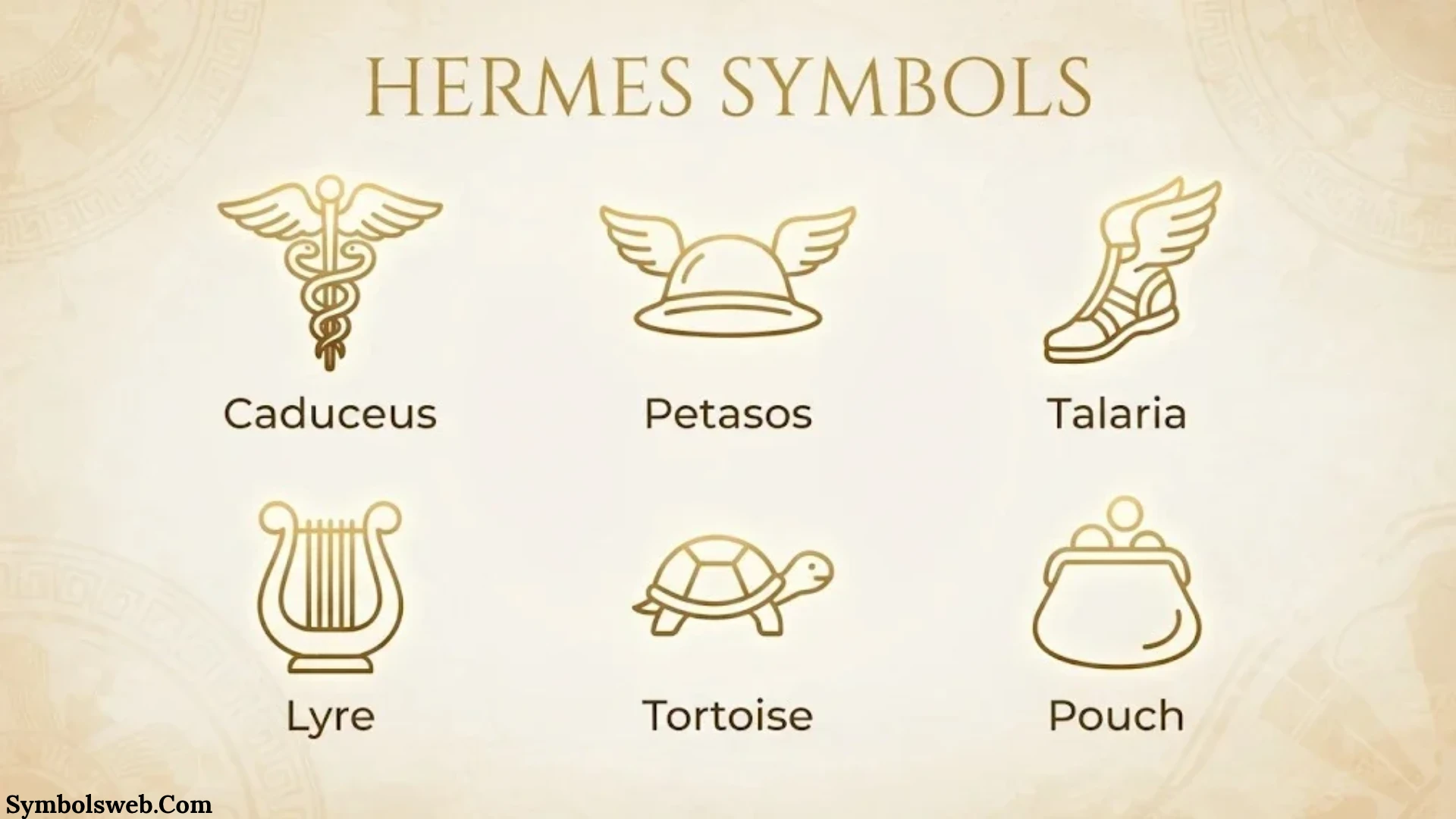
Hermes is one of the most recognizable gods in Greek mythology. Known as the Messenger of the Gods, he connects Mount Olympus with the mortal world. His symbols represent speed, communication, cleverness, travel, trade, and divine protection.
The symbols of Hermes tell fascinating stories about his personality and responsibilities. His famous caduceus features two intertwined serpents. His winged sandals represent extraordinary speed while his tortoise connects him to the invention of music. Each attribute reveals another part of his identity.
However, Hermes represents much more than messages and fast travel. Ancient Greeks also honored him as the god of merchants, thieves, travelers, shepherds, and athletes. He even guided deceased souls toward the Underworld. These different responsibilities made him one of the most versatile Olympian deities.
This guide explores the major Hermes symbols and their meanings, including their mythological origins, sacred animals, famous stories, and historical importance. You’ll also discover how his symbols influenced ancient Greek art, Roman mythology, medicine, business, and modern culture.
What Are the Symbols of Hermes?
The symbols of Hermes are objects, animals, and artistic attributes associated with his divine identity. Ancient Greek artists used these recognizable features to show his responsibilities and distinguish him from other gods.
His most familiar attributes include the caduceus, winged sandals, petasos, winged helmet, and tortoise. Ancient representations also show him carrying a ram or appearing beside a rooster.
Some symbols connect directly to ancient myths. Others developed through religious worship and artistic traditions.
For example, the tortoise recalls Hermes’ invention of the lyre. His staff identifies him as a divine herald while his winged footwear emphasizes his ability to travel quickly.
Complete List of Hermes Symbols and Their Meanings
| Hermes symbol | Meaning and significance |
| Caduceus | Divine communication, heraldry, and mediation |
| Winged sandals (Talaria) | Speed, movement, and travel |
| Winged helmet | Swift movement and divine messenger duties |
| Petasos | Travel and protection |
| Tortoise | Musical invention, creativity, and intelligence |
| Rooster | Alertness and associations with athletic life |
| Ram | Shepherding, livestock, and protection of herds |
| Serpents | Recognizable elements of the caduceus |
| Herms | Boundaries, roads, entrances, and protection |
| Herald’s staff | Divine authority and messenger responsibilities |
These attributes help explain why Hermes appears in so many different settings throughout Greek mythology. His symbols connect the divine world with everyday human activities.
Hermes Symbols and Their Meanings Explained
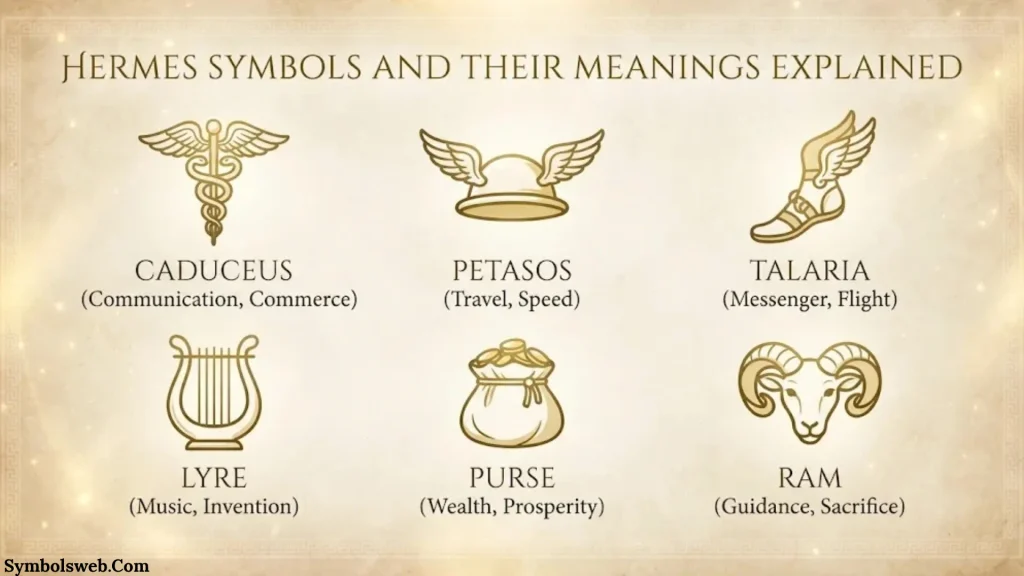
Each Hermes symbol represents a different part of his character. Some highlight his supernatural abilities while others recall specific mythological stories.
Caduceus: The Staff of Hermes
The caduceus is the most recognizable symbol of Hermes. It features a staff with two serpents winding around its central shaft. Many familiar artistic versions also include a pair of wings near the top.
The ancient Greek name for this herald’s staff is kerykeion. The Romans later used the name caduceus. Hermes carries it in many ancient representations as a sign of his authority.
The staff reflects his position as the Messenger of the Gods. As a divine intermediary, Hermes delivers messages and travels between different realms. His responsibilities require communication, negotiation, and diplomacy.
The caduceus also became associated with trade and commerce. These connections grew stronger through Hermes’ identification with Mercury, the Roman god of merchants and commercial activity.
What does the caduceus symbolize?
- Communication: Hermes delivers messages between gods and mortals.
- Authority: The staff identifies him as a divine herald.
- Negotiation: His diplomatic responsibilities connect the staff with mediation.
- Commerce: His relationship with merchants encouraged commercial associations.
- Divine movement: The caduceus accompanies him during journeys between worlds.
One important distinction deserves attention. The caduceus is not the same as the Rod of Asclepius.
| Feature | Caduceus | Rod of Asclepius |
| Appearance | Two serpents, often with wings | One serpent around a staff |
| Associated deity | Hermes | Asclepius |
| Original association | Heraldry and mediation | Healing and medicine |
| Common modern use | Commerce and some medical organizations | Medicine and healthcare |
The Rod of Asclepius has the stronger historical connection to healing. Asclepius was the Greek god of medicine. His staff traditionally features one serpent without wings.
Although some modern medical organizations use the caduceus, that association developed through later institutional choices. It doesn’t reflect the original distinction between these mythological symbols.
Winged Sandals (Talaria): Symbol of Speed and Travel
Hermes’ winged sandals, known as talaria, represent speed and freedom of movement. These extraordinary sandals allow him to travel rapidly through the sky and across the world.
As the messenger of the Olympian gods, Hermes frequently travels between Mount Olympus and Earth. His responsibilities also take him into the Underworld. The winged sandals make him an ideal divine messenger and guide.
Ancient literature describes Hermes using supernatural movement during important missions. In Homer’s Odyssey, he travels to Calypso’s island to deliver Zeus’ command concerning Odysseus.
The sandals therefore represent more than physical speed. They also express Hermes’ ability to cross boundaries that separate different worlds.
The main meanings of Hermes’ winged sandals include:
- Speed and agility.
- Freedom of movement.
- Divine messages and communication.
- Safe passage during journeys.
- Travel between divine and mortal realms.
- Movement between the living world and the Underworld.
Modern artists frequently depict Hermes with small wings attached to his ankles or sandals. This visual feature remains one of the easiest ways to recognize him.
Winged Helmet: Symbol of the Divine Messenger
The winged helmet is another recognizable attribute of Hermes. Artists often place small wings on his headgear to emphasize his supernatural speed.
However, ancient representations of Hermes weren’t always identical. Some show him wearing a traditional traveler’s hat while others give his hat wings.
This distinction matters because the winged helmet and the petasos are related but not interchangeable terms. The petasos was an actual type of ancient Greek hat. Wings were an additional artistic feature used to identify Hermes.
The winged helmet reinforces several aspects of his mythology:
- Speed: It emphasizes his extraordinary movement.
- Communication: It identifies him as a messenger.
- Mobility: It reflects his frequent journeys.
- Divine identity: It helps distinguish him from ordinary travelers.
In modern paintings, sculptures, illustrations, and popular culture, the winged helmet has become a familiar visual shorthand for Hermes and his Roman counterpart Mercury.
Petasos: The Traveler’s Hat
The petasos was a broad-brimmed hat worn in ancient Greece. Travelers commonly used this practical head covering to protect themselves from sunlight and outdoor conditions.
Hermes frequently appears wearing a petasos in ancient artwork. Its connection to travel makes it especially appropriate for a god who protects roads, travelers, and messengers.
Unlike the more elaborate winged helmet seen in modern illustrations, the traditional petasos usually has a simple design.
It generally features:
- A rounded crown.
- A broad brim.
- A practical shape for outdoor use.
- A recognizable association with travelers.
The petasos represents mobility, travel, and protection. It also connects Hermes with ordinary people who depended on roads and journeys for their livelihoods.
Ancient artists sometimes added wings to the hat. This detail strengthened Hermes’ association with supernatural speed and divine communication.
Tortoise: Symbol of Invention and Creativity
The tortoise has one of the most interesting connections to Hermes. Unlike the winged sandals and caduceus, this animal comes directly from an important story about his childhood.
According to the Homeric Hymn to Hermes, the young god discovered a tortoise outside his mother’s cave on Mount Cyllene.
Rather than simply passing by, Hermes recognized the possibilities hidden inside its shell. He used the hollow shell as the body of a musical instrument and stretched strings across it.
This creation became the lyre, one of the most important musical instruments in ancient Greek mythology.
Hermes later presented the instrument to Apollo as part of their reconciliation after stealing his cattle.
The tortoise consequently represents:
- Invention: Hermes transforms an ordinary object into something useful.
- Creativity: Its shell becomes the foundation of a musical instrument.
- Intelligence: Hermes recognizes an opportunity others might overlook.
- Resourcefulness: He uses available materials to solve a problem.
- Music: The tortoise connects directly to the lyre and Apollo.
This story shows why Hermes is celebrated as a god of invention and cleverness. His intelligence isn’t limited to clever speech or deception. He can also create something valuable from an unexpected discovery.
Rooster: Symbol of Alertness and Athletic Life
The rooster appears among animals associated with Hermes in some ancient artistic and symbolic traditions.
Its crowing at dawn makes it a natural image of alertness and wakefulness. These qualities fit a god known for quick thinking, movement, and awareness.
Hermes also had an important relationship with athletics. Ancient Greeks honored him in connection with gymnasiums and athletic activities. Roosters appeared in the wider culture of Greek competitions and animal symbolism.
However, the rooster doesn’t have the same direct mythological importance as the tortoise. The tortoise has a clearly documented role in the story of Hermes and the lyre.
Therefore, it’s more accurate to describe the rooster as an associated animal rather than claim it was his universally established sacred animal.
Serpents: Symbol of the Caduceus
The two intertwined serpents form a central feature of the caduceus. Their curved bodies wind around the staff and create its distinctive appearance.
Serpents appear throughout Greek mythology. Different gods and mythological figures have their own connections with snakes. However, the two serpents on Hermes’ staff should be understood primarily as components of his heraldic attribute.
Their presence helps identify the caduceus in ancient artwork and later representations.
The staff became associated with communication, mediation, and commercial activity through Hermes’ divine responsibilities.
Modern interpretations sometimes connect the intertwined serpents with balance and harmony. These meanings can appear in contemporary symbolic readings, but they shouldn’t automatically be treated as the original meaning of the ancient Greek attribute.
Ram: Symbol of Shepherds and Livestock
The ram has a strong connection to Hermes’ role as a protector of shepherds and livestock.
Ancient Greeks depended heavily on sheep and other domestic animals for food, clothing, and economic activity. Protecting herds was therefore an important responsibility.
Hermes appears in ancient art carrying a ram across his shoulders. This representation is known as Hermes Kriophoros, meaning Hermes the Ram-Bearer.
The image highlights his protective relationship with shepherds and their animals.
The ram represents:
- Protection of livestock.
- Shepherding and pastoral life.
- Fertility and healthy herds.
- Agricultural wealth.
- Hermes’ connection to rural communities.
The ram is an especially useful addition to discussions of Hermes because it reveals a side of his mythology that winged sandals and the caduceus don’t explain.
Herms: Stone Pillars Associated With Hermes
Herms were stone pillars associated with Hermes and used throughout ancient Greek communities.
Traditional herms often featured a rectangular pillar topped with a carved head of Hermes. Many also included an explicit representation of male genitalia as a symbol associated with fertility and protection.
These monuments appeared at roads, crossroads, property boundaries, and entrances. They marked important spaces while connecting them with Hermes’ protective influence.
Unlike the caduceus or winged sandals, herms were physical religious monuments used in everyday Greek life.
Their importance extended beyond personal worship.
Herms could serve several purposes:
- Marking roads and boundaries.
- Identifying entrances and property divisions.
- Protecting public spaces.
- Representing the presence of Hermes.
- Expressing civic and religious identity.
One famous historical event involving herms occurred in Athens in 415 BCE. During the Peloponnesian War, many herms were deliberately mutilated shortly before the Athenian expedition to Sicily.
The incident caused serious public alarm because herms had important religious and civic meaning.
What Does Hermes Represent in Greek Mythology?
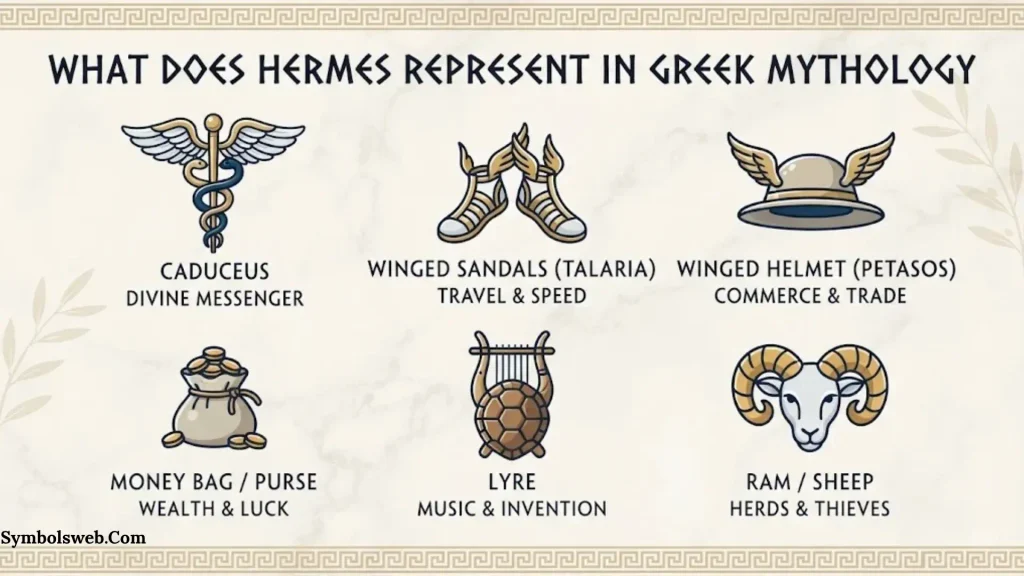
Hermes represents communication, movement, trade, intelligence, and transitions between different worlds. His many responsibilities make him one of the most versatile Olympian gods.
Unlike deities associated with a narrower domain, Hermes connects several parts of ancient Greek life.
Hermes as the Messenger of the Gods
Hermes is best known as the Messenger of the Gods. He carries instructions between Olympian deities and delivers important messages to mortals.
Zeus frequently relies on him to complete divine missions. Hermes can communicate with different gods and travel to places that other figures cannot easily reach.
His messenger responsibilities include:
- Delivering Zeus’ commands.
- Communicating with mortals.
- Carrying messages between gods.
- Helping resolve disputes.
- Guiding important mythological journeys.
His caduceus, winged sandals, and petasos all reinforce this identity.
Hermes as the God of Travel and Roads
Hermes protects travelers and helps people navigate unfamiliar places.
Ancient Greek travel often involved difficult roads, dangerous landscapes, and uncertain conditions. Travelers needed protection during long journeys.
His connection to crossroads and herms reflects this responsibility.
Hermes also represents movement between different spaces. He can travel from Mount Olympus to Earth and enter the Underworld.
This ability makes him a natural divine guide and protector of journeys.
Hermes as the God of Trade and Commerce
Hermes also has an important connection to merchants and commercial exchange.
Markets depended on communication, negotiation, transportation, and trust. These activities fit his role as a god who manages movement and interactions.
His responsibilities include:
- Protecting merchants.
- Supporting commercial exchanges.
- Encouraging successful negotiations.
- Connecting sellers and buyers.
- Representing economic movement.
His Roman counterpart, Mercury, developed an especially strong association with commerce and trade.
Hermes as the God of Thieves and Trickery
Hermes has a mischievous personality. His reputation as a trickster god comes from stories involving deception, cleverness, and theft.
His most famous example is stealing Apollo’s cattle shortly after birth.
However, Hermes isn’t simply a god of dishonesty. His trickery also reveals intelligence, adaptability, and an ability to overcome difficult situations.
His mythology explores the complicated relationship between cleverness and morality.
Hermes as the Guide of Souls (Psychopomp)
One of Hermes’ most important responsibilities involves guiding deceased souls toward the Underworld.
The Greek term psychopomp describes a figure who guides souls after death.
Hermes carries the title Psychopompos because he helps souls make the transition from the world of the living to the realm of the dead.
His role connects him with:
- The Underworld.
- Hades and Persephone.
- The journey after death.
- The boundaries between life and death.
- The movement of souls between different realms.
He doesn’t rule the Underworld. Hades holds that position. Hermes serves as a guide and intermediary.
This responsibility adds another layer to the meaning of his symbols. His ability to travel between worlds represents transition as much as speed.
Hermes as the God of Athletics and Competition
Hermes also has a strong relationship with physical activity and athletic life.
Ancient Greeks honored him as a protector of gymnasiums and athletic spaces. Artists frequently represented him as a youthful and athletic figure.
His connection to sports reflects qualities such as:
- Agility.
- Physical strength.
- Speed.
- Coordination.
- Competition.
- Athletic skill.
These characteristics also explain why Hermes’ image became popular in classical sculpture.
Hermes’ Sacred Animals and Their Symbolic Meanings
Animals help explain several parts of Hermes’ identity. Some connect to specific myths while others reflect his responsibilities as a protector of livestock, travelers, and athletic communities.
The most important animal associations include the tortoise, ram, rooster, and hawk.
| Animal | Connection to Hermes | Symbolic meaning |
| Tortoise | Invention of the lyre | Creativity and intelligence |
| Ram | Protection of herds | Shepherding and pastoral life |
| Rooster | Artistic and cultural associations | Alertness and vigilance |
| Hawk | Listed among animals associated with Hermes | Speed and sharp awareness |
Tortoise
The tortoise has the clearest connection to a specific Hermes myth. Its shell provided the body of the first lyre in the Homeric Hymn to Hermes.
This story links the animal with music, invention, and resourcefulness.
Ram
The ram represents Hermes’ responsibilities as a protector of shepherds. His title Kriophoros refers to his representation carrying a ram.
Ancient sculptures and pottery frequently show this pastoral aspect of the god.
Rooster
The rooster appears in some representations associated with Hermes. Its connection to dawn and alertness makes it a fitting companion for a quick and watchful deity.
However, its symbolic status varies across ancient traditions.
Hawk
The hawk also appears among animals associated with Hermes in some mythological reference traditions. Its speed and sharp awareness fit his broader qualities.
Nevertheless, the hawk isn’t as strongly connected to his major myths as the tortoise or ram.
The Mythological Origins of Hermes’ Symbols
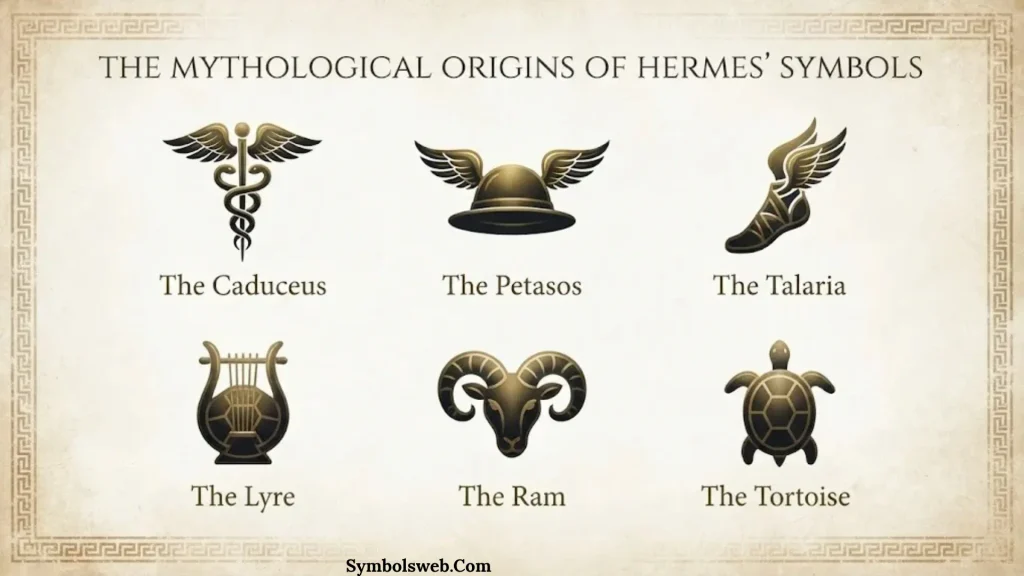
The symbols of Hermes become easier to understand when you explore the stories behind them. Several of his most recognizable attributes emerged through adventures involving Apollo, Zeus, and other mythological figures.
How Hermes Invented the Lyre Using a Tortoise Shell
The invention of the lyre is one of the most famous stories about Hermes.
According to the Homeric Hymn to Hermes, he was born to Zeus and Maia in a cave on Mount Cyllene in Arcadia.
Even as a newborn, Hermes displayed extraordinary curiosity and intelligence.
He left his mother’s cave and discovered a tortoise outside. After examining the animal, he recognized that its hollow shell could become the foundation of a musical instrument.
He used the shell as a soundbox and stretched strings across it. He then created the first lyre and began playing music.
This invention demonstrates his resourcefulness and creative thinking.
The story also introduces an important connection between Hermes and Apollo. The instrument eventually becomes the center of their reconciliation.
Why Hermes Stole Apollo’s Cattle
Hermes’ theft of Apollo’s cattle is another famous childhood adventure.
After inventing the lyre, Hermes traveled to the region where Apollo’s cattle grazed. He stole fifty animals and attempted to conceal their tracks.
Some versions describe him making the cattle walk backward to confuse anyone following them.
Apollo eventually discovered the theft and identified Hermes as the culprit.
However, Hermes denied responsibility and tried to defend himself through clever arguments. Their disagreement eventually reached Zeus.
Instead of allowing the conflict to continue, Zeus encouraged the brothers to reconcile.
Hermes played his newly invented lyre. Apollo loved its sound and accepted the instrument in exchange for the cattle.
This exchange transformed their relationship.
The story explains several aspects of Hermes’ mythology:
- His reputation as a trickster god.
- His intelligence and persuasive abilities.
- His association with cattle and shepherding.
- His invention of the lyre.
- His relationship with Apollo.
- His growing position among the Olympian gods.
Hermes and Argus Panoptes
The story of Hermes and Argus Panoptes highlights his role as a clever servant of Zeus.
Zeus became involved with Io, a mortal woman. Hera discovered the relationship and transformed Io into a cow in many familiar versions of the myth.
Hera then placed Io under the watch of Argus Panoptes. This giant had numerous eyes and could remain alert even while some of them slept.
Zeus sent Hermes to free Io.
Hermes approached Argus and used conversation, storytelling, and music to distract him. In Ovid’s Metamorphoses, Hermes eventually puts Argus to sleep and kills him.
The story explains Hermes’ association with the title Argeiphontes, commonly translated as the slayer of Argus.
It also demonstrates his abilities as a messenger, strategist, and problem-solver.
Hermes as a Divine Messenger of Zeus
Hermes regularly carries out missions for Zeus throughout Greek mythology.
His responsibilities include delivering commands, escorting individuals, and assisting other gods.
One famous example appears in Homer’s Iliad. Zeus sends Hermes to guide Priam safely into the Greek camp so he can recover Hector’s body from Achilles.
Hermes disguises himself as a young man and helps Priam complete the dangerous journey.
This story demonstrates his protective role and his ability to move between different groups.
It also reveals that Hermes’ duties involve more than delivering messages. He can guide people through difficult situations and help them cross dangerous boundaries.
Hermes Guiding Souls Into the Underworld
Hermes’ role as a psychopomp is among his most important religious responsibilities.
Ancient Greek beliefs included the idea that deceased souls traveled to the Underworld after death. Hermes helped guide these souls toward their destination.
His responsibilities differed from those of Hades. Hades ruled the Underworld while Hermes served as a guide.
This role explains why ancient literature frequently connects him with journeys, boundaries, and transitions.
It also gives his symbols deeper meaning. His winged sandals represent movement between worlds while his herald’s staff identifies him as a divine intermediary.
Hermes’ Powers and Abilities in Greek Mythology
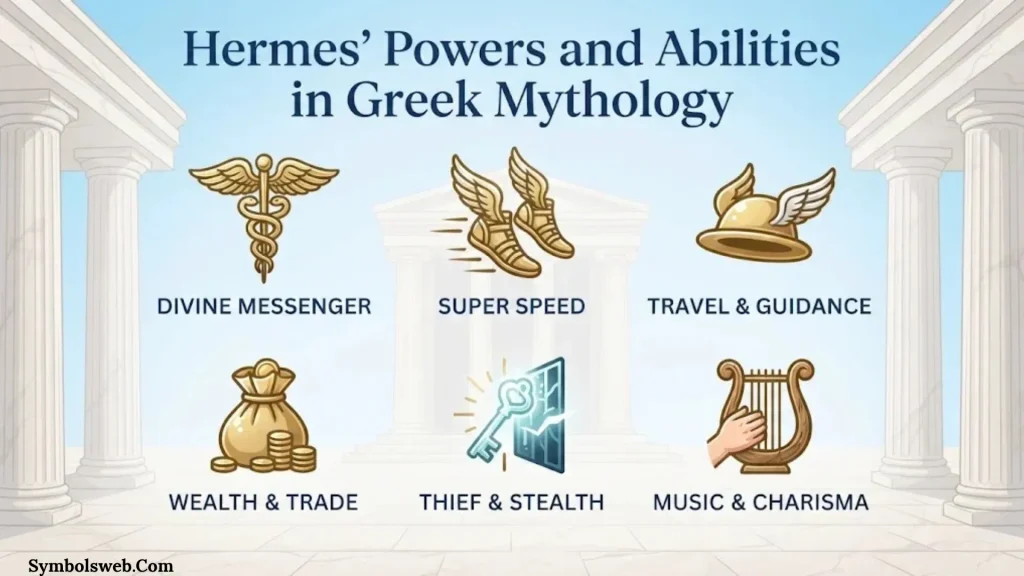
Hermes possesses several extraordinary abilities that reflect his many responsibilities. His powers include supernatural speed, persuasive speech, cunning intelligence, and the ability to guide souls.
Supernatural Speed and Flight
Hermes’ most recognizable ability is his incredible speed.
His winged sandals allow him to travel quickly between different locations. He can move between Mount Olympus and the mortal world while also entering the Underworld.
His speed makes him particularly useful when Zeus needs someone to deliver an urgent message.
Divine Communication and Persuasion
Hermes has exceptional communication skills.
He can speak persuasively, negotiate with others, and deliver important messages. These abilities make him an effective mediator between gods and mortals.
His eloquence also supports his reputation as the god of communication.
Cunning Intelligence and Trickery
Hermes frequently solves problems through intelligence rather than physical strength.
His theft of Apollo’s cattle demonstrates his ability to plan carefully and confuse his opponents.
His cleverness also appears in the Argus story and his many divine missions.
Invention and Creativity
Hermes demonstrates his inventive abilities through the creation of the lyre.
The tortoise-shell instrument becomes an important symbol of his creative intelligence.
Later traditions also attribute other inventions and forms of knowledge to Hermes. However, these claims vary between sources and shouldn’t all be treated as equally established.
Guiding Souls Between Worlds
Hermes can enter different mythological realms and guide souls toward the Underworld.
This ability makes him a unique figure among the Olympian gods.
He connects the living and the dead through his role as Psychopompos.
Hermes’ Personality Traits and Characteristics
Hermes has a complex personality that combines intelligence, humor, athletic ability, and mischief.
His mythology presents him as a god who can be helpful and deceptive depending on the situation.
Cleverness and Intelligence
Hermes frequently finds solutions that other gods overlook.
His invention of the lyre shows creative intelligence. His cattle theft reveals strategic thinking and an understanding of deception.
These qualities make him one of Greek mythology’s most resourceful figures.
Mischief and Playfulness
Hermes displays a playful personality from infancy.
His theft of Apollo’s cattle shows his willingness to break rules and challenge authority.
However, his mischievous behavior also helps explain his role as a trickster.
Eloquence and Communication
Hermes knows how to use language effectively.
He delivers messages, persuades others, and negotiates difficult situations.
His communication abilities are central to his position as the divine messenger.
Adaptability and Resourcefulness
Hermes adjusts quickly when circumstances change.
He can move between different worlds, interact with gods and mortals, and find practical solutions to complicated problems.
His invention of the lyre is one of the clearest examples.
Athleticism and Agility
Hermes is often represented as a youthful and athletic god.
His connection to physical competition reflects his speed, coordination, and agility.
These qualities also connect him with ancient Greek gymnasiums and athletic festivals.
Hermes’ Family, Parents, Siblings, and Children
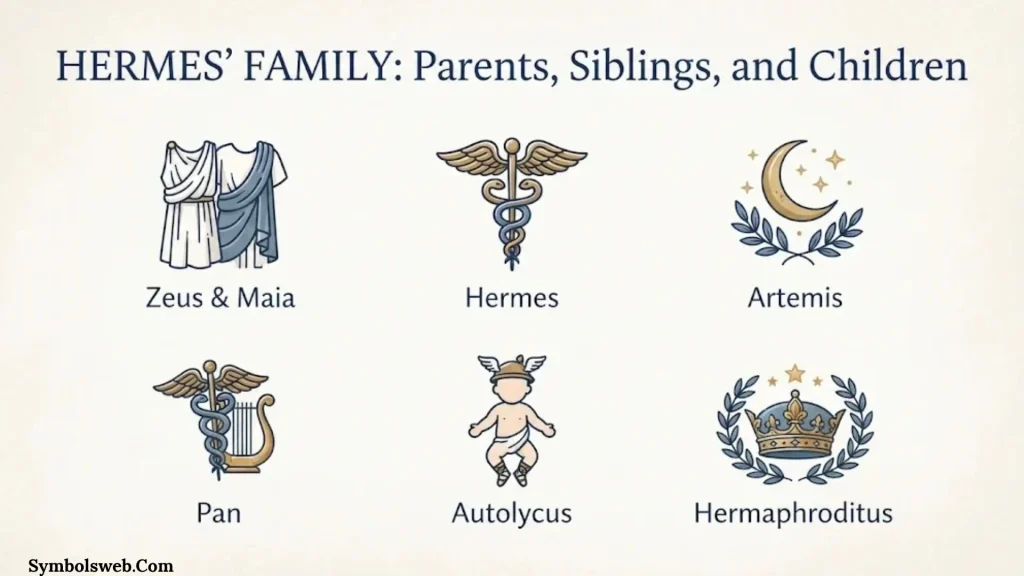
Understanding Hermes’ family helps explain his relationships with other important figures in Greek mythology.
Who Are Hermes’ Parents?
Hermes is the son of Zeus and Maia.
Zeus is the king of the Olympian gods while Maia is one of the seven Pleiades, daughters of Atlas and Pleione.
Hermes was born in a cave on Mount Cyllene in Arcadia. This location connects him with the epithet Cyllenius.
Who Are Hermes’ Siblings?
Hermes has several half-siblings through Zeus.
His mythological family includes:
- Apollo: God of music, prophecy, and healing.
- Artemis: Goddess of hunting and wilderness.
- Ares: God of war.
- Athena: Goddess of wisdom and strategic warfare.
- Dionysus: God of wine and ecstatic celebration.
Ancient genealogies vary, so not every family relationship appears consistently in all traditions.
Hermes’ Romantic Relationships
Hermes has several romantic associations in Greek mythology.
One of his best-known relationships involves Aphrodite, the goddess of love and beauty.
Their union is associated with Hermaphroditus, a mythological figure whose story appears in Ovid’s Metamorphoses.
Hermes also appears in stories involving nymphs and other mythological figures. Ancient sources differ regarding his partners and the identities of some of his children.
Who Are Hermes’ Children?
Several mythological figures are identified as children of Hermes in different traditions.
| Child | Mythological connection |
| Pan | God associated with shepherds and wilderness |
| Hermaphroditus | Child of Hermes and Aphrodite |
| Autolycus | Legendary thief and grandfather of Odysseus |
| Abderus | Companion of Heracles in one tradition |
| Eudoros | Leader in the Trojan War described in the Iliad as a son of Hermes |
These relationships demonstrate how widely Hermes appears in Greek genealogical traditions.
Hermes and Other Greek Gods
Hermes interacts with several major Olympian deities. These relationships reveal his role as a messenger, mediator, and participant in important mythological events.
Hermes and Zeus
Zeus is Hermes’ father and frequently relies on him to carry out divine missions.
Their relationship highlights Hermes’ position within the Olympian hierarchy.
He serves Zeus by delivering messages, guiding individuals, and carrying out important instructions.
Hermes and Apollo
Apollo and Hermes share one of the most entertaining relationships in Greek mythology.
Their famous disagreement over Apollo’s cattle eventually leads to the exchange of the lyre.
Apollo receives the musical instrument while Hermes receives recognition and a golden herald’s staff.
Their story combines rivalry, negotiation, invention, and reconciliation.
Hermes and Aphrodite
Hermes and Aphrodite are connected through the myth of Hermaphroditus.
Their child becomes an important figure in ancient mythology and later artistic traditions.
Their relationship also illustrates how Greek myths connect divine families with stories about love and identity.
Hermes and Hades
Hermes works closely with Hades through his role as a guide of souls.
He escorts deceased individuals toward the Underworld and helps them make the transition after death.
Unlike Hades, Hermes doesn’t rule the dead. His responsibility is to guide them.
Hermes and Dionysus
Hermes appears in the story of the infant Dionysus.
In some traditions, Hermes carries the child away for protection following the conflict surrounding Dionysus’ birth.
The famous sculpture Hermes and the Infant Dionysus, traditionally attributed to Praxiteles, depicts this mythological relationship.
Hermes in Roman Mythology: The Connection to Mercury
The Roman counterpart of Hermes is Mercury.
The Romans identified Mercury with Hermes and adopted many of his familiar attributes. These included winged sandals, the herald’s staff, and the traveler’s hat.
However, Roman religious traditions developed their own emphasis on Mercury’s responsibilities.
Mercury became especially important as a god of commerce, merchants, and financial exchange.
Similarities Between Hermes and Mercury
| Attribute | Hermes | Mercury |
| Divine messenger | Yes | Yes |
| Winged sandals | Yes | Yes |
| Caduceus | Yes | Yes |
| Trade and commerce | Yes | Strong association |
| Travelers | Yes | Yes |
| Thievery and cunning | Yes | Yes |
Differences Between Hermes and Mercury
Hermes belongs to Greek religious traditions while Mercury developed within Roman religion.
Although their identities became closely connected, their worship and cultural importance weren’t completely identical.
Mercury’s association with commerce became especially prominent in Roman culture. Some Roman representations also show him carrying a moneybag.
Hermes and Other Mythological Trickster Figures
Hermes shares certain characteristics with other mythological trickster figures.
Loki in Norse mythology is known for deception, cleverness, and mischief. Both figures can challenge established rules and create unexpected situations.
Thoth in Egyptian mythology has a different role. He is associated with writing, wisdom, calculation, and knowledge.
Hermes was also identified with Thoth in later religious and philosophical traditions. This association contributed to the development of Hermes Trismegistus, a legendary figure connected with Hermetic writings.
However, Hermes, Loki, and Thoth come from distinct religious traditions. Their similarities don’t make them identical gods.
How Ancient Greeks Worshipped Hermes
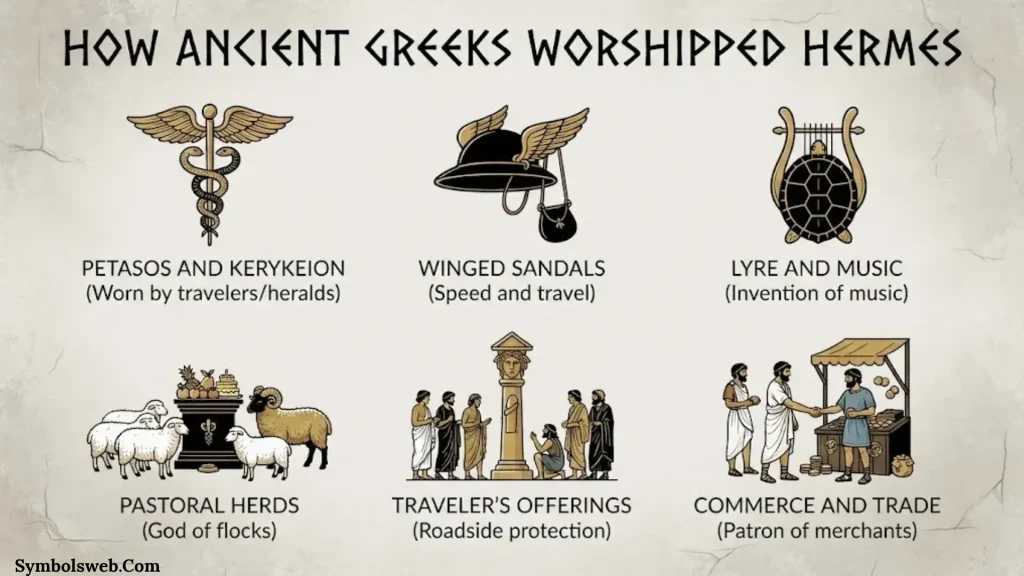
Hermes wasn’t simply a character in ancient stories. He was an important deity in everyday Greek religious life.
His responsibilities connected him with roads, households, commercial activities, athletic spaces, and livestock.
Hermes in Ancient Greek Religion
Ancient Greeks honored Hermes as a protector of travelers, merchants, shepherds, and messengers.
His influence extended into ordinary activities that required movement and communication.
People associated him with:
- Safe journeys and transportation.
- Protection of livestock.
- Successful trade and commercial exchange.
- Athletic competitions.
- Communication and negotiation.
- Protection of entrances and boundaries.
His worship wasn’t limited to one major sanctuary. Herms and other representations appeared throughout Greek communities.
Herms and Sacred Boundary Markers
Herms were among the most recognizable religious objects associated with Hermes.
These pillars marked entrances, roads, crossroads, and property boundaries. Their placement reflected his responsibilities as a protector of transitional spaces.
A traditional herm often featured a carved head at the top and an explicit representation of male genitalia lower down.
These monuments served religious and practical purposes. They identified important locations while invoking Hermes’ protection.
The Hermaea Festival
The Hermaea refers to athletic celebrations associated with Hermes.
Ancient traditions connected the god with physical training, gymnasiums, and young athletes.
These celebrations varied across Greek communities. Their details weren’t identical everywhere.
Hermes’ athletic associations also appeared in sculptures, pottery, and other religious representations.
Offerings and Worship Practices
Ancient Greek worship involved different offerings and local religious customs.
Hermes received sacrifices and dedications from people seeking protection or success in activities connected with his responsibilities.
Offerings and religious practices could include:
- Animal sacrifices according to local traditions.
- Food offerings.
- Incense and ritual dedications.
- Objects placed at shrines.
- Offerings connected with travel and commercial activities.
Specific offerings varied by region and historical period. There wasn’t one universal ritual followed throughout ancient Greece.
Hermes in Ancient Greek Literature and Art
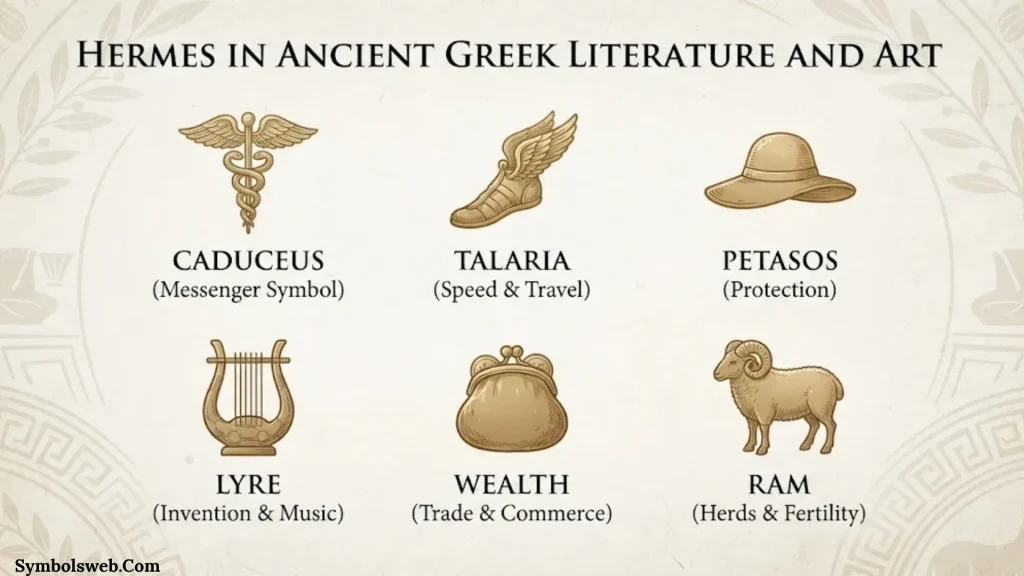
Ancient literature and artwork preserve much of what people know about Hermes.
His recognizable attributes appear in epic poetry, religious hymns, pottery, sculptures, coins, and later European paintings.
Hermes in Homer’s Iliad and Odyssey
Homer’s Iliad and Odyssey contain important appearances of Hermes.
In the Iliad, Hermes helps Priam reach Achilles’ camp to recover Hector’s body.
He guides Priam through enemy territory and protects him during the journey.
In the Odyssey, Hermes delivers Zeus’ instructions to Calypso. He tells her to release Odysseus so the hero can continue his journey home.
These episodes demonstrate Hermes’ importance as a divine messenger and guide.
Hermes in the Homeric Hymn to Hermes
The Homeric Hymn to Hermes provides one of the most detailed accounts of his early mythology.
It describes:
- His birth to Zeus and Maia.
- His discovery of a tortoise.
- The invention of the lyre.
- His theft of Apollo’s cattle.
- His encounter with Apollo.
- His reconciliation with his half-brother.
- His acceptance among the Olympian gods.
This ancient hymn is especially important because it connects several major Hermes symbols with their mythological origins.
Hermes in Ovid’s Metamorphoses
The Roman poet Ovid includes several Hermes-related stories in Metamorphoses.
One famous episode describes Hermes defeating Argus Panoptes.
The story explores deception, music, transformation, and divine conflict.
Ovid’s version became especially influential in European art. Artists frequently represented Hermes playing music while Argus gradually falls asleep.
Hermes in Ancient Greek Sculpture
Greek sculptors frequently represented Hermes as a youthful, athletic figure.
His appearance reflected his connection to physical movement, agility, and divine travel.
One of the best-known examples is Hermes and the Infant Dionysus, traditionally attributed to Praxiteles.
The sculpture depicts Hermes holding the infant Dionysus. Its surviving marble version is associated with the archaeological site of Olympia.
Other ancient representations show Hermes carrying a ram or holding his caduceus.
These sculptures reveal how artists used recognizable attributes to communicate his identity.
Hermes in Renaissance and Later European Art
Hermes continued to influence European artists long after ancient Greek religion declined.
Roman versions of Hermes, particularly Mercury, became popular subjects in Renaissance and Baroque paintings.
Notable examples include:
- Diego Velázquez: Mercury and Argus.
- Peter Paul Rubens: Mythological paintings featuring Mercury.
- Paolo Veronese: Paintings depicting Hermes and stories involving Herse.
- Hendrik van Balen: Classical mythological scenes featuring Mercury.
These works preserved Hermes’ recognizable identity through his winged footwear, caduceus, and distinctive headgear.
Hermes’ Inventions and Contributions to Greek Mythology
Hermes has a reputation as an inventor and creative thinker.
His most famous invention is the lyre. Later traditions also associate him with writing, numbers, astronomy, and other forms of knowledge.
However, these claims come from different historical periods and shouldn’t be treated as equally established.
The Invention of the Lyre
The lyre is Hermes’ most important mythological invention.
He created it using a tortoise shell, animal hide, and strings. The instrument became a central part of his relationship with Apollo.
Apollo later became closely associated with music and the lyre.
This story connects Hermes with creativity, musical invention, and practical intelligence.
Hermes and the Syrinx or Reed Pipes
The syrinx, commonly called the panpipes, is primarily associated with Pan.
Pan is a pastoral deity connected with shepherds, forests, and wilderness.
Hermes is Pan’s father in several mythological traditions. This family connection sometimes leads to confusion between their musical attributes.
For historical accuracy, the syrinx should be identified primarily as Pan’s instrument rather than one of Hermes’ principal inventions.
Hermes and Other Ancient Inventions
Later traditions expanded Hermes’ reputation as a source of knowledge.
Some accounts associate him with:
- The alphabet.
- Numbers and calculation.
- Astronomy.
- Writing and communication.
- Practical arts and invention.
These associations became especially important in later Hermetic traditions.
The ancient Greek stories about Hermes’ inventions should remain distinct from the later philosophical traditions that developed around Hermes Trismegistus.
What Do Hermes’ Symbols Mean in Modern Culture?
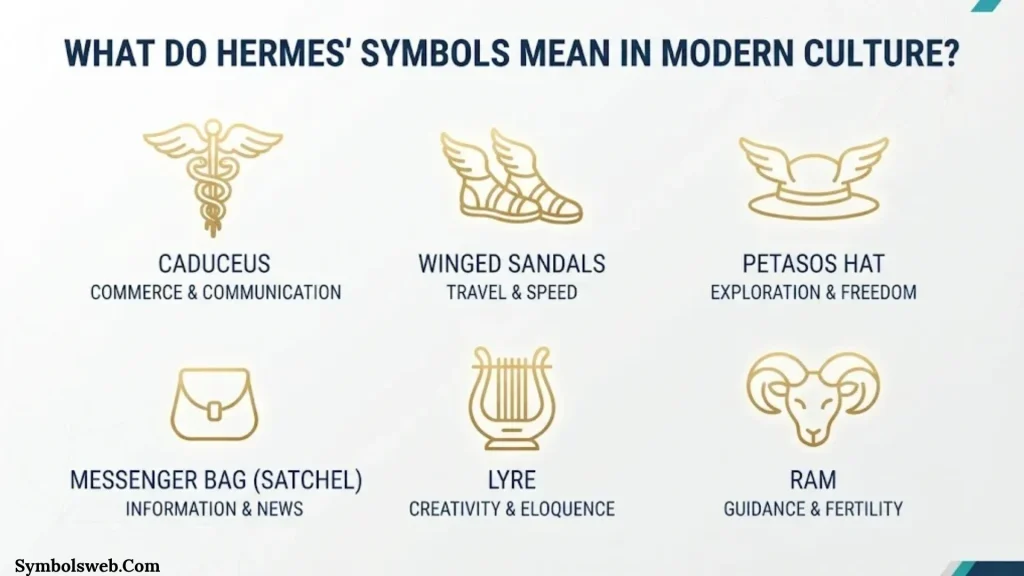
Hermes’ symbols continue to appear in modern society.
His caduceus, winged sandals, and recognizable imagery have influenced commercial branding, jewelry, tattoos, artwork, and popular culture.
However, modern interpretations don’t always match their original ancient meanings.
The Caduceus in Modern Medicine
The caduceus appears in some modern medical organizations and healthcare-related imagery.
However, its original mythological association was with Hermes rather than Asclepius.
The Rod of Asclepius is the more historically appropriate symbol for medicine because Asclepius was the Greek god of healing.
The distinction is important when discussing Greek mythology and medical symbolism.
Hermes Symbols in Business and Commerce
Hermes’ connection with merchants and trade has influenced modern commercial symbolism.
His attributes can represent:
- Communication.
- Transportation.
- Commercial exchange.
- Negotiation.
- Speed and efficiency.
- Movement of goods and information.
The caduceus is especially recognizable in commercial and business-related imagery.
His Roman counterpart Mercury also contributed to these associations.
Hermes Symbols in Jewelry, Tattoos, and Fashion
Hermes’ attributes provide popular designs for jewelry and tattoos.
Different symbols offer different visual and personal meanings.
| Hermes symbol | Common modern interpretation |
| Caduceus | Communication and negotiation |
| Winged sandals | Freedom and movement |
| Winged helmet | Speed and ambition |
| Tortoise | Creativity and intelligence |
| Ram | Protection and strength |
| Herms | Boundaries and protection |
These interpretations can help explain why someone might choose a particular design.
However, modern tattoo meanings aren’t automatically ancient Greek beliefs. Personal symbolism often adds new interpretations to traditional mythological imagery.
Hermes and the Hermès Luxury Fashion Brand
Hermès is a French luxury fashion company founded by Thierry Hermès in Paris in 1837.
The company began as a harness workshop serving the horse-riding community.
Today, Hermès is known for luxury leather goods, scarves, clothing, accessories, perfumes, and other products.
Despite the similarity in names, the Greek god Hermes and the French company Hermès are separate subjects.
The mythological figure belongs to ancient Greek religion. The company developed from a nineteenth-century French business.
It’s best to avoid suggesting that the brand’s name automatically establishes a direct connection with Hermes’ mythology.
Hermes and the Planet Mercury
The planet Mercury carries the Roman name of Hermes’ counterpart.
Roman mythology associated Mercury with speed, communication, and commerce. These qualities made the name suitable for the planet known for its rapid orbit around the Sun.
In astrology, Mercury also represents communication, reasoning, information, and movement.
These interpretations belong to later astrological traditions rather than ancient Greek religious practice.
Understanding this distinction helps separate the historical god from the modern symbolic meanings attached to his name.
What Is the Difference Between Hermes’ Symbols and Other Greek Mythological Symbols?
Greek mythology includes many gods with recognizable attributes.
Some symbols resemble each other, which can make identification confusing. Understanding their differences helps prevent common mistakes.
Caduceus vs. Rod of Asclepius
The caduceus belongs to Hermes while the Rod of Asclepius belongs to the god of healing.
Their visual differences are easy to recognize.
- Caduceus: Two serpents and commonly a pair of wings.
- Rod of Asclepius: One serpent winding around a staff.
The caduceus represents Hermes’ heraldic role. The Rod of Asclepius represents healing and medicine.
Hermes’ Winged Helmet vs. Athena’s Helmet
Athena is the Greek goddess of wisdom and strategic warfare.
She is commonly depicted wearing a helmet associated with military protection.
Hermes’ winged headgear serves a different purpose. Its wings emphasize his speed and responsibilities as a divine messenger.
Their helmets therefore communicate different divine identities.
Hermes vs. Apollo’s Symbols
Hermes and Apollo share an important mythological relationship, but their attributes differ.
| Hermes | Apollo |
| Caduceus | Lyre |
| Winged sandals | Bow and arrows |
| Petasos | Laurel wreath |
| Tortoise association | Musical and prophetic attributes |
| Herald and traveler | Music and prophecy |
The lyre is an especially interesting example because Hermes invented it and later gave it to Apollo.
Hermes’ Symbols vs. Mercury’s Symbols
Hermes and Mercury share many visual attributes because Roman religion identified Mercury with the Greek god.
Both are commonly represented with:
- Winged sandals.
- Caduceus.
- Winged headgear.
- Traveler’s cloak.
- Attributes connected with trade and communication.
However, their religious histories and cultural contexts remain distinct.
Frequently Asked Questions About Hermes Symbols
What Are the Main Symbols of Hermes?
The main symbols of Hermes include the caduceus, winged sandals, petasos, winged helmet, tortoise, ram, and herms. Each represents a different part of his mythology, including communication, speed, travel, invention, and protection.
What Does the Caduceus Symbolize?
The caduceus represents Hermes’ role as a divine herald and messenger. Its two intertwined serpents and staff identify him with communication, mediation, and divine authority. It later became associated with commerce and some modern medical organizations.
Why Does Hermes Have Winged Sandals?
Hermes wears winged sandals called talaria because they represent his supernatural speed. They allow him to travel quickly between Mount Olympus, Earth, and other mythological realms.
What Is Hermes’ Sacred Animal?
The tortoise and ram are among the animals most clearly associated with Hermes. The tortoise connects to his invention of the lyre while the ram reflects his role as a protector of shepherds and livestock.
Why Is the Tortoise Associated With Hermes?
Hermes discovered a tortoise outside his mother’s cave and used its shell to create the first lyre. This story connects the animal with creativity, musical invention, intelligence, and resourcefulness.
What Does Hermes’ Winged Helmet Represent?
The winged helmet represents speed, mobility, and Hermes’ responsibilities as the Messenger of the Gods. It also helps artists distinguish him from other Olympian deities.
Is the Caduceus a Symbol of Medicine?
The caduceus is sometimes used by modern medical organizations. However, its original Greek mythological association is with Hermes. The Rod of Asclepius, featuring one serpent, has a stronger historical connection to medicine.
What Is Hermes the God Of?
Hermes is the Greek god of communication, trade, merchants, travelers, thieves, shepherds, and athletes. He also serves as the divine messenger and guide of souls entering the Underworld.
Who Are Hermes’ Parents?
Hermes is the son of Zeus and Maia. Maia was one of the seven Pleiades and the daughter of Atlas and Pleione.
What Is Hermes’ Roman Name?
Hermes’ Roman counterpart is Mercury. The Romans adopted many of his attributes, including winged sandals, the caduceus, and his association with commerce.
Why Is Hermes Called the Messenger of the Gods?
Hermes frequently delivers messages and carries out instructions for Zeus and other Olympian gods. His ability to travel between divine and mortal realms makes him an effective messenger and intermediary.
What Is Hermes’ Connection to the Underworld?
Hermes serves as a psychopomp, meaning a guide of souls. He escorts deceased individuals toward the Underworld and helps them cross the boundary between life and death.
Conclusion
The symbols of Hermes reveal the many responsibilities and qualities of one of Greek mythology’s most versatile gods. His caduceus represents his position as a divine messenger while his winged sandals highlight his extraordinary speed. The petasos connect him with travelers and the tortoise recalls his invention of the lyre.
His animal associations and religious monuments reveal another side of his identity. The ram connects him with shepherds while herms marked roads, boundaries, and entrances throughout ancient Greek communities. These attributes show how closely Hermes was connected with everyday life.
Hermes’ influence also extends beyond ancient Greek religion. His Roman counterpart Mercury helped carry his imagery into European art and commercial traditions. Today, the caduceus, winged sandals, and other attributes remain recognizable symbols of communication, movement, and creativity.

Jordan Hayes is a writer with a passion for exploring the history, meanings, and cultural significance behind symbols from around the world. He enjoys turning complex topics into clear, engaging content that anyone can understand. Jordan is also the fictional author of The Silent Language of Ancient Marks and Hidden Symbols Beyond the Surface, two original book concepts created for his author profile. When he’s not writing, he spends time researching myths, traditions, and forgotten stories that inspire his work. His goal is to help readers discover the deeper meanings behind the symbols they encounter every day.
 Eliana Foster
 Ethan Holloway