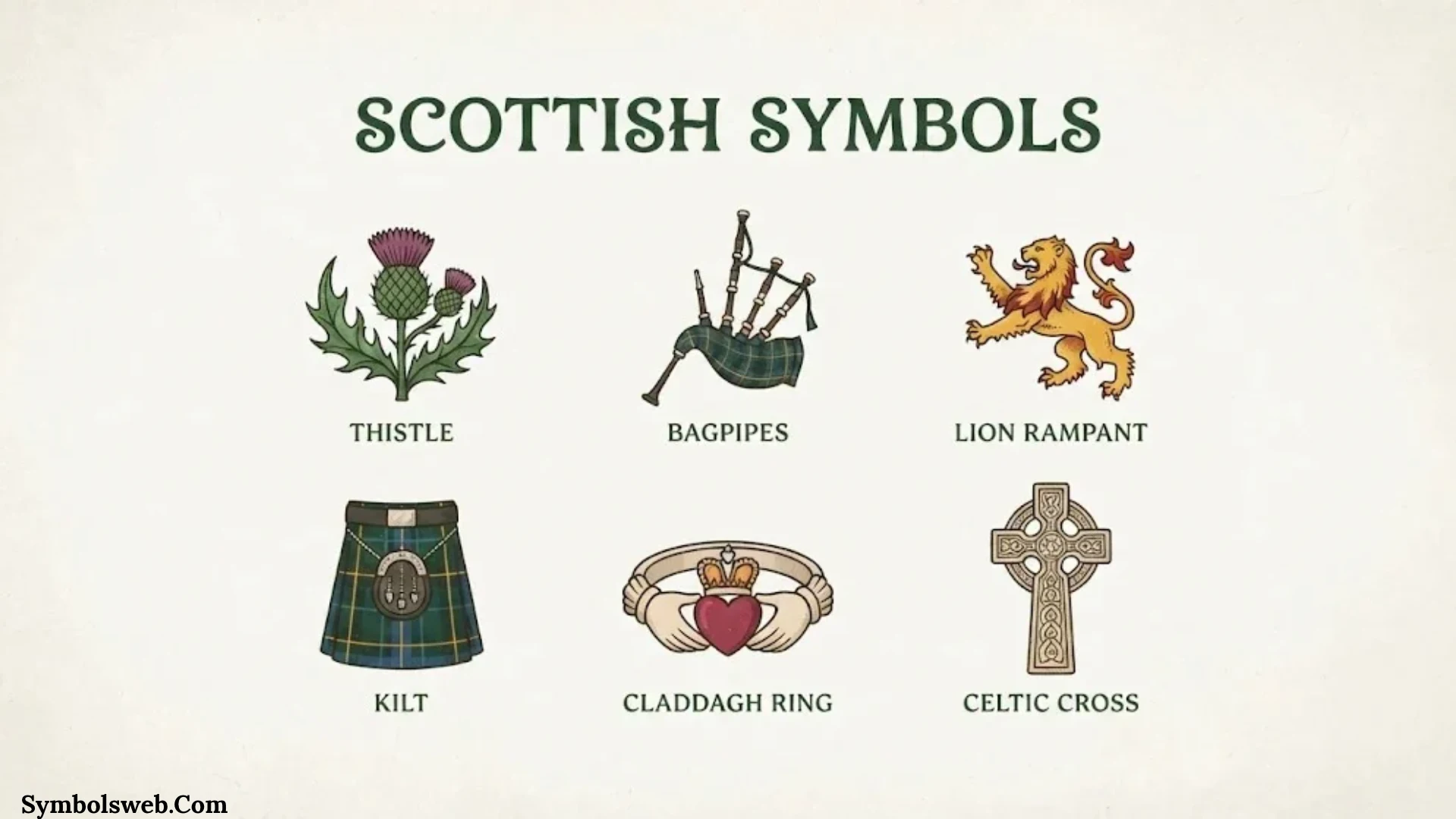
Scottish symbols tell the story of a nation shaped by ancient traditions, royal history, religious beliefs, and centuries of cultural change. From the famous Saltire flag to the Scottish thistle and unicorn, each emblem represents a different part of Scotland’s identity.
Some symbols reflect the country’s royal heritage, while others connect with Celtic art, Highland traditions, and Scottish folklore. Together, they preserve stories about the people, communities, and historical events that helped shape Scotland.
If you’re exploring Scottish ancestry, researching traditional emblems, or looking for meaningful cultural designs, understanding these Scottish symbols and their meanings offers a fascinating look into Scotland’s past.
What Are Scottish Symbols?
Scottish symbols are objects, designs, plants, animals, flags, and traditional items associated with Scotland’s history and cultural identity. They represent the country’s national pride, royal authority, religious traditions, and connection with its landscape.
Some symbols have official recognition, while others developed through folklore, historical events, and everyday customs.
For example, the Saltire serves as Scotland’s national flag. The thistle represents the country’s national floral identity, while the unicorn holds an important place in Scottish royal heraldry.
Scottish symbols generally fall into several categories:
- National symbols: The Saltire, thistle, and unicorn.
- Royal symbols: The Lion Rampant, Royal Banner, and Stone of Destiny.
- Religious symbols: The Celtic cross and Christian imagery.
- Cultural symbols: Tartan, kilts, clan badges, and bagpipes.
- Historical symbols: Pictish carvings, ancient stones, and royal artifacts.
- Folklore symbols: Kelpies, selkies, brownies, and the Cailleach.
These symbols aren’t interchangeable. Each has its own history, purpose, and cultural significance.
National Symbols of Scotland and Their Meanings
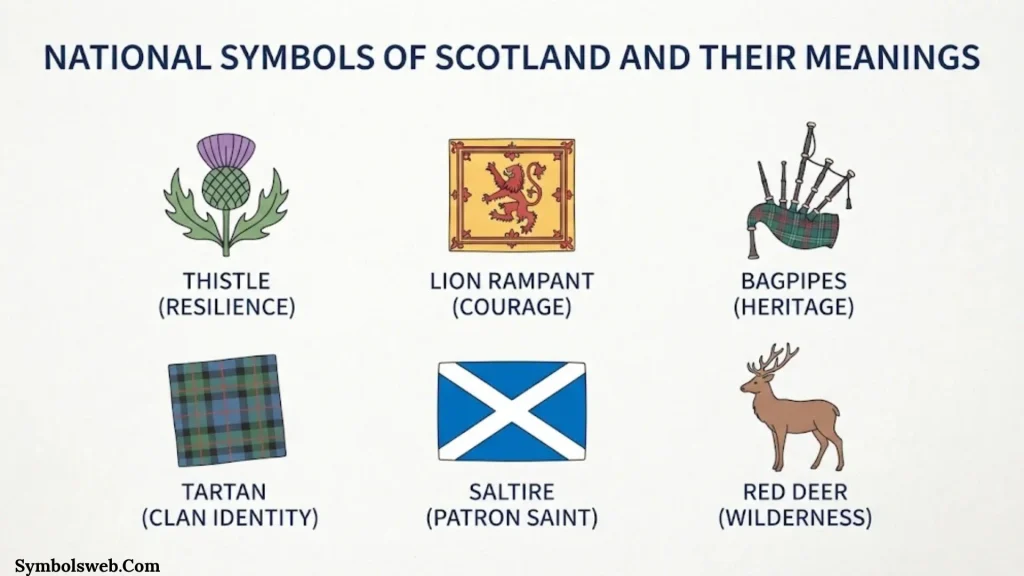
Scotland has several recognizable national emblems. Some represent the country as a whole, while others reflect its monarchy, natural environment, and historical traditions.
The Saltire: Scotland’s National Flag
The Saltire, also called St Andrew’s Cross, is the national flag of Scotland. Its design features a white diagonal cross against a blue background.
The cross forms an X shape and represents Saint Andrew, Scotland’s patron saint. According to Christian tradition, Andrew was crucified on a diagonal cross rather than the traditional upright cross.
The Saltire has a long association with Scottish national identity. Its traditional origin story connects it with a battle involving Pictish forces and the Angles.
According to the legend, a white cross appeared in the sky before the Scottish army achieved victory. The unusual sign encouraged the soldiers and eventually became associated with Scotland.
However, historians distinguish this traditional account from documented evidence. The earliest surviving representations of the Saltire developed during the medieval period.
Important facts about the Scottish Saltire:
- Official name: Saltire.
- Alternative name: St Andrew’s Cross.
- Design: White diagonal cross.
- Background: Blue.
- Associated figure: Saint Andrew.
- National significance: Scottish identity and heritage.
- Celebration: St Andrew’s Day on November 30.
The Saltire remains one of the strongest expressions of Scottish national pride. You’ll find it at sporting events, public celebrations, government buildings, and international gatherings.
The Scottish Thistle: National Flower of Scotland
The Scottish thistle is the national flower and one of Scotland’s most recognizable emblems. Its distinctive purple flower and sharp spines make it a natural representation of resilience and protection.
The thistle became associated with Scotland through historical tradition and popular folklore.
One famous legend tells of a Norse invasion during which an enemy soldier stepped barefoot onto a thistle. His painful reaction alerted Scottish defenders to the approaching attackers.
The story explains why people connect the plant with vigilance and defence. However, historians have not established this event as the proven origin of the national emblem.
The thistle also appears in Scottish heraldry and national decorations.
Its important associations include:
- Protection: Sharp spines provide natural defence.
- Resilience: The plant survives in challenging environments.
- Vigilance: Its traditional legend connects it with guarding against enemies.
- National pride: It represents Scottish identity.
- Strength: Its appearance reflects toughness and endurance.
The Order of the Thistle, Scotland’s highest order of chivalry, also uses the plant as its central emblem.
Founded in its modern form under Queen Anne in 1687, the order recognizes individuals for their contributions and service.
The Scottish Unicorn: National Animal of Scotland
The unicorn is Scotland’s national animal and an important figure in its royal heraldry.
Although unicorns belong to mythology rather than the natural world, they have a long history in European art and royal symbolism.
Scottish monarchs adopted the unicorn as a representation of strength, purity, nobility, and sovereign authority.
The creature appears in the Royal Arms of Scotland, where it traditionally stands alongside a lion.
One unusual feature is its chain. Scottish royal heraldry frequently depicts the unicorn restrained by a golden chain around its body.
This detail has attracted different interpretations. It is commonly associated with the idea that the unicorn possesses such extraordinary strength that even a powerful ruler must restrain it.
The unicorn’s main symbolic associations include:
- Strength and courage.
- Purity and innocence.
- Royal authority.
- Sovereignty and independence.
- Nobility and dignity.
- Mythological power.
The unicorn became especially important during the reign of the Scottish Stuart monarchs. Its appearance in royal heraldry helped establish its lasting connection with Scotland.
Today, the unicorn remains one of the country’s most recognizable national symbols.
The Lion Rampant: Royal Banner of Scotland
The Scottish Lion Rampant is a royal emblem featuring a red lion standing upright against a golden background.
Its design includes a blue tongue and claws, along with a decorative border.
The lion appears in Scottish royal heraldry and represents the authority of the monarchy.
Medieval European heraldry frequently used lions to communicate strength, courage, and noble status. Scottish rulers adopted this powerful image as part of their royal identity.
The Lion Rampant is often confused with Scotland’s national flag. However, the two serve different purposes.
The Saltire is the national flag, while the Lion Rampant is the Royal Banner of Scotland.
Important details include:
| Feature | Description |
| Animal | Red heraldic lion |
| Background | Gold |
| Position | Standing upright |
| Tongue and claws | Blue |
| Main association | Scottish monarchy |
| Traditional meanings | Strength, courage, and royal authority |
The royal banner has specific legal and ceremonial significance. It isn’t simply an alternative national flag for general public use.
The Scottish royal motto also appears in heraldic traditions:
Nemo me impune lacessit
This Latin phrase means “No one provokes me with impunity.”
Its traditional Scots equivalent is:
Wha daur meddle wi’ me?
The motto reflects the defensive and protective character associated with Scottish royal heraldry.
The Stone of Destiny: Symbol of Scottish Kingship
The Stone of Destiny, also known as the Stone of Scone, is one of Scotland’s most important historical artifacts.
This rectangular block of sandstone has a long association with Scottish kingship and royal inauguration ceremonies.
According to historical tradition, Scottish rulers were inaugurated at Scone using the stone as part of the ceremony.
Its significance increased during the medieval period because it represented the authority and continuity of the Scottish monarchy.
In 1296, King Edward I of England seized the Stone of Scone during his invasion of Scotland. He transported it to Westminster Abbey in London, where it became part of the English coronation arrangements.
The stone remained in England for centuries.
However, Scottish students removed it from Westminster Abbey in 1950 and took it to Scotland. Authorities recovered it later that year.
In 1996, the British government officially returned the stone to Scotland.
Today, it is housed at Perth Museum, where visitors can learn about its historical and cultural importance.
Key historical events include:
| Year | Historical event |
| Before 1296 | Associated with Scottish royal inaugurations |
| 1296 | Edward I seized the stone |
| 1950 | Scottish students removed it from Westminster Abbey |
| 1951 | Authorities recovered the stone |
| 1996 | Official return to Scotland |
| 2024 | Displayed at Perth Museum |
The Stone of Destiny represents Scottish kingship, historical continuity, and national heritage.
It also remains connected with modern British coronation ceremonies.
The Honours of Scotland: Scottish Crown Jewels
The Honours of Scotland are the oldest surviving set of crown jewels in the British Isles.
They consist of three important royal objects:
- The Crown of Scotland.
- The Sceptre.
- The Sword of State.
These objects were used during royal ceremonies and represent the authority of the Scottish monarchy.
The Crown of Scotland dates mainly from the 16th century. King James V commissioned its remodeling in 1540 using existing crown elements.
The sceptre was presented to James IV in 1494 by Pope Alexander VI.
The Sword of State arrived in Scotland in 1507 as a gift from Pope Julius II to James IV.
Together, these objects represent royal power, ceremony, and Scotland’s historic monarchy.
They are displayed at Edinburgh Castle as part of the country’s national heritage.
Ancient Scottish Symbols and Their Meanings
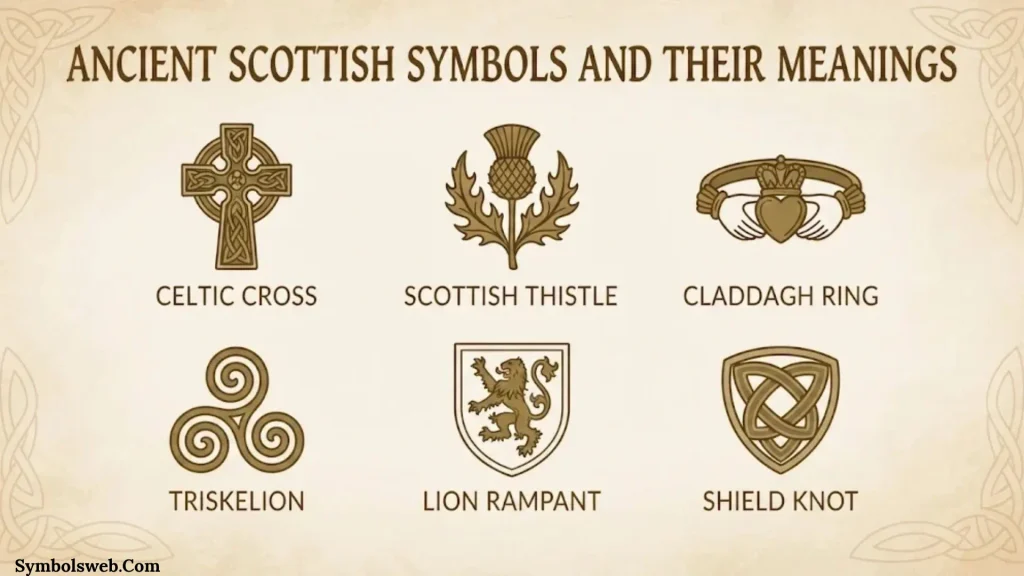
Scotland’s symbolic history extends far beyond medieval flags and royal emblems.
Pictish communities, Celtic traditions, early Christian groups, and ancient artistic cultures left behind monuments and designs that still attract historical interest.
Celtic Cross
The Celtic cross is a Christian cross featuring a circular ring around the intersection of its vertical and horizontal arms.
It is one of the most recognizable designs associated with early medieval religious art in Scotland and Ireland.
Celtic crosses appear on ancient stone monuments, church grounds, and historical grave markers.
Their designs often include elaborate carvings, biblical scenes, and interlaced decorations.
The cross primarily represents Christian faith and religious devotion.
Modern interpretations also associate it with:
- Eternity.
- Spirituality.
- Faith.
- Religious heritage.
- Continuity.
- Christian identity.
The circular ring is often interpreted symbolically as eternity or the eternal nature of God. However, historians cannot establish one universal meaning for every historical Celtic cross.
Some of Scotland’s most notable examples appear on the island of Iona and at other early Christian sites.
Celtic Knot
Celtic knots are decorative patterns made from continuous interwoven lines.
Their designs appear in medieval manuscripts, carved stone monuments, metalwork, and religious artwork.
The patterns often create complicated shapes without an obvious beginning or ending.
Celtic knotwork became particularly prominent in Insular art, a style that developed in Ireland and Britain during the early medieval period.
One famous example appears in the Book of Kells, an illuminated Gospel manuscript created around the late eighth or early ninth century.
Common modern interpretations include:
- Unity and interconnectedness.
- Eternal relationships.
- Family connections.
- Continuity.
- Spiritual devotion.
- Love and commitment.
Different knot patterns have acquired specific names and modern meanings. However, historical evidence does not support assigning one fixed interpretation to every ancient design.
Celtic knots remain popular in Scottish jewelry, wedding accessories, decorative artwork, and tattoos.
Celtic Spirals
Celtic spirals are ancient decorative patterns found in prehistoric and early historical artwork.
Their designs feature curved lines that wind inward or outward from a central point.
Spiral patterns appear at archaeological sites across Scotland, Ireland, and other parts of western Europe.
They are particularly associated with prehistoric rock art and monuments.
Common modern interpretations connect spirals with:
- Growth.
- Movement.
- Life cycles.
- Nature.
- Transformation.
- Continuity.
However, archaeologists cannot confidently identify the exact beliefs behind every prehistoric spiral.
Their historical importance lies in demonstrating the artistic skills and symbolic practices of ancient communities.
Pictish Symbols
The Picts were an important group of early medieval communities in northern and eastern Scotland.
They left behind distinctive carved stones featuring geometric shapes, animals, and mysterious symbols.
Common Pictish designs include:
- Crescent and V-rod.
- Double disc and Z-rod.
- Mirror and comb.
- Pictish beast.
- Serpent and Z-rod.
- Crescent-shaped patterns.
These symbols appear on standing stones, cross slabs, and other carved monuments.
Some stones combine Pictish designs with Christian crosses, showing how artistic and religious traditions changed over time.
The exact meaning of many Pictish symbols remains uncertain.
Researchers have suggested that they may have represented personal identity, family relationships, political authority, or other social connections.
Nevertheless, they remain valuable evidence of Scotland’s early medieval heritage.
Ogham Symbols
Ogham is an early medieval writing system that uses groups of lines and notches to represent letters.
The characters usually appear along a central stemline or the edge of a stone.
Ogham inscriptions are particularly associated with Ireland, but examples and related inscriptions have also been found in Scotland.
They provide evidence of early medieval communication, language, and cultural connections between communities.
Ogham is sometimes included in collections of ancient Celtic symbols. However, it is important to understand that it is primarily an alphabet rather than a collection of decorative symbols.
Scottish Cultural and Traditional Symbols
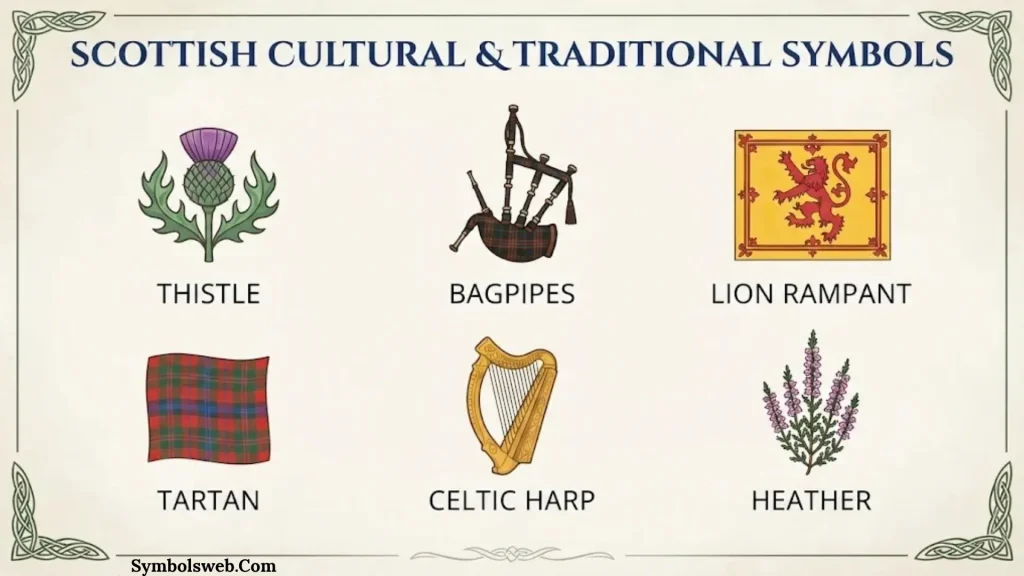
Scottish culture includes many objects, clothing styles, and traditions that have become recognizable expressions of national identity.
These symbols connect modern Scotland with its regional communities, family histories, and Highland traditions.
Scottish Tartans
Scottish tartan is a woven fabric pattern featuring intersecting horizontal and vertical lines.
The crossing bands create distinctive checks in different colors and arrangements.
Tartan is strongly associated with Scottish clans and Highland dress. However, its history is more complicated than the idea that every ancient family originally had its own pattern.
People wore tartan in Scotland long before the modern clan-tartan system developed.
The connection between specific tartan patterns and clan names became especially popular during the 19th century.
Common tartan categories include:
- Clan tartans.
- District tartans.
- Hunting tartans.
- Dress tartans.
- Modern tartans.
Tartan represents Scottish identity, ancestry, and cultural heritage.
Today, people wear it at weddings, Highland games, formal celebrations, and traditional gatherings.
Scottish Kilts
The Scottish kilt is a traditional garment made from pleated tartan fabric.
It has become one of the strongest visual representations of Highland culture.
An early predecessor was the feileadh mòr, commonly called the great kilt.
This garment consisted of a large piece of woolen cloth that could be wrapped around the body and arranged as an outer covering.
The modern tailored kilt is shorter and features permanently arranged pleats.
Traditional Highland clothing may include:
- Tartan kilt.
- Sporran.
- Kilt hose.
- Ghillie brogues.
- Belt and buckle.
- Jacket and waistcoat.
- Sgian-dubh.
Kilts became closely connected with Scottish identity, particularly during the 18th and 19th centuries.
Today, people wear them at weddings, military ceremonies, Highland games, and cultural celebrations.
Scottish Clan Badges
Scottish clan badges represent connections with Scotland’s historic clan communities.
A traditional clan badge often features a plant enclosed within a strap and buckle displaying the clan chief’s motto.
Common plant badges include:
- Thistle.
- Heather.
- Juniper.
- Oak.
- Pine.
- Common heath.
These emblems provide recognizable signs of clan affiliation.
However, clan badges aren’t the same as coats of arms.
Scottish heraldry distinguishes between the chief’s personal armorial rights and the badges that clan members may use.
Clan identity also involves historical relationships, geographical origins, and connections with a chief.
A shared surname alone doesn’t prove direct descent from an original clan chief.
The Quaich: Traditional Scottish Loving Cup
The quaich is a traditional Scottish drinking cup with two small handles.
Its name comes from the Gaelic word cuach, meaning cup.
Historically, people used quaichs to share drinks during gatherings and celebrations.
Their two-handled design made passing the cup between people convenient.
The quaich became associated with hospitality, friendship, and welcoming guests.
Today, people commonly use quaichs during:
- Scottish weddings.
- Family celebrations.
- Heritage gatherings.
- Retirement ceremonies.
- Formal welcoming events.
Traditional examples were made from wood. Later designs also included silver, pewter, and other metals.
At weddings, sharing a quaich can represent trust, commitment, and the beginning of a shared journey.
Scottish Jewellery and Celtic Designs
Scottish jewellery combines traditional craftsmanship with symbols connected to national identity and family heritage.
Popular designs include:
- Celtic knot rings.
- Thistle pendants.
- Unicorn necklaces.
- Clan crest jewelry.
- Tartan-inspired bracelets.
- Silver brooches.
- Celtic cross pendants.
Celtic knotwork is especially popular because its interwoven patterns create attractive designs associated with unity and continuity.
One important distinction concerns the Claddagh ring.
Although people sometimes include it in broader Celtic jewelry collections, it originated in Ireland rather than Scotland.
Its heart, hands, and crown traditionally represent love, friendship, and loyalty.
Scottish Bagpipes
The Great Highland Bagpipe is one of Scotland’s most recognizable cultural symbols.
Its powerful sound is closely connected with Highland traditions, military ceremonies, national celebrations, and Scottish music.
A traditional bagpipe consists of several main parts:
- Airbag.
- Blowpipe.
- Chanter.
- Drones.
The chanter produces the melody, while the drones create continuous supporting notes.
Bagpipes appear at weddings, funerals, military parades, Highland games, and national celebrations.
Scottish military regiments helped strengthen the instrument’s association with courage, discipline, and national identity.
Today, bagpipes remain an active part of Scotland’s musical heritage.
Scottish Heather
Heather is a flowering plant commonly found across Scotland’s moorlands, hillsides, and open landscapes.
Its purple and pink flowers create some of the country’s most recognizable natural scenery.
Heather also appears in Scottish folklore and traditional customs.
White heather, in particular, has a popular association with good luck and protection.
Modern floral traditions commonly associate different colors with different meanings:
- Purple heather: Admiration and beauty.
- Pink heather: Affection and romance.
- White heather: Good fortune and protection.
These associations reflect folklore and modern interpretations rather than fixed historical rules.
Scottish Religious and Spiritual Symbols
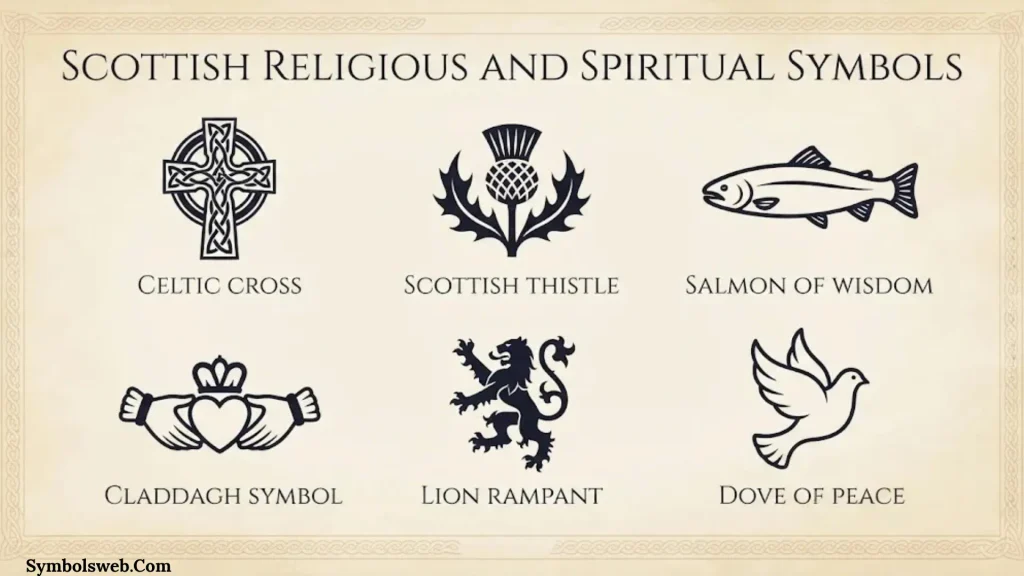
Religion played an important role in the development of Scotland’s visual culture.
Early Christian communities produced carved crosses, religious manuscripts, and monuments that remain valuable parts of Scottish heritage.
Saint Andrew and His Cross
Saint Andrew is the patron saint of Scotland.
His association with the Saltire makes him one of the most important religious figures in Scottish national history.
According to Christian tradition, Andrew was one of Jesus’s apostles.
Later accounts describe his crucifixion on an X-shaped cross. This distinctive shape became known as St Andrew’s Cross.
Scotland’s connection with the saint developed through medieval religious traditions.
His feast day, November 30, is celebrated as St Andrew’s Day.
The celebration provides an opportunity to recognize Scottish history, music, food, and cultural traditions.
Iona and Early Christian Symbols
The island of Iona holds an important place in Scottish religious history.
Saint Columba arrived there from Ireland in 563 AD and established a monastery.
The community became an important center for Christian learning, religious art, and missionary activity.
Iona’s historic monuments include carved crosses, grave slabs, and religious stonework.
The island also became associated with Scottish kingship because several early Scottish rulers were traditionally buried there.
Today, Iona remains an important destination for people interested in religious history and Celtic Christian heritage.
Christian Symbolism in Scottish Heritage
Christian imagery appears throughout Scotland’s historic churches, monasteries, graveyards, and carved monuments.
Common designs include:
- Latin crosses.
- Celtic crosses.
- Biblical figures.
- Angels and saints.
- Interlaced patterns.
- Religious inscriptions.
- Symbolic animals.
These designs helped communicate religious beliefs in communities where many people couldn’t read written texts.
They also demonstrate how Christian traditions blended with regional artistic styles.
Scottish Folklore and Mythological Symbols
Scottish folklore includes legendary creatures, supernatural beings, and stories connected with mountains, rivers, islands, and rural communities.
These traditions preserve the storytelling customs of different Scottish regions.
Not every legendary creature is an official Scottish symbol. However, these figures remain important parts of the country’s cultural identity.
The Kelpie
The kelpie is a supernatural water horse from Scottish folklore.
Traditional stories describe it as a shape-shifting creature that lives near rivers and lochs.
It often appears as a beautiful horse that attracts unsuspecting travelers.
In some stories, people who climb onto its back become trapped. The kelpie then drags them into the water.
The legend may have helped explain the dangers of Scotland’s deep waters and unpredictable rivers.
One famous modern representation is The Kelpies, a pair of enormous horse-head sculptures in Falkirk.
Created by artist Andy Scott, the sculptures celebrate the region’s industrial and equine heritage while drawing inspiration from Scottish folklore.
The Selkie
Selkies are mythical beings from Scottish coastal folklore, particularly traditions associated with Orkney and Shetland.
According to legend, selkies live as seals in the sea but can remove their skins and take human form on land.
Many traditional stories explore relationships between selkies and humans.
These tales often involve love, separation, captivity, and the desire to return home.
Selkies commonly represent:
- Freedom and independence.
- Love and longing.
- Identity and belonging.
- Relationships between humans and nature.
- The pull of home and family.
Selkie stories remain popular in Scottish literature, films, music, and storytelling.
The Cailleach
Cailleach is an important figure in Scottish Gaelic folklore.
Her name is commonly translated as an old woman or hag.
Traditional stories often portray her as a powerful supernatural being connected with winter, mountains, storms, and the landscape.
In some stories, she creates or shapes mountains by dropping stones from her apron.
Other traditions connect her with changing seasons and the arrival of winter.
The Cailleach reflects the close relationship between Scottish folklore and the natural environment.
The Brownie
The brownie is a helpful household spirit found in Scottish folklore.
Traditional stories describe brownies as small supernatural beings who perform household tasks during the night.
They might clean rooms, care for animals, or complete farm work while the family sleeps.
Some stories suggest that brownies dislike payment or excessive attention.
People traditionally left small offerings of food as a sign of appreciation.
Unlike the kelpie, which often represents danger, the brownie is generally associated with helpfulness, domestic life, and hospitality.
Scottish Symbols of Strength, Protection, Love, and Good Luck
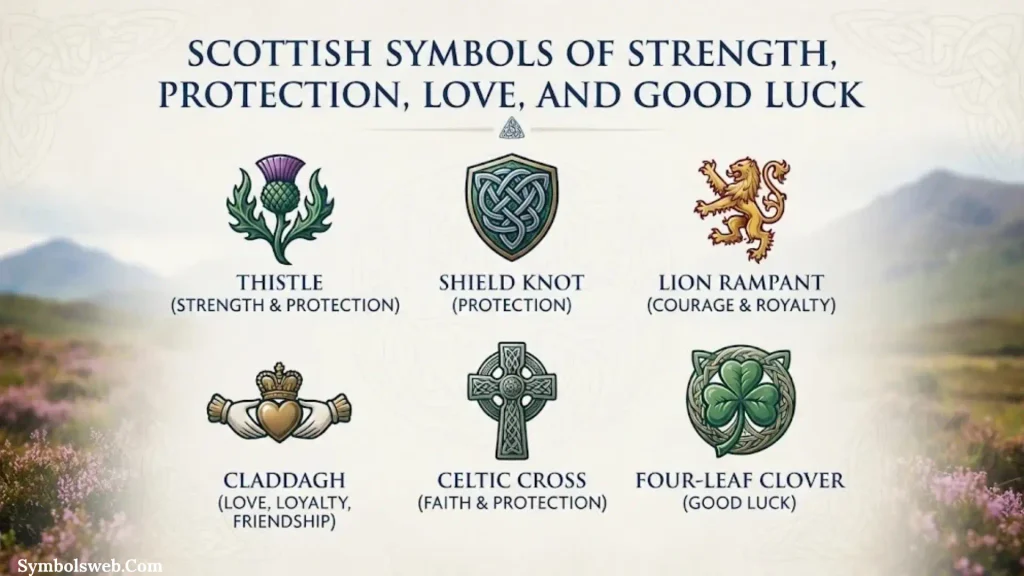
Many people search for Scottish symbols because they want to understand what particular designs represent.
Some symbols have documented historical associations, while others gained their meanings through folklore and modern cultural interpretations.
Scottish Symbols of Strength and Courage
Several Scottish emblems represent strength, bravery, and determination.
| Symbol | Associated meaning |
| Lion Rampant | Courage, authority, and royal power |
| Thistle | Resilience, protection, and endurance |
| Unicorn | Strength, purity, and sovereignty |
| Saltire | National identity and unity |
| Heraldic shield | Defence and family identity |
The Lion Rampant is particularly suitable for representing courage and royal authority.
The thistle offers a different interpretation through its ability to protect itself with sharp spines.
The unicorn combines strength with nobility and independence.
Scottish Symbols of Protection
Protection appears in several Scottish cultural and religious traditions.
The thistle is a natural example because its sharp spines defend it against animals.
Its association with Scotland also connects it with a popular story about defending against invaders.
Other symbols have protective associations through religious beliefs and heraldic traditions.
Examples include:
- Thistle: Defence, vigilance, and resilience.
- Celtic Cross: Christian faith and religious devotion.
- Heraldic shields: Protection, family identity, and authority.
- Unicorn: Strength and the ability to resist capture.
- Traditional charms: Regional folklore involving protection and good fortune.
These associations vary according to historical context.
A Celtic cross, for example, is primarily a Christian religious monument rather than a universal protective charm.
Scottish Symbols of Love and Unity
Scottish-inspired love symbols often combine Celtic designs with traditional objects and wedding customs.
Celtic knotwork is especially popular because its connected lines create patterns associated with lasting relationships.
Other meaningful designs include:
- Celtic love knot: Modern association with commitment and interconnectedness.
- Quaich: Friendship, hospitality, and shared experiences.
- Celtic wedding jewelry: Love, family connections, and heritage.
- Interlaced rings: Modern representations of lasting commitment.
- Tartan: Family connections and shared ancestry.
The quaich is particularly meaningful during Scottish weddings.
Couples may share a drink from the same cup to celebrate their relationship and welcome their families.
Scottish Symbols of Good Luck and Fortune
Scottish folklore includes several plants and traditional objects associated with good fortune.
White heather is among the best-known examples.
Popular traditions connect it with luck, protection, and positive outcomes.
Other associations include:
- White heather: Good fortune and protection.
- Horseshoe: Protection and luck in household traditions.
- Unicorn: Purity, strength, and magical qualities in European folklore.
- Celtic knotwork: Continuity and interconnectedness in modern interpretations.
These meanings should be understood as folklore and cultural associations rather than proven supernatural properties.
Scottish Symbols of Victory and Independence
Scotland’s struggle for political independence shaped several important historical symbols.
The Saltire became a powerful national emblem, while the Stone of Destiny represented the authority of Scottish kings.
Another important historical document is the Declaration of Arbroath, written in 1320.
Scottish nobles sent this letter to Pope John XXII to defend Scotland’s independence and explain its political position.
The document is especially remembered for expressing the principle that Scotland’s freedom should be defended.
Its famous passage states:
For so long as a hundred of us remain alive, never will we on any conditions be brought under English rule.
The declaration isn’t a national emblem in the same sense as the Saltire.
However, it remains an important historical expression of Scottish independence and sovereignty.
Scottish Symbols in History and National Identity
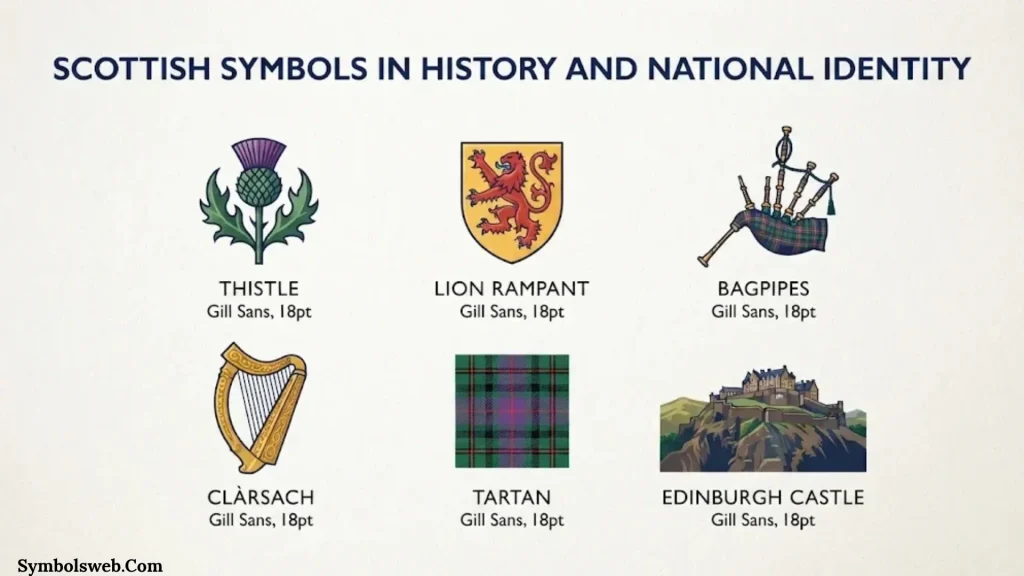
Scotland’s symbols developed through centuries of political change, migration, warfare, religion, and cultural exchange.
Understanding these historical influences explains why different Scottish emblems carry different meanings.
Pictish Heritage and Early Scottish Identity
The Picts played an important role in Scotland’s early medieval history.
They occupied territories across northern and eastern Scotland and developed distinctive artistic traditions.
Their carved stones remain among the most important surviving examples of their culture.
Pictish monuments feature:
- Crescent and V-rod designs.
- Double disc and Z-rod symbols.
- Animals and geometric patterns.
- Christian crosses.
- Elaborate carved scenes.
These monuments provide valuable evidence about early Scottish society.
Their exact meanings remain a subject of archaeological research.
Scottish Symbols and the Wars of Independence
The Wars of Scottish Independence were a series of conflicts between Scotland and England during the late 13th and 14th centuries.
The struggle began after King Alexander III died in 1286 without leaving a surviving direct male heir.
The resulting succession crisis weakened Scotland’s political stability.
Edward I of England later intervened in Scottish affairs and asserted authority over the kingdom.
In 1296, Edward invaded Scotland and seized the Stone of Destiny.
Scottish resistance developed under important leaders, including William Wallace and Robert the Bruce.
Robert the Bruce eventually secured a major victory at the Battle of Bannockburn in 1314.
The Declaration of Arbroath followed in 1320 and defended Scotland’s right to remain an independent kingdom.
Important historical connections include:
- Saltire: National identity and Scottish heritage.
- Stone of Destiny: Scottish kingship and sovereignty.
- Royal Arms: Authority of the Scottish monarchy.
- Declaration of Arbroath: Political independence and national freedom.
- Lion Rampant: Scottish royal identity.
These historical objects and emblems helped preserve a sense of Scottish nationhood during periods of political conflict.
Norse Influence on Scottish Culture
Viking settlement influenced many parts of Scotland, especially Orkney, Shetland, and the western islands.
Norse communities brought their languages, artistic traditions, maritime skills, and religious practices.
Their influence remains visible in Scottish place names, archaeological sites, and folklore.
Examples include:
- Norse place names in northern Scotland.
- Viking archaeological remains in Orkney.
- Runic inscriptions.
- Norse influence on Scottish island culture.
- Stories about sea travel and supernatural creatures.
The Norse influence on Scotland shouldn’t be confused with Celtic symbolism.
Although both traditions contributed to Scottish heritage, they developed through different cultural and historical backgrounds.
Scottish Symbols During the Jacobite Period
The Jacobite movement sought to restore the Stuart dynasty to the British throne.
It became particularly important in Scotland during the late 17th and 18th centuries.
Jacobite supporters used different visual emblems to express loyalty to the Stuart cause.
One recognizable example was the white cockade, traditionally associated with Jacobite allegiance.
Highland clothing and tartan also became strongly connected with the period.
After the Jacobite defeat at the Battle of Culloden in 1746, the British government introduced laws restricting Highland dress in Scotland.
The legislation formed part of wider efforts to weaken traditional Highland military and clan structures.
The restrictions were later repealed in 1782.
During the 19th century, tartan and Highland dress gained renewed popularity as symbols of Scottish identity.
Scottish Symbols in Modern National Identity
Scottish symbols continue to play an important role in modern public life.
The Saltire appears at national celebrations, sporting events, government buildings, and international gatherings.
The thistle remains common in official decorations, while the Lion Rampant represents the country’s royal heraldic traditions.
Other cultural symbols appear in everyday settings:
- Tartan clothing at weddings and formal events.
- Bagpipes at ceremonies and sporting occasions.
- Clan badges at family gatherings.
- Celtic jewelry as a form of heritage expression.
- Quaichs during weddings and celebrations.
- Scottish folklore in books, music, and tourism.
These traditions show how Scotland’s symbolic heritage continues to develop without losing its historical foundations.
Scottish Symbols in Art, Architecture, and Literature
Scottish symbols appear throughout the country’s historic buildings, monuments, manuscripts, and creative traditions.
They preserve important visual details about the people, beliefs, and communities that shaped Scotland.
Scottish Symbols in Historic Architecture
Scottish historic architecture contains many examples of heraldic and religious symbolism.
Medieval churches and chapels often feature carved crosses, biblical scenes, geometric decorations, and interlaced patterns.
Rosslyn Chapel near Edinburgh is particularly famous for its detailed stone carvings.
Its architecture includes elaborate plant designs, figures, and decorative patterns.
Other important locations include:
- Iona Abbey.
- St Magnus Cathedral in Orkney.
- Dunfermline Abbey.
- Edinburgh Castle.
- Historic Scottish parish churches.
These buildings demonstrate how religious and royal symbols became part of Scotland’s architectural heritage.
Scottish Symbols in Stone Carvings
Stone carving played an important role in preserving Scotland’s ancient artistic traditions.
Pictish stones are among the most valuable examples.
Some monuments feature animals and mysterious symbols, while others contain Christian crosses and religious scenes.
The Aberlemno stones in Angus are particularly well-known examples of Pictish carved monuments.
They demonstrate the skill of early medieval stoneworkers and preserve evidence of an artistic culture that remains only partly understood.
Scottish Symbols in Literature and Poetry
Scottish literature has helped preserve the country’s language, folklore, and national identity.
Robert Burns, Scotland’s national poet, remains one of its most influential literary figures.
His poetry and songs celebrate Scottish life, relationships, friendship, and cultural traditions.
One of his best-known works is Auld Lang Syne, a song traditionally associated with friendship and remembering the past.
Burns Night takes place every year on January 25 to celebrate his birthday.
Traditional celebrations often include:
- A Burns supper.
- Haggis.
- Recitations of Burns’s poetry.
- Bagpipe performances.
- Toasts and traditional songs.
Scottish literary heritage also includes writers such as Sir Walter Scott and Robert Louis Stevenson.
Their works helped introduce Scottish history, landscapes, and folklore to readers around the world.
Scottish Symbols in Music and Festivals
Music and festivals provide some of the most visible examples of Scottish cultural identity.
Bagpipes, Highland dancing, tartan clothing, and traditional songs appear at many national and regional celebrations.
Important events include:
- St Andrew’s Day: Celebrated on November 30.
- Burns Night: Celebrated on January 25.
- Highland Games: Events featuring traditional sports, music, and dancing.
- Royal Edinburgh Military Tattoo: A major international military and cultural performance event.
- Hogmanay: Scotland’s traditional New Year celebration.
These events keep Scottish traditions active and introduce them to new generations.
Scottish Symbols in Tattoos and Modern Design
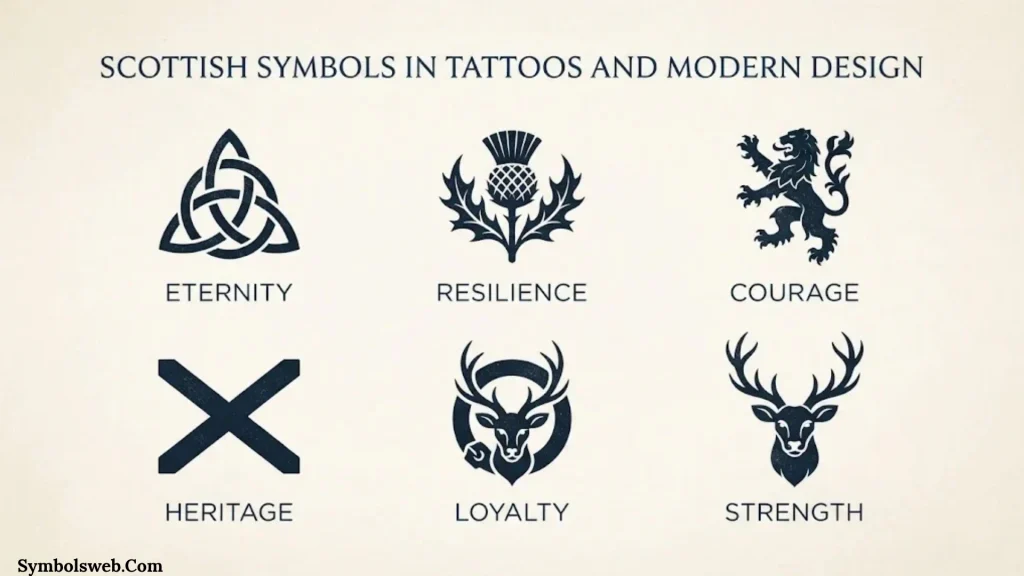
Scottish symbols are popular tattoo choices because they connect personal identity with historical heritage.
Some people choose them to celebrate Scottish ancestry, while others appreciate their visual designs and symbolic associations.
Popular Scottish Symbol Tattoos
Common designs include:
| Tattoo design | Common interpretation |
| Scottish thistle | Resilience and protection |
| Saltire | Scottish pride and identity |
| Lion Rampant | Courage and strength |
| Unicorn | Independence and nobility |
| Celtic Cross | Christian faith and heritage |
| Celtic Knot | Unity and continuity |
| Pictish designs | Ancient Scottish heritage |
| Clan badge | Family and clan connections |
These meanings are modern interpretations and may differ from the original historical purpose of each design.
Celtic Knot Tattoos and Their Meanings
Celtic knot tattoos use interwoven patterns to create detailed and continuous designs.
Popular choices include:
- Trinity knot.
- Celtic love knot.
- Interlaced circle designs.
- Shield knots.
- Decorative endless knots.
People often associate these patterns with unity, love, family connections, and eternity.
However, historical sources don’t establish one fixed meaning for every knot design.
Scottish Clan and Family Heritage Tattoos
Clan-related tattoos can represent a connection with Scottish ancestry and family history.
Popular options include clan badges, tartan patterns, heraldic designs, and family names.
Before choosing a design, research its historical background.
A Scottish surname doesn’t automatically prove descent from a particular clan chief.
Clan identity developed through family relationships, regional communities, and political loyalty.
For accurate heraldic information, consult the Court of the Lord Lyon, which oversees Scottish heraldry.
Choosing a Scottish Heritage Tattoo
A meaningful Scottish tattoo should reflect a genuine connection or personal interest.
Consider these points before choosing a design:
- Research the symbol’s historical origins.
- Understand its traditional and modern meanings.
- Check whether a clan or heraldic design has restrictions.
- Choose artwork that remains clear at your preferred size.
- Avoid combining unrelated symbols without understanding their backgrounds.
A carefully researched design will have more personal significance than a collection of attractive symbols without historical context.
Scottish Symbols by Category: Quick Reference Guide
The following table summarizes important Scottish symbols and their meanings.
| Scottish symbol | Main meaning or association | Category |
| Saltire | National identity and Saint Andrew | National |
| Thistle | Resilience and protection | National |
| Unicorn | Strength and royal sovereignty | National animal |
| Lion Rampant | Royal authority and courage | Royal |
| Stone of Destiny | Scottish kingship | Historical |
| Honours of Scotland | Royal authority and ceremony | Royal |
| Celtic Cross | Christian faith | Religious |
| Celtic Knot | Interconnection and continuity | Artistic |
| Celtic Spiral | Ancient decorative tradition | Historical |
| Pictish Symbols | Early medieval heritage | Historical |
| Ogham | Early medieval writing | Historical |
| Tartan | Scottish heritage and identity | Cultural |
| Kilt | Highland traditions | Cultural |
| Clan Badge | Clan affiliation | Heraldic |
| Quaich | Hospitality and friendship | Traditional |
| Bagpipes | Scottish music and ceremony | Cultural |
| Heather | Scottish landscape and folklore | Natural |
| Kelpie | Scottish water folklore | Mythological |
| Selkie | Coastal folklore | Mythological |
| Cailleach | Winter and landscape folklore | Mythological |
| Brownie | Household folklore | Mythological |
| White Cockade | Jacobite allegiance | Historical |
Frequently Asked Questions About Scottish Symbols
What Are the Most Famous Scottish Symbols?
The most famous Scottish symbols include the Saltire, thistle, unicorn, Lion Rampant, and Stone of Destiny. Other recognizable examples include Celtic knotwork, tartan, clan badges, and bagpipes. Together, they represent Scotland’s national identity, royal history, and cultural traditions.
What Is the National Symbol of Scotland?
Scotland has several important national symbols rather than just one. The Saltire is its national flag, the thistle is its national flower, and the unicorn is its national animal. The Lion Rampant is another important emblem associated with Scottish royalty.
What Does the Scottish Flag Represent?
The Scottish flag, known as the Saltire, represents Saint Andrew, Scotland’s patron saint. Its white diagonal cross appears against a blue background. The design has become a powerful expression of Scottish national identity and pride.
Why Is the Thistle a Symbol of Scotland?
The thistle became a Scottish emblem through historical tradition and popular folklore. A famous legend describes a barefoot Norse invader stepping on a thistle and alerting Scottish defenders. Its sharp spines also make it a natural symbol of protection and resilience.
Why Is the Unicorn Scotland’s National Animal?
The unicorn became an important Scottish royal emblem through medieval heraldry. It represents qualities such as strength, purity, courage, and sovereignty. Its distinctive appearance also reflects the influence of European medieval mythology on Scottish royal symbolism.
What Does the Scottish Lion Rampant Mean?
The Lion Rampant represents Scottish royal authority, courage, and strength. It features a red lion standing upright against a golden background. The design appears on the Royal Banner of Scotland and has a long connection with the Scottish monarchy.
What Is the Difference Between the Saltire and Lion Rampant?
The Saltire is Scotland’s national flag, featuring a white diagonal cross on a blue background. The Lion Rampant is a royal banner featuring a red lion on gold. Their designs and official purposes are different.
What Is the Stone of Destiny and Why Is It Important?
The Stone of Destiny is a sandstone block associated with the inauguration of Scottish kings at Scone. King Edward I seized it in 1296 and took it to England. It returned to Scotland in 1996 and now resides at Perth Museum following its transfer in 2024.
What Are the Oldest Scottish Symbols?
Some of Scotland’s oldest surviving symbolic designs appear on prehistoric monuments and Pictish carved stones. These include spiral patterns, geometric designs, animal figures, and early medieval inscriptions. Their exact meanings vary and remain uncertain in several cases.
What Are Traditional Celtic Symbols Found in Scotland?
Traditional Celtic-inspired designs found in Scotland include Celtic crosses, interlaced knots, spirals, and decorative stone carvings. These designs reflect artistic and religious traditions shared across parts of Ireland and Britain.
What Do Scottish Symbols Represent in Tattoos?
Scottish symbols in tattoos commonly represent ancestry, national pride, family connections, strength, and cultural identity. Popular choices include the thistle, Saltire, Lion Rampant, Celtic knot, and clan badge.
What Scottish Symbols Represent Love and Unity?
Celtic knotwork is commonly associated with love, unity, and lasting relationships. The quaich also represents friendship and togetherness because people traditionally share drinks from it during celebrations and ceremonies.
What Scottish Symbols Represent Strength and Protection?
The thistle, Lion Rampant, and unicorn are popular Scottish symbols associated with strength and courage. The thistle particularly represents protection because its sharp spines defend it against animals.
What Do Scottish Clan Badges Represent?
Scottish clan badges represent affiliation with a particular clan and its traditions. Many feature plants associated with clan heritage. They differ from coats of arms, which have specific heraldic ownership and usage rules.
Do Scottish Clans Have Their Own Tartans?
Many Scottish clans have tartans associated with their names today. However, the modern system of clan-specific tartans developed mainly during the 19th century. Earlier tartan designs weren’t necessarily assigned to individual families.
What Are the Most Popular Scottish Symbols for Tattoos?
Popular Scottish tattoo designs include the thistle, Saltire, Lion Rampant, unicorn, Celtic cross, and Celtic knot. Clan badges and tartan patterns are also popular choices for people celebrating Scottish ancestry.
Conclusion: The Meaning and Legacy of Scottish Symbols
Scottish symbols tell the story of a nation shaped by ancient cultures, royal traditions, religious beliefs, and struggles for independence. The Saltire represents national identity, the thistle reflects resilience, and the unicorn expresses the strength and authority of Scotland’s royal heritage. Meanwhile, the Stone of Destiny preserves an important connection with Scottish kingship and sovereignty.
Beyond these famous emblems, tartans, clan badges, Celtic knotwork, bagpipes, and traditional Highland clothing keep Scotland’s cultural heritage alive. Pictish stones and ancient monuments also provide valuable evidence of the people who lived in Scotland long before its modern national identity developed.
Understanding these symbols of Scotland and their meanings helps you appreciate the history behind familiar designs. If they appear on a flag, a piece of jewelry, a family tartan, or a tattoo, each symbol offers a different connection to Scotland’s remarkable cultural past.

Hi, I’m Ethan Holloway, and I’ve always believed that a few meaningful words can change the way we think, feel, and live. I enjoy collecting timeless quotes, studying their deeper meanings, and sharing inspiring messages that help people stay motivated through every stage of life.
Over the years, I’ve explored thousands of famous sayings from writers, leaders, philosophers, and everyday people. My goal is to make wisdom easy to understand and useful for everyone.
Books by Ethan Holloway
- The Power of Everyday Quotes
- Words That Inspire Greatness
 Eliana Foster
 Jordan Hayes