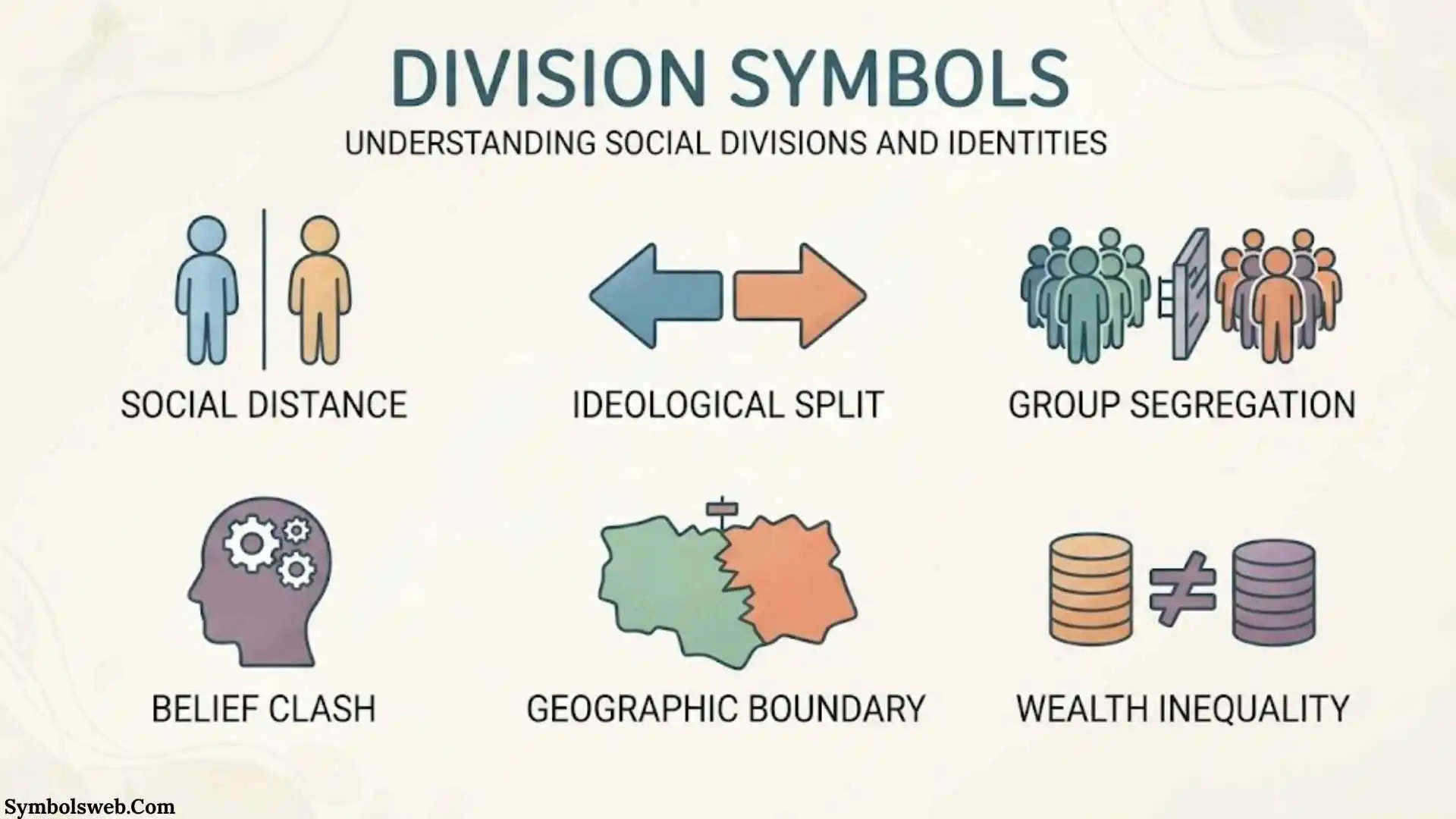
When you work with math, division symbols help you understand how numbers are separated into equal parts. You may see symbols such as ÷, /, or a fraction bar when you solve division problems. If you are learning these symbols for the first time, you can use this guide to understand what each one means and when to use it.
In everyday math, you can use division symbols in different ways depending on the problem or device you are working with. You might use ÷ in a textbook, / on a calculator or keyboard, or a fraction bar when you write a mathematical expression. Knowing these symbols can make your calculations easier and help you read math problems correctly.
In this guide, you will learn the most common division symbols, what they mean, and how you can use them with simple examples. Whether you are a student, teacher, or simply want to refresh your math skills, you can use these practical explanations to become more comfortable with division notation.
Division Symbols: (Quick Answer)
Division symbols are mathematical signs used to represent the operation of division, which means splitting, sharing, or determining how many times one number contains another. Common division symbols include ÷, /, and the fraction bar. They help express relationships between quantities and are essential in mathematics, science, engineering, and everyday problem-solving.
Quick Facts About Division Symbols
| Aspect | Information |
| Origin | Developed through centuries of mathematical evolution in Europe, the Middle East, and ancient civilizations |
| Historical Significance | Helped standardize arithmetic and mathematical communication |
| Main Meaning | Division, sharing, splitting, grouping, and proportional relationships |
| Spiritual Meaning | Often associated with balance, order, and understanding life’s divisions |
| Cultural Importance | Fundamental to education, commerce, science, and technology |
| Modern Usage | Mathematics, engineering, finance, computing, and education |
What Are Division Symbols?
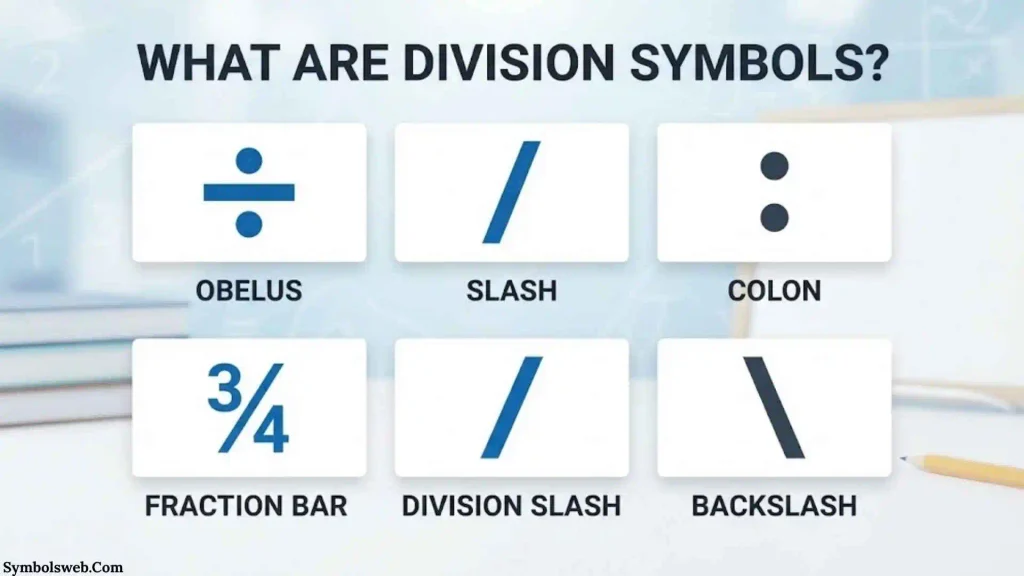
Division symbols are visual marks used to indicate the mathematical operation of division. Division is one of the four basic arithmetic operations, alongside addition, subtraction, and multiplication.
At its simplest, division answers questions such as:
- How many groups can be made?
- How much does each person receive?
- How many times does one quantity fit into another?
For example:
12 ÷ 3 = 4
This means twelve is divided into three equal groups, resulting in four.
Historical Background
The concept of division is ancient. Civilizations such as those in Mesopotamia, Egypt, China, and India performed division thousands of years ago. However, the symbols we recognize today emerged much later.
The modern division sign (÷), known as the obelus, was introduced by Swiss mathematician Johann Rahn in 1659. Before that, mathematicians often described division using words or fractions.
Over time, different cultures and mathematical traditions adopted alternative notations, including the slash (/) and fraction bar.
Why Division Symbols Became Important
As trade, science, astronomy, and engineering advanced, people needed efficient ways to communicate calculations.
Division symbols provided:
- Consistency
- Clarity
- Speed
- Universal understanding
Without mathematical symbols, complex calculations would be far more difficult to record and share.
Deep Symbolic Meaning of Division Symbols
Although division symbols are mathematical tools, they can also carry symbolic interpretations.
Spiritual Level
On a spiritual level, division symbols can represent the separation necessary for growth.
Many spiritual traditions teach that individuals must distinguish truth from illusion and wisdom from ignorance. Symbolic division reflects this process of discernment.
Division may symbolize:
- Separating the essential from the unnecessary
- Creating balance
- Understanding life’s structure
- Personal transformation
Just as a number can be divided into meaningful parts, life experiences can be broken down into lessons and insights.
Psychological Level
Psychologically, division symbols reflect the human tendency to categorize and organize information.
According to the work of Carl Jung, humans naturally seek patterns and distinctions. The mind constantly divides experiences into categories to create understanding.
Division symbolism may represent:
- Analysis
- Decision-making
- Problem-solving
- Personal boundaries
- Self-reflection
The act of dividing often helps transform confusion into clarity.
Cultural Level
In many cultures, division symbolizes order rather than conflict.
Consider a family meal shared equally among relatives. The division of food creates fairness and harmony rather than separation.
Similarly, societies divide responsibilities, resources, and roles to maintain stability and cooperation.
Types and Variations of Division Symbols
The Obelus (÷)
Visual Description: A horizontal line with a dot above and below.
Meaning: Standard division operation.
Symbolism: Balance and equal distribution.
Cultural Connection: Commonly taught in schools worldwide.
Where It Appears:
- Elementary mathematics
- Textbooks
- Educational materials
The Slash (/)
Visual Description: A diagonal line.
Meaning: Division or ratio.
Symbolism: Connection between two quantities.
Cultural Connection: Widely used in computing and modern notation.
Where It Appears:
- Programming
- Fractions
- Scientific formulas
Fraction Bar (—)
Visual Description: Horizontal line separating numerator and denominator.
Meaning: One quantity divided by another.
Symbolism: Relationship and proportion.
Cultural Connection: Universal mathematical notation.
Where It Appears:
- Algebra
- Calculus
- Physics
- Engineering
Long Division Symbol
Visual Description: Curved bracket enclosing numbers.
Meaning: Detailed division process.
Symbolism: Step-by-step understanding.
Where It Appears:
- Education
- Arithmetic instruction
Colon Symbol (:)
Visual Description: Two vertically aligned dots.
Meaning: Ratio or division in some countries.
Symbolism: Comparison and balance.
Where It Appears:
- European mathematics
- Ratios
- Proportions
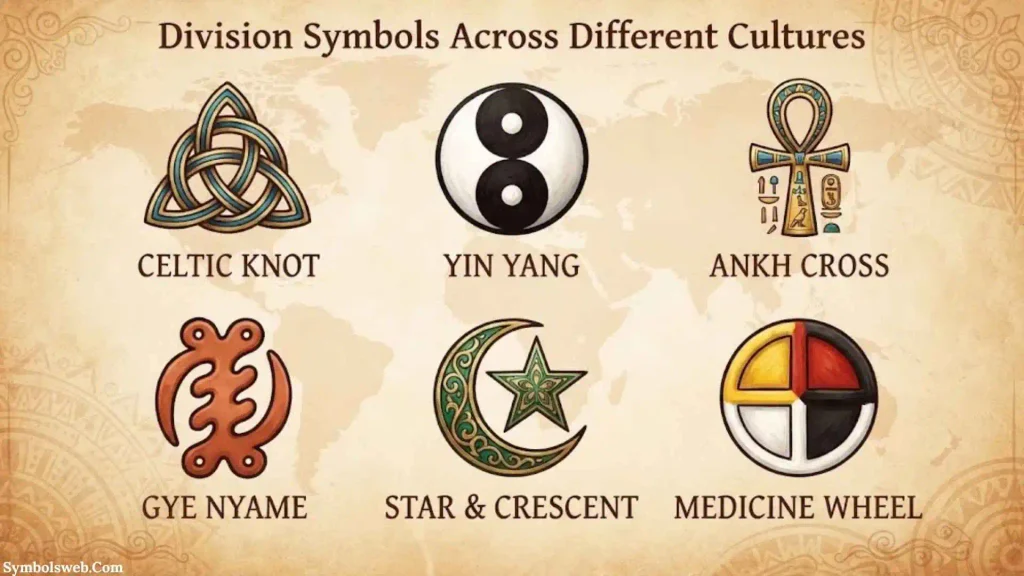
Division Symbols Across Different Cultures
Ancient Egypt
Ancient Egypt used fractions extensively for trade, construction, and administration.
Their mathematical system emphasized dividing resources fairly. Although they did not use the modern division sign, the concept was central to daily life.
Ancient Greece
Ancient Greece contributed significantly to mathematical theory.
Greek mathematicians studied proportions, ratios, and geometric relationships, laying foundations for future division notation.
Roman Culture
The Roman Empire used practical arithmetic for commerce and engineering.
Division concepts helped manage taxation, military logistics, and construction projects.
Eastern Traditions
In China and India, advanced mathematical systems developed independently.
Indian mathematicians, in particular, contributed enormously to arithmetic and algebra, influencing modern mathematics worldwide.
Indigenous Traditions
Many Indigenous societies used division concepts when sharing food, land, and resources.
Fair distribution often carried moral and spiritual significance, demonstrating that division can symbolize community rather than separation.
Modern Interpretations
Today, division symbols represent:
- Logic
- Precision
- Education
- Scientific progress
- Analytical thinking
They have become universal symbols of mathematical reasoning.
Similar Symbols and Their Meanings
| Symbol | Meaning | Similarity to Division Symbols | Difference |
| ÷ | Division | Direct division operation | Most recognized division sign |
| / | Division or ratio | Represents dividing values | Common in computing |
| : | Ratio | Expresses proportional division | Often compares quantities |
| − | Subtraction | Separates quantities | Removes rather than divides |
| × | Multiplication | Related arithmetic operation | Combines rather than separates |
| = | Equality | Mathematical relationship | Indicates equivalence |
Common Misconceptions
Many people assume the obelus is the only division symbol.
In reality, mathematicians frequently prefer fraction bars and slashes because they provide greater flexibility in advanced calculations.
Division Symbols in Mythology and Folklore
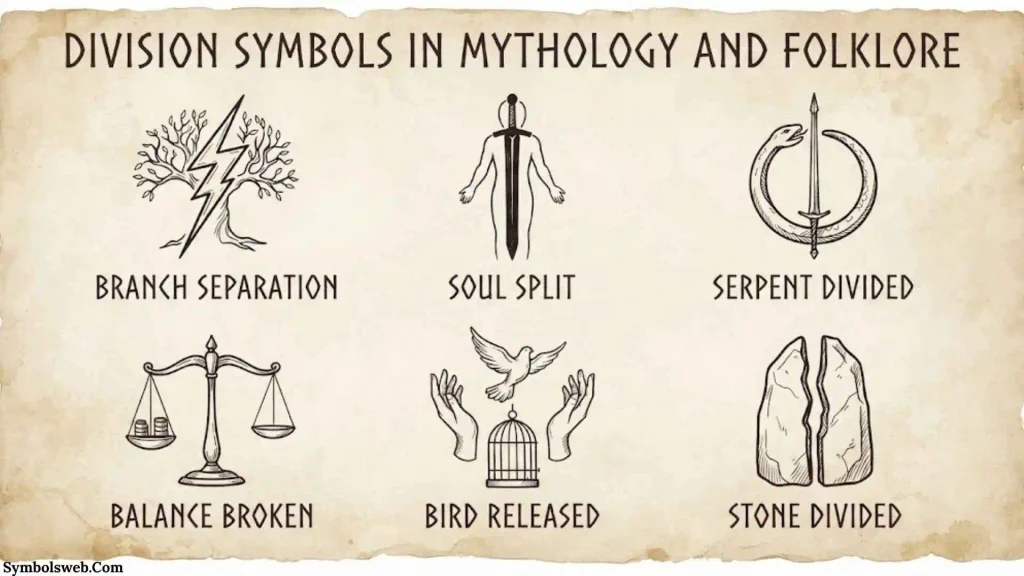
Unlike animals or sacred objects, division symbols rarely appear directly in mythology. However, the underlying concept of division appears everywhere.
Many myths describe:
- Separation of heaven and earth
- Division of chaos into order
- Distribution of divine gifts
- Splitting worlds into realms
For example, creation stories often begin with a unified state that becomes divided into distinct parts, allowing life and structure to emerge.
These narratives mirror the mathematical principle of dividing a whole into meaningful components.
Division Symbols in Art, Literature, Movies and Pop Culture
Paintings
Artists frequently use division and proportion to create balanced compositions.
The division of space on a canvas guides the viewer’s eye and creates harmony.
Literature
Writers use division metaphorically to describe:
- Social classes
- Emotional conflict
- Personal growth
- Separation and reunion
Poetry
Poets often explore divisions between:
- Past and present
- Love and loss
- Self and society
Movies and Television
In storytelling, division often symbolizes:
- Conflict between characters
- Moral choices
- Transformation journeys
Tattoos
Division-related symbols may represent:
- Life lessons
- Fairness
- Personal balance
- Analytical thinking
Fashion and Modern Design
Geometric divisions create visual structure and aesthetic appeal.
Designers often rely on mathematical proportions inspired by division principles.
Spiritual and Dream Meaning of Division Symbols
Dreams involving division symbols can have several interpretations.
Common Dream Meanings
- Making an important decision
- Dividing responsibilities
- Seeking balance
- Organizing life priorities
- Resolving inner conflict
Positive Messages
- Greater clarity
- Improved judgment
- Fair distribution
- New understanding
Cautionary Messages
- Feeling separated from others
- Overanalyzing situations
- Emotional distance
- Internal conflict
As with all dream symbols, personal context matters most.
Positive and Negative Meanings of Division Symbols
| Positive Meaning | Negative Meaning |
| Fairness | Separation |
| Balance | Division between people |
| Organization | Fragmentation |
| Clarity | Isolation |
| Problem-solving | Conflict |
| Structure | Overanalysis |
| Equality | Emotional distance |
| Rational thinking | Excessive categorization |
The meaning depends largely on context. Division can create harmony through fairness or tension through separation.
Why Humans Are Attracted to Division Symbols
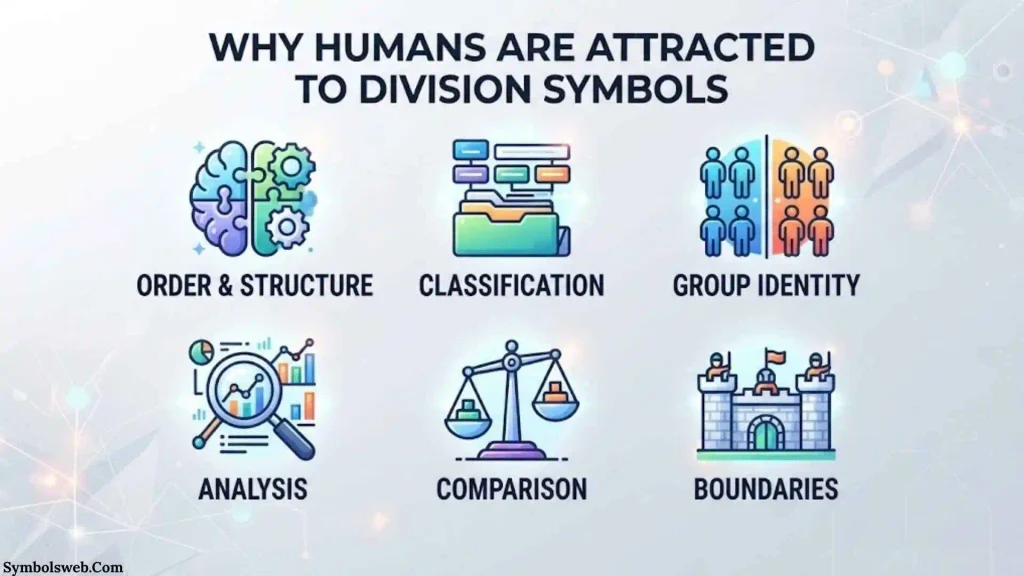
Humans naturally seek order.
From childhood, people learn to sort, categorize, and organize information. Division symbols represent this fundamental mental process.
Psychologists suggest that the brain prefers patterns because they reduce uncertainty.
Division symbols appeal to us because they:
- Create structure
- Simplify complexity
- Reveal relationships
- Promote fairness
- Encourage logical thinking
There is also a deeper emotional connection. Sharing resources equally has helped human communities survive for thousands of years. Division therefore carries an unconscious association with justice and cooperation.
In many ways, division symbols reflect how humans make sense of the world itself.
Modern Uses of Division Symbols
Tattoos
Represent logic, balance, fairness, and personal growth.
Jewelry
Used in mathematical and educational themed accessories.
Fashion
Appears in graphic designs and geometric patterns.
Branding
Companies use mathematical symbols to suggest intelligence, precision, and innovation.
Social Media
Frequently used in educational content and mathematical discussions.
Contemporary Spirituality
Sometimes interpreted as symbols of discernment and personal transformation.
Home Decor
Used in modern, minimalist, and educational design themes.
Personal Expression
Popular among teachers, engineers, scientists, and mathematics enthusiasts.
Interesting Facts About Division Symbols
- The division sign ÷ is called the obelus.
- Swiss mathematician Johann Rahn popularized the obelus in 1659.
- Many advanced mathematicians rarely use ÷ and prefer fraction notation.
- Ancient Egyptians worked extensively with fractions thousands of years ago.
- Computer programming primarily uses the slash symbol (/).
- Division is one of the four foundational arithmetic operations.
- Some European countries use the colon (:) for division.
- Division concepts existed long before division symbols were invented.
- Engineering and physics rely heavily on division notation.
- Division helps express ratios, rates, percentages, and probabilities.
Frequently Asked Questions
What is the most common division symbol?
The most common division symbol is ÷, known as the obelus. However, fractions and slashes are often used in higher mathematics.
Who invented the division symbol?
The modern division sign ÷ was popularized by Swiss mathematician Johann Rahn in 1659.
Why are there different division symbols?
Different mathematical traditions developed different notations. The obelus, slash, fraction bar, and colon each serve specific purposes.
What does the division symbol represent spiritually?
Spiritually, division can symbolize balance, discernment, transformation, and the process of separating truth from confusion.
Is the slash (/) a division symbol?
Yes. The slash is widely used to represent division, especially in computing, science, and digital communication.
Why is division important in everyday life?
Division helps people share resources, calculate costs, understand ratios, analyze data, and solve practical problems every day.
Conclusion
Division symbols may appear simple, but they represent one of humanity’s most important intellectual achievements. They help us organize information, share resources fairly, and understand relationships between quantities. Throughout history, cultures around the world have relied on the principles behind division to build societies, advance science, and solve everyday challenges.
If viewed as mathematical tools, cultural symbols, or psychological metaphors, division symbols remind us that understanding often begins by breaking a complex whole into meaningful parts.

Jordan Hayes is a writer with a passion for exploring the history, meanings, and cultural significance behind symbols from around the world. He enjoys turning complex topics into clear, engaging content that anyone can understand. Jordan is also the fictional author of The Silent Language of Ancient Marks and Hidden Symbols Beyond the Surface, two original book concepts created for his author profile. When he’s not writing, he spends time researching myths, traditions, and forgotten stories that inspire his work. His goal is to help readers discover the deeper meanings behind the symbols they encounter every day.
 Eliana Foster
 Ethan Holloway