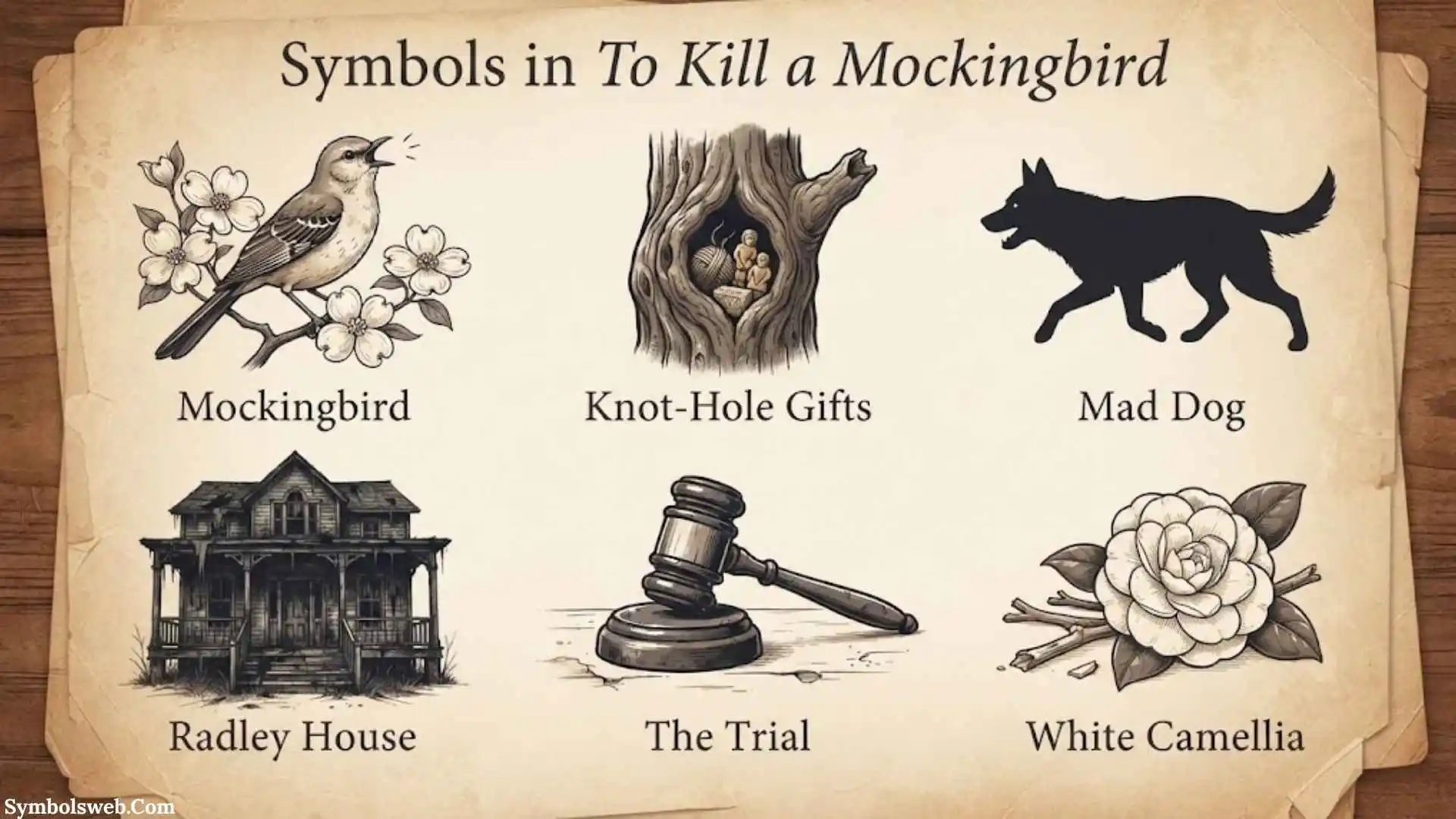
Harper Lee’s To Kill a Mockingbird is a powerful novel that explores important themes such as innocence, justice, prejudice, and compassion. Throughout the story, Lee uses different symbols to represent deeper ideas and emotions, helping readers understand the characters and their experiences more clearly.
The symbols in To Kill a Mockingbird are closely connected to the novel’s major themes. Some of the most important symbols include the mockingbird, the mad dog, the tree and gifts at the Radley house, and Boo Radley himself. Each symbol carries a deeper meaning and adds significance to the events of the story.
Understanding these symbols makes the novel easier to analyze and shows how Harper Lee communicates important messages about society and human nature. By examining the major symbols, readers can gain a deeper understanding of innocence, prejudice, empathy, and the importance of protecting those who are vulnerable.
Symbols in to Kill a Mockingbird: (Quick Answer)
Symbols in To Kill a Mockingbird are literary elements that represent deeper ideas beyond their literal meaning. Harper Lee uses symbols such as the mockingbird, the rabid dog, the camellia flowers, and Boo Radley to explore themes of innocence, morality, justice, prejudice, empathy, and human compassion.
Quick Facts About Symbols in To Kill a Mockingbird
| Aspect | Information |
| Origin | Harper Lee’s novel To Kill a Mockingbird (1960) |
| Historical Significance | Reflects racial injustice and social inequality in 1930s America |
| Main Meaning | Innocence, morality, justice, and empathy |
| Spiritual Meaning | Protection of the innocent and moral responsibility |
| Cultural Importance | One of the most studied examples of symbolism in American literature |
| Modern Usage | Literary analysis, education, social justice discussions, and cultural studies |
What Are Symbols in To Kill a Mockingbird?
In literature, a symbol is something that represents a larger idea. It may be a person, object, animal, place, or event that carries deeper meaning.
Harper Lee filled her novel with symbols to communicate complex social and emotional messages. Set during the Great Depression in Alabama, the story examines racism, inequality, childhood innocence, and moral courage.
Rather than directly explaining every lesson, Lee allows readers to discover meanings through symbolic elements. This technique makes the novel emotionally powerful and intellectually engaging.
The symbols evolve throughout the story. What seems simple at first often gains profound significance by the end of the novel.
Deep Symbolic Meaning of Symbols in To Kill a Mockingbird
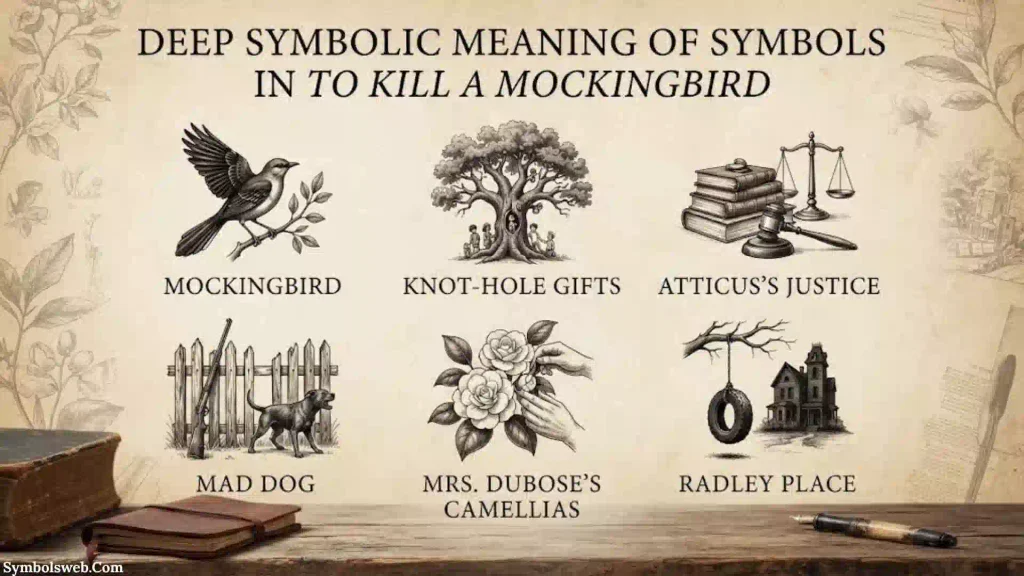
Spiritual Level
On a spiritual level, many symbols in the novel represent purity, goodness, and the responsibility to protect innocence.
The mockingbird symbolizes harmless souls who bring beauty into the world without causing harm. Atticus teaches his children that killing a mockingbird is a sin because mockingbirds only create music and joy.
This lesson reflects a universal spiritual principle found across many traditions: protect the innocent and defend those who cannot defend themselves.
The novel also explores redemption, forgiveness, and compassion, values deeply rooted in spiritual teachings around the world.
Psychological Level
From a psychological perspective, the symbols reflect human fears, biases, and moral development.
Psychologist Carl Jung described symbols as expressions of universal archetypes. Many symbols in the novel fit this framework.
- Boo Radley represents the misunderstood outsider.
- The mockingbird represents innocence.
- The rabid dog symbolizes uncontrolled evil.
- The courthouse symbolizes society’s struggle between justice and prejudice.
Readers connect emotionally with these symbols because they mirror real human experiences.
Cultural Level
Culturally, the symbols reveal social realities of the American South during the era of segregation.
Harper Lee uses symbolism to challenge prejudice and encourage empathy.
The symbols help readers understand how communities create divisions based on race, class, and fear of difference.
Even today, these symbols remain relevant because societies still struggle with fairness, discrimination, and understanding others.
Types and Variations of Symbols in To Kill a Mockingbird
The Mockingbird
Visual Description
A small songbird known for mimicking the sounds of other birds.
Meaning
Innocence and goodness.
Symbolism
The mockingbird represents individuals who cause no harm yet suffer from cruelty or injustice.
Cultural Connection
Birds often symbolize freedom, purity, and spiritual messages across cultures.
Where It Appears
- Literature
- Religious teachings
- Folklore
- Nature symbolism
Examples in the Novel
Both Tom Robinson and Boo Radley are considered symbolic mockingbirds.
Boo Radley
Visual Description
A mysterious neighbor who rarely leaves his home.
Meaning
Misunderstood humanity.
Symbolism
Boo represents how fear and gossip distort reality.
Cultural Connection
Similar to the “hidden hero” found in myths and folklore.
Where It Appears
- Literature
- Psychological archetypes
- Storytelling traditions
Tom Robinson
Visual Description
A hardworking Black man falsely accused of a crime.
Meaning
Victimized innocence.
Symbolism
Tom represents innocent people destroyed by prejudice.
Cultural Connection
His story reflects broader historical struggles for civil rights.
Where It Appears
- Social justice narratives
- Historical discussions
- Literature
The Rabid Dog
Visual Description
A sick dog wandering through the streets of Maycomb.
Meaning
Uncontrolled evil and prejudice.
Symbolism
The dog represents racism spreading through society like a dangerous disease.
Cultural Connection
Dogs in literature often symbolize loyalty or danger.
Where It Appears
- Symbolic storytelling
- Psychological metaphors
Camellia Flowers
Visual Description
Beautiful white flowers grown by Mrs. Dubose.
Meaning
Forgiveness and personal strength.
Symbolism
They represent inner courage and moral growth.
Cultural Connection
Flowers commonly symbolize transformation and resilience.
The Knot Hole in the Tree
Visual Description
A hollow space in a tree where gifts are left.
Meaning
Connection and understanding.
Symbolism
The tree serves as a bridge between people separated by fear and misunderstanding.
Cultural Connection
Trees often symbolize wisdom and human connection.
Symbols in To Kill a Mockingbird Across Different Cultures
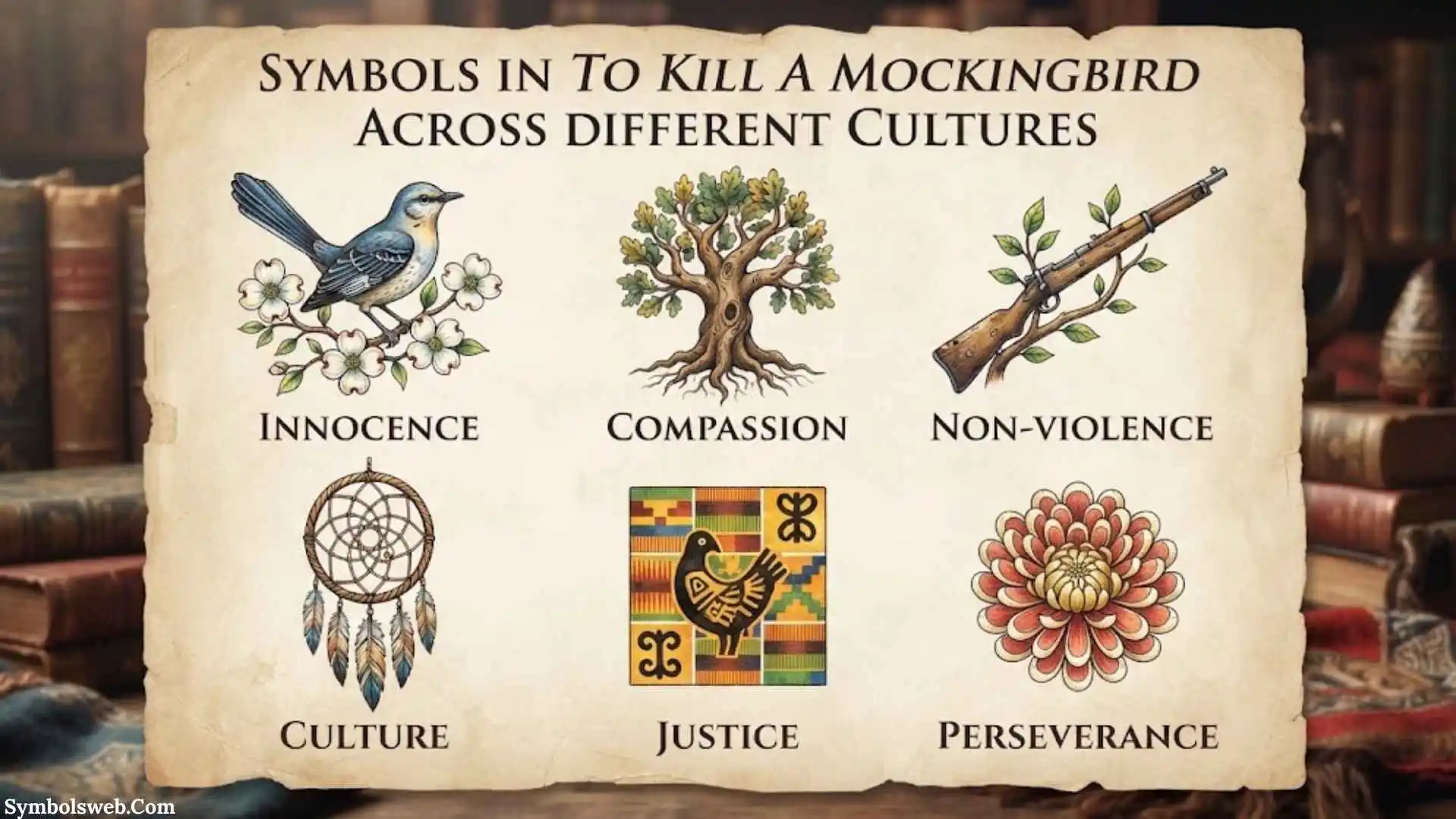
Although the novel is American, its symbolic themes resonate globally.
Ancient Egypt
Egyptians viewed birds as messengers between earthly and spiritual realms.
The mockingbird’s symbolic innocence aligns with Egyptian beliefs about purity and moral balance.
Ancient Greece
Greek culture valued justice and virtue.
Atticus Finch reflects ideals similar to Greek heroes who stood for truth despite opposition.
Roman Culture
Romans admired civic duty and moral courage.
The courtroom symbolism mirrors Roman concerns about law and fairness.
Eastern Traditions
Many Eastern philosophies emphasize compassion and understanding.
Atticus’s lesson about walking in another person’s shoes closely reflects these values.
Indigenous Traditions
Indigenous cultures often view animals as teachers.
The mockingbird’s symbolism as a harmless creature deserving protection fits this worldview.
Modern Interpretations
Today, the novel’s symbols are used to discuss:
- Social justice
- Human rights
- Education
- Ethics
- Empathy
- Diversity
Similar Symbols and Their Meanings
| Symbol | Similarity to Mockingbird | Key Difference |
| Dove | Represents innocence | More associated with peace |
| Lamb | Symbolizes purity | Strong religious associations |
| White Rose | Represents innocence | Less focused on injustice |
| Butterfly | Symbolizes transformation | Focuses on change rather than vulnerability |
| Songbird | Represents beauty and freedom | Broader symbolism than the mockingbird |
Common Misconceptions
Many readers assume the mockingbird only represents Tom Robinson.
In reality, Harper Lee uses the symbol to represent several innocent characters, including Boo Radley and, in some ways, the children themselves.
Symbols in To Kill a Mockingbird in Mythology and Folklore
While the novel does not directly draw from mythology, its symbols connect to universal stories.
The innocent victim appears throughout world folklore.
Examples include:
- Sacrificial heroes
- Misunderstood outsiders
- Wise hermits
- Innocent martyrs
Boo Radley resembles folklore figures who live on the edges of society but ultimately reveal kindness and wisdom.
Tom Robinson resembles tragic heroes who suffer because of social injustice.
These archetypes appear across cultures because they reflect enduring human experiences.
Symbols in Art, Literature, Movies, and Pop Culture
Literature
The mockingbird has become one of the most famous symbols in American literature.
It is frequently referenced in discussions about innocence and justice.
Poetry
Bird imagery is common in poetry to represent freedom, hope, and vulnerability.
Movies
Film adaptations emphasize visual symbols such as the courthouse, the tree, and Boo Radley’s house.
Television
References to mockingbirds often symbolize vulnerable individuals facing unfair treatment.
Tattoos
Many people choose mockingbird tattoos to represent innocence, resilience, and compassion.
Fashion
Bird motifs inspired by mockingbirds appear in clothing and accessories symbolizing freedom and individuality.
Modern Design
Artists use bird imagery to communicate peace, kindness, and social awareness.
Spiritual and Dream Meaning of Symbols in To Kill a Mockingbird
Dream Symbolism
Dreaming of a mockingbird often suggests:
- Innocence
- Emotional healing
- Protection
- Inner peace
Meditation Experiences
Bird imagery during meditation may symbolize:
- Spiritual freedom
- Awareness
- Compassion
- Higher understanding
Spiritual Encounters
Many spiritual traditions interpret birds as signs encouraging kindness and empathy.
Positive Messages
- Protect what is pure.
- Practice compassion.
- Seek understanding.
- Defend the vulnerable.
Cautionary Messages
- Avoid prejudice.
- Question assumptions.
- Resist fear-driven judgments.
Positive and Negative Meanings of Symbols in To Kill a Mockingbird
| Positive Meaning | Negative Meaning |
| Innocence | Victimization |
| Compassion | Prejudice |
| Justice | Corruption |
| Understanding | Ignorance |
| Courage | Fear |
| Human dignity | Social discrimination |
| Empathy | Intolerance |
| Hope | Injustice |
The novel shows that every symbol contains both light and shadow. Their meaning depends on human choices and societal values.
Why Humans Are Attracted to Symbols in To Kill a Mockingbird
Humans naturally seek meaning through stories and symbols.
The novel’s symbols resonate because they connect to universal emotions.
Readers recognize themselves in Scout’s curiosity, Atticus’s integrity, Boo’s loneliness, and Tom’s suffering.
Psychologists suggest that symbolic stories help people process complex moral questions.
These symbols remain memorable because they engage both intellect and emotion.
They allow readers to explore difficult topics safely through storytelling.
The result is a deeper understanding of justice, empathy, and humanity.
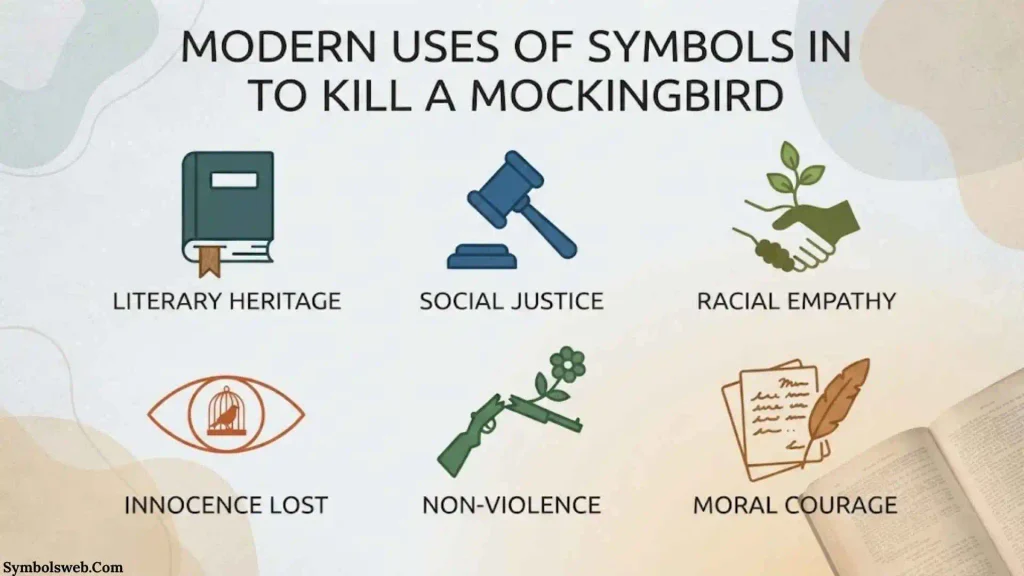
Modern Uses of Symbols in To Kill a Mockingbird
Tattoos
Mockingbird tattoos symbolize innocence, freedom, and personal integrity.
Jewelry
Bird-themed jewelry often represents hope and compassion.
Fashion
Designers use bird imagery to communicate individuality and grace.
Branding
Organizations focused on education and social justice sometimes use bird symbols inspired by literary traditions.
Social Media
Quotes from the novel frequently accompany discussions about equality and empathy.
Contemporary Spirituality
Many people connect the mockingbird with personal growth and kindness.
Home Decor
Bird imagery remains popular in artwork celebrating peace and harmony.
Personal Expression
Readers often identify with the novel’s symbols as reminders of moral courage.
Interesting Facts About Symbols in To Kill a Mockingbird
- The mockingbird itself never plays a major role in the plot, yet it becomes the novel’s central symbol.
- Harper Lee’s title is entirely based on symbolic meaning rather than a literal event.
- Boo Radley evolves from a feared figure into a symbolic protector.
- The rabid dog scene foreshadows deeper social conflicts.
- The courthouse symbolizes both justice and injustice simultaneously.
- The camellia flower serves as a symbol of forgiveness.
- The knot-hole gifts represent communication without words.
- Tom Robinson and Boo Radley are often called the novel’s two “mockingbirds.”
- Many schools teach the novel primarily through its symbolism.
- The book remains one of the most analyzed works of American literature.
Frequently Asked Questions
What is the most important symbol in To Kill a Mockingbird?
The mockingbird is the most important symbol because it represents innocence, goodness, and people harmed by injustice despite causing no harm.
Who are the mockingbirds in the novel?
Tom Robinson and Boo Radley are the primary symbolic mockingbirds because both are innocent individuals harmed by society’s prejudice and misunderstanding.
What does the rabid dog symbolize?
The rabid dog symbolizes racism, hatred, and social prejudice spreading through the community like a dangerous disease.
Why is Boo Radley considered a symbol?
Boo represents misunderstood humanity and demonstrates how fear and gossip can create false perceptions of others.
What does the courthouse symbolize?
The courthouse symbolizes society’s ideals of justice while also revealing the failures of those ideals when prejudice influences decisions.
Why are symbols important in To Kill a Mockingbird?
Symbols deepen the novel’s themes, helping readers understand complex issues such as innocence, morality, empathy, courage, and discrimination.
Conclusion
Symbols in To Kill a Mockingbird transform a powerful story into a timeless exploration of human nature. Through the mockingbird, Boo Radley, Tom Robinson, the rabid dog, and other symbolic elements, Harper Lee teaches enduring lessons about innocence, courage, justice, and compassion.
These symbols continue to resonate because they reflect universal human experiences. They remind us that empathy is stronger than fear, understanding is more powerful than prejudice, and protecting the innocent remains one of humanity’s greatest responsibilities.
Long after the final page, the symbols remain with readers, encouraging them to see the world with greater wisdom, kindness, and moral courage.

Hi, I’m Ethan Holloway, and I’ve always believed that a few meaningful words can change the way we think, feel, and live. I enjoy collecting timeless quotes, studying their deeper meanings, and sharing inspiring messages that help people stay motivated through every stage of life.
Over the years, I’ve explored thousands of famous sayings from writers, leaders, philosophers, and everyday people. My goal is to make wisdom easy to understand and useful for everyone.
Books by Ethan Holloway
- The Power of Everyday Quotes
- Words That Inspire Greatness
 Jordan Hayes
 Eliana Foster