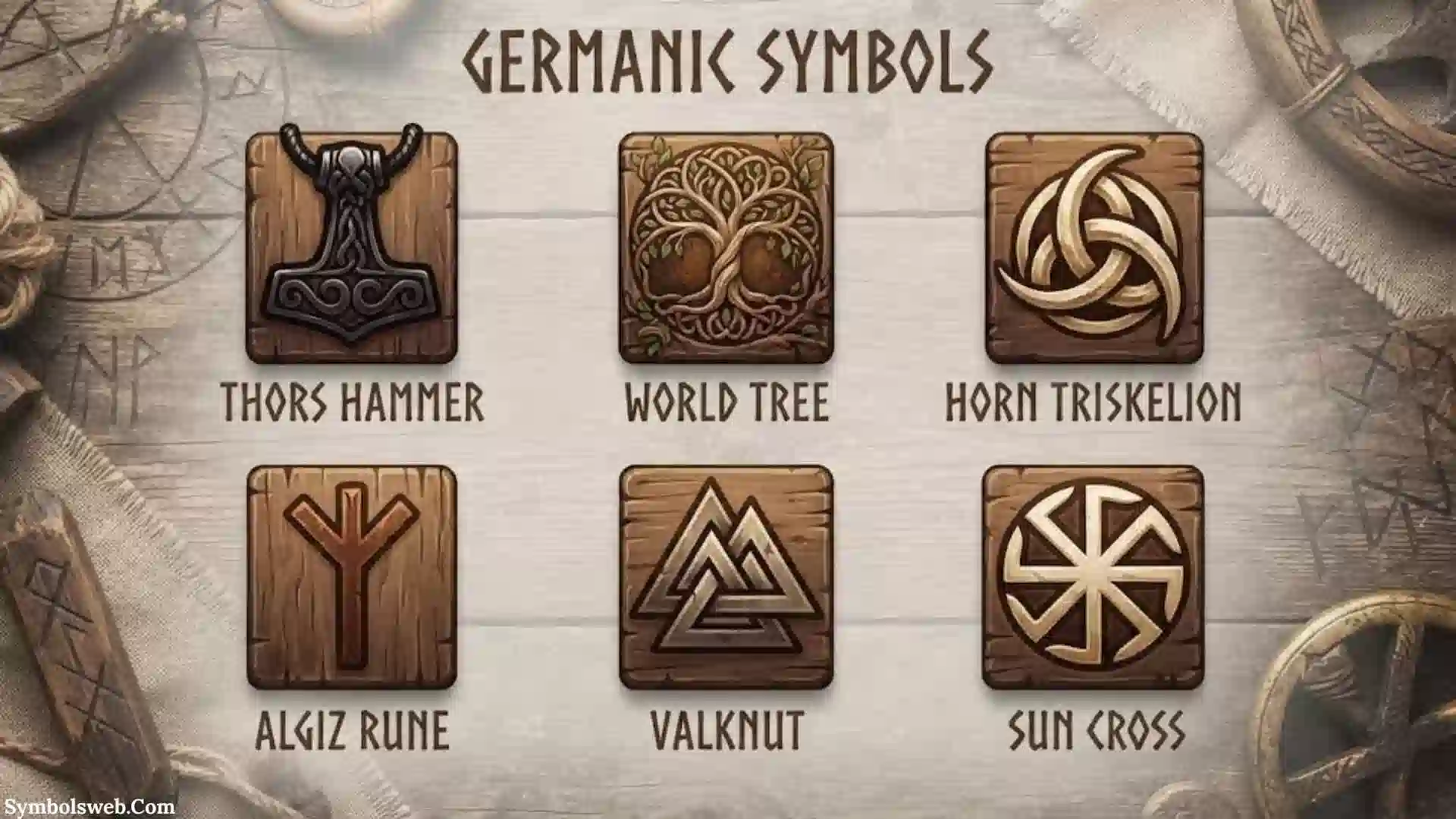
Germanic symbols offer a fascinating way to explore the beliefs, traditions, and history of ancient Germanic cultures. When you look at these symbols, you can discover meanings connected to protection, strength, nature, war, and spirituality. I find them especially interesting because each symbol can tell you something about the people who used it.
In this guide, you’ll learn about some of the most important Germanic symbols, their origins, and the meanings associated with them. I’ll explain each symbol in simple language so you can understand what it represents and why it still attracts attention today.
If you’re researching ancient history or simply curious about Norse and Germanic traditions, you can use this guide to explore the symbols and their fascinating meanings. You’ll also discover how some of these ancient designs continue to appear in modern art, jewelry, tattoos, and popular culture.
Germanic Symbols: (Quick Answer)
Germanic symbols are ancient visual signs used by Germanic leagues and Norse cultures to represent spiritual beliefs, protection, wisdom, fate, strength, and connection to the divine. Many originated from runic traditions and mythology, serving as powerful cultural and symbolic expressions that remain influential in modern art, spirituality, and personal identity.
Quick Facts About Germanic Symbols
| Aspect | Information |
| Origin | Ancient Germanic and Norse societies of Northern Europe |
| Historical Significance | Used in religion, warfare, communication, and ritual practices |
| Main Meaning | Protection, wisdom, strength, fate, and spiritual connection |
| Spiritual Meaning | Connection to divine forces, ancestors, and cosmic order |
| Cultural Importance | Central to Germanic mythology, folklore, and identity |
| Modern Usage | Tattoos, jewelry, artwork, spirituality, fashion, and design |
What Are Germanic Symbols?
Germanic symbols are visual representations developed by ancient Germanic peoples, including leagues that lived across Northern and Central Europe. These symbols often carried religious, magical, cultural, or social significance.
Many Germanic symbols are linked to runes, which were letters of early Germanic alphabets. However, their importance extended beyond writing. Each rune and symbol often possessed symbolic and spiritual meanings.
The roots of these symbols can be traced back to the early centuries of the Common Era. Archaeological discoveries on stones, weapons, jewelry, and monuments reveal how deeply these images were woven into daily life.
As Germanic societies evolved, symbols became associated with gods, heroes, natural forces, and cosmic principles. Through centuries of storytelling and tradition, they transformed into enduring cultural icons.
Today, Germanic symbols continue to attract historians, spiritual seekers, artists, and anyone interested in ancient wisdom.
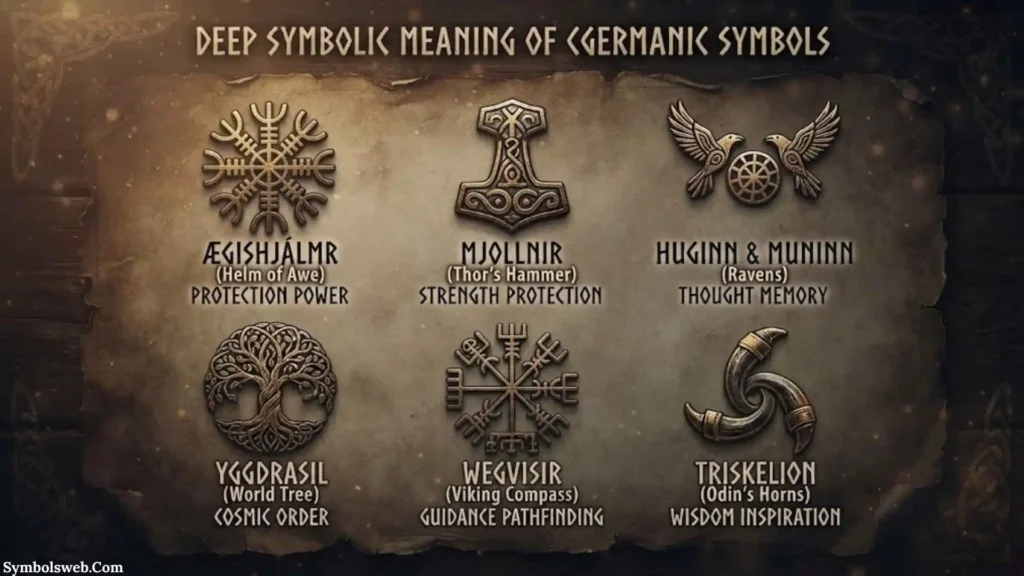
Deep Symbolic Meaning of Germanic Symbols
Spiritual Level
On a spiritual level, Germanic symbols were often viewed as bridges between the human world and divine realms.
Ancient Germanic peoples believed that symbols could channel sacred energies and provide guidance from higher powers. Many symbols represented cosmic balance, destiny, and the interconnectedness of life.
Certain symbols were thought to:
- Protect against negative forces
- Strengthen spiritual awareness
- Connect individuals with ancestors
- Promote courage and wisdom
- Align people with natural cycles
The spiritual significance of these symbols often reflected humanity’s search for meaning and purpose.
Inner Transformation
Many Germanic symbols symbolize personal growth. They remind individuals that challenges are opportunities for transformation.
Just as heroes in Germanic myths faced trials before achieving greatness, these symbols encourage resilience and self-discovery.
Psychological Level
Psychologically, Germanic symbols tap into powerful archetypes that resonate across cultures.
Swiss psychologist Carl Jung suggested that symbols emerge from the collective unconscious, a shared layer of human experience filled with universal patterns.
Germanic symbols often embody archetypes such as:
- The Warrior
- The Wise Elder
- The Hero
- The Protector
- The Seeker
People are naturally drawn to these images because they reflect inner desires for strength, belonging, purpose, and identity.
Emotional Attraction
Germanic symbols evoke emotions because they represent timeless human struggles and aspirations. They remind us of courage during adversity, wisdom during uncertainty, and hope during change.
Cultural Level
Culturally, Germanic symbols served as markers of identity and community.
They appeared on:
- Weapons
- Shields
- Amulets
- Burial sites
- Sacred objects
- Ceremonial artifacts
These symbols helped communities preserve traditions and communicate shared beliefs.
For example, a warrior carrying a symbolic rune into battle might view it as both a spiritual protector and a representation of tribal unity.
Types and Variations of Germanic Symbols
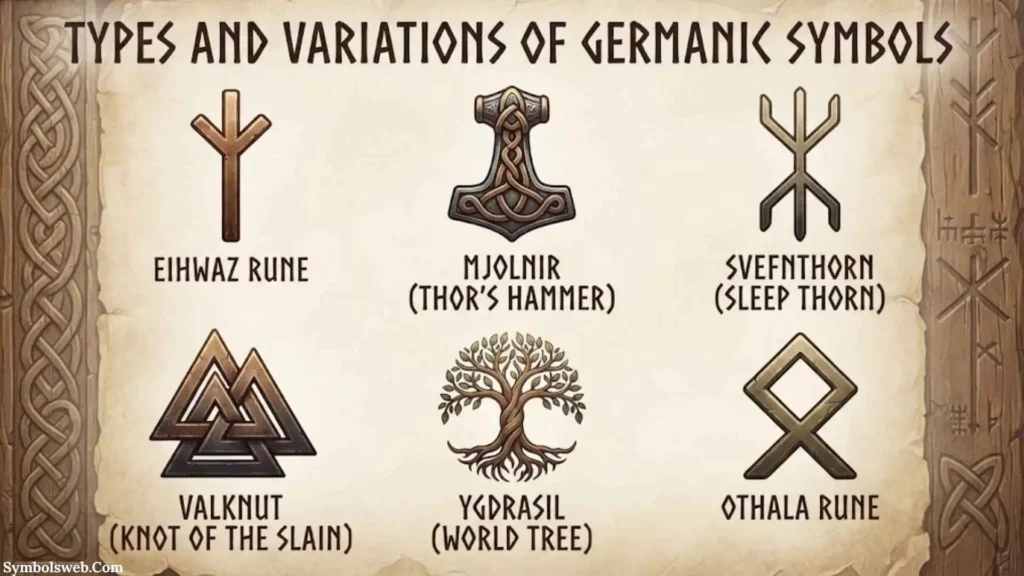
The Valknut
Visual Description
Three interlocking triangles.
Meaning
Associated with death, transition, and the afterlife.
Symbolism
Represents the connection between life, death, and destiny.
Cultural Connection
Strongly linked to Odin and warrior traditions.
Where It Appears
- Burial stones
- Norse artwork
- Modern tattoos
Yggdrasil
Visual Description
A vast cosmic tree connecting multiple worlds.
Meaning
Represents interconnected existence.
Symbolism
Life, wisdom, growth, and cosmic order.
Cultural Connection
Central to Norse cosmology.
Where It Appears
- Mythological texts
- Spiritual artwork
- Modern symbolism
Mjölnir
Visual Description
Thor’s hammer.
Meaning
Protection and divine strength.
Symbolism
Power, courage, blessing, and defense.
Cultural Connection
One of the most recognized Norse symbols.
Where It Appears
- Jewelry
- Religious artifacts
- Modern media
Helm of Awe (Ægishjálmr)
Visual Description
Eight-armed geometric design radiating outward.
Meaning
Protection and victory.
Symbolism
Mental strength and fearlessness.
Cultural Connection
Used in magical traditions and folklore.
Where It Appears
- Manuscripts
- Tattoos
- Spiritual practices
Rune Symbols
Visual Description
Angular characters from ancient runic alphabets.
Meaning
Each rune carries unique symbolism.
Symbolism
Wisdom, fate, communication, and magic.
Cultural Connection
Integral to Germanic spirituality.
Where It Appears
- Stones
- Weapons
- Divination systems
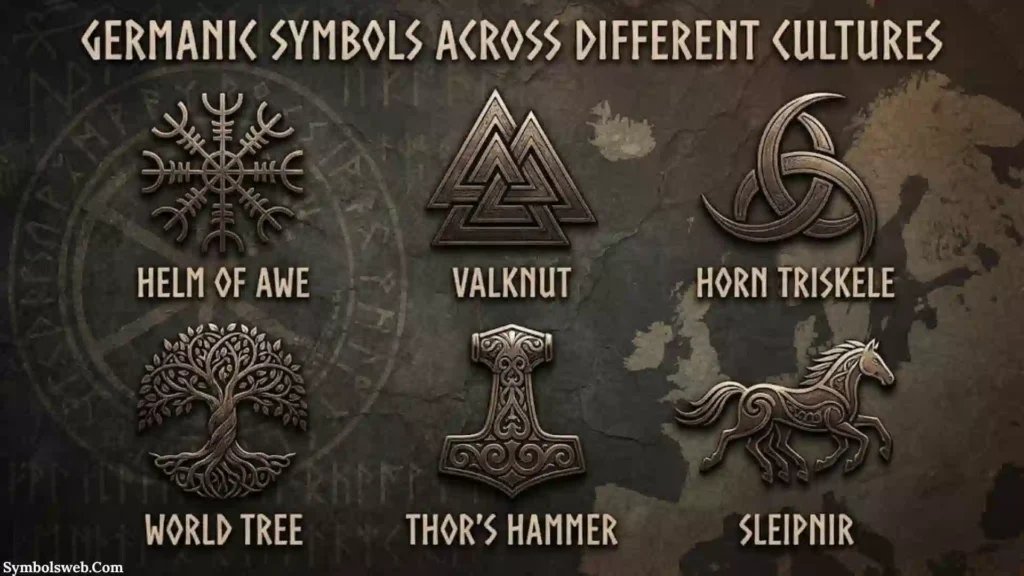
Germanic Symbols Across Different Cultures
Ancient Egypt
Although Germanic symbols did not originate in Egypt, both cultures used sacred imagery to represent divine forces and cosmic order.
Egyptian symbols such as the ankh shared similar spiritual functions by connecting humanity with eternal life.
Ancient Greece
Greek and Germanic traditions both emphasized heroic journeys and divine intervention.
Symbols from each culture represented wisdom, power, fate, and protection.
The similarities suggest common human concerns despite geographic differences.
Roman Culture
Romans encountered Germanic leagues through trade and conflict.
Roman historians documented Germanic customs and symbols, helping preserve knowledge about these traditions.
Many Germanic symbols survived despite Roman influence.
Eastern Traditions
Eastern spiritual systems often emphasize harmony and interconnectedness.
Germanic symbols such as Yggdrasil reflect similar concepts through their portrayal of cosmic unity and balance.
Indigenous Traditions
Many Indigenous cultures use symbolic imagery to express relationships with nature, ancestors, and spiritual forces.
Germanic symbolism shares this deep respect for the natural world and sacred heritage.
Modern Interpretations
Today, Germanic symbols are interpreted through historical, cultural, artistic, and spiritual lenses.
People use them to express:
- Heritage
- Personal strength
- Spiritual beliefs
- Interest in mythology
- Connection to nature
Similar Symbols and Their Meanings
| Symbol | Similarity to Germanic Symbols | Key Difference |
| Celtic Knot | Represents interconnectedness | Celtic rather than Germanic origin |
| Ankh | Spiritual significance | Focuses on eternal life |
| Triskelion | Cyclical movement and balance | Different cultural background |
| Mandala | Cosmic order | Eastern spiritual tradition |
| Labyrinth | Journey and transformation | Primarily Mediterranean origin |
Common Misconceptions
One misconception is that all Germanic symbols are runes. In reality, runes are only one category within a much larger symbolic tradition.
Another misconception is that every symbol had a single fixed meaning. Many carried multiple interpretations depending on time, region, and context.
Germanic Symbols in Mythology and Folklore
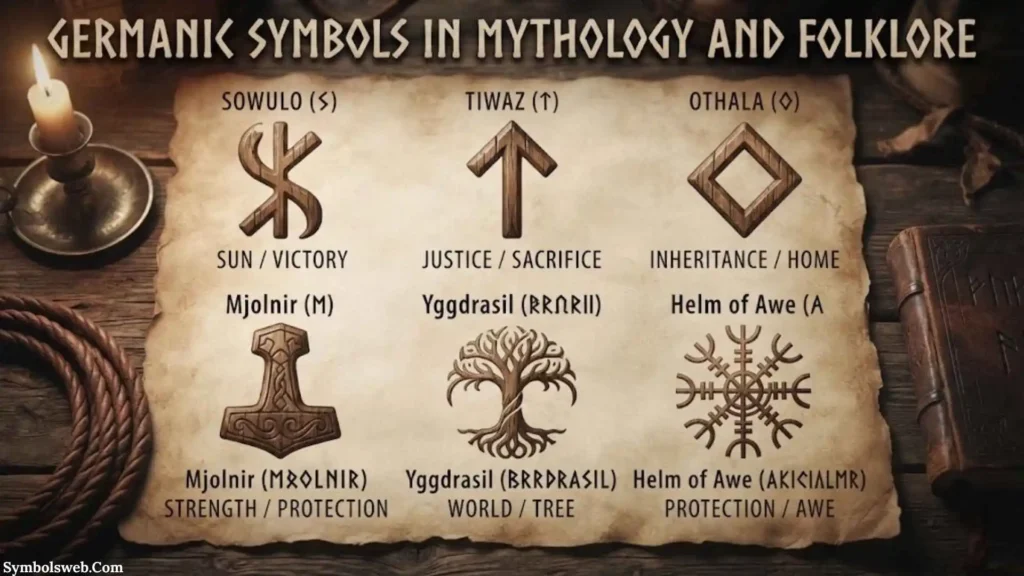
Germanic mythology is filled with symbols that shaped ancient worldviews.
Odin, the chief deity, sought wisdom through sacrifice and mystical knowledge. Symbols connected to him often represented insight, destiny, and transformation.
Thor’s hammer became a symbol of protection and divine power. Stories describe Thor defending both gods and humans from chaos.
Yggdrasil connected nine worlds, illustrating the belief that all realms of existence were linked.
The Valknut appeared in contexts associated with death and Odin, reinforcing themes of transition and fate.
These myths transformed symbols into living stories that continue to inspire modern audiences.
Germanic Symbols in Art, Literature, Movies and Pop Culture
Paintings
Artists frequently use Germanic symbols to evoke mystery, heroism, and spiritual depth.
Literature
Writers draw upon Germanic symbolism to enrich stories involving quests, destiny, and personal growth.
Fantasy literature often incorporates runes, magical symbols, and mythological imagery.
Poetry
Poets use Germanic symbols as metaphors for resilience, wisdom, and transformation.
Movies
Films inspired by Norse mythology frequently feature symbols such as Mjölnir and Yggdrasil.
These symbols help audiences connect with timeless themes of courage and sacrifice.
Television
Modern television series exploring Viking history and mythology often showcase authentic Germanic imagery.
Tattoos
Germanic symbols are popular tattoo designs because they communicate personal values such as strength, protection, and perseverance.
Fashion and Design
Designers incorporate these symbols into:
- Clothing
- Accessories
- Jewelry
- Home décor
- Digital artwork
Their ancient appearance creates a sense of timeless significance.
Spiritual and Dream Meaning of Germanic Symbols
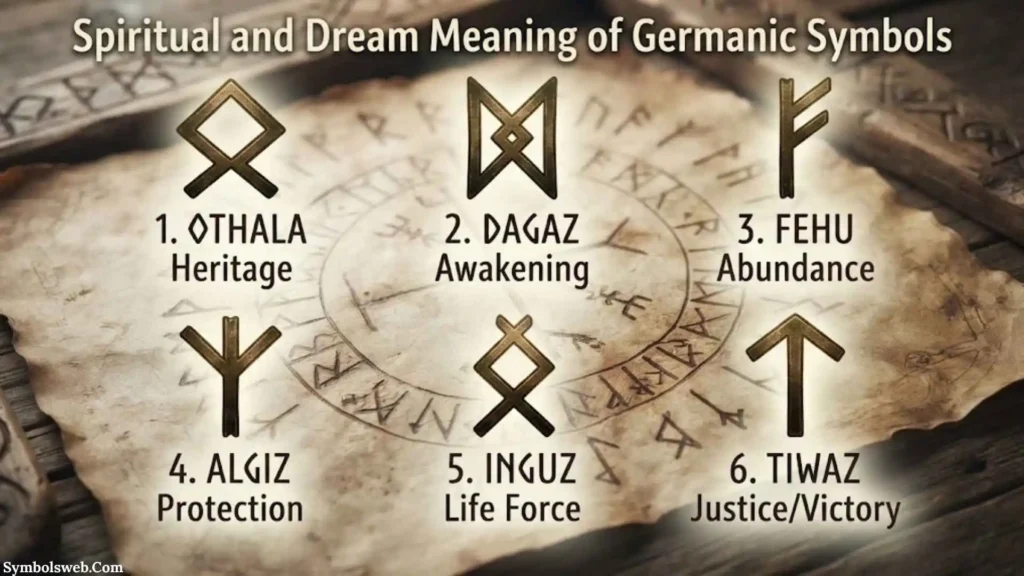
Dreams involving Germanic symbols often suggest messages from the subconscious mind.
Common Interpretations
Seeing runes in a dream
May indicate a search for guidance or hidden knowledge.
Seeing Yggdrasil
Often symbolizes growth, stability, and life connections.
Seeing Thor’s Hammer
Can represent protection, confidence, and personal power.
Seeing the Valknut
May symbolize transformation, endings, and new beginnings.
Meditation and Spiritual Experiences
Many people use Germanic symbols during meditation to encourage focus, self-reflection, and spiritual exploration.
Positive and Negative Meanings of Germanic Symbols
| Positive Meaning | Negative Meaning |
| Strength | Excessive aggression |
| Protection | Fear of vulnerability |
| Wisdom | Obsession with hidden knowledge |
| Courage | Recklessness |
| Transformation | Resistance to change |
| Identity | Tribal division |
| Spiritual growth | Dogmatic thinking |
Symbols often contain both light and shadow aspects. Their meaning depends on intention, interpretation, and context.
Why Humans Are Attracted to Germanic Symbols
Humans naturally seek symbols that help explain life’s mysteries.
Germanic symbols appeal to us because they combine history, mythology, psychology, and spirituality into powerful visual forms.
Several factors contribute to their enduring attraction:
Pattern Recognition
The human brain is wired to find meaning in shapes and patterns.
Cultural Memory
Ancient stories continue to influence modern imagination.
Archetypal Power
These symbols represent universal human experiences such as struggle, courage, wisdom, and transformation.
Personal Identity
Many people use Germanic symbols to express heritage, values, or personal beliefs.
Storytelling
Every symbol carries a story, and humans are deeply connected to stories.
Modern Uses of Germanic Symbols
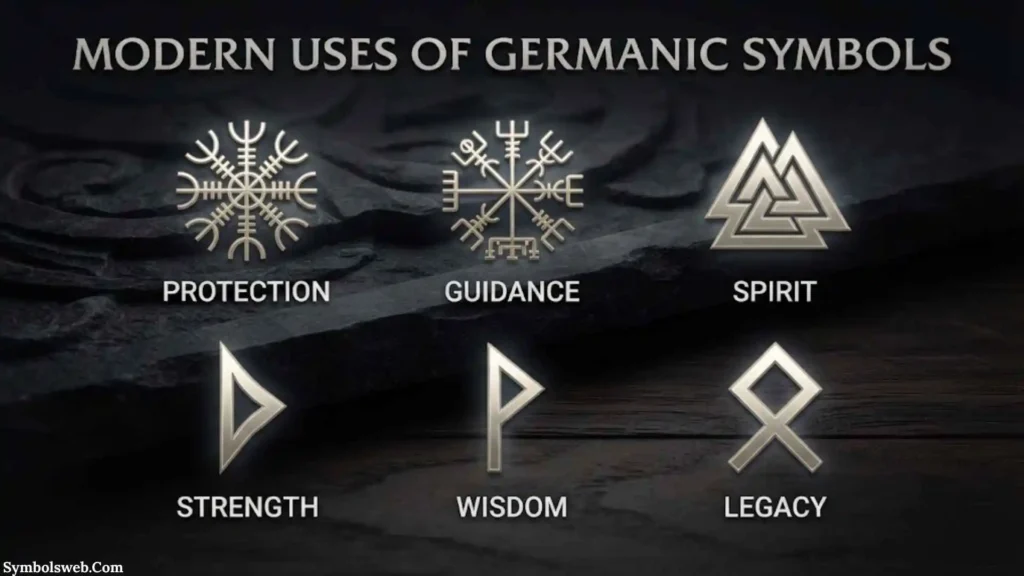
Tattoos
Represent strength, protection, heritage, and personal transformation.
Jewelry
Popular in pendants, rings, bracelets, and amulets.
Fashion
Used in clothing designs inspired by mythology and history.
Branding
Some organizations use symbolic imagery to communicate tradition and strength.
Social Media
Frequently shared among communities interested in mythology and cultural history.
Contemporary Spirituality
Used in meditation, personal reflection, and symbolic rituals.
Home Decor
Appears in wall art, carvings, and handcrafted designs.
Interesting Facts About Germanic Symbols
- Many Germanic symbols predate the Viking Age.
- Runes were believed to possess magical properties.
- Yggdrasil connects nine worlds in Norse mythology.
- The Valknut is one of the most debated Germanic symbols among scholars.
- Mjölnir pendants were commonly worn for protection.
- Some symbols appear on archaeological artifacts over 1,000 years old.
- Germanic symbolism heavily influenced modern fantasy literature.
- Several ancient symbols remain popular tattoo designs today.
- Symbol meanings often varied between regions and leagues.
- Many symbols combine spiritual, cultural, and practical functions.
Frequently Asked Questions
What are Germanic symbols?
Germanic symbols are ancient visual signs used by Germanic and Norse peoples to represent spiritual beliefs, protection, wisdom, identity, fate, and divine power.
Are Germanic symbols the same as Norse symbols?
Not exactly. Norse symbols are part of the broader Germanic symbolic tradition. Germanic symbolism includes earlier and wider cultural influences beyond Viking-age Scandinavia.
What is the most famous Germanic symbol?
Mjölnir, Thor’s hammer, is one of the most recognized Germanic symbols due to its association with strength, protection, and Norse mythology.
Do Germanic symbols have spiritual meanings?
Yes. Many symbolize protection, wisdom, transformation, divine connection, and the relationship between humanity and the cosmos.
Are Germanic symbols used today?
Absolutely. They appear in tattoos, jewelry, artwork, literature, spirituality, fashion, and popular culture worldwide.
What do runes symbolize?
Runes functioned as letters but also carried symbolic meanings related to wisdom, destiny, protection, communication, and magical knowledge.
Conclusion
Germanic symbols are far more than ancient designs carved into stone or metal. They represent humanity’s enduring search for meaning, strength, wisdom, and connection. Through mythology, spirituality, psychology, and culture, these symbols continue to speak across centuries. Whether viewed as historical artifacts, spiritual tools, or artistic inspirations, Germanic symbols remind us that the stories of the past still shape the human experience today.

Jordan Hayes is a writer with a passion for exploring the history, meanings, and cultural significance behind symbols from around the world. He enjoys turning complex topics into clear, engaging content that anyone can understand. Jordan is also the fictional author of The Silent Language of Ancient Marks and Hidden Symbols Beyond the Surface, two original book concepts created for his author profile. When he’s not writing, he spends time researching myths, traditions, and forgotten stories that inspire his work. His goal is to help readers discover the deeper meanings behind the symbols they encounter every day.
 Eliana Foster
 Ethan Holloway