Man and His Symbols by Carl Gustav Jung explores the hidden meanings behind dreams, symbols, myths, and human behavior. It introduces readers to Jungian psychology and explains how the unconscious mind influences thoughts, emotions, relationships, and everyday experiences. The book also examines how symbols connect personal experiences with deeper patterns found across different cultures.
First published in 1964, this illustrated book was designed to make Jung’s complex psychological ideas easier for general readers to understand. Jung worked on the project during the final years of his life. He invited several trusted colleagues to contribute chapters on mythology, individuation, visual art, and individual psychological analysis.
If you’ve ever wondered why certain images appear in your dreams or why similar symbols show up in different cultures, this book offers an interesting starting point. It encourages you to look beyond the obvious meaning of an image and consider its personal and psychological significance.
What Is Man and His Symbols About?
Man and His Symbols explains how people use symbols to express thoughts and feelings that ordinary language cannot always communicate. Jung believed that symbols play an important role in the relationship between the conscious and unconscious parts of the human mind.
The book focuses especially on dreams. It explains how dreams may reveal emotions, conflicts, fears, desires, and experiences that a person hasn’t fully recognized while awake. However, Jung didn’t believe that every dream image had one universal meaning. He argued that personal experiences and individual circumstances matter when interpreting a dream.
The book also introduces several important ideas from analytical psychology, including:
- The unconscious mind: Mental activity and experiences outside immediate conscious awareness.
- The personal unconscious: Forgotten memories, unresolved experiences, and other personal material outside awareness.
- The collective unconscious: Jung’s proposed deeper layer of the psyche containing inherited archetypal patterns.
- Archetypes: Recurring psychological patterns that influence how people experience life.
- Dream symbolism: The use of images and symbolic situations in dreams.
- Individuation: A lifelong process of developing a more integrated sense of self.
- Psychological wholeness: Greater awareness and integration of different parts of the personality.
- Symbolic communication: The way images and symbols can express complex psychological experiences.
Rather than treating symbols as simple decorations or signs, Jung considered them meaningful expressions of the human psyche. He believed that studying them could help people understand aspects of themselves that might otherwise remain hidden.
Carl Jung and the Background of the Book
Carl Gustav Jung (1875–1961) was a Swiss psychiatrist and the founder of analytical psychology, commonly known as Jungian psychology. His work explored dreams, personality, mythology, religion, symbolism, and the unconscious mind.
Jung initially worked closely with Sigmund Freud. Both psychologists believed that unconscious processes influenced human behavior. However, their ideas eventually moved in different directions. Jung developed his own psychological approach and placed greater emphasis on symbolism, mythology, spirituality, and the collective unconscious.
His work introduced concepts that remain widely discussed today, including archetypes, the shadow, psychological types, and individuation.
Why Jung Wrote Man and His Symbols
Jung wanted to explain his psychological ideas to people without specialized knowledge of psychology. He believed that symbols and dreams offered an accessible way to introduce readers to the unconscious mind.
According to the book’s introductory account, a dream discussed with journalist John Freeman helped convince Jung that he should create a work for general readers. Jung planned the project and selected several close associates to write different sections.
He completed his own chapter shortly before his final illness. After his death in 1961, Marie-Louise von Franz helped complete and edit the work.
The book appeared in 1964, three years after Jung’s death. Its original edition was published by Doubleday and contained approximately 320 pages with numerous illustrations.
The Contributors Behind the Book
Although Jung’s name appears most prominently, the book is a collaborative work. Each contributor explores a different part of Jungian psychology.
| Contributor | Main contribution |
| Carl G. Jung | Explains the unconscious mind, dreams, and symbolism |
| Joseph L. Henderson | Explores ancient myths and their relationship with modern life |
| Marie-Louise von Franz | Discusses individuation and the relationship between science and the unconscious |
| Aniela Jaffé | Examines symbolism in visual arts |
| Jolande Jacobi | Explores symbols through individual psychological analysis |
| John Freeman | Writes the introduction and coordinates the editorial project |
These contributors help connect Jung’s theories with mythology, art, personal development, and everyday psychological experiences.
The Five Main Parts of Man and His Symbols
The book contains five main parts followed by a separate conclusion. Each section explores a different aspect of symbolism and the human psyche.
Understanding this structure makes the book easier to follow because its ideas build on one another.
Approaching the Unconscious by Carl G. Jung
The first part introduces Jung’s central ideas about dreams, symbols, and the unconscious mind. Jung explains that human awareness represents only one part of psychological life.
People often believe they understand their thoughts and actions completely. However, unconscious feelings, forgotten experiences, and hidden conflicts can influence their decisions without their full awareness.
Jung uses dreams to explain how unconscious material can enter conscious experience. A dream might contain familiar people, unusual places, animals, objects, or strange situations. These images may express psychological concerns that a person hasn’t consciously recognized.
He also explains the difference between signs and symbols.
A sign generally points toward something already understood. A symbol can express something deeper or more complex than its immediate appearance suggests.
For example, a key may simply represent an object used to open a door. In a particular dream, however, it might suggest access, opportunity, secrecy, or a personal memory. Its meaning depends on the dreamer’s circumstances.
Jung encourages readers to pay attention to their dreams rather than dismissing them as meaningless mental activity.
Main topics covered:
- The conscious and unconscious mind
- The importance of dreams
- Symbolic meaning and communication
- Signs versus symbols
- Personal dream associations
- The relationship between everyday experiences and unconscious material
Ancient Myths and Modern Man by Joseph L. Henderson
The second part explores the relationship between ancient mythology and modern psychological experiences.
Joseph L. Henderson explains how myths contain recurring patterns that can still connect with human life. Stories about heroes, monsters, journeys, challenges, and transformation appear in many cultures.
These stories may differ in their characters and settings. However, they often explore familiar human experiences such as fear, courage, responsibility, conflict, and personal growth.
Henderson connects these recurring patterns with Jung’s idea of archetypes. He shows how mythological stories can provide a symbolic language for understanding psychological development.
The hero’s journey is one example. A hero may leave a familiar environment, face difficult challenges, overcome obstacles, and return with new knowledge. This pattern can resemble the emotional challenges people experience during important stages of life.
The chapter also considers how modern society continues to use myths and symbolic stories. Ancient mythology may seem distant from contemporary life, but its themes remain recognizable in literature, popular stories, and cultural traditions.
Main topics covered:
- Ancient mythology
- Modern man and symbolic stories
- Hero myths and transformation
- Recurring archetypal patterns
- Cultural symbolism
- The psychological meaning of myths
The Process of Individuation by Marie-Louise von Franz
The third part introduces individuation, one of the most important concepts in Jungian psychology.
Individuation describes the process of becoming a more integrated and self-aware individual. It involves recognizing different parts of your personality and learning how they relate to one another.
People often develop a public identity based on family expectations, social roles, professional responsibilities, and cultural values. However, this outward identity may not represent every part of their personality.
Individuation encourages a person to recognize neglected emotions, hidden abilities, personal conflicts, and unconscious tendencies.
The process doesn’t mean becoming perfect or avoiding difficult feelings. Instead, it involves developing a more complete understanding of yourself.
Von Franz explains how symbols and dreams may reflect this psychological development. Images of journeys, circles, changing landscapes, and other symbolic patterns can appear during periods of personal transformation.
Main topics covered:
- Individuation and self-discovery
- Psychological development
- Integration of conscious and unconscious material
- Personal transformation
- The relationship between symbols and inner growth
- Psychological wholeness
Symbolism in the Visual Arts by Aniela Jaffé
The fourth part explores how symbols appear in paintings, sculptures, religious images, and other forms of visual art.
Aniela Jaffé examines the psychological significance of artistic images. She explains how artists may express conscious ideas and deeper psychological material through colors, shapes, figures, and compositions.
Art can communicate experiences that are difficult to describe through ordinary language. A painting might express fear, hope, conflict, spiritual longing, or transformation without directly explaining those feelings.
The chapter also explores how symbolic patterns appear in traditional and modern artwork.
One important example is the mandala, a circular design often associated with wholeness, order, and psychological integration in Jungian interpretation.
Jaffé’s discussion shows that symbolism isn’t limited to dreams or ancient mythology. It can also appear in creative expression and everyday visual culture.
Main topics covered:
- Symbolism in paintings and visual arts
- Psychological meaning of artistic images
- Mandalas and circular patterns
- Religious and cultural imagery
- Modern art and unconscious expression
- Creativity and symbolic communication
Symbols in an Individual Analysis by Jolande Jacobi
The fifth part examines how symbols can become meaningful during individual psychological analysis.
Jolande Jacobi explores the relationship between personal experiences and symbolic material. She explains why a symbol must be understood within the context of the individual rather than through a fixed dictionary of meanings.
For example, a dream about water might connect with childhood memories for one person. Another person might associate it with fear, relaxation, travel, or an important life event.
The same image can therefore carry different meanings for different people.
This chapter highlights the importance of personal associations, psychological history, and individual circumstances during dream interpretation.
It also demonstrates how symbolic material may help people explore unresolved conflicts and develop greater self-awareness.
Main topics covered:
- Individual psychological analysis
- Personal dream symbols
- Individual associations
- Symbolic interpretation
- Psychological conflicts
- The relationship between personal history and unconscious material
Conclusion: Science and the Unconscious by Marie-Louise von Franz
The book ends with a separate conclusion by Marie-Louise von Franz. This section considers the relationship between scientific thinking and the unconscious mind.
It reflects on the challenges of studying psychological experiences that cannot always be measured or explained through ordinary observation.
Von Franz discusses the importance of approaching unconscious material carefully. Symbols may offer meaningful insights, but interpreting them requires attention to context and individual experience.
The conclusion brings the book’s main ideas together. It reinforces the importance of understanding the relationship between conscious awareness and unconscious processes.
What Does Jung Mean by Symbols?
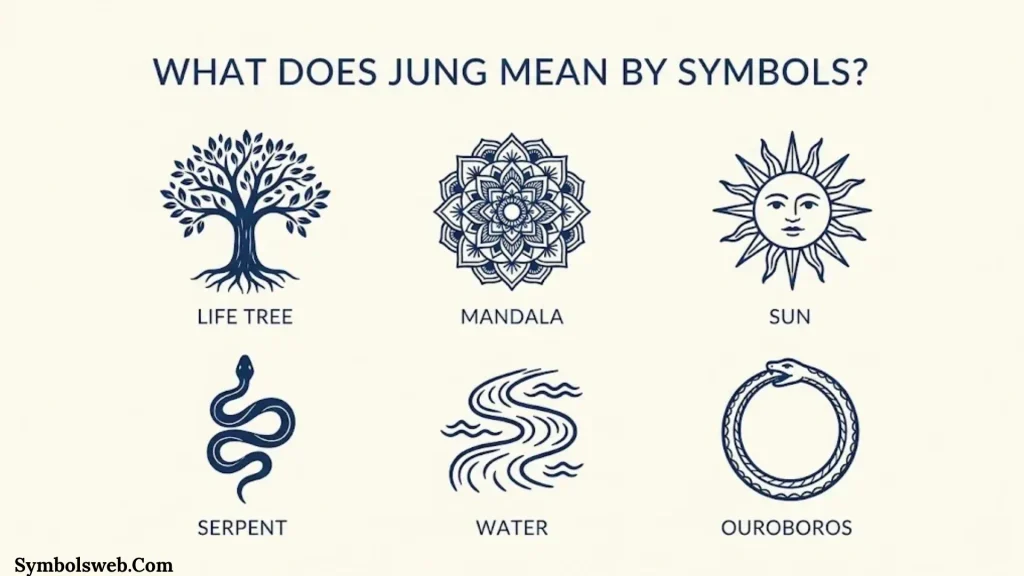
In Jungian psychology, a symbol is an image, object, word, or situation that points toward a meaning beyond its immediate appearance.
A symbol may communicate something that a person cannot fully explain through logical thought. It can represent emotional experiences, psychological conflicts, cultural beliefs, or unconscious patterns.
Consider a dream about a locked door. The door might represent a boundary, an opportunity, a personal memory, or something the dreamer feels unable to access. The image alone cannot establish its meaning.
Jung believed that symbols could help people approach unfamiliar parts of their inner lives.
Symbols and Signs: What’s the Difference?
Symbols and signs may look similar, but Jung’s approach treats them differently.
| Signs | Symbols |
| Point toward something already known | Suggest meanings that may not be fully understood |
| Usually have a direct meaning | Can carry several layers of meaning |
| Often communicate clear information | May express unconscious experiences |
| Depend on shared conventions | Can involve personal and cultural associations |
A traffic sign, for example, communicates a specific instruction. A dream image may have a more complex psychological meaning that depends on the dreamer’s life.
This distinction is important because Jung didn’t treat every image as a symbol with one universal definition.
Understanding the Conscious and Unconscious Mind
One of Jung’s central ideas is that the human psyche contains both conscious and unconscious processes.
The conscious mind includes thoughts, feelings, memories, and experiences that you can recognize at a particular moment.
The unconscious mind refers to psychological material outside immediate awareness. Some of this material may include forgotten experiences, hidden emotions, unresolved conflicts, and patterns that influence behavior.
Jung believed that unconscious processes could appear through dreams, fantasies, emotional reactions, and symbolic experiences.
The Personal Unconscious
The personal unconscious contains material connected with an individual’s life.
It may include forgotten memories, experiences that were pushed out of awareness, and emotions that a person hasn’t fully recognized.
For example, someone might feel unusually uncomfortable in a particular situation without understanding why. A past experience could influence that reaction even if the person doesn’t immediately remember it.
Jung also discussed psychological complexes. A complex is an emotionally charged group of ideas, memories, and associations that can influence how someone responds to particular situations.
The Collective Unconscious
The collective unconscious is one of Jung’s best-known and most debated theories.
Jung proposed that beneath the personal unconscious lies a deeper layer of the psyche containing inherited psychological patterns. He called these patterns archetypes.
He used similarities between myths, religious stories, dreams, and cultural images to support his theory.
For example, stories about mothers, heroes, wise figures, and journeys appear in many traditions. Jung interpreted these recurring patterns as expressions of archetypal structures.
However, the collective unconscious is a theoretical concept within analytical psychology. It shouldn’t be presented as an established biological fact or a scientifically proven storehouse of inherited memories.
Jungian Archetypes and Their Meanings
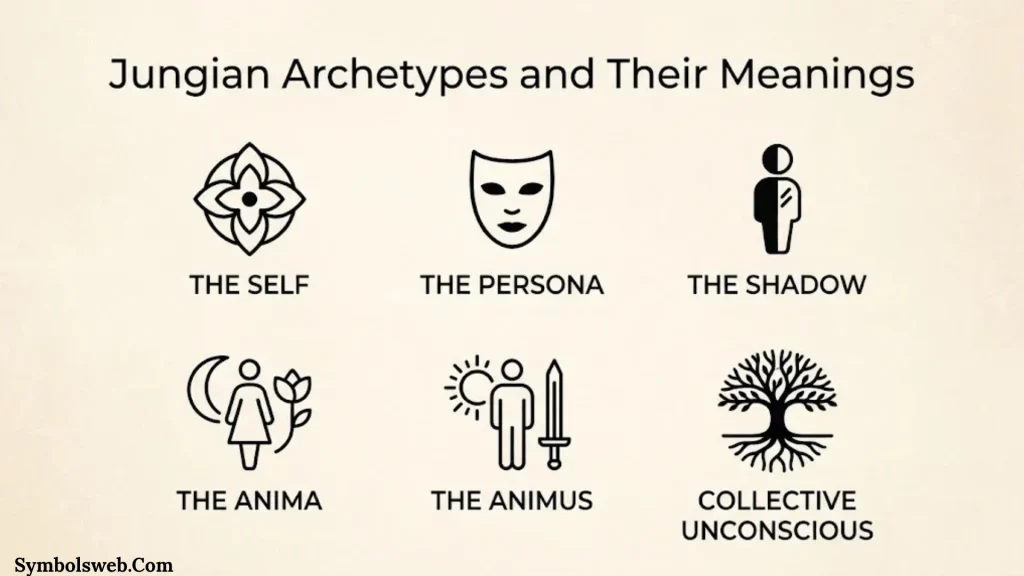
Archetypes are recurring patterns that Jung believed influenced human imagination, behavior, dreams, and cultural stories.
They don’t necessarily appear as identical characters or images. Instead, they can take different forms depending on a person’s experiences and cultural background.
Several archetypes are especially important in Jungian psychology.
The Shadow Archetype
The shadow represents aspects of the personality that a person doesn’t fully recognize or accept.
It may include anger, jealousy, fear, selfishness, hidden desires, or qualities that conflict with someone’s public identity.
However, the shadow isn’t limited to negative traits. It can also contain neglected strengths, creativity, confidence, and abilities that a person has learned to hide.
Recognizing the shadow involves becoming more honest about personal behavior and emotional reactions.
The Anima and Animus
Jung used the terms anima and animus to describe unconscious gender-related figures in his psychological model.
In his original theory, anima referred to a feminine inner figure in a man’s psyche, while animus referred to a masculine inner figure in a woman’s psyche.
These concepts were influenced by the gender assumptions of Jung’s historical period. Many contemporary readers and psychologists question their traditional framing.
They can still be studied as part of Jung’s historical theory, but they shouldn’t be treated as universal descriptions of gender or personality.
The Self Archetype
The Self represents psychological wholeness in Jungian psychology.
It refers to the integration of conscious and unconscious aspects of the personality. Jung considered the Self an important organizing principle within the psyche.
The Self is different from the everyday ego. The ego represents the center of conscious awareness, while the Self refers to a broader sense of psychological completeness.
The Mother Archetype
The mother archetype is associated with nurturing, protection, care, fertility, and the origins of life.
It may appear through images of mothers, gardens, homes, the earth, or other protective figures.
However, its meaning isn’t always positive. Depending on the context, it may also represent control, dependence, fear, or overwhelming protection.
The Hero Archetype
The hero archetype appears in stories about courage, struggle, sacrifice, and transformation.
A hero often faces challenges that require personal strength and change. This pattern appears in mythology, literature, religious stories, and modern entertainment.
In psychological interpretation, the hero may represent the struggle to overcome obstacles and develop a stronger sense of identity.
The Wise Old Man Archetype
The wise old man archetype represents guidance, knowledge, experience, and insight.
It may appear as a teacher, elder, mentor, spiritual guide, or mysterious figure in a dream or story.
The figure often helps the main character understand a difficult situation or move toward a new stage of development.
Dream Interpretation and Dream Symbolism
Dreams are a central subject in Man and His Symbols. Jung believed they could reveal aspects of the unconscious that remain outside ordinary awareness.
He viewed dreams as meaningful psychological experiences rather than random collections of images.
However, his approach differs from popular dream dictionaries. Jung didn’t argue that every symbol has one permanent meaning for everyone.
Why Dreams Matter in Jungian Psychology
Dreams may bring attention to emotions, conflicts, desires, and experiences that a person hasn’t fully considered.
For example, someone might dream about missing a train during a stressful period. The image could connect with concerns about time, missed opportunities, or personal expectations.
But the dream doesn’t automatically mean one specific thing. Its interpretation depends on the person’s associations and current circumstances.
Jung believed that dreams could sometimes compensate for a one-sided conscious attitude. In simple terms, a dream might bring attention to feelings or perspectives that a person has overlooked.
How to Explore a Dream’s Meaning
Jungian dream interpretation focuses on the dreamer’s personal experience.
These steps can help you explore a dream without assuming that every image has a fixed meaning:
- Write down the dream: Record the people, places, objects, emotions, and events you remember.
- Identify important images: Notice which details seem especially vivid or emotionally powerful.
- Explore personal associations: Ask what each image means to you based on your own memories and experiences.
- Consider current circumstances: Think about recent challenges, relationships, decisions, and emotional concerns.
- Look for recurring patterns: Notice whether similar images or situations appear in other dreams.
- Avoid fixed interpretations: Don’t assume that a particular animal, color, or object always has the same meaning.
- Reflect carefully: Consider whether the dream highlights something you may have overlooked while awake.
Dream interpretation is a reflective practice, not a reliable method for predicting the future or diagnosing a mental health condition.
Individuation: The Journey Toward Psychological Wholeness
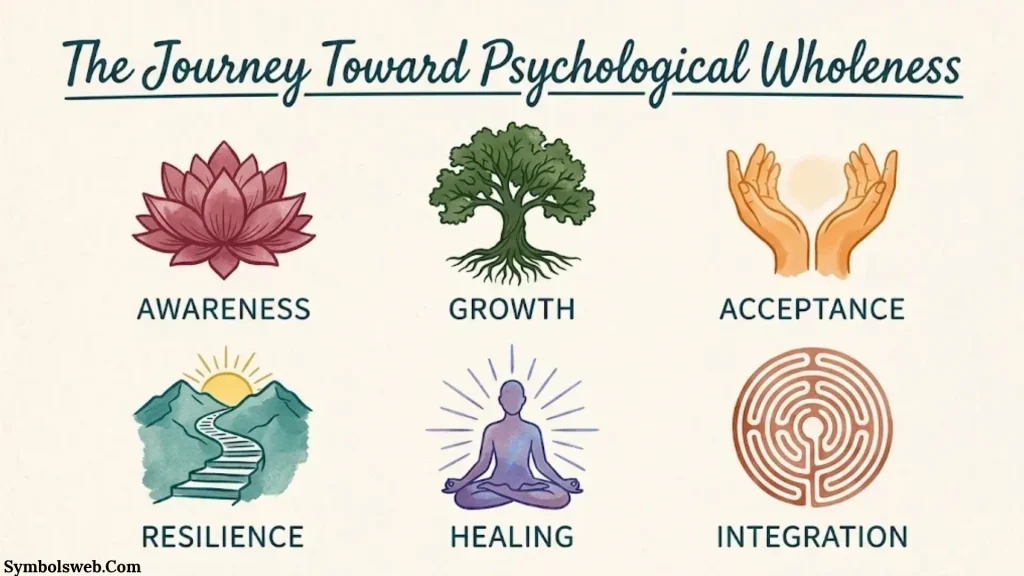
Individuation is the process of developing a more complete relationship with yourself.
Jung believed that psychological growth involved more than building a successful public identity. It also required recognizing the less familiar parts of the personality.
A person may spend years trying to meet family expectations, follow social rules, or maintain a particular image. During this process, certain emotions, interests, or abilities may receive little attention.
Individuation encourages people to examine these neglected parts of themselves.
The Role of Self-Discovery
Self-discovery involves becoming more aware of personal values, emotional patterns, strengths, and limitations.
It may require asking difficult questions:
- Which parts of my personality do I hide from others?
- What emotions do I struggle to accept?
- Am I following my own values or simply meeting expectations?
- Which personal strengths have I ignored?
- What recurring conflicts influence my decisions?
These questions don’t produce instant answers. They encourage honest reflection and gradual psychological development.
Integrating Opposing Forces
Jungian psychology often explores opposing forces within the personality.
Examples include:
- Independence and dependence
- Confidence and insecurity
- Logic and emotion
- Public identity and private feelings
- Conscious intentions and unconscious reactions
Psychological integration doesn’t mean choosing one side and rejecting the other. It involves recognizing these opposing tendencies and understanding how they influence behavior.
Individuation and Personal Growth
Individuation isn’t a simple self-improvement checklist. It is a continuing process that may change as people move through different stages of life.
Greater self-awareness can help people recognize repeated behavior patterns, understand emotional reactions, and make more thoughtful decisions.
In Jung’s framework, this process supports psychological maturity and wholeness.
Ancient Myths, Cultural Symbols, and Modern Life
Mythology plays an important role in Jungian psychology because myths often contain recurring symbolic patterns.
Stories from different cultures may explore similar themes even when their characters, traditions, and historical settings differ.
For example, many myths describe a hero who leaves home, faces danger, gains knowledge, and returns changed. This pattern can represent a symbolic journey of transformation.
Why Ancient Myths Still Matter
Ancient myths preserve stories about human fears, hopes, relationships, and struggles.
They explore experiences such as:
- The search for identity
- The fear of death
- The desire for belonging
- Conflict between good and evil
- Courage during difficult situations
- The transition from childhood to adulthood
- The relationship between humans and nature
Jung believed these stories could reveal recurring psychological patterns.
However, similar themes across cultures don’t automatically prove that all traditions share one psychological origin. Historical contact, cultural exchange, and independent storytelling can also explain similarities.
Symbols in Modern Culture
Symbols continue to influence modern life through films, books, advertising, fashion, religious traditions, and digital media.
A journey may represent personal change in a film. A mask may suggest hidden identity. A broken chain may communicate freedom or resistance.
These examples show how symbols can communicate complex ideas quickly.
Jung’s approach offers one way to explore their psychological meaning, although cultural context remains essential.
Symbolism in Visual Arts and Mandalas
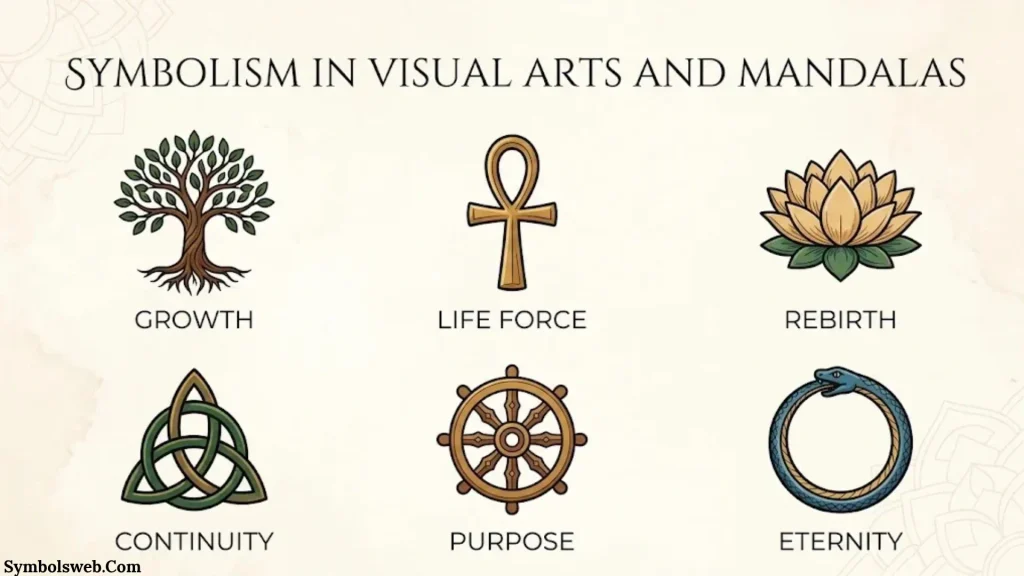
Visual art offers another way to explore the relationship between conscious ideas and unconscious expression.
Artists use images, colors, shapes, figures, and patterns to communicate experiences that may be difficult to describe directly.
Aniela Jaffé’s chapter examines this connection through examples of symbolic imagery in art.
The Psychological Meaning of Mandalas
A mandala is a circular design with an organized arrangement of shapes or patterns around a central point.
Mandalas appear in several religious and cultural traditions, including Hinduism and Buddhism. Their meanings vary depending on the tradition and context.
Jung also studied mandala imagery in relation to psychological development. He interpreted certain circular patterns as expressions of the search for order and wholeness.
In his framework, a mandala could symbolize the organization of the psyche around the Self.
However, not every circular design should be interpreted as a psychological mandala. Its cultural background and intended purpose matter.
How Art Expresses Unconscious Material
Art can communicate emotional experiences without using direct explanations.
For example, a dark landscape might express uncertainty or fear. A bright open space might suggest hope or freedom. A fragmented figure could communicate conflict or instability.
These interpretations depend on the artwork and the viewer’s associations. There isn’t one universal meaning for every color or shape.
Symbols in Individual Psychological Analysis
Individual psychological analysis examines personal experiences, emotional patterns, and unconscious material.
Jolande Jacobi’s chapter explores how symbolic images can become meaningful during this process.
A symbol that appears in a dream may connect with a person’s memories, relationships, fears, or personal history.
For example, a house might remind one person of childhood security. Another person may associate it with family conflict or a difficult period.
The image is the same, but the personal meaning differs.
Why Personal Associations Matter
Personal associations help prevent overly simple interpretations.
A dream dictionary might claim that a snake always represents danger or transformation. Jung’s approach would ask what the snake means to the particular dreamer.
Questions might include:
- Have you recently encountered a snake?
- Does the animal remind you of a personal experience?
- Do you feel afraid, curious, or calm when you see it?
- Does the image connect with a story or cultural belief?
- What is happening in your life at the moment?
These questions help place the image within its proper context.
The Role of Psychological Integration
Exploring personal symbols may help people recognize feelings and conflicts they haven’t fully understood.
This doesn’t mean every dream requires professional analysis. Many people can reflect on their dreams through journaling and personal observation.
However, persistent distress, trauma-related experiences, or serious mental health concerns deserve appropriate professional support. Jungian interpretation is not a substitute for evidence-based diagnosis or treatment.
Religion, Spirituality, and Symbolic Meaning
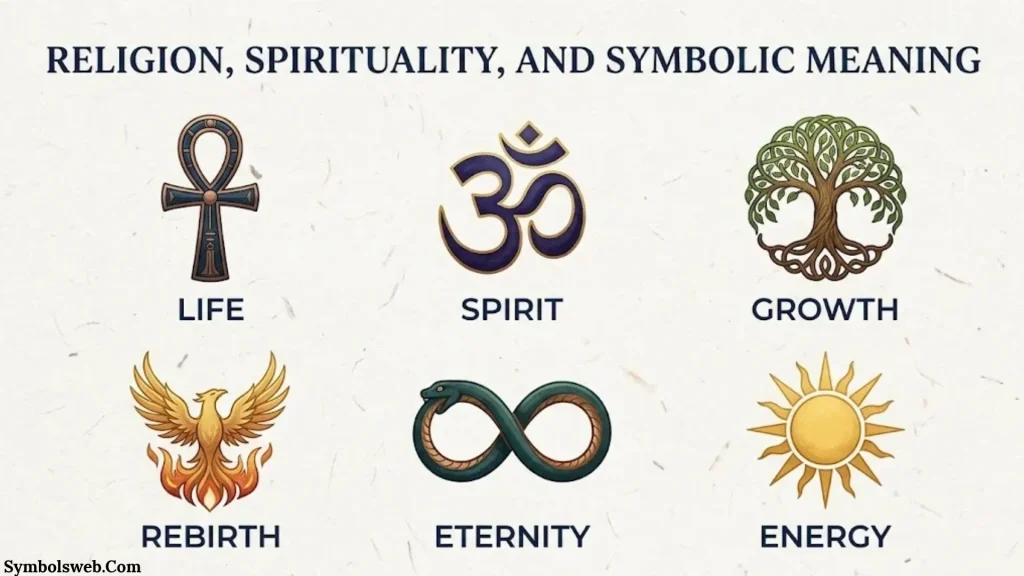
Religion and spirituality are important subjects in Jung’s work.
He studied religious images, rituals, myths, and traditions because they contain rich symbolic material. He believed religious symbols could express deep psychological experiences and questions about human existence.
A religious image may have several layers of meaning. It can carry spiritual significance within a tradition while also holding personal meaning for an individual.
For example, a circle may represent unity in one context. In another, it may symbolize eternity, completeness, or a particular religious teaching.
Jung explored how such images could relate to psychological development.
However, psychological interpretation doesn’t replace the beliefs or teachings of a religious tradition. A symbol’s meaning should be understood within its cultural and spiritual context.
Why Man and His Symbols Still Matters
Man and His Symbols remains an accessible introduction to several influential ideas in analytical psychology.
Its continued appeal comes from its broad subject matter. It connects dreams, myths, art, culture, personal experience, and psychological development.
The book also encourages readers to think carefully about the images and stories that influence their lives.
It Makes Jungian Psychology More Accessible
Jung’s theories can feel complicated when readers encounter them through academic writing. This book presents many of his ideas in a more approachable format.
Its illustrations also help readers understand how symbols appear in different settings.
It Connects Personal Experiences With Cultural Stories
The book explores connections between individual dreams and recurring patterns in mythology and art.
It encourages readers to consider how personal experiences may relate to wider cultural themes without assuming that every symbol has an identical meaning.
It Encourages Self Reflection
Readers can use the book’s ideas to think about dreams, emotional reactions, personal conflicts, and neglected aspects of their personalities.
This reflective approach may help people become more aware of their behavior and assumptions.
It Introduces Important Psychological Concepts
The book provides an introduction to concepts such as:
- Analytical psychology
- Collective unconscious
- Personal unconscious
- Archetypal patterns
- Shadow and Self
- Dream interpretation
- Symbolic meaning
- Individuation
- Psychological integration
- Mythological symbolism
These concepts also provide a foundation for exploring Jung’s other writings.
Is Man and His Symbols Worth Reading?
Yes, Man and His Symbols is worth considering if you’re interested in dreams, mythology, symbolism, art, and the unconscious mind.
It was written for general readers rather than only trained psychologists. You don’t need an advanced background in psychology to follow its main ideas.
However, some sections are more demanding than others. Readers unfamiliar with analytical psychology may need time to understand terms such as archetype, collective unconscious, and individuation.
The illustrations and chapter structure make the book easier to explore. You can also read each section separately before considering how its ideas connect with the others.
Who Should Read This Book?
This book may interest:
- Readers curious about Carl Jung and Jungian psychology
- People interested in dream symbolism and dream interpretation
- Students exploring analytical psychology
- Readers studying mythology and cultural symbols
- Artists interested in visual symbolism
- People exploring personal growth and self-awareness
- Readers interested in the relationship between psychology and religion
Who May Find It Challenging?
Readers looking for a modern scientific textbook may find parts of the book difficult to evaluate.
Jung’s ideas belong to a particular psychological tradition. Some concepts, especially the collective unconscious and archetypes, remain theoretical and debated.
The book is best approached as an introduction to Jung’s perspective rather than a complete account of contemporary psychology.
Key Lessons From Man and His Symbols
The book offers several important ideas about human experience and psychological development.
- Symbols can carry deeper meanings: An image may express more than its literal appearance.
- Dreams can encourage reflection: They may bring attention to emotions and concerns outside immediate awareness.
- Personal context matters: The meaning of a symbol depends partly on the dreamer’s experiences and associations.
- The unconscious influences behavior: People may respond to feelings and patterns they don’t fully recognize.
- Archetypes appear in stories and images: Jung used recurring symbolic patterns to explore shared themes in human experience.
- Self-awareness requires honesty: Recognizing hidden or neglected parts of the personality can support personal growth.
- Individuation involves integration: Psychological development includes understanding different parts of yourself.
- Art and mythology communicate ideas: Visual images and traditional stories can express complex human experiences.
- Symbols need careful interpretation: No single image should automatically receive one fixed meaning.
- Psychological theories deserve critical thinking: Jung’s ideas can be valuable to study without treating every claim as established scientific fact.
Frequently Asked Questions About Man and His Symbols
What is the main message of Man and His Symbols?
The main message is that symbols and dreams can help people explore the unconscious mind. Jung believed that understanding symbolic experiences could support greater self-awareness and psychological wholeness.
Who wrote Man and His Symbols?
Carl Gustav Jung planned and edited the book and wrote its opening chapter. Joseph L. Henderson, Marie-Louise von Franz, Aniela Jaffé, and Jolande Jacobi contributed the other main sections. John Freeman wrote the introduction and coordinated the editorial project.
When was Man and His Symbols published?
The book was first published in 1964 by Doubleday. It appeared three years after Jung’s death in 1961.
What are the five main parts of Man and His Symbols?
The five main parts are Approaching the Unconscious by Carl Jung, Ancient Myths and Modern Man by Joseph L. Henderson, The Process of Individuation by Marie-Louise von Franz, Symbolism in the Visual Arts by Aniela Jaffé, and Symbols in an Individual Analysis by Jolande Jacobi. Marie-Louise von Franz also wrote the separate conclusion, Science and the Unconscious.
What is the collective unconscious in Jungian psychology?
The collective unconscious is Jung’s proposed deeper layer of the psyche containing inherited archetypal patterns. He used it to explain recurring themes in dreams, myths, stories, and cultural symbols.
What are archetypes according to Carl Jung?
Archetypes are recurring psychological patterns that influence human imagination and experience. Examples in Jung’s work include the shadow, Self, mother, hero, and wise old man.
What does individuation mean in Man and His Symbols?
Individuation is the process of developing a more integrated personality. It involves recognizing different aspects of yourself and building a deeper relationship between conscious and unconscious experiences.
Does Jung believe every dream symbol has one meaning?
No. Jung emphasized personal associations and individual circumstances. The same dream image can mean different things to different people.
Is Man and His Symbols suitable for beginners?
Yes. The book was designed to introduce Jung’s ideas to general readers. Some psychological concepts may require extra attention, but its illustrations and practical examples make it a useful starting point.
Is Man and His Symbols scientifically proven?
The book presents Jung’s theories within analytical psychology. Some ideas remain influential as interpretive frameworks, while concepts such as the collective unconscious are debated and aren’t established scientific facts. Readers should distinguish Jungian theory from current empirical psychological research.
Conclusion
Man and His Symbols by Carl Jung offers an introduction to the relationship between dreams, symbols, mythology, art, and the unconscious mind. Through its five main parts and a separate conclusion, the book explores how symbolic experiences may reflect personal conflicts, cultural patterns, and psychological development. Its discussions of archetypes, dream interpretation, and individuation provide readers with a framework for exploring the deeper dimensions of human experience.
The book’s most useful lesson is that symbols deserve thoughtful attention rather than automatic interpretation. A dream image or cultural symbol may carry different meanings depending on personal history and context. Although some of Jung’s theories remain debated, Man and His Symbols continues to offer an engaging starting point for readers interested in analytical psychology, self discovery, and symbolic meaning.

Hi, I’m Ethan Holloway, and I’ve always believed that a few meaningful words can change the way we think, feel, and live. I enjoy collecting timeless quotes, studying their deeper meanings, and sharing inspiring messages that help people stay motivated through every stage of life.
Over the years, I’ve explored thousands of famous sayings from writers, leaders, philosophers, and everyday people. My goal is to make wisdom easy to understand and useful for everyone.
Books by Ethan Holloway
- The Power of Everyday Quotes
- Words That Inspire Greatness
 Eliana Foster
 Jordan Hayes