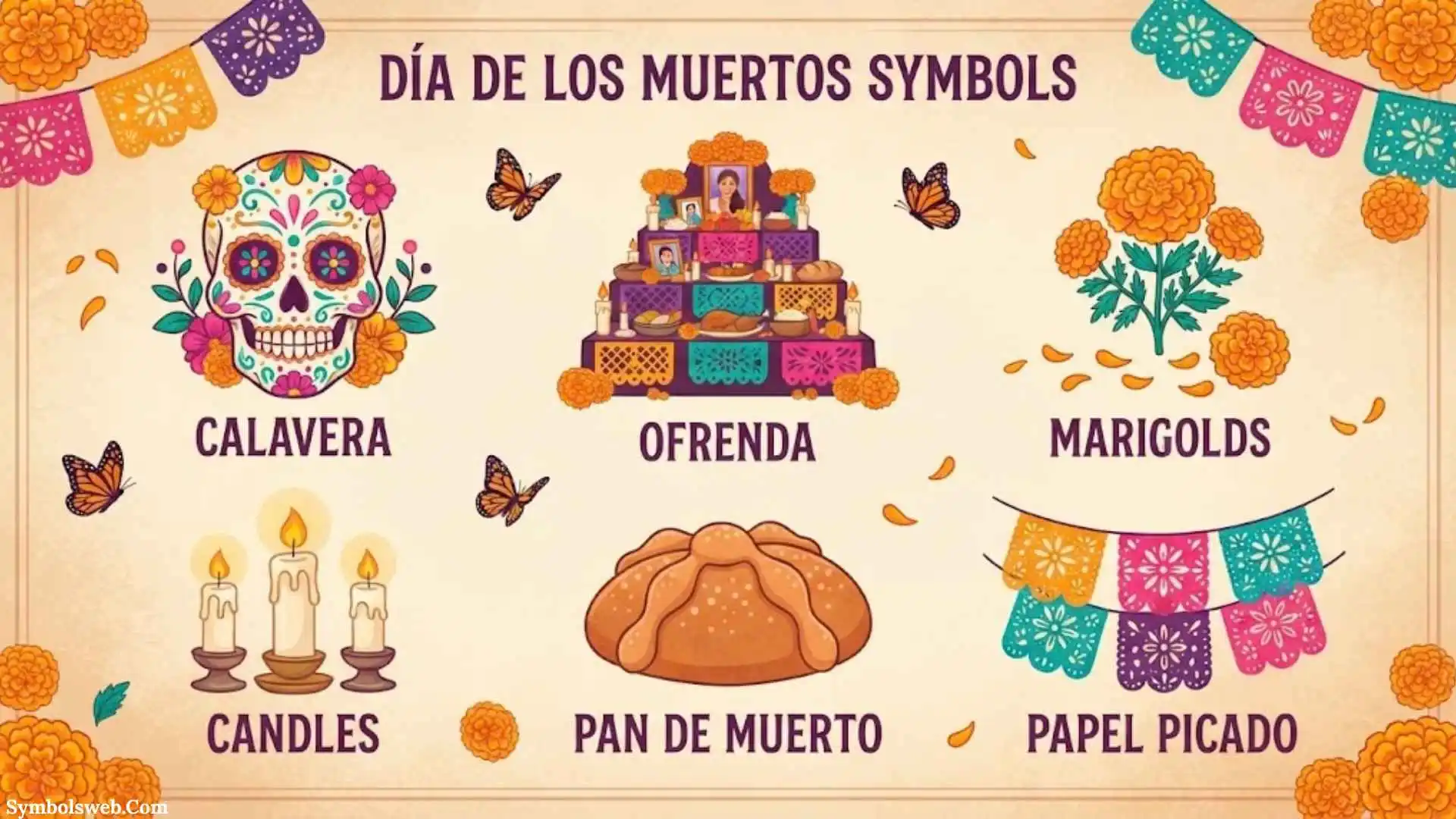
Día de los Muertos symbols are a beautiful part of a tradition that honors loved ones who have passed away while celebrating life, family, memory, and cultural heritage. From colorful marigolds and decorated sugar skulls to candles, photographs, and papel picado, each symbol carries its own special meaning. If you want to understand this meaningful tradition, learning the symbolism behind these elements is a great place to start.
When you explore Día de los Muertos, you may notice that its symbols are both colorful and deeply emotional. Marigolds are often connected with guiding loved ones, candles represent light and remembrance, and sugar skulls can symbolize the beauty and acceptance of death. I find these symbols especially meaningful because they show how families can remember someone with love rather than focusing only on loss.
In this guide, you will discover the meanings behind the most important Día de los Muertos symbols in a simple and easy-to-understand way. Whether you are learning about Mexican culture, researching a school project, planning a Día de los Muertos celebration, or simply curious about these traditions, you can explore each symbol and understand the story it represents.
Día de los Muertos Symbols: (Quick Answer)
Día de los Muertos symbols are objects and images used to honor deceased loved ones during the Mexican Day of the Dead. Common symbols include marigolds, ofrendas, candles, sugar skulls, papel picado, photographs, pan de muerto, monarch butterflies, water, and personal offerings. Their meanings vary by region and family, but together they express remembrance, love, identity, and the continuing bond between the living and the dead.
Quick Facts About Día de los Muertos Symbols
| Aspect | Information |
| Origin | Rooted in Indigenous Mesoamerican traditions and later shaped through interaction with Catholic observances brought by Spain |
| Historical Significance | Developed over centuries as communities honored deceased relatives and connected remembrance with seasonal and religious traditions |
| Main Meaning | Remembering and honoring people who have died |
| Spiritual Meaning | In many traditions, the dead are welcomed home temporarily and are believed to share in the offerings prepared for them |
| Cultural Importance | Strengthens family memory, community identity, and connections between generations |
| Modern Usage | Seen in home ofrendas, cemeteries, public art, schools, museums, festivals, tattoos, fashion, and popular culture |
UNESCO recognizes Indigenous festivities associated with Día de los Muertos as part of Mexico’s Intangible Cultural Heritage, emphasizing that the celebration is living, community-based, diverse, and continually transmitted between generations.
What Are Día de los Muertos Symbols?
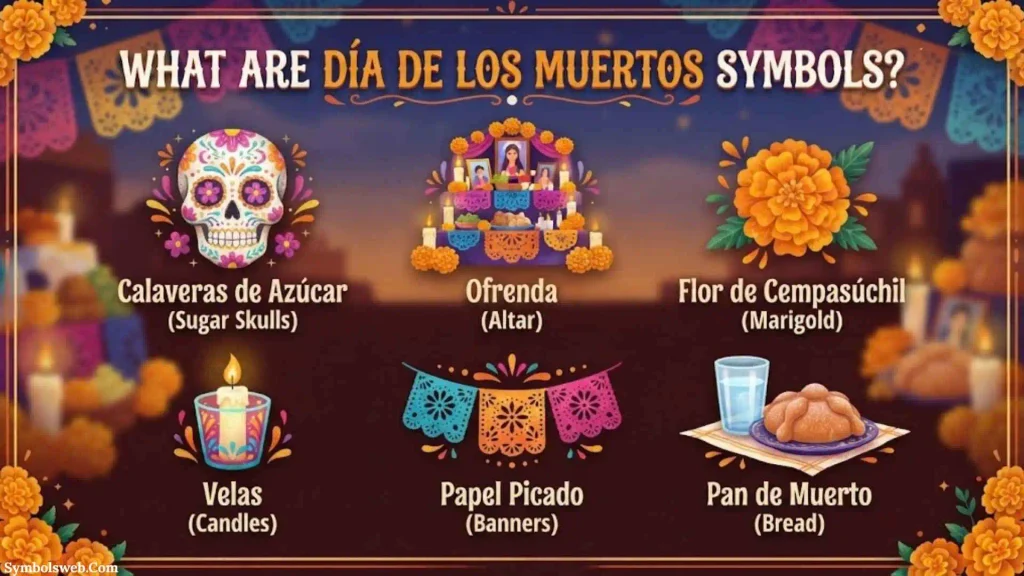
Día de los Muertos symbols are meaningful objects, decorations, foods, flowers, images, and rituals associated with remembering the dead.
They are most visible on an ofrenda, the temporary altar created for a deceased person. Families may place photographs, candles, marigolds, favorite foods, drinks, personal belongings, religious images, water, salt, and other objects connected to the person’s life.
The important point is that there is no single universal altar design.
Día de los Muertos varies greatly by region, Indigenous community, family, religion, and personal belief. Some traditions are strongly Catholic, some emphasize Indigenous practices, and many combine elements from both. UNESCO describes the celebration as a syncretic tradition whose expressions differ across Mexico’s many communities.
Where Did Día de los Muertos Come From?
The roots of Día de los Muertos reach into pre-Hispanic Mesoamerica, where Indigenous peoples had established traditions for commemorating the dead.
The Mexica, Maya, Mixtec, Zapotec, Tlaxcalan, Totonac, and other peoples had different beliefs and ceremonies surrounding death and ancestors. These traditions were later reshaped after Spanish colonization and became intertwined with Catholic observances including All Saints’ Day and All Souls’ Day.
Rather than being a simple continuation of one ancient festival, modern Día de los Muertos developed through centuries of cultural interaction.
The result is a living tradition that contains Indigenous, Catholic, regional, family, and contemporary influences.
Why Is Día de los Muertos Important?
At its heart, Día de los Muertos is about remembering rather than forgetting.
The celebration creates a moment when families can speak about people who have died, tell their stories, prepare their favorite foods, visit their graves, and bring memories into the center of family life.
UNESCO describes the celebration as a ritual of memory that gives important social and cultural meaning to communities.
Deep Symbolic Meaning of Día de los Muertos Symbols
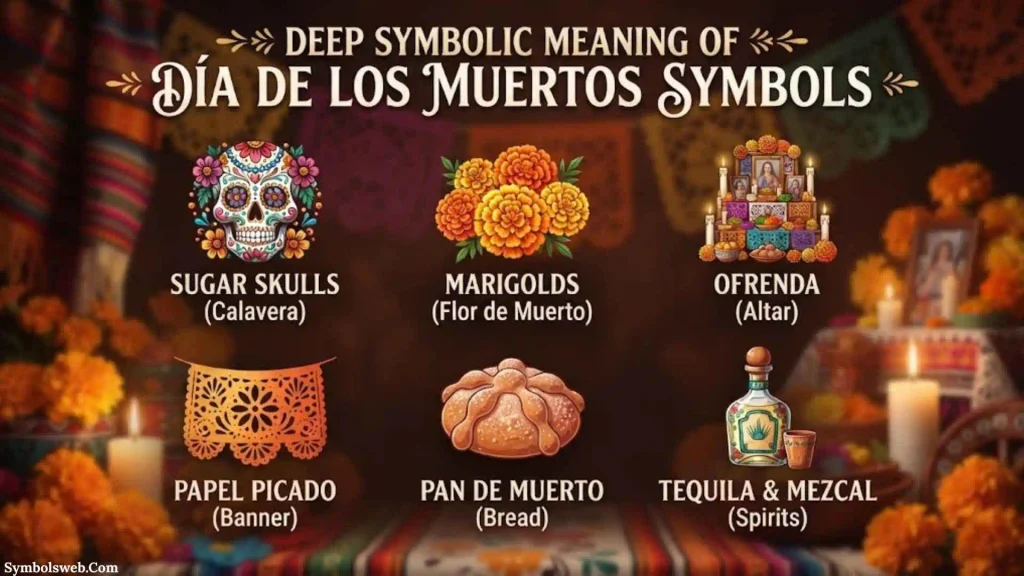
The symbols of Día de los Muertos work on several levels at once.
A flower may be beautiful, practical, emotional, spiritual, and cultural at the same time. A photograph can be a family keepsake and a way of making a deceased person present during the celebration.
That layered meaning is one reason the tradition remains so powerful.
Spiritual Level
In many Día de los Muertos traditions, the boundary between the living and the dead becomes temporarily less distant.
Families prepare an ofrenda to welcome deceased relatives. Food, water, flowers, candles, and personal belongings create a symbolic environment associated with the person’s return.
UNESCO describes the tradition as involving the temporary return of deceased relatives and loved ones to the world of the living, where they are welcomed by family members and honored through offerings.
This does not mean every Mexican family interprets the tradition in exactly the same spiritual way. Beliefs differ widely.
For some, the returning spirits are understood literally. For others, the ritual is primarily a way of keeping memory alive.
Both perspectives can exist within the broader cultural tradition.
Psychological Level
El Día de los Muertos also tendrá una powerful psychological dimension.
Grief can make a person feel absent. Ritual can give that absence a form.
A photograph gives the face a place. A favorite meal recalls a familiar taste. A song brings back a voice. A piece of clothing can suddenly make someone feel close again.
Psychologically, these objects can act as memory cues. They connect the present with experiences from the past.
The tradition also changes the emotional language surrounding death. Instead of treating death only as something frightening or silent, Día de los Muertos can create space for storytelling, humor, music, food, art, and affection.
That does not mean grief disappears. Instead, grief becomes something that can be shared.
Cultural Level
Culturally, Día de los Muertos symbols help families pass memory from one generation to another.
A child learning how to arrange flowers or place a photograph is also learning who came before them.
The altar becomes a small family archive.
It may contain the face of a grandparent, the favorite candy of an uncle, a tool used by a great-grandparent, or a recipe that has survived for decades.
In this way, the symbols are not simply decorations. They help communities remember their history.
15 Important Día de los Muertos Symbols and Their Meanings
1. Ofrenda
Visual Description: A temporary altar decorated with photographs, flowers, candles, food, drinks, and personal objects.
Meaning: Remembrance and welcome.
Symbolism: The ofrenda creates a special space where the living honor someone who has died.
Cultural Connection: It is one of the central practices associated with Día de los Muertos.
Where It Appears: Homes, cemeteries, schools, museums, community spaces, and public celebrations.
The Smithsonian describes the ofrenda as a central component of the celebration, filled with photographs, objects, and reminders of the person being honored.
2. Cempasúchil, or Marigolds
Visual Description: Bright yellow or orange flowers with a strong fragrance.
Meaning: Guidance and remembrance.
Symbolism: Their color, scent, and petals are traditionally associated with helping guide the deceased toward the family and the altar.
Cultural Connection: Cempasúchil is one of the best-known flowers of Día de los Muertos.
Where It Appears: Ofrendas, graves, arches, pathways, garlands, and public displays.
Families may arrange petals from the cemetery toward the home or altar. The Smithsonian notes that the flower’s strong scent and vivid color are traditionally associated with creating a path for returning spirits.
3. Sugar Skulls
Visual Description: Colorfully decorated skulls made from sugar or other materials.
Meaning: Mortality, remembrance, and celebration.
Symbolism: The skull does not simply represent something frightening. In Día de los Muertos, the decorated calavera can be a joyful and affectionate reminder of someone who has died.
Cultural Connection: Sugar skulls, or calaveritas de azúcar, have become one of the most recognizable images associated with the holiday.
Where It Appears: Ofrendas, crafts, festivals, art, clothing, and educational activities.
Some sugar skulls carry the name of the person being remembered. Their bright decoration transforms the image of the skull from something purely morbid into something personal and celebratory.
4. Calaveras
Visual Description: Artistic representations of human skeletons or skulls.
Meaning: Death, equality, humor, and the temporary nature of life.
Symbolism: Skeleton imagery reminds people that death is universal.
One important influence on modern Mexican skull imagery was artist José Guadalupe Posada, whose satirical skeleton illustrations commented on Mexican society.
His famous skeletal figure, later known as La Catrina, became especially influential in Día de los Muertos visual culture. The Mexican Museum notes that Posada used calaveras as social satire, including commentary on class and social behavior.
5. La Catrina
Visual Description: An elegantly dressed female skeleton, often shown wearing a large decorative hat.
Meaning: Mortality and social equality.
Symbolism: Beneath wealth, fashion, status, and appearance, everyone shares the same human fate.
Cultural Connection: La Catrina grew from José Guadalupe Posada’s satirical imagery and was later popularized and developed in Mexican visual culture.
Where It Appears: Murals, paintings, costumes, festivals, tattoos, posters, sculptures, and contemporary design.
La Catrina is sometimes treated as if she were an ancient Aztec goddess. That is inaccurate. Her recognizable modern form is closely connected to Mexican art history, particularly Posada’s work, rather than being an ancient pre-Hispanic deity.
6. Papel Picado
Visual Description: Delicate sheets of tissue paper cut into intricate designs.
Meaning: Air, movement, celebration, and the relationship between life and death.
Symbolism: Because the paper moves with the breeze, it is often associated with wind.
Cultural Connection: Papel picado has Indigenous and Mexican craft traditions and is now widely associated with Día de los Muertos.
Where It Appears: Ofrendas, streets, homes, schools, festivals, and public decorations.
The Smithsonian notes that papel picado was historically made from amate, a bark-based paper, before contemporary tissue paper became common.
7. Candles
Visual Description: Candles placed around or on an altar.
Meaning: Light, remembrance, guidance, and welcome.
Symbolism: The flame creates a visible path and marks the sacred or special space of remembrance.
Cultural Connection: Candles also reflect Catholic influences within many Día de los Muertos traditions.
Where It Appears: Ofrendas, graves, churches, processions, and homes.
The exact arrangement and number of candles vary. In some traditions, candles are arranged to represent directions or create a path for the deceased.
8. Photographs
Visual Description: Framed or displayed photographs of deceased family members.
Meaning: Identity, memory, and personal connection.
Symbolism: The photograph makes the person being honored visible within the family space.
Cultural Connection: Photographs are among the most personal parts of many ofrendas.
Where It Appears: Family altars, cemeteries, public memorials, and community installations.
A photograph changes an abstract idea about death into the memory of a particular human being.
9. Pan de Muerto
Visual Description: A traditional sweet bread prepared around Día de los Muertos.
Meaning: Food, hospitality, remembrance, and connection.
Symbolism: Sharing food connects the celebration to ordinary life and to memories of family meals.
Cultural Connection: Recipes vary throughout Mexico.
Where It Appears: Ofrendas, family tables, bakeries, markets, and seasonal celebrations.
Food is particularly important because Día de los Muertos is not only about remembering who someone was. It can also mean remembering what they loved.
10. Water
Visual Description: A glass, cup, pitcher, or container of water placed on an ofrenda.
Meaning: Refreshment and welcome.
Symbolism: Water is associated with the needs of the returning dead.
Cultural Connection: Water is included in many altar traditions, although practices vary.
The Smithsonian identifies water as one of the elements represented on many ofrendas.
11. Salt
Visual Description: Salt placed in a small dish or arranged as part of an altar.
Meaning: Purification and protection in some traditions.
Symbolism: Salt has long appeared in religious and ritual traditions around the world.
Cultural Connection: Its use on Día de los Muertos ofrendas varies by region and family.
Smithsonian folklife documentation lists salt among traditional altar elements, while emphasizing the wide variation in contemporary practices.
12. Personal Belongings
Visual Description: Clothing, tools, books, musical instruments, jewelry, toys, or other objects associated with the deceased.
Meaning: Individual identity.
Symbolism: These objects tell the story of the person rather than reducing them to the fact that they died.
Cultural Connection: Personal objects make each ofrenda unique.
Where It Appears: Family altars and memorial installations.
A musician might be remembered with an instrument. A gardener might have flowers. A grandmother might be represented through a favorite recipe.
13. Favorite Foods and Drinks
Visual Description: Meals, sweets, fruit, beverages, or other favorite foods.
Meaning: Hospitality and affection.
Symbolism: The family offers something that belongs to the person’s everyday pleasures.
Cultural Connection: Food choices are often highly personal.
The Smithsonian describes favorite foods and drinks as important offerings used to personalize an altar.
14. Monarch Butterflies
Visual Description: Orange-and-black monarch butterflies.
Meaning: In some traditions, connection between the living and the dead.
Symbolism: Their seasonal arrival in Mexico around the same time as Día de los Muertos has contributed to their association with returning souls.
Cultural Connection: Monarch butterflies have become a recognizable part of contemporary Día de los Muertos imagery.
The Smithsonian notes that monarchs arrive in Mexico each fall, with their timing overlapping Día de los Muertos, helping explain their symbolic association with the holiday.
15. Copal and Incense
Visual Description: Aromatic resin burned to produce fragrant smoke.
Meaning: Ritual, purification, and spiritual atmosphere.
Symbolism: Fragrance can mark sacred space and form part of the sensory experience of remembrance.
Cultural Connection: Copal has deep Indigenous Mesoamerican roots and remains part of some contemporary altar traditions.
Smithsonian folklife research lists copal among traditional ofrenda elements, although its use varies by community.
Día de los Muertos Symbols Across Different Cultures
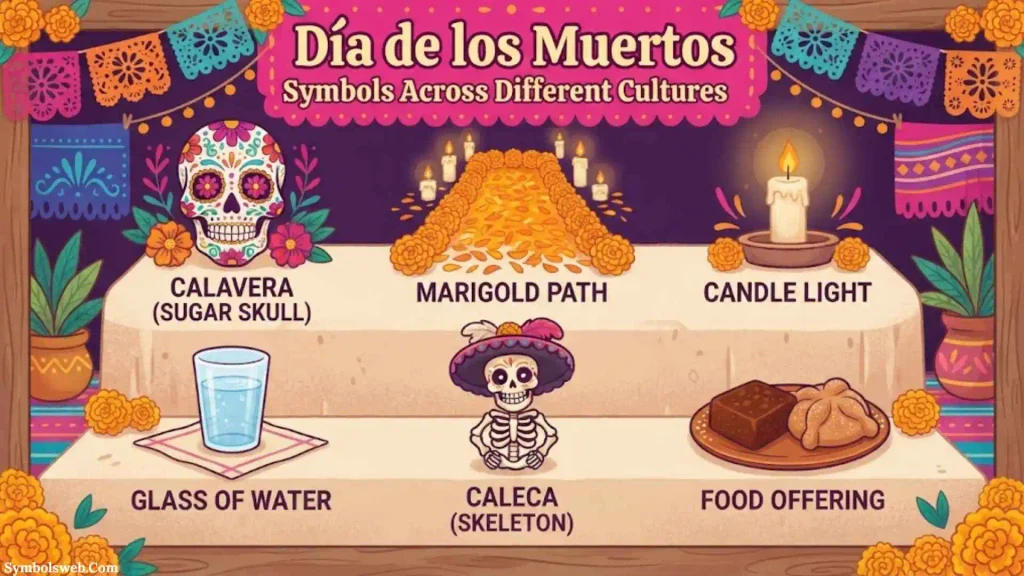
Día de los Muertos symbols should not be treated as universal symbols with exactly the same meaning everywhere.
Death, flowers, skulls, candles, butterflies, and offerings appear in many cultures, but their meanings depend on historical context.
Ancient Egypt
Ancient Egyptians placed enormous importance on death, burial, memory, and the afterlife.
Tombs contained objects, food, images, and texts connected with the deceased’s journey beyond death.
This creates an interesting comparison with Día de los Muertos: both traditions use physical objects to maintain a relationship with someone who has died.
However, they are not the same tradition.
Egyptian funerary religion developed within its own religious system, while Día de los Muertos developed from Mesoamerican and Catholic Mexican traditions.
Ancient Greece
Ancient Greek traditions included offerings to the dead, funerary rituals, graveside practices, and beliefs about the underworld.
Food and drink could be associated with honoring the deceased.
The similarity is striking because humans in very different societies have used ritual offerings to express respect for the dead.
Still, Greek funerary practices should not be described as direct origins of Día de los Muertos.
Roman Culture
Romans had important traditions surrounding ancestors, household religion, funerals, and remembrance.
Parentalia, for example, was a Roman period of honoring deceased family members.
Like Día de los Muertos, such practices demonstrate that remembering ancestors can be a deeply social activity.
The difference is historical and cultural context. Roman ancestor rites belong to Roman religious and family traditions, not Mexican Día de los Muertos.
Eastern Traditions
Several Asian traditions also contain important rituals for remembering ancestors.
In Japan, Obon is a major Buddhist-influenced tradition associated with honoring ancestral spirits. Families may visit graves, clean memorial spaces, offer food, and participate in communal observances.
The resemblance to Día de los Muertos is useful for comparison because both traditions connect family memory, ritual, and ancestors.
Yet Obon and Día de los Muertos developed independently and should not be treated as versions of the same festival.
Indigenous Traditions
The strongest historical connection for Día de los Muertos is with Indigenous peoples of Mesoamerica.
Pre-Hispanic Mexican societies had complex beliefs about death, ancestors, ritual calendars, agriculture, and the continuation of existence after death.
Modern Día de los Muertos reflects centuries of interaction between Indigenous traditions and Catholic practices introduced during Spanish colonization.
Modern Interpretations
Today, Día de los Muertos symbols appear far beyond their traditional settings.
They can be found in museums, public art, schools, community events, Mexican-American cultural celebrations, films, fashion, tattoos, and commercial design.
This wider visibility can help people learn about Mexican culture.
However, context matters.
A sugar skull displayed as part of a family memorial carries a different meaning from a generic skull graphic used as a Halloween decoration.
Similar Symbols and Their Meanings
| Symbol | Día de los Muertos Meaning | Similar Symbol Elsewhere | Important Difference |
| Skull | Mortality, remembrance, celebration | Skull in European art | Meaning depends heavily on cultural context |
| Candle | Light, remembrance, guidance | Religious candles | Día de los Muertos combines several cultural traditions |
| Flower | Memory and guidance | Funeral flowers worldwide | Cempasúchil has specific Mexican cultural importance |
| Butterfly | Transformation and connection | Butterfly symbolism worldwide | Monarch migration adds a particular Mexican context |
| Food | Hospitality and remembrance | Offerings to ancestors | Foods are often linked directly to the deceased’s preferences |
| Photograph | Personal memory | Memorial portraits | Especially important for individual family identity |
| Altar | Honoring the dead | Ancestor shrines worldwide | The ofrenda has a distinctive Mexican history and form |
Is a Día de los Muertos Skull the Same as a Halloween Skull?
No.
Both traditions may use skull imagery, but the cultural meaning can be very different.
Halloween skulls can represent fear, danger, horror, or the supernatural.
A Día de los Muertos calavera is often colorful, humorous, decorative, affectionate, or connected to a specific person.
The Smithsonian specifically emphasizes that Día de los Muertos is not simply another version of Halloween.
Día de los Muertos Symbols in Mythology and Folklore
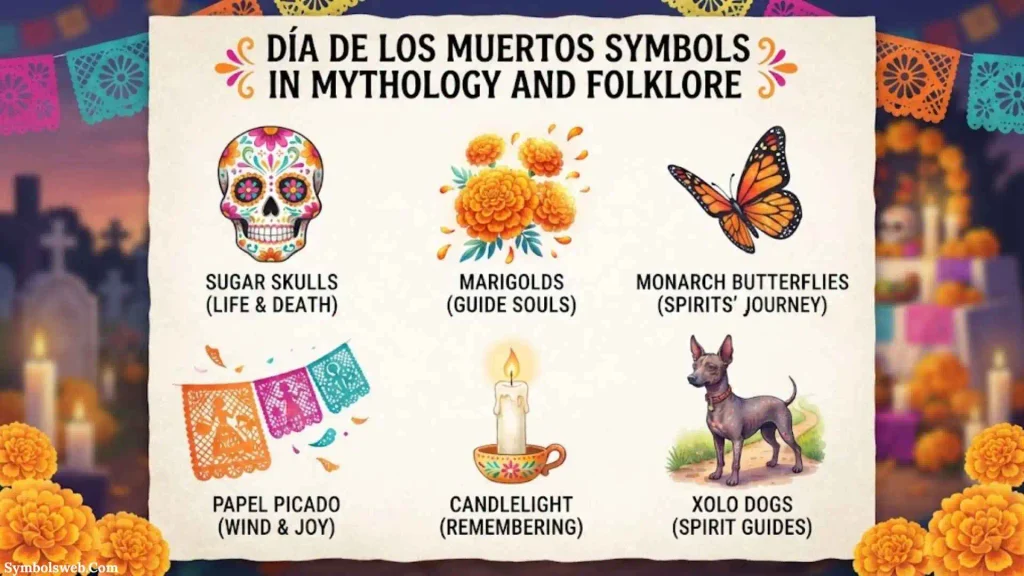
Many modern explanations connect Día de los Muertos to ancient Mesoamerican beliefs about death and the journey of the soul.
These traditions were diverse.
The Mexica, for example, had complex ideas about death and different destinations after death. Other Mesoamerican cultures had their own systems of belief.
It is therefore misleading to say that every modern symbol comes directly from one ancient Aztec ritual.
Instead, modern Día de los Muertos should be understood as a living tradition shaped by Indigenous history, Catholic influence, local customs, family practices, and changing Mexican culture.
Folklore continues to add meaning.
Stories about ancestors returning home, flowers guiding spirits, butterflies appearing at the right time of year, and families preparing favorite foods give the celebration an emotional narrative.
The result is a tradition where memory itself becomes almost tangible.
Día de los Muertos Symbols in Art, Literature, Movies, and Pop Culture
Paintings and Visual Art
Mexican artists have used skeletons, flowers, masks, altars, and death imagery to explore identity, politics, class, religion, and mortality.
José Guadalupe Posada is especially important because his calavera illustrations transformed skeleton imagery into a form of social commentary.
Literature and Poetry
The imagery of death in Mexican literature often explores humor, mortality, memory, identity, and the relationship between the individual and society.
The idea of making conversation with death or treating death with humor can challenge cultures where death is often discussed only in solemn terms.
Movies
Modern films have helped introduce Día de los Muertos imagery to global audiences.
Movies can make marigolds, skulls, butterflies, family altars, and ancestral themes visually familiar to millions of people.
However, fictional portrayals may simplify regional traditions for storytelling. Popular culture should therefore be viewed as an interpretation, not a complete guide to Mexican cultural practice.
Television and Animation
Animated stories frequently use glowing marigold paths, colorful ofrendas, skeleton characters, and family memories to represent the connection between generations.
These images have helped make Día de los Muertos recognizable around the world.
Tattoos
Día de los Muertos-inspired tattoos often combine:
- Sugar skulls
- Marigolds
- La Catrina
- Butterflies
- Candles
- Roses
- Names and dates
- Family photographs
- Decorative patterns
For many people, these tattoos are memorial pieces.
The meaning is strongest when the design has a genuine personal connection rather than being chosen simply because it looks visually striking.
Fashion and Modern Design
Calavera faces, marigolds, papel picado patterns, and Catrina imagery now appear in clothing, accessories, murals, posters, and graphic design.
This visibility has helped Mexican visual traditions reach global audiences, but it also raises an important cultural question: appreciation should include understanding.
Spiritual and Dream Meaning of Día de los Muertos Symbols
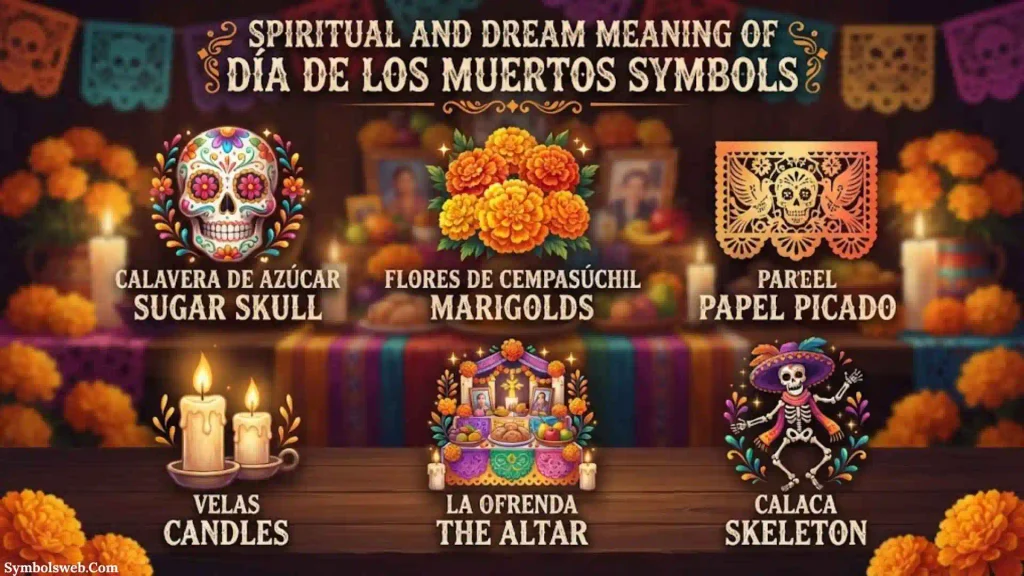
Dream interpretations are personal rather than fixed facts.
There is no single scientifically established meaning for dreaming about a sugar skull, marigold, cemetery, or deceased relative.
Still, these images can carry powerful personal associations.
Dreaming About a Deceased Relative
A dream involving someone who has died may reflect grief, memory, love, unresolved feelings, or recent reminders of that person.
For someone who celebrates Día de los Muertos, the dream may also connect with cultural ideas about remembrance and family.
Dreaming About Marigolds
Marigolds may symbolize remembrance, family, transition, or connection with someone who has died.
Their meaning depends heavily on the dreamer’s personal experience.
Dreaming About a Skull
A skull can represent mortality, change, the end of one stage, or awareness of life’s limits.
In a Día de los Muertos context, it may carry a more celebratory meaning than the frightening symbolism often associated with skulls elsewhere.
Spiritual Reflection
Meditation on Día de los Muertos imagery can become a way of thinking about impermanence.
A candle burns for a limited time.
A flower blooms and fades.
A photograph preserves a moment that cannot return.
These images can encourage reflection on how temporary life is and why relationships matter.
Positive and Negative Meanings of Día de los Muertos Symbols
| Positive Meaning | Negative Meaning |
| Love | Grief |
| Family connection | Loss |
| Remembrance | Fear of death |
| Celebration of life | Painful memories |
| Ancestral identity | Separation |
| Spiritual reflection | Mortality |
| Community | Cultural misunderstanding |
| Continuity between generations | Commercialization |
The same symbol can hold both light and shadow.
A skull can represent death and celebration.
A cemetery can represent loss and reunion.
A photograph can bring comfort while also reminding someone that the person is gone.
That emotional complexity is part of what makes Día de los Muertos so meaningful.
Why Humans Are Attracted to Día de los Muertos Symbols
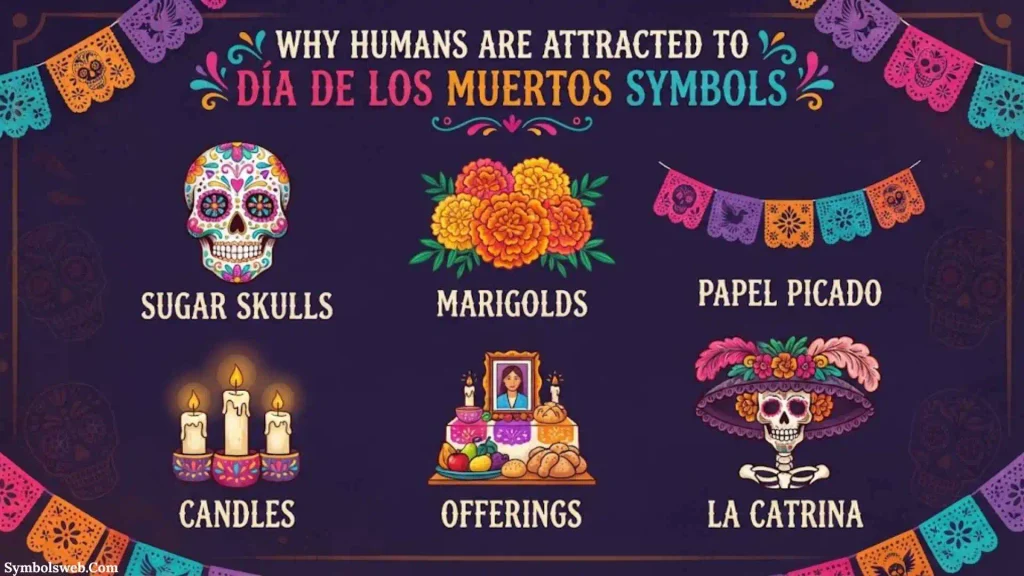
Humans have always created symbols for experiences that are difficult to explain with ordinary language.
Death is one of the greatest examples.
We cannot see memories, but we can place a photograph on an altar.
We cannot hold grief, but we can light a candle.
We cannot bring someone back, but we can cook the meal they loved.
Symbols give emotion a physical form.
Human Nature and Pattern Recognition
The human brain naturally looks for meaning and patterns.
When certain objects repeatedly appear during a cultural ritual, people learn to associate them with particular ideas.
Marigolds become connected with remembrance.
Candles become connected with light and guidance.
Photographs become connected with the person being honored.
Over time, these associations become part of cultural memory.
Collective Symbolism
Psychologist Carl Jung wrote extensively about archetypes and symbolic images shared across human experience.
However, Jungian concepts should be used carefully here.
There is no single Jungian interpretation of Día de los Muertos.
Instead, Jung’s broader ideas can help explain why images such as death, rebirth, ancestors, shadows, and transformation can have emotional power across cultures.
The specific meanings of Día de los Muertos symbols still come from Mexican history and cultural practice.
Cultural Memory
Perhaps the deepest reason people are drawn to these symbols is simple.
They help people remember.
A culture survives partly through the stories it chooses to carry forward.
An ofrenda can turn a family history into something visible.
The face of a deceased relative becomes part of the living room.
A favorite food becomes part of a yearly ritual.
A name is spoken again.
Memory becomes an act of love.
Modern Uses of Día de los Muertos Symbols
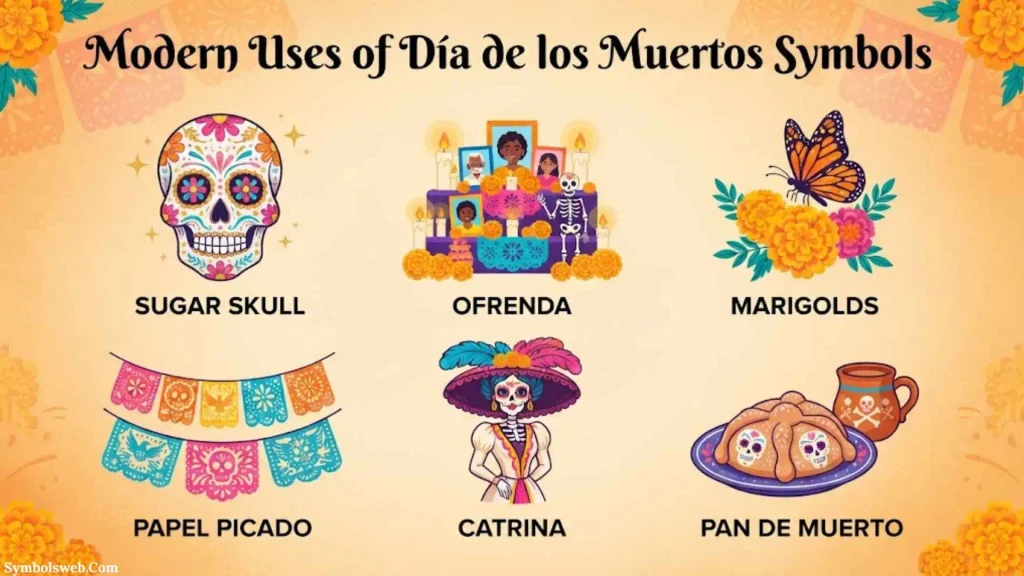
Día de los Muertos imagery is now used in many modern settings.
Tattoos
People may use calaveras, marigolds, butterflies, or portraits as memorial tattoos.
Jewelry
Skull pendants, floral designs, colorful beads, and Catrina-inspired pieces are popular forms of artistic expression.
Fashion
Día de los Muertos-inspired designs appear on shirts, dresses, makeup, accessories, and costumes.
Branding
Businesses sometimes use skulls, marigolds, and papel picado in seasonal campaigns.
This can create cultural visibility, but respectful use requires more than copying an attractive aesthetic.
Social Media
People share photos of ofrendas, family memories, recipes, cemetery visits, artwork, and community events.
Social media has helped younger generations document and reinterpret traditions.
Contemporary Spirituality
Some people outside Mexico use Día de los Muertos imagery as a personal meditation on mortality, ancestors, and memory.
Again, personal interpretation is different from belonging to the cultural tradition itself.
Home Decor
Marigold arrangements, paper decorations, candles, and skull artwork may appear in homes during the season.
For families who actively celebrate Día de los Muertos, however, these objects can represent real people and real memories rather than simply seasonal decoration.
Interesting Facts About Día de los Muertos Symbols
- Día de los Muertos is not simply Mexican Halloween. Its history and purpose are distinct, even though the celebrations occur close together.
- UNESCO recognized Indigenous festivities connected with Día de los Muertos as Intangible Cultural Heritage in 2008.
- Cempasúchil is the Mexican marigold associated with the celebration. Its fragrance and bright petals are traditionally connected with guiding the dead.
- La Catrina is not an ancient Aztec goddess. Her modern visual identity is strongly connected to José Guadalupe Posada’s early 20th-century satirical artwork.
- Papel picado has Indigenous craft connections. Smithsonian sources note that it was historically made from amate bark paper before tissue paper became common.
- Monarch butterflies became associated with Día de los Muertos partly because their annual migration to Mexico overlaps with the holiday season.
- Ofrendas are highly personal. A family may include objects that would mean nothing to another family but are deeply important to the deceased person being remembered.
- Día de los Muertos has no single universal altar design. Regional, Indigenous, religious, family, and individual practices can differ considerably.
- The celebration is strongly connected with food. Favorite dishes and drinks can be placed on an ofrenda as part of welcoming and remembering the deceased.
- The holiday is fundamentally about memory. Its rituals help families keep relationships with previous generations present in community life.
Frequently Asked Questions
What are the most important Día de los Muertos symbols?
The most recognizable symbols include the ofrenda, cempasúchil marigolds, sugar skulls, calaveras, La Catrina, papel picado, candles, photographs, pan de muerto, water, personal belongings, favorite foods, and monarch butterflies. Their meanings vary between communities and families.
What does the marigold mean in Día de los Muertos?
The cempasúchil, or Mexican marigold, is traditionally associated with guiding deceased loved ones toward the altar. Its bright color and strong fragrance make it one of the most recognizable symbols of Día de los Muertos.
What does a sugar skull symbolize?
A sugar skull represents death, remembrance, and the person being honored. Its bright colors and decorations reflect the celebratory nature of Día de los Muertos. Some sugar skulls include the name of a deceased loved one.
Why are skulls used for Día de los Muertos?
Skulls remind people that death is a universal part of human life. In Día de los Muertos, skull imagery can be colorful, humorous, affectionate, and celebratory rather than purely frightening. Mexican artist José Guadalupe Posada also played a major role in shaping modern calavera imagery.
¿Es el Día de los Muertos the same as Halloween?
No. Although the dates are close, Día de los Muertos has a different history and purpose. It focuses on remembering and honoring deceased loved ones through family rituals, ofrendas, food, flowers, music, and remembrance.
What does an ofrenda represent?
An ofrenda is a temporary altar created to honor a deceased person. It may contain their photograph, favorite foods, personal belongings, candles, flowers, water, and other meaningful objects. It represents remembrance, welcome, family connection, and the continuing importance of the deceased within the family.
Conclusion
Día de los Muertos symbols are powerful because they turn memory into something visible and shared. A marigold can become a path, a candle can become a light, and a photograph can bring an absent loved one back into the center of family life.
Behind the colorful skulls and flowers is a deeper message: death may end a life, but it does not have to end remembrance. In the end, Día de los Muertos is not only about the dead. It is about the living choosing to remember, love, and carry their family stories forward.

Eliana Foster is a writer with a passion for exploring the meanings behind symbols, traditions, and cultural history. She enjoys breaking down complex topics into simple, engaging articles that are easy for everyone to understand. Eliana is also the fictional author of The Hidden Language of Silent Marks and Beyond the Circle of Ancient Signs, two original book concepts created for her author profile. When she’s not writing, she loves visiting museums, reading about mythology, and researching the stories behind symbols from around the world. Her goal is to help readers discover the fascinating meanings hidden in everyday signs and ancient emblems.
 Jordan Hayes
 Ethan Holloway