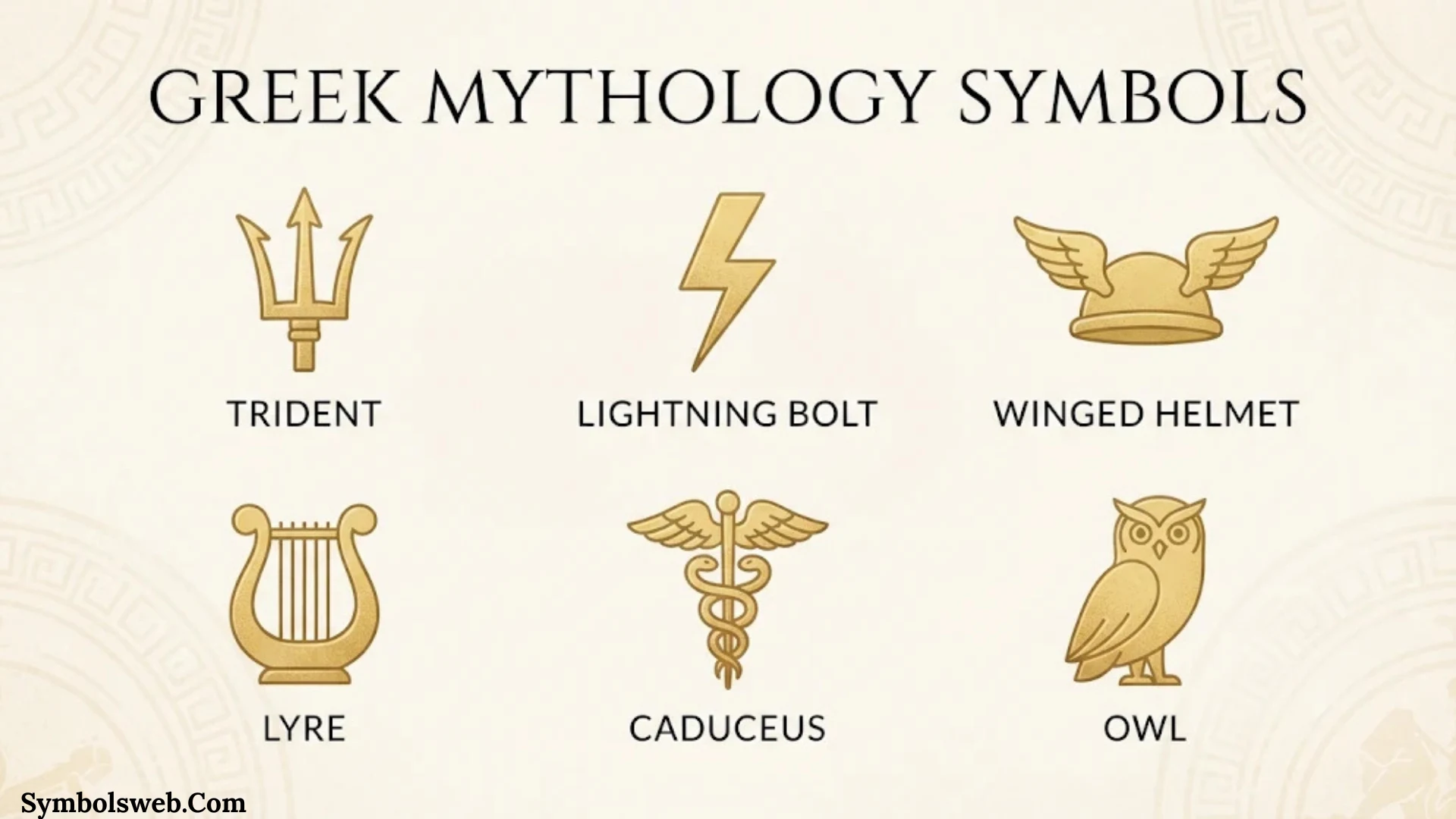
Greek mythology is filled with powerful symbols that tell stories about gods, goddesses, heroes, nature, and human life. A thunderbolt represents Zeus’s authority. An owl reflects Athena’s wisdom. A trident connects Poseidon with the sea and its unpredictable power.
These symbols appeared throughout ancient Greek culture. You can find them in temple decorations, pottery, sculptures, coins, jewelry, and religious ceremonies. Each one carried meaning shaped by myths, local traditions, and the beliefs of ancient communities.
Understanding Greek mythology symbols helps you explore the stories behind the gods. It also reveals how ancient Greek ideas continue to influence modern art, literature, tattoos, jewelry, and popular culture.
What Are Greek Mythology Symbols?
Greek mythology symbols are objects, animals, plants, weapons, and natural elements associated with Greek gods, goddesses, heroes, and mythological stories. They help identify divine figures and communicate their powers, personalities, responsibilities, and sacred connections.
For example, Zeus carries a thunderbolt because he rules the sky and commands storms. Athena is often shown with an owl because the bird represents wisdom and clear judgment. Poseidon carries a trident, reflecting his control over the sea.
These symbols served several purposes:
- Identification: They helped people recognize gods and goddesses in paintings, sculptures, and other artwork.
- Religious meaning: Certain objects and animals had sacred connections with particular deities.
- Storytelling: Symbols reminded people of important myths and divine events.
- Cultural expression: Artists used them to communicate ideas about power, wisdom, love, war, and nature.
- Protection and devotion: Certain images appeared in religious settings and personal objects as expressions of belief.
Not every symbol had one fixed meaning. Its interpretation could change depending on the period, location, artistic context, or myth being represented.
Greek Gods and Goddesses Symbols and Their Meanings
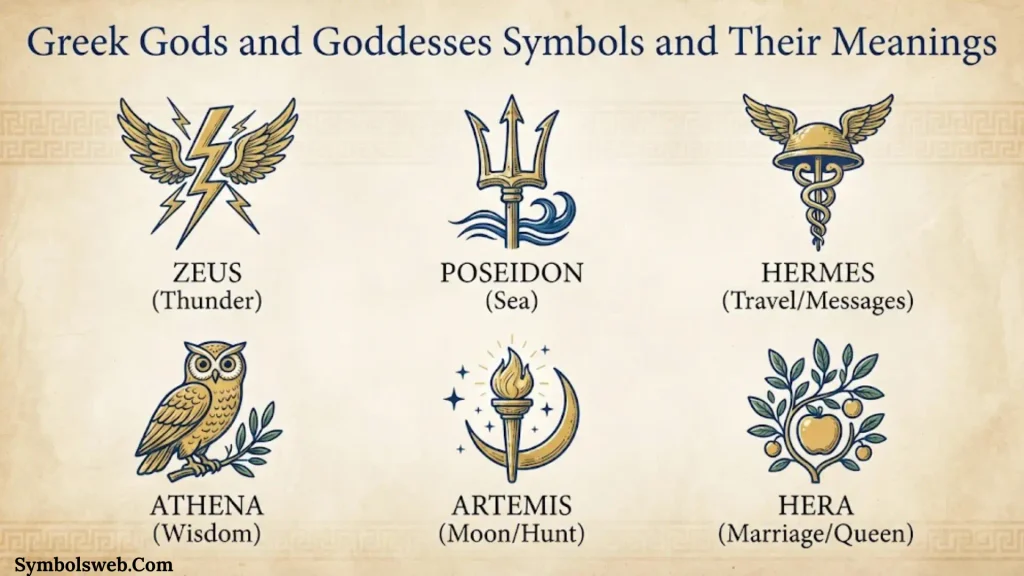
Greek gods and goddesses had distinctive attributes that helped people recognize them. Some symbols were strongly associated with one deity, while others appeared in several mythological traditions.
The following sections explain the best known Greek deities and the symbols connected with them.
Zeus Symbols: Thunderbolt, Eagle, and Oak Tree
Zeus was the king of the Olympian gods and the ruler of the sky, thunder, and lightning. He represented divine authority, justice, leadership, and order.
His most recognized symbols include:
- Thunderbolt: Represents Zeus’s power over lightning, storms, and divine punishment.
- Eagle: Reflects strength, authority, and his connection with the heavens.
- Oak tree: Represents strength and sacred authority. The ancient sanctuary of Dodona was especially associated with Zeus and its sacred oak.
- Scepter: Symbolizes kingship, command, and leadership.
The thunderbolt is perhaps the most recognizable of all Greek god symbols. Ancient artists often portrayed Zeus holding it as a weapon of divine power.
The eagle also played an important role in Zeus’s mythology. Its ability to soar high above the earth made it a fitting representation of the ruler of the heavens.
Hera Symbols: Peacock, Cow, and Pomegranate
Hera was the wife of Zeus and queen of the Olympian gods. She was associated with marriage, women, family, and royal authority.
Her important symbols include:
- Peacock: Represents beauty, majesty, and royal dignity.
- Cow: Connects Hera with motherhood and fertility. Ancient poetry sometimes describes her with cow-related imagery.
- Pomegranate: Can represent marriage, fertility, and abundance, although it also has important connections with other Greek goddesses.
- Diadem: Represents her position as queen of the gods.
The peacock is especially familiar in later artistic representations of Hera. Its colorful feathers made it a fitting symbol of her royal status.
Poseidon Symbols: Trident, Horse, and Dolphin
Poseidon ruled the seas and was also associated with earthquakes and horses. Ancient Greeks depended heavily on maritime travel and fishing, making his divine influence especially important.
His main symbols include:
- Trident: Represents his authority over the sea and his ability to stir storms.
- Horse: Reflects his connection with horses and their mythological origins.
- Dolphin: Represents the sea, navigation, and marine life.
- Bull: Appears in several traditions connected with Poseidon’s power and sacrifices.
The trident symbol is one of the clearest examples of an object associated with a Greek deity. Artists frequently used it to identify Poseidon in sculptures, pottery, and mosaics.
Athena Symbols: Owl, Olive Tree, and Aegis
Athena was the goddess of wisdom, strategic warfare, crafts, and practical intelligence. She was also the patron goddess of Athens.
Her most important symbols include:
- Owl: Represents wisdom, observation, and intelligence.
- Olive tree: Represents peace, prosperity, and the agricultural gift associated with Athena’s patronage of Athens.
- Aegis: A protective garment or shield associated with Athena and Zeus, often decorated with the head of Medusa.
- Helmet and spear: Represent military strategy, courage, and defense.
- Gorgoneion: The image of a Gorgon’s head, used as a protective emblem.
The owl became particularly famous through Athenian coinage. Silver coins from Athens often featured Athena on one side and an owl on the other.
Athena’s olive tree also carried a special meaning for Athens. According to mythology, Athena offered the city an olive tree during her contest with Poseidon. The gift represented practical prosperity and became closely connected with the city’s identity.
Apollo Symbols: Lyre, Laurel Wreath, and Bow
Apollo was associated with music, prophecy, healing, archery, and several aspects of knowledge and order.
His symbols include:
- Lyre: Represents music, poetry, and artistic harmony.
- Laurel wreath: Connects Apollo with victory, honor, and the myth of Daphne.
- Bow and arrow: Represent his skill as an archer and his ability to send disease or protection.
- Tripod: Associated with prophecy and the Oracle of Delphi.
- Raven: Appears in myths connected with Apollo, although it was not his only animal association.
The laurel wreath became a lasting symbol of achievement. Its connection with Apollo helped establish the laurel as an emblem of honor and victory in ancient Greek culture.
Apollo’s lyre also reflects the importance of music in Greek religious and cultural life. The instrument became one of the clearest visual signs of his artistic identity.
Artemis Symbols: Bow, Deer, and Crescent Moon
Artemis was the goddess of hunting, wild animals, wilderness, and childbirth. She was also associated with protecting young people.
Her common symbols include:
- Bow and arrows: Represent hunting and her skill as an archer.
- Deer: Reflect her relationship with wild animals and nature.
- Hunting dogs: Represent her role as a hunter.
- Cypress tree: Appears in traditions associated with her sacred landscape.
- Crescent moon: Became a familiar symbol of Artemis in later artistic traditions.
Artemis and Apollo were twins. Both were skilled archers, but their divine responsibilities were different.
The deer is particularly important in Artemis’s imagery. It reflects her connection with the wilderness and her role as a protector of wild animals.
Ares Symbols: Spear, Helmet, and Vulture
Ares represented the violent and destructive side of warfare. Unlike Athena, who was associated with strategy and military wisdom, Ares reflected battle fury, bloodshed, and aggression.
His symbols include:
- Spear: Represents combat and aggression.
- Helmet: Symbolizes battle readiness and military strength.
- Shield: Represents defense and warfare.
- Sword: Reflects violence and armed conflict.
- Vulture: Appears among the animals associated with Ares in ancient literary traditions.
- Dog: Also appears in some descriptions of his animal associations.
Ares’s symbols remind us that Greek mythology did not present war as a purely glorious activity. It also explored its violence and human cost.
Aphrodite Symbols: Dove, Rose, and Seashell
Aphrodite was the goddess of love, beauty, desire, and attraction. Her influence extended beyond romantic relationships into fertility and the power of desire.
Her familiar symbols include:
- Dove: Represents love, beauty, and gentleness.
- Rose: Symbolizes beauty, passion, and romantic love.
- Myrtle: A sacred plant associated with Aphrodite.
- Seashell: Connects with traditions about her birth from sea foam.
- Swan: Represents beauty and grace.
- Apple: Appears in stories connected with beauty and the Judgment of Paris.
Aphrodite’s symbols remain popular in modern art, jewelry, romantic designs, and tattoos.
The rose and dove are especially familiar because they communicate love and beauty without needing a detailed explanation. The seashell also became a recognizable image in later European artwork depicting Aphrodite’s birth.
Demeter Symbols: Wheat, Torch, and Cornucopia
Demeter was the goddess of agriculture, grain, fertility, and the harvest. Her myths explained the seasonal cycle of growth and the connection between farming and divine power.
Her symbols include:
- Wheat and grain: Represent agriculture, food, and harvest.
- Torch: Connects with her search for Persephone after her daughter’s disappearance.
- Cornucopia: Represents abundance, nourishment, and prosperity.
- Poppy: Appears in ancient imagery associated with fertility and agriculture.
- Pig: Was connected with agricultural and fertility-related religious practices.
The cornucopia, often called the horn of plenty, is not exclusive to Demeter. It appears in traditions involving several Greek figures and represents abundance more broadly.
Wheat is one of the strongest symbols associated with Demeter. It reflects the importance of agriculture to ancient Greek communities and their dependence on successful harvests.
Hermes Symbols: Caduceus, Winged Sandals, and Petasos
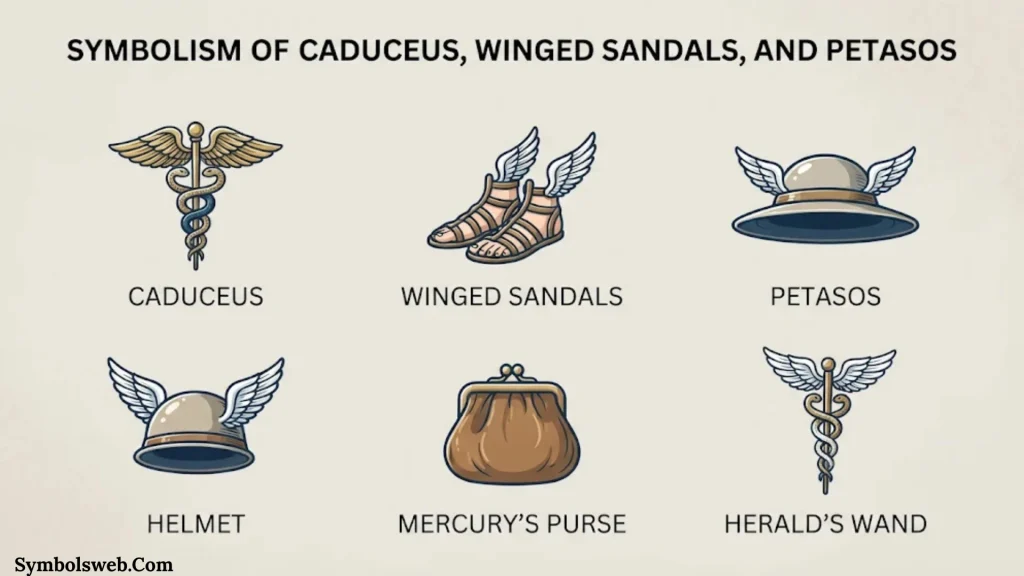
Hermes served as the messenger of the gods. He was associated with travel, trade, communication, boundaries, and the movement of souls into the underworld.
His symbols include:
- Caduceus: A staff with two intertwined snakes, associated with Hermes.
- Winged sandals: Represent speed and travel.
- Petasos: A broad-brimmed traveler’s hat often shown with wings.
- Herma: A pillar or boundary marker associated with Hermes.
- Tortoise: Connected with the myth of Hermes inventing the lyre.
One important distinction matters here: the caduceus belongs to Hermes, while the Rod of Asclepius is associated with healing.
The Rod of Asclepius has one snake and no pair of wings in its traditional form. The caduceus has two snakes and is associated with Hermes. These two symbols are often confused today.
Hephaestus Symbols: Hammer, Anvil, and Tongs
Hephaestus was the divine blacksmith. He created weapons, armor, and extraordinary objects for gods and heroes.
His symbols include:
- Hammer: Represents metalworking and craftsmanship.
- Anvil: Symbolizes creation and skilled labor.
- Tongs: Represent the tools of the forge.
- Volcano: Connects with fire and the traditional location of his workshop.
- Axe: Appears in some artistic and mythological representations.
Hephaestus shows how Greek mythology valued skilled work and technical creativity alongside physical strength and divine power.
His workshop was a place of extraordinary creation. Several famous mythological objects and weapons were associated with his craftsmanship.
Dionysus Symbols: Thyrsus, Grapevine, and Leopard
Dionysus was the god of wine, festivity, theater, and ecstatic religious experience. His myths explored celebration, transformation, freedom, and the loss of ordinary boundaries.
His symbols include:
- Thyrsus: A staff decorated with a pinecone and foliage, representing divine power and ritual celebration.
- Grapevine: Represents wine, harvest, and transformation.
- Ivy: A sacred plant associated with Dionysus.
- Leopard or panther: Reflects his wild and powerful nature.
- Drinking cup: Represents wine and communal celebration.
- Mask: Connects him with theater and dramatic performance.
The thyrsus is one of the most distinctive objects in Dionysian imagery. It appears in artistic representations of Dionysus and his followers.
Hades Symbols: Cerberus, Bident, and Cypress
Hades ruled the underworld, the realm of the dead. He was not simply a Greek version of an evil devil. His role was to govern the dead and maintain the boundaries of his kingdom.
His symbols include:
- Cerberus: The multi-headed dog that guarded the entrance to the underworld.
- Bident: A two-pronged weapon associated with Hades in some artistic traditions.
- Cypress: A tree connected with mourning and funerary traditions.
- Helmet of invisibility: A magical object that concealed its wearer.
- Black animals: Some sacrificial traditions connected dark-colored animals with underworld deities.
Hades’s symbols often represent death, hidden wealth, and the boundary between the living and the dead.
Cerberus is particularly recognizable. His role as the guardian of the underworld appears in several famous myths, including the story of Heracles and his final labor.
Persephone Symbols: Pomegranate, Flowers, and Torch
Persephone was the daughter of Demeter and the queen of the underworld. Her story explains the relationship between seasonal change, loss, and renewal.
Her symbols include:
- Pomegranate: Represents her connection with the underworld and the story of her return.
- Flowers: Reflect spring, growth, and the world before her abduction.
- Torch: Connects her story with Demeter’s search.
- Grain: Reflects her connection with agriculture and her mother.
- Crown: Represents her position as queen of the underworld.
The pomegranate is especially important because Persephone eats its seeds while in the underworld. The story explains why she must spend part of the year there.
Her myth connects the underworld with the changing seasons. It also explores the relationship between loss, family, and the return of life.
Hecate Symbols: Torch, Keys, and Dogs
Hecate was associated with magic, crossroads, night, and transitions. She also played an important role in the story of Persephone.
Her symbols include:
- Torch: Represents light in darkness and guidance.
- Keys: Symbolize access, boundaries, and hidden places.
- Dogs: Appear in traditions involving Hecate and the night.
- Crossroads: Reflect her connection with places where paths meet.
- Triple form: Some ancient images portray her in three connected figures.
Hecate’s symbols often appear in discussions of protection, spiritual boundaries, and ancient Greek religious practices.
Asclepius Symbols: Serpent and Staff
Asclepius was the Greek god of medicine and healing. His sanctuaries attracted people seeking treatment, religious assistance, and recovery.
His main symbols include:
- Serpent: Represents renewal and is closely associated with his healing tradition.
- Staff: Symbolizes medicine and healing.
- Dog: Appears in some traditions connected with healing sanctuaries.
- Healing sanctuary: Represents the religious setting in which people sought divine help.
The Rod of Asclepius remains a widely recognized medical symbol. Its single serpent distinguishes it from Hermes’s caduceus.
Eros Symbols: Bow, Arrow, and Wings
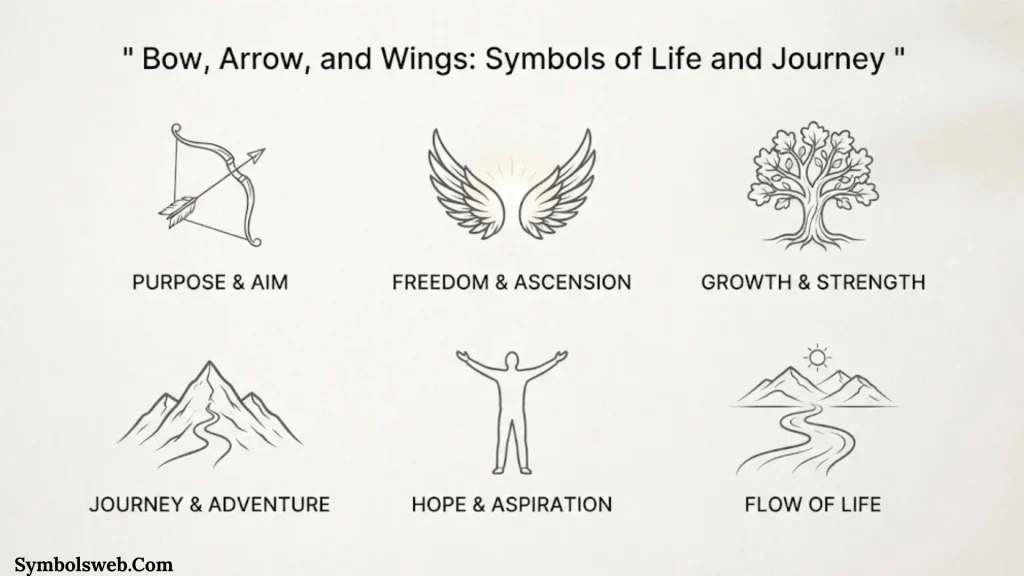
Eros represented love, attraction, and desire. In early Greek traditions, he could appear as a powerful primordial force. Later art often portrayed him as a winged youth.
His symbols include:
- Bow and arrows: Represent the power to inspire desire.
- Wings: Reflect the swift and unpredictable nature of love.
- Torch: Can represent passion and desire.
- Dove: Appears in broader imagery associated with love, although it is more strongly connected with Aphrodite.
Eros later became closely identified with the Roman Cupid. His arrows remain a familiar image of romantic attraction.
Helios Symbols: Sun, Chariot, and Horses
Helios was the Greek personification of the sun. Ancient stories described him driving his chariot across the sky each day.
His symbols include:
- Sun: Represents daylight and his divine identity.
- Chariot: Represents his daily journey across the heavens.
- Horses: Draw his solar chariot.
- Radiant crown: Appears in artistic representations of the sun god.
Helios should not automatically be treated as identical to Apollo. Apollo became increasingly associated with solar imagery in later Greek and Roman traditions, but Helios had his own distinct identity in early Greek mythology.
Most Famous Greek Mythology Symbols and Their Meanings
Some symbols appear so frequently in Greek mythology that they have become familiar even to people who don’t know the stories behind them.
The following table brings together important Greek mythology symbols and meanings.
| Greek symbol | Associated figure | Common meaning |
| Thunderbolt | Zeus | Divine power, authority, and lightning |
| Eagle | Zeus | Strength, leadership, and the heavens |
| Owl | Athena | Wisdom and intelligence |
| Olive tree | Athena | Peace, prosperity, and protection |
| Trident | Poseidon | Sea power and earthquakes |
| Dolphin | Poseidon | The sea and marine life |
| Lyre | Apollo | Music, poetry, and harmony |
| Laurel wreath | Apollo | Victory, honor, and achievement |
| Bow and arrows | Artemis, Apollo, Eros | Hunting, skill, and desire |
| Peacock | Hera | Beauty and royal dignity |
| Dove | Aphrodite | Love and beauty |
| Rose | Aphrodite | Passion and romantic love |
| Wheat | Demeter | Agriculture and harvest |
| Cornucopia | Several deities | Abundance and prosperity |
| Caduceus | Hermes | Travel, communication, and exchange |
| Winged sandals | Hermes | Speed and movement |
| Hammer | Hephaestus | Craftsmanship and creation |
| Thyrsus | Dionysus | Wine, celebration, and divine power |
| Cerberus | Hades | The underworld and its boundaries |
| Pomegranate | Persephone | Underworld, fertility, and seasonal change |
| Torch | Hecate, Demeter | Guidance, searching, and illumination |
| Serpent and staff | Asclepius | Medicine and healing |
| Bow and arrow | Eros | Love and desire |
| Sun chariot | Helios | Daylight and the sun’s journey |
Greek Mythology Symbols of Wisdom
Wisdom was an important theme in ancient Greek religion and philosophy. Several symbols represented knowledge, thoughtful judgment, and the ability to make good decisions.
Owl
The owl is strongly associated with Athena. Its ability to see in low light made it a fitting image for observation and awareness.
Athenian coins featuring the owl helped spread this association throughout the ancient Mediterranean. The bird became one of the most recognizable symbols of the city.
Olive Tree
The olive tree represents Athena’s gift to Athens in the famous contest with Poseidon. According to the myth, Athena offered the city an olive tree while Poseidon offered a source of water or a saltwater spring.
The people chose Athena’s gift. The olive tree became an important symbol of the city and its prosperity.
Lyre
The lyre represents music, education, and artistic expression. Its connection with Apollo reflects the importance of music and poetry in Greek culture.
Together, these symbols connect wisdom with observation, practical knowledge, and creative expression.
Greek Mythology Symbols of Strength and Power
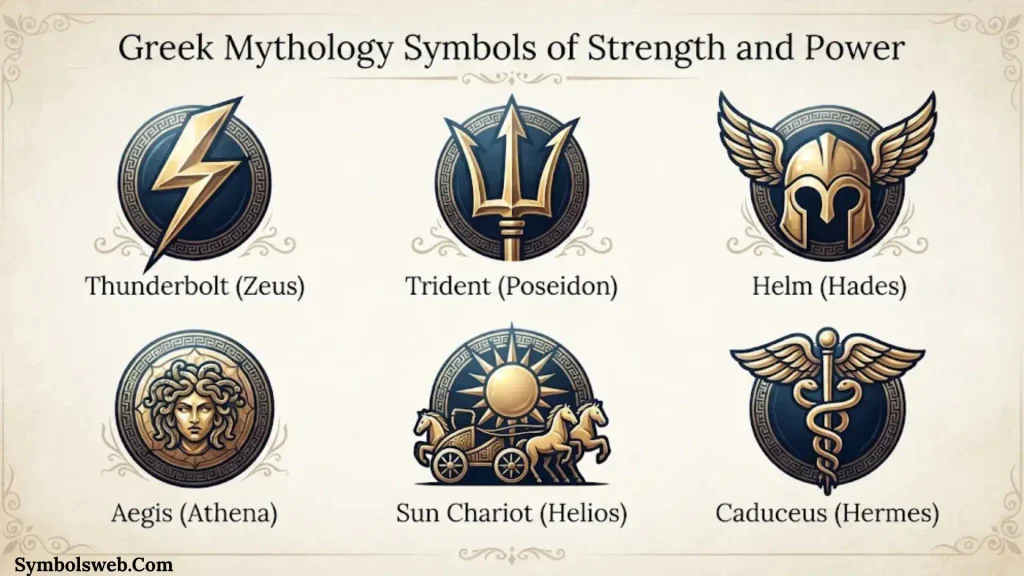
Greek mythology frequently explored physical strength and divine authority. Symbols of power helped communicate a god’s ability to control nature, protect people, or defeat enemies.
Thunderbolt
Zeus’s thunderbolt represents supreme authority. It connects his position as king of the gods with his control over lightning and storms.
Trident
Poseidon’s trident represents his command over the sea. It also reflects the destructive force of earthquakes and violent waters.
Spear and Helmet
The spear and helmet appear in the imagery of Athena and Ares. However, their meanings differ.
Athena’s weapons represent strategy and disciplined defense. Ares’s weapons emphasize the violence and aggression of battle.
Eagle
The eagle symbolizes strength, leadership, and the sky. Its connection with Zeus made it an especially powerful emblem of divine authority.
Greek Mythology Symbols of Protection
Ancient Greeks used protective imagery in religious settings, household objects, and personal decorations. Some symbols were connected with particular deities, while others belonged to wider Mediterranean traditions.
Gorgoneion and Medusa’s Head
The Gorgoneion is an image of a Gorgon’s face, especially Medusa’s. It appeared on shields, armor, pottery, and buildings.
Its frightening appearance could serve an apotropaic purpose. In other words, it was intended to turn away danger or harmful forces.
Athena’s aegis often included a Gorgon’s head. This connection made the image particularly recognizable in Greek art.
Aegis
The aegis was a protective object associated with Zeus and Athena. Ancient descriptions and artistic depictions vary, but it often appears as a shield or protective garment.
It represents divine protection and authority.
Evil Eye
The evil eye is a belief that harmful envy or a hostile gaze can bring misfortune. Protective eye charms developed across several Mediterranean and Near Eastern cultures.
The Greek word mati is commonly used for the evil eye today. However, it would be inaccurate to describe the modern blue eye charm as the personal symbol of one Greek god or goddess.
Greek Mythology Symbols of Love and Beauty
Love and beauty appear throughout Greek myths. These themes are especially connected with Aphrodite and Eros.
Rose
The rose is a familiar symbol of beauty, desire, and romantic love. Its modern meaning reflects a long artistic association with Aphrodite.
Dove
The dove represents gentleness and love. It is one of the most recognizable birds connected with Aphrodite.
Seashell
The seashell is associated with artistic traditions about Aphrodite’s birth from sea foam. It became especially familiar through later European paintings.
Bow and Arrow
Eros’s bow and arrows represent the sudden and powerful nature of attraction. In myth, his arrows could inspire love or desire in gods and mortals.
Greek Mythology Symbols of Healing and Rebirth
Healing and renewal appear in several Greek myths. Serpents, plants, and divine objects often communicate these themes.
Serpent
The serpent is associated with Asclepius and ancient healing traditions. Snakes shed their skin, which may help explain why they became connected with renewal and regeneration.
However, serpents had many meanings in Greek culture. They could represent protection, danger, the underworld, fertility, or divine power depending on the context.
Rod of Asclepius
The Rod of Asclepius features a single serpent wrapped around a staff. It remains one of the strongest historical symbols of medicine.
Don’t confuse it with the caduceus. The caduceus has two snakes and belongs to Hermes.
Phoenix
The phoenix is a mythical bird connected with renewal and long life. Its story changed across ancient sources and later traditions.
The familiar image of a bird burning and rising from its ashes became especially popular in later interpretations. Early Greek accounts do not all describe that exact process.
Greek Mythology Symbols of Peace and Victory
Ancient Greeks valued both military achievement and peaceful prosperity. Their symbolic language reflected these ideas through plants, objects, and divine stories.
Laurel Wreath
The laurel wreath represents victory, honor, and achievement. Its connection with Apollo also made it an important artistic symbol.
Laurel wreaths were used in ancient Greek traditions to honor victors in athletic and cultural competitions.
Olive Branch
The olive branch represents peace and prosperity. It also connects with Athena’s relationship with Athens.
Nike’s Wings
Nike, the Greek goddess of victory, was often portrayed with wings. Her image represents success and triumph.
The goddess Nike should not be confused with Athena’s owl or Apollo’s laurel. Each symbol has a distinct mythological connection.
Greek Mythology Symbols of Fertility and Abundance
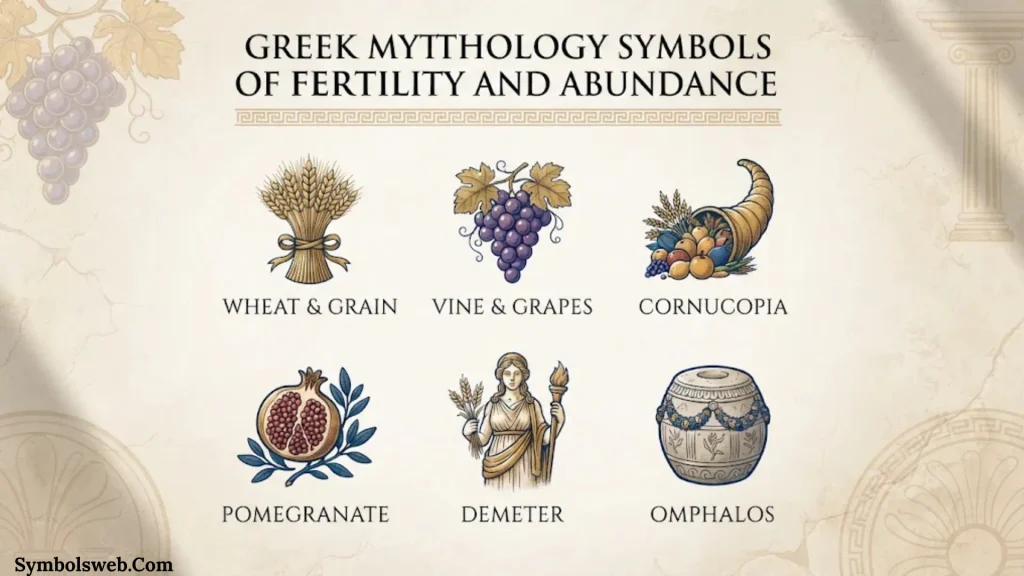
Agriculture shaped daily life in ancient Greece. As a result, many religious symbols represented food, fertility, harvest, and the natural cycle of growth.
Wheat and Grain
Wheat and grain are closely associated with Demeter. They represent food, farming, harvest, and the survival of communities.
Cornucopia
The cornucopia, or horn of plenty, represents abundance and nourishment. It appears in stories and images involving several divine figures.
Pomegranate
The pomegranate connects with Persephone and the underworld. It can also represent fertility and abundance in wider Greek symbolism.
Grapevine
The grapevine belongs to Dionysus’s symbolic world. It represents wine, harvest, celebration, and transformation.
Greek Mythology Symbols of Death, the Underworld, and Rebirth
Greek myths explored death through stories about Hades, Persephone, and the souls of the dead. These symbols often represented boundaries, mourning, and the possibility of renewal.
Cerberus
Cerberus was the guardian of the underworld. He prevented the dead from leaving and the living from entering without permission.
His presence represented the boundary between the world of the living and the realm of the dead.
Pomegranate
The pomegranate connects Persephone with the underworld. Its seeds became central to the myth explaining her seasonal return.
Cypress Tree
The cypress was associated with mourning and funerary traditions in the ancient Mediterranean. Its symbolism extended beyond one deity.
Torch
The torch represents searching and guidance. It is particularly important in the story of Demeter’s search for Persephone and in imagery associated with Hecate.
Sacred Animals in Greek Mythology
Animals played important roles in ancient Greek religious stories. Some were sacred to specific deities, while others appeared as companions, messengers, or transformations.
| Animal | Associated deity | Symbolic connection |
| Eagle | Zeus | Power and authority |
| Owl | Athena | Wisdom |
| Peacock | Hera | Royal beauty |
| Deer | Artemis | Wilderness and hunting |
| Dolphin | Poseidon | Sea and navigation |
| Horse | Poseidon | Horses and natural power |
| Dove | Aphrodite | Love and beauty |
| Swan | Aphrodite, Apollo | Beauty and artistic associations |
| Serpent | Asclepius and others | Healing, renewal, and divine power |
| Dog | Hecate, Artemis, and others | Protection and hunting |
| Bull | Poseidon and others | Strength and sacrifice |
| Leopard | Dionysus | Wildness and ecstatic power |
| Tortoise | Hermes | Music and invention |
Eagle
The eagle was especially associated with Zeus. Its strength and ability to soar high above the earth made it an effective image of divine power.
Owl
The owl was the familiar bird of Athena. It became a recognizable emblem of Athens and its goddess.
Peacock
The peacock became closely connected with Hera in Greek and later Roman artistic traditions.
Deer
The deer reflects Artemis’s relationship with hunting and the wilderness. It appears frequently in her artistic imagery.
Dolphin
Dolphins were associated with the sea and appeared in stories involving Poseidon and other marine figures.
Serpent
Serpents carried several meanings. They could represent healing, protection, danger, or the underworld depending on the myth.
Sacred Plants and Trees in Greek Mythology
Plants were more than decorative details in Greek myths. They connected gods with agriculture, seasonal change, healing, and sacred landscapes.
| Plant | Associated deity | Meaning |
| Olive tree | Athena | Peace and prosperity |
| Laurel | Apollo | Victory and honor |
| Wheat | Demeter | Agriculture and harvest |
| Pomegranate | Persephone | Underworld and fertility |
| Grapevine | Dionysus | Wine and celebration |
| Ivy | Dionysus | Sacred growth and ritual |
| Myrtle | Aphrodite | Love and beauty |
| Poppy | Demeter | Fertility and agricultural imagery |
| Cypress | Underworld traditions | Mourning and funerary associations |
Olive Tree
Athena’s olive tree became a powerful symbol of Athens. Olive oil was also important for food, lighting, bathing, and trade.
Laurel
The laurel is connected with Apollo and the story of Daphne. It later became a symbol of victory and achievement.
Wheat
Wheat represents Demeter’s agricultural role. It reflects the importance of grain production in ancient Greek life.
Grapevine and Ivy
Both plants are strongly associated with Dionysus. Grapevines connect him with wine production, while ivy appears in his ritual and artistic imagery.
Greek Mythology Symbols in Ancient Greek Art and Religion
Symbols were an important part of ancient Greek visual culture. They helped people identify gods and understand stories without needing long written explanations.
Symbols on Greek Pottery
Greek pottery often showed gods, heroes, battles, and mythological events.
Artists used recognizable attributes to identify characters. Athena might appear with a helmet and spear. Dionysus might appear with a drinking cup or thyrsus.
These images helped preserve mythological stories and spread familiar visual traditions.
Symbols on Coins
Ancient Greek coins often featured deities, animals, and civic emblems.
Athenian silver coins are famous for their owl imagery. The owl helped identify the city and became a widely recognized emblem.
Symbols in Temples
Temples and sanctuaries displayed divine figures and sacred objects. Their decorations reflected the identity of the deity worshiped there.
For example, the sanctuary of Apollo at Delphi was famous for its connection with prophecy. The sanctuary of Asclepius at Epidaurus became an important healing center.
Symbols in Religious Practices
Religious ceremonies could include offerings, processions, sacrifices, and sacred objects.
The meaning of an object depended on its role in the ritual. A torch, for instance, could represent illumination or searching, while grain could symbolize agricultural fertility.
Greek Mythology Symbols in Modern Culture
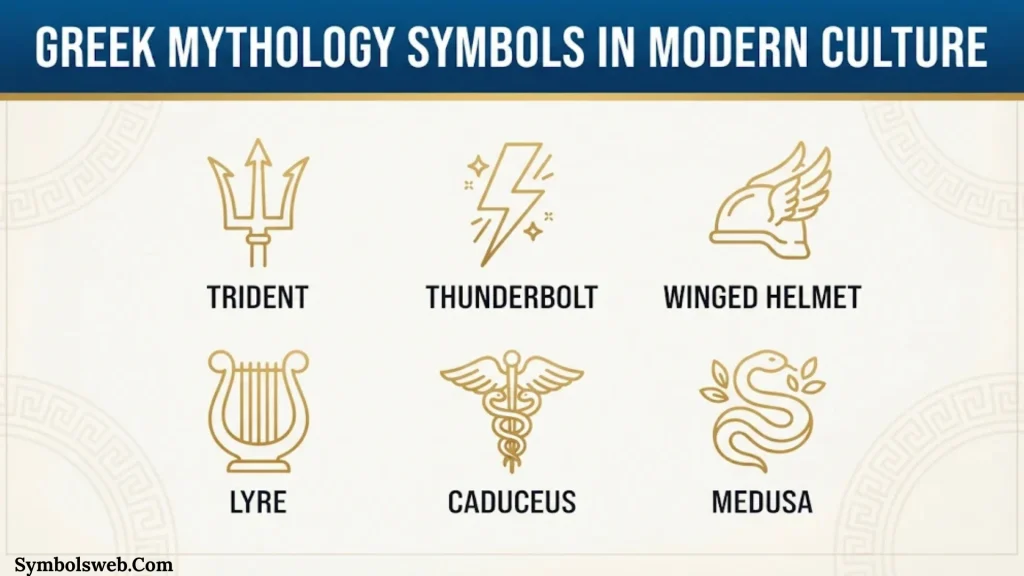
Greek mythology continues to influence modern life. Its gods, animals, objects, and stories appear in books, films, games, fashion, jewelry, and tattoos.
Greek Mythology Symbols in Tattoos
People often choose mythological symbols because they represent ideas they value.
Some popular choices include:
- Athena’s owl: Wisdom, intelligence, and thoughtful decisions.
- Zeus’s thunderbolt: Power, confidence, and authority.
- Poseidon’s trident: Strength, independence, and connection with the sea.
- Aphrodite’s rose: Love, beauty, and passion.
- Medusa: Protection, transformation, and personal interpretations of resilience.
- Phoenix: Renewal and overcoming difficult experiences.
- Laurel wreath: Achievement, victory, and ambition.
- Rod of Asclepius: Healing and medicine.
Modern tattoo meanings don’t always match ancient interpretations. A design can carry personal meaning even when its historical background is different.
Greek Mythology Symbols in Jewelry
Greek inspired jewelry often includes:
- Laurel wreath pendants
- Owl necklaces
- Medusa designs
- Greek key patterns
- Trident charms
- Serpent bracelets
- Pomegranate motifs
These designs combine classical imagery with modern fashion.
Greek Mythology Symbols in Movies and Games
Greek mythology has influenced many modern entertainment stories.
Films, television shows, and video games frequently use familiar symbols to communicate a character’s identity. A trident suggests Poseidon. A lightning bolt suggests Zeus. An owl may suggest Athena.
However, modern adaptations often change ancient stories to fit their own fictional worlds.
Greek Mythology Symbols Compared With Roman, Egyptian, and Norse Symbols
Greek mythology shares themes and imagery with other ancient traditions. However, similar symbols don’t always carry identical meanings.
| Tradition | Example symbol | Common association |
| Greek | Thunderbolt of Zeus | Divine authority |
| Roman | Thunderbolt of Jupiter | Sky and divine power |
| Egyptian | Ankh | Life |
| Egyptian | Eye of Horus | Protection and well-being |
| Norse | Mjölnir | Thor’s power and protection |
| Norse | Valknut | Associated with imagery of Odin and the dead; interpretation debated |
| Greek | Owl of Athena | Wisdom |
| Roman | Owl in Minerva imagery | Wisdom |
| Greek | Trident of Poseidon | Sea power |
| Hindu | Trishula | Divine power and multiple aspects of existence |
Greek and Roman Symbols
Greek and Roman mythology share many divine figures. Zeus corresponds broadly with Jupiter, Hera with Juno, Athena with Minerva, and Poseidon with Neptune.
However, these gods developed within different religious and cultural settings. Their stories and attributes are not always identical.
Greek and Egyptian Symbols
Greek and Egyptian traditions interacted for centuries. Their religious imagery sometimes influenced each other, especially during the Hellenistic period.
The Egyptian ankh, for example, represents life and should not be treated as an original Greek symbol.
Greek and Norse Symbols
Greek and Norse myths both explore divine power, conflict, fate, and the natural world.
However, symbols such as Thor’s hammer, Mjölnir, belong to Norse mythology rather than Greek religion.
Greek and Hindu Symbols
Some Greek and Hindu symbols share broad themes, such as divine power and protection. That doesn’t mean they have the same origin or meaning.
The trishula, for example, is associated with Hindu deities, particularly Shiva. It is not a Greek version of Poseidon’s trident.
How to Choose a Greek Mythology Symbol
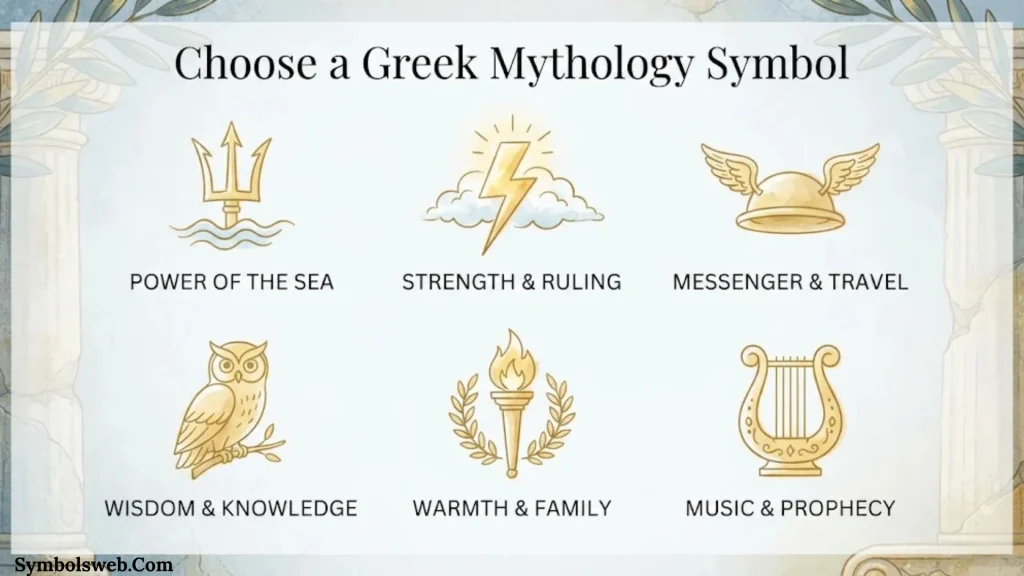
Choosing a Greek mythology symbol becomes easier when you understand the idea behind it. Instead of selecting a design only because it looks attractive, consider the story and meaning you want it to express.
Choose a Symbol Based on Its Meaning
Start with the quality you want the symbol to represent.
| Your chosen meaning | Greek mythology symbol |
| Wisdom | Athena’s owl |
| Strength | Zeus’s thunderbolt |
| Love | Aphrodite’s rose |
| Protection | Gorgoneion |
| Healing | Rod of Asclepius |
| Victory | Apollo’s laurel wreath or Nike’s wings |
| Peace | Athena’s olive tree |
| Independence | Artemis’s bow |
| Renewal | Phoenix |
| Abundance | Cornucopia |
| Guidance | Hecate’s torch |
| Creativity | Apollo’s lyre |
Consider the Historical Meaning
Some symbols have complicated histories. The modern interpretation may differ from the ancient one.
For example, the phoenix is widely used today to represent rising from the ashes. Early Greek descriptions don’t always tell the familiar modern story.
Researching the original myth can help you choose a design with a meaning you understand.
Think About the Visual Design
Consider how the symbol will look in your chosen format.
A simple owl may work well as a small pendant. A detailed depiction of Athena may suit a larger tattoo or artwork.
You can also combine symbols when their stories support your intended message. For example, an owl and olive branch can connect wisdom with peace.
Respect the Cultural Context
Greek mythology is part of a long cultural and religious history. Avoid presenting modern interpretations as unquestioned ancient facts.
A symbol can have personal meaning today while still deserving an accurate historical explanation.
Common Misconceptions About Greek Mythology Symbols
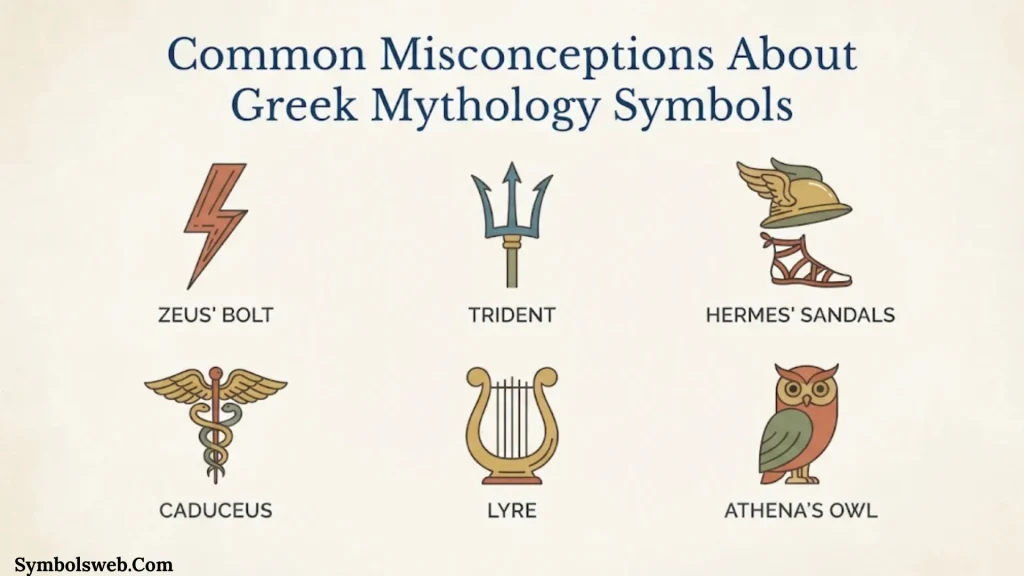
Greek mythology symbols are widely used, but their meanings are sometimes simplified or misunderstood.
The Caduceus Is Not the Traditional Symbol of Asclepius
The caduceus has two snakes and belongs to Hermes. The Rod of Asclepius has one snake and is connected with medicine.
Although the caduceus is sometimes used by modern medical organizations, the Rod of Asclepius has the clearer historical connection to healing.
Helios and Apollo Were Not Always the Same God
Helios personified the sun in early Greek mythology. Apollo had several important roles, including music, prophecy, healing, and archery.
Their identities became more closely connected over time, but they shouldn’t be treated as interchangeable in every ancient source.
The Labrys Is Not Exclusively a Classical Greek Symbol
The labrys, or double-headed axe, is strongly associated with Minoan Crete. It also appears in later contexts and modern interpretations.
Its exact religious and cultural meaning remains debated. It shouldn’t automatically be described as the personal symbol of a particular Olympian god.
The Evil Eye Does Not Belong to One Greek Deity
The evil eye is part of a broad Mediterranean and Near Eastern belief tradition.
Although eye imagery appears in ancient Greek art, the familiar modern blue protective charm shouldn’t be assigned exclusively to Athena, Zeus, or another Greek god.
The Phoenix Story Changed Over Time
The phoenix became a symbol of renewal and rebirth in later traditions. However, early accounts don’t all describe a bird that burns and rises from its own ashes.
The familiar modern version developed through a long history of retelling and interpretation.
The Cornucopia Has Several Divine Associations
The horn of plenty is connected with abundance and nourishment. It appears in stories and images involving different Greek figures.
It’s therefore inaccurate to describe it as a symbol belonging only to Demeter.
Frequently Asked Questions About Greek Mythology Symbols
What Is the Most Famous Symbol in Greek Mythology?
The thunderbolt of Zeus is one of the most recognizable Greek mythology symbols. It represents divine authority, lightning, and the power of the king of the gods. The owl of Athena and Poseidon’s trident are also widely recognized.
What Is the Greek Symbol for Wisdom?
The owl is the best-known symbol of wisdom in Greek mythology. It is associated with Athena, the goddess of wisdom and strategic warfare. The olive tree is another important symbol connected with Athena.
What Is the Greek Symbol for Love?
The rose and dove are commonly associated with Aphrodite, the goddess of love and beauty. Eros’s bow and arrows also represent desire and romantic attraction.
What Is the Greek Symbol for Protection?
The Gorgoneion, an image of Medusa’s head, was used as a protective emblem in ancient Greek art. Athena’s aegis also represents divine protection.
What Is the Greek Symbol for Healing?
The Rod of Asclepius, a staff with one serpent wrapped around it, is the traditional Greek symbol of medicine and healing. It is associated with Asclepius, the god of medicine.
What Does the Owl Symbolize in Greek Mythology?
The owl represents wisdom, intelligence, and observation. It is especially associated with Athena and became a recognizable emblem of ancient Athens.
What Does the Pomegranate Symbolize in Greek Mythology?
The pomegranate is strongly associated with Persephone and her time in the underworld. It can also represent fertility, abundance, and the cycle of seasonal change.
What Does the Laurel Wreath Symbolize?
The laurel wreath represents victory, honor, and achievement. It is closely connected with Apollo and later became a familiar emblem of success.
What Is the Greek Symbol for Strength?
Several Greek symbols represent strength. Zeus’s thunderbolt reflects divine power, Poseidon’s trident represents control over the sea, and the eagle symbolizes authority and might.
What Is the Difference Between Greek and Roman Mythology Symbols?
Greek and Roman mythology share many gods and symbols, but their traditions developed in different cultural settings. Zeus and Jupiter, for example, have similar roles, but their myths and religious identities aren’t always identical.
Conclusion
Greek mythology symbols offer a fascinating way to understand the gods, stories, and beliefs of ancient Greece. The thunderbolt of Zeus, owl of Athena, trident of Poseidon, and laurel wreath of Apollo each communicate ideas about divine power, wisdom, nature, and achievement. Other symbols, such as Aphrodite’s rose, Persephone’s pomegranate, and Asclepius’s serpent, reveal how ancient myths explored love, seasonal change, healing, and renewal.
These symbols remain meaningful because their stories continue to connect with modern life. You might recognize them in a museum, a book, a tattoo, or a piece of jewelry. Learning their original context makes each design more interesting and helps you distinguish historical meanings from modern interpretations.

Jordan Hayes is a writer with a passion for exploring the history, meanings, and cultural significance behind symbols from around the world. He enjoys turning complex topics into clear, engaging content that anyone can understand. Jordan is also the fictional author of The Silent Language of Ancient Marks and Hidden Symbols Beyond the Surface, two original book concepts created for his author profile. When he’s not writing, he spends time researching myths, traditions, and forgotten stories that inspire his work. His goal is to help readers discover the deeper meanings behind the symbols they encounter every day.
 Eliana Foster
 Ethan Holloway