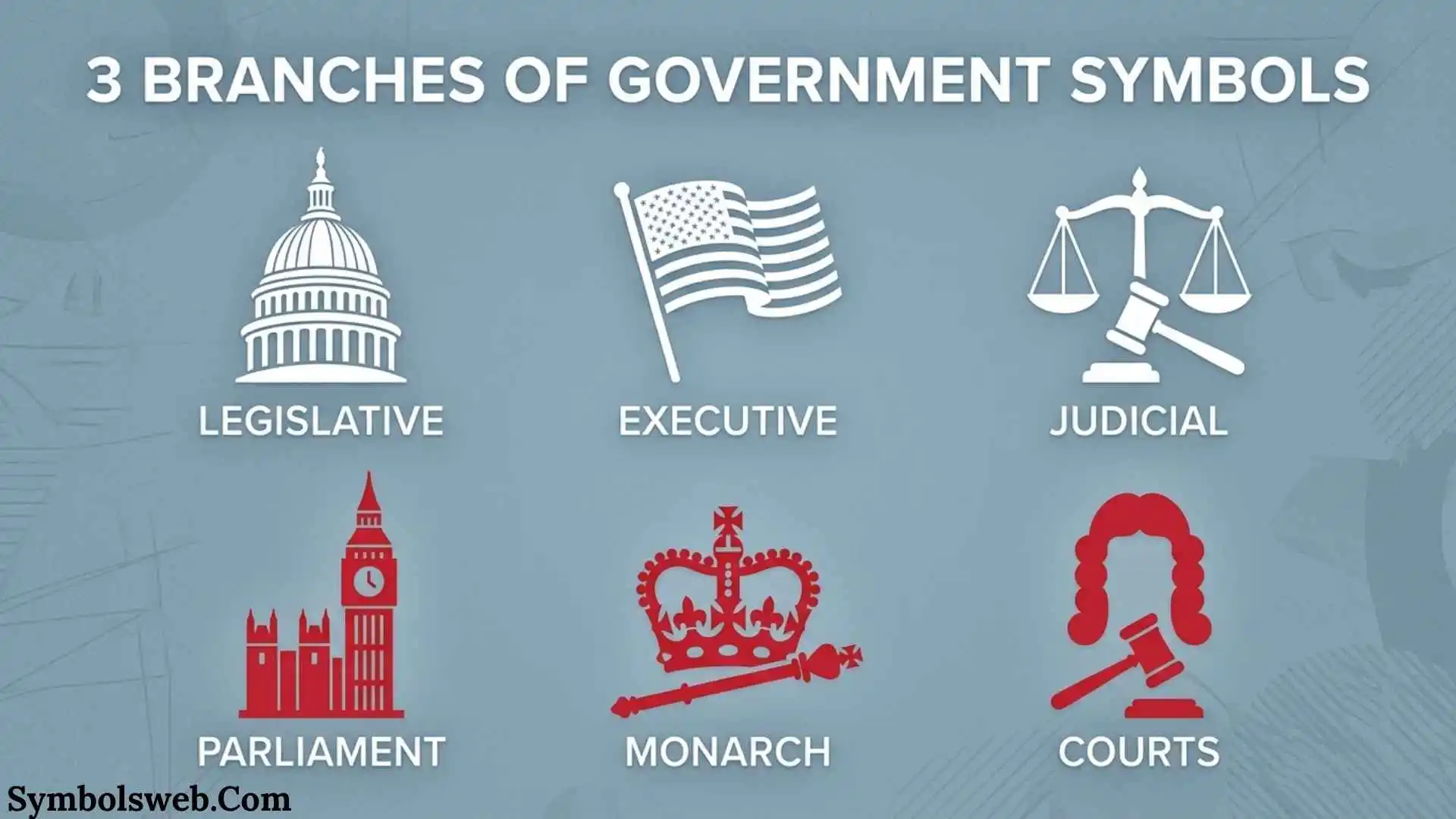
3 branches of government symbols represent one of the most important ideas in American democracy: power should never belong completely to one person or institution. The legislative, executive, and judicial branches each have recognizable symbols, buildings, objects, and images that help people understand their different roles.
From the Capitol dome to the White House and the scales of justice, these symbols turn an abstract constitutional system into something people can see and remember. Behind each image is a deeper story about freedom, law, authority, balance, responsibility, and the protection of individual rights.
3 Branches of Government Symbols: (Quick Answer)
The 3 branches of government symbols are visual representations associated with the legislative, executive, and judicial branches of the U.S. federal government. Common examples include the U.S. Capitol for Congress, the White House and presidential seal for the executive branch, and the Supreme Court Building and scales of justice for the judicial branch. Together, they symbolize separation of powers, checks and balances, law, leadership, and justice.
Quick Facts About 3 Branches of Government Symbols
| Aspect | Information |
| Origin | The three-branch structure comes from the U.S. Constitution, with legislative, executive, and judicial powers associated with Articles I, II, and III. |
| Historical Significance | The system was designed to divide federal power and prevent excessive concentration of authority. |
| Main Meaning | Separation of powers, accountability, representation, law enforcement, and justice. |
| Spiritual Meaning | These symbols can be interpreted more broadly as representing order, balance, responsibility, truth, and the moral use of power. |
| Cultural Importance | They have become part of American civic identity and appear in architecture, art, education, ceremonies, documents, and public life. |
| Modern Usage | Government buildings, official seals, educational materials, legal settings, media, political communication, and civic ceremonies. |
The U.S. Constitution divides the federal government into three branches: legislative, executive, and judicial. The legislative branch is Congress, the executive branch is headed by the President, and the judicial branch consists of the federal courts. The purpose is not simply to create three offices. It is to divide governmental authority so that each branch has important responsibilities and can limit the power of the others.
What Are 3 Branches of Government Symbols?
The phrase “3 branches of government symbols” does not refer to one single official three-part logo. Instead, it describes the visual symbols commonly associated with America’s three constitutional branches.
The three branches are:
- Legislative branch: Congress, made up of the Senate and House of Representatives.
- Executive branch: The President, Vice President, Cabinet, and executive departments and agencies.
- Judicial branch: The Supreme Court and the lower federal courts.
The Constitution gives each branch a different primary role. Congress makes laws, the executive branch carries out and enforces laws, and the judicial branch interprets laws and applies them to cases.
The Historical Origin of the Three Branch System
The idea of dividing political power has roots in much older political thought. Ancient societies had different approaches to law, leadership, courts, councils, and public authority. However, the modern theory of separation of powers became especially influential during the European Enlightenment.
The French political philosopher Montesquieu famously developed the idea of dividing government authority among different functions in The Spirit of the Laws. His work became an important part of the intellectual background surrounding the American constitutional system.
When the U.S. Constitution was written in 1787, its designers created a federal government with three separate branches. Article I establishes Congress, Article II establishes the presidency and executive power, and Article III establishes the federal judiciary.
This arrangement created something more important than three departments. It created a system in which governmental power could be divided, challenged, reviewed, and balanced.
Why Symbols Became Important
Government can be difficult to visualize.
A constitutional provision is powerful, but it is only words on a page. A massive building, a seal, a statue, a courtroom symbol, or an official emblem can make that idea easier to understand.
For example, the Capitol immediately suggests Congress. The White House suggests presidential leadership. A courtroom with scales of justice suggests law and impartial judgment.
These images have become a kind of visual language for the American government.
The Three Main Branches and Their Symbols
Each branch has several symbols rather than one universally designated symbol.
| Branch | Main Institution | Common Symbol | Core Idea |
| Legislative | Congress | U.S. Capitol | Representation and lawmaking |
| Executive | President and executive agencies | White House and Presidential Seal | Leadership and enforcement |
| Judicial | Federal courts | Supreme Court Building and Scales of Justice | Law and impartial judgment |
The U.S. government itself describes the three branches as legislative, executive, and judicial, with their powers vested in Congress, the President, and federal courts respectively.
Legislative Branch Symbols
The U.S. Capitol
The U.S. Capitol is perhaps the most recognizable architectural symbol of the legislative branch.
Congress meets in the Capitol, where the Senate and House of Representatives conduct their work. Because Congress creates federal legislation, the Capitol has become strongly associated with debate, representation, public policy, taxation, national spending, and the lawmaking process.
Symbolically, the Capitol represents an important democratic idea: government should involve discussion.
A law does not simply appear. Members of Congress introduce proposals, debate them, negotiate, vote, and sometimes disagree intensely before legislation becomes law.
That makes the Capitol more than a beautiful building. It represents the idea that public decisions can emerge from a process of representation and debate.
The Capitol Dome
The large dome gives the Capitol much of its visual identity.
Domes have been used for centuries in religious, civic, and governmental architecture. They can create an impression of stability, importance, permanence, and shared public space.
In the American context, the Capitol dome has become a visual reminder of the federal legislative system.
The Statue of Freedom
The Statue of Freedom stands above the Capitol dome.
Her presence adds another layer of meaning to the building. Freedom is not simply a political slogan. It is one of the central ideals associated with American constitutional identity.
The combination of the Capitol and the Statue of Freedom creates a powerful visual message: lawmaking is connected to the protection of liberty.
The Mace of the House of Representatives
Another lesser-known symbol is the Mace of the U.S. House of Representatives.
The ceremonial mace is displayed in the House chamber when the House is in session. It represents the authority of the House and has roots in older European parliamentary traditions.
Its symbolism is particularly interesting because it reminds us that government symbols are not always modern inventions. Some carry traditions forward from much older political cultures.
Executive Branch Symbols
The White House
The White House is the most recognizable physical symbol of the executive branch.
The President heads the executive branch and is responsible for implementing and enforcing federal laws. The executive branch also includes the Vice President, Cabinet departments, and numerous federal agencies.
For many people around the world, the White House is almost instantly associated with the American presidency.
It can symbolize:
- Presidential leadership
- Executive authority
- National administration
- Diplomacy
- Government decision-making
- The responsibilities of the presidency
The building therefore carries both political and emotional meaning.
When people see the White House in a photograph, they may think about elections, presidential decisions, national crises, foreign policy, celebrations, or moments of historical change.
The Presidential Seal
The Presidential Seal is another major symbol connected with the executive branch.
It features the bald eagle, which is also a national symbol of the United States. The eagle holds an olive branch and arrows, creating a visual contrast between peace and military strength.
This symbolism connects presidential authority with national security, diplomacy, leadership, and the responsibility to protect the country.
The Presidential Flag
The Presidential Flag also uses the eagle as its central image.
Like other official government symbols, it helps identify presidential authority in ceremonies and official settings.
The important point is that the presidential eagle should not be confused with every other eagle symbol used by the federal government. The bald eagle is a broad national emblem that appears in many official contexts.
Judicial Branch Symbols
The Supreme Court Building
The Supreme Court Building is the most recognizable architectural symbol of the federal judicial branch.
The Supreme Court is the highest court in the United States and is the only federal court specifically established by the Constitution. Federal courts interpret law, decide cases, and determine constitutional questions that come before them.
The building’s classical architecture contributes to its symbolic character.
It communicates seriousness, stability, tradition, and the importance of law.
The Scales of Justice
The scales of justice are among the world’s best-known legal symbols.
They represent the weighing of competing claims or evidence. In the Supreme Court Building, traditional legal imagery includes scales, books of law, tablets, and scrolls.
The Supreme Court explains that the scales symbolize impartial deliberation, meaning that competing sides in a legal dispute are weighed carefully.
The symbolism is simple but powerful.
One side makes an argument.
The other side makes an argument.
Justice requires careful consideration rather than automatic loyalty to either side.
Lady Justice
Lady Justice is another important symbol associated with courts and law.
She is commonly depicted as a woman holding scales and sometimes a sword. In many modern representations, she also wears a blindfold.
The blindfold is commonly interpreted as impartiality. The scales represent weighing competing claims, while the sword can represent the authority of law.
However, Lady Justice is not the official symbol of the entire judicial branch in the same way that the Supreme Court Building is a recognizable institutional symbol.
She is better understood as a broader cultural and artistic symbol of justice.
The Great Seal and the Three Branches
The Great Seal of the United States deserves special attention because it is a national symbol rather than a symbol belonging exclusively to one branch.
The Great Seal was officially adopted by the Continental Congress on June 20, 1782. It represents American sovereignty, independence, and self-government.
The Bald Eagle
The bald eagle is the central figure on the front of the Great Seal.
It represents national strength and independence.
The Olive Branch
The eagle holds an olive branch.
The olive branch represents peace.
The Arrows
The eagle also holds thirteen arrows.
Together with the olive branch, the arrows symbolize the nation’s power in relation to peace and war. The eagle’s orientation toward the olive branch has traditionally been understood as emphasizing a preference for peace.
E Pluribus Unum
The phrase E Pluribus Unum means “Out of many, one.”
It expresses the idea that separate states and communities form one nation.
This is especially relevant to the broader symbolism of the three branches because the branches are separate but operate within one constitutional system.
The Number 13
The number thirteen appears repeatedly in the Great Seal.
It represents the original thirteen states. Thirteen stars, thirteen arrows, and thirteen stripes on the shield all connect the design to the nation’s founding period.
Deep Symbolic Meaning of 3 Branches of Government Symbols
The three branches are more than a civics lesson.
They represent a philosophy of power.
Spiritual Level
The three branches do not have an official religious or spiritual meaning.
However, people can interpret their structure symbolically through broader human ideas such as balance, responsibility, restraint, order, and moral judgment.
The basic message is powerful:
Power should be balanced by responsibility.
A leader may have authority, but authority has limits.
A legislature may create laws, but those laws can be challenged.
A court may interpret laws, but courts operate within a constitutional system.
This creates a symbolic relationship between power and restraint.
Inner Transformation and Consciousness
On a personal level, the three branches can also be used as a metaphor.
Imagine a person as a small government.
One part creates rules and plans.
Another part takes action.
Another part evaluates whether those actions are fair and consistent with deeper principles.
In this metaphor:
- Legislative thinking creates rules.
- Executive thinking turns decisions into action.
- Judicial thinking evaluates choices.
This is not a constitutional interpretation. It is a psychological metaphor.
Yet it can help explain why the idea of balance feels familiar to people.
Human beings constantly balance desire, action, judgment, responsibility, and consequences.
Psychological Level
The symbolism of separation of powers also connects with a basic psychological concern: the fear of uncontrolled power.
People understand what happens when one individual or group can make every decision without limits.
The three-branch structure communicates a different message.
Power is divided.
Authority is checked.
Decisions can be questioned.
That can create a psychological sense of order and security.
Jungian Symbolism and Archetypes
From a Jungian perspective, symbols often work because they connect with broad human archetypes.
The leader can resemble the ruler archetype.
The judge can resemble the wise elder or moral authority.
The lawmaker can resemble the organizer who creates rules for the community.
These interpretations are psychological and cultural rather than official meanings of the U.S. Constitution.
Still, they help explain why government imagery can feel emotionally powerful.
Cultural Meaning of the Three Branches
American government symbols have become part of civic culture.
Children encounter them in school.
Tourists see them in Washington, D.C.
Artists reproduce them in paintings and illustrations.
Journalists use them when discussing the government.
Politicians reference them during speeches and campaigns.
The symbols therefore exist at several levels at once.
They are governmental.
They are historical.
They are educational.
They are cultural.
And sometimes they become deeply personal.
For an immigrant who becomes a U.S. citizen, the Capitol or Constitution may represent a new beginning.
For a student studying civics, the same building may represent a lesson.
For a lawyer, a courtroom symbol may represent professional responsibility.
For another person, the same image may bring up arguments about political power.
A symbol can carry different emotions while retaining its basic historical meaning.
3 Branches of Government Symbols Across Different Cultures
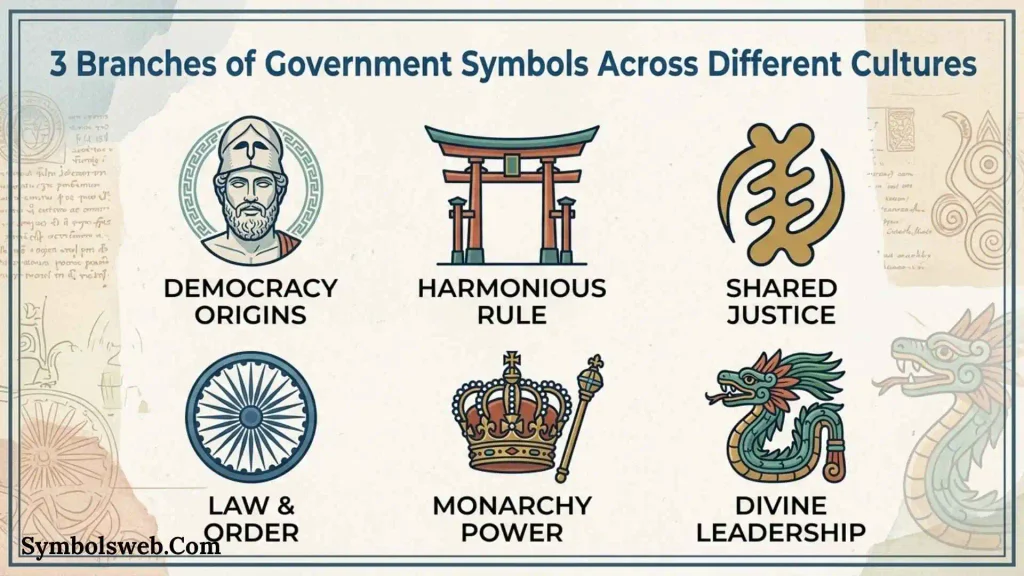
The American three-branch system is specifically rooted in U.S. constitutional history. It should not be incorrectly presented as an ancient Egyptian, Greek, Roman, or indigenous system.
However, the individual symbolic ideas surrounding law, authority, justice, leadership, and balance have much older cultural roots.
Ancient Egypt
Ancient Egyptian civilization developed powerful symbols of kingship, order, and justice.
One of the most important concepts was Ma’at, associated with truth, justice, harmony, order, and cosmic balance.
Ma’at is not a symbol of the U.S. three-branch government.
However, it provides an interesting cultural comparison because both systems use the idea of maintaining order against chaos.
Ancient Egyptian imagery often connected legitimate rule with maintaining cosmic and social balance.
Ancient Greece
Ancient Greece contributed heavily to Western political thought.
Greek city-states experimented with different forms of government, including monarchy, oligarchy, democracy, and mixed political arrangements.
Athens is particularly important because of its development of democratic institutions.
Greek philosophical debates about citizenship, law, justice, and political authority influenced later Western political thought.
The Greek connection is therefore more intellectual than symbolic. The U.S. three-branch system did not simply copy an ancient Greek government.
Roman Culture
Roman civilization contributed important ideas about law, republican government, civic authority, and political institutions.
Roman symbols such as the fasces became associated with authority and public office.
Interestingly, the fasces later appeared in American government architecture and symbolism, including federal buildings.
Its presence demonstrates how political symbols can travel across centuries and cultures, sometimes changing meaning along the way.
Eastern Traditions
Many Eastern philosophical and religious traditions contain ideas related to balance, harmony, duty, justice, and responsible leadership.
For example, Confucian political thought emphasizes moral conduct, social responsibility, proper relationships, and the responsibilities of rulers.
These ideas are not equivalent to American separation of powers.
However, both traditions show how societies have long asked a similar question:
How should human power be controlled so that society can remain stable and just?
Indigenous Traditions
Indigenous nations in North America developed many different political systems long before the United States existed.
The Haudenosaunee Confederacy is especially important in discussions of American political history because it created a sophisticated system of alliance and governance among several nations.
It is important not to reduce these traditions to a simple claim that they “created” the U.S. Constitution. Scholars debate the extent and nature of influence.
What can be said confidently is that Indigenous political traditions demonstrate that complex systems of governance existed in North America before the United States was founded.
Modern Interpretations
Today, the three branches are often represented through simplified icons.
A Capitol dome may stand for Congress.
A White House silhouette may stand for the presidency.
A courthouse or scales may stand for the judiciary.
These simplified images allow complicated constitutional concepts to be communicated quickly.
That is particularly useful in education, news graphics, websites, infographics, and social media.
Similar Symbols and Their Meanings
Many symbols connected with government and law can look similar, but their meanings are not identical.
| Symbol | Main Association | Common Meaning |
| U.S. Capitol | Legislative branch | Lawmaking and representation |
| White House | Executive branch | Presidential leadership |
| Supreme Court Building | Judicial branch | Constitutional law and judicial authority |
| Scales of Justice | Law and courts | Balance and impartial judgment |
| Lady Justice | Justice and law | Fairness and impartiality |
| Bald Eagle | United States | National strength and sovereignty |
| Great Seal | U.S. federal government | Sovereignty, unity, and self-government |
| Statue of Freedom | U.S. Capitol | Freedom and liberty |
The Capitol vs. White House
The Capitol represents Congress and the legislative process.
The White House represents the presidency and executive leadership.
One is strongly associated with lawmaking.
The other is strongly associated with executing and administering federal law.
White House vs. Supreme Court
Both are symbols of federal authority, but their constitutional functions are different.
The White House represents executive power.
The Supreme Court represents judicial power.
The distinction is central to the idea of separation of powers.
Scales of Justice vs. Lady Justice
The scales are a specific visual symbol of weighing and impartial judgment.
Lady Justice is a personification of justice.
She may hold scales, a sword, and sometimes wear a blindfold.
They are closely related but are not interchangeable in every context.
Common Misconceptions About the Three Branches
There Is Not One Official Symbol for Each Branch
People sometimes search for “the official symbol of the legislative branch” as if each branch has one universally designated logo.
That is misleading.
Each branch has multiple symbols and recognizable institutions.
The Capitol is strongly associated with Congress, but it is not the only legislative symbol.
The White House is strongly associated with the executive branch, but the executive branch includes many departments and agencies.
The Supreme Court Building is strongly associated with the judiciary, but the judicial branch includes the broader federal court system.
The Great Seal Does Not Belong to Only One Branch
The Great Seal is a national symbol.
It should not be treated as the exclusive emblem of Congress, the presidency, or the courts.
It appears on official documents, passports, treaties, and other federal materials.
The Three Branches Are Not Completely Independent
Separation of powers does not mean that the branches operate in isolation.
They are designed to interact.
For example, the President nominates federal judges, the Senate confirms them, and the courts interpret laws passed by Congress.
This interaction is part of the checks and balances system.
3 Branches of Government Symbols in Mythology and Folklore
The American three-branch system itself is not a mythological symbol.
However, some individual images used in American government have much older cultural histories.
The Eagle
Birds of prey have represented power, vision, courage, and authority in many cultures.
The American bald eagle became the national emblem of the United States in 1782 and was incorporated into the Great Seal.
The Olive Branch
The olive branch has a long history as a symbol of peace.
Its appearance alongside arrows on the Great Seal creates a visual contrast between the desire for peace and the ability to defend the nation.
The Scales
The scales of justice developed from a long tradition of representing judgment through weighing.
The image works because weighing suggests careful comparison rather than immediate emotional reaction.
Lady Justice
Lady Justice developed from classical traditions of personifying justice.
Her modern image combines older ideas with later artistic conventions.
That is why she appears in courthouses, legal illustrations, books, films, logos, and tattoos around the world.
3 Branches of Government Symbols in Art, Literature, Movies and Pop Culture
Government symbols are particularly effective in visual storytelling because viewers can recognize them immediately.
Paintings and Visual Art
Artists often use the Capitol, eagle, flag, courthouse, or scales to communicate ideas about democracy and national identity.
A government building can represent the state itself without showing a single politician.
Literature
Writers frequently use political symbols as shorthand for larger ideas.
A courthouse can represent justice.
A government building can represent authority.
A presidential seal can represent executive power.
A damaged or abandoned government building can symbolize political instability or social conflict.
Movies and Television
Films and television programs often show the White House, Capitol, or Supreme Court when a story involves national politics.
The image immediately tells viewers that the stakes are national rather than local.
Tattoos
Government symbols can also become personal tattoo designs.
Someone may choose the scales of justice to represent fairness.
Another person may choose an eagle to represent strength or freedom.
A Capitol design might represent American identity or political interest.
The meaning depends heavily on the individual.
Fashion and Modern Design
Government imagery appears in clothing, posters, graphic design, political campaigns, educational materials, and patriotic merchandise.
Modern designers often simplify complex symbols into clean silhouettes.
A recognizable dome or eagle can communicate a concept within seconds.
Spiritual and Dream Meaning of 3 Branches of Government Symbols
There is no official spiritual interpretation of the three branches of government.
Dream and spiritual meanings are personal rather than constitutional facts.
Still, symbolic interpretation can be useful when clearly presented as interpretation rather than historical truth.
Dreaming About the Capitol
A Capitol building in a dream might be interpreted as a symbol of authority, decision-making, public responsibility, or the need to make an important choice.
Dreaming About the White House
A White House might symbolize leadership, responsibility, recognition, ambition, or a desire to influence events.
Dreaming About a Courtroom
A courtroom may represent judgment, accountability, fairness, guilt, conflict, or the need to make peace with a difficult decision.
Dreaming About Scales
Scales may symbolize the need to balance two competing choices.
For example, someone struggling between career and family might dream about scales because their mind is trying to weigh competing priorities.
These interpretations are psychological possibilities, not scientific predictions.
A Positive Spiritual Interpretation
At a symbolic level, the three branches can represent:
- Balance
- Responsibility
- Self-control
- Justice
- Order
- Wisdom
- Protection of freedom
- Respect for limits
A Cautionary Interpretation
The same symbols can also represent:
- Excessive authority
- Political conflict
- Fear of judgment
- Bureaucracy
- Power struggles
- Distrust of institutions
- Anxiety about rules
The meaning depends on context.
Positive and Negative Meanings of 3 Branches of Government Symbols
| Positive Meaning | Negative Meaning |
| Balance | Political conflict |
| Justice | Fear of judgment |
| Freedom | Abuse of authority |
| Accountability | Bureaucracy |
| Representation | Partisan division |
| Stability | Institutional rigidity |
| Law and order | Excessive control |
| Responsible leadership | Concentration of power |
A powerful symbol can contain both light and shadow.
A courthouse can represent justice, but someone facing a legal dispute may associate it with fear.
A presidential symbol can represent leadership, but another person may associate it with political disagreement.
A Capitol can represent democracy, but it can also remind people of intense political conflict.
This emotional flexibility is one reason symbols remain powerful.
Why Humans Are Attracted to 3 Branches of Government Symbols
Human beings naturally use symbols to make complicated ideas easier to understand.
A political system contains thousands of rules, institutions, relationships, and procedures.
People cannot carry all of that information in their minds at once.
Symbols compress meaning.
A Capitol can stand for Congress.
A courthouse can stand for the justice system.
A presidential seal can stand for executive authority.
This is connected to pattern recognition, memory, emotion, and cultural learning.
Human Nature and Authority
Humans have lived in organized communities for thousands of years.
Every large society must answer questions about authority:
Who makes the rules?
Who enforces them?
Who decides whether they were followed correctly?
The three branches provide one constitutional answer to these questions.
Emotional Connection
Government symbols can become attached to major life events.
A person might see the Capitol during a school trip.
Another might see the White House during a historic presidential election.
Someone else might enter a courthouse during a deeply personal legal matter.
The symbol then becomes connected to memory.
Collective Symbolism
A symbol can become part of collective cultural memory.
Millions of people may never enter the Supreme Court Building, yet they recognize it.
That recognition gives the building cultural power beyond its physical location.
Modern Uses of 3 Branches of Government Symbols
Education
Schools use simplified government symbols to teach students about the Constitution and civic institutions.
Government educational resources also use visual representations to explain the three branches to younger audiences.
News and Journalism
News organizations often use the Capitol, White House, and Supreme Court as visual shorthand.
A viewer can often identify the topic of a story before reading the headline.
Tattoos and Personal Expression
Individuals may use legal, patriotic, or governmental imagery to express personal values.
The same symbol can mean justice, patriotism, freedom, political identity, or personal responsibility.
Branding and Graphic Design
Government-related symbols are often adapted into educational websites, civic organizations, historical projects, museums, and political communication.
However, official government seals and emblems may be subject to specific rules governing their use.
Social Media
The symbols have become particularly useful in digital communication.
A simple Capitol or scales icon can instantly communicate “Congress,” “government,” “law,” or “justice.”
Contemporary Spirituality
Some people use ideas of balance, justice, and responsible power in personal spiritual reflection.
This is a modern personal interpretation, not an official spiritual doctrine of the U.S. government.
Home Decor
Capitol imagery, eagle designs, scales, flags, and other government-related imagery can appear in offices, libraries, study rooms, and patriotic home decor.
Interesting Facts About 3 Branches of Government Symbols
1. The Three Branches Come From the Constitution
The federal government’s three branches are rooted in the U.S. Constitution. Articles I, II, and III establish the legislative, executive, and judicial branches respectively.
2. The Great Seal Took Years to Develop
The process of designing the Great Seal began shortly after the Declaration of Independence and went through several committees and proposals before the final design was adopted in 1782.
3. The Bald Eagle Became a National Emblem in 1782
Congress designated the bald eagle as the national emblem in 1782, and it became deeply connected with official American symbolism.
4. The Great Seal Contains Repeated References to 13
The original thirteen states are represented by thirteen stars, thirteen arrows, and thirteen stripes on the shield.
5. The Scales of Justice Have a Deeper History Than the U.S.
The scales are part of a much older tradition of using weighing as a metaphor for judgment and fairness. The Supreme Court Building incorporates this traditional legal imagery.
6. The Great Seal Is Still Used Today
The Great Seal appears on official government documents and is also visible to the public on items such as U.S. passports and the reverse of the one-dollar bill.
7. The Three Branches Are Designed to Work Together
The branches have separate powers, but they also interact through checks and balances. The system is designed to prevent one branch from becoming too powerful.
8. The Three-Branch Structure Is Not Limited to Washington
State governments also commonly use executive, legislative, and judicial branches, although the U.S. Constitution does not require every state to copy the federal three-branch structure exactly.
9. Government Symbols Can Be Architectural
A symbol does not have to be an emblem or logo.
Buildings such as the Capitol, White House, and Supreme Court Building can function as powerful symbols because their appearance and location have become connected with particular institutions.
10. Symbols Can Outlive Political Leaders
Presidents, senators, representatives, and judges change.
The institutions remain.
That is one reason buildings and traditional symbols can become more enduring than individual political figures.
Frequently Asked Questions
What are the three branches of government and their symbols?
The three branches of the U.S. federal government are legislative, executive, and judicial. The U.S. Capitol commonly represents the legislative branch, the White House and presidential imagery represent the executive branch, and the Supreme Court Building and scales of justice commonly represent the judicial branch.
What does the legislative branch symbol represent?
The U.S. Capitol is the best-known symbol of the legislative branch. It represents Congress, lawmaking, representation, debate, and the constitutional role of the House of Representatives and Senate.
What is the symbol of the executive branch?
The White House and the Presidential Seal are among the most recognizable symbols of the executive branch. They represent presidential leadership, executive authority, and the administration and enforcement of federal law.
What symbolizes the judicial branch?
The Supreme Court Building is a major institutional symbol of the judicial branch. The scales of justice and Lady Justice are also widely recognized cultural symbols of law, fairness, and judicial judgment. The Supreme Court itself identifies scales, books, tablets, and scrolls among the traditional legal symbols used in its architecture.
What do the three branches of government symbolize?
Together, the three branches symbolize separation of powers, checks and balances, accountability, representation, executive responsibility, and judicial interpretation. Their deeper message is that governmental power should be divided rather than concentrated in one institution.
Is the Great Seal a symbol of the three branches?
The Great Seal is better understood as a national symbol of the United States rather than a symbol belonging to the three branches individually. Its imagery represents sovereignty, independence, unity, peace, defense, and self-government.
Conclusion
The 3 branches of government symbols tell a much larger story than the names of three institutions. The Capitol represents representation and lawmaking, the White House represents executive leadership, and the Supreme Court represents law and judgment.
Together, they express a central democratic idea: power is strongest when it is balanced by responsibility and limits. Behind every dome, seal, eagle, and scale is a reminder that government is ultimately about people, their rights, and the difficult work of keeping freedom and authority in balance.

Eliana Foster is a writer with a passion for exploring the meanings behind symbols, traditions, and cultural history. She enjoys breaking down complex topics into simple, engaging articles that are easy for everyone to understand. Eliana is also the fictional author of The Hidden Language of Silent Marks and Beyond the Circle of Ancient Signs, two original book concepts created for her author profile. When she’s not writing, she loves visiting museums, reading about mythology, and researching the stories behind symbols from around the world. Her goal is to help readers discover the fascinating meanings hidden in everyday signs and ancient emblems.
 Jordan Hayes
 Ethan Holloway