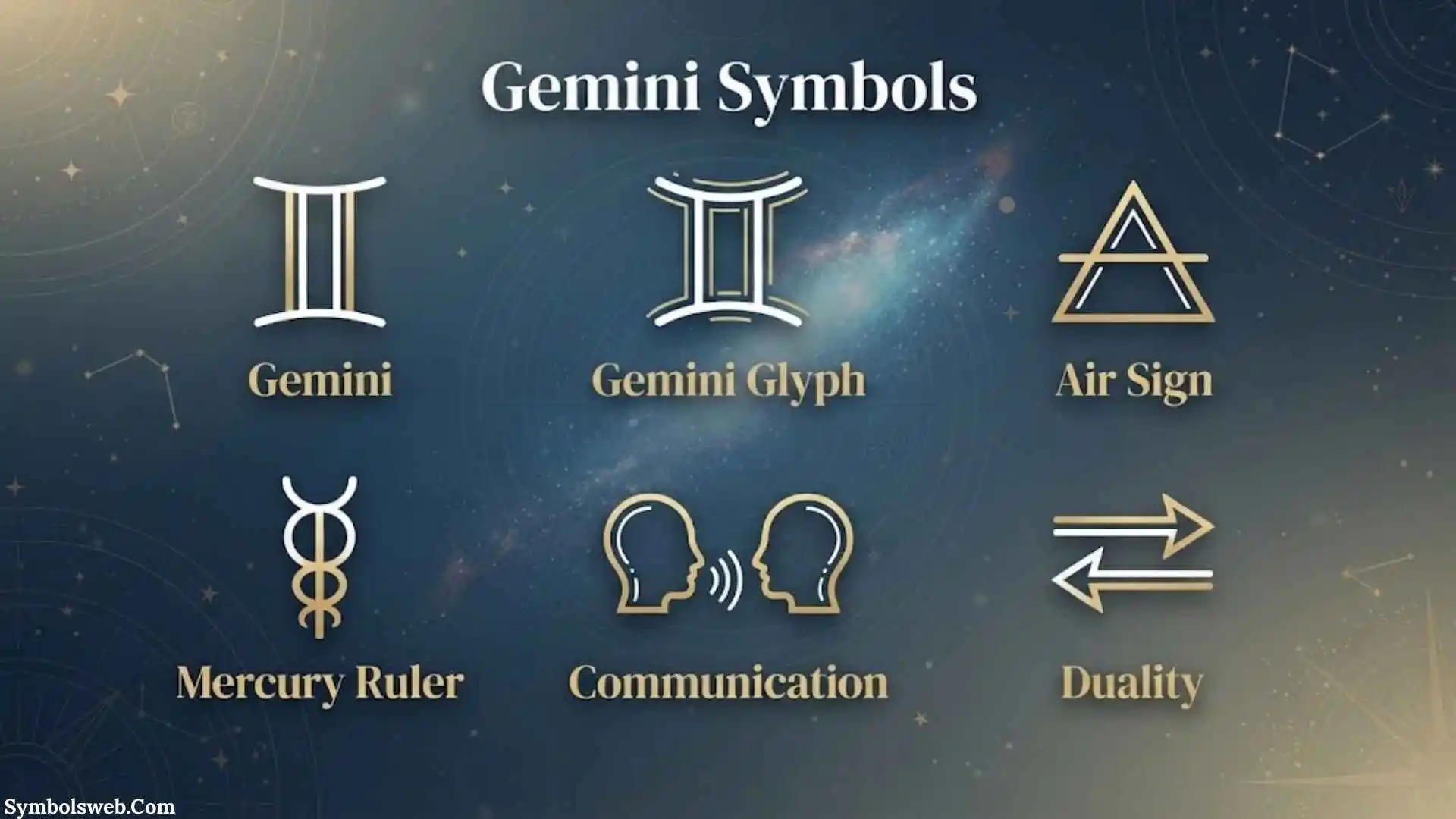
Gemini symbols have fascinated people for centuries because they represent one of humanity’s most enduring mysteries: duality. From ancient mythology to modern astrology, these symbols capture the idea that every person contains multiple sides, strengths, emotions, and possibilities.
If you are interested in astrology, symbolism, spirituality, psychology, or cultural history, Gemini symbols offer a rich world of meaning. They tell stories about balance, communication, curiosity, transformation, and the relationship between opposites.
In this guide, you will discover the history, symbolism, spiritual significance, psychological interpretations, and cultural meanings behind Gemini symbols across civilizations and time.
Gemini Symbols: (Quick Answer)
Gemini symbols are visual representations associated with the Gemini zodiac sign, traditionally symbolized by twins. They represent duality, communication, adaptability, intelligence, curiosity, balance, and the connection between opposing forces. Spiritually and psychologically, Gemini symbols reflect the complexity of human nature and the ability to see multiple perspectives.
Quick Facts About Gemini Symbols
| Aspect | Information |
| Origin | Ancient Greek mythology and Babylonian astrology |
| Historical Significance | Represents the twin brothers Castor and Pollux |
| Main Meaning | Duality, communication, adaptability |
| Spiritual Meaning | Balance between opposing energies |
| Cultural Importance | Widely used in astrology and symbolic traditions |
| Modern Usage | Astrology, jewelry, tattoos, fashion, art, and spirituality |
What Are Gemini Symbols?
Gemini symbols are symbolic images connected to Gemini, the third sign of the zodiac. The most recognized Gemini symbol is the Twins, usually represented by two identical figures standing together.
The zodiac sign Gemini spans approximately from May 21 to June 20 and is associated with the element of air. In astrology, Gemini is ruled by the planet Mercury, which governs communication, learning, intelligence, and movement.
Historically, Gemini symbolism can be traced back thousands of years to Mesopotamian star traditions. Ancient astronomers observed twin stars in the constellation Gemini and associated them with divine twins and dual forces.
Over time, the symbol evolved into one of the most recognizable images in astrology. Today, Gemini symbols continue to represent adaptability, intellectual curiosity, social connection, and the fascinating complexity of human personality.
Deep Symbolic Meaning of Gemini Symbols
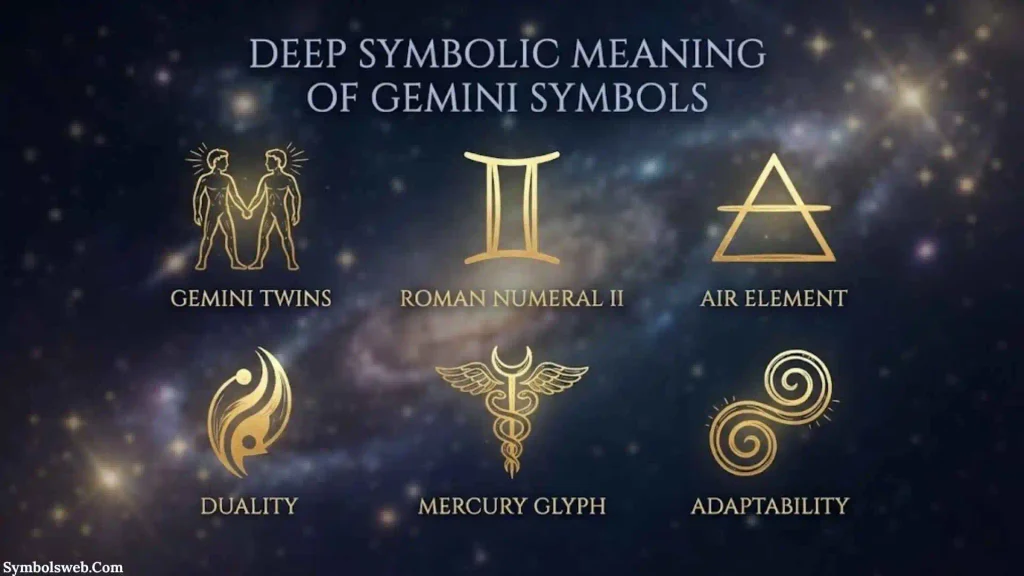
Spiritual Level
On a spiritual level, Gemini symbols represent the journey toward inner balance.
The twins symbolize two forces existing within every human being:
- Logic and intuition
- Light and shadow
- Action and reflection
- Physical and spiritual awareness
Many spiritual traditions teach that growth comes from integrating opposing aspects of ourselves. Gemini symbolism reflects this process of uniting dual energies into a more complete self.
Spiritually, the twins remind us that wisdom often comes from seeing more than one side of a situation.
Psychological Level
From a psychological perspective, Gemini symbols resonate deeply with the complexity of human nature.
Swiss psychologist Carl Jung discussed concepts such as the shadow self and the integration of different personality aspects. Gemini symbolism aligns closely with these ideas.
Psychologically, Gemini symbols can represent:
- Multiple identities
- Internal dialogue
- Curiosity
- Mental flexibility
- Adaptability
People are naturally drawn to Gemini symbolism because it reflects the reality that humans are rarely one-dimensional.
Cultural Level
Across cultures, twin symbols often represent cooperation, balance, and interconnectedness.
Stories of twins appear in myths worldwide because they illustrate universal human experiences such as:
- Brotherhood
- Partnership
- Conflict and harmony
- Life and death
- Mortality and immortality
Gemini symbolism continues to connect communities through shared stories about relationships and duality.
Types and Variations of Gemini Symbols
The Twin Figures
Visual Description: Two identical human figures.
Meaning: Duality and partnership.
Symbolism: Balance between opposing forces.
Cultural Connection: Greek mythology and astrology.
Where It Appears: Astrology charts, artwork, jewelry, tattoos.
Roman Numeral II Symbol
Visual Description: A symbol resembling the Roman numeral II.
Meaning: The official astrological glyph for Gemini.
Symbolism: Two connected pillars representing twins.
Cultural Connection: Western astrology.
Where It Appears: Horoscopes, zodiac charts, spiritual artwork.
Castor and Pollux
Visual Description: Twin brothers represented in art and constellations.
Meaning: Brotherhood and loyalty.
Symbolism: Human and divine aspects united.
Cultural Connection: Ancient Greece.
Where It Appears: Mythology, literature, astronomy.
Twin Stars of Gemini
Visual Description: Two bright stars in the Gemini constellation.
Meaning: Cosmic duality.
Symbolism: Unity despite differences.
Cultural Connection: Ancient astronomy.
Where It Appears: Star maps and celestial traditions.
Gemini Symbols Across Different Cultures
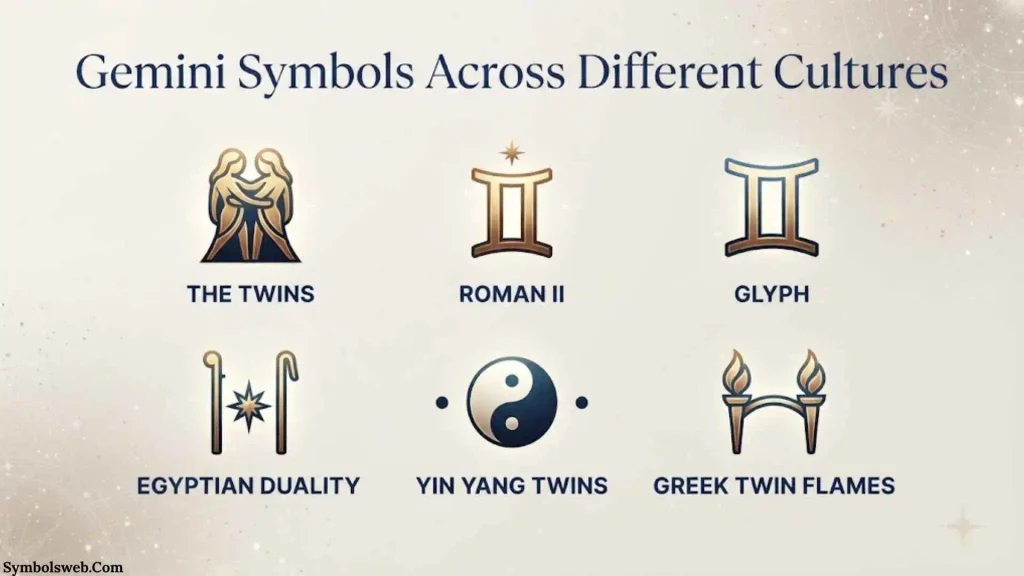
Ancient Egypt
Ancient Egyptian traditions often viewed paired deities as expressions of balance and cosmic order. Although Gemini itself was not central to Egyptian astrology, twin imagery frequently symbolized harmony between opposing forces.
Ancient Greece
Gemini symbolism became strongly associated with the legendary twin brothers Castor and Pollux.
According to Greek mythology, Castor was mortal while Pollux possessed divine immortality. Their devotion to one another became a powerful symbol of loyalty and sacrifice.
Roman Culture
The Romans adopted the Greek story and revered Castor and Pollux as protectors of travelers, sailors, and soldiers.
Their images appeared on coins, temples, and military standards.
Eastern Traditions
Many Eastern philosophies emphasize balance between complementary forces.
Concepts such as yin and yang share thematic similarities with Gemini symbolism because both explore harmony between apparent opposites.
Indigenous Traditions
Many Indigenous cultures feature stories about twin heroes, creator twins, or cosmic siblings.
These stories often explain creation, balance, and the relationship between humanity and nature.
Modern Interpretations
Today, Gemini symbols are associated with:
- Communication
- Intelligence
- Adaptability
- Creativity
- Social connection
- Personal growth
Modern spirituality often views Gemini as a symbol of lifelong learning and self-discovery.
Similar Symbols and Their Meanings
| Symbol | Similarity to Gemini | Key Difference |
| Yin Yang | Balance of opposites | Focuses on cosmic harmony |
| Twins | Shared duality | Not always linked to astrology |
| Mirror Symbol | Reflection and identity | Less emphasis on partnership |
| Janus | Two perspectives | Roman god of beginnings and endings |
| Butterfly | Transformation | Focuses on change rather than duality |
Common Misconceptions
One common misconception is that Gemini symbols represent dishonesty or having “two faces.”
In reality, the symbolism primarily refers to adaptability, versatility, and the ability to understand multiple viewpoints.
Gemini Symbols in Mythology and Folklore
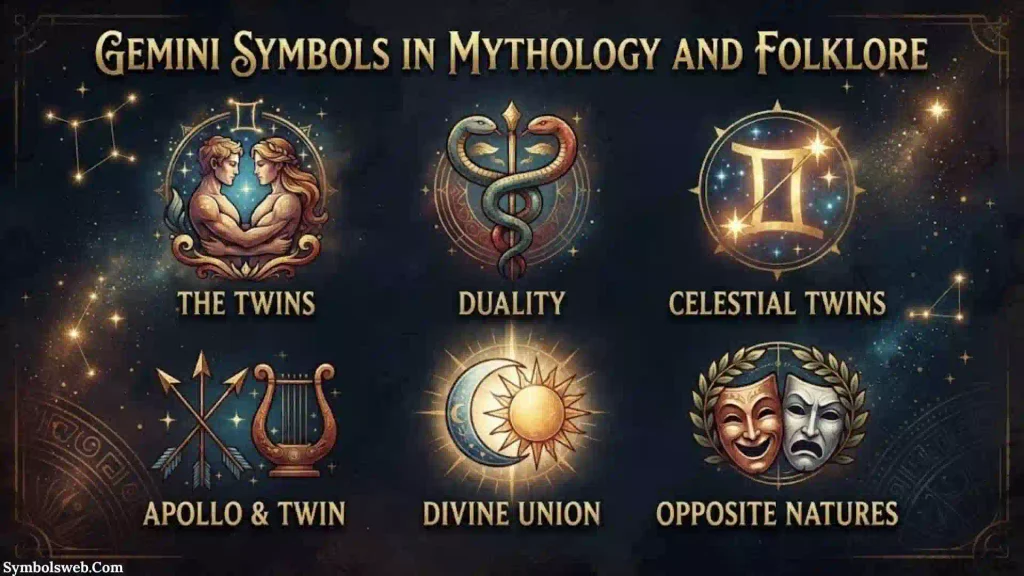
The most famous Gemini story comes from Greek mythology.
Castor and Pollux were inseparable brothers. When Castor died, Pollux begged the king of the gods, Zeus, to allow them to remain together.
Moved by his devotion, Zeus placed both brothers among the stars as the constellation Gemini.
This story transformed Gemini into a symbol of:
- Loyalty
- Sacrifice
- Brotherhood
- Eternal connection
- Love beyond death
Folklore around the world often uses twins to represent complementary forces working together to maintain balance.
Gemini Symbols in Art, Literature, Movies and Pop Culture
Paintings
Artists frequently use Gemini imagery to explore identity, relationships, and internal conflict.
Literature
Many novels and poems use twin characters to symbolize dual personalities or contrasting viewpoints.
Poetry
Poets often employ Gemini symbolism to explore themes of love, memory, self-discovery, and human contradiction.
Movies and Television
Gemini-inspired characters frequently display:
- Intelligence
- Wit
- Adaptability
- Complex personalities
Twin characters often serve as symbolic representations of human duality.
Tattoos
Gemini tattoos remain among the most popular zodiac designs.
Common choices include:
- Twin figures
- Gemini glyph
- Constellation tattoos
- Celestial artwork
Fashion and Modern Design
Gemini symbols appear in:
- Jewelry collections
- Zodiac-themed clothing
- Home décor
- Graphic design
- Social media aesthetics
They often symbolize individuality and personal expression.
Spiritual and Dream Meaning of Gemini Symbols
Dream Symbolism
Seeing Gemini symbols in dreams may indicate:
- A major decision ahead
- Conflicting emotions
- Personal growth
- New opportunities
- Relationship dynamics
Meditation Experiences
Some spiritual practitioners view Gemini imagery as a reminder to integrate different parts of the self.
Positive Messages
- Adaptability
- Learning
- Communication
- Self-awareness
- Curiosity
Cautionary Messages
- Indecisiveness
- Mental overload
- Scattered focus
- Inner conflict
Dream interpretation always depends on personal circumstances and emotional context.
Positive and Negative Meanings of Gemini Symbols
| Positive Meaning | Negative Meaning |
| Intelligence | Overthinking |
| Adaptability | Inconsistency |
| Communication | Gossip |
| Curiosity | Restlessness |
| Creativity | Distraction |
| Versatility | Lack of focus |
| Social skills | Superficiality |
Like many symbols, Gemini contains both light and shadow aspects. The meaning often depends on context and interpretation.
Why Humans Are Attracted to Gemini Symbols
Humans naturally seek symbols that reflect their inner experiences.
Gemini symbols resonate because they acknowledge a simple truth: people contain contradictions.
We can be confident and uncertain.
We can be logical and emotional.
We can desire freedom while seeking connection.
Psychologists suggest that symbols become powerful when they express universal human experiences. Gemini symbolism speaks directly to the complexity of identity and the search for balance.
Stories of twins appear across cultures because they mirror our everyday struggle to reconcile different parts of ourselves.
This emotional and psychological depth explains why Gemini symbols remain meaningful thousands of years after they first appeared.
Modern Uses of Gemini Symbols
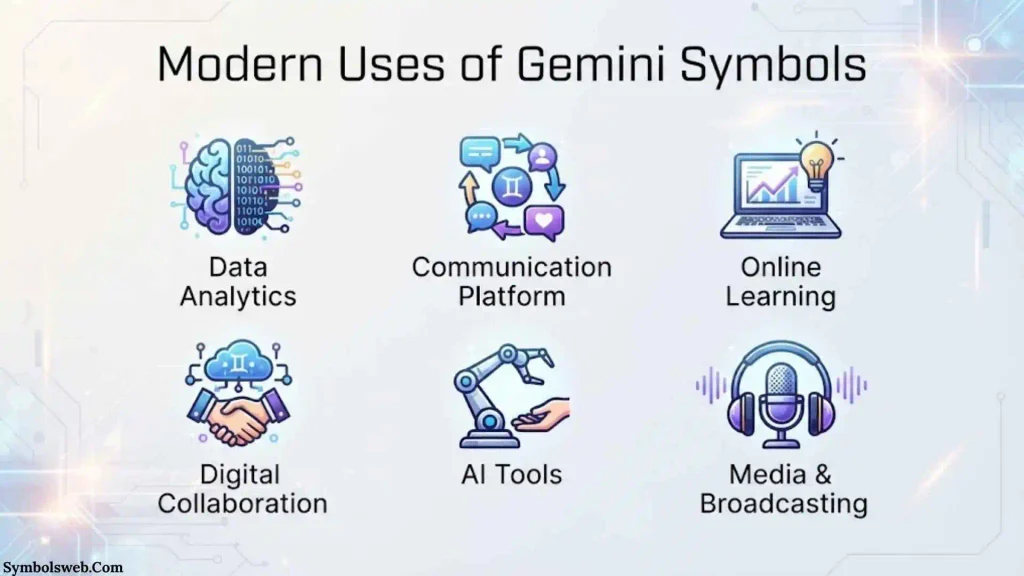
Tattoos
Gemini tattoos symbolize individuality, duality, intelligence, and personal growth.
Jewelry
Necklaces, rings, and pendants featuring Gemini symbols remain popular among astrology enthusiasts.
Fashion
Designers use Gemini motifs to represent creativity, adaptability, and self-expression.
Branding
Some brands incorporate twin imagery to communicate flexibility and innovation.
Social Media
Gemini symbols frequently appear in zodiac content, personality discussions, and digital communities.
Contemporary Spirituality
Many people use Gemini imagery during meditation, journaling, and self-reflection practices.
Home Decor
Constellation art and zodiac-themed décor often feature Gemini symbols as expressions of identity.
Interesting Facts About Gemini Symbols
- Gemini is the third sign of the zodiac.
- The Gemini constellation contains the bright stars Castor and Pollux.
- Mercury is Gemini’s ruling planet.
- Gemini belongs to the air element group.
- Twin myths appear in cultures across the world.
- Gemini symbolism dates back more than 4,000 years.
- The Gemini glyph resembles the Roman numeral II.
- Castor and Pollux were considered protectors of sailors in ancient times.
- Gemini is one of the oldest recorded constellations.
- Modern psychology often finds symbolic connections between Gemini themes and personality complexity.
Frequently Asked Questions
What do Gemini symbols mean?
Gemini symbols primarily represent duality, communication, adaptability, intelligence, curiosity, and the balance between opposing forces.
Why is Gemini represented by twins?
Gemini is represented by twins because of the Greek myth of Castor and Pollux, twin brothers whose bond became a symbol of loyalty and eternal connection.
Are Gemini symbols spiritual?
Yes. Spiritually, Gemini symbols often represent balance, self-discovery, inner transformation, and the integration of different aspects of consciousness.
What does the Gemini glyph symbolize?
The Gemini glyph symbolizes twin pillars or twin beings standing together, representing partnership, balance, and dual perspectives.
What does dreaming about Gemini symbols mean?
Dreaming about Gemini symbols often relates to decisions, communication, personal growth, conflicting emotions, or the need to consider multiple viewpoints.
Are Gemini symbols only related to astrology?
No. While commonly associated with astrology, Gemini symbols also appear in mythology, psychology, literature, art, folklore, and spiritual traditions.
Conclusion
Gemini symbols are far more than simple zodiac imagery. They embody humanity’s timeless fascination with duality, balance, communication, and personal growth. From the legendary story of Castor and Pollux to modern psychology and spirituality, these symbols continue to inspire reflection and self-discovery.
Their enduring power comes from their ability to mirror the complexity of human nature. Gemini symbols remind us that growth often happens when we embrace every part of ourselves and learn to find harmony within life’s many contradictions.

Eliana Foster is a writer with a passion for exploring the meanings behind symbols, traditions, and cultural history. She enjoys breaking down complex topics into simple, engaging articles that are easy for everyone to understand. Eliana is also the fictional author of The Hidden Language of Silent Marks and Beyond the Circle of Ancient Signs, two original book concepts created for her author profile. When she’s not writing, she loves visiting museums, reading about mythology, and researching the stories behind symbols from around the world. Her goal is to help readers discover the fascinating meanings hidden in everyday signs and ancient emblems.
 Jordan Hayes
 Ethan Holloway