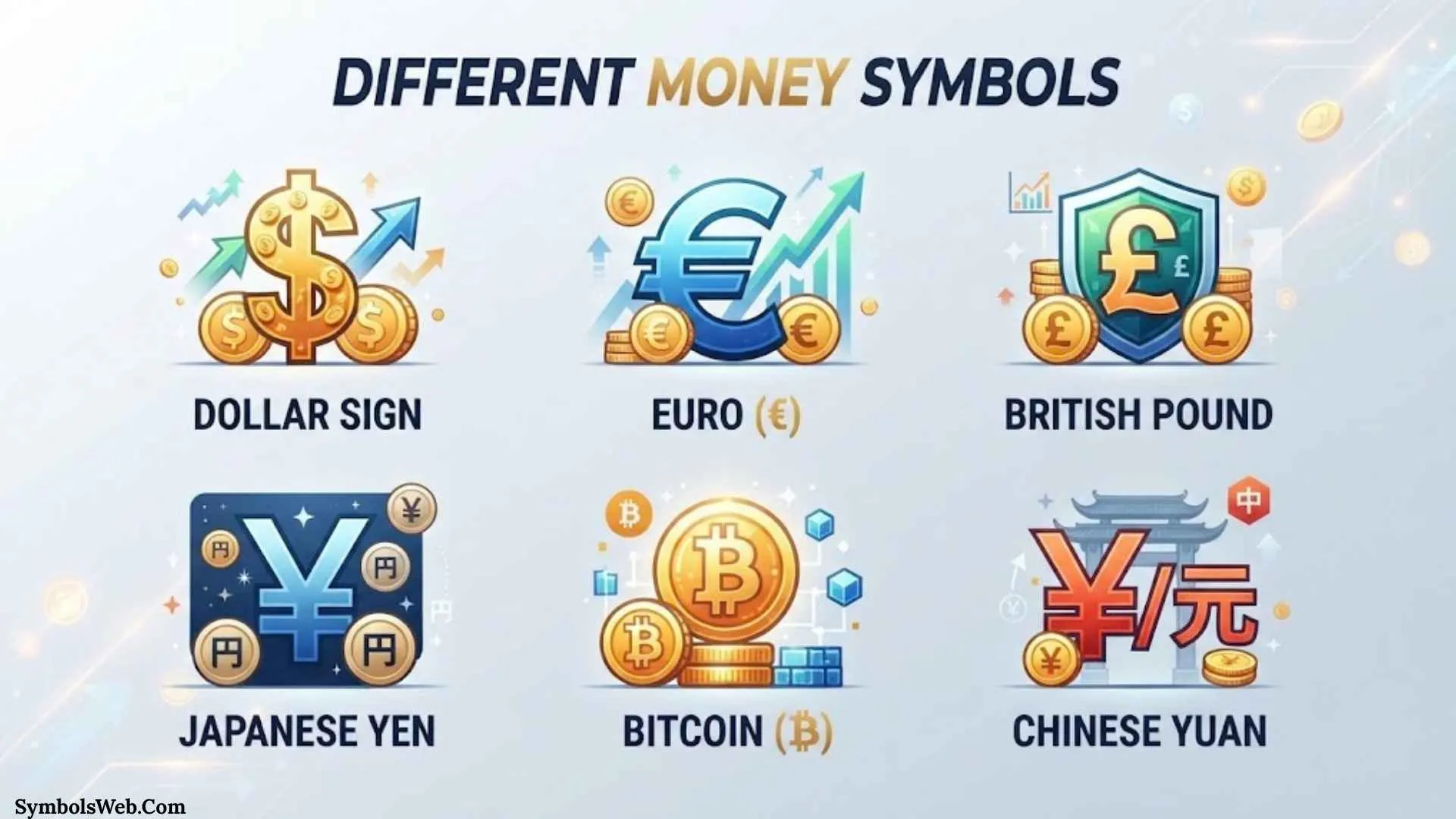
Money is an important part of everyday life, and you see different money symbols whenever you shop, travel, save, or compare prices. You may already recognize symbols like $, €, £, or ¥, but there are many other currency symbols used around the world. Each symbol represents a specific currency and helps you quickly understand the value and origin of money.
When you learn about different money symbols, you can understand prices more easily and avoid confusion when dealing with international currencies. You can also use this knowledge while traveling, shopping online, or comparing exchange rates. I will help you explore some of the most common currency symbols and explain what they mean in simple terms.
In this guide, you will discover different money symbols from various countries, their names, and the currencies they represent. I’ll also explain how you can recognize these symbols and where they are commonly used. By the end, you will have a clear and practical understanding of different money symbols and how they appear in everyday transactions.
Different Money Symbols: (Quick Answer)
Different money symbols are visual signs used to represent currencies around the world. Examples include the dollar sign ($), euro (€), pound (£), yen (¥), and rupee (₹). These symbols help identify currencies quickly and often reflect a nation’s history, culture, economic identity, and global influence.
Quick Facts About Different Money Symbols
| Aspect | Information |
| Origin | Developed from abbreviations, ancient accounting systems, and trade practices |
| Historical Significance | Facilitated commerce and standardized currency identification |
| Main Meaning | Representation of monetary value and economic exchange |
| Spiritual Meaning | Often associated with abundance, prosperity, and material success |
| Cultural Importance | Reflects national identity and economic heritage |
| Modern Usage | Banking, finance, digital payments, accounting, branding, and commerce |
What Are Different Money Symbols?
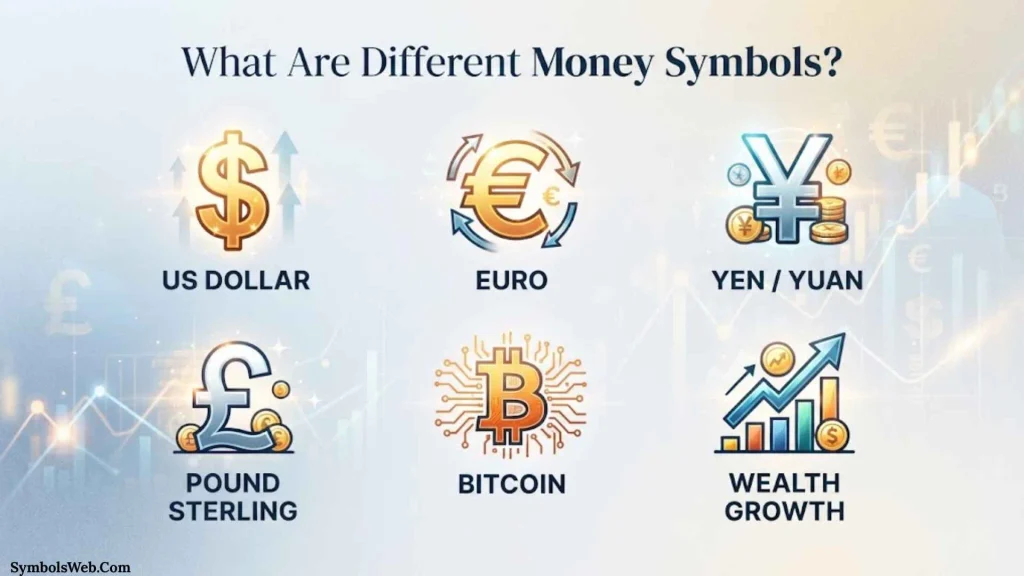
Money symbols are special characters used to represent specific currencies. They simplify financial communication and make transactions easier across countries and languages.
For example:
- Dollar = $
- Euro = €
- British Pound = £
- Japanese Yen = ¥
- Indian Rupee = ₹
- South Korean Won = ₩
Before money symbols existed, merchants often wrote the full names of currencies. As trade expanded across continents, shorter visual representations became necessary.
The earliest forms of currency identification appeared in ancient civilizations such as Mesopotamia, Egypt, Greece, and Rome. Traders used marks, seals, and abbreviations to indicate value and ownership.
Over time, these marks evolved into official currency symbols recognized worldwide. Today, money symbols are used in international trade, stock markets, digital banking systems, and online commerce.
Deep Symbolic Meaning of Different Money Symbols
Spiritual Level
Although money itself is practical, many cultures connect money symbols with deeper spiritual ideas.
Common spiritual associations include:
- Prosperity
- Abundance
- Opportunity
- Manifestation
- Material blessings
- Gratitude for resources
In many spiritual traditions, money is viewed as a form of energy exchange. Currency symbols therefore become visual reminders of flow, giving, receiving, and balance.
For example, some people place dollar signs or prosperity symbols in vision boards to represent financial goals and abundance.
Psychological Level
Psychologically, money symbols trigger powerful emotions.
Studies in behavioral economics show that people often react emotionally when seeing currency signs. These reactions may include:
- Security
- Success
- Ambition
- Fear of loss
- Motivation
- Status consciousness
According to the theories of psychologist Carl Jung, symbols gain power because they connect to collective human experiences. Money symbols often function as modern archetypes representing achievement, survival, and social recognition.
Cultural Level
Different societies attach unique meanings to money symbols.
For some cultures, money represents independence and freedom. For others, it symbolizes responsibility, family support, or social status.
A simple currency sign can therefore carry generations of cultural memory and economic history.
Types and Variations of Different Money Symbols
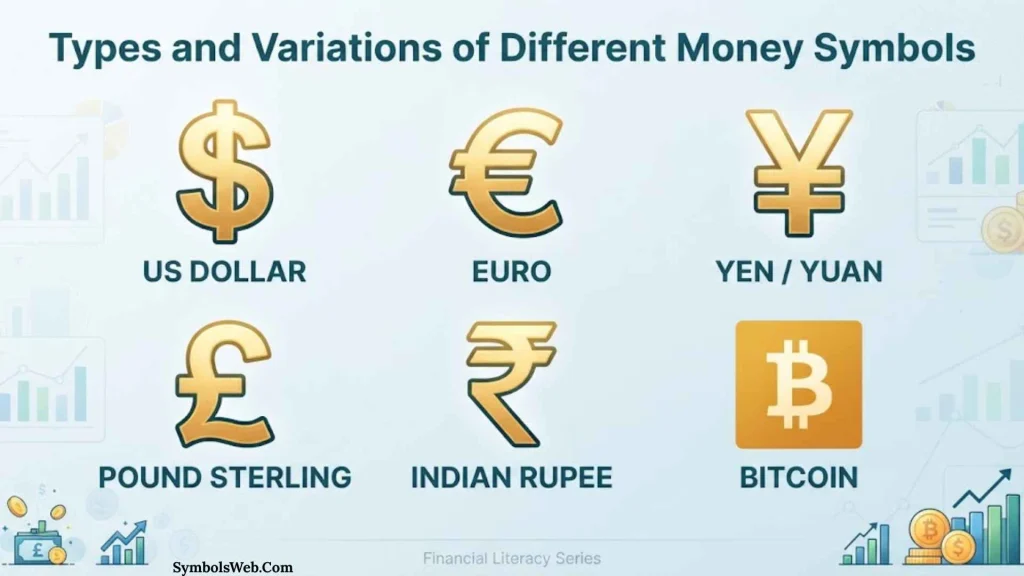
Dollar Sign ($)
Visual Description: An “S” crossed by one or two vertical lines.
Meaning: Monetary value, commerce, wealth.
Symbolism: Economic opportunity and global trade.
Cultural Connection: Widely associated with the United States, although several countries use dollar-based currencies.
Where It Appears:
- Banking
- Movies
- Advertising
- Digital payments
- Financial reports
Euro Symbol (€)
Visual Description: A curved “E” crossed by two horizontal lines.
Meaning: European economic unity.
Symbolism: Stability, cooperation, integration.
Cultural Connection: Represents the shared currency of many European nations.
Where It Appears:
- European markets
- International trade
- Financial institutions
British Pound Symbol (£)
Visual Description: Stylized letter L with a horizontal line.
Meaning: Pound sterling.
Symbolism: Tradition, financial stability, historical influence.
Cultural Connection: Linked to centuries of British commerce and global trade.
Where It Appears:
- United Kingdom
- International currency exchanges
- Banking systems
Yen and Yuan Symbol (¥)
Visual Description: Y-shaped character with horizontal strokes.
Meaning: Japanese Yen and Chinese Yuan.
Symbolism: Economic growth and Asian market influence.
Cultural Connection: Represents two of the world’s most important economies.
Indian Rupee Symbol (₹)
Visual Description: Combination of Devanagari and Latin script elements.
Meaning: Indian currency.
Symbolism: Modernization combined with cultural heritage.
Cultural Connection: Reflects India’s blend of tradition and innovation.
Won Symbol (₩)
Visual Description: W-shaped symbol crossed by horizontal lines.
Meaning: South Korean currency.
Symbolism: Economic resilience and technological advancement.
Cultural Connection: Associated with South Korea’s rapid economic development.
Different Money Symbols Across Cultures
Ancient Egypt
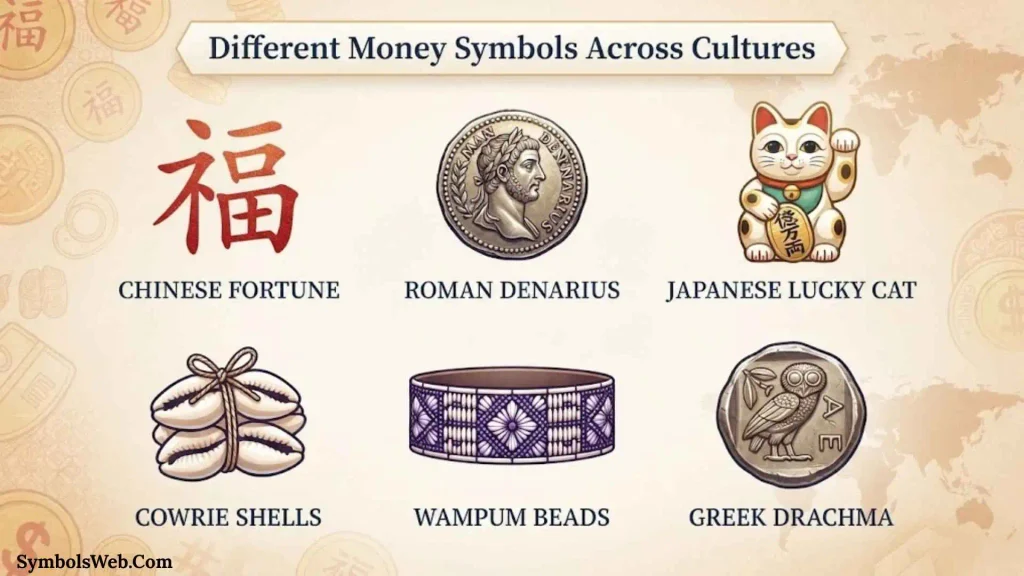
Ancient Egyptians used precious metals, grain measurements, and accounting symbols to represent value.
Money symbols did not exist in their modern form, but economic markings on records helped manage trade and taxation.
Ancient Greece
Greek city-states stamped symbols onto coins.
Owls, gods, and mythological figures served as recognizable markers of monetary authority.
Coins became symbols of civic identity and political power.
Roman Culture
Romans used inscriptions and imperial imagery on coins.
Currency symbols were less important than official markings that demonstrated the authority of the emperor.
Roman monetary systems influenced later European currencies.
Eastern Traditions
China developed sophisticated monetary systems early in history.
Ancient Chinese coins often featured square holes and symbolic inscriptions representing prosperity and harmony.
These traditions influenced later Asian currency designs.
Indigenous Traditions
Many Indigenous societies used alternative forms of value exchange, including:
- Shells
- Beads
- Feathers
- Precious stones
These objects often carried symbolic and spiritual meaning alongside economic value.
Modern Interpretations
Today, money symbols represent:
- National identity
- Economic power
- Globalization
- Financial technology
- Digital commerce
They have become universal icons understood across languages and cultures.
Similar Symbols and Their Meanings
| Symbol | Meaning | Similarity to Money Symbols | Difference |
| Gold Symbol | Wealth | Represents value | Refers to a commodity rather than currency |
| Infinity Symbol | Abundance | Linked to prosperity beliefs | Not tied to economics |
| Treasure Chest | Riches | Symbolizes wealth | Visual object rather than currency sign |
| Coin Symbol | Financial value | Represents money directly | More literal representation |
| Prosperity Knot | Good fortune | Associated with abundance | Spiritual rather than financial |
Common Misconceptions
Many people assume all money symbols represent the same idea. In reality, each currency sign carries unique historical and cultural significance.
The dollar sign and euro sign, for example, symbolize entirely different economic histories and political contexts.
Different Money Symbols in Mythology and Folklore
Money symbols themselves are relatively modern, but wealth symbols appear throughout mythology.
Ancient legends often feature:
- Golden treasures
- Sacred coins
- Magical wealth
- Divine gifts
- Prosperity gods
Examples include:
- Greek stories of King Midas
- Roman tales of Fortuna
- Chinese prosperity traditions
- Norse treasure legends
These stories shaped modern beliefs about wealth, luck, and abundance.
Many modern money symbols inherit symbolic meaning from these older traditions.
Different Money Symbols in Art, Literature, Movies, and Pop Culture
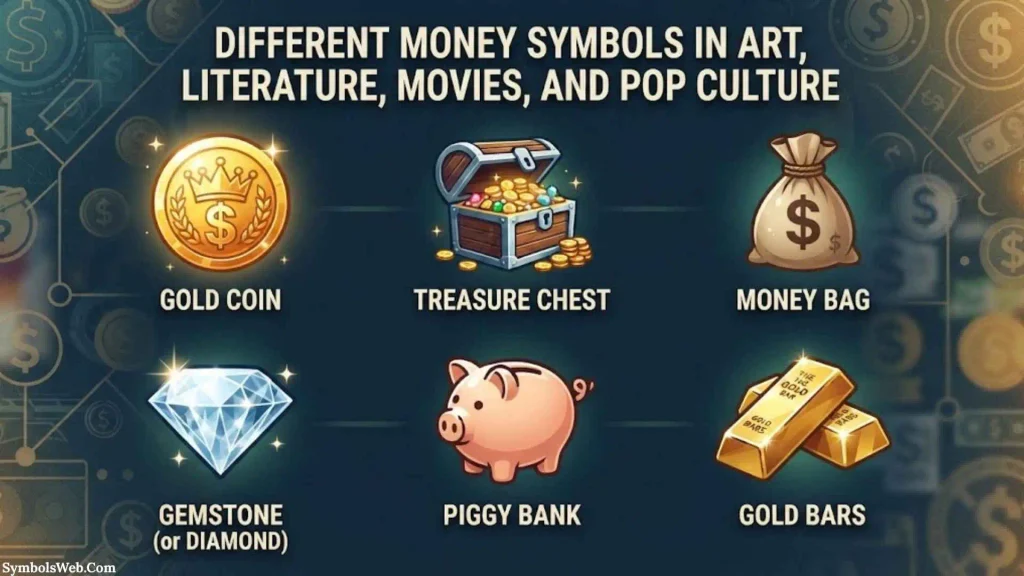
Paintings
Artists often use money symbols to critique greed, power, inequality, or consumer culture.
Literature
Authors employ currency symbols as shorthand for ambition, corruption, success, or social class.
Poetry
Poets frequently contrast money symbols with emotional or spiritual values.
Movies
In films, money symbols often represent:
- Wealth
- Crime
- Corporate power
- Success
- Temptation
Television
Television programs frequently use currency symbols to indicate business, luxury, and financial achievement.
Tattoos
Money symbol tattoos can represent:
- Ambition
- Financial freedom
- Entrepreneurial spirit
- Personal goals
Fashion
Luxury brands sometimes incorporate money-inspired imagery into designs to evoke exclusivity and status.
Modern Design
Graphic designers use money symbols in:
- Logos
- Marketing campaigns
- Financial apps
- Economic reports
Spiritual and Dream Meaning of Different Money Symbols
Dreaming about money symbols can carry several interpretations.
Positive Meanings
- New opportunities
- Financial growth
- Personal confidence
- Resourcefulness
- Success
Cautionary Meanings
- Excessive materialism
- Fear of financial loss
- Stress about money
- Unbalanced priorities
Meditation and Spiritual Reflection
Some spiritual practitioners view money symbols as reminders of energy exchange.
In this context, prosperity involves not only receiving wealth but also using resources wisely and ethically.
Positive and Negative Meanings of Different Money Symbols
| Positive Meaning | Negative Meaning |
| Prosperity | Greed |
| Success | Materialism |
| Security | Obsession with wealth |
| Opportunity | Financial anxiety |
| Achievement | Social inequality |
| Independence | Power struggles |
| Growth | Excessive consumption |
The meaning depends largely on context, intention, and cultural interpretation.
Why Humans Are Attracted to Different Money Symbols
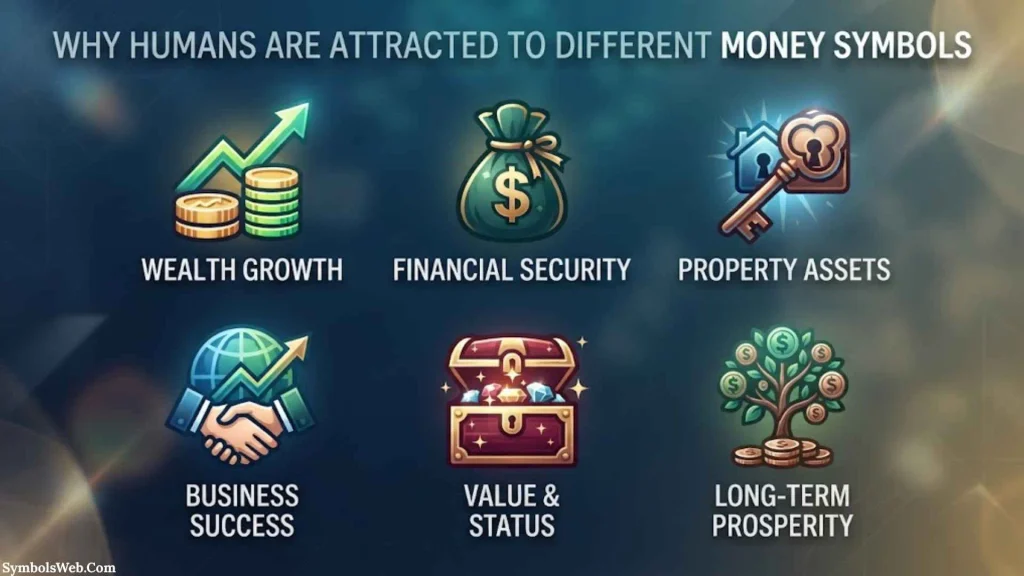
Humans naturally respond to symbols.
Money symbols attract attention because they connect directly to survival, security, and opportunity.
Several psychological factors explain this attraction:
Pattern Recognition
The human brain quickly identifies familiar symbols.
Emotional Associations
Currency signs become linked to experiences involving success, rewards, and goals.
Collective Symbolism
Entire societies agree on the value represented by these symbols.
Cultural Memory
Generations pass down stories about wealth, trade, and prosperity.
Personal Meaning
For one person, a money symbol may represent freedom.
For another, it may symbolize hard work, family support, or future dreams.
Modern Uses of Different Money Symbols
Tattoos
Many people choose currency symbols as reminders of financial goals.
Jewelry
Money-themed jewelry often symbolizes prosperity and confidence.
Fashion
Designers incorporate currency imagery into clothing and accessories.
Branding
Financial companies use money symbols to communicate trust and economic expertise.
Social Media
Currency symbols appear in posts about investing, entrepreneurship, and personal finance.
Contemporary Spirituality
Some prosperity practices use money symbols as visual focus points.
Home Decor
Artwork featuring currency signs can represent abundance and achievement.
Personal Expression
Many individuals use money symbols to communicate ambition and financial independence.
Interesting Facts About Different Money Symbols
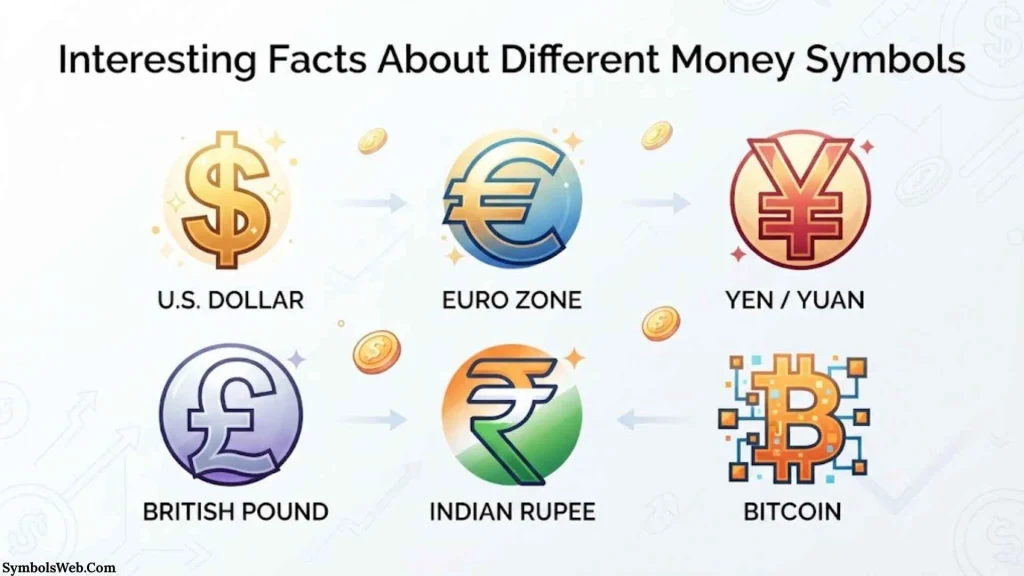
- The dollar sign is one of the most recognized symbols in the world.
- The euro symbol was designed to represent both Europe and stability.
- The British pound symbol originates from the Latin word libra.
- The Indian rupee symbol was officially adopted in 2010.
- Several countries use the dollar sign, not just the United States.
- Currency symbols are encoded into digital systems through Unicode standards.
- Ancient coins often served as political propaganda.
- Some modern currencies share the same symbol but represent different values.
- Currency symbols appear billions of times daily in digital transactions.
- Money symbols are among the most globally understood visual icons.
Frequently Asked Questions
What is the most recognized money symbol in the world?
The dollar sign ($) is generally considered the most widely recognized money symbol due to the global influence of dollar-based economies and international trade.
Why do currencies have symbols?
Currency symbols make financial communication faster, easier, and more recognizable across different languages and regions.
Which money symbol is the oldest?
The British pound symbol (£) traces its roots to the Latin word libra, giving it one of the oldest historical origins among modern currency symbols.
What does the dollar sign symbolize?
Beyond currency, the dollar sign often symbolizes wealth, opportunity, capitalism, ambition, and financial success.
Are money symbols universal?
No. Different countries use different currency symbols, although some symbols may be shared among multiple currencies.
Can money symbols have spiritual meanings?
Yes. Many people associate money symbols with abundance, prosperity, gratitude, and the flow of resources and energy.
Conclusion
Different money symbols are much more than financial shorthand. They are powerful cultural icons that reflect history, identity, trade, ambition, and human values. From ancient marketplaces to modern digital economies, these symbols have helped shape how societies exchange value and understand prosperity.
If viewed through the lens of economics, culture, psychology, or spirituality, money symbols reveal a fascinating story about humanity itself. They remind us that behind every currency sign lies a deeper narrative of trust, cooperation, aspiration, and the enduring search for security and abundance.

Hi, I’m Ethan Holloway, and I’ve always believed that a few meaningful words can change the way we think, feel, and live. I enjoy collecting timeless quotes, studying their deeper meanings, and sharing inspiring messages that help people stay motivated through every stage of life.
Over the years, I’ve explored thousands of famous sayings from writers, leaders, philosophers, and everyday people. My goal is to make wisdom easy to understand and useful for everyone.
Books by Ethan Holloway
- The Power of Everyday Quotes
- Words That Inspire Greatness
 Jordan Hayes
 Eliana Foster