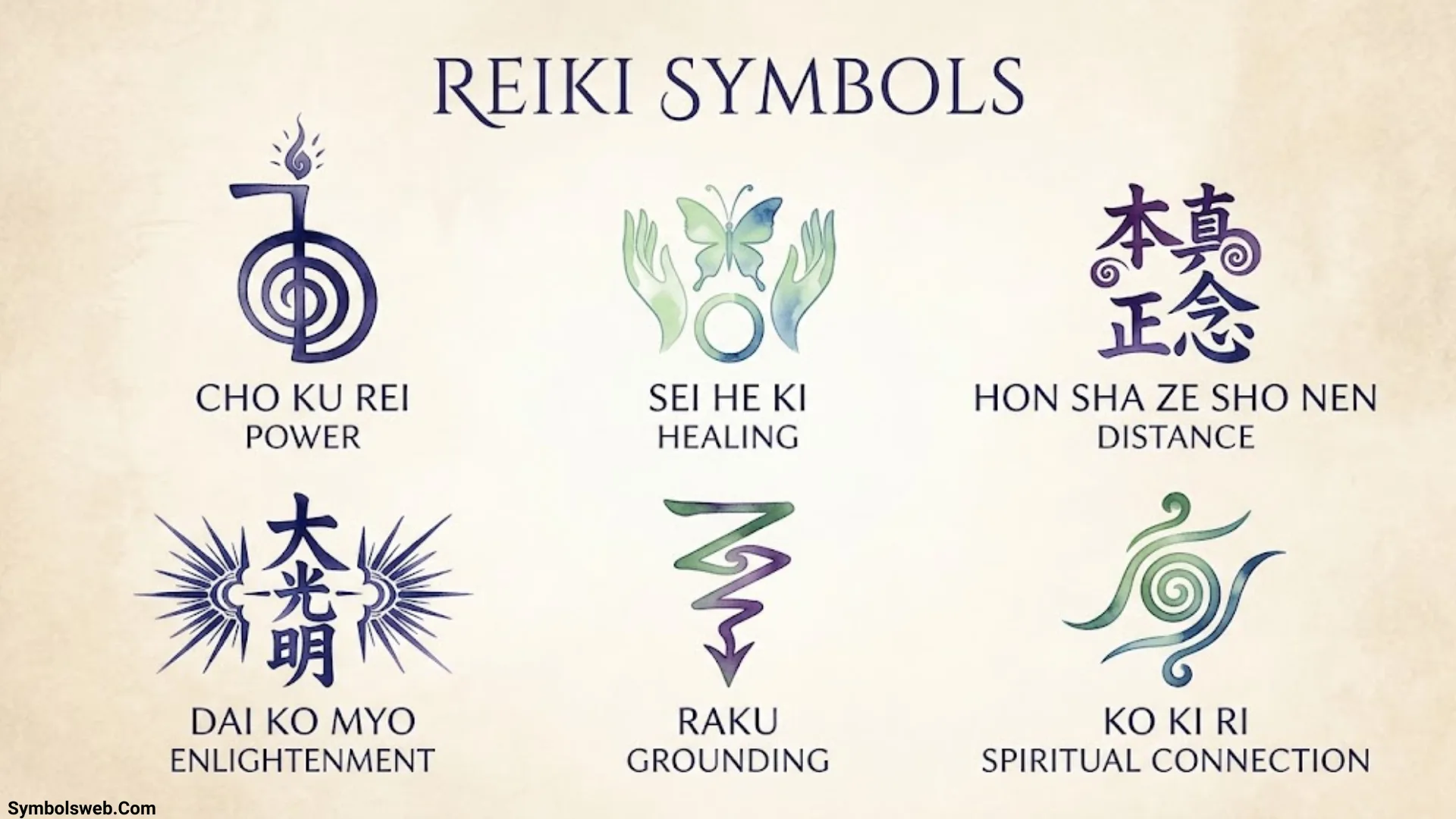
Reiki symbols are visual forms that practitioners use to focus their attention and intentions during Reiki practice. Each symbol has a particular meaning within the tradition that teaches it. Some represent power and focus, while others relate to emotional harmony, distance healing, or spiritual development.
The most widely recognized traditional Usui Reiki symbols include Cho Ku Rei, Sei He Ki, Hon Sha Ze Sho Nen, and Dai Ko Myo. Other systems, including Karuna Reiki and Shamballa Reiki, use additional symbols with different interpretations. Understanding these differences helps you explore Reiki without confusing symbols from separate traditions.
If you’re a beginner, a Reiki student, or an experienced practitioner, this guide explains Reiki symbols and meanings, their traditional uses, and how practitioners incorporate them into their routines. You’ll also learn about symbol drawing, activation, attunement, chakra associations, and the difference between spiritual beliefs and scientifically supported health information.
What Are Reiki Symbols?
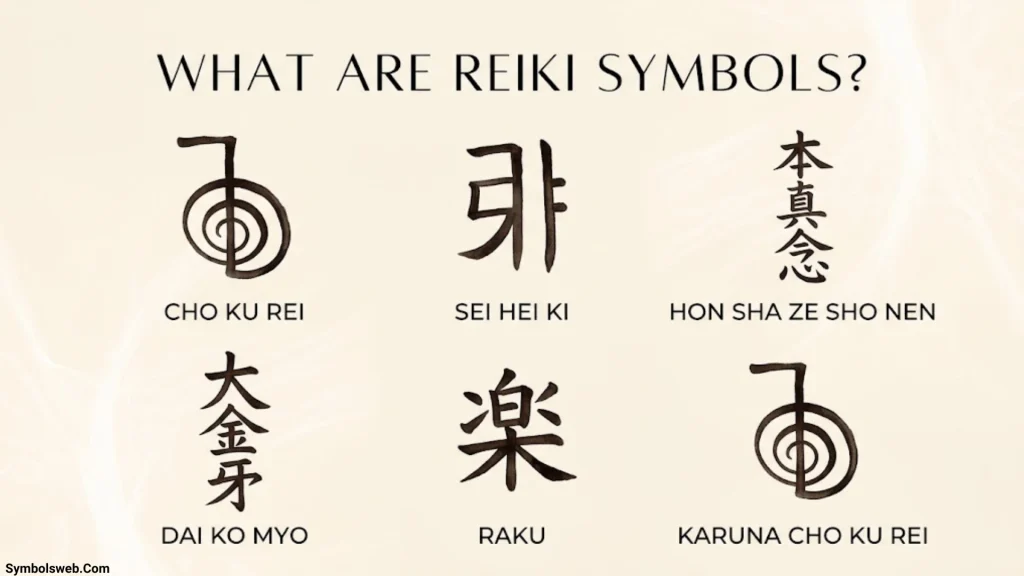
Reiki symbols are visual representations used in certain Reiki traditions during meditation, energy-focused practices, and healing sessions. Practitioners may draw them with a hand, visualize them mentally, or recall their names while focusing on a particular intention.
Reiki originated in Japan in the early 20th century through the teachings of Mikao Usui. The practice centers on the idea of Reiki, commonly described as universal life force energy. Practitioners use this concept to explain their approach to relaxation, spiritual development, and complementary care.
Within Reiki traditions, symbols can serve as reminders of specific qualities or intentions. For example, Cho Ku Rei is commonly associated with power and focus, while Sei He Ki relates to mental and emotional harmony.
However, symbols aren’t interpreted identically by every teacher. Their meanings, drawings, and teaching requirements can vary across Reiki lineages.
What Do Reiki Symbols Represent?
Each symbol has a traditional role within the system that teaches it. Some common associations include:
- Power and focus: Cho Ku Rei.
- Mental and emotional harmony: Sei He Ki.
- Distance Reiki: Hon Sha Ze Sho Nen.
- Spiritual development and master-level practice: Dai Ko Myo.
- Compassion and emotional connection: Harth in Karuna Reiki.
- Peace and calm: Shanti in Karuna Reiki.
These descriptions reflect common spiritual teachings rather than universally accepted definitions. A practitioner should understand the tradition behind a symbol before applying its meaning to another system.
How Do Reiki Symbols Work?
Reiki practitioners traditionally use symbols to guide attention and intention during a session. Depending on their training, they might trace a symbol in the air, visualize its shape, or silently repeat its name.
For example, a practitioner may focus on Sei He Ki during a session intended to encourage calm and emotional reflection. Another may use Hon Sha Ze Sho Nen as part of a distance Reiki practice.
These methods describe how practitioners use the symbols within their spiritual framework. They don’t establish that symbols transmit a measurable healing force or independently treat medical conditions.
The National Center for Complementary and Integrative Health reports that Reiki hasn’t been clearly shown to be effective for any health-related purpose. Scientific evidence also doesn’t support the existence of the energy field proposed in Reiki explanations.
How Many Reiki Symbols Are There?
There isn’t one universal number of Reiki symbols. The total depends on which system, lineage, and teaching materials you consider.
Many Western Usui Reiki schools teach four principal symbols. Three are commonly introduced at Level 2, while Dai Ko Myo is associated with master-level training. Some schools teach different curricula or distinguish additional symbols.
Karuna Reiki has its own recognized symbol set. Some advanced Karuna Reiki methods also include symbols such as Dumo, Nin Giz Zida, and Om. Shamballa Reiki and Tibetan-influenced systems introduce further symbols.
Online lists may include dozens of names, but that doesn’t mean every symbol belongs to traditional Usui Reiki. The most useful approach is to identify each symbol’s system before studying its meaning.
Reiki Symbols and Their Meanings
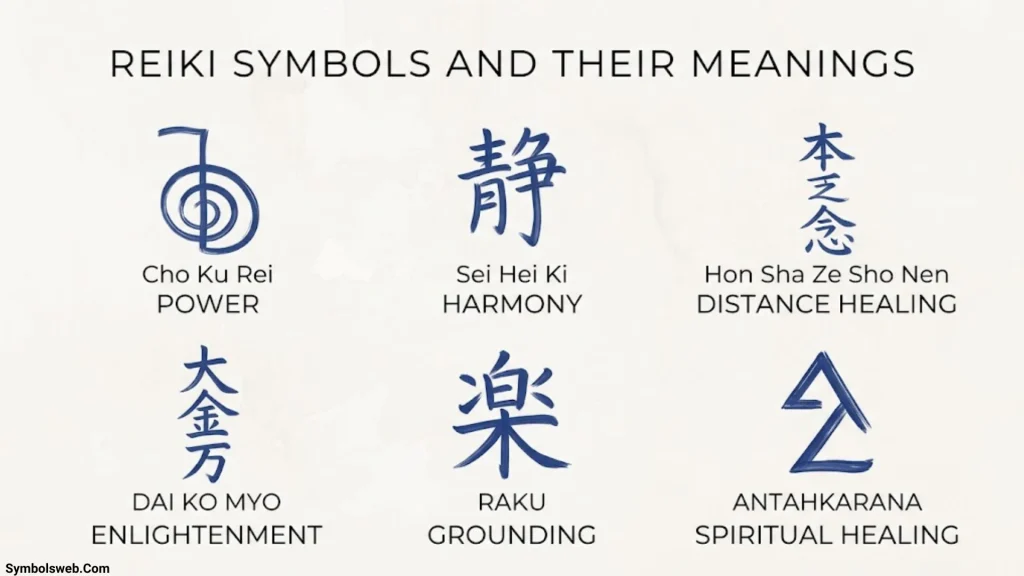
The following table summarizes four symbols commonly taught in Western Usui Reiki.
| Reiki symbol | Common meaning | Traditional context |
| Cho Ku Rei | Power and focus | Focusing intention during Reiki practice |
| Sei He Ki | Mental and emotional harmony | Practices centered on emotional balance |
| Hon Sha Ze Sho Nen | Distance healing | Distance Reiki practices |
| Dai Ko Myo | Great Shining Light | Master-level practice and spiritual development |
These associations are common teaching conventions, not standardized definitions shared by every Reiki lineage.
Cho Ku Rei: The Reiki Power Symbol
Cho Ku Rei is widely known as the Reiki Power Symbol. Practitioners commonly associate it with power, focus, and directing attention toward a specific intention.
Its name is often explained in English through phrases such as “place the power of the universe here.” However, translations and interpretations can differ, so this wording shouldn’t be treated as the only literal translation.
Practitioners may use Cho Ku Rei at the beginning of a Reiki session or incorporate it into self-treatment. Some traditions also associate it with purification and spiritual protection.
Commonly described uses include:
- Focusing intention before a Reiki session.
- Beginning a personal Reiki practice.
- Incorporating visualization into meditation.
- Supporting a practitioner’s symbolic approach to protection.
- Combining it with other symbols according to lineage-specific methods.
Cho Ku Rei is a useful starting point for understanding Reiki symbolism because its central association is relatively straightforward: focus and power within the practitioner’s spiritual practice.
Sei He Ki: The Mental and Emotional Harmony Symbol
Sei He Ki is commonly associated with mental and emotional harmony. Practitioners may use it during sessions focused on calm, self-reflection, and emotional well-being.
Some teachings connect this symbol with balancing thoughts and feelings. Others emphasize awareness of emotional patterns and the relationship between mental and physical experiences.
For example, someone might incorporate Sei He Ki into a quiet meditation while reflecting on a stressful situation. The symbol serves as a focal point for that practice rather than a proven treatment for the underlying problem.
Common associations include:
- Emotional balance.
- Mental clarity.
- Self-reflection.
- Compassion toward oneself.
- Awareness of recurring thought patterns.
Although practitioners sometimes describe Sei He Ki as an emotional healing symbol, it shouldn’t be presented as a clinically proven treatment for anxiety, depression, or trauma.
Hon Sha Ze Sho Nen: The Distance Healing Symbol
Hon Sha Ze Sho Nen is commonly known as the Reiki distance healing symbol. In many Western Usui lineages, practitioners learn it at Level 2 and use it in practices intended to extend beyond an in-person session.
Its teachings often connect the symbol with distance, time, and the idea that Reiki practice doesn’t depend on physical proximity.
A practitioner may visualize Hon Sha Ze Sho Nen while conducting a distance session. Some traditions combine it with other symbols as part of their established method.
Its commonly described uses include:
- Distance Reiki sessions.
- Visualization during remote spiritual practice.
- Intention-setting for a person who has agreed to participate.
- Practices that connect a session with a particular time or situation.
These are traditional Reiki applications, not proof that healing energy travels across distances or produces measurable effects. Consent and clear communication remain important whenever a practice involves another person.
Dai Ko Myo: The Reiki Master Symbol
Dai Ko Myo is commonly translated as “Great Shining Light” and is associated with master-level Reiki practice in many Western Usui systems.
Practitioners often connect it with spiritual awareness, personal development, and the deeper principles of Reiki. Some lineages teach it as part of Reiki Level 3 or master training.
Dai Ko Myo isn’t identical across every system. The Usui master symbol differs from forms described as Tibetan Dai Ko Myo, and related names can appear in additional Reiki lineages.
Common associations include:
- Spiritual development.
- Deeper engagement with Reiki practice.
- Master-level instruction.
- Meditation and self-reflection.
- Personal growth within a spiritual tradition.
Learning the name alone doesn’t establish mastery. Students should understand the symbol’s drawing, intended role, and teaching context within their chosen lineage.
Traditional Usui Reiki Symbols
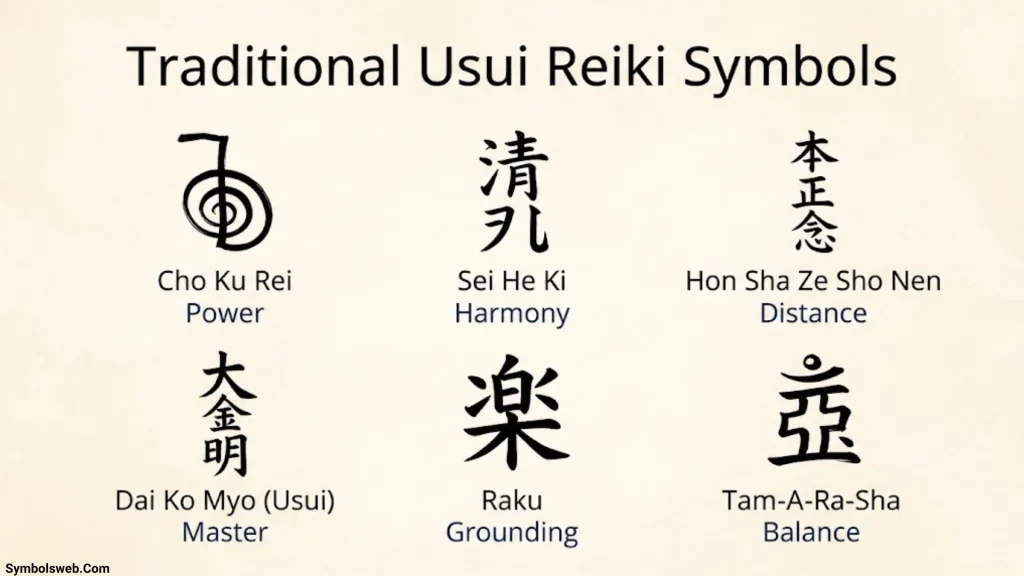
The four symbols discussed above form the core of many Western Usui Reiki curricula. Their teaching sequence and some details vary between schools, but they provide a useful foundation for beginners.
What Makes Usui Reiki Symbols Traditional?
Traditional Usui Reiki symbols belong to the Usui system or a lineage that teaches them as part of that system. Their names and interpretations reflect the history and practices passed down through Reiki teachers.
The International Center for Reiki Training describes four symbols in its account of the Usui system. It also distinguishes those symbols from additional forms used in other Reiki traditions.
This distinction matters because online articles sometimes combine symbols from Usui, Karuna, Tibetan, and Shamballa systems without identifying their origins.
When studying a symbol, ask three questions:
- Which Reiki system teaches it?
- What meaning does that lineage assign to it?
- How does the lineage teach practitioners to use it?
These questions help separate established teaching conventions from modern interpretations.
Are Shika Sei Ki and Shika So Traditional Usui Reiki Symbols?
Shika Sei Ki and Shika So appear in some expanded Reiki symbol lists, but they aren’t part of the four-symbol set commonly taught in Western Usui Reiki.
In some teachings, Shika Sei Ki is associated with the heart chakra, love, or emotional expression. Shika So may be associated with the throat chakra and communication.
However, these interpretations aren’t universal. Their spellings, drawings, and classifications can vary between sources.
Treat them as lineage-specific symbols unless a reliable source establishes their role within the particular system you’re studying.
What Is the Raku Reiki Symbol?
Raku appears in several Usui/Tibetan and related Reiki lineages. Practitioners commonly associate it with grounding and the completion of certain attunement practices.
Its role differs from the four principal Usui symbols. Some schools teach Raku during advanced training, while others incorporate it into their particular attunement methods.
If you’re studying Raku, use the instructions provided by your teacher rather than assuming every Reiki system uses the symbol in the same way.
Karuna Reiki Symbols and Their Meanings
Karuna Reiki is a distinct Reiki system with its own training framework and symbol set. The word karuna is commonly associated with compassion in Sanskrit-derived spiritual contexts.
Many Karuna Reiki teaching materials introduce eight principal symbols: Zonar, Halu, Harth, Rama, Gnosa, Kriya, Iava, and Shanti. Additional symbols may appear in advanced methods.
The following descriptions summarize common associations within Karuna Reiki teachings. They aren’t universal meanings across every Reiki tradition.
Zonar Reiki Symbol
Zonar is commonly associated with infinity, deep reflection, and compassion. Some teachings connect it with exploring difficult experiences and recurring emotional patterns.
Practitioners may incorporate Zonar into meditation or Reiki sessions focused on self-understanding. Its reported association with past experiences belongs to the spiritual framework of the system rather than an established psychological mechanism.
Halu Reiki Symbol
Halu is associated in some Karuna Reiki teachings with harmony, awareness, and clarity. Some interpretations describe it as building on themes associated with Zonar.
Practitioners may use Halu when reflecting on unhelpful patterns or seeking greater awareness. These uses should be understood as spiritual practices, not verified methods for treating psychological conditions.
Harth Reiki Symbol
Harth is commonly associated with the heart, love, compassion, and forgiveness.
Within Karuna Reiki, practitioners may incorporate it into sessions focused on self-acceptance or emotional connection. It can also serve as a reminder to approach difficult relationships with greater compassion.
However, using Harth doesn’t guarantee reconciliation or change another person’s feelings. Healthy relationships also depend on communication, boundaries, and individual choices.
Rama Reiki Symbol
Rama is commonly associated with grounding, balance, and connection with the earth in certain Karuna Reiki teachings.
Practitioners may use it during meditation or as part of a routine intended to bring attention back to the present moment.
Its role and interpretation should follow the teaching system in which the symbol appears.
Gnosa Reiki Symbol
Gnosa is associated with knowledge, understanding, and awareness in some Karuna Reiki materials.
Practitioners may use it while reflecting on personal beliefs or exploring a question through meditation. The symbol can serve as a focus for thoughtful inquiry rather than a source of guaranteed answers or supernatural knowledge.
Kriya Reiki Symbol
Kriya is commonly connected with action, balance, and purposeful intention.
Some practitioners use it while focusing on practical goals or bringing greater structure to their spiritual routines.
A useful distinction is that intention can help clarify what you want to do, but achieving a goal still requires appropriate planning and action.
Iava Reiki Symbol
Iava, sometimes spelled Java in particular symbol lists, is associated in some teachings with awareness, personal responsibility, and a clearer relationship with one’s surroundings.
Practitioners may incorporate it into reflective practices involving personal habits or choices. Its exact meaning depends on the relevant Karuna Reiki lineage.
Shanti Reiki Symbol
Shanti is associated with peace, calm, and tranquility.
Practitioners may use it during meditation or sessions intended to support a sense of spiritual calm. Its name and traditional associations make it relevant to people exploring Reiki symbols for inner peace.
However, Shanti shouldn’t be described as a guaranteed method for relieving anxiety or treating a mental health condition.
AUM and OM in Reiki Practice
AUM and OM are closely related sacred syllables in several Indian religious and spiritual traditions. They also appear in some Reiki teaching systems.
Their wider spiritual significance predates their inclusion in modern Reiki curricula. In meditation, OM is commonly used as a sound or mantra for concentration and contemplation.
Some Karuna Reiki methods include Om among their symbols. However, it isn’t universally classified as one of the four traditional Usui Reiki symbols.
Understanding this distinction prevents a broader spiritual symbol from being incorrectly assigned to every Reiki system.
Shamballa Reiki Symbols and Their Meanings
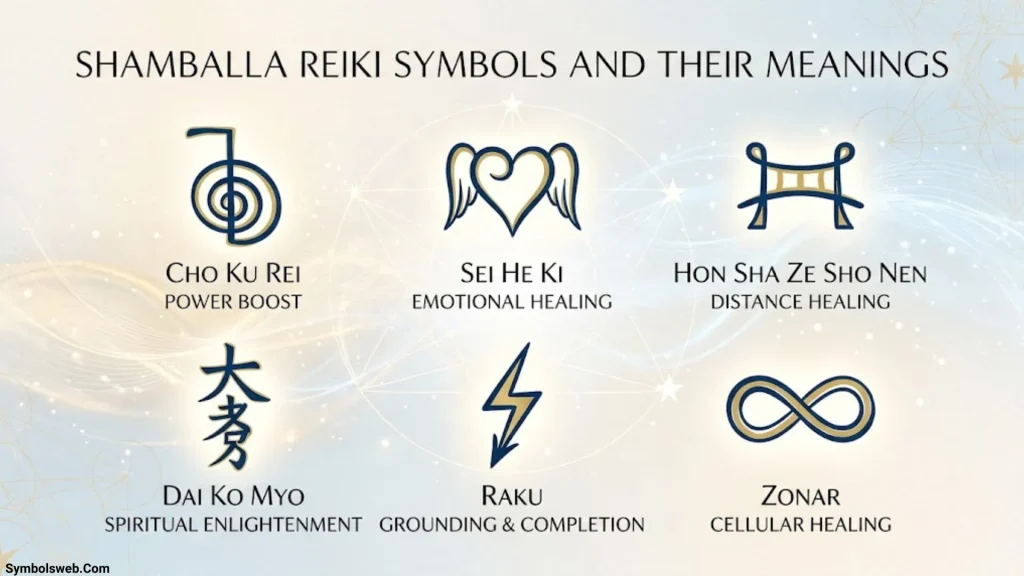
Shamballa Reiki, including systems described as Shamballa MDH Reiki, is associated with an expanded set of spiritual practices and symbols. Its symbol lists can differ substantially from those used in traditional Usui Reiki.
The following symbols appear in some Shamballa-related teaching materials. Their meanings should be attributed to those specific teachings rather than treated as universal Reiki definitions.
Mer Ka Fa Ka Lish Ma
Mer Ka Fa Ka Lish Ma is a symbol name found in some Shamballa Reiki materials. Its reported associations include spiritual development, divine connection, and work with the energetic body.
Some practitioners connect it with chakra visualization and broader spiritual concepts. However, its precise meaning and method of use depend on the teaching system.
Don’t confuse it with the general term Merkaba, which appears in other spiritual traditions and has its own history and interpretations.
Motor Zanon Reiki Symbol
Motor Zanon appears in some Shamballa Reiki symbol lists and is sometimes called an antiviral symbol.
That label requires an important distinction. Some spiritual teaching materials associate Motor Zanon with infections or viruses, but there is no established clinical evidence that drawing or visualizing this symbol prevents or treats viral infections.
It shouldn’t replace vaccination, medical testing, prescribed medication, or other appropriate health care. Readers interested in the symbol can explore its role within the relevant spiritual tradition without treating its reported associations as medical facts.
Palm Master Reiki Symbol
The Palm Master symbol appears in some Shamballa-related teachings. Practitioners may associate it with spiritual awareness, the inner self, or a connection between personal identity and consciousness.
Its meaning and application depend on the source teaching it. It isn’t a universally recognized component of the four-symbol Usui Reiki set.
Amsui Reiki Symbol
Amsui appears in some expanded Reiki symbol lists. Certain teachings associate it with the seven primary chakras and practices intended to promote energetic balance.
These associations belong to a spiritual framework. The chakras described in these practices aren’t anatomical structures recognized by conventional medicine.
Ho Ka O Ili Ili
Ho Ka O Ili Ili is another name found in some expanded Reiki and Shamballa-related symbol lists.
Some teaching materials associate it with self-worth, confidence, and respect. Practitioners may use it as a focus for reflection on personal boundaries or self-acceptance.
Its meaning isn’t standardized across Reiki systems. Verify the source and lineage before treating a particular interpretation as authoritative.
Abundance Reiki Symbol
The Abundance Reiki symbol appears in some modern Reiki-related teachings. Practitioners associate it with prosperity, gratitude, opportunity, and personal aspirations.
Someone might incorporate the symbol into meditation while reflecting on financial goals or a new career direction. The exercise can serve as a reminder of those goals, but it doesn’t guarantee wealth or attract money through a scientifically established mechanism.
Practical planning, informed decisions, and consistent effort remain essential when pursuing financial goals.
Other Reiki Symbols and Their Meanings
Some Reiki-related symbols belong to Tibetan-influenced lineages or expanded systems. Others appear in separate spiritual traditions. Understanding their origins is more useful than treating every symbol found online as traditional Usui Reiki.
Dumo and Tibetan Dai Ko Myo
Dumo appears in some Tibetan-influenced Reiki systems and advanced Karuna-related methods. Its reported meanings and applications depend on the particular lineage.
The name Tibetan Dai Ko Myo also appears in some Reiki teaching materials. It refers to a form distinguished from the commonly taught Usui master symbol.
Although the names are sometimes discussed together, they shouldn’t automatically be treated as identical symbols. Consult the relevant teaching material to understand their differences.
Serpent of Fire and Fire Serpent
The Serpent of Fire, also called the Fire Serpent in some materials, appears in Tibetan-influenced Reiki practices and certain expanded systems.
Some teachings associate it with grounding, the Sushumna energy channel, or the relationship between the body’s energy centers.
The related name Dragon of Fire also appears in some symbol lists. However, names and drawings can vary. Check the source lineage before assuming these terms always identify the same symbol.
Nin Giz Zida
Nin Giz Zida appears in some advanced Karuna Reiki methods and other expanded symbol collections. Some sources associate the name with serpent imagery and related spiritual symbolism.
Its classification depends on the system being discussed. It shouldn’t be presented as one of the four principal Usui Reiki symbols.
Johrei Reiki Symbol
Johrei is associated with a spiritual purification tradition distinct from the standard Usui Reiki system. Although Johrei appears in some expanded Reiki symbol lists, that inclusion doesn’t make it a traditional Usui symbol.
When researching Johrei, distinguish its original religious and spiritual context from later references in Reiki-related materials.
Hosanna Reiki Symbol
Hosanna appears in some expanded symbol collections, including certain Karuna-related lists. Interpretations may associate it with spiritual support or cleansing, but those meanings aren’t universal.
Its precise role should be checked against the teaching materials of the system in which it appears.
Len So My Reiki Symbol
Len So My is another name found in expanded Reiki symbol collections. Some sources associate it with love, emotional comfort, or spiritual reflection.
Because the symbol isn’t part of the four-symbol Usui set, readers should verify its origin and intended use before relying on a particular interpretation.
How to Verify Less-Common Reiki Symbols
When researching a symbol that appears unfamiliar, follow these steps:
- Identify the lineage: Determine whether the symbol belongs to Usui, Karuna, Shamballa, Tibetan-influenced, or another system.
- Check the spelling: Alternate transliterations can make related symbols difficult to identify.
- Compare reputable teaching materials: Look for agreement about the symbol’s name, form, and role.
- Separate tradition from evidence: A reported spiritual association isn’t proof of a physical or medical effect.
- Avoid unsupported historical claims: A symbol’s appearance in a modern Reiki system doesn’t establish that it originated in ancient Japan or Tibet.
This approach is particularly useful when researching less-standardized names such as Amsui, Motor Zanon, Hosanna, and Len So My.
How to Use Reiki Symbols
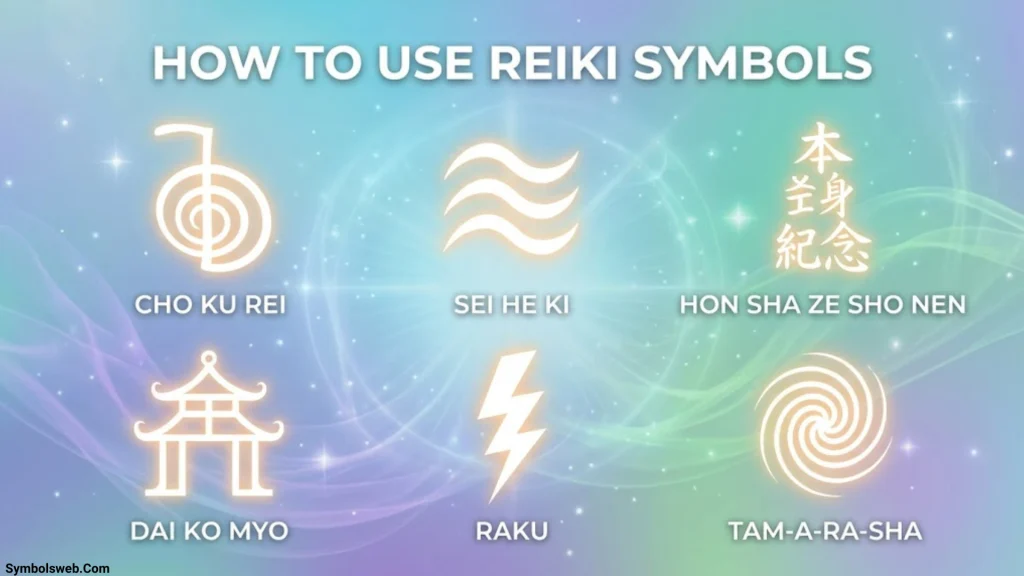
The way practitioners use Reiki healing symbols depends on their training, lineage, and personal practice. Some draw symbols physically, while others visualize them or incorporate their names into meditation.
The following examples describe common approaches. They aren’t universal instructions for every Reiki system.
Using Reiki Symbols During Self-Treatment
Reiki self-treatment involves practicing Reiki on yourself rather than another person. Practitioners often combine the practice with quiet reflection and traditional hand positions.
A basic routine may include:
- Choose a quiet place where you can sit comfortably.
- Set an intention for your practice.
- Select a symbol that fits the purpose taught in your Reiki system.
- Draw or visualize the symbol using the method you learned.
- Place your hands comfortably on or above appropriate areas of your body.
- Spend several minutes in quiet reflection.
- Finish by returning your attention to your surroundings.
For example, a practitioner might focus on Sei He Ki while reflecting on a stressful day. The practice can provide a structured opportunity for self-reflection, but it shouldn’t be treated as a substitute for professional mental health care.
Using Reiki Symbols on Another Person
Practitioners may incorporate symbols into a Reiki session with another person. Depending on the tradition, they might draw a symbol in the air, visualize it, or use it as part of their usual session method.
Consent is essential. Explain the nature of the practice before beginning, respect the recipient’s preferences, and stop if they become uncomfortable.
Reiki should also remain separate from medical diagnosis and treatment. A practitioner shouldn’t claim that a symbol can identify an illness or guarantee recovery.
Using Reiki Symbols for Distance Healing
Reiki distance healing is a practice in which a practitioner conducts a session without being physically present with the recipient. In many Usui lineages, Hon Sha Ze Sho Nen is associated with this method.
A practitioner may establish a time for the session, clarify the recipient’s consent, and follow the visualization or symbolic method taught in their lineage.
Some practitioners incorporate additional symbols, but the sequence depends on their training.
Distance Reiki remains a spiritual or complementary practice. Its traditional explanation shouldn’t be confused with scientific proof that energy travels between people or produces a medical benefit.
Using Reiki Symbols During Meditation
Reiki symbols can also serve as focal points during meditation. Instead of conducting a full session, a practitioner may spend a few minutes contemplating a symbol’s traditional meaning.
For example, someone reflecting on compassion might use Harth within a Karuna Reiki practice. Another practitioner might contemplate Cho Ku Rei while focusing on a clear intention.
A simple routine includes:
- Sitting in a comfortable position.
- Breathing naturally and settling your attention.
- Visualizing the symbol if appropriate to your training.
- Reflecting on its traditional association.
- Returning your attention to your breathing when your mind wanders.
The purpose is to support focused reflection, not to prove that a symbol changes an invisible energy field.
How to Combine Reiki Symbols
Some Reiki traditions teach practitioners to combine symbols during a session. A practitioner might use Cho Ku Rei to focus intention and Hon Sha Ze Sho Nen during a distance Reiki practice.
Other combinations may involve symbols from Karuna Reiki or Tibetan-influenced systems. Their sequence and purpose depend on the relevant lineage.
Beginners shouldn’t assume that more symbols produce better results. Learn the intended role of each symbol before combining them, and follow the method taught by a qualified instructor.
How to Draw and Activate Reiki Symbols
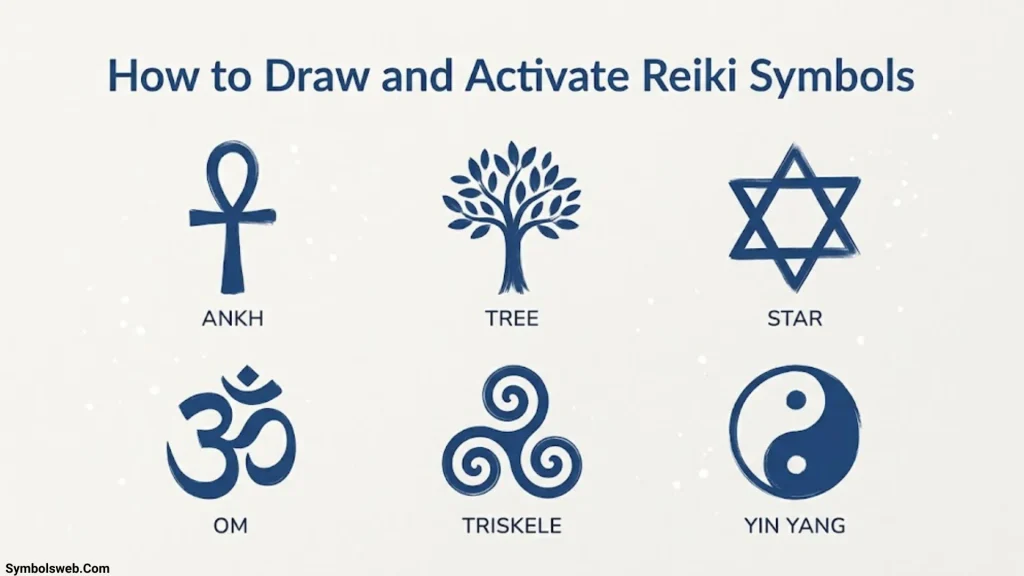
Learning to draw a Reiki symbol involves more than copying a picture. Its shape, stroke order, and method of use may be part of the teaching passed down within a particular lineage.
How to Draw Reiki Symbols Correctly
Start with reliable materials from the Reiki system you’re studying. Compare the symbol’s shape and drawing instructions with those provided by your teacher.
Keep these points in mind:
- Follow your lineage’s version: Different schools may teach variations in symbol drawings.
- Learn the stroke order: Some traditions specify the sequence used to draw each part.
- Practice carefully: Repeated drawing can help you become familiar with the form.
- Check the symbol’s name: Similar spellings can refer to different symbols or teaching traditions.
- Avoid mixing systems: Don’t assume a drawing from Shamballa Reiki matches the version used in Usui Reiki.
A symbol chart can help you review names and common associations. However, a chart doesn’t replace instruction when a lineage teaches a specific method of drawing or use.
How to Activate Reiki Symbols
Some Reiki schools use the term symbol activation to describe the process of incorporating a symbol into practice.
Depending on the lineage, this may involve drawing the symbol, visualizing it, repeating its name, or setting an intention.
A general example of a reflective practice is:
- Settle into a comfortable position.
- Recall the symbol’s form and traditional meaning.
- Draw or visualize it according to your training.
- Focus on the intention relevant to your practice.
- Continue with meditation or your established Reiki routine.
This describes a spiritual exercise rather than a scientifically verified process that activates a measurable healing force.
Can You Draw Reiki Symbols With Your Finger?
Some practitioners trace symbols in the air with a finger or hand. Others visualize the symbol without making a physical movement.
The appropriate approach depends on the system and the method taught by the instructor. Don’t assume that one hand movement or stroke direction applies to every symbol.
Can You Chant or Visualize Reiki Symbols?
Some Reiki traditions incorporate the mental repetition of a symbol’s name. Others emphasize visualization, drawing, or focused attention.
These methods can help a practitioner concentrate during a spiritual routine. However, no single method is universal, and claims about its effects should reflect the limits of available evidence.
Common Mistakes When Learning Reiki Symbols
Avoid these common errors:
- Treating every online symbol list as a traditional Usui reference.
- Assuming that a symbol has the same meaning in every lineage.
- Copying a drawing without checking its source.
- Claiming that symbol activation guarantees healing.
- Using spiritual practices as replacements for appropriate medical care.
- Combining symbols without understanding their intended role.
A clear understanding of the symbol’s origin and context matters more than memorizing a long list of names.
Reiki Symbols for Different Purposes
Different Reiki symbols have different traditional associations. The following guide organizes common examples by purpose while recognizing that these uses vary between lineages.
| Intended focus | Symbols commonly associated with it | Important distinction |
| Power and focus | Cho Ku Rei | A traditional association, not a measurable energy effect |
| Mental and emotional harmony | Sei He Ki | Not a substitute for mental health treatment |
| Distance Reiki | Hon Sha Ze Sho Nen | Does not establish scientifically proven distance healing |
| Spiritual development | Dai Ko Myo | Its role depends on the Reiki lineage |
| Compassion and love | Harth | A spiritual focus, not a way to control relationships |
| Peace and calm | Shanti | May serve as a meditation focus |
| Grounding | Raku or Rama in relevant systems | Associations vary by tradition |
| Abundance | Abundance symbol in some expanded systems | Doesn’t guarantee wealth or prosperity |
Reiki Symbols for Protection and Grounding
Cho Ku Rei is commonly associated with focus and protection. In some lineages, practitioners also use Raku or Rama in grounding-related practices.
These symbols may serve as reminders to establish a calm, intentional space before meditation. However, symbolic protection doesn’t replace practical safety measures or professional help when needed.
Reiki Symbols for Emotional Balance and Inner Peace
Sei He Ki, Harth, and Shanti have associations with emotional harmony, compassion, and peace in their respective traditions.
A practitioner might contemplate one of these symbols while reflecting on a difficult experience. The exercise can provide a structured opportunity to examine feelings and intentions.
Still, Reiki symbols aren’t established treatments for trauma, anxiety, or depression. Anyone experiencing persistent emotional distress should consider appropriate support from a qualified mental health professional.
Reiki Symbols for Chakra Alignment
Some practitioners associate particular symbols with chakras or other concepts within spiritual energy systems.
For example, Shika Sei Ki is linked with the heart chakra in certain expanded teachings. Shika So may be associated with the throat chakra, while Dumo and the Fire Serpent appear in some systems that discuss the Sushumna channel.
These associations aren’t universal across Reiki. They’re also part of spiritual frameworks rather than established descriptions of human anatomy.
Reiki Symbols for Love and Relationships
Harth is commonly associated with compassion and love in Karuna Reiki. Practitioners may use it as a focus during reflection on forgiveness, self-acceptance, or interpersonal relationships.
For example, you might meditate on compassion before having a difficult conversation. The symbol can remind you to approach that conversation thoughtfully.
It cannot guarantee reconciliation, remove another person’s feelings, or replace healthy communication. Relationship changes depend on the choices and actions of everyone involved.
Reiki Symbols for Abundance and Personal Goals
Some expanded Reiki systems include an Abundance symbol associated with prosperity and opportunity. Kriya, in Karuna Reiki, is associated in some teachings with action and purposeful intention.
Practitioners may incorporate these symbols into meditation while considering career plans or personal goals.
A useful approach is to pair reflection with practical steps. If you’re working toward a financial goal, for example, combine personal intention-setting with budgeting, skill development, and informed decisions.
Reiki Symbols for Cleansing a Room or Crystals
Some practitioners use Reiki symbols in spiritual cleansing rituals involving rooms, personal objects, or crystals.
These practices may involve visualization, focused attention, and an intention to create a calm environment. They can be meaningful to someone whose spiritual practice includes symbolic rituals.
However, spiritual cleansing isn’t the same as physical cleaning or disinfection. Visualizing a symbol doesn’t establish that a room, crystal, or other object is free from germs or harmful substances.
Reiki Symbols for Animals and Pets
Some practitioners offer Reiki sessions for animals and may incorporate symbols according to their training.
An animal’s comfort should always come first. Allow the animal to move away, avoid restraining it for a session, and stop if it shows signs of distress.
Reiki shouldn’t replace veterinary examination, medication, or other appropriate treatment. If an animal appears ill or injured, contact a qualified veterinarian.
Reiki Symbols and the Chakra System
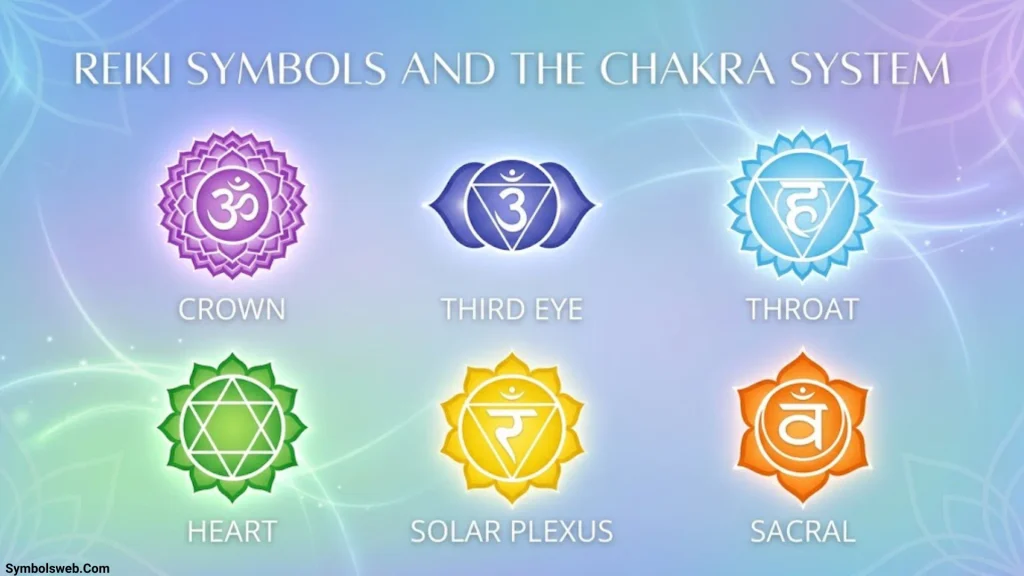
The chakra system is a spiritual framework used in several traditions to describe centers associated with different aspects of human experience. Some Reiki practitioners incorporate chakra concepts into meditation and energy-focused practices.
However, chakras aren’t recognized as physical organs or anatomical energy centers by conventional medicine. Reiki symbol associations with chakras also vary between teachers.
The Seven Primary Chakras
The seven-chakra model commonly includes these centers:
| Chakra | Common Sanskrit name | Traditional associations |
| Root | Muladhara | Grounding and stability |
| Sacral | Svadhisthana | Creativity and emotional expression |
| Solar plexus | Manipura | Confidence and personal agency |
| Heart | Anahata | Love and compassion |
| Throat | Vishuddha | Communication and expression |
| Third eye | Ajna | Intuition and perception |
| Crown | Sahasrara | Spiritual awareness |
Some expanded spiritual systems also discuss the Soul Star chakra above the head and the Earth Star chakra below the feet. These aren’t part of the standard seven-chakra model.
Which Reiki Symbols Are Associated With Each Chakra?
There is no single universal chart matching every Reiki symbol to a particular chakra. Some teachers make associations based on the symbol’s traditional meaning, while others follow a specific lineage’s instructions.
Examples include:
- Heart chakra: Shika Sei Ki or Harth in certain teachings.
- Throat chakra: Shika So in certain teachings.
- Crown chakra: OM or AUM in some spiritual practices.
- Sushumna channel: Dumo and Fire Serpent in some Tibetan-influenced systems.
- Grounding: Raku or Rama in relevant Reiki lineages.
Treat these as tradition-specific associations, not a standardized Reiki map.
Can Reiki Symbols Balance All Seven Chakras?
Some practitioners use visualization, meditation, and Reiki symbols as part of a chakra-focused routine. They may move their attention through the seven centers or reflect on the qualities associated with each one.
Such a practice can provide a structured spiritual or meditative experience. However, chakra balancing isn’t a scientifically established medical procedure, and no evidence shows that drawing a symbol physically realigns anatomical structures.
Reiki Attunement and Symbol Access
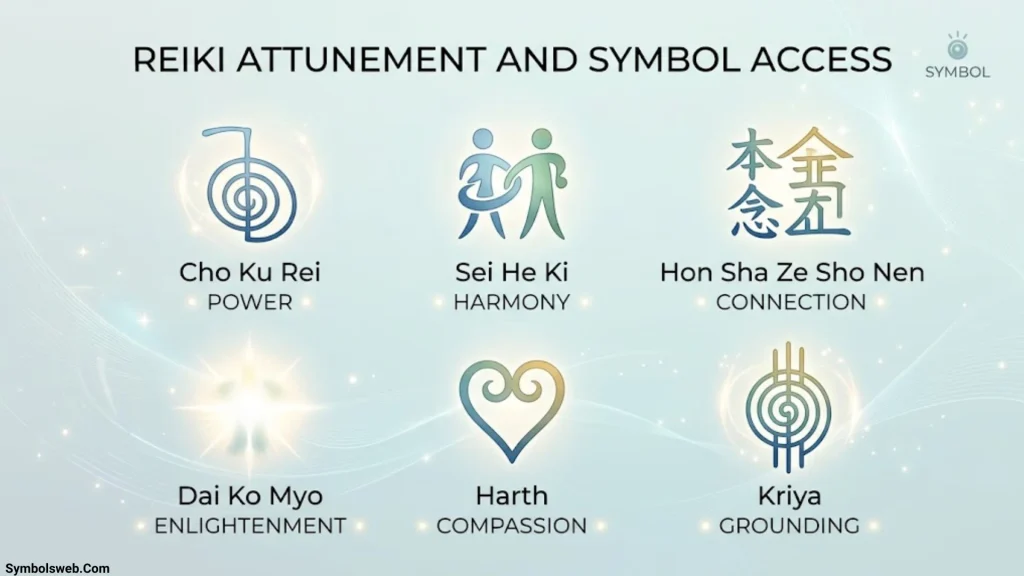
Reiki attunement is a process used in many Reiki lineages to prepare students for practice. Teachers explain and conduct attunements according to the methods of their particular system.
Its traditional significance is spiritual. An attunement shouldn’t be described as a medically verified transfer of energy.
What Is Reiki Attunement?
In many schools, a Reiki teacher guides students through an attunement as part of their training. The process may involve meditation, symbolic practices, and specific instructions associated with the lineage.
The teacher also explains how students should approach self-treatment, hand positions, and other aspects of practice.
Attunement methods vary. Students should ask their instructor which process the course follows and what skills they will learn.
Which Reiki Symbols Are Taught at Each Level?
Many Western Usui Reiki programs organize training into levels. A common teaching structure looks like this:
| Training level | Common focus | Symbol instruction |
| Usui Reiki Level 1 | Foundations and self-treatment | Basic principles, hand positions, and practice methods |
| Usui Reiki Level 2 | Expanded practice | Often teaches Cho Ku Rei, Sei He Ki, and Hon Sha Ze Sho Nen |
| Usui Reiki Level 3 or master training | Advanced practice and teaching | Often introduces Dai Ko Myo and master-level methods |
This table describes a common Western curriculum rather than a universal standard. Some schools use different level names, sequences, or teaching requirements.
Can You Use Reiki Symbols Without Attunement?
There isn’t one answer that applies to every Reiki system.
Many traditional lineages teach symbols within a structured training process and expect students to learn their use from an instructor. Other teachers may take different approaches to studying or practicing them.
Learning about a symbol’s history and meaning is different from receiving training in a particular Reiki lineage.
If you want to practice Reiki, ask a teacher about their training requirements, symbol instruction, and lineage. Avoid claims that an online symbol chart alone provides the same instruction as a full course.
How to Choose a Reiki Teacher
A suitable teacher should explain their training background, teaching system, and expectations clearly.
Before enrolling, ask:
- Which Reiki lineage do you teach?
- Which symbols are included in the course?
- How do you teach their meanings and applications?
- What does the attunement involve?
- What practice and support are available afterward?
- Do you make any medical claims about Reiki?
Be cautious of instructors who promise guaranteed cures or claim their symbols can replace medical treatment.
Traditional vs. Nontraditional Reiki Symbols
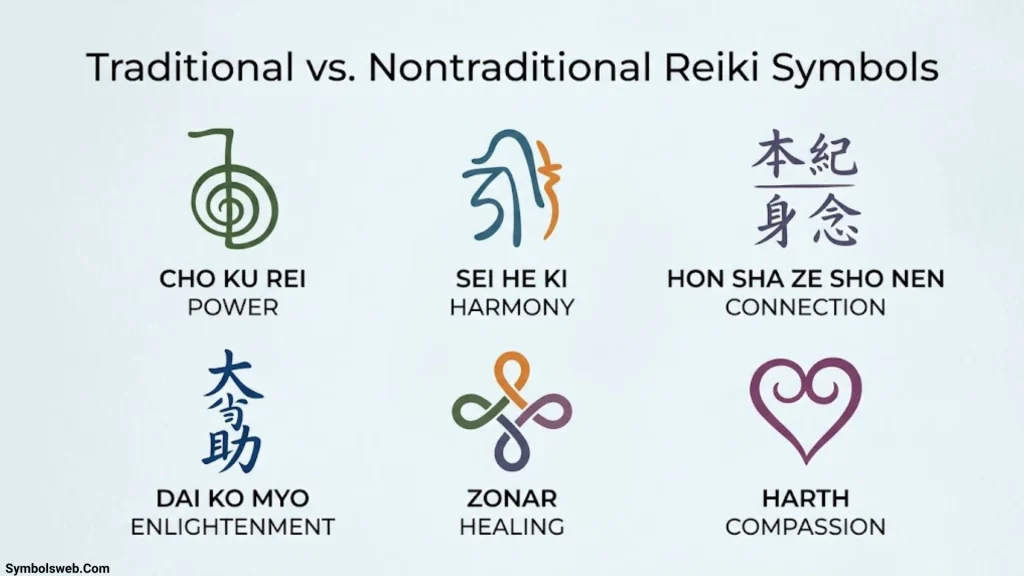
The distinction between traditional and nontraditional Reiki symbols helps explain why different websites publish different symbol lists.
Traditional symbols belong to a particular Reiki lineage. Additional symbols may come from later systems, expanded teaching methods, or other spiritual traditions.
What Makes a Reiki Symbol Traditional?
The answer depends on the system being discussed. The four commonly taught Usui symbols form a recognizable set in many Western Reiki curricula.
Their names, meanings, and teaching methods have been passed through Reiki lineages, although schools may differ in their presentations.
Historical context matters, too. A symbol’s presence in a modern Reiki course doesn’t prove that it originated in ancient Japan or that every Reiki practitioner has historically used it.
How Do Nontraditional Reiki Symbols Differ?
Expanded Reiki systems may include symbols that don’t belong to the four-symbol Usui set.
Examples include:
- Karuna Reiki: Zonar, Halu, Harth, Rama, Gnosa, Kriya, Iava, and Shanti.
- Tibetan-influenced systems: Dumo and the Fire Serpent.
- Shamballa-related systems: Motor Zanon, Amsui, Palm Master, and Mer Ka Fa Ka Lish Ma.
- Other expanded symbol lists: Shika Sei Ki, Shika So, Hosanna, and Len So My.
These classifications depend on the source and lineage. Some symbols appear in more than one system, and their meanings may differ.
Usui Reiki vs. Karuna Reiki
| Feature | Usui Reiki | Karuna Reiki |
| System | Reiki system associated with Mikao Usui | A distinct Reiki system |
| Common symbol set | Four principal symbols in many Western curricula | Eight commonly taught principal symbols |
| Examples | Cho Ku Rei, Sei He Ki, Hon Sha Ze Sho Nen, Dai Ko Myo | Zonar, Halu, Harth, Rama, Gnosa, Kriya, Iava, Shanti |
| Training | Depends on the teacher and lineage | Depends on the specific training method |
| Main distinction | Foundational Usui Reiki framework | Expanded system with its own symbols and teaching framework |
Both systems have variations in how teachers organize their courses. Neither table nor symbol list captures every lineage.
Karuna Reiki vs. Shamballa Reiki
Karuna Reiki has a recognizable group of eight commonly taught principal symbols. Shamballa Reiki materials often present broader symbol collections that can include names such as Amsui, Motor Zanon, and Palm Master.
The systems shouldn’t be treated as interchangeable. Their training methods, symbol sets, and interpretations differ.
If a symbol appears on a website that covers several Reiki traditions, check its specific classification before assuming it belongs to Usui Reiki.
Why Do Reiki Symbols Have Different Spellings and Meanings?
Several factors explain the differences.
Transliteration can produce different English spellings for names originally written in other languages. Teaching lineages may also preserve different drawings or interpretations.
Modern Reiki systems sometimes introduce additional symbols or use existing symbols in new ways. As a result, two sources may describe the same name differently or assign a symbol to different systems.
When accuracy matters, prioritize the lineage’s teaching materials and compare them with reliable historical or educational sources.
Are Reiki Symbols Scientifically Proven to Heal?
Reiki symbols have spiritual meanings within the traditions that teach them. However, their traditional roles should remain separate from claims about medical effectiveness.
The National Center for Complementary and Integrative Health (NCCIH) explains that research hasn’t clearly established Reiki’s effectiveness for any health-related purpose. It also reports that scientific evidence doesn’t support the proposed energy field involved in Reiki explanations.
Some people report feeling relaxed during Reiki sessions. Those personal experiences don’t establish that symbols cure diseases, correct physical energy imbalances, or treat specific medical conditions.
What Does Scientific Research Say About Reiki?
Reiki has been studied in connection with concerns such as pain, anxiety, and depression. However, the NCCIH describes the available research as limited by problems with study quality and inconsistent findings.
This means that strong claims about Reiki’s medical benefits aren’t justified by the current evidence.
A responsible explanation distinguishes between three things:
- Traditional belief: What Reiki teachers and practitioners say a symbol represents.
- Personal experience: What someone reports feeling during a session.
- Scientific evidence: What well-designed research demonstrates about an intervention’s effects.
These categories can overlap in someone’s personal experience, but they aren’t interchangeable.
Can Reiki Symbols Replace Medical Treatment?
No. Reiki symbols shouldn’t replace medical diagnosis, prescribed treatment, or professional health advice.
People may choose to include spiritual practices in their personal routines or alongside appropriate health care. However, they shouldn’t delay necessary treatment because they believe a symbol will cure an illness.
Be especially cautious of claims that Motor Zanon treats viral infections or that particular symbols eliminate physical disease. These claims aren’t supported by established clinical evidence.
Frequently Asked Questions About Reiki Symbols
What Are the Four Main Reiki Symbols?
The four symbols commonly taught in Western Usui Reiki are Cho Ku Rei, Sei He Ki, Hon Sha Ze Sho Nen, and Dai Ko Myo. Their common associations include power, emotional harmony, distance Reiki, and master-level practice.
What Do Reiki Symbols Mean?
Reiki symbols represent particular concepts or intentions within the traditions that teach them. Cho Ku Rei is commonly associated with power and focus, while Sei He Ki relates to mental and emotional harmony. Interpretations can vary between lineages.
Which Reiki Symbol Is Used for Protection?
Cho Ku Rei is commonly associated with protection and focus in many Reiki teachings. Some expanded systems also use other symbols for grounding or protection-related practices. These are spiritual associations rather than scientifically established protective effects.
Which Reiki Symbol Is Used for Emotional Healing?
Sei He Ki is commonly associated with mental and emotional harmony. Practitioners may use it during meditation or reflective practices. It isn’t a proven treatment for mental health conditions.
Which Reiki Symbol Is Used for Distance Healing?
Hon Sha Ze Sho Nen is the symbol commonly associated with distance Reiki in many Western Usui lineages. Practitioners may incorporate it into remote sessions according to their training.
Can Beginners Use Reiki Symbols?
Beginners can study Reiki symbols, their names, and their traditional meanings. However, training requirements for practice vary between Reiki systems. Many lineages teach symbol use as part of structured instruction.
Do You Need Attunement to Use Reiki Symbols?
Many Reiki schools teach symbols through formal training and attunement. However, practices and requirements vary by lineage. Ask a qualified teacher how their system approaches symbol access and use.
How Do You Activate Reiki Symbols?
Depending on the tradition, practitioners may draw a symbol, visualize it, repeat its name, or focus on its traditional meaning. These methods describe spiritual practice rather than a scientifically verified energy-activation process.
What Is the Difference Between Usui and Karuna Reiki Symbols?
Usui Reiki commonly teaches four principal symbols in Western curricula. Karuna Reiki has its own symbol set, including Zonar, Halu, Harth, Rama, Gnosa, Kriya, Iava, and Shanti. The systems also have distinct teaching frameworks.
Are Reiki Symbols the Same in Every Reiki System?
No. Symbol names, drawings, meanings, and training requirements can differ between Usui, Karuna, Shamballa, Tibetan-influenced, and other Reiki systems. Always check the lineage associated with a particular symbol.
What Does the AUM Reiki Symbol Mean?
AUM, often written OM, is a sacred syllable with significance in several Indian spiritual traditions. It appears in some Reiki-related systems, but it isn’t one of the four principal Usui Reiki symbols.
Is There a Reiki Symbol for Abundance?
Some expanded Reiki teachings include an Abundance symbol associated with prosperity and personal aspirations. This is a spiritual association, not evidence that drawing the symbol guarantees financial success.
Can Reiki Symbols Cure Illnesses?
There is no reliable scientific evidence that Reiki symbols cure illnesses. Reiki may be meaningful to some people as a spiritual practice, but it shouldn’t replace medical diagnosis or treatment.
Conclusion
Reiki symbols offer a way to explore the meanings, traditions, and practices associated with different Reiki systems. The four commonly taught Usui symbols provide a useful foundation, while Karuna, Shamballa, and other lineages introduce additional forms and interpretations.
Understanding each symbol’s origin helps you avoid confusing traditional teachings with modern additions. It also makes it easier to distinguish spiritual associations from claims that lack scientific support.
If you want to explore Reiki further, begin with reliable teaching materials, learn the symbols associated with your chosen lineage, and approach health claims carefully. A thoughtful understanding of Reiki symbols and their meanings starts with knowing what a tradition teaches and recognizing what the available evidence can actually establish.

Eliana Foster is a writer with a passion for exploring the meanings behind symbols, traditions, and cultural history. She enjoys breaking down complex topics into simple, engaging articles that are easy for everyone to understand. Eliana is also the fictional author of The Hidden Language of Silent Marks and Beyond the Circle of Ancient Signs, two original book concepts created for her author profile. When she’s not writing, she loves visiting museums, reading about mythology, and researching the stories behind symbols from around the world. Her goal is to help readers discover the fascinating meanings hidden in everyday signs and ancient emblems.
 Jordan Hayes
 Ethan Holloway