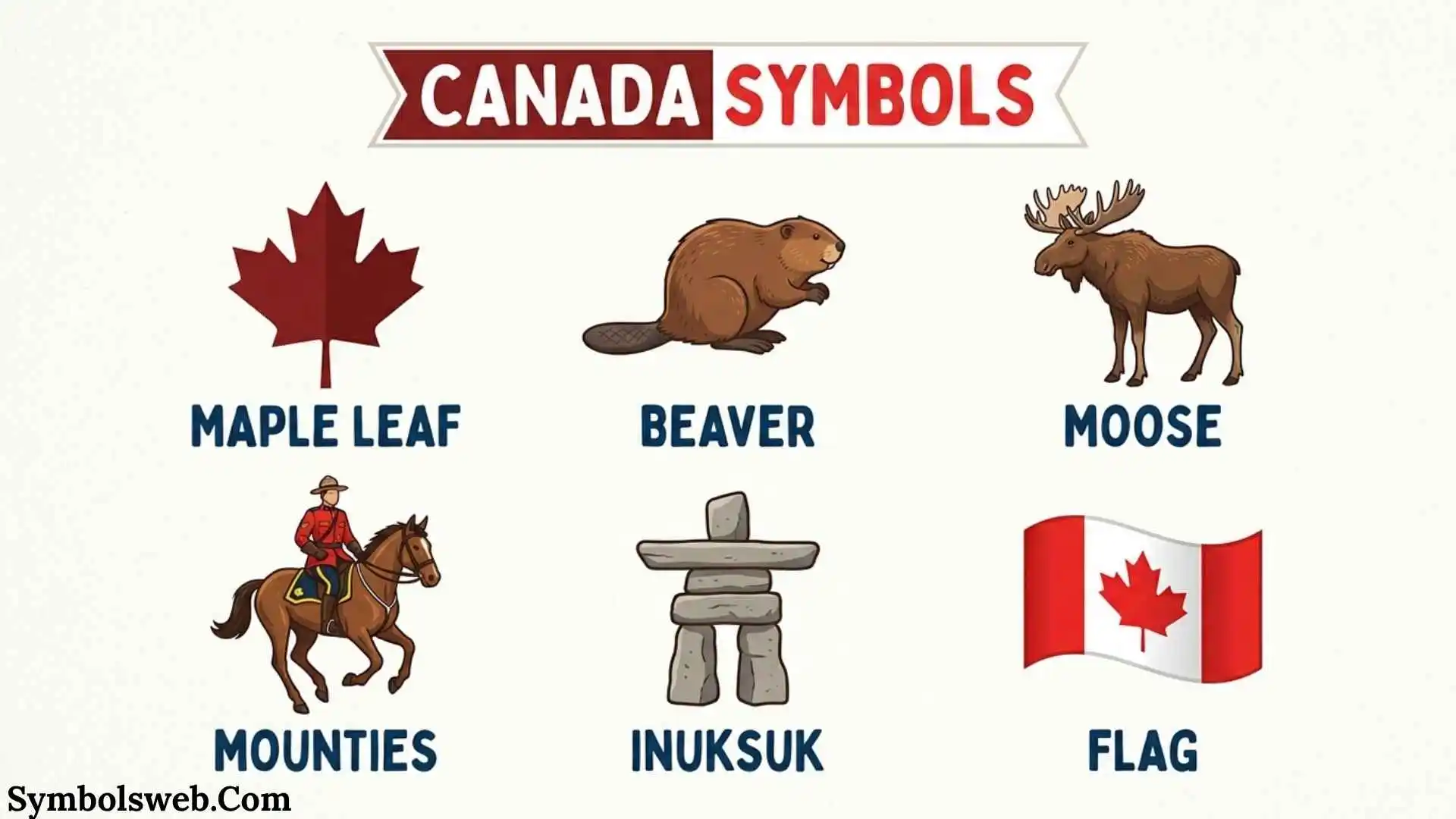
Canada symbols tell a story that is much bigger than a maple leaf on a red and white flag. They reflect the country’s land, Indigenous histories, French and British heritage, political development, wildlife, sports, military history, and the everyday identity of Canadians.
Some symbols, such as the maple leaf, beaver, national flag, coat of arms, and “O Canada,” have official status. Others, including the Royal Canadian Mounted Police and Parliament Buildings, became powerful symbols through history and public recognition. Together, they help explain what Canada represents at home and around the world.
Canada Symbols: (Quick Answer)
Canada symbols are national emblems, images, animals, colours, traditions, and cultural objects that represent Canada’s identity and heritage. Major official symbols include the Canadian flag, coat of arms, beaver, maple tree, national anthem, hockey, lacrosse, national horse, Maple Leaf Tartan, and national colours. Other widely recognized symbols include the maple leaf, Mounties, Inukshuk, Canada geese, and the Canadian Rockies.
Quick Facts About Canada Symbols
| Aspect | Information |
| National Flag | Red and white flag featuring a stylized 11-point maple leaf |
| Flag Adopted | January 28, 1965 |
| First Raised | February 15, 1965, on Parliament Hill |
| Most Recognizable Emblem | Maple leaf |
| Official Animal Symbol | Beaver |
| National Tree Emblem | Maple tree |
| National Anthem | “O Canada” |
| Official National Sports | Lacrosse and hockey |
| National Horse | Canadian horse |
| National Tartan | Maple Leaf Tartan |
| National Colours | Red and white through established national usage |
| Coat of Arms | Royal Arms of Canada, adopted in 1921 |
Canada’s official symbols are recognized through formal government action or long-standing national use. The Government of Canada distinguishes between official symbols and unofficial symbols that are strongly associated with Canadian identity.
What Are Canada Symbols?
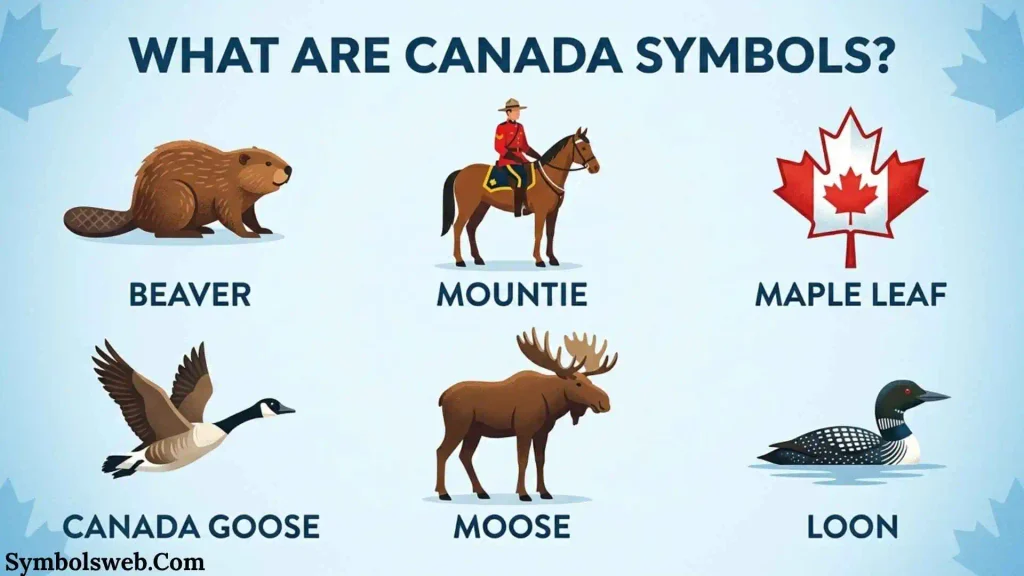
Canada symbols are visual, natural, historical, musical, sporting, and cultural representations associated with the country and its people.
Some have official legal or governmental recognition. Others became symbols because Canadians repeatedly used them to express national pride. This distinction matters because not every famous Canadian image is an officially designated national symbol.
For example, the maple leaf is one of Canada’s strongest national emblems, but its importance developed through generations of use before the modern Canadian flag was created. The beaver, meanwhile, became an official symbol through legislation in 1975.
Why Canada Needed National Symbols
Canada developed as a country with several major cultural and historical influences. Indigenous peoples have lived across these lands since long before European colonization. French and British colonial histories later shaped Canadian institutions, languages, and traditions.
After Confederation in 1867, Canada gradually developed symbols that could express a distinct national identity.
This process was not always simple. For decades, Canadian flags and emblems reflected connections to Britain. The search for a more distinct Canadian flag eventually became one of the country’s most important debates about national identity.
The result was the red and white maple leaf flag, officially adopted in 1965.
Canada Symbols And Meanings
Canada has many symbols that represent its nature, history, culture, and national identity. If you are searching for Canada symbols and meanings, you will find familiar examples such as the maple leaf, beaver, Canadian flag, and coat of arms.
When I explore Canadian symbols, I find that each one tells a different story. You can use this guide to understand what these symbols mean and choose the ones that best fit your school project, artwork, research, or personal interest.
National Symbol Of Canada Animal
The beaver is one of Canada’s most recognizable national animal symbols. It became an official symbol of Canada in 1975 and has a long connection with Canadian history and nature.
The beaver played an important role in the fur trade, which had a major influence on Canada’s early history. You can also find the beaver in historical Canadian imagery, including the Hudson’s Bay Company’s coat of arms and Canada’s famous Three-Penny Beaver stamp.
If you are looking for an animal that represents Canada, I would choose the beaver because its connection with Canadian wildlife and history makes its symbolism easy to understand.
You can associate the beaver with:
- Canadian wildlife
- Rivers and forests
- Canadian history
- The fur trade
- Natural resources
Canada Symbol Flag

The Canadian flag is one of the clearest symbols of Canadian identity. It features two red vertical bands, a white center, and a red 11-point maple leaf.
If you want to represent Canada in a drawing, poster, classroom project, or piece of artwork, you can use the Canadian flag because its design is instantly recognizable.
The maple leaf represents Canada’s connection with nature and has been associated with Canadian identity for generations. The colors red and white are Canada’s official national colors.
When I see the Canadian flag, I immediately associate it with Canada’s national identity. You can also combine the flag with other Canadian symbols when creating a larger Canada-themed design.
National Symbols Of Canada Maple Leaf
The maple leaf is one of Canada’s most recognizable national symbols. Maple trees are widespread across Canada, and the maple leaf has been associated with Canadian identity for generations.
You can see the maple leaf on Canada’s national flag and in many Canadian government, military, sporting, and cultural designs.
The maple leaf can represent:
- Canadian identity
- Nature
- Forests
- National unity
- Canadian heritage
If you need one simple symbol to represent Canada, I would choose the maple leaf. You can draw it easily, use it in artwork, or include it in a school project without needing a complicated design.
Indigenous People Of Canada Symbols
Indigenous peoples in Canada include First Nations, Inuit, and Métis peoples. Each group contains diverse Nations and communities with their own histories, languages, cultural traditions, and symbols.
If you are researching Indigenous Canadian symbols, you should remember that there is no single symbol representing every Indigenous person or community in Canada.
Different Nations may use specific animals, plants, patterns, colors, and other imagery with particular cultural meanings. When I research an Indigenous symbol, I would always look at the specific Nation or community connected with it.
You can make your research more accurate by identifying where a symbol comes from rather than treating all Indigenous symbols as having the same meaning.
United Church Of Canada Symbols
The United Church of Canada has symbols connected with Christianity, worship, community, and its own history. You may see Christian imagery such as the cross, dove, flame, Bible, and water associated with Christian traditions.
The United Church of Canada was formed in 1925 through the union of several Protestant denominations.
If you are looking for symbols specifically connected with the United Church, you should distinguish them from Canadian national symbols. I would consider the cross and other Christian imagery as religious symbols, while the maple leaf and beaver represent Canada more broadly.
You can therefore choose a symbol based on whether your project is about Canadian identity or the religious identity of the church.
Beaver Canada Symbols
The beaver is an important Canadian symbol with strong connections to wildlife and history. Canada officially recognized the beaver as a national symbol in 1975.
The animal became particularly important during the fur trade because beaver pelts were highly valuable. You can also find the beaver in historical Canadian imagery and on Canada’s early postage stamp known as the Three-Penny Beaver.
Today, you can see beaver imagery in Canadian coins, artwork, educational materials, and various Canadian designs.
When I think about Canadian animal symbolism, the beaver stands out because you can connect it to both Canada’s natural environment and its history.
Coat Of Arms Canada Symbols Meaning
Canada’s coat of arms contains several symbols that reflect the country’s history and historical relationships. The shield includes symbols associated with England, Scotland, Ireland, and France.
You can also see three maple leaves on the shield, representing Canada. The supporters include a lion holding the Union Flag and a unicorn holding the royal standard of France.
The coat of arms also includes the Crown and the motto A Mari Usque Ad Mare, which means “From Sea to Sea.”
If you are studying Canadian symbols, I think the coat of arms is especially interesting because you can see several historical elements combined into one official emblem.
Canada Symbols For Christmas

Canadian Christmas celebrations include many familiar Christmas symbols, including Christmas trees, lights, wreaths, ornaments, stockings, gifts, and Santa Claus.
Because winter is an important part of life in many parts of Canada, you can also find snow, evergreen trees, winter landscapes, and outdoor lights in Canadian Christmas imagery.
If you are creating a Canada-themed Christmas design, you can combine traditional Christmas symbols with Canadian imagery such as:
- Maple leaf — Canadian identity.
- Canadian flag — national identity.
- Evergreen tree — Christmas and winter.
- Snow — Canadian winter imagery.
- Christmas lights — celebration.
- Moose — Canadian wildlife.
- Red and white colors — commonly associated with Canada.
When I create a Canadian Christmas concept, I would combine a maple leaf or Canadian flag with traditional Christmas elements so you can immediately recognize both themes.
Ontario Canada Symbols
Ontario has several official symbols that represent its natural environment and provincial identity. The white trillium is Ontario’s official flower and is one of the province’s best-known natural symbols.
The eastern white pine is Ontario’s official tree, while the common loon is the province’s official bird. Ontario’s official animal is the white-tailed deer.
If you are researching Ontario symbols, you can use these official examples:
- White trillium — official provincial flower.
- Eastern white pine — official provincial tree.
- Common loon — official provincial bird.
- White-tailed deer — official provincial animal.
When I compare Ontario symbols with national Canadian symbols, I find it helpful to remember that these represent the province specifically. You can use the trillium, pine, loon, or deer when you want your project to focus on Ontario rather than Canada as a whole.
Canada Symbols For Kids
If you are teaching children about Canada, you can start with simple symbols that are easy to recognize and draw. The maple leaf and Canadian flag are especially useful because kids can quickly connect them with Canada.
Some common Canada-related symbols for kids include:
- Maple leaf — represents Canada.
- Canadian flag — Canada’s national flag.
- Beaver — an official national animal symbol.
- Canada goose — a familiar Canadian bird.
- Maple tree — connects with Canada’s natural environment.
- Mountains — represent Canada’s diverse landscapes.
- Hockey — an important part of Canadian sporting culture.
- Snow — represents the winter environment found across many Canadian regions.
If you are making a school project, I would start with the maple leaf, flag, and beaver. You can draw each one simply and then add a short explanation of what it represents. This makes it easier for you to create a clear and interesting Canada symbols project.
The Maple Leaf: Canada’s Most Famous Symbol
The maple leaf is perhaps the single image most closely connected with Canada.
It began appearing as a Canadian symbol as early as the 18th century, while Indigenous peoples had already been using maple sap as a valuable seasonal food source long before European settlement. During the 19th century, the leaf increasingly appeared on Canadian badges, songs, coins, decorations, and other expressions of national identity.
Historical Meaning of the Maple Leaf
The maple leaf became particularly powerful during periods when Canadians wanted to distinguish their identity from European powers.
In 1860, it appeared on the badge of the 100th Regiment during the visit of the Prince of Wales. In 1867, Alexander Muir wrote “The Maple Leaf Forever,” a song associated with Confederation. The maple leaf also appeared on Canadian coins and military badges.
During the First World War, the maple leaf became even more strongly associated with Canadian military identity. It appeared on the badges of Canadian soldiers, and maple leaves were later carved on many graves of Canadian service members who died in the two world wars.
What Does the Maple Leaf Symbolize?
The maple leaf can represent:
- Canadian identity
- National pride
- Nature and the Canadian landscape
- Unity
- Courage
- Loyalty
- Sacrifice
- Belonging
- Seasonal change
- A shared national identity
Its meaning can change depending on context. On a sports jersey, it may represent competition and national pride. On a military memorial, it can evoke sacrifice and remembrance. On the national flag, it represents Canada as a sovereign country.
The Canadian Flag and Its Symbolism
The National Flag of Canada is one of the world’s most recognizable national flags.
Its design consists of two red vertical bands surrounding a white square containing a stylized red maple leaf with 11 points. The flag was officially adopted on January 28, 1965, and was first raised on Parliament Hill on February 15, 1965.
The Great Flag Debate
The modern Canadian flag was not created overnight.
Before 1965, Canada used several flags, including the Union Jack and the Canadian Red Ensign. After the Second World War, pressure increased for a distinctive Canadian flag.
In 1964, Prime Minister Lester B. Pearson pushed the issue forward. An all-party parliamentary committee considered thousands of designs before choosing the concept that eventually became Canada’s current flag. Parliament approved the design by a vote of 163 to 78.
Why the Flag Uses a Maple Leaf
The maple leaf already had deep roots in Canadian culture when the flag was designed.
The committee wanted an emblem that could represent Canada clearly and distinguish it from British and French symbols. The maple leaf had already become widely recognized as a Canadian emblem, making it a natural choice.
The maple leaf used on the flag is a specific stylized design with 11 points. It is not intended to be an exact representation of one particular maple species.
What Do Red and White Mean?
Red and white are Canada’s national colours through long-standing national use.
A common interpretation connects white with winter snow and red with the colours of autumn maple leaves. However, the Government of Canada notes that the 1921 proclamation of Canada’s coat of arms did not actually formally designate red and white as national colours. Their status developed through history, public use, and national identity.
The Beaver: A Symbol of Canada’s History
The beaver is one of Canada’s oldest and most historically important symbols.
It became an official Canadian symbol on March 24, 1975, when the National Symbol of Canada Act received royal assent. The legislation recognizes the beaver, Castor canadensis, as a symbol of Canadian sovereignty.
Why the Beaver Became a Canadian Symbol
The beaver played a major role in the fur trade from the 17th through the middle of the 19th century.
European demand for beaver pelts helped drive exploration, trade, and colonial expansion across what became Canada. Beaver fur was particularly valuable for producing waterproof felt hats in Europe.
The animal was important to Indigenous peoples as well. Beaver meat provided food, fur provided material for clothing, and bones could be used to make tools. Indigenous communities had recognized the animal’s value long before European traders arrived.
The Beaver as a Symbol of Hard Work
The beaver is often associated with:
- Industry
- Construction
- Persistence
- Resourcefulness
- Cooperation
- Adaptation
- Canada’s waterways and wilderness
The symbolism fits the animal’s behaviour. Beavers transform their environment by building dams and lodges, making them a natural metaphor for patience and productive work.
The Maple Tree: Canada’s National Arboreal Emblem
The maple tree is another important Canadian symbol.
Canada formally designated the maple tree as its national arboreal emblem in 1996. Ten maple species are native to Canada, including sugar, black, red, silver, and Manitoba maple.
Why the Maple Tree Matters
The maple connects Canadian identity with the natural landscape.
Maple trees are especially famous for their changing colours. Their leaves shift through shades of green, yellow, orange, red, and brown as the seasons change.
The tree also has economic importance through maple products, especially maple syrup. Indigenous peoples were the first to recognize and use maple sap as a seasonal resource.
The maple tree therefore represents more than national pride. It connects Canada’s national identity with land, seasons, food, forests, and traditional knowledge.
Canada’s Coat of Arms
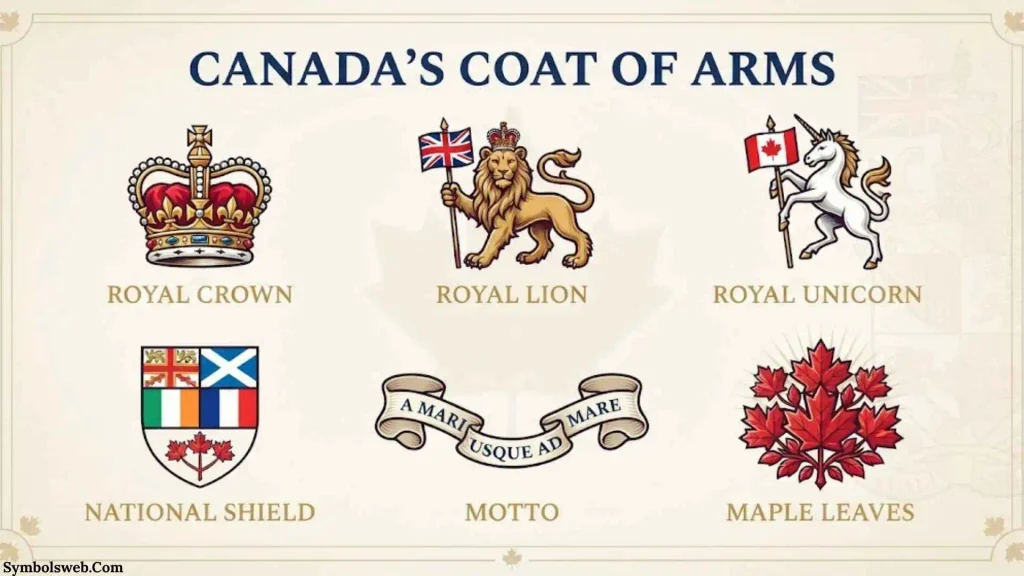
The Coat of Arms of Canada, also called the Arms of Canada or Royal Arms of Canada, was adopted by proclamation of King George V in 1921.
Heraldry has a long European history. Coats of arms originally helped identify people and groups, especially in military settings, before becoming symbols used by institutions, cities, regions, and countries.
Canada’s coat of arms reflects several layers of the country’s history and its constitutional connections to the British monarchy.
Maple Leaves in the Coat of Arms
Three maple leaves appear together in the Canadian arms.
Their presence is important because the maple leaf had already become an emerging symbol of Canadian identity before the arms were adopted.
The coat of arms therefore helped establish the maple leaf as an enduring national emblem years before it became the central feature of the modern flag.
Canada’s National Anthem: O Canada
“O Canada” is Canada’s national anthem.
It was first performed on June 24, 1880, during Saint-Jean-Baptiste Day celebrations in Quebec City. The music was composed by Calixa Lavallée, while the original French lyrics were written by Adolphe-Basile Routhier.
The English lyrics developed later, with the version associated with today’s official English lyrics written by Robert Stanley Weir in 1908.
“O Canada” was officially proclaimed the national anthem on July 1, 1980, through the National Anthem Act.
What Does O Canada Represent?
The anthem represents:
- National belonging
- Love of country
- Shared identity
- Civic pride
- Historical continuity
- Canadian sovereignty
Its importance is especially visible at schools, sporting events, public ceremonies, Remembrance Day events, and national celebrations.
The sound of the anthem can create an emotional response because music connects national identity with memory. A person may hear the opening notes and immediately remember a school ceremony, hockey game, public event, or Canada Day celebration.
Canada’s National Sports: Hockey and Lacrosse
Canada has two official national sports.
Lacrosse is Canada’s national summer sport, while hockey is Canada’s national winter sport.
Both sports have deep cultural significance, but their histories are different.
Lacrosse
Lacrosse has Indigenous roots and was played by Indigenous peoples long before European settlers adopted and modified the game.
The sport therefore carries an important connection to Indigenous history and cultural traditions.
Its recognition as Canada’s national summer sport acknowledges a sporting tradition with deep roots in the land.
Hockey
Hockey has become one of the most recognizable parts of Canadian popular culture.
For many Canadians, hockey represents community, winter, competition, family traditions, and national pride.
The sport is not simply a game. In many communities, local arenas function as gathering places where generations meet and shared memories are created.
The Canadian Horse
The Canadian horse is Canada’s national horse.
Its history is closely connected to the development of Canadian society. The breed is known for strength, endurance, and adaptability.
As a national symbol, the Canadian horse reflects the practical relationship between people and animals in Canada’s agricultural and rural history.
It also represents resilience, a quality often associated with life in a country known for large distances and challenging winters. The Canadian horse is formally included among Canada’s official national symbols.
The Maple Leaf Tartan
The Maple Leaf Tartan is another official Canadian symbol.
Its colours are inspired by the changing appearance of maple leaves throughout the seasons. Green represents summer leaves, gold reflects early autumn, red represents the first frost, and brown recalls fallen leaves before winter.
The tartan combines Canadian landscape symbolism with the cultural history of tartan and Scottish traditions.
It was designed as a symbol that Canadians from different backgrounds could wear as an expression of national pride.
Canada also recognizes April 6 as Tartan Day.
Canada’s National Colours
Red and white are strongly associated with Canada.
They appear on the national flag and are used widely during national celebrations, sporting events, military ceremonies, and public events.
Although the colours are not formally established by the 1921 coat of arms proclamation in the way many people assume, their repeated use has made them an important part of Canadian identity.
Unofficial Symbols of Canada
Not every famous Canadian symbol has formal official status.
Some images became powerful through culture, history, tourism, media, and public perception.
Important unofficial or widely recognized Canadian symbols include:
- The maple leaf
- The Mountie or Royal Canadian Mounted Police
- The Inukshuk
- Canada geese
- The Canadian Rockies
- The beaver
- The canoe
- The northern landscape
- The Canadian wilderness
- Maple syrup
The Government of Canada specifically distinguishes official symbols from unofficial symbols that are strongly connected with Canadian identity.
The Mountie as a Canadian Symbol
The Royal Canadian Mounted Police, commonly known as the RCMP, has become a recognizable Canadian image.
The red serge uniform, wide-brimmed hat, horse, and ceremonial traditions have helped create an international image of Canada associated with order, service, and the country’s frontier history.
However, the Mountie is best understood as a cultural and institutional symbol rather than one of Canada’s formally listed core national symbols.
Its meaning can also be more complicated than the friendly tourist image suggests because the history of policing in Canada is connected to colonial expansion and relationships with Indigenous peoples.
That complexity is important when discussing national symbols honestly. A symbol can represent pride while also carrying difficult historical memories.
The Inukshuk and Indigenous Cultural Symbolism

The Inukshuk is widely associated with Canada, particularly the North and Inuit culture.
An inuksuk is a stone structure traditionally used by Inuit and other Arctic Indigenous peoples for purposes connected with travel, communication, hunting, navigation, and marking places.
It is important not to treat every stone structure as having exactly the same meaning. Indigenous traditions are diverse, and meanings vary by community and context.
The Inukshuk became especially visible to the wider Canadian public through its use in modern Canadian imagery, including the emblem associated with the 2010 Vancouver Winter Olympics.
This modern use helped turn the image into a global representation of Canada, although its deeper cultural history belongs to Indigenous peoples and should not be reduced to a simple tourism logo.
Canada Symbols and Indigenous Heritage
Canada’s national identity cannot be fully understood without Indigenous peoples.
Indigenous nations have their own symbols, stories, animals, artistic traditions, ceremonies, and relationships with the land. These traditions existed for thousands of years before Confederation.
The maple tree and beaver are two examples where Indigenous knowledge and use predate European settlement. Indigenous peoples recognized the value of maple sap, while beavers were important sources of food, materials, and other resources.
This history reminds us that Canadian symbolism is not only a story about modern government.
It is also a story about people, land, animals, seasons, languages, and cultural traditions that existed long before the modern Canadian state.
Canada Symbols Across History
Canadian symbols have changed as the country itself has changed.
Before Confederation
Before 1867, the lands that later formed Canada were influenced by Indigenous nations, New France, British North America, and other communities.
European flags and royal symbols were common in colonial settings.
After Confederation
After 1867, Canada gradually developed symbols that could express a more distinct Canadian identity.
The maple leaf became increasingly important during this period.
The First and Second World Wars
Military use strengthened the maple leaf’s association with Canada.
Canadian soldiers carried maple leaf emblems, helping turn the symbol into an international representation of Canadian identity and sacrifice.
The 1960s
The 1960s brought a major shift in Canadian national symbolism.
The Great Flag Debate reflected a larger question: should Canada continue using symbols closely connected to Britain, or should it create a clearly Canadian national identity?
The 1965 flag became the answer.
Modern Canada
Today, Canadian symbols appear in government, education, sports, tourism, fashion, advertising, social media, public ceremonies, and everyday life.
Some symbols remain traditional while others continue to evolve.
Spiritual Meaning of Canada Symbols
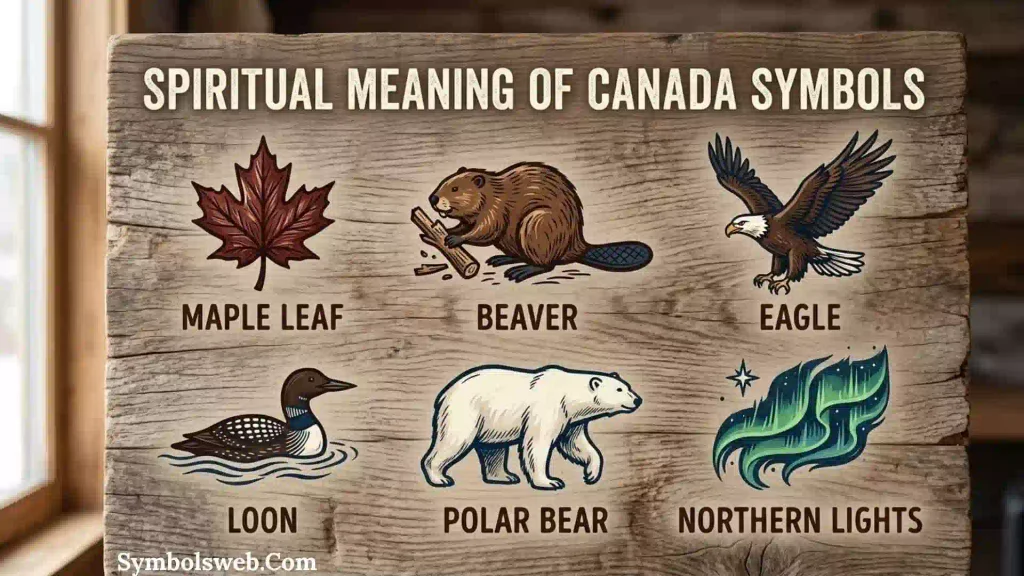
National symbols are not spiritual objects in themselves, and Canada does not have one universal spiritual interpretation of its symbols.
However, people can attach personal or spiritual meanings to national imagery.
The Maple Leaf and Renewal
Because maple trees change dramatically with the seasons, the maple leaf can inspire ideas of:
- Change
- Renewal
- Growth
- Acceptance
- Resilience
- The cycle of life
These are personal interpretations rather than official religious meanings.
The Beaver and Creation
The beaver’s ability to build can symbolize creation, patience, cooperation, and transformation.
A person reflecting on the beaver may see a reminder that meaningful things are built slowly.
The Canadian Landscape
Mountains, forests, lakes, rivers, snow, and northern skies often appear in Canadian imagery.
For many people, these landscapes create feelings of peace, freedom, humility, and connection with nature.
Again, these are cultural or personal interpretations rather than an official spiritual doctrine.
Psychological Meaning of Canada Symbols
Symbols work because humans naturally connect images with memories and emotions.
A red maple leaf is not merely a shape. For someone who grew up in Canada, it might remind them of school, family, hockey, autumn, national holidays, travel, or childhood.
Collective Memory
National symbols can act as containers for collective memory.
The maple leaf, for example, can connect modern Canadians with historical events, military sacrifice, political debates, sports, and everyday experiences.
Identity and Belonging
Psychologically, symbols can answer an important human question:
“Where do I belong?”
A national flag provides a simple visual answer.
It allows millions of individuals with different languages, religions, ethnic backgrounds, regions, and personal experiences to recognize themselves as part of a larger community.
Archetypal Symbolism
Some Canadian symbols also connect with broad human archetypes.
The beaver can represent the builder.
The maple tree can represent growth and renewal.
The mountain can represent endurance and strength.
The flag can represent collective identity.
These interpretations are psychological frameworks, not official meanings.
Positive and Negative Meanings of Canada Symbols
| Positive Meaning | Possible Complex or Negative Meaning |
| Unity | Pressure to conform |
| National pride | Excessive nationalism |
| Belonging | Exclusion of people who feel outside the national story |
| Nature | Romanticized wilderness |
| Strength | Simplification of complex history |
| Diversity | Tension between different identities |
| Freedom | Different experiences of what freedom means |
| Heritage | Nostalgia for an idealized past |
| Resilience | Ignoring historical hardship |
A national symbol can carry both light and shadow.
The maple leaf, for example, may inspire pride and sacrifice, but national symbols can also be used to create simplified versions of history.
Understanding both sides makes the study of symbolism more honest.
Similar Canadian Symbols and Their Meanings
| Symbol | Main Meaning | Type |
| Maple Leaf | Canadian identity and national pride | National emblem |
| Canadian Flag | Sovereignty and citizenship | Official national symbol |
| Beaver | Sovereignty, history, industry | Official national symbol |
| Maple Tree | Nature, landscape, seasonal identity | Official national emblem |
| O Canada | National belonging and pride | Official anthem |
| Hockey | Winter culture and community | Official national sport |
| Lacrosse | Indigenous heritage and summer sport | Official national sport |
| Maple Leaf Tartan | Landscape and national identity | Official symbol |
| Coat of Arms | State identity and history | Official symbol |
| Inukshuk | Arctic and Indigenous cultural associations | Widely recognized cultural symbol |
| Mountie | Canadian institutional and frontier imagery | Cultural symbol |
The important difference is that some of these are formally recognized by the Government of Canada while others are famous because of cultural association.
Canada Symbols in Art, Literature, Fashion, and Pop Culture
Canadian symbols appear far beyond government buildings.
Art
Artists use maple leaves, forests, mountains, wildlife, and northern landscapes to explore Canadian identity.
These images can communicate both beauty and questions about belonging, land, memory, and history.
Literature
Canadian writers often use landscape as more than background.
Forests, lakes, winter, wilderness, and distance can become symbols of isolation, freedom, survival, or identity.
The maple leaf also appears in Canadian poetry, songs, stories, and patriotic writing.
Sports
The maple leaf is particularly powerful in Canadian sports.
It appears on jerseys, team logos, merchandise, and international uniforms.
The Toronto Maple Leafs, for example, adopted the maple leaf as their logo in 1927, further strengthening the leaf’s connection with Canadian hockey culture.
Fashion and Jewelry
Maple leaf necklaces, pins, scarves, jackets, hats, and other products allow people to express Canadian identity in everyday life.
For travelers, these items can also become souvenirs.
Tattoos
A maple leaf tattoo may represent Canada, family roots, immigration, military service, travel memories, or personal pride.
The meaning depends heavily on the individual.
Canada Symbols in Modern Life
Canadian symbols remain visible because they are adaptable.
You can find them in:
- Government buildings
- Schools
- Sports arenas
- Airports
- Tourism campaigns
- Military ceremonies
- Canada Day celebrations
- Social media profiles
- Jewelry
- Clothing
- Tattoos
- Home decorations
- Corporate branding
- Educational materials
The maple leaf is especially flexible because its simple shape remains recognizable even when redesigned.
Why Are People So Attracted to Canada Symbols?

Humans are drawn to symbols because symbols compress complicated ideas into simple forms.
A flag can represent an entire country.
A maple leaf can represent generations of history.
A song can create a shared emotional memory.
A beaver can connect a modern nation with an animal that played a major role in its economic history.
This is why national symbols remain powerful even in an age of digital communication.
They give people something visible, memorable, and emotionally meaningful.
Interesting Facts About Canada Symbols
- The modern Canadian flag was first raised on Parliament Hill on February 15, 1965.
- Canada’s flag contains a stylized maple leaf with 11 points.
- The maple leaf was already used as a Canadian emblem long before the modern flag existed.
- The beaver appeared on Canada’s first postage stamp in 1851.
- The beaver became an official symbol of Canadian sovereignty in 1975.
- Canada has two official national sports: hockey and lacrosse.
- The maple tree became Canada’s national arboreal emblem in 1996.
- “O Canada” was officially proclaimed Canada’s national anthem in 1980, although it had been performed for about a century before that.
- Thousands of Canadian flag designs were considered during the Great Flag Debate of the 1960s.
- The Maple Leaf Tartan uses colours inspired by the seasonal changes of maple leaves.
Frequently Asked Questions About Canada Symbols
What is the most important symbol of Canada?
The maple leaf is widely considered Canada’s most recognizable national emblem. It has represented Canadian identity since the 19th century and became the central feature of the National Flag of Canada in 1965.
What are the 10 official symbols of Canada?
The Government of Canada lists the Coat of Arms, National Flag, beaver, national anthem, lacrosse, hockey, maple tree, national horse, Maple Leaf Tartan, and national colours among Canada’s official symbols.
What does the maple leaf symbolize in Canada?
The maple leaf symbolizes Canadian identity, pride, belonging, nature, and national unity. Its meaning has developed through centuries of use in Canadian culture, military history, coins, literature, sports, and national imagery.
Why is the beaver a symbol of Canada?
The beaver became an important Canadian symbol because of its major role in the fur trade and its long-standing importance to Indigenous peoples. It was formally recognized as a symbol of Canadian sovereignty in 1975.
What do the colours of the Canadian flag mean?
Red and white are Canada’s national colours through long-standing use and national association. They are commonly connected with Canadian heritage and the country’s natural landscape, although the 1921 coat of arms proclamation did not formally designate them as national colours.
When was the Canadian flag adopted?
The National Flag of Canada was officially adopted on January 28, 1965. It was first raised on Parliament Hill on February 15, 1965.
Conclusion
Canada symbols are more than familiar images on flags, jerseys, souvenirs, and government buildings. They are pieces of a much larger story involving land, Indigenous heritage, colonial history, immigration, war, sport, nature, and national identity.
The maple leaf may be the most recognizable, but the beaver, flag, anthem, sports, maple tree, tartan, and coat of arms each reveal another side of Canada. Together, these symbols show how a diverse country turns history and memory into a shared identity.

Jordan Hayes is a writer with a passion for exploring the history, meanings, and cultural significance behind symbols from around the world. He enjoys turning complex topics into clear, engaging content that anyone can understand. Jordan is also the fictional author of The Silent Language of Ancient Marks and Hidden Symbols Beyond the Surface, two original book concepts created for his author profile. When he’s not writing, he spends time researching myths, traditions, and forgotten stories that inspire his work. His goal is to help readers discover the deeper meanings behind the symbols they encounter every day.
 Eliana Foster
 Ethan Holloway