My name is a student, and I am a simple and hardworking person. I like to learn new things and improve myself every day. I always try to complete my work on time and respect everyone around me.
You are also an important part of my life because you help me learn and understand new things. I believe that when you work hard and stay positive, you can achieve your goals. I always appreciate people who support and encourage me.
In the future, I want to become a successful person and make my family proud. I know that success needs hard work, patience, and confidence. I will keep learning, and I hope you will also work hard to achieve your dreams.
Quick Answer
Gaelic symbols are traditional Celtic and Gaelic designs used throughout Ireland and Scotland to represent spiritual beliefs, family connections, protection, eternity, nature, courage, and divine wisdom. Many Gaelic symbols, such as the Celtic Knot, Triskelion, and Claddagh, continue to be used today in art, jewelry, tattoos, and spiritual practices.
Quick Facts About Gaelic Symbols
| Aspect | Information |
| Origin | Ancient Celtic and Gaelic cultures of Ireland and Scotland |
| Historical Significance | Used in religion, tribal identity, storytelling, and sacred traditions |
| Main Meaning | Connection, eternity, protection, wisdom, and unity |
| Spiritual Meaning | The interconnectedness of life, nature, and the divine |
| Cultural Importance | Represents Celtic heritage, identity, and ancestral traditions |
| Modern Usage | Tattoos, jewelry, artwork, fashion, logos, and spirituality |
What Are Gaelic Symbols?
Gaelic symbols are visual representations created and used by Gaelic-speaking peoples, particularly in Ireland and Scotland. Many of these symbols emerged from broader Celtic traditions that flourished across Europe before and after the Roman period.
These symbols served many purposes. Some marked sacred places. Others appeared in manuscripts, stone carvings, jewelry, weapons, and monuments. Many conveyed spiritual teachings, while others represented family bonds, protection, or social status.
The history of Gaelic symbols stretches back more than two thousand years. Archaeological discoveries reveal intricate carvings on standing stones, crosses, and metalwork that demonstrate remarkable artistic skill and symbolic depth.
Perhaps the most famous examples are Celtic knotwork patterns. Unlike many other artistic traditions, these knots often have no beginning and no end, symbolizing eternity and the endless cycle of existence.
As Christianity spread through Ireland and Scotland, many ancient symbols blended with Christian imagery. This fusion created unique artistic traditions visible in illuminated manuscripts such as the famous Book of Kells.
Deep Symbolic Meaning of Gaelic Symbols
Spiritual Level
On a spiritual level, Gaelic symbols often represent the interconnected nature of existence. Ancient Celts believed that the physical and spiritual worlds were deeply connected.
Many symbols express:
- Eternal life
- Spiritual growth
- Harmony with nature
- Divine protection
- The cycle of birth, death, and rebirth
The endless lines of Celtic knots symbolize that life is not a straight path but an ongoing journey of transformation and renewal.
Psychological Level
Psychologically, Gaelic symbols resonate because they reflect universal human experiences.
According to the ideas of Carl Jung, symbols often connect to deep archetypes within the human mind. Gaelic symbols frequently represent:
- Belonging
- Courage
- Wisdom
- Love
- Personal transformation
People are naturally drawn to these symbols because they communicate complex emotions without words.
Cultural Level
Within Gaelic culture, symbols served as visual reminders of community values and shared identity.
For example:
- Warriors carried protective symbols.
- Families used symbolic patterns to represent heritage.
- Religious communities employed sacred imagery for spiritual teaching.
These symbols helped preserve traditions across generations, especially in societies where storytelling played a central role.
Types and Variations of Gaelic Symbols
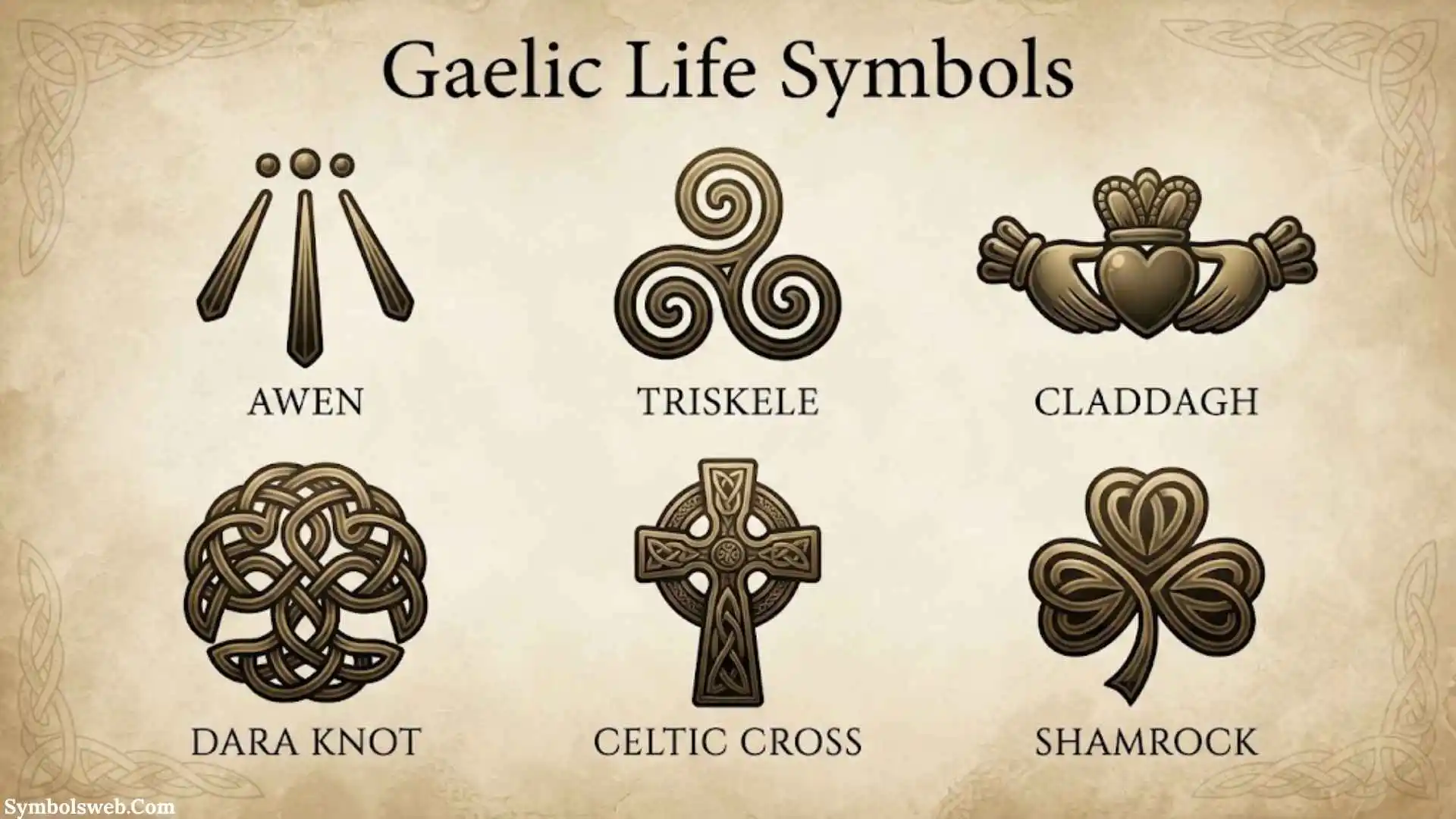
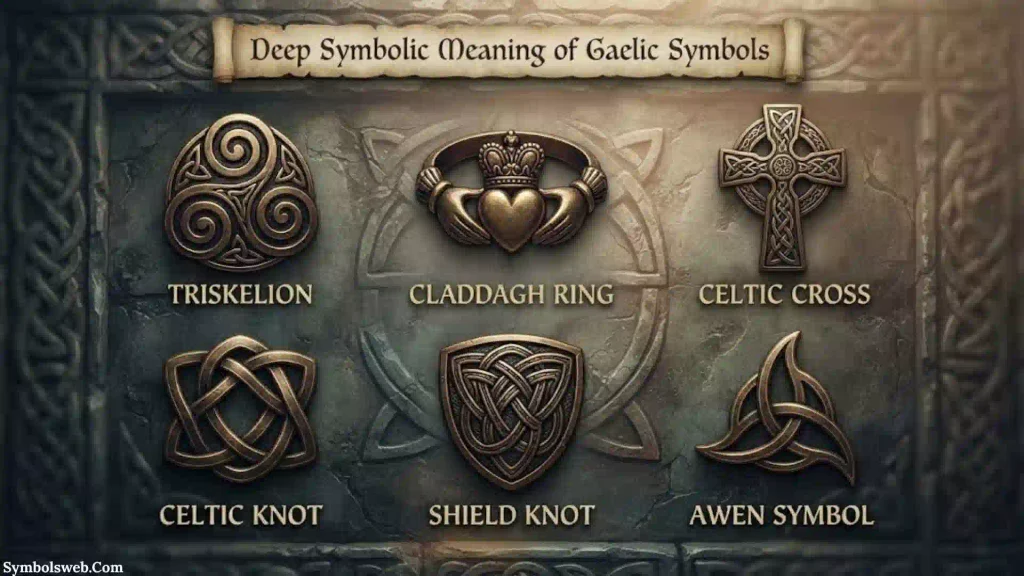
Celtic Knot
Visual Description: Interwoven lines with no beginning or end.
Meaning: Eternity and interconnectedness.
Symbolism: Endless cycles of life and spiritual unity.
Cultural Connection: Common throughout Irish and Scottish art.
Where It Appears: Manuscripts, stone carvings, jewelry, tattoos.
Triskelion (Triple Spiral)
Visual Description: Three connected spirals radiating from a central point.
Meaning: Motion, growth, and progress.
Symbolism: Mind, body, and spirit or land, sea, and sky.
Cultural Connection: One of the oldest Celtic symbols.
Where It Appears: Ancient stone monuments and artwork.
Claddagh
Visual Description: Two hands holding a heart topped by a crown.
Meaning: Love, loyalty, and friendship.
Symbolism: Human relationships and trust.
Cultural Connection: Strongly associated with Irish heritage.
Where It Appears: Rings, jewelry, wedding traditions.
Celtic Cross
Visual Description: A cross surrounded by a circular ring.
Meaning: Faith and eternity.
Symbolism: The meeting of spiritual and earthly worlds.
Cultural Connection: Prominent throughout Ireland.
Where It Appears: Churches, cemeteries, monuments.
Dara Knot
Visual Description: Intricate knot inspired by tree roots.
Meaning: Strength and resilience.
Symbolism: Deep inner wisdom.
Cultural Connection: Linked to the sacred oak tree.
Where It Appears: Decorative artwork and jewelry.
Awen Symbol
Visual Description: Three rays extending upward.
Meaning: Inspiration and enlightenment.
Symbolism: Creative energy and spiritual awakening.
Cultural Connection: Associated with Celtic bards and poets.
Where It Appears: Modern Celtic spirituality.
Gaelic Symbols Across Different Cultures
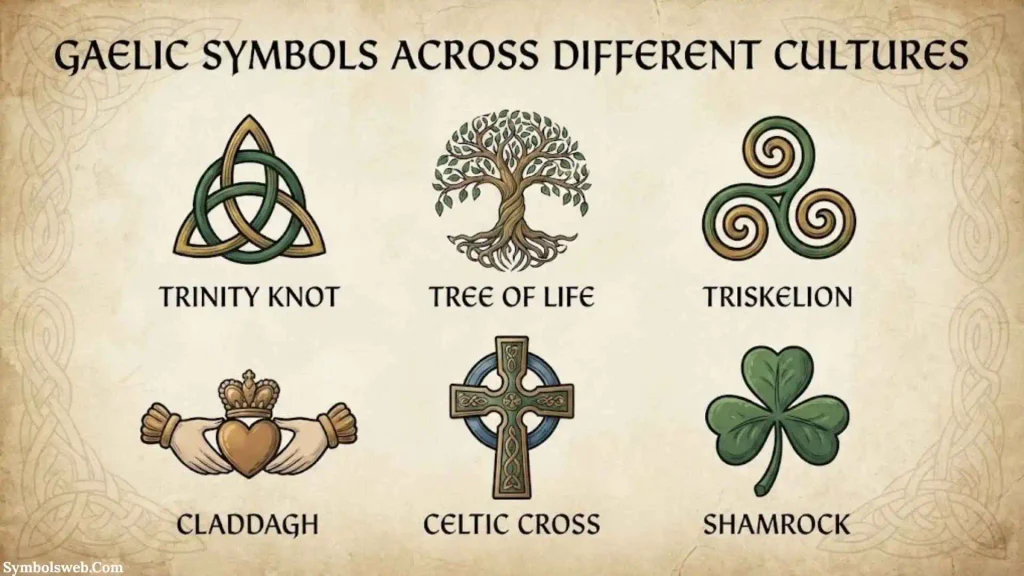
Ancient Egypt
Although not directly connected to Gaelic culture, Egyptian symbols such as the ankh also represented eternal life. Like Celtic knots, they expressed continuity beyond death.
Ancient Greece
Greek philosophers explored ideas of harmony and balance similar to concepts found in Celtic symbolism. Spirals and geometric designs appear in both traditions.
Roman Culture
Romans encountered Celtic peoples across Europe and documented their artistic traditions. Celtic symbols often survived Roman influence and continued evolving.
Eastern Traditions
Many Eastern spiritual traditions use circular and spiral imagery to represent life’s cycles. This parallels the symbolism found in Gaelic knotwork.
Indigenous Traditions
Many Indigenous cultures worldwide view nature as sacred. Gaelic traditions similarly honored rivers, forests, animals, and seasonal cycles.
Modern Interpretations
Today, Gaelic symbols represent:
- Cultural pride
- Spiritual exploration
- Family heritage
- Personal growth
- Artistic expression
Their meanings continue to evolve while retaining ancient roots.
Similar Symbols and Their Meanings
| Symbol | Similarity to Gaelic Symbols | Key Difference |
| Ankh | Represents eternal life | Egyptian origin |
| Yin Yang | Symbolizes balance | Chinese philosophy |
| Mandala | Reflects unity and wholeness | Buddhist and Hindu traditions |
| Norse Valknut | Spiritual symbolism | Associated with Norse mythology |
| Tree of Life | Connection and growth | Appears in many cultures |
Common Misconceptions
One common misconception is that all Celtic symbols have a single fixed meaning. In reality, meanings often vary depending on region, era, and context.
Another misconception is that every knot pattern was originally sacred. Some were decorative, though many later acquired symbolic significance.
Gaelic Symbols in Mythology and Folklore
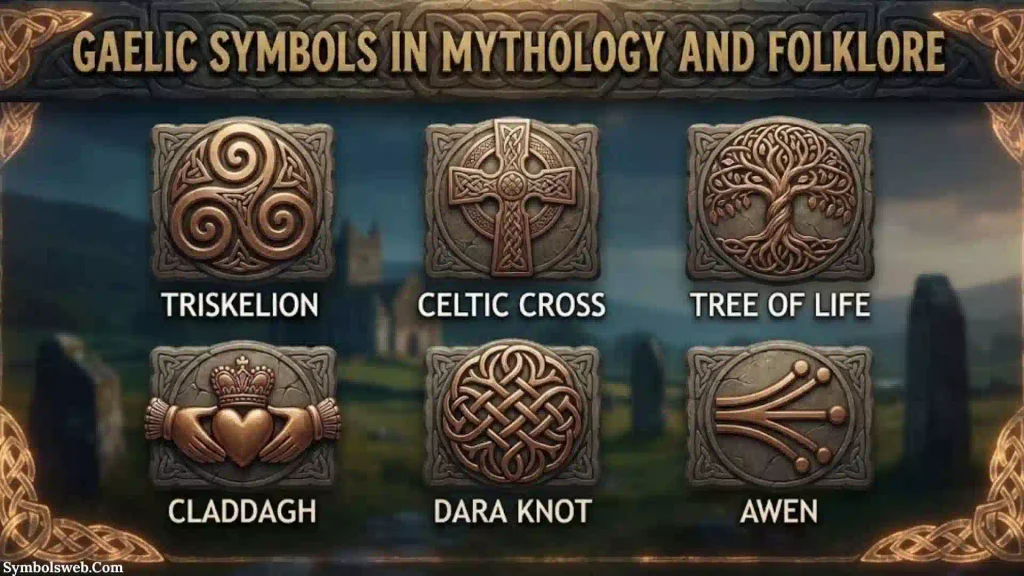
Gaelic mythology is filled with symbolic imagery.
Stories involving the legendary hero Cú Chulainn frequently emphasize courage, destiny, and supernatural protection.
Ancient tales of the Tuatha Dé Danann describe powerful beings associated with wisdom, magic, and nature. Their stories helped shape the symbolic meanings attached to many Celtic designs.
The sacred oak tree held special importance in Celtic belief. Symbols connected to trees often represented strength, endurance, and knowledge.
Folklore also linked spirals and circles to the Otherworld, a mystical realm where spiritual beings and ancestors resided.
These myths transformed simple artistic patterns into powerful cultural symbols.
Gaelic Symbols in Art, Literature, Movies, and Pop Culture
Paintings and Traditional Art
Gaelic symbols frequently appear in illuminated manuscripts, stone carvings, and Celtic metalwork. Their intricate patterns showcase extraordinary craftsmanship.
Literature
Irish and Scottish literature often references symbolic motifs connected to ancestry, destiny, and spiritual journeys.
Writers such as William Butler Yeats drew inspiration from Celtic mythology and symbolism.
Poetry
Poets have long used Celtic imagery to explore themes of love, loss, memory, and transcendence.
Movies and Television
Films featuring Celtic themes often include knotwork, spirals, and ancient symbols to create a sense of mystery and heritage.
Tattoos
Gaelic symbols rank among the world’s most popular tattoo designs.
Common choices include:
- Celtic knots
- Claddagh symbols
- Celtic crosses
- Triskelions
Fashion and Design
Modern designers use Gaelic symbols in:
- Clothing
- Jewelry
- Logos
- Home décor
- Digital artwork
Their timeless appearance gives them lasting appeal.
Spiritual and Dream Meaning of Gaelic Symbols
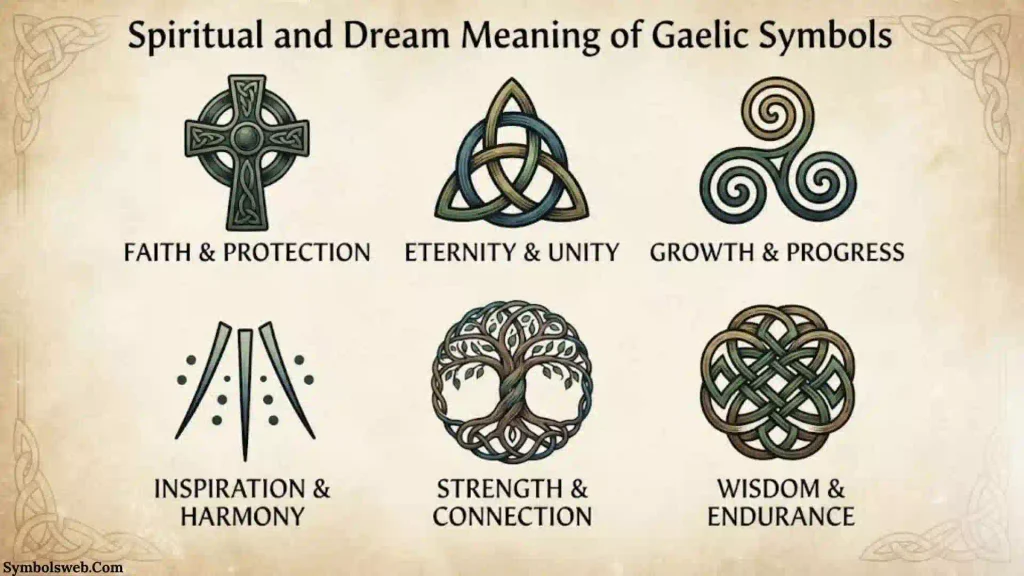
Dreams involving Gaelic symbols often suggest personal growth, connection, or spiritual awakening.
Common Dream Interpretations
Seeing a Celtic Knot
May indicate an important relationship, life cycle, or unresolved connection.
Seeing a Spiral
Often symbolizes personal evolution and transformation.
Seeing a Celtic Cross
May represent guidance, faith, or protection during challenging times.
Meditation Experiences
People who meditate on Gaelic symbols frequently report feelings of:
- Calmness
- Unity
- Clarity
- Spiritual connection
Positive Messages
- Growth
- Healing
- Protection
- Wisdom
- Harmony
Cautionary Messages
Depending on context, some symbols may remind individuals to address unfinished emotional issues or recurring life patterns.
Positive and Negative Meanings of Gaelic Symbols
| Positive Meaning | Negative Meaning |
| Unity | Feeling trapped in repetitive cycles |
| Protection | Overattachment to the past |
| Wisdom | Resistance to change |
| Spiritual growth | Excessive idealism |
| Loyalty | Dependency |
| Eternal connection | Difficulty letting go |
The same symbol can carry both positive and challenging meanings depending on circumstances and interpretation.
Why Humans Are Attracted to Gaelic Symbols
Humans naturally seek meaning through symbols.
Gaelic symbols appeal to us because they combine beauty with deep storytelling.
Psychologists suggest several reasons for their popularity:
Pattern Recognition
The human brain enjoys identifying complex patterns. Celtic knotwork creates visual satisfaction through repetition and balance.
Cultural Memory
Many people feel connected to ancestral traditions, even if they cannot fully explain why.
Archetypal Meaning
Themes such as love, courage, wisdom, and eternity are universal human experiences.
Personal Identity
People often adopt Gaelic symbols to express values, heritage, or life experiences.
Emotional Storytelling
Unlike ordinary decorations, these symbols feel alive with meaning and history.
Modern Uses of Gaelic Symbols
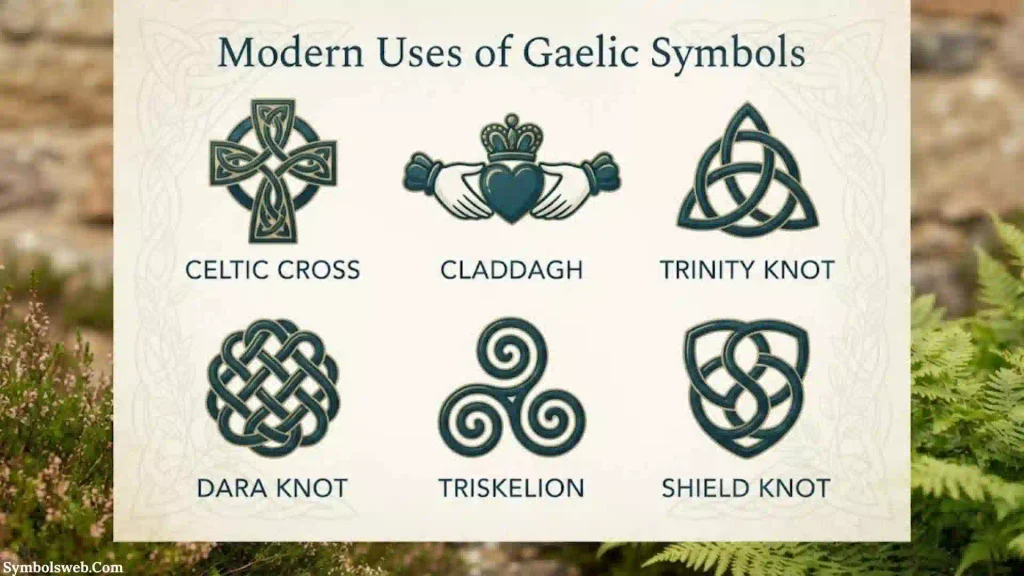
Tattoos
Many individuals choose Gaelic symbols to commemorate family, faith, or personal transformation.
Jewelry
Claddagh rings remain popular expressions of love and commitment.
Fashion
Designers incorporate Celtic motifs into contemporary clothing and accessories.
Branding
Businesses use Celtic-inspired imagery to communicate tradition, authenticity, and craftsmanship.
Social Media
Gaelic symbols often appear in profile artwork, digital graphics, and cultural communities.
Contemporary Spirituality
Modern spiritual practitioners use these symbols during meditation and personal reflection.
Home Décor
Wall art, carvings, and decorative pieces frequently feature Celtic knotwork and crosses.
Personal Expression
Many people use Gaelic symbols as visual reminders of their values and life journey.
Interesting Facts About Gaelic Symbols
- Many Celtic knot designs contain no visible beginning or end.
- The Triskelion predates Christianity by centuries.
- Celtic crosses often combine pagan and Christian symbolism.
- The Claddagh ring originated in Ireland during the seventeenth century.
- Ancient stone carvings preserve some of the earliest Celtic symbols.
- Oak trees were considered sacred in Celtic tradition.
- Many symbols gained new meanings after the spread of Christianity.
- Celtic knotwork influenced medieval European art.
- Modern tattoo culture helped revive global interest in Gaelic symbols.
- Some ancient symbols remain open to scholarly interpretation today.
Frequently Asked Questions
What are the most popular Gaelic symbols?
The most popular Gaelic symbols include the Celtic Knot, Claddagh, Triskelion, Celtic Cross, Dara Knot, and Awen symbol.
What do Gaelic symbols represent?
They commonly represent eternity, love, loyalty, protection, wisdom, spiritual growth, and the interconnectedness of life.
Are Gaelic and Celtic symbols the same?
Not exactly. Gaelic symbols are part of the broader Celtic tradition, particularly associated with Ireland and Scotland.
What is the spiritual meaning of Celtic knots?
Celtic knots generally symbolize eternity, unity, and the endless cycle of life, death, and rebirth.
Why are Gaelic symbols used in tattoos?
People choose them to express heritage, personal values, spiritual beliefs, family connections, or important life experiences.
Are Gaelic symbols still relevant today?
Yes. They remain widely used in art, jewelry, fashion, spirituality, cultural celebrations, and personal expression worldwide.
Conclusion
Gaelic symbols are far more than ancient designs carved into stone or woven into artwork. They represent humanity’s timeless search for meaning, connection, identity, and spiritual understanding. From the endless paths of Celtic knots to the heartfelt message of the Claddagh, these symbols continue to inspire people across cultures and generations. Their enduring power reminds us that some truths transcend time, speaking to the human heart no matter where or when we live.

Eliana Foster is a writer with a passion for exploring the meanings behind symbols, traditions, and cultural history. She enjoys breaking down complex topics into simple, engaging articles that are easy for everyone to understand. Eliana is also the fictional author of The Hidden Language of Silent Marks and Beyond the Circle of Ancient Signs, two original book concepts created for her author profile. When she’s not writing, she loves visiting museums, reading about mythology, and researching the stories behind symbols from around the world. Her goal is to help readers discover the fascinating meanings hidden in everyday signs and ancient emblems.
 Jordan Hayes
 Ethan Holloway