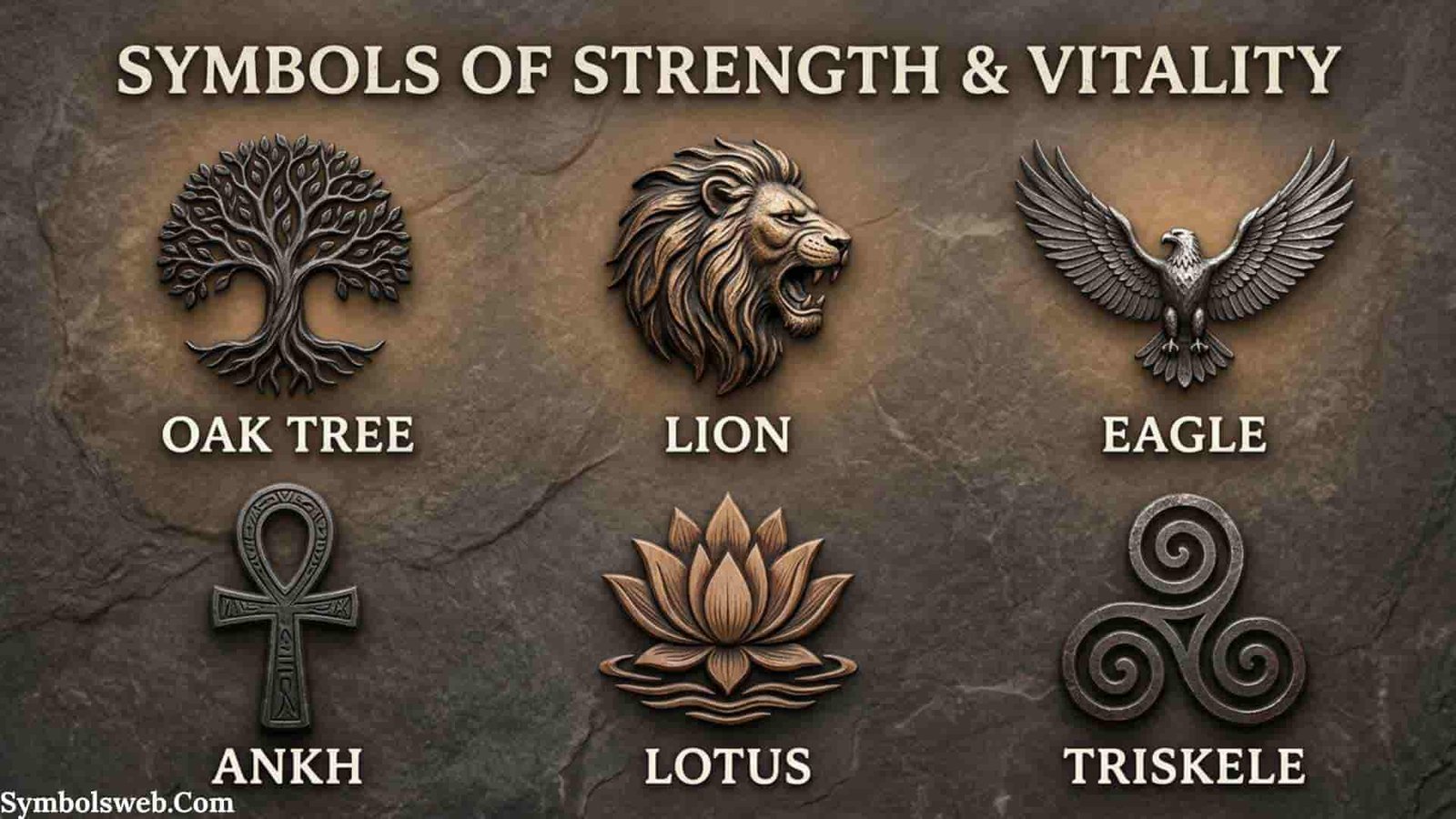
Strength symbols have been used for thousands of years to express courage, power, resilience, protection, and endurance. From mighty lions and bears to mountains, oak trees, ancient gods, and legendary heroes, these symbols give a visible form to an invisible human quality.
Across cultures, strength has never meant only physical power. It can also represent inner courage, spiritual stability, emotional resilience, leadership, and the ability to rise after hardship.
Strength Symbols: (Quick Answer)
Strength symbols are images, animals, objects, plants, or mythological figures that represent courage, power, resilience, protection, endurance, or inner strength. Common examples include the lion, bear, bull, Hercules, hammer, mountain, oak tree, vajra, phoenix, and Egyptian djed pillar. Their exact meanings depend on cultural and historical context.
Also Check This Post: 83+ Space Symbols: A Simple Beginner’s Guide to Every Type
Quick Facts About Strength Symbols
| Aspect | Information |
| Origin | Ancient civilizations, mythology, religion, nature, and traditional art |
| Historical Significance | Used to represent power, courage, protection, leadership, and endurance |
| Main Meaning | Strength, courage, resilience, power, and determination |
| Spiritual Meaning | Inner stability, spiritual courage, protection, and transformation |
| Cultural Importance | Connected with heroes, gods, rulers, animals, nature, and sacred traditions |
| Modern Usage | Tattoos, jewelry, fashion, artwork, branding, social media, and personal expression |
What Are Strength Symbols?
Strength symbols are visual representations of qualities such as courage, power, resilience, endurance, and determination.
Humans have used symbols to express strength since ancient times. Powerful animals were often chosen because their physical abilities were easy to recognize. Lions represented power and royal authority, bulls suggested physical force and vitality, while bears became associated with courage and protection in different traditions.
Other strength symbols came from nature. Mountains represented stability because they appeared unshakable. Trees represented endurance because they could survive for generations. Fire represented transformation and power.
Mythology also gave strength to a human face. Heroes such as Hercules became symbols of extraordinary physical power and perseverance. Sacred objects such as the vajra represented a different kind of strength, one connected with spiritual clarity and indestructibility.
Over time, these ancient meanings evolved. Today, strength symbols are often used to represent personal struggles, achievements, healing, confidence, and resilience.
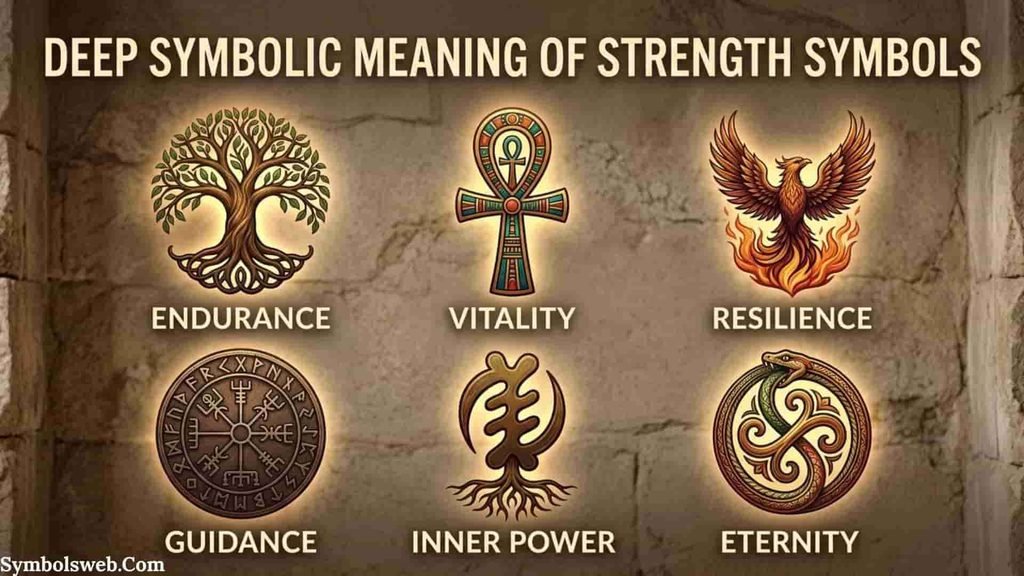
Deep Symbolic Meaning of Strength Symbols
Spiritual Level
Spiritually, strength can represent the ability to remain steady during difficult times.
A strength symbol may remind someone to stay calm, resist fear, protect their values, or continue moving forward.
The vajra, for example, is an important Buddhist and Hindu symbol associated with the thunderbolt and diamond. Its diamond-like quality represents something difficult to destroy, while its thunderbolt quality represents powerful and penetrating force.
This gives strength a deeper meaning. True strength may not always involve defeating another person. It can mean overcoming fear, ignorance, anger, or inner weakness.
A mountain can represent spiritual stability. A tree can represent spiritual growth. A phoenix can represent transformation and renewal.
Psychological Level
Strength symbols can also have powerful psychological meaning.
People are naturally attracted to images that represent qualities they admire or want to develop. Someone who chooses a lion may connect with courage and confidence. Someone who chooses a mountain may associate it with overcoming challenges.
Carl Jung’s concept of archetypes is often discussed when exploring symbolic images. Archetypal imagery can help explain why certain powerful figures and animals appear repeatedly in myths and stories, although individual interpretations vary.
A symbol can become a personal reminder of a difficult experience.
For example, someone who survived a major life challenge might choose a phoenix because it represents the idea of rising again.
Cultural Level
Strength symbols reflect the values of the cultures that created them.
In royal societies, lions and eagles often represented authority. In warrior traditions, weapons and heroic figures represented courage. In religious traditions, sacred objects could represent spiritual power.
The same symbol can have different meanings in different cultures.
That is why historical context matters when interpreting strength symbols.
Types and Variations of Strength Symbols
Lion
Visual Description: A large powerful cat, often shown standing, roaring, or guarding.
Meaning: Strength, courage, leadership, authority, and protection.
Symbolism: The lion’s physical power and position as a dominant predator made it a natural symbol of strength.
Cultural Connection: Lions appear in Egyptian, Mesopotamian, Persian, Greek, Roman, African, and Asian traditions.
Where It Appears: Mythology, temples, royal art, sculpture, architecture, heraldry, jewelry, tattoos, and logos.
Bear
Visual Description: A large bear, often shown standing or in a powerful pose.
Meaning: Courage, protection, endurance, independence, and physical strength.
Symbolism: The bear’s size and power make it a natural symbol of protection and resilience.
Cultural Connection: Bear symbolism appears in several northern and Indigenous traditions, although its meaning varies between cultures.
Where It Appears: Mythology, ceremonial art, folklore, tattoos, jewelry, and modern designs.
Bull
Visual Description: A muscular bull with large horns and a strong stance.
Meaning: Strength, fertility, vitality, power, and abundance.
Symbolism: The bull combines physical force with ideas of life, fertility, and agricultural prosperity.
Cultural Connection: Bulls were important in ancient Greek, Mycenaean, Egyptian, Mesopotamian, and other Mediterranean traditions.
Where It Appears: Religious art, mythology, sculpture, coins, temples, and modern logos.
Hercules
Visual Description: A muscular heroic figure carrying a club and often wearing the skin of the Nemean lion.
Meaning: Physical strength, courage, perseverance, endurance, and heroism.
Symbolism: Hercules represents strength tested through difficult challenges.
Cultural Connection: Greek mythology and later Roman mythology.
Where It Appears: Ancient sculpture, pottery, literature, Renaissance art, movies, tattoos, and popular culture.
Hammer
Visual Description: A heavy hand tool often shown as a weapon or symbolic object.
Meaning: Strength, hard work, force, creation, craftsmanship, and determination.
Symbolism: A hammer represents the power to shape or change something through effort.
Cultural Connection: Norse mythology, especially through Thor and his hammer Mjölnir.
Where It Appears: Mythology, jewelry, tattoos, artwork, logos, fashion, and modern media.
Vajra
Visual Description: A symmetrical ritual object resembling a thunderbolt or diamond.
Meaning: Spiritual strength, clarity, indestructibility, wisdom, and power.
Symbolism: The diamond represents durability while the thunderbolt represents penetrating force.
Cultural Connection: Hindu and Buddhist traditions.
Where It Appears: Buddhist ritual objects, religious art, sculpture, meditation traditions, and sacred designs.
Mountain
Visual Description: A large mountain rising toward the sky.
Meaning: Stability, endurance, achievement, strength, and spiritual growth.
Symbolism: Mountains appear permanent and powerful despite changing weather and seasons.
Cultural Connection: Mountains have sacred and symbolic roles in many cultures.
Where It Appears: Mythology, religion, poetry, landscape art, tattoos, jewelry, and modern design.
Oak Tree
Visual Description: A large tree with a thick trunk and wide branches.
Meaning: Strength, stability, longevity, wisdom, endurance, and rootedness.
Symbolism: Its deep roots and long life make the oak a symbol of lasting strength.
Cultural Connection: European mythology, folklore, heraldry, and traditional cultures.
Where It Appears: Literature, artwork, jewelry, tattoos, architecture, and family symbolism.
Djed Pillar
Visual Description: A pillar-like Egyptian symbol with several horizontal sections near the top.
Meaning: Stability, endurance, permanence, and continuity.
Symbolism: The djed represents the idea of remaining firm and stable.
Cultural Connection: Ancient Egyptian religion and the mythology of Osiris.
Where It Appears: Egyptian temples, amulets, religious art, inscriptions, and modern Egyptian-inspired designs.
Sekhmet
Visual Description: A woman with the head of a lioness.
Meaning: Power, courage, protection, war, destruction, and resilience.
Symbolism: Sekhmet represents both destructive force and protective power.
Cultural Connection: Ancient Egypt.
Where It Appears: Temple reliefs, statues, religious art, mythology, museums, and modern symbolic artwork.
Eagle
Visual Description: A large bird with extended wings and powerful talons.
Meaning: Strength, courage, freedom, vision, authority, and spiritual power.
Symbolism: Its ability to fly high makes it a symbol of freedom and broad vision.
Cultural Connection: Many ancient and modern cultures.
Where It Appears: Heraldry, mythology, national symbols, art, jewelry, tattoos, and logos.
Phoenix
Visual Description: A mythical bird rising from flames.
Meaning: Rebirth, resilience, transformation, recovery, and renewal.
Symbolism: The phoenix represents strength after destruction and the ability to begin again.
Cultural Connection: Ancient Mediterranean traditions and later European literature and popular culture.
Where It Appears: Mythology, literature, tattoos, jewelry, movies, artwork, and modern spirituality.
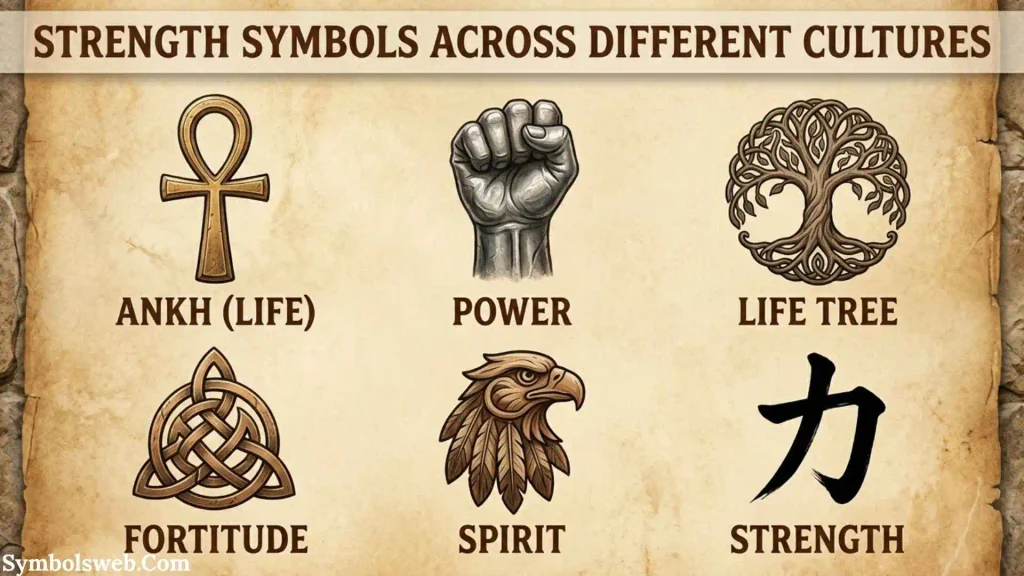
Strength Symbols Across Different Cultures
Ancient Egypt
Ancient Egypt had many symbols connected with strength and protection.
Lions were associated with kingship and protection. Sekhmet represented powerful and destructive force. The djed represented stability and endurance.
Egyptian symbolism shows that strength was not limited to physical power. Stability, protection, life, and divine authority could also represent strength.
Ancient Greece
Ancient Greek culture often expressed strength through gods, heroes, animals, and athletic ideals.
Hercules, known as Herakles in Greek mythology, became the classic image of physical strength and heroic endurance.
His twelve labors showed that strength was not simply about having a powerful body. He also needed courage, persistence, and determination.
Roman Culture
Roman culture adopted and transformed many Greek myths.
Hercules became an important Roman figure associated with extraordinary strength and heroic achievement.
Roman art also used eagles, lions, weapons, armor, and military imagery to communicate authority and power.
Eastern Traditions
Eastern traditions contain many symbols that focus on spiritual strength.
The vajra is an important example. Its association with the diamond and thunderbolt expresses durability, clarity, and powerful spiritual force.
In Buddhist traditions, strength can mean the ability to overcome ignorance and remain committed to a spiritual path.
Indigenous Traditions
Indigenous cultures do not share one universal system of symbolism. Different communities have their own traditions, languages, histories, and sacred meanings.
Animals such as bears, eagles, wolves, and other powerful creatures can hold important meanings in specific communities.
These symbols should always be understood within their particular cultural context rather than given one universal interpretation.
Modern Interpretations
Today, strength symbols are often deeply personal.
A lion might represent confidence. A mountain might represent overcoming hardship. A phoenix might symbolize recovery. A tree might represent family and stability.
Modern symbolism often combines historical meanings with personal experiences.
Also Check This Post: 83+ Shinto Symbols: Hidden Meanings, Sacred Signs, and the Spiritual Language of Japan
Similar Symbols and Their Meanings
| Symbol | Main Meaning | Type of Strength |
| Lion | Courage and power | Physical and leadership |
| Bear | Protection and courage | Physical and protective |
| Bull | Vitality and power | Physical and life-giving |
| Hercules | Heroism and endurance | Tested strength |
| Hammer | Work and force | Practical strength |
| Vajra | Clarity and indestructibility | Spiritual strength |
| Mountain | Stability and achievement | Enduring strength |
| Oak Tree | Longevity and stability | Patient strength |
| Djed | Stability and endurance | Spiritual and symbolic |
| Phoenix | Renewal and resilience | Transformational strength |
Common Misconceptions
A common misconception is that every strength symbol has one universal meaning.
Symbolism does not work that way.
A lion can represent courage in one context and royal authority in another. A bull can symbolize fertility in one tradition and physical power in another.
Another common mistake is treating modern interpretations as ancient facts.
For example, a modern tattoo may give a phoenix a personal meaning of survival. That personal meaning is valid, but it should not automatically be presented as the original historical interpretation.
Strength Symbols in Mythology and Folklore
Hercules and the Nemean Lion
The story of Hercules and the Nemean lion is one of the best-known examples of strength in mythology.
The lion could not be defeated by ordinary weapons. Hercules had to rely on his own physical power to overcome it.
After defeating the lion, he wore its skin as armor.
The story turned the lion into a symbol of both danger and heroic victory.
The Egyptian Lioness
Sekhmet represents another form of strength.
She was associated with war, destruction, power, courage, and protection.
Her story demonstrates that strength can have two sides. Power can destroy, but it can also protect.
The Assyrian Lion Hunt
Ancient Assyrian kings were often shown hunting lions.
The royal lion hunt became a powerful political image. The king appeared as a protector capable of defeating dangerous forces.
The lion therefore represented both physical danger and the king’s ability to control it.
The Vajra and Spiritual Power
The vajra represents a different kind of strength.
Rather than focusing on physical combat, its symbolism is connected with spiritual power, clarity, and indestructibility.
This shows how cultures can understand strength as an inner quality rather than simply physical force.
Strength Symbols in Art, Literature, Movies and Pop Culture
Paintings
Artists have long used powerful animals, heroic bodies, mountains, warriors, and mythological figures to express strength.
Hercules became especially popular in European art because his body allowed artists to explore physical power, courage, suffering, and heroism.
Literature
Writers frequently use strength symbols as metaphors.
A mountain can represent a difficult challenge.
A tree can represent family and stability.
A lion can represent courage.
A phoenix can represent recovery.
These symbols allow writers to express complicated emotions through simple images.
Movies
Modern films use symbols to communicate character traits quickly.
Shields, hammers, animals, armor, crowns, and heroic figures can immediately suggest courage, power, protection, or leadership.
Television
Television series often use symbolic clothing, logos, animals, weapons, and locations to represent characters and groups.
Tattoos
Strength symbols are among the most popular tattoo themes.
Common examples include:
- Lion tattoos for courage
- Bear tattoos for protection
- Mountain tattoos for endurance
- Phoenix tattoos for rebirth
- Hercules tattoos for perseverance
- Tree tattoos for family and stability
- Hammer tattoos for hard work
- Eagle tattoos for freedom and courage
Fashion
Strength symbols appear on clothing, accessories, jewelry, shoes, bags, and watches.
They can communicate confidence, athleticism, independence, power, or personal identity.
Modern Design
Mountains, shields, animals, crowns, trees, and geometric symbols are often used in modern graphic design because they communicate ideas quickly.
Spiritual and Dream Meaning of Strength Symbols
Dream meanings are highly personal. There is no scientifically proven universal dictionary in which every dream symbol has one fixed meaning.
However, strength-related images can be useful for self-reflection.
Dreaming of a Lion
A lion may represent courage, confidence, authority, danger, or confrontation.
Ask yourself:
Where do I need more courage in my life?
Dreaming of a Bear
A bear may bring thoughts of protection, independence, boundaries, or strength.
Ask:
What am I protecting?
Dreaming of a Mountain
A mountain may represent a challenge, goal, or obstacle.
Ask:
What difficult goal am I trying to reach?
Dreaming of a Tree
A tree may represent family, roots, growth, stability, or patience.
Ask:
What keeps me grounded?
Dreaming of a Phoenix
A phoenix may represent transformation, recovery, or a new beginning.
Ask:
What part of my life is ready to change?
These interpretations are best treated as personal reflection rather than predictions.
Positive and Negative Meanings of Strength Symbols
| Positive Meaning | Negative Meaning |
| Courage | Aggression |
| Resilience | Stubbornness |
| Protection | Control |
| Leadership | Domination |
| Confidence | Arrogance |
| Endurance | Emotional rigidity |
| Power | Abuse of power |
| Determination | Obsession |
| Independence | Isolation |
| Stability | Resistance to change |
A strength symbol can have both positive and negative meanings.
The lion can represent protection but also aggression.
The hammer can represent creation but also destruction.
The warrior can represent courage but also conflict.
This balance is one reason strength symbols remain meaningful across cultures.
Why Humans Are Attracted to Strength Symbols
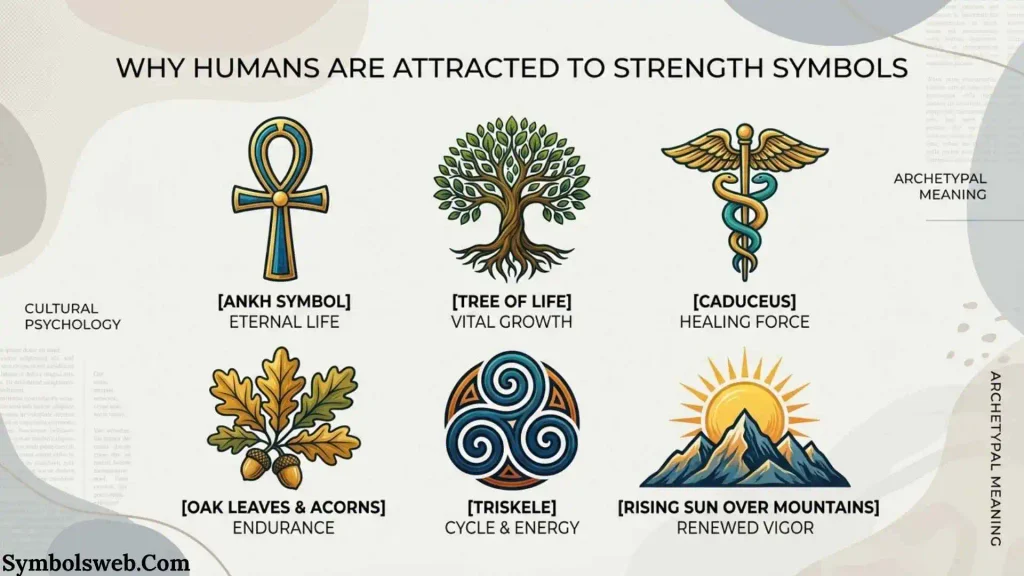
Humans have always faced challenges.
Early societies dealt with predators, natural disasters, disease, conflict, hunger, and uncertainty. Powerful animals and natural forces became part of human stories because they represented forces larger than the individual.
Strength symbols also help people express complicated emotions.
Instead of saying, “I survived something difficult,” someone might wear a phoenix.
Instead of saying, “I want to stay strong,” someone might wear a mountain.
Instead of saying, “I want to protect the people I love,” someone might choose a bear.
Symbols make invisible emotions visible.
They can also become reminders of personal experiences.
A symbol chosen after hardship may continue to remind a person of what they survived and how far they have come.
Modern Uses of Strength Symbols
Tattoos
Tattoos allow people to permanently connect strength symbolism with personal experiences.
Jewelry
Strength symbols can be worn as pendants, rings, bracelets, and necklaces.
Fashion
Animals, mythological figures, shields, and powerful natural images can communicate confidence and identity.
Branding
Companies often use lions, eagles, mountains, shields, and other strong images to suggest reliability, leadership, performance, or protection.
Social Media
Strength symbols are commonly used in profile pictures, motivational posts, captions, and personal milestones.
Contemporary Spirituality
People may use symbolic images during meditation, journaling, reflection, or personal spiritual practices.
Home Decor
Mountain landscapes, trees, lions, bears, and other strength symbols can be used to create an atmosphere of stability and confidence.
Interesting Facts About Strength Symbols
- Lions have been used as symbols of power and royal authority across many ancient cultures.
- Hercules was known as Herakles in Greek mythology and Hercules in Roman tradition.
- The Nemean lion was defeated by Hercules through physical strength after ordinary weapons failed.
- The Egyptian djed is associated with stability and endurance.
- Sekhmet represented power, war, destruction, courage, and protection in ancient Egyptian religion.
- The vajra is associated with both a thunderbolt and a diamond.
- Bulls were connected with strength, fertility, and divine power in several ancient traditions.
- The mountain is one of the clearest modern metaphors for endurance and overcoming challenges.
- The phoenix is widely used today as a symbol of rebirth and resilience.
- Strength symbols do not have one universal meaning. Their interpretation depends on history, culture, context, and personal experience.
Frequently Asked Questions
What is the most powerful symbol of strength?
There is no single universal symbol of strength. The lion, Hercules, bear, bull, mountain, oak tree, hammer, vajra, and phoenix are all powerful examples. The best symbol depends on the type of strength you want to represent.
What animal symbolizes strength?
The lion is one of the most widely recognized animals associated with strength and power. Bears and bulls are also strongly connected with strength, courage, protection, fertility, and vitality in different traditions.
What symbol represents inner strength?
The mountain, oak tree, vajra, and phoenix are strong symbols of inner strength. The mountain represents endurance, the oak represents stability, the vajra represents spiritual strength, and the phoenix represents resilience and renewal.
What symbol represents strength and courage?
The lion is a classic symbol of strength and courage. Hercules is another powerful symbol because his mythology focuses on overcoming extraordinary challenges through strength, courage, and perseverance.
What symbol represents strength after hardship?
The phoenix is one of the most popular symbols of strength after hardship because it represents renewal and rising again. Mountains and trees can also represent endurance and survival.
What is the Egyptian symbol for strength?
Ancient Egypt had several symbols connected with strength. The djed represented stability and endurance, while Sekhmet represented power, courage, war, destruction, and protection. Lions were also connected with royal power and guardianship.
Conclusion
Strength symbols are more than powerful images. They are visual expressions of courage, resilience, protection, endurance, and hope.From the lion and bull of ancient civilizations to the phoenix, mountain, and tree of modern symbolism, each represents a different way of being strong.
Real strength is not always loud or aggressive. Sometimes it means fighting, sometimes enduring, and sometimes simply finding the courage to stand again.
Also Check This Post: 99+ Warning Symbols: Hidden Meanings, History, Psychology, and Cultural Significance Explained

Jordan Hayes is a writer with a passion for exploring the history, meanings, and cultural significance behind symbols from around the world. He enjoys turning complex topics into clear, engaging content that anyone can understand. Jordan is also the fictional author of The Silent Language of Ancient Marks and Hidden Symbols Beyond the Surface, two original book concepts created for his author profile. When he’s not writing, he spends time researching myths, traditions, and forgotten stories that inspire his work. His goal is to help readers discover the deeper meanings behind the symbols they encounter every day.
 Ethan Holloway
 Eliana Foster
[…] The Outsiders Symbols: A Complete Guide to Their Meaning 85+ Strength Symbols: The Ultimate Guide to Powerful Meanings 83+ Space Symbols: A Simple Beginner’s Guide to Every Type 83+ Shinto Symbols: Hidden […]