Water symbols have fascinated humanity for thousands of years because they represent some of the deepest aspects of life itself. From ancient temples and sacred texts to modern art and dream interpretation, water has been used to express emotions, transformation, healing, and spiritual growth.
If flowing through a river, falling as rain, or resting in a calm lake, water carries powerful symbolic meaning across cultures and generations. Understanding water symbols reveals not only ancient wisdom but also profound insights into the human mind, heart, and soul.
In this guide, you’ll discover the history, symbolism, psychology, spirituality, and cultural significance of water symbols, along with their meanings in mythology, dreams, art, and modern life.
Quick Answer
Water symbols represent life, purification, renewal, emotions, transformation, and spiritual growth. Across cultures and religions, water is viewed as a powerful force that sustains life, cleanses the soul, and symbolizes the flow of consciousness, intuition, and personal change.
Quick Facts About Water Symbols
| Aspect | Information |
| Origin | Prehistoric civilizations and early spiritual traditions |
| Historical Significance | Essential symbol of life, fertility, purification, and survival |
| Main Meaning | Life, renewal, transformation, and emotional depth |
| Spiritual Meaning | Purification, enlightenment, healing, and rebirth |
| Cultural Importance | Appears in myths, religions, ceremonies, and folklore worldwide |
| Modern Usage | Tattoos, logos, meditation practices, art, and environmental movements |
What Are Water Symbols?
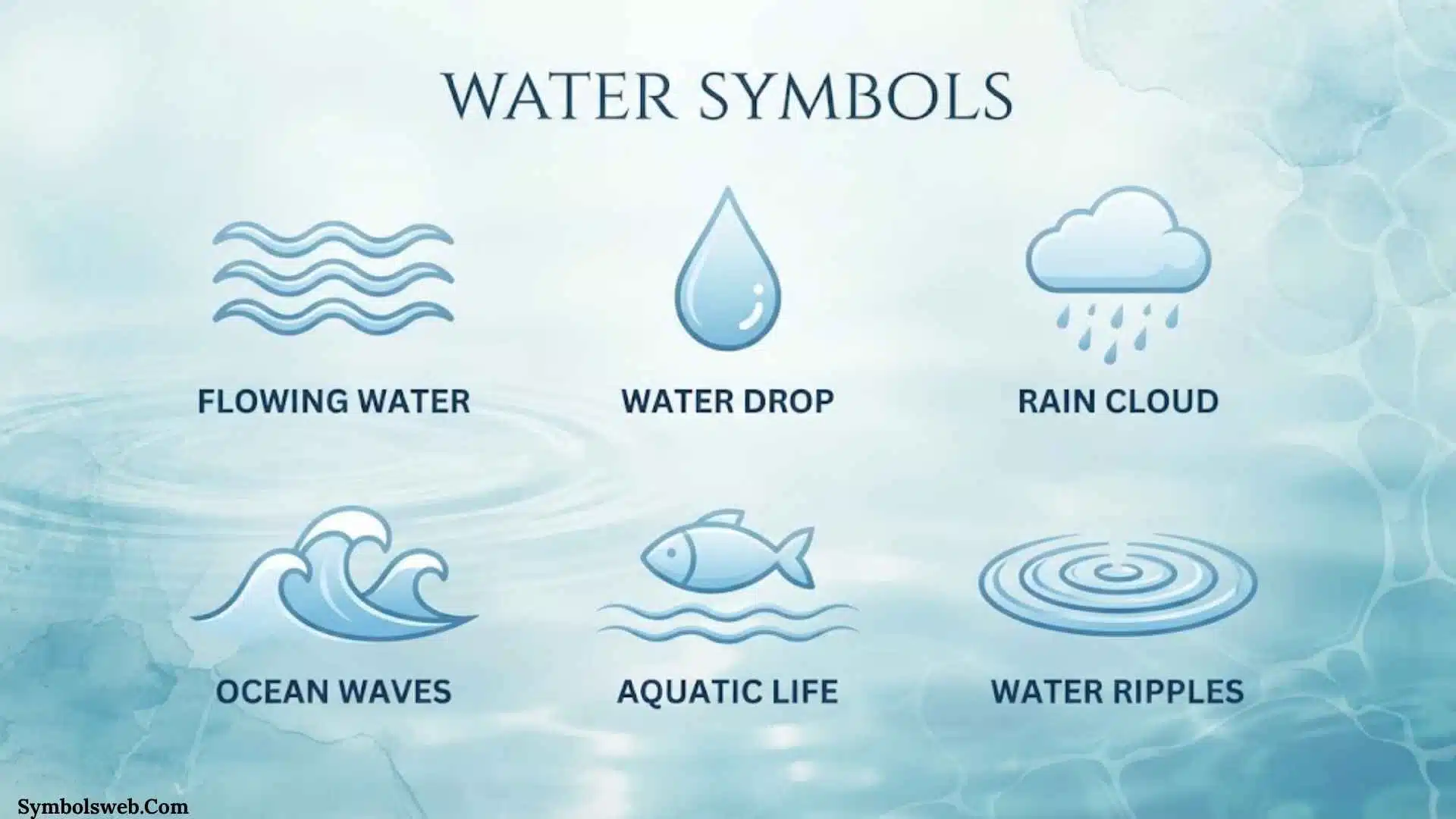
Water symbols are visual, spiritual, cultural, or literary representations associated with water and its qualities. These symbols can appear as rivers, oceans, raindrops, waves, fountains, wells, or simple geometric signs representing water.
The symbolic importance of water began long before written history. Ancient communities depended on rivers and rainfall for survival. As a result, water became more than a physical necessity. It evolved into a sacred symbol representing life, abundance, fertility, and divine blessings.
Early civilizations such as Ancient Egypt, Mesopotamia, China, and India built entire cultures around major rivers. The annual flooding of rivers often determined agricultural success, reinforcing the idea that water was a gift from higher powers.
Over time, water symbolism expanded beyond survival. Philosophers, priests, artists, and storytellers began associating water with emotions, wisdom, purification, and transformation.
Today, water symbols remain among the most universally recognized and meaningful symbols in human culture.
Deep Symbolic Meaning of Water Symbols
Spiritual Level
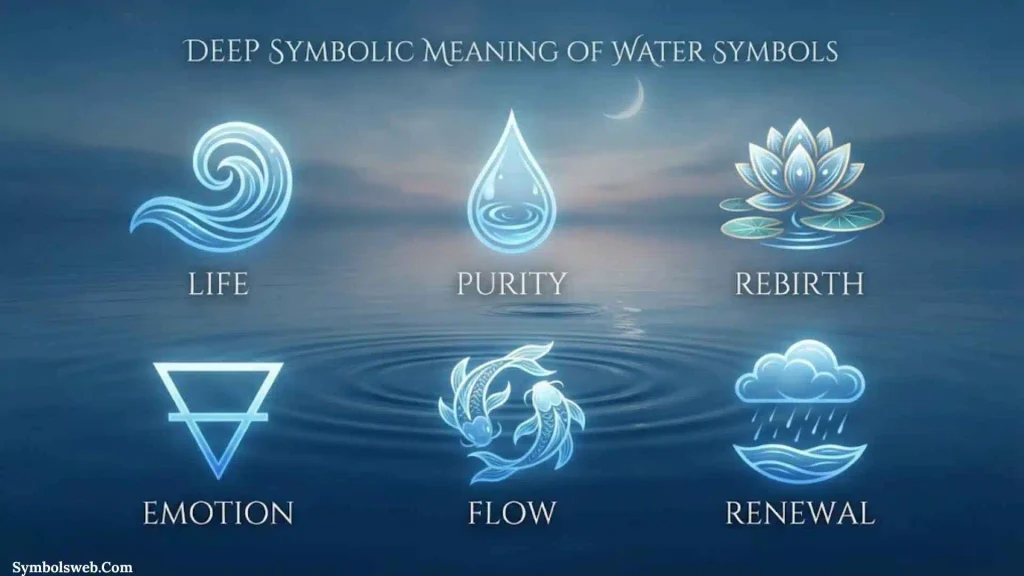
On a spiritual level, water symbolizes cleansing and renewal.
Many religious traditions use water in sacred rituals to wash away impurities and mark new beginnings. Water often represents the journey of the soul from ignorance to enlightenment.
Key spiritual meanings include:
- Purification
- Healing
- Rebirth
- Divine grace
- Spiritual awakening
- Connection with the sacred
The flowing nature of water also symbolizes surrender and trust. Unlike solid objects, water adapts to every environment while maintaining its essence.
This flexibility makes water a symbol of spiritual wisdom and resilience.
Psychological Level
Psychologists often associate water with the unconscious mind.
According to the work of Carl Jung, water frequently appears in dreams as a symbol of hidden emotions, intuition, memories, and psychological depth.
Common psychological associations include:
- Emotional awareness
- Inner healing
- Intuition
- Creativity
- Self-discovery
- Emotional transformation
Calm water may reflect peace and emotional balance, while stormy water can symbolize unresolved fears or inner conflict.
Cultural Level
Across societies, water serves as a symbol of community, survival, and continuity.
Villages often formed around rivers and springs. These water sources became gathering places where traditions, stories, and cultural identities developed.
Water symbols therefore represent:
- Collective memory
- Cultural heritage
- Shared survival
- Prosperity
- Unity
Many cultures continue to honor water through festivals, ceremonies, and sacred traditions.
Types and Variations of Water Symbols
Rivers
Visual Description: Flowing streams moving toward larger bodies of water.
Meaning: Journey, progress, life path.
Symbolism: Continuous growth and change.
Cultural Connection: Sacred rivers appear in many religions and myths.
Where It Appears: Mythology, literature, spiritual traditions, dreams.
Ocean
Visual Description: Vast, open body of water.
Meaning: Mystery and infinite potential.
Symbolism: The unconscious mind and cosmic wisdom.
Cultural Connection: Often linked to creation myths.
Where It Appears: Religious stories, folklore, poetry, and dreams.
Waves
Visual Description: Rhythmic movement on water surfaces.
Meaning: Change and emotional cycles.
Symbolism: Life’s ups and downs.
Cultural Connection: Common in coastal traditions and artistic designs.
Where It Appears: Art, tattoos, literature, and meditation imagery.
Rain
Visual Description: Water falling from the sky.
Meaning: Blessings and renewal.
Symbolism: Fertility, cleansing, and divine favor.
Cultural Connection: Often associated with harvest and prosperity.
Where It Appears: Mythology, agriculture, folklore, and religion.
Wells and Springs
Visual Description: Natural sources of fresh water.
Meaning: Wisdom and hidden knowledge.
Symbolism: Inner truth and spiritual nourishment.
Cultural Connection: Frequently regarded as sacred places.
Where It Appears: Legends, pilgrimage sites, and folklore.
Raindrops
Visual Description: Single droplets of water.
Meaning: Individual emotions and moments of grace.
Symbolism: Small changes leading to transformation.
Where It Appears: Jewelry, tattoos, artwork, and modern symbolism.
Water Symbols Across Different Cultures
Ancient Egypt
In Ancient Egyptian culture, the Nile River was considered the source of life. Water represented creation, fertility, and divine order.
The annual flooding of the Nile brought fertile soil, making water a sacred symbol of prosperity and survival.
Ancient Greece
Greek mythology connected water to gods, sea nymphs, and powerful deities.
The sea represented both opportunity and danger. Water symbolized wisdom, transformation, and the unpredictable nature of life.
Roman Culture
Romans viewed water as both practical and sacred.
Public baths, aqueducts, and fountains reflected the belief that water promoted health, civilization, and spiritual purification.
Eastern Traditions
In Chinese philosophy, water represents adaptability, balance, and harmony.
In Taoist teachings, water is considered the ideal model of strength through softness. It yields without breaking and overcomes obstacles through persistence.
In Hindu traditions, sacred rivers symbolize purification and liberation.
Indigenous Traditions
Many Indigenous cultures regard water as a living spiritual force.
Water is often viewed as a sacred relative deserving respect and protection.
Ceremonies involving rivers, lakes, and springs reinforce humanity’s connection to nature.
Modern Interpretations
Today, water symbolizes:
- Environmental awareness
- Personal growth
- Emotional intelligence
- Wellness
- Mindfulness
- Healing
Its ancient meanings continue to influence modern spirituality and self-development practices.
Similar Symbols and Their Meanings
| Symbol | Similarity to Water | Key Difference |
| Fire | Represents transformation | Fire transforms through destruction |
| Air | Associated with movement | Air symbolizes intellect more than emotion |
| Earth | Sustains life | Earth represents stability rather than flow |
| Moon | Linked to emotional cycles | Moon influences water but is not fluid itself |
| Tree | Symbolizes growth | Trees emphasize rootedness rather than adaptability |
Common Misconceptions
One common misconception is that water only represents peace.
In reality, water can symbolize both calmness and chaos. Oceans, storms, floods, and whirlpools remind us that water embodies immense power alongside gentleness.
Water Symbols in Mythology and Folklore
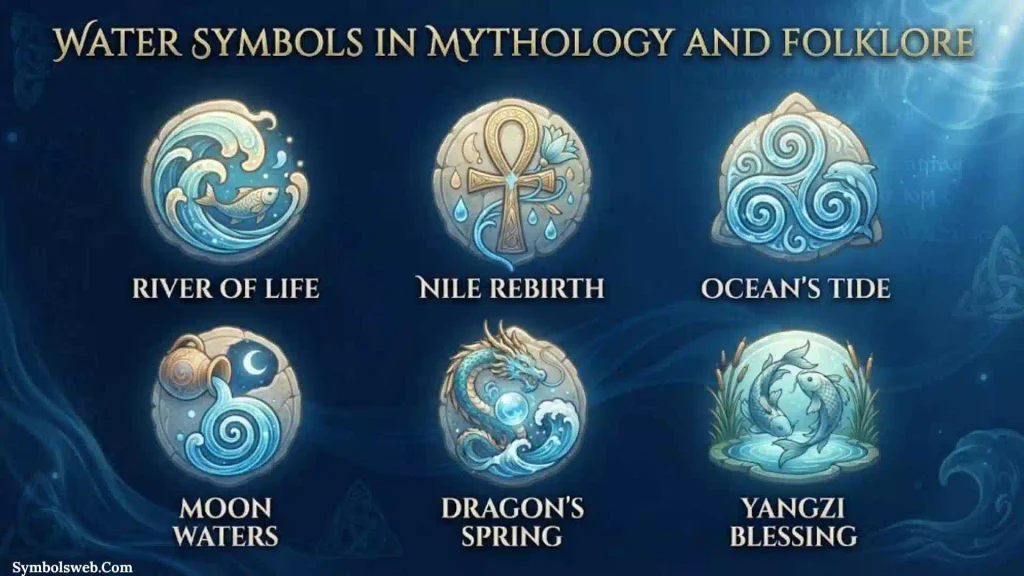
Water appears in creation stories around the world.
Many ancient myths describe life emerging from primordial waters.
In Greek mythology, powerful sea gods ruled vast oceans. In Norse traditions, sacred wells held cosmic wisdom. In Celtic folklore, lakes and rivers were believed to connect the human world with spiritual realms.
Mermaids, water spirits, river guardians, and sea deities appear in countless legends.
These stories shaped humanity’s understanding of water as a mysterious bridge between known and unknown worlds.
Water Symbols in Art, Literature, Movies, and Pop Culture
Paintings
Artists frequently use water to express mood and emotion.
Calm lakes suggest peace, while turbulent seas symbolize struggle or uncertainty.
Literature
Writers often use water as a metaphor for personal transformation.
Characters crossing rivers or oceans frequently undergo profound emotional change.
Poetry
Poets use water imagery to evoke beauty, memory, longing, and renewal.
Movies and Television
Water often symbolizes emotional breakthroughs, rebirth, or hidden truths.
Many cinematic scenes use rain or oceans to reflect a character’s inner state.
Tattoos
Water tattoos commonly represent:
- Freedom
- Adaptability
- Healing
- Emotional strength
- Personal transformation
Fashion and Design
Wave patterns, aquatic themes, and flowing designs remain popular because they communicate elegance, fluidity, and natural beauty.
Spiritual and Dream Meaning of Water Symbols
Dreams involving water often carry significant emotional messages.
Clear Water
Usually symbolizes:
- Clarity
- Peace
- Emotional balance
- Spiritual growth
Flowing Water
Often represents:
- Progress
- Healing
- Life transitions
Deep Water
May symbolize:
- Hidden emotions
- Intuition
- Unconscious thoughts
Stormy Water
Can indicate:
- Anxiety
- Emotional conflict
- Unresolved challenges
Spiritual Messages
Positive interpretations include:
- Renewal
- Awakening
- Healing
- Divine guidance
Cautionary interpretations may include:
- Emotional overwhelm
- Fear of change
- Suppressed feelings
The meaning always depends on personal context and emotional experience.
Positive and Negative Meanings of Water Symbols
| Positive Meaning | Negative Meaning |
| Healing | Emotional turmoil |
| Renewal | Chaos |
| Purification | Uncertainty |
| Wisdom | Fear of the unknown |
| Adaptability | Instability |
| Spiritual growth | Loss of control |
| Fertility | Destruction through floods |
| Emotional depth | Emotional overwhelm |
Water reminds us that every powerful force contains both constructive and destructive potential.
Why Humans Are Attracted to Water Symbols
Humans are naturally drawn to water because it is deeply connected to survival and emotional experience.
Psychologically, people often find water calming because our brains associate it with life and safety.
From an evolutionary perspective, access to water meant greater chances of survival. Over thousands of years, this connection became embedded in human consciousness.
Water also mirrors our emotional lives.
Sometimes we feel calm like a still lake. Other times we feel turbulent like a stormy sea.
Because water reflects these inner experiences so accurately, it remains one of humanity’s most meaningful symbols.
Cultural memory strengthens this attraction. Ancient myths, religious stories, and collective traditions continue to reinforce water’s symbolic power.
Modern Uses of Water Symbols
Tattoos
Water tattoos symbolize:
- Emotional resilience
- Personal growth
- Freedom
- Transformation
Jewelry
Wave and droplet designs often represent healing, intuition, and balance.
Fashion
Flowing water motifs communicate elegance, fluidity, and natural beauty.
Branding
Companies frequently use water imagery to suggest purity, trustworthiness, freshness, and sustainability.
Social Media
Water-themed visuals are widely used to promote mindfulness, wellness, and self-care.
Contemporary Spirituality
Meditation practices often incorporate water imagery to encourage calmness and emotional clarity.
Home Decor
Fountains, aquatic artwork, and water-inspired designs create peaceful environments.
Interesting Facts About Water Symbols
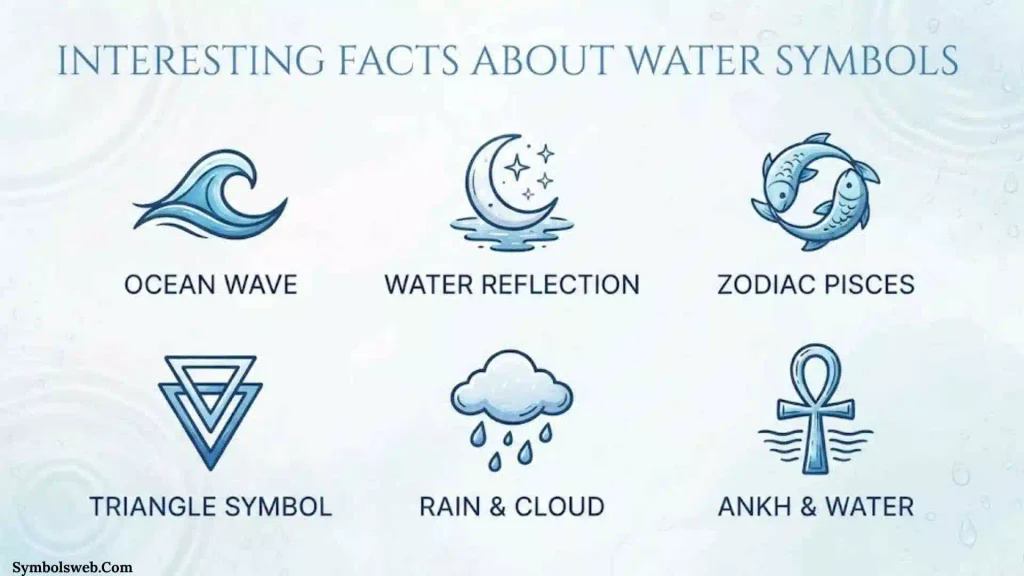
- Water appears in nearly every major religion on Earth.
- Many creation myths begin with a vast ocean or primordial waters.
- Ancient philosophers considered water one of the fundamental elements of existence.
- Water is among the oldest known symbols used by human civilizations.
- Sacred rivers attract millions of pilgrims every year.
- Water is one of the most common dream symbols worldwide.
- Wave patterns have been used in art for thousands of years.
- Many cultures believe water can carry blessings and prayers.
- Psychological studies show that people generally feel calmer near water environments.
- Water symbolism remains central to modern wellness and mindfulness movements.
Frequently Asked Questions
What do water symbols represent?
Water symbols primarily represent life, renewal, emotions, purification, transformation, healing, and spiritual growth.
Why is water considered sacred?
Water is considered sacred because it sustains life, cleanses impurities, and has been central to religious rituals and spiritual traditions throughout history.
What does water symbolize in dreams?
Water in dreams often reflects emotions, intuition, personal growth, and unconscious thoughts. The condition of the water usually influences its meaning.
What is the spiritual meaning of water?
Spiritually, water symbolizes purification, rebirth, healing, divine grace, wisdom, and connection with higher consciousness.
Why do so many cultures use water symbolism?
Because all human societies depend on water for survival, it naturally became a universal symbol of life, fertility, abundance, and transformation.
What does flowing water symbolize?
Flowing water symbolizes movement, progress, adaptability, emotional healing, and the continuous journey of life.
Conclusion
Water symbols have endured across civilizations because they speak to something universal within every human being. They represent life and death, calm and chaos, endings and new beginnings. From ancient myths and sacred rituals to dreams and modern art, water continues to reflect our deepest emotions and spiritual aspirations.
Perhaps the greatest lesson of water is its ability to adapt, flow, and transform. Like water itself, human life is constantly changing. By understanding water symbols, we gain a deeper appreciation for the wisdom, resilience, and beauty that flow through both nature and ourselves.

Eliana Foster is a writer with a passion for exploring the meanings behind symbols, traditions, and cultural history. She enjoys breaking down complex topics into simple, engaging articles that are easy for everyone to understand. Eliana is also the fictional author of The Hidden Language of Silent Marks and Beyond the Circle of Ancient Signs, two original book concepts created for her author profile. When she’s not writing, she loves visiting museums, reading about mythology, and researching the stories behind symbols from around the world. Her goal is to help readers discover the fascinating meanings hidden in everyday signs and ancient emblems.
 Jordan Hayes
 Ethan Holloway