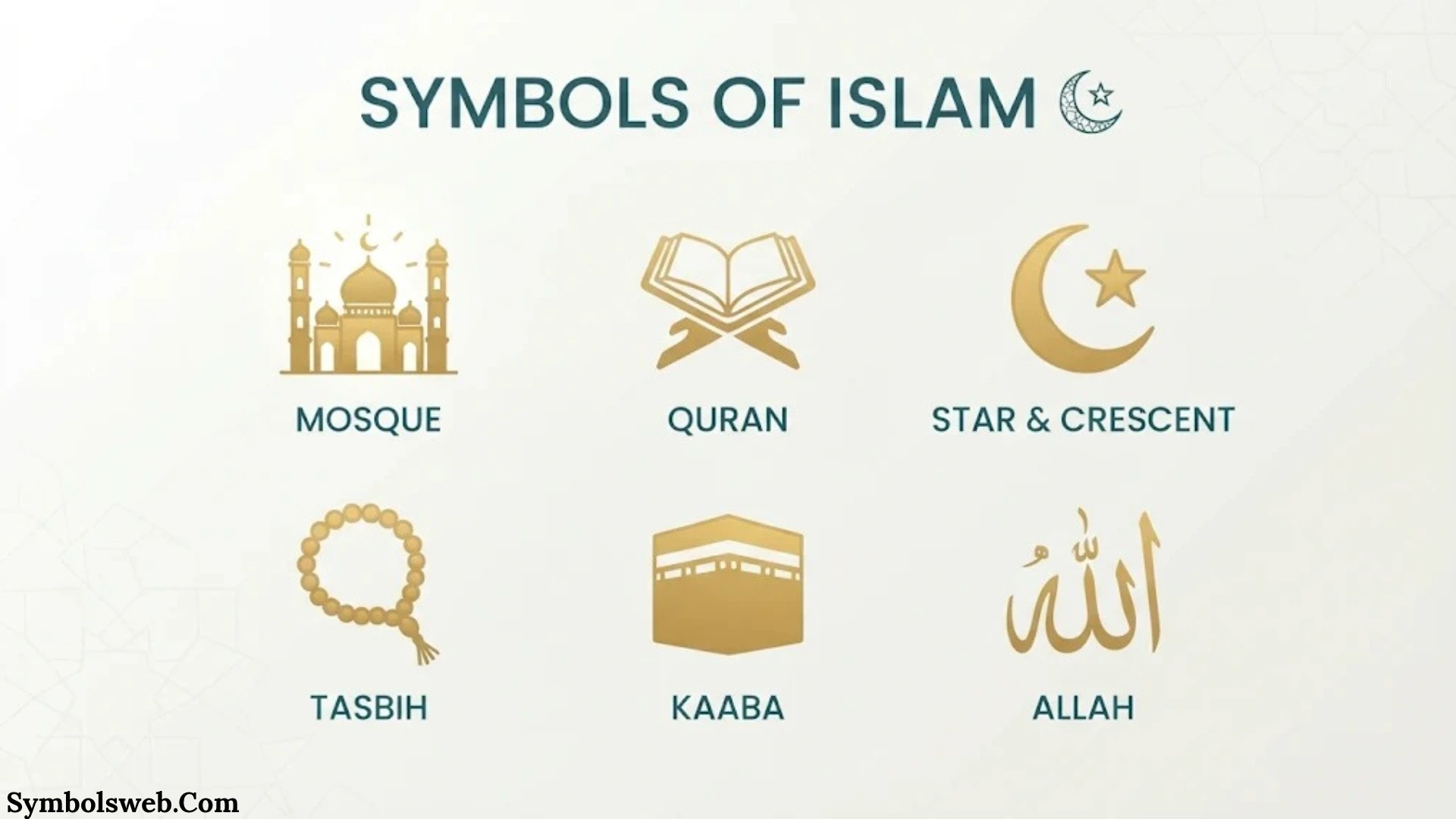
When you think about the symbols of Islam, the crescent moon and star might be the first images that come to mind. You can find this familiar design on national flags, mosque domes, religious decorations, and Ramadan greeting cards. Yet its connection with Islam has a fascinating history that goes beyond its modern appearance.
Unlike some religions, Islam doesn’t have one universally prescribed official emblem. Instead, Muslim communities express their faith through several meaningful elements. These include the Shahada, Arabic calligraphy, the Kaaba, mosque architecture, and geometric patterns. Each has a different connection to Islamic beliefs, worship, history, or artistic traditions.
Understanding the Islam symbol and meaning requires separating religious teachings from cultural traditions. Some images have direct connections with the Qur’an and Islamic practices. Others became associated with Muslim identity through historical events and regional customs. This guide explores their meanings, origins, and importance in Muslim communities around the world.
Does Islam Have an Official Symbol?
Islam doesn’t have one universally prescribed official religious symbol. The Qur’an and authentic Hadith don’t establish a particular image that every Muslim must display to represent the faith.
This distinction matters because many people automatically identify the crescent and star as the official symbol of Islam. Although the design has become internationally recognizable, its association with Islam developed through historical and cultural events rather than a universal religious command.
Islam places its central emphasis on belief in Allah, worship, moral conduct, and following the teachings of Prophet Muhammad (peace be upon him). The religion doesn’t require Muslims to wear a particular emblem, display a specific design, or decorate their homes with religious imagery.
However, Muslim civilizations have developed rich visual traditions over many centuries. Arabic calligraphy, geometric patterns, mosque architecture, and religious inscriptions all contribute to the recognizable appearance of Islamic culture.
Why Doesn’t Islam Have One Official Religious Symbol?
The foundation of Islam is Tawhid, the belief in the absolute oneness of Allah. Muslims worship Allah alone and recognize no partner or equal alongside Him.
The religion expresses this belief through the Qur’an, the Sunnah, and established acts of worship. A decorative emblem isn’t necessary to establish someone’s Muslim identity.
Consider these important foundations:
- Tawhid: Belief in the oneness of Allah.
- Shahada: The declaration of Islamic faith.
- Salah: Performing the five daily prayers.
- Zakat: Giving obligatory charity to eligible recipients.
- Sawm: Fasting during Ramadan.
- Hajj: Performing pilgrimage to Mecca when physically and financially able.
These foundations explain Islamic religious identity more directly than any decorative image.
Different Muslim communities also have different artistic traditions. A mosque in Pakistan may feature elaborate geometric tiles while a mosque in Indonesia may incorporate local architectural styles. Both reflect Islamic heritage without requiring an identical visual emblem.
Is the Crescent and Star the Real Symbol of Islam?
The crescent moon and star are widely recognized representations of Islam, particularly in Western media and international visual culture. However, they aren’t official religious requirements.
Their association with Islam became stronger through the Ottoman Empire. Ottoman flags, architecture, and political influence helped spread crescent imagery across different regions.
Today, the design appears on several national flags and religious buildings. Nevertheless, Muslims don’t need to use it to identify themselves or demonstrate their faith.
Are Islamic Symbols Mentioned in the Qur’an?
The Qur’an mentions several natural objects and concepts that later became important in Islamic artistic and cultural traditions.
These include:
- The moon and its phases.
- Stars and their role in navigation.
- Light as an image of divine guidance.
- The Kaaba and the sacred sanctuary.
- The Qibla and the direction of prayer.
However, mentioning an object in the Qur’an doesn’t automatically establish it as an official religious emblem.
For example, the Qur’an discusses the moon as a means of calculating time. This has a direct practical connection with the Islamic calendar. It doesn’t mean Muslims must display a crescent as a religious logo.
Crescent Moon and Star: The Most Recognized Symbol of Islam
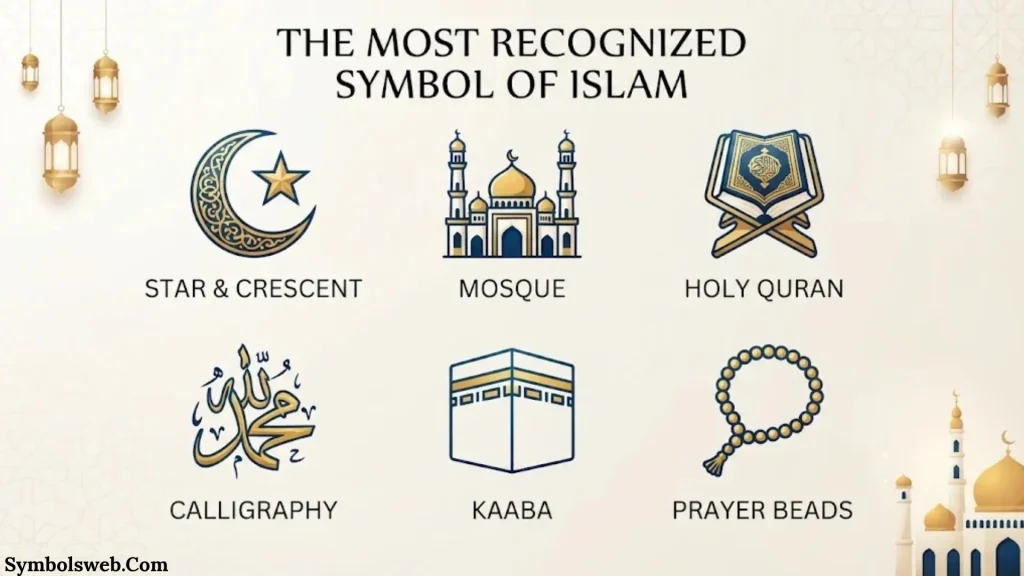
Related keywords: crescent moon and star, Islamic crescent, crescent and star meaning, Islamic moon symbol.
The crescent and star have become the most familiar visual representation associated with Islam. Their appearance on flags, mosque decorations, and cultural artwork has helped establish a strong connection with Muslim identity.
The design usually features a crescent moon with a five-pointed star positioned inside or beside its curve. However, historical versions have included different star shapes, arrangements, and orientations.
Although people often associate the combination with Islamic faith, its historical development is more complicated. Both elements existed in different ancient civilizations before the rise of Islam.
Meaning of the Crescent Moon in Islamic Culture
The crescent moon, known in Arabic as Hilal (هلال), has a genuine connection with Islamic religious practices.
Islam follows a lunar calendar. Its months begin with the appearance of the new crescent, subject to the relevant calendar and moon-sighting practices.
This makes the moon important for determining significant religious dates.
For example:
- Ramadan: The beginning of the fasting month is determined through the Islamic lunar calendar.
- Eid al-Fitr: This celebration marks the end of Ramadan and the beginning of Shawwal.
- Eid al-Adha: This festival takes place on the tenth day of Dhul-Hijjah.
- Hajj: The pilgrimage occurs during specific days of Dhul-Hijjah.
- Islamic New Year: The first day of Muharram marks the beginning of another Islamic year.
The Qur’an directly addresses the importance of lunar phases in Surah Al-Baqarah 2:189:
“They ask you about the new moons. Say, ‘They are measurements of time for the people and for Hajj.'”
This verse establishes the practical importance of the moon in Islamic timekeeping.
However, the crescent also carries broader cultural associations. Many people connect it with renewal, the passage of time, and the arrival of Ramadan.
These interpretations are meaningful in different communities, but they shouldn’t be confused with mandatory religious beliefs.
Meaning of the Star in Islamic Culture
Stars appear throughout Islamic scripture and artistic traditions. The Qur’an describes them as part of Allah’s creation and refers to their usefulness in navigation.
Surah Al-An’am 6:97 explains that Allah made the stars so people could find their way through the darkness of land and sea.
Stars therefore have a genuine place in Islamic teachings.
However, the five-pointed star commonly displayed beside the crescent doesn’t have one universally established religious meaning.
In different cultural settings, people associate it with:
- Light and guidance.
- The beauty of creation.
- Knowledge and learning.
- National identity.
- Historical Muslim heritage.
These interpretations depend on the particular culture, flag, or artistic tradition.
What Does the Crescent and Star Together Represent?
Together, the crescent and star have become a recognizable expression of Islamic cultural identity.
Their modern meaning often reflects a combination of historical heritage, national identity, and public recognition.
The design may represent:
- Muslim identity: A familiar image associated with Muslim communities.
- Historical heritage: Its connection with Ottoman and other historical traditions.
- Cultural recognition: A recognizable design used in international media.
- National identity: Its appearance on several Muslim-majority country flags.
- Religious association: Its widespread use in Islamic decorations and architecture.
It’s important to remember that these meanings aren’t identical everywhere. A crescent on a national flag may represent the country’s history rather than a specific religious teaching.
Is the Crescent Moon a Religious Requirement in Islam?
No. Islam doesn’t require Muslims to display a crescent moon or star.
Muslims can practice their religion without wearing crescent jewelry, placing a crescent on their homes, or using the design in religious artwork.
The moon matters because of its role in the lunar calendar. Its appearance on flags and buildings represents a separate historical and cultural development.
This distinction helps explain why some Muslim communities use the crescent extensively while others prefer different forms of religious and artistic expression.
History and Origin of the Crescent and Star in Islamic Culture
The history of the Islamic crescent and star begins long before Islam emerged in seventh-century Arabia.
Ancient civilizations used lunar and stellar imagery in their artwork, architecture, coins, and religious traditions. Over time, these designs passed through different cultural settings.
The Ottoman Empire eventually played a major role in making the crescent and star recognizable across the wider Islamic world.
Crescent and Star in Ancient Civilizations
The crescent and star appeared in several ancient civilizations. Their meanings varied depending on the society and historical period.
In ancient Mesopotamia, celestial imagery frequently appeared on religious objects and boundary stones.
Some designs associated the crescent with the moon deity Sin and the star with Ishtar, a goddess associated with Venus.
The symbol also appeared in ancient Persian traditions. Different rulers and societies used celestial designs on coins and other objects.
The Byzantine world adopted crescent imagery as well. The crescent became particularly associated with the city of Byzantium, later known as Constantinople.
These historical examples show that the crescent and star weren’t created specifically for Islam.
The Crescent and Star During the Early Islamic Period
Islam emerged in the seventh century in the Arabian Peninsula. Early Muslim communities developed their own religious, political, and artistic traditions.
The crescent and star didn’t immediately become a universal emblem of the new religion.
Historical evidence suggests that early Islamic societies used different banners and decorative designs. The adoption of crescent imagery developed gradually through contact with existing cultures and political traditions.
The expansion of Muslim rule brought Islamic civilization into contact with Byzantine, Persian, and other societies. These interactions influenced architecture, coinage, administration, and artistic expression.
However, it’s important not to assume that every design adopted by a Muslim ruler automatically became an Islamic religious symbol.
How the Ottoman Empire Popularized the Crescent and Star
The Ottoman Empire played a major role in connecting the crescent and star with Muslim identity.
The Ottomans established their state in Anatolia around the end of the thirteenth century. Over subsequent centuries, their influence expanded across southeastern Europe, western Asia, and North Africa.
Crescent imagery appeared in Ottoman artistic and political traditions. However, historians distinguish the earlier use of the crescent alone from the later widespread combination of a crescent and star.
Research on Ottoman flags commonly places the growing official use of the combined design in the eighteenth century, particularly during the period of Sultan Selim III. It became increasingly prominent during the nineteenth century.
Several developments helped popularize the design:
- Ottoman military and naval flags displayed crescent imagery.
- Government institutions used recognizable state emblems.
- Ottoman mosques incorporated crescents into architectural decoration.
- The empire’s political influence spread the design across different regions.
- European descriptions increasingly associated the crescent with Muslim societies.
Following the collapse of the Ottoman Empire in 1922, the crescent and star continued to appear in the national flags of several countries.
How the Crescent and Star Became a Global Symbol of Islam
The association became stronger through international politics, national flags, architecture, and popular media.
As more countries adopted crescent imagery, people increasingly recognized it as a representation of Islam.
The symbol also became associated with humanitarian organizations. The Red Crescent is now an internationally recognized emblem used by humanitarian organizations in the International Red Cross and Red Crescent Movement.
However, the Red Crescent has a specific humanitarian meaning. It shouldn’t be confused with a universal religious emblem.
Today, the crescent and star appear in many different settings:
- National flags.
- Mosque decorations.
- Islamic cultural festivals.
- Ramadan greeting cards.
- Religious publications.
- International media.
- Community organizations.
Its worldwide recognition reflects centuries of historical development rather than one religious instruction.
Important Islamic Symbols and Their Meanings
Islamic civilization has developed a wide range of visual traditions. Some have direct connections with religious beliefs and worship. Others developed through architecture, literature, and regional artistic practices.
Understanding these differences helps you recognize the Islamic symbols and their meanings without treating every decorative design as a religious requirement.
| Symbol or element | Meaning or significance | Religious or cultural connection |
| Shahada | Declaration of Islamic faith | Religious foundation |
| Allah calligraphy | The name of God | Religious expression |
| Bismillah | Beginning in the name of Allah | Religious expression |
| Kaaba | Sacred direction of Muslim prayer | Religious significance |
| Prayer mat | Used during Salah | Worship practice |
| Crescent moon | Lunar calendar and cultural identity | Religious and cultural |
| Star | Celestial creation and decorative imagery | Religious and cultural |
| Geometric patterns | Symmetry and artistic design | Artistic tradition |
| Mosque | Place of Muslim worship | Religious architecture |
| Green color | Cultural and historical associations | Cultural tradition |
Shahada: The Islamic Declaration of Faith
The Shahada is one of the most important expressions of Islamic belief. It declares the foundation of Muslim faith and explains the relationship between Allah and Prophet Muhammad (peace be upon him).
Its Arabic wording is:
لَا إِلَٰهَ إِلَّا اللَّهُ مُحَمَّدٌ رَسُولُ اللَّهِ
Its meaning is:
“There is no god but Allah, and Muhammad is the Messenger of Allah.”
The Shahada has two central parts:
- Belief that Allah alone deserves worship.
- Belief that Muhammad is Allah’s messenger.
Muslims recite this declaration in prayer and other religious settings. It also appears in Islamic calligraphy, historical manuscripts, and national flags.
For example, Saudi Arabia’s national flag features the Shahada above a sword. This makes it an important example of religious wording appearing in national symbolism.
The Shahada isn’t simply a decorative phrase. Its words express the central foundation of Islamic faith.
Allah’s Name in Arabic Calligraphy
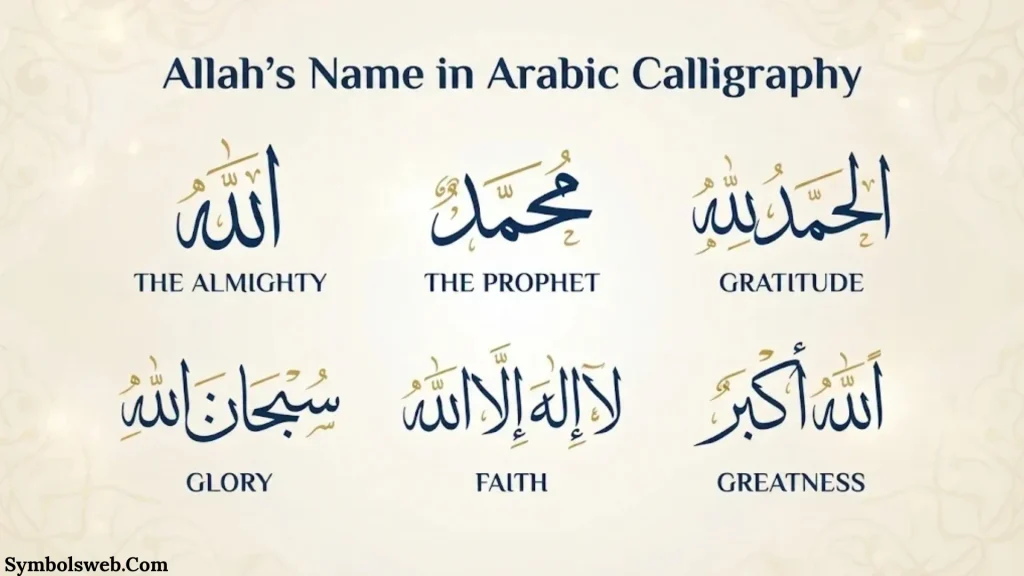
The Arabic word Allah (الله) represents the name of God in Islam.
Muslims use this name when discussing worship, prayer, gratitude, and belief. It appears frequently in the Qur’an and throughout everyday Islamic religious expression.
Arabic calligraphers have developed several artistic ways to write Allah’s name. Some designs feature flowing letters while others use balanced geometric arrangements.
Common applications include:
- Mosque walls and architectural inscriptions.
- Islamic paintings and decorative panels.
- Religious books and manuscripts.
- Home decorations.
- Educational materials.
- Traditional Islamic artwork.
Arabic calligraphy also reflects the importance of the Qur’an’s original language.
However, the written name of Allah should be treated respectfully. It isn’t simply an ordinary decorative shape without meaning.
Bismillah: Beginning in the Name of Allah
Bismillah (بِسْمِ اللَّهِ الرَّحْمَٰنِ الرَّحِيمِ) is one of the most recognizable phrases in Islamic culture.
It means:
“In the name of Allah, the Most Compassionate, the Most Merciful.”
Muslims commonly say Bismillah before beginning everyday activities. It expresses awareness of Allah and the desire to begin an action with His name.
The phrase appears at the beginning of most chapters of the Qur’an. Surah At-Tawbah is the notable exception.
Bismillah also appears in traditional Arabic calligraphy. Artists often write it using elaborate lettering for religious manuscripts, mosque decorations, and cultural artwork.
Its significance comes from its religious meaning rather than its visual design.
The Kaaba: The Sacred Center of Muslim Prayer
The Kaaba is one of the most important sacred structures in Islam. It stands inside Masjid al-Haram in Mecca, Saudi Arabia.
Muslims around the world face the Kaaba when performing Salah. This direction is called the Qibla.
The Kaaba also plays a central role in Hajj and Umrah.
Its historical and religious importance connects Muslim communities across different countries. Regardless of where they live, Muslims turn toward the same direction during their daily prayers.
Important facts about the Kaaba include:
- It is located in Mecca, Saudi Arabia.
- It stands inside the Grand Mosque, Masjid al-Haram.
- Muslims face it during their five daily prayers.
- Pilgrims perform Tawaf by walking around it.
- It is traditionally covered with a black cloth called the Kiswah.
- The Black Stone, known as Hajar al-Aswad, is set into one of its corners.
The Kaaba is a sacred place of worship rather than a decorative logo for Islam.
Its importance comes from Islamic teachings and its role in Muslim worship.
The Prayer Mat: An Object Connected With Islamic Worship
A prayer mat, commonly called a Sajjadah, is used by many Muslims during Salah.
It provides a clean surface for prayer. Its designs often include a central arch resembling the mihrab found in traditional mosques.
Common decorative features include:
- Geometric patterns.
- Floral designs.
- Mosque architecture.
- Arabic inscriptions.
- Decorative borders.
- Mihrab-shaped arches.
Prayer mats come in different materials, sizes, and designs. Some are simple and practical while others feature detailed embroidery.
Although prayer mats are widely used, Islam doesn’t require Muslims to own a specially designed mat. Prayer can take place on any suitable clean surface.
The Mosque and Minaret
A mosque, known in Arabic as Masjid, is a place where Muslims gather for worship.
Mosques also serve important educational and community functions. They provide spaces for religious instruction, Friday congregational prayers, and community activities.
Traditional mosque architecture may include several recognizable features.
| Architectural feature | Purpose |
| Dome | Architectural and decorative element |
| Minaret | Traditionally associated with the call to prayer |
| Mihrab | Indicates the direction of Mecca |
| Minbar | Elevated platform used for sermons |
| Prayer hall | Main space for congregational worship |
| Courtyard | Open area used for gathering and other activities |
Some mosque domes and minarets feature crescent-shaped decorations.
However, these ornaments aren’t mandatory Islamic architectural requirements. Mosques around the world have different designs depending on their location, history, and building traditions.
The Mihrab and Minbar
The mihrab is a niche in a mosque wall that indicates the direction of the Qibla.
It helps worshippers identify the direction they should face during prayer.
The minbar is an elevated platform where an imam or religious speaker delivers the Friday sermon, known as the Khutbah.
Both features are common in traditional mosque architecture.
Their importance comes from their practical religious functions rather than symbolic interpretations.
Islamic Geometric Patterns and Eight Pointed Stars
Islamic geometric art is among the most recognizable artistic traditions associated with Muslim civilizations.
Artists create these patterns using circles, polygons, intersecting lines, and repeated geometric shapes.
One familiar design is the eight-pointed star. It appears in tiles, wooden screens, manuscripts, ceilings, and architectural decoration.
Other common patterns include:
- Six-pointed geometric arrangements.
- Eight-pointed stars.
- Ten-pointed star designs.
- Interlocking polygons.
- Repeating circles.
- Symmetrical arrangements.
- Complex tessellations.
These designs demonstrate mathematical skill, careful planning, and artistic creativity.
Their appearance across different regions also reveals the influence of Persian, Ottoman, Andalusian, and other artistic traditions.
However, not every geometric design carries a fixed spiritual meaning. Many patterns serve primarily decorative and architectural purposes.
Arabic Calligraphy and Quranic Inscriptions
Arabic calligraphy has a special place in Islamic art because of its connection with the Qur’an.
Muslim calligraphers developed elaborate writing styles to preserve and present Arabic text beautifully.
Some major calligraphic styles include:
| Calligraphy style | Main characteristics |
| Kufic | Angular and structured lettering |
| Naskh | Clear and readable rounded script |
| Thuluth | Tall, flowing, decorative letters |
| Nastaliq | Sloping and elegant lettering |
These styles appear in religious manuscripts, mosque inscriptions, historical buildings, and decorative artwork.
Quranic inscriptions are especially significant because they contain actual passages from Islamic scripture.
Artists must also consider the meaning and proper presentation of religious text when creating decorative designs.
Islamic Symbols in Religious Art and Architecture
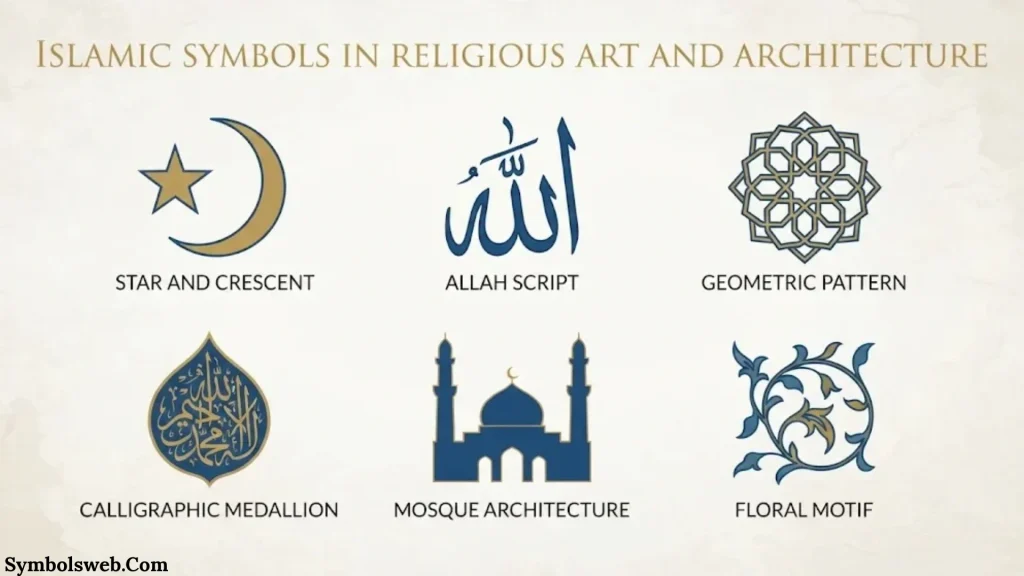
Islamic art developed across many centuries and regions. Its appearance reflects local materials, cultural influences, religious practices, and artistic preferences.
Calligraphy, geometric ornament, and floral patterns became especially important in many religious and architectural settings.
Islamic Calligraphy as an Expression of Faith
Calligraphy allows artists to present meaningful Arabic words through carefully designed lettering.
Religious inscriptions often feature:
- Verses from the Qur’an.
- The name of Allah.
- The Shahada.
- Bismillah.
- Names of prophets.
- Other religious expressions.
Historical mosques frequently feature calligraphic inscriptions around entrances, domes, arches, and prayer halls.
These designs combine written meaning with artistic craftsmanship.
Geometric Patterns in Islamic Architecture
Islamic geometric designs often used repetition and symmetry to create complex visual arrangements.
A simple circle can become the foundation for an elaborate pattern involving dozens of connected shapes.
Architects and craftsmen use these designs in:
- Ceramic tiles.
- Wooden screens.
- Mosque ceilings.
- Decorative walls.
- Stone carvings.
- Metalwork.
- Manuscript borders.
The designs vary across historical periods. Andalusian buildings, Persian monuments, Ottoman mosques, and Mughal structures each developed distinctive decorative approaches.
Floral and Arabesque Patterns
Arabesque patterns feature flowing leaves, stems, vines, and interconnected plant-inspired designs.
These patterns often repeat across large surfaces. Their flowing forms create a sense of continuity and visual movement.
Floral ornament appears in Persian manuscripts, Ottoman ceramics, Mughal buildings, and other Islamic artistic traditions.
Common examples include:
- Stylized leaves.
- Interconnected vines.
- Flower arrangements.
- Repeating branches.
- Symmetrical plant designs.
Artists often combine floral ornament with geometric patterns and Arabic calligraphy.
Why Islamic Art Often Uses Nonfigurative Decoration
Many religious settings emphasize calligraphy, geometry, and plant-based ornament rather than figurative imagery.
This approach relates partly to Islamic concerns about idolatry and the representation of living beings in sacred contexts.
However, Islamic art isn’t completely free of human or animal figures.
Historical manuscripts, palace decorations, ceramics, and secular artwork from different Muslim societies include figurative representations.
Practices also vary among Islamic scholars, communities, and historical periods. Therefore, describing all Islamic art as nonfigurative would overlook an important part of its history.
Religious Meanings of the Moon, Stars, and Light in Islam
The moon, stars, and light appear in Islamic scripture. They also have important connections with timekeeping, navigation, and spiritual reflection.
Understanding these references helps separate Islamic religious teachings from later interpretations of the crescent and star emblem.
The Moon in the Qur’an
The Qur’an refers to the moon in several passages.
Surah Yunus 10:5 describes Allah as the One who made the sun a source of brightness and the moon a light. It also explains that He determined the moon’s phases so people could calculate years and time.
Surah Al-Baqarah 2:189 also explains the importance of new moons.
These references establish the moon’s role in understanding time and recognizing the changing months.
The Islamic calendar is lunar and contains twelve months:
| Islamic month | Significance |
| Muharram | Beginning of the Islamic year |
| Safar | Second Islamic month |
| Rabi al-Awwal | Month associated with the Prophet’s birth in traditional observances |
| Rabi al-Thani | Fourth Islamic month |
| Jumada al-Awwal | Fifth Islamic month |
| Jumada al-Thani | Sixth Islamic month |
| Rajab | One of the four sacred months |
| Sha’ban | Month preceding Ramadan |
| Ramadan | Month of fasting |
| Shawwal | Month containing Eid al-Fitr |
| Dhul-Qa’dah | One of the four sacred months |
| Dhul-Hijjah | Month of Hajj and Eid al Adha |
The lunar calendar explains why moon sightings remain important in Muslim communities.
Stars in the Qur’an
The Qur’an describes stars as part of Allah’s creation.
Surah Al An’am 6:97 specifically mentions their usefulness in finding direction through darkness on land and at sea.
Stars also appear in other Quranic passages that discuss the heavens and the natural world.
Their religious significance comes from their place in creation rather than the five-pointed star used in modern Islamic imagery.
This distinction is especially important when discussing the meaning of the star in Islam.
Light and Guidance in Islamic Teachings
Light has a powerful place in Islamic scripture.
Surah An-Nur 24:35 is commonly known as the Light Verse. It describes Allah as the Light of the heavens and the earth.
The passage uses the image of a lamp within a niche to communicate a profound spiritual meaning.
In Islamic thought, light can also appear in discussions about:
- Divine guidance.
- Knowledge.
- Faith.
- Spiritual understanding.
- Revelation.
- The path toward righteousness.
These concepts have influenced Islamic poetry, architecture, calligraphy, and religious literature.
However, spiritual light shouldn’t be confused with a specific official visual emblem.
Islamic Symbols on Flags Around the World
Several Muslim-majority countries use crescents, stars, Arabic inscriptions, or other religiously significant designs on their national flags.
These designs reflect different historical experiences and national identities. Some have direct religious associations while others represent independence, progress, or political heritage.
The crescent and star on Islamic flags are particularly recognizable. However, not every Muslim-majority country uses this combination.
Pakistan’s Crescent and Star
Pakistan’s national flag features a white crescent and five-pointed star on a dark green field. A vertical white stripe appears along the flag’s left side.
The design represents important elements of Pakistan’s national identity.
The main features include:
- Green field: Represents Pakistan’s Muslim majority population.
- White stripe: Represents religious Indigenous peoples.
- White crescent: Represents progress.
- Five-pointed star: Represents light and knowledge.
Pakistan adopted its national flag on August 11, 1947, shortly before independence.
The crescent and star connect the country’s national identity with a widely recognized visual tradition. However, their presence on the flag doesn’t make the design a universal religious requirement for Muslims.
Turkey’s Crescent and Star
Turkey’s national flag features a white crescent and five-pointed star on a red background.
The design has a strong historical association with the Ottoman Empire and Turkish national identity.
The Ottoman state helped popularize crescent imagery across different regions. Its influence also contributed to the modern association between the crescent and Muslim communities.
Today, the Turkish flag represents the Turkish Republic rather than serving as an official religious emblem for all Muslims.
Algeria’s Crescent and Star
Algeria’s national flag features a red crescent and star positioned between green and white sections.
The colors and design reflect the country’s national history and identity.
The flag became especially important during Algeria’s struggle for independence from French colonial rule. Its symbolism connects national independence with cultural and historical heritage.
Tunisia’s Crescent and Star
Tunisia’s national flag features a red background with a white circle containing a red crescent and star.
The design reflects historical influences from the Ottoman period.
Its crescent and star also connect the country’s national identity with a broader visual tradition associated with Muslim societies.
Malaysia’s Crescent and Star
Malaysia’s national flag, known as the Jalur Gemilang, includes a yellow crescent and a 14-pointed star.
The crescent represents Islam as the country’s official religion. The star represents the unity of the thirteen states and the federal government.
Its design also features alternating red and white stripes with a blue canton.
Malaysia’s flag demonstrates how national governments can give specific meanings to familiar Islamic visual elements.
Why Some Muslim Majority Countries Don’t Use the Crescent and Star
Not all Muslim-majority countries use the crescent and star.
Their national flags often reflect different historical events, political movements, and cultural traditions.
| Country | National flag design | Important association |
| Pakistan | Crescent and five-pointed star | National identity and progress |
| Turkey | Crescent and five-pointed star | Turkish and Ottoman heritage |
| Algeria | Crescent and star | National independence |
| Tunisia | Crescent and star | National and historical identity |
| Malaysia | Crescent and 14-pointed star | Islam and national unity |
| Saudi Arabia | Shahada and sword | Islamic declaration and national identity |
| Indonesia | Red and white | National independence and heritage |
Saudi Arabia uses the Shahada and a sword rather than a crescent and star. Indonesia uses a simple red-and-white design.
These examples demonstrate an important point: Muslim identity doesn’t depend on one particular national or religious symbol.
Cultural Significance of Islamic Symbols Around the World
Islam has spread across different continents and societies. As a result, Muslim communities have developed diverse cultural expressions while sharing the same central religious foundations.
The appearance of Islamic cultural symbols can vary considerably between the Middle East, South Asia, Southeast Asia, Africa, and Europe.
Islamic Symbols in Middle Eastern Culture
The Middle East contains some of the world’s most important historical Islamic sites and architectural traditions.
Arabic calligraphy, mosque architecture, geometric patterns, and religious inscriptions are common features of Islamic artistic heritage.
You can find these elements in:
- Historic mosques.
- Religious schools.
- Manuscripts.
- Traditional homes.
- Public buildings.
- Decorative ceramics.
- Religious festivals.
The region also contains important architectural traditions from different Islamic dynasties.
For example, the Umayyad Mosque in Damascus and the Dome of the Rock in Jerusalem demonstrate the historical importance of Islamic architecture.
Islamic Symbols in South Asian Culture
South Asia has developed a rich tradition of Islamic architecture and decorative art.
Pakistan, India, and Bangladesh contain important examples of Islamic artistic heritage.
The Mughal Empire played a particularly influential role in shaping architecture across the Indian subcontinent.
Examples include:
- The Taj Mahal in Agra.
- Badshahi Mosque in Lahore.
- Wazir Khan Mosque in Lahore.
- Jama Masjid in Delhi.
These buildings demonstrate the use of geometric ornament, calligraphy, domes, arches, and decorative stonework.
In Pakistan, crescent and star imagery also appears in national celebrations, religious decorations, and cultural artwork.
Islamic Symbols in Southeast Asian Culture
Indonesia and Malaysia have developed distinctive Islamic artistic traditions.
Their mosque architecture often combines Islamic design principles with regional building styles.
Traditional wooden structures, decorative roof forms, Arabic inscriptions, and geometric ornament appear in different locations.
Indonesia is home to the world’s largest Muslim population. Its Islamic heritage includes centuries of cultural exchange involving Arab, Indian, Persian, and local traditions.
Malaysia also has a rich tradition of Islamic architecture and calligraphy.
These examples demonstrate that Islamic artistic identity can develop differently across regions without changing the foundations of the religion.
Islamic Heritage and Muslim Identity
Muslim identity comes primarily from shared religious beliefs and practices.
However, cultural traditions also influence how people express their connection with Islam.
A Muslim in Pakistan might recognize a crescent and star through national celebrations. Someone in Morocco might associate Islamic heritage with geometric tiles and traditional mosque architecture.
Both experiences reflect different cultural settings.
Religious and cultural expressions may include:
- Arabic calligraphy.
- Traditional mosque designs.
- Ramadan decorations.
- Islamic geometric patterns.
- National flags.
- Religious clothing.
- Community celebrations.
- Historical monuments.
These elements can create a sense of belonging and connection with shared heritage.
Nevertheless, no single visual design represents every Muslim community or individual.
Islamic Symbols During Ramadan and Eid Celebrations
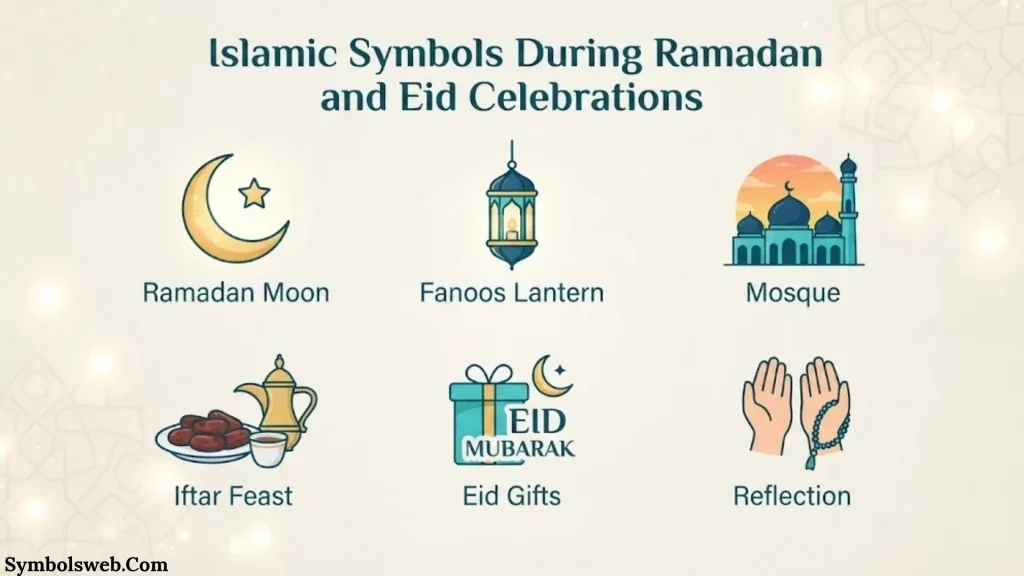
Ramadan and Eid are important occasions in Muslim life. Their celebrations often feature familiar Islamic imagery, particularly crescent moons, lanterns, and Arabic calligraphy.
These decorations create a recognizable festive atmosphere. However, it’s important to distinguish cultural decorations from religious requirements.
Crescent Moon and Ramadan
Ramadan is the ninth month of the Islamic lunar calendar.
Muslims fast from dawn until sunset during this month. Fasting includes avoiding food, drink, and other activities that invalidate the fast during the prescribed hours.
The beginning of Ramadan is connected with the sighting of the new crescent.
This explains why the crescent moon has such a strong association with Ramadan.
Common Ramadan decorations include:
- Crescent moon ornaments.
- Star-shaped decorations.
- Traditional lanterns.
- Arabic calligraphy.
- Mosque silhouettes.
- Decorative lights.
- Ramadan greeting banners.
These designs reflect cultural celebration rather than obligatory religious practices.
Islamic Symbols During Eid al-Fitr
Eid al-Fitr marks the end of Ramadan.
Muslims celebrate the occasion with congregational prayers, family gatherings, charitable giving, and festive meals.
Common visual elements include:
- Crescent and star decorations.
- Arabic Eid greetings.
- Mosque illustrations.
- Geometric patterns.
- Decorative lanterns.
- Islamic calligraphy.
The phrase Eid Mubarak is commonly used to wish others a blessed Eid.
Its Arabic spelling is:
عيد مبارك
Although crescent decorations are popular during Eid, Muslims don’t need to display them to celebrate the occasion.
Islamic Symbols During Eid al-Adha
Eid al-Adha is celebrated on the tenth day of Dhul-Hijjah.
It commemorates the devotion and obedience associated with Prophet Ibrahim (Abraham) and his willingness to follow Allah’s command.
The occasion is closely connected with Hajj and the tradition of animal sacrifice.
Common visual representations include:
- The Kaaba.
- Images of the Grand Mosque.
- Hajj-related illustrations.
- Arabic calligraphy.
- Geometric Islamic patterns.
- Eid greeting designs.
The Kaaba is particularly relevant because of its connection with pilgrimage and Muslim worship.
Symbols and Objects Often Mistaken for Official Islamic Symbols
Some designs appear frequently in Muslim communities but have broader cultural origins or different religious interpretations.
Understanding their backgrounds prevents confusion between Islamic religious symbols and cultural objects.
The Hamsa Hand (Hand of Fatima)
The Hamsa Hand is a hand shaped design found in several Middle Eastern and North African traditions.
It usually features an open palm with five fingers. Some versions include an eye in the center.
Different communities associate the design with protection, blessings, or good fortune.
Some people call it the Hand of Fatima, referring to Fatima al-Zahra, the daughter of Prophet Muhammad (peace be upon him).
However, the design isn’t an official symbol of Islam.
Its use and interpretation vary across Muslim, Jewish, and other cultural traditions. Muslims should also distinguish cultural beliefs about protective objects from Islamic teachings about seeking protection from Allah.
The Evil Eye (Nazar)
The evil eye is a belief found in many cultures.
It refers to the idea that envy or an envious gaze can cause harm to another person.
In some communities, people use a blue eye-shaped charm called Nazar to represent protection.
Islam also recognizes the concept of the evil eye through prophetic traditions. However, the belief itself and the use of a particular charm are separate matters.
Muslims traditionally seek protection through prayer and supplication rather than assuming that a decorative object has independent protective power.
The Nazar charm isn’t an official Islamic religious emblem.
The Number 786 and Its Association With Bismillah
The number 786 has a special cultural association with Bismillah in some South Asian Muslim communities.
Its connection comes from the Abjad system, which assigns numerical values to Arabic letters.
Under this system, the Arabic letters in the phrase Bismillah al-Rahman al-Rahim add up to 786.
Some people use the number in letters, documents, decorative artwork, and personal inscriptions.
However, its acceptance and use vary among Muslims.
The number isn’t a Quranic symbol or a universally accepted replacement for writing Bismillah.
It’s important to understand that the religious significance belongs to the actual phrase rather than the number itself.
Green Color in Islamic Culture
Green has a long-standing association with Islamic culture.
It appears in several Muslim-majority national flags, traditional decorations, and religious artwork.
The Qur’an also describes green garments and greenery in passages about Paradise. For example, Surah Al-Insan 76:21 mentions green garments made of fine silk.
However, Islam doesn’t establish green as an exclusive religious color.
Muslim communities use many colors in their artistic traditions. Blue, white, red, gold, and other shades appear throughout Islamic architecture and decorative art.
Green remains culturally recognizable, but its use isn’t a requirement of Islamic belief.
The Five Pillars of Islam
The Five Pillars of Islam are sometimes presented alongside Islamic symbols because they visually represent the foundations of Muslim religious life.
However, they’re religious obligations and practices rather than decorative symbols.
| Pillar | Arabic name | Meaning |
| Declaration of faith | Shahada | Affirming belief in Allah and His messenger |
| Prayer | Salah | Performing five daily prayers |
| Charity | Zakat | Giving obligatory charity |
| Fasting | Sawm | Fasting during Ramadan |
| Pilgrimage | Hajj | Pilgrimage to Mecca when able |
Together, these pillars provide the foundation for Muslim worship and religious practice.
Islamic Symbols in Modern Design and Digital Culture
Traditional Islamic imagery continues to influence modern graphic design, clothing, digital communication, and decorative artwork.
Designers often combine historical motifs with modern typography and digital illustrations. These designs help communicate cultural heritage and religious identity to wider audiences.
Islamic Symbols in Graphic Design
Islamic graphic design frequently uses familiar visual elements from traditional architecture and artwork.
Popular design elements include:
- Crescent moon and star illustrations.
- Arabic calligraphy.
- Islamic geometric patterns.
- Mosque silhouettes.
- Decorative lanterns.
- Quranic inscriptions.
- Floral arabesque designs.
These elements appear in Ramadan posters, Eid greeting cards, event invitations, educational materials, and religious publications.
However, designers should understand the meaning of religious text before including it in commercial or decorative artwork.
Islamic Symbols in Social Media
Social media has made Islamic visual expressions easier to share across different countries.
Muslims use decorative imagery to communicate religious messages, celebrate important occasions, and share reminders about Islamic teachings.
Common examples include:
- Crescent and star emojis.
- Arabic calligraphy in Instagram bios.
- Ramadan greeting posts.
- Eid Mubarak designs.
- Islamic quotes and reminders.
- Mosque illustrations.
- Quranic verses shared online.
The moon emoji is especially common during Ramadan. However, an emoji doesn’t automatically represent an official Islamic religious symbol.
Islamic Symbols in Jewelry and Clothing
Islamic-inspired jewelry and clothing often feature cultural and religious designs.
Common examples include:
- Crescent-shaped pendants.
- Arabic calligraphy necklaces.
- Geometric patterned clothing.
- Decorative Islamic bracelets.
- Rings featuring Arabic inscriptions.
- Traditional embroidered fabrics.
Some people choose these items because they appreciate Islamic heritage. Others wear them as personal expressions of faith.
When jewelry contains Quranic verses or Allah’s name, respectful handling becomes especially important.
How to Use Islamic Symbols Respectfully
Religious and cultural imagery deserves careful treatment.
Whether you’re creating a poster, designing clothing, or decorating a building, understanding the meaning behind an image helps avoid accidental disrespect.
Consider these guidelines:
- Understand the design: Research its historical and religious background before using it.
- Check Arabic wording: Make sure religious inscriptions are written correctly.
- Respect Quranic verses: Avoid placing sacred text in unsuitable locations.
- Avoid false claims: Don’t describe cultural decorations as mandatory Islamic symbols.
- Recognize diversity: Understand that Muslim communities have different artistic and cultural traditions.
- Consider the context: A design suitable for a national flag may not be appropriate for every religious setting.
Respectful representation begins with accurate information.
Common Misconceptions About Islamic Symbols
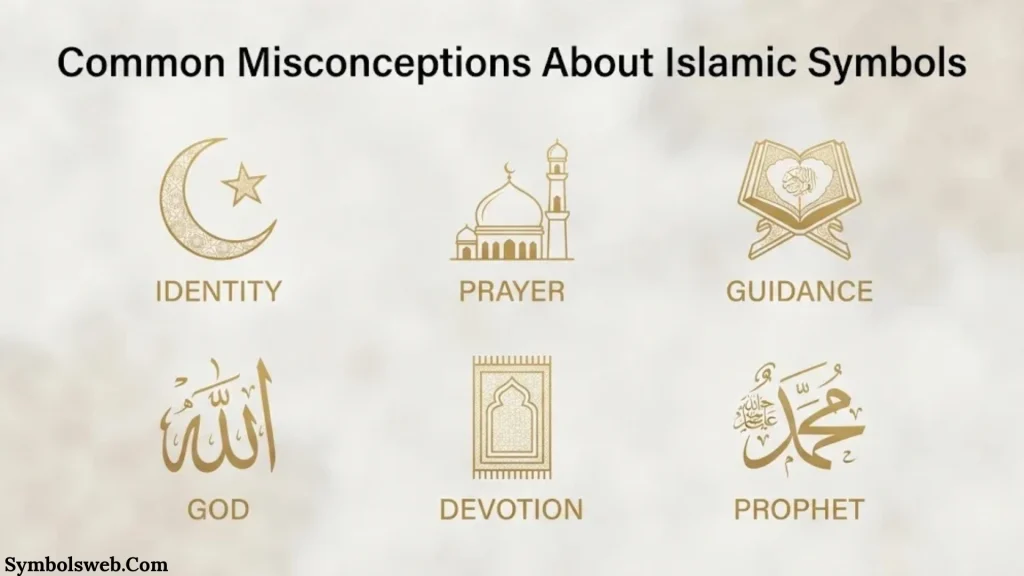
Many misunderstandings arise because people confuse cultural traditions with religious requirements.
The following explanations address some of the most common misconceptions.
Islam Requires Muslims to Display the Crescent and Star
This is incorrect.
Islam doesn’t require Muslims to display the crescent and star. The design became widely associated with Muslim communities through historical and cultural developments.
A Muslim’s faith doesn’t depend on wearing or displaying this emblem.
Every Muslim Country Uses the Same Islamic Symbol
Muslim-majority countries have different national flags and historical traditions.
Pakistan, Turkey, and Algeria use crescent imagery. Saudi Arabia features the Shahada and a sword while Indonesia uses red and white.
These differences demonstrate the diversity of Muslim national identities.
The Crescent and Star Originated With Islam
The crescent and star existed in ancient civilizations before Islam.
Mesopotamian, Persian, and Byzantine societies used celestial imagery in different historical contexts.
The Ottoman Empire later helped establish the design’s widespread association with Muslim identity.
Every Geometric Star Pattern Has a Religious Meaning
Geometric stars are common in Islamic art, but not every design represents a specific religious teaching.
Many patterns were created through mathematical construction and artistic experimentation.
Their importance often comes from their craftsmanship, symmetry, and decorative value.
Islamic Art Never Includes Human or Animal Figures
This statement oversimplifies Islamic artistic history.
Although figurative imagery is often avoided in religious settings, historical Islamic manuscripts, palace decorations, and secular artwork sometimes include people and animals.
Artistic practices have varied across different societies and periods.
Frequently Asked Questions About Symbols of Islam
What Is the Main Symbol of Islam?
The crescent moon and star are the most widely recognized visual representations associated with Islam. However, Islam doesn’t have one universally prescribed official emblem. The Shahada, Arabic calligraphy, and other religious expressions also have important places in Islamic culture.
What Does the Crescent Moon and Star Mean in Islam?
The crescent and star are commonly associated with Muslim identity and Islamic cultural heritage. The crescent also connects with the lunar calendar, which determines Islamic months and religious occasions. The combined design doesn’t have one universally established religious meaning.
Is the Crescent Moon Mentioned in the Qur’an?
Yes. The Qur’an discusses the moon and its phases in several passages. Surah Al-Baqarah 2:189 explains the importance of new moons for measuring time and determining Hajj. However, the crescent-and-star emblem isn’t prescribed as an official Islamic symbol.
Why Do Mosques Have Crescent Moons on Their Domes?
Crescent decorations became popular through historical architectural traditions, particularly Ottoman influence. Many mosques adopted the design as a recognizable cultural ornament. However, Islamic teachings don’t require mosques to display crescents.
What Does the Star Represent in Islamic Symbols?
Stars appear in the Qur’an as part of Allah’s creation and are associated with navigation and the beauty of the heavens. In modern crescent-and-star designs, the five-pointed star can represent different cultural or national ideas. It doesn’t have one universally accepted religious meaning.
What Are the Most Important Symbols Associated With Islam?
Common elements associated with Islam include:
- The Shahada.
- Allah’s name in Arabic calligraphy.
- Bismillah.
- The Kaaba.
- The crescent and star.
- Islamic geometric patterns.
- Mosque architecture.
These elements have different religious, historical, and cultural meanings.
Is the Number 786 an Islamic Symbol?
The number 786 comes from the Abjad numerical system, which assigns numerical values to Arabic letters. Some South Asian Muslims associate it with Bismillah. However, it isn’t an official Islamic symbol or a universally accepted replacement for the actual phrase.
Is Green the Official Color of Islam?
No. Green has important cultural and historical associations with Islam. It also appears in Quranic descriptions of Paradise. However, Islamic teachings don’t establish green as the religion’s exclusive or mandatory color.
Are the Hamsa Hand and Evil Eye Islamic Symbols?
Neither is an official Islamic emblem. Both have wider cultural histories and appear in some Muslim communities. Islamic teachings about protection and the evil eye should be distinguished from the use of decorative charms.
Do All Muslims Use the Crescent and Star?
No. Some Muslims use the crescent and star in decorations, jewelry, and cultural celebrations. Others don’t use it at all. Islamic belief and religious practice don’t depend on displaying this design.
Conclusion: Understanding the Real Meaning of Islamic Symbols
The symbols of Islam represent a fascinating combination of religious teachings, historical developments, and cultural traditions. Although the crescent and star are widely recognized around the world, they aren’t an official religious requirement. Their association with Islam developed over centuries, particularly through the influence of the Ottoman Empire.
Other elements have more direct connections with Islamic beliefs and practices. The Shahada expresses the foundation of faith while the Kaaba provides the direction of Muslim prayer. Arabic calligraphy, Quranic inscriptions, and geometric patterns also demonstrate the richness of Islamic artistic heritage.
Understanding these differences gives you a clearer picture of Muslim identity and Islamic culture. Rather than treating every familiar image as an official religious emblem, consider its actual history and meaning. That’s the best way to appreciate the diversity and significance of Islamic symbols.

Hi, I’m Ethan Holloway, and I’ve always believed that a few meaningful words can change the way we think, feel, and live. I enjoy collecting timeless quotes, studying their deeper meanings, and sharing inspiring messages that help people stay motivated through every stage of life.
Over the years, I’ve explored thousands of famous sayings from writers, leaders, philosophers, and everyday people. My goal is to make wisdom easy to understand and useful for everyone.
Books by Ethan Holloway
- The Power of Everyday Quotes
- Words That Inspire Greatness
 Jordan Hayes
 Eliana Foster