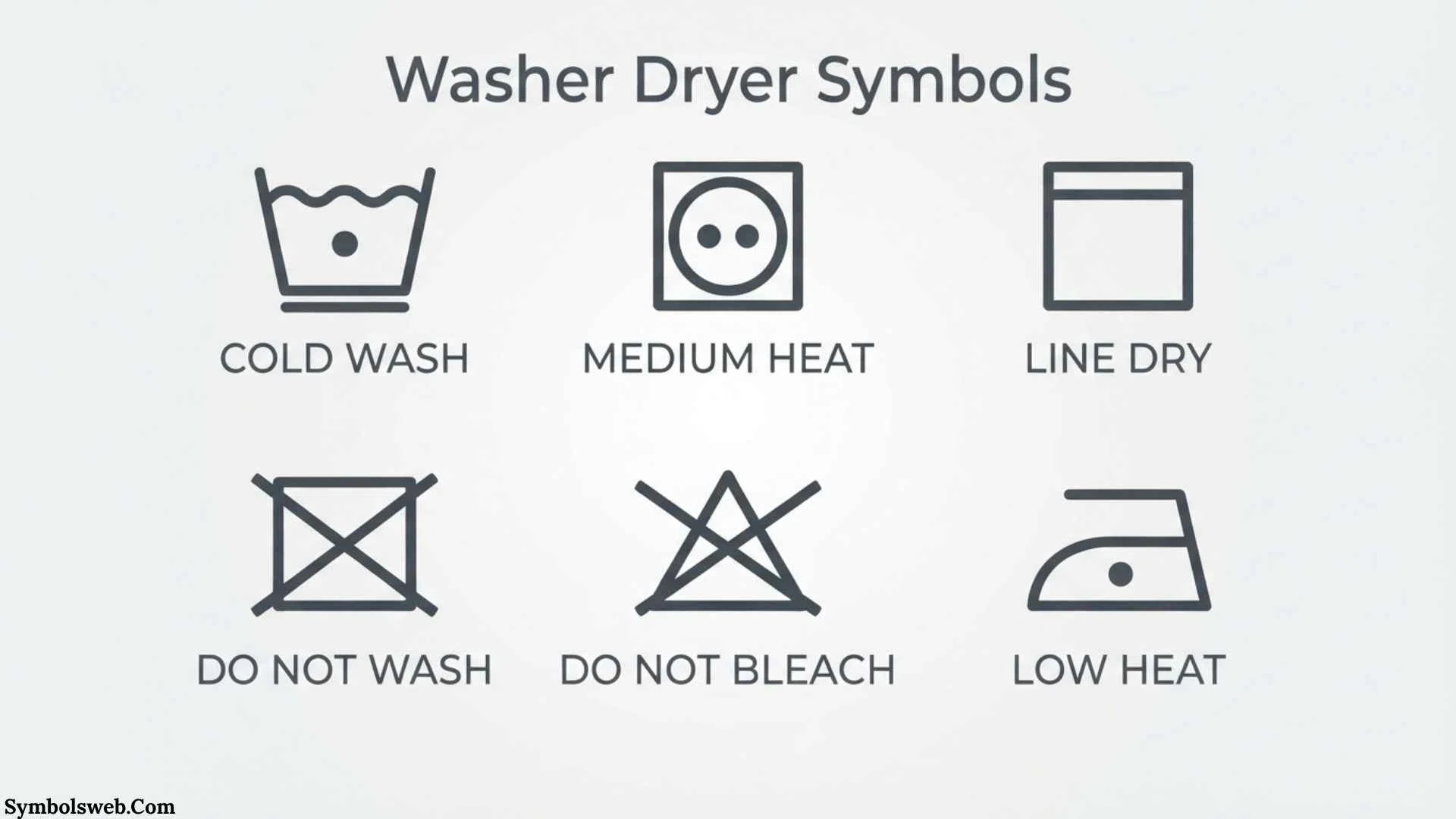
Washer dryer symbols can often feel confusing when you first look at a clothing care label. A tiny tub, square, circle, or crossed-out sign can determine whether your favorite clothes stay in good condition or come out damaged. Once you understand what these simple symbols mean, laundry care becomes much easier.
These symbols create a simple visual language for washing, drying, bleaching, ironing, and professional textile care. They are especially useful because the same basic shapes can communicate important instructions across different languages and countries. Instead of guessing which cycle or temperature to use, you can read the label and care for each fabric correctly.
In this guide, you will discover what the most common washer dryer symbols mean, how dots and lines change their instructions, and how to tell the difference between washing, tumble drying, and other care symbols. By learning a few simple patterns, you can avoid common laundry mistakes and help your clothes last longer.
Quick Answer
Washer dryer symbols are care-label icons that explain how a garment should be washed, dried, bleached, ironed, or professionally cleaned. A wash tub describes washing, while a square represents drying. A circle inside a square means tumble drying, dots indicate heat level, and a crossed-out symbol means the treatment should not be used.
Quick Facts About Washer Dryer Symbols
| Aspect | Information |
| Origin | Modern textile care symbols developed into standardized international systems for communicating garment-care instructions |
| Historical Significance | Standardized symbols made clothing-care instructions easier to understand across languages and countries |
| Main Meaning | They tell you the maximum or appropriate care treatment a textile can safely receive |
| Spiritual Meaning | Washer dryer symbols do not have an established spiritual meaning; they are practical care instructions |
| Cultural Importance | They provide a common visual language for clothing care across different markets |
| Modern Usage | Found on clothing, towels, bedding, household textiles, and care labels |
What Are Washer Dryer Symbols?
Washer dryer symbols are visual instructions printed on clothing and textile care labels. They tell you how an item should be treated during washing, drying, bleaching, ironing, and professional cleaning.
The system is based on simple visual shapes. A wash tub relates to washing. A triangle relates to bleaching. A square relates to drying. An iron relates to ironing. A circle relates to professional textile care.
This design makes the instructions easier to understand without relying entirely on written language. International standardization has helped make these symbols recognizable across many countries.
The international care-label system is closely associated with ISO 3758, with the 2023 edition replacing the earlier 2012 version. GINETEX, the International Association for Textile Care Labelling, states that the symbols communicate the maximum permitted treatment for a textile rather than promising that every stain or type of dirt will be removed.
The most important point is simple: a care label tells you how far you can safely go with a garment.
If a label permits a particular temperature, using a lower temperature is generally the safer choice when practical. If the label prohibits tumble drying, putting the garment into a dryer can cause damage even if the garment has already been washed successfully.
Deep Symbolic Meaning of Washer Dryer Symbols
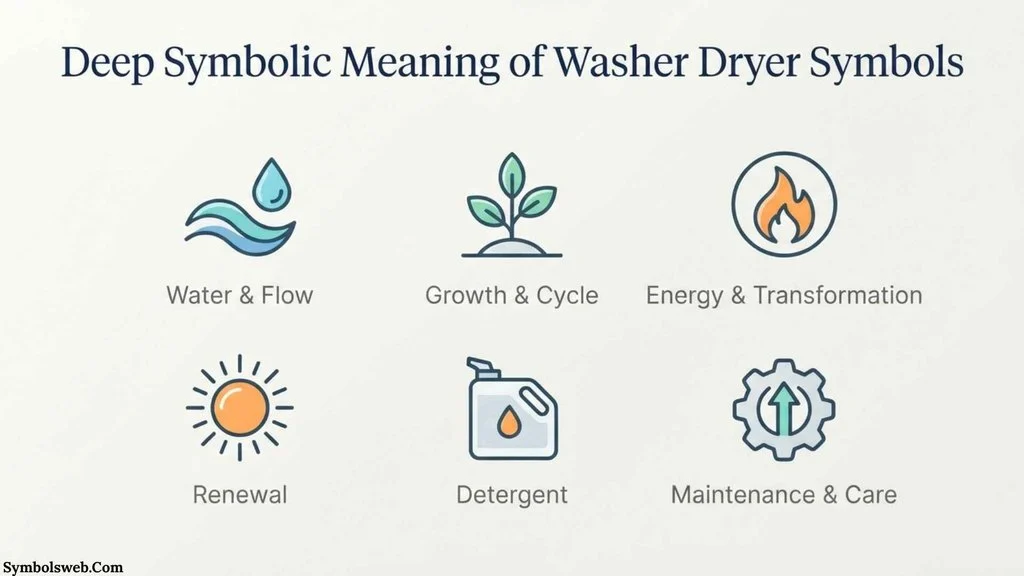
Unlike religious, mythological, or spiritual symbols, washer dryer symbols are not designed to represent beliefs or emotions. Their “symbolic meaning” is functional.
They form a visual language that turns complicated textile-care instructions into recognizable shapes.
Spiritual Level
Washer dryer symbols do not have a recognized spiritual meaning in established religious or spiritual traditions.
However, there is a useful personal lesson hidden in their everyday purpose. They remind us that different materials need different kinds of care. A strong cotton towel can tolerate treatment that would damage a delicate knitted garment.
In that practical sense, the symbols encourage careful attention rather than treating every object in the same way.
Psychological Level
People naturally look for patterns. Laundry symbols use repeated shapes, lines, dots, and crossed-out marks, which makes them easier to learn once the basic system is understood.
For example:
- A cross generally signals that something is not permitted.
- More dots generally indicate greater heat.
- Lines often indicate gentler treatment.
- A square relates to drying.
- A circle inside a square relates to tumble drying.
Once these patterns become familiar, you no longer need to memorize every individual label. You start recognizing the visual rules.
Cultural Level
Care symbols are especially useful in a world where clothing is manufactured, sold, and worn across international borders.
A person may not speak the language printed on a garment label, but a wash tub or crossed-out dryer symbol can still communicate an important instruction.
This makes laundry symbols a practical form of visual communication rather than a cultural or spiritual symbol system.
Types and Variations of Washer Dryer Symbols
The easiest way to understand washer dryer symbols is to learn the main shapes first.
Wash Tub Symbol
Visual Description: A tub or basin-shaped symbol.
Meaning: It provides washing instructions.
Symbolism: The wash tub represents washing with water.
Cultural Connection: It is part of the standardized textile-care system used across many markets.
Where It Appears: Clothing labels, bedding, towels, washable household textiles, and other fabric products.
Numbers inside the wash tub usually indicate the maximum washing temperature in degrees Celsius.
For example:
- 30°C: Wash at a maximum of 30°C.
- 40°C: Wash at a maximum of 40°C.
- 60°C: Wash at a maximum of 60°C.
- Higher temperature: Only use when the label specifically permits it.
Wash Tub With One Line
Visual Description: A wash tub with one horizontal line underneath.
Meaning: Use a milder washing process.
The line indicates reduced mechanical action compared with a normal wash.
Wash Tub With Two Lines
Visual Description: A wash tub with two horizontal lines underneath.
Meaning: Use a very gentle washing process.
This type of instruction is particularly important for delicate textiles that can be damaged by strong agitation or spinning.
Hand Wash Symbol
Visual Description: A hand inside the wash tub.
Meaning: Hand washing is required.
This instruction is commonly associated with delicate garments that should not receive the mechanical action of a standard washing machine cycle.
Do Not Wash Symbol
Visual Description: A wash tub crossed out.
Meaning: Do not wash the garment with water.
The item may require professional cleaning or another specific treatment indicated elsewhere on the label.
Tumble Dry Symbol
Visual Description: A square containing a circle.
Meaning: The garment can be tumble dried.
The square identifies drying, while the circle inside it identifies tumble drying.
Do Not Tumble Dry Symbol
Visual Description: A square containing a circle with a cross through the symbol.
Meaning: Do not place the garment in a tumble dryer.
This is one of the most important dryer symbols because excessive heat or mechanical tumbling can damage some fabrics.
Tumble Dry With One Dot
Visual Description: A square with a circle containing one dot.
Meaning: Tumble dry using a low-temperature setting.
When a dryer-safe garment is heat sensitive, this symbol tells you to choose a lower heat level.
Tumble Dry With Two Dots
Visual Description: A square with a circle containing two dots.
Meaning: Tumble dry at a medium or normal temperature according to the applicable care-label system.
Tumble Dry With Three Dots
Visual Description: A square with a circle containing three dots.
Meaning: Higher-temperature tumble drying is permitted under the relevant care-label system.
Always follow the garment’s actual label rather than assuming that a higher setting is automatically better.
No-Heat or Air Dry Symbol
Visual Description: A tumble-drying square with a solid circle.
Meaning: Use a no-heat or air-only drying process where the applicable label system uses this symbol.
This can be useful for items that tolerate tumbling but are sensitive to heat.
Dry Flat Symbol
Visual Description: A square containing a horizontal line.
Meaning: Lay the garment flat to dry.
This method can help delicate or knitted items maintain their shape.
Line Dry Symbol
Visual Description: A square containing a vertical line.
Meaning: Dry the garment by hanging or line drying.
Drip Dry Symbol
Visual Description: A square containing several vertical lines.
Meaning: Allow the garment to drip dry without aggressive wringing.
Dry in the Shade Symbol
Visual Description: A drying symbol with diagonal lines indicating shade.
Meaning: Dry away from direct sunlight.
This instruction can be especially useful for textiles that may be sensitive to sunlight or fading.
Bleach Symbol
Visual Description: A triangle.
Meaning: The triangle provides information about bleaching.
A plain triangle indicates that bleaching is permitted under the applicable care-label system.
A triangle with two diagonal lines indicates that only certain non-chlorine or oxygen-based bleaching is allowed.
A crossed-out triangle means do not bleach.
Ironing Symbol
Visual Description: An iron-shaped symbol.
Meaning: It tells you whether ironing is permitted and how much heat should be used.
Dots inside the iron indicate the permitted temperature level.
Dry Cleaning Symbol
Visual Description: A circle.
Meaning: The circle provides instructions for professional textile care.
Letters inside the circle can specify the type of solvent or process that may be used by a professional cleaner.
A crossed-out circle means the garment should not be dry cleaned.
Washer Dryer Symbols Across Different Cultures
The major washer dryer symbols are intended to communicate practical care instructions across international markets. Their value comes from standardization rather than from mythology or religion.
International Textile Care Standards
The international care-label system is associated with ISO 3758. GINETEX notes that ISO 3758:2023 is the fourth edition of the standard and replaced ISO 3758:2012.
The basic visual language remains straightforward:
- Wash tub = washing
- Triangle = bleaching
- Square = drying
- Iron = ironing
- Circle = professional textile care
This system helps reduce language barriers when garments move between countries.
North American Care Labels
North American clothing labels commonly use washing, drying, bleaching, ironing, and dry-cleaning symbols.
The ASTM care-symbol system also uses familiar concepts such as wash temperatures, tumble-drying heat levels, line drying, drip drying, dry-flat instructions, ironing temperatures, and professional cleaning instructions.
European Care Labels
European textile care labels commonly use the internationally standardized care-symbol system associated with ISO 3758.
Temperature numbers are particularly important because they communicate the maximum washing temperature in degrees Celsius.
Imported Clothing
Imported garments can sometimes appear confusing because manufacturers may use regional variations or combine symbols with written instructions.
When a symbol seems unfamiliar, the safest approach is to use the garment manufacturer’s care information and choose the gentler permitted treatment rather than guessing.
Modern Global Clothing
Today, a garment can be designed in one country, manufactured in another, sold internationally, and washed by someone thousands of miles away.
That makes visual care instructions more valuable than ever.
Similar Symbols and Their Meanings
Several washer dryer symbols look similar but communicate completely different instructions.
| Symbol Type | Main Shape | Meaning |
| Washing | Wash tub | How to wash |
| Drying | Square | How to dry |
| Tumble drying | Square with circle | Whether and how to use a dryer |
| Bleaching | Triangle | Whether bleach is allowed |
| Ironing | Iron | Whether and how to iron |
| Dry cleaning | Circle | Professional cleaning instructions |
Tumble Dry vs Dry Flat
These are easy to confuse because both belong to the drying category.
A square with a circle means tumble drying.
A square with a horizontal line means dry flat.
Tumble Dry vs Dry Clean
These symbols are especially easy to confuse when reading quickly.
A circle inside a square relates to tumble drying.
A circle by itself relates to professional dry cleaning.
The square is the clue that you are looking at a drying instruction.
One Line vs Two Lines
Lines beneath washing or drying symbols generally indicate a gentler treatment.
One line normally indicates a mild process.
Two lines indicate a very mild process.
The exact cycle available on your machine can vary by manufacturer, so the garment label should always take priority.
Washer Dryer Symbols in Mythology and Folklore
Washer dryer symbols do not have a meaningful role in ancient mythology or traditional folklore.
The symbols are modern practical communication tools rather than ancient cultural icons.
A wash tub, triangle, square, iron, and circle may look like abstract symbols, but their meanings come from textile-care standards rather than ancient myths.
This distinction matters because assigning spiritual or mythological meanings to everyday laundry icons can create misinformation.
Their real story is arguably more interesting: they represent an attempt to create a common visual language that can communicate care instructions across languages and borders.
Washer Dryer Symbols in Art, Literature, Movies and Pop Culture
Laundry symbols rarely appear as major cultural symbols in traditional art or literature. However, they have become recognizable parts of modern visual culture.
Clothing Design
Fashion labels often use the familiar care-symbol sequence to communicate washing and drying instructions without taking up much space.
Tattoos
Some people may use laundry symbols humorously in tattoos or graphic designs, especially as part of fashion, domestic-life, or pop-culture humor.
Such uses are personal and creative rather than standardized meanings.
Modern Design
Laundry symbols have influenced graphic design because their simple shapes communicate information quickly.
The wash tub, triangle, square, iron, and circle are examples of how minimal visual language can replace lengthy written instructions.
Social Media
Laundry mistakes are a common source of online humor. Shrunk sweaters, damaged clothes, and confusing care labels often become relatable social-media content.
The symbols themselves have therefore become part of everyday digital conversations about clothing care.
Spiritual and Dream Meaning of Washer Dryer Symbols
There is no established spiritual or religious interpretation of washer dryer symbols.
If someone dreams about washing clothes, drying clothes, or reading care labels, the personal meaning depends on the dreamer’s experiences and emotions rather than on an established universal symbol dictionary.
For example, someone might personally associate washing with cleaning up a difficult situation or drying with moving beyond a stressful period. That is a personal psychological interpretation, not an official meaning of laundry symbols.
It is important to separate personal symbolism from factual care-label instructions.
When you are actually doing laundry, the care label should always be interpreted literally.
Positive and Negative Meanings of Washer Dryer Symbols
Because washer dryer symbols are practical instructions, they do not have traditional positive and negative meanings.
| Positive Meaning | Negative Meaning |
| Protects clothing | Incorrect interpretation can damage clothing |
| Reduces guesswork | Confusing symbols can lead to mistakes |
| Makes care instructions easier to understand | Ignoring a symbol may cause shrinking or fading |
| Supports consistent textile care | Using excessive heat can harm some fabrics |
| Helps extend garment life | Wrong washing or drying may change shape or texture |
The same symbol can therefore have very different consequences depending on whether it is followed correctly.
Why Humans Are Attracted to Washer Dryer Symbols
At first glance, laundry symbols seem boring. Yet they demonstrate an important feature of human communication: we are very good at recognizing patterns.
Consider how quickly you learn that a cross means “do not use.”
Then you notice that dots represent heat.
Then you recognize that a line means a gentler process.
Suddenly, what looked like dozens of unrelated symbols becomes a small visual system with a few repeated rules.
Pattern Recognition
Humans naturally recognize repeated shapes and visual patterns. Standardized symbols take advantage of this ability.
Reduced Language Dependence
A visual symbol can communicate basic information without requiring a long sentence.
Memory
Once you learn the basic shapes, you can often recognize them again on different garments.
Risk Reduction
The symbols also serve a practical purpose. They help prevent mistakes that can lead to shrinking, fading, stretching, or other forms of textile damage.
Modern Uses of Washer Dryer Symbols
Washer dryer symbols are now part of everyday clothing and textile manufacturing.
Clothing Labels
The most common use is on garments. Labels may include a complete sequence of washing, bleaching, drying, ironing, and professional-care symbols.
Bedding and Towels
Household textiles also use care symbols. This helps consumers choose appropriate washing and drying methods.
Sportswear
Technical fabrics can be sensitive to heat, fabric softeners, or aggressive washing. Care labels provide important instructions for maintaining these materials.
Wool and Knitwear
Knitted garments may require gentle washing and flat drying to help maintain their shape.
Fashion and Personal Expression
The symbols can also appear in graphic design, packaging, clothing prints, and humorous artwork.
Appliance Instructions
Washing machines, dryers, and washer-dryer combinations use their own control-panel icons and programme names. These can vary by manufacturer and model.
This is an important distinction: the symbols on a clothing care label are standardized care instructions, while symbols on an appliance control panel can be manufacturer-specific.
How to Read Washer Dryer Symbols in the Correct Order
You do not need to memorize every symbol at once.
Use this simple process.
Find the Care Label
Look inside the garment for the permanent care label.
Identify the Wash Symbol
Find the wash tub.
Check whether it has a temperature number, hand symbol, lines, or a cross.
Check the Drying Symbol
Look for the square.
If there is a circle inside it, check whether tumble drying is allowed and what heat level is permitted.
Check for Air-Drying Instructions
A square with lines may indicate line drying, drip drying, dry flat, or shade drying.
Check the Bleaching Symbol
Look for the triangle.
Never assume bleach is safe simply because the garment is white.
Check the Ironing Symbol
Look for the iron symbol and count the dots if ironing is allowed.
Check Professional Cleaning Instructions
A circle provides information about professional textile care.
Follow the Most Restrictive Instruction
If one symbol says not to tumble dry, do not use the dryer even if the garment can be machine washed.
What Do the Dots Mean on Washer Dryer Symbols?
Dots generally communicate temperature intensity.
For washing, the actual temperature may be shown as a number, such as 30°C, 40°C, or 60°C.
For tumble drying and ironing, dots can indicate different heat levels.
As a general rule:
- One dot means lower heat.
- Two dots mean medium heat.
- Three dots mean higher heat.
However, always interpret the dots as part of the complete symbol rather than looking at them alone.
What Do Lines Under Washer Dryer Symbols Mean?
Lines generally indicate a gentler treatment.
A wash tub with no line normally represents a normal process.
One line indicates a milder process.
Two lines indicate a very mild process.
The same visual principle can appear with tumble-drying instructions, where lines beneath the dryer symbol indicate gentler drying processes.
What Does a Crossed Out Washer Dryer Symbol Mean?
A crossed-out symbol means that the treatment shown by the symbol should not be used.
Examples include:
- Crossed-out wash tub = do not wash.
- Crossed-out triangle = do not bleach.
- Crossed-out tumble-dry symbol = do not tumble dry.
- Crossed-out iron = do not iron.
- Crossed-out circle = do not dry clean.
The cross is therefore one of the easiest visual clues to remember.
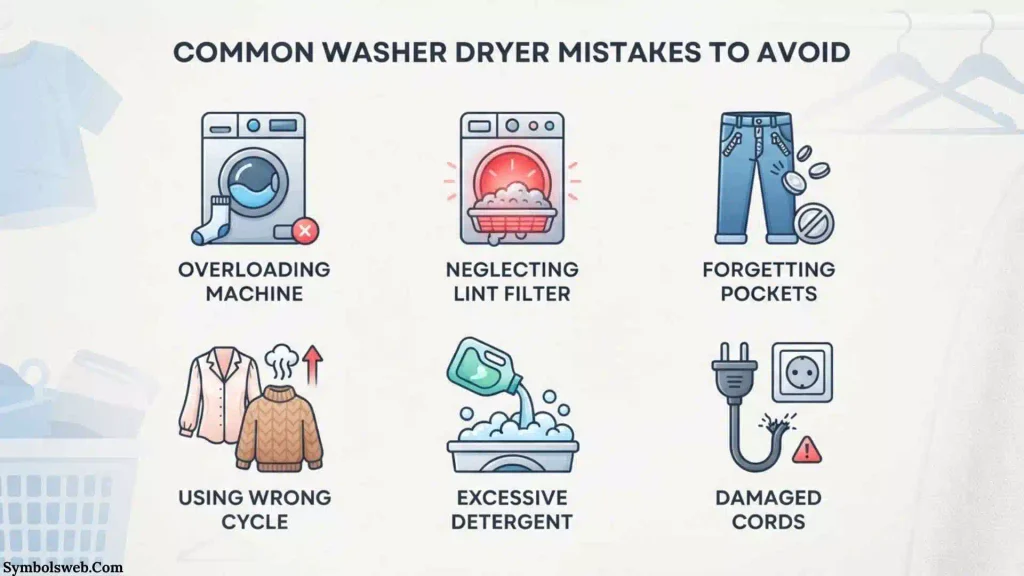
Common Washer Dryer Mistakes to Avoid
Ignoring the Dryer Symbol
A garment may be washable but not suitable for tumble drying.
Choosing the Hottest Setting
More heat is not automatically better. Excessive heat can damage fabrics or change their shape.
Treating Hand Wash as a Normal Cycle
A hand-wash instruction should not automatically be treated like an ordinary machine-wash cycle.
Ignoring Gentle-Cycle Lines
Lines under a wash tub or drying symbol are meaningful. They indicate reduced treatment.
Mixing Delicates With Heavy Items
Even if several items can technically be washed, delicate garments may be damaged by rubbing against heavier items.
Assuming Every Machine Uses the Same Programme Names
Washer and dryer programmes differ between brands and models. The clothing care label tells you what the textile can tolerate, while the appliance manual explains how your specific machine achieves that treatment.
Interesting Facts About Washer Dryer Symbols
- The wash tub represents washing, while the square is the basic symbol for drying.
- A circle inside a square means tumble drying. The square identifies drying and the circle identifies the tumble-drying process.
- Dots can indicate heat levels. More dots generally mean a higher permitted temperature.
- Lines can indicate gentler treatment. One or two lines can change how carefully a garment should be processed.
- A triangle is associated with bleaching. Its variations tell you whether bleaching is allowed and what type may be used.
- A circle is associated with professional textile care. Letters inside the circle can provide additional instructions for professional cleaners.
- The ISO 3758 standard has been revised over time. ISO 3758:2023 replaced the 2012 edition.
- Care labels indicate permitted treatment, not guaranteed cleaning results. Following a label does not guarantee that every stain will disappear.
- Lower temperatures are generally permitted when the label specifies a maximum temperature. A maximum temperature is not a command to use that exact temperature.
- Appliance symbols and clothing-label symbols are not always the same thing. Your washer or dryer may have manufacturer-specific icons that should be explained in its user manual.
Frequently Asked Questions
What is the symbol for tumble drying?
The tumble-drying symbol is a square with a circle inside it. If the symbol is crossed out, the garment should not be tumble dried.
What does a square with a circle mean on clothes?
A square containing a circle means the garment can be tumble dried. Dots inside the circle provide information about the permitted drying temperature.
What does a crossed-out dryer symbol mean?
A crossed-out dryer symbol means the garment should not be tumble dried. Use the appropriate air-drying method shown on the care label instead.
What do the dots mean on laundry symbols?
Dots generally indicate heat level. One dot represents lower heat, two dots represent medium heat, and three dots represent higher heat where that symbol system applies.
What does a wash tub with a number mean?
The number inside the wash tub indicates the maximum washing temperature in degrees Celsius. For example, 30 means the garment should be washed at no more than 30°C.
Are washer dryer symbols universal?
The major care symbols are standardized and designed to communicate textile-care instructions internationally, but details and appliance-control symbols can vary by country, manufacturer, and model. When in doubt, check the garment label and the appliance manual.
Conclusion
Washer dryer symbols are much more than confusing little pictures on clothing labels. They form a practical visual language that tells you how to wash, dry, bleach, iron, and care for textiles safely.
Once you understand the basic shapes, the system becomes surprisingly simple. Wash tubs describe washing, squares describe drying, circles inside squares describe tumble drying, dots show heat levels, and crossed out symbols warn you not to use a particular treatment.
The best habit is to read the complete care label before starting a load, especially when a garment is delicate, expensive, or unfamiliar.A few seconds spent understanding these symbols can save your favorite clothes from shrinking, fading, stretching, or other avoidable damage.

Eliana Foster is a writer with a passion for exploring the meanings behind symbols, traditions, and cultural history. She enjoys breaking down complex topics into simple, engaging articles that are easy for everyone to understand. Eliana is also the fictional author of The Hidden Language of Silent Marks and Beyond the Circle of Ancient Signs, two original book concepts created for her author profile. When she’s not writing, she loves visiting museums, reading about mythology, and researching the stories behind symbols from around the world. Her goal is to help readers discover the fascinating meanings hidden in everyday signs and ancient emblems.
 Jordan Hayes
 Ethan Holloway