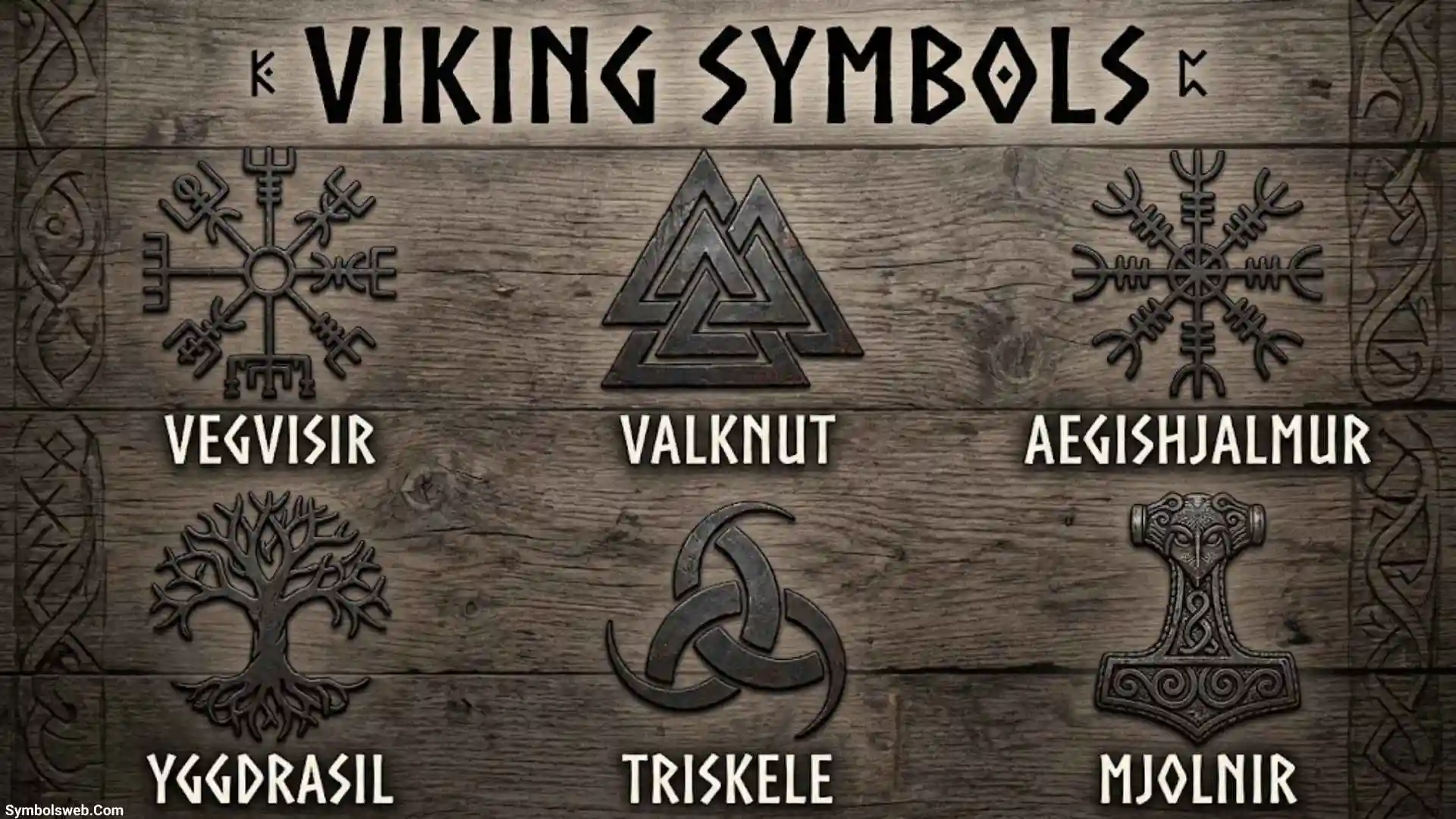
Viking symbols offer a fascinating look into the history, beliefs, and daily lives of the Norse people. From powerful runes carved into stones to Thor’s hammer and the world tree Yggdrasil, these symbols connect us with ancient Scandinavian culture. Today, people use them in jewelry, tattoos, artwork, and personal designs because of their historical meanings and connections to Norse mythology.
However, not every symbol commonly called a Viking symbol originated during the Viking Age. Some have clear historical evidence, while others come from later Icelandic traditions or modern interpretations. Understanding these differences helps you appreciate their original meaning instead of relying on popular myths.
In this guide, you’ll discover the most recognizable Viking symbols, explore Viking rune meanings, learn about the ancient runic alphabets, and understand how Norse symbols are interpreted today.
What Are Viking Symbols?
Viking symbols are signs, designs, and images associated with Viking Age Scandinavia, Norse mythology, and the wider Germanic cultural world. They appeared on weapons, jewelry, tools, memorial stones, ships, and other objects.
Some symbols represented gods, legendary creatures, or religious beliefs. Others were decorative designs or practical writing marks. Their meaning depended on the historical period, the object, and the people who used them.
Common examples include:
- Runes: Characters used in ancient Germanic writing systems.
- Mjölnir: Thor’s hammer, associated with the thunder god.
- Yggdrasil: The world tree in Norse mythology.
- Valknut: A design consisting of three interlocking triangles.
- Huginn and Muninn: Odin’s two ravens.
- Viking ships: Images connected to seafaring, exploration, trade, and warfare.
These symbols remain popular because they connect people with Norse history, mythology, and traditional craftsmanship.
Viking Symbols vs. Norse Symbols
The terms Viking symbols and Norse symbols are often used interchangeably, but they do not mean exactly the same thing.
The word Viking usually refers to people who participated in seaborne expeditions, raiding, trading, and exploration during the Viking Age. The term Norse refers more broadly to the people, language, culture, and mythology of medieval Scandinavia.
For example, a Viking ship design reflects the maritime world of the Viking Age. Yggdrasil belongs to Norse mythology, which includes religious traditions and stories that developed over a longer period.
Understanding this difference helps you identify whether a design represents a historical object, a mythological idea, or a modern interpretation.
How Historians Identify Authentic Viking Symbols
Historians study archaeological discoveries, runic inscriptions, surviving objects, medieval literature, and comparisons between different historical sources.
A symbol found on a Viking Age object provides stronger evidence of historical use during that period than a design documented only in a much later manuscript.
When researching a symbol, consider three questions:
- Where was it found? Its archaeological location may help establish its age and cultural context.
- When was it created? A symbol from medieval Iceland may not date to the Viking Age.
- What evidence explains its meaning? An inscription or historical account may provide more reliable information than a modern interpretation.
This approach is especially useful when researching Viking tattoos, rune jewelry, and symbols associated with protection or spiritual power.
Viking Runes and Their Historical Meanings
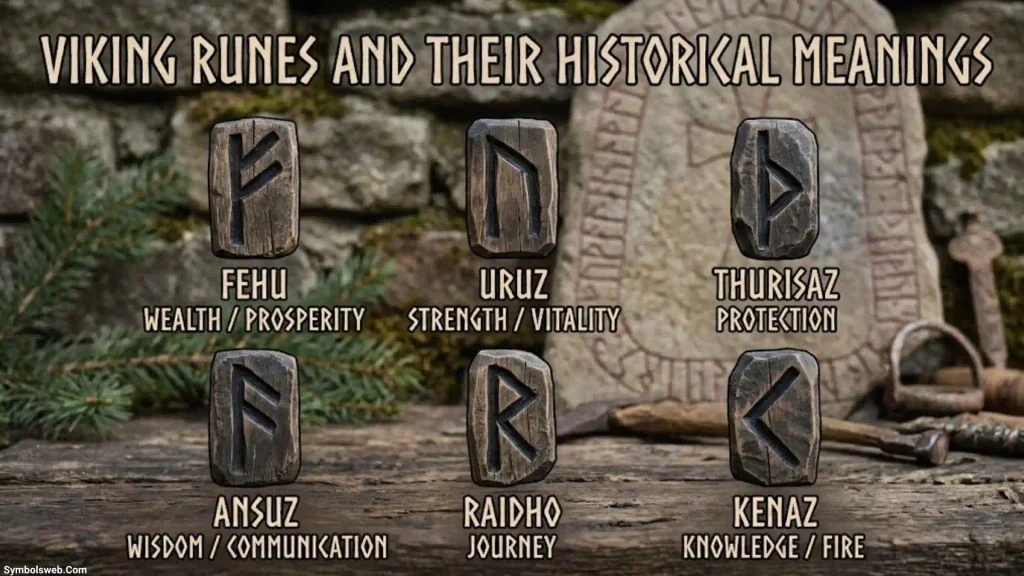
Viking runes were characters used for writing in early Germanic and Scandinavian societies. They were carved into materials such as wood, stone, bone, metal, and horn.
Runes are often presented today as mysterious spiritual symbols. Although some runic inscriptions and historical accounts suggest that runes could have ritual or magical associations, their primary documented role was writing.
The meaning of an individual rune could depend on its sound, name, context, and historical period. A modern symbolic interpretation should not automatically be treated as the meaning understood by every Viking.
What Is the Runic Alphabet Called?
The runic alphabet is commonly called the futhark, a name formed from the sounds represented by its first six characters.
Two major runic systems are particularly important:
- Elder Futhark: An alphabet of 24 characters used by Germanic peoples before the Viking Age and during its early historical background.
- Younger Futhark: A 16-character system used in Scandinavia during the Viking Age.
The Elder Futhark appeared in inscriptions from approximately the second century CE. The Younger Futhark developed later and became the main runic writing system in Viking Age Scandinavia.
These alphabets were not simply collections of mystical signs. They were writing systems that helped people record names, messages, memorials, and other information.
What Were Viking Runes Used For?
Runes served several practical purposes in Norse society. Their use depended on the available material, the writer, and the purpose of the inscription.
Common uses included:
- Memorial inscriptions: Remembering people who had died.
- Personal names: Marking ownership or identifying individuals.
- Messages: Communicating information on portable objects.
- Objects and tools: Inscribing items such as combs, weapons, and other everyday possessions.
- Public records: Carving messages or commemorative statements into stones.
- Religious or ritual contexts: Using written characters in settings where religious beliefs or magical practices may have played a role.
Runestones are among the best-known examples of Scandinavian runic writing. Many commemorate individuals, describe family relationships, or record achievements. Runes also appeared on smaller objects, showing that writing was not limited to large monuments.
Were Viking Runes Used for Magic or Divination?
Some historical evidence connects runes with magic and ritual practices. However, it is difficult to establish exactly how widespread these practices were or what people believed each rune could accomplish.
Modern rune divination often assigns individual runes meanings related to personal growth, relationships, challenges, and future possibilities. These interpretations can be meaningful within contemporary spiritual practices, but they should not be confused with proven Viking Age rules for predicting the future.
If you want to explore rune symbolism, separate three things: the rune’s historical use as a written character, evidence of historical ritual practices, and meanings developed in modern spiritual traditions.
Elder Futhark vs. Younger Futhark
The Elder and Younger Futhark are two important stages in the development of runic writing. Their differences matter because a rune’s name, shape, and sound can change across historical periods.
Elder Futhark: The 24-Rune Alphabet
The Elder Futhark contains 24 runes and was used by Germanic peoples during the centuries before the Viking Age and into its early period.
Researchers generally group its characters into three sets of eight, often called ættir. The system appears in early runic inscriptions across parts of northern and central Europe.
Modern rune charts frequently use Elder Futhark because it has 24 distinct characters and is widely discussed in contemporary rune symbolism.
However, not every meaning found in a modern Elder Futhark chart is historically established. Some rune names are known from later traditions, while others are reconstructed using linguistic evidence.
Younger Futhark: The 16 Runes of the Viking Age
The Younger Futhark contains 16 runes and was used extensively in Scandinavia during the Viking Age.
Although Old Norse had many distinct sounds, the Younger Futhark used fewer characters than the Elder Futhark. As a result, a single rune could represent more than one sound.
This makes historical runic interpretation more complicated than matching each character with one modern letter.
Younger Futhark inscriptions are especially important when studying Viking Age Scandinavia because they appear on runestones and everyday objects from that period.
How to Read a Viking Rune Chart
A Viking rune chart can help you recognize individual characters, but you should check which runic system it presents.
Use these guidelines when reading a chart:
- Identify whether it shows Elder Futhark, Younger Futhark, or medieval runes.
- Check the rune’s historical form instead of relying only on a modern decorative version.
- Distinguish the rune’s sound from its traditional name.
- Treat symbolic meanings as interpretations unless historical evidence supports them.
- Avoid assuming that a rune translates directly into a complete modern word or sentence.
These steps are especially helpful when choosing a rune for a necklace, engraving, or tattoo.
Popular Viking Rune Meanings and Symbolism
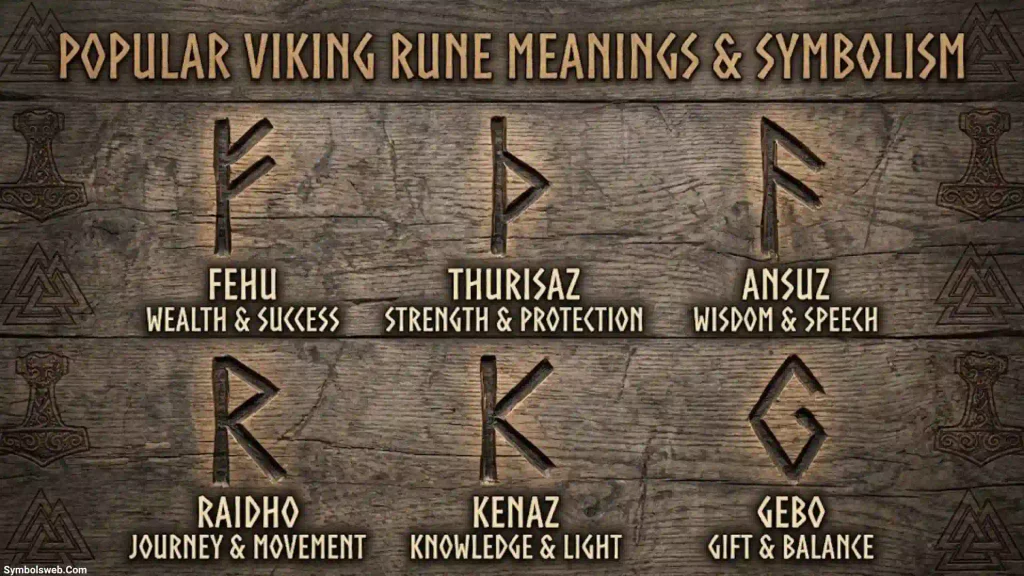
Many people explore rune meanings to understand Norse history or select symbols that reflect personal values. The following examples combine historical information about rune names with clearly identified modern associations.
Fehu (ᚠ): Cattle and Wealth
Fehu is associated with cattle, a valuable form of movable wealth in early Germanic societies. Its name connects it with property and resources.
In modern rune interpretations, Fehu commonly represents wealth, abundance, prosperity, and the responsible management of resources.
You might choose Fehu as a reminder to value your work, develop your skills, or manage your resources wisely. However, the idea that wearing Fehu guarantees financial success is a modern belief, not an established historical fact.
Algiz (ᛉ): Modern Protection Symbolism
Algiz is frequently associated with protection in contemporary rune charts and spiritual practices.
Its exact historical interpretation requires care. The familiar modern meaning of Algiz as a universal protective rune should not be treated as a proven belief shared by all Vikings.
Today, people may use this rune as a personal reminder of safety, awareness, boundaries, or resilience. If you choose it for jewelry or artwork, understand that its contemporary symbolism is distinct from what can be firmly established about its ancient use.
Ansuz (ᚨ): The Divine and Communication
Ansuz is associated with a word related to a deity in early Germanic linguistic traditions. In modern symbolic interpretations, it is often connected with communication, wisdom, inspiration, and learning.
People may use Ansuz to represent the importance of thoughtful speech, listening, or seeking knowledge.
These associations can provide a modern personal meaning, but they should not be treated as a complete historical description of how every Norse person understood the rune.
Raidho (ᚱ): Riding and Journeys
Raidho is connected with riding or travel in traditional rune-name interpretations.
Modern rune guides often expand this idea to include journeys, direction, movement, and personal progress. It may represent a physical trip or the effort required to move through a major life change.
If travel is an important part of your life, Raidho can serve as a personal symbol of exploration. Its historical name, however, does not prove that Vikings used it as a universal charm for safe journeys.
Tiwaz (ᛏ): The God Týr
Tiwaz is associated with the Germanic god Týr through its name and historical linguistic connections.
Modern interpretations often connect it with courage, duty, justice, discipline, and victory. These ideas are partly influenced by later knowledge of Týr and broader Germanic traditions.
For a personal design, Tiwaz may represent keeping your promises or standing firm during difficult situations. The exact symbolic meaning should still be understood within its historical and modern contexts.
Ehwaz (ᛖ): The Horse
Ehwaz is associated with the horse. Horses played important roles in transportation, farming, warfare, and cultural life across early Germanic societies.
Modern rune interpretations often connect Ehwaz with movement, partnership, trust, and cooperation. These ideas draw on the relationship between a horse and its rider.
You may find this symbolism useful when representing teamwork or progress. However, the modern list of personal meanings is broader than what the rune’s name alone can establish.
Berkano (ᛒ): The Birch Rune
Berkano is traditionally associated with the birch tree. In modern rune symbolism, it is often connected with growth, renewal, birth, and new beginnings.
People may use it to represent a fresh chapter, personal development, or the care needed to nurture a project.
These contemporary meanings are influenced by the rune’s traditional name and later interpretations. They should not be presented as a single, universally documented Viking belief.
Other Elder Futhark Runes and Their Names
The following table provides a quick reference to the remaining Elder Futhark characters. Historical rune names and linguistic associations are not the same as modern spiritual meanings.
| Rune | Traditional name | Common association |
| ᚢ | Uruz | Aurochs or wild ox |
| ᚦ | Thurisaz | Giant or powerful being |
| ᚷ | Gebo | Gift |
| ᚹ | Wunjo | Joy |
| ᚺ | Hagalaz | Hail |
| ᚾ | Nauthiz | Need or constraint |
| ᛁ | Isa | Ice |
| ᛃ | Jera | Year or harvest |
| ᛇ | Eihwaz | Yew; interpretation is debated |
| ᛈ | Perthro | Meaning remains uncertain |
| ᛊ | Sowilo | Sun |
| ᛗ | Mannaz | Human or person |
| ᛚ | Laguz | Water or lake |
| ᛜ | Ingwaz | Associated with Ing |
| ᛟ | Othala | Inherited property or ancestral estate |
| ᛞ | Dagaz | Day |
These associations are useful starting points for research. They do not mean that every rune had a fixed spiritual function or that every modern interpretation has been confirmed by historical evidence.
Other Important Viking Symbols and Their Meanings
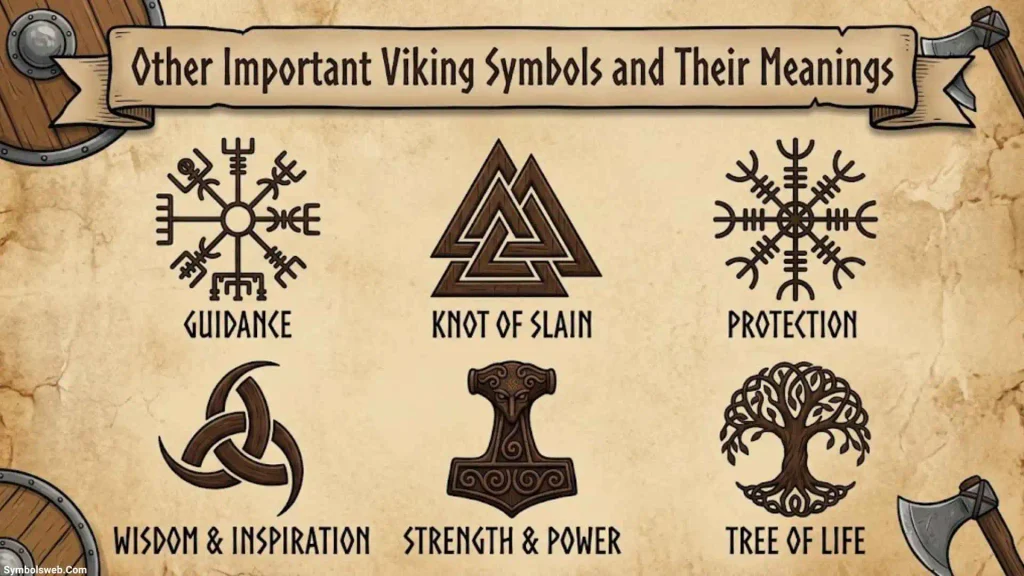
Runes are only one part of Norse symbolism. Mythological stories, animal imagery, weapons, and decorative patterns also help people explore Viking Age culture and the wider Norse world.
Mjölnir: Thor’s Hammer
Mjölnir is the hammer belonging to Thor, the Norse god associated with thunder. It is one of the most recognizable objects in Norse mythology.
In mythological stories, Thor uses his hammer against giants and other threats. Hammer-shaped pendants also appear in the archaeological record, including examples associated with the Viking Age.
Today, Mjölnir is commonly associated with strength, protection, courage, and connections to Norse heritage. Its historical and mythological significance makes it a popular choice for pendants, rings, and other designs.
A hammer pendant may reflect an interest in Thor, Norse mythology, or Scandinavian history. The meaning depends on the wearer rather than on one universal modern interpretation.
Valknut: The Interlocking Triangles
The Valknut is a design made of three interlocking triangles. It appears in some Scandinavian archaeological contexts and is often discussed in connection with Odin and death-related imagery.
However, its original name and exact meaning are not securely established by surviving Viking Age evidence. The term Valknut is a modern label.
Today, people commonly interpret the design through themes of Odin, the afterlife, warriors, and the relationship between life and death. These interpretations should be distinguished from what historians can prove about its original purpose.
Yggdrasil: The World Tree
Yggdrasil is the great tree described in Norse mythology. It connects different parts of the mythological cosmos and plays an important role in stories about gods, beings, and the structure of existence.
Modern designs often use Yggdrasil to represent connection, life, growth, balance, and the relationship between different parts of the world.
It is popular in artwork, pendants, and tattoos because the tree provides a visual way to express interconnectedness. These modern personal meanings draw on its mythological role but may extend beyond the details found in historical sources.
Huginn and Muninn: Odin’s Ravens
Huginn and Muninn are the two ravens associated with Odin. In Norse mythological literature, they travel through the world and bring information back to him.
Their names are commonly translated as Thought and Memory. Together, they are often interpreted as representing observation, knowledge, reflection, and the importance of remembering.
Modern artwork featuring Odin’s ravens may symbolize curiosity, wisdom, or a desire to understand the world. Their mythological connection makes them recognizable motifs in Norse-inspired jewelry and art.
Wolves and Their Connections to Norse Mythology
Wolves appear in several important Norse myths. Fenrir, a powerful wolf, plays a significant role in stories about the gods and Ragnarök, the events associated with the end of the mythological world order.
Wolves in modern Norse-inspired designs may represent strength, independence, loyalty, or untamed power. These meanings vary according to the story or design being referenced.
If you want a wolf symbol with a clear mythological connection, learning about Fenrir can help you distinguish that reference from generic wolf imagery.
Viking Ships and Serpent Motifs
Viking ships were essential to travel, trade, exploration, and warfare. Their construction allowed Scandinavian sailors to navigate coastal waters, rivers, and open seas.
Ship imagery therefore provides a strong connection to the practical history of the Viking Age. It can represent exploration or maritime heritage in modern designs.
Serpent and dragon-like motifs also appear in Norse art. Their meanings depend on the specific design and context, so it is better not to assign one universal symbolic meaning to every serpent-shaped carving.
Gungnir: Odin’s Spear
Gungnir is the spear associated with Odin in Norse mythology. It appears in stories about the god and his role in the mythological world.
Modern interpretations may connect the spear with authority, resolve, strategy, or the pursuit of knowledge. These are contemporary associations rather than a definitive list of historical meanings.
Gungnir can be a suitable reference for people interested in Odin and Norse mythological objects, especially when the design clearly reflects the traditional spear.
Vegvísir and the Helm of Awe: Are They Viking Age Symbols?
Vegvísir and the Helm of Awe are frequently marketed as ancient Viking symbols. Their historical origins, however, require a closer look.
Vegvísir is commonly described today as a wayfinding or protection symbol. Its documented appearance comes from later Icelandic magical material, rather than securely established Viking Age evidence.
The Helm of Awe, often called Ægishjálmur, is also associated with Icelandic magical traditions recorded in later sources. Its familiar modern graphic should not automatically be treated as a Viking Age emblem.
Both symbols have become popular in modern Norse-inspired artwork and tattoos. If historical accuracy matters to you, distinguish their later documented history from the Viking Age.
Viking Runes for Protection, Strength, Wealth, and Wisdom
Modern rune guides often connect particular runes with personal goals. These interpretations can help you choose a meaningful design, but they are not all confirmed descriptions of historical Viking beliefs.
Which Rune Is Associated With Protection?
Algiz is widely associated with protection in contemporary rune symbolism. People may use it to represent awareness, safety, or personal boundaries.
Mjölnir is another option if you want a symbol with a stronger connection to Norse mythology and historical pendants. Its association with Thor provides a clear mythological context, although modern protective meanings should still be understood as interpretations.
Which Rune Is Associated With Wealth and Prosperity?
Fehu is the rune most commonly associated with wealth in modern rune guides because its name is linked to cattle and movable property.
Its historical background makes it a relevant choice for a design about resources, prosperity, or the value of hard work. It does not guarantee financial success.
Which Rune Is Associated With Courage and Victory?
Tiwaz is often associated with courage, duty, and victory in modern interpretations. Its connection with Týr makes it relevant to people interested in Norse mythology and Germanic traditions.
If you choose Tiwaz, consider whether its associations with discipline and responsibility reflect what you want the symbol to represent.
Which Rune Is Associated With Wisdom?
Ansuz is frequently linked to communication, inspiration, and wisdom in modern rune symbolism. Odin is another important mythological reference when exploring knowledge and the pursuit of understanding.
Odin’s ravens, Huginn and Muninn, provide a separate mythological design associated with thought and memory.
Which Rune Is Associated With Travel and New Beginnings?
Raidho is commonly connected with riding and journeys, while Berkano is associated with the birch tree and is interpreted in modern settings as a symbol of growth and renewal.
For a travel-related design, Raidho offers a connection to a traditional rune name. For a design representing a fresh start, Berkano may fit your intended modern interpretation.
| Personal theme | Common modern choice | Historical context |
| Protection | Algiz or Mjölnir | Algiz has modern protective associations; Mjölnir belongs to Norse mythology and appears in historical pendants |
| Wealth | Fehu | Associated with cattle and movable wealth |
| Courage | Tiwaz | Connected with the Germanic god Týr |
| Wisdom | Ansuz or Huginn and Muninn | Ansuz has linguistic links to a deity; the ravens belong to Odin’s mythology |
| Travel | Raidho | Associated with riding |
| Growth | Berkano | Associated with the birch tree |
| Memory and thought | Huginn and Muninn | Odin’s two ravens in Norse mythology |
| Heritage | Mjölnir or a historically appropriate runic inscription | Choices depend on the specific cultural or historical connection |
Viking Rune Jewelry and Its Symbolism
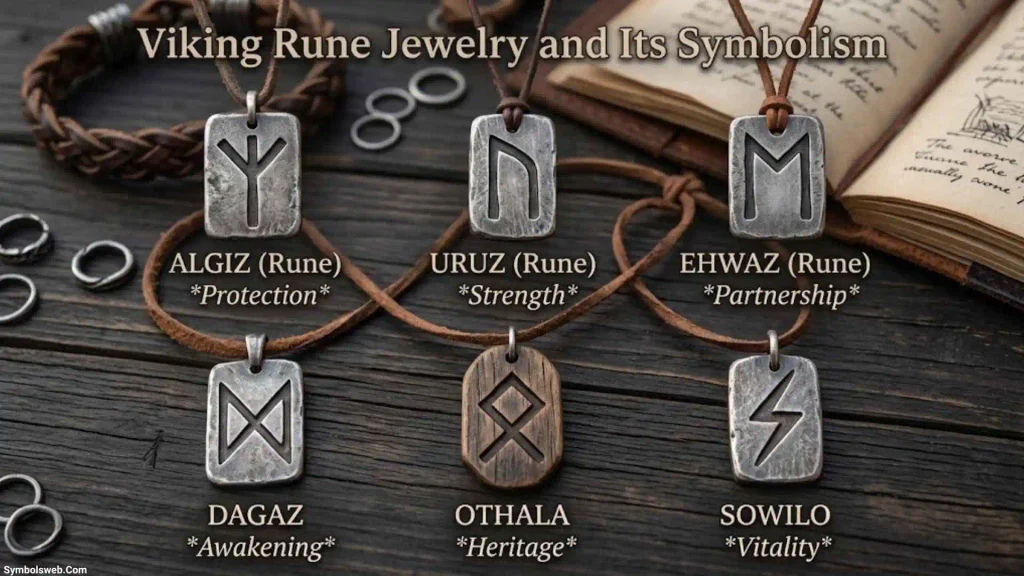
Viking rune jewelry combines decorative design with historical, mythological, or personal meaning. Necklaces, pendants, rings, and bracelets often feature individual runes, inscriptions, hammer designs, or other Norse-inspired motifs.
When choosing jewelry, consider the source of the symbol and the meaning you want it to carry.
Viking Rune Necklaces and Pendants
Rune necklaces often feature a single character or a short inscription. Mjölnir pendants are also popular because of their connection to Thor and their presence in the archaeological record.
Before buying a pendant, check whether the design is based on a historical artifact or a modern interpretation. Some pieces use authentic-looking shapes but combine symbols from different periods.
If you want an inscription rather than a decorative rune, verify the spelling and runic system. A modern English word cannot always be converted into historically accurate runes simply by replacing each letter with a character from an online chart.
Rune Rings, Bracelets, and Earrings
Rings and bracelets may feature runic borders, individual characters, or mythological designs. Earrings may use smaller runes or recognizable motifs such as ravens and hammers.
These pieces can be meaningful reminders of your interests, values, or family heritage. Their significance depends on the accuracy of the design and your reasons for choosing it.
How to Choose a Rune for Jewelry
Start by deciding what you want the jewelry to represent.
- Choose a historical inscription if you value documented language and craftsmanship.
- Choose a mythological motif if you are interested in a particular Norse god or story.
- Choose a rune based on its traditional name if you want a link to early Germanic language.
- Treat modern spiritual interpretations as personal symbolism rather than proven historical facts.
- Ask the seller about the source of the design if historical accuracy is important.
Historical Rune Jewelry vs. Modern Designs
Historical jewelry can provide evidence of how people made and wore objects during the Viking Age. Modern jewelry, on the other hand, may combine authentic motifs with contemporary spiritual meanings or decorative choices.
Neither approach automatically makes a piece more meaningful. The important distinction is whether the seller accurately describes the design and its history.
A modern necklace inspired by Norse mythology can be a thoughtful choice without being advertised as an exact Viking Age artifact.
Viking Rune Tattoos and Their Meanings
Viking-inspired tattoos often feature runes, Mjölnir, Yggdrasil, ravens, wolves, and other Norse mythological designs.
A tattoo can express your personal connection to history, mythology, family heritage, or a particular value. However, the meaning of a symbol should be researched before it becomes a permanent part of your body.
Popular Viking Rune Tattoo Designs
Popular designs include individual runes, runic inscriptions, combinations of characters, and larger mythological scenes.
Fehu may be chosen for its connection to wealth, while Tiwaz is often selected for its modern associations with courage and duty. Mjölnir and Yggdrasil offer mythological imagery without requiring a runic translation.
Before choosing a design, identify the historical period and source. A tattoo described as an ancient Viking symbol may actually come from a later Icelandic manuscript or a contemporary artist’s interpretation.
How to Check a Rune Tattoo for Historical Accuracy
Follow these steps before finalizing a design:
- Identify the runic system used in the tattoo.
- Verify the individual characters against a reliable reference.
- Check the original spelling if the design contains a word or sentence.
- Confirm whether the symbol belongs to the Viking Age or a later period.
- Ask the artist to explain any combined or modified characters.
- Avoid relying on social media graphics as your only source.
Historical accuracy matters most when you want the tattoo to represent a specific culture, inscription, or period.
Choosing a Rune Tattoo for Personal Meaning
Think about the message you want the design to express. You may prefer a historical inscription, a mythological image, or a rune whose traditional name connects with your interests.
You can also combine a rune with other artwork, but make sure the elements come from compatible historical contexts if authenticity is important to you.
Remember that the meaning you give a tattoo today may be personal rather than identical to the meaning understood by people in the Viking Age.
What Are Bindrunes?
A bindrune is a design formed by combining two or more runic characters into a single figure. In some historical inscriptions, runes were joined for practical or stylistic reasons.
Modern spiritual and decorative designs often use bindrunes to combine selected runes into a symbol representing a personal goal or intention.
However, not every modern bindrune has a historical example, and there is no universal system that guarantees a specific result from combining runes.
Historical Bindrunes vs. Modern Bindrune Designs
Historical bindrunes can appear in inscriptions where characters share strokes or are combined within a word. Their purpose depends on the inscription and its context.
Modern bindrunes may be created by combining characters chosen for their contemporary symbolic meanings. These designs can be artistic or personally meaningful, but they should not automatically be described as traditional Viking magical symbols.
How Combined Runes Are Interpreted Today
A modern design might combine Fehu with a rune selected for a different personal theme. The creator may interpret the combination as representing prosperity and personal growth.
That interpretation belongs to the design’s modern symbolic framework. It is not proof that Vikings used the same combination for that purpose.
What to Check Before Using a Bindrune
Before using a bindrune for jewelry or a tattoo, identify each character and confirm its form. Check whether the combination is documented historically or was created recently.
If the design includes an inscription, make sure the characters form the intended text. A decorative combination of runes does not necessarily spell a meaningful word.
How to Choose and Use Viking Symbols Respectfully
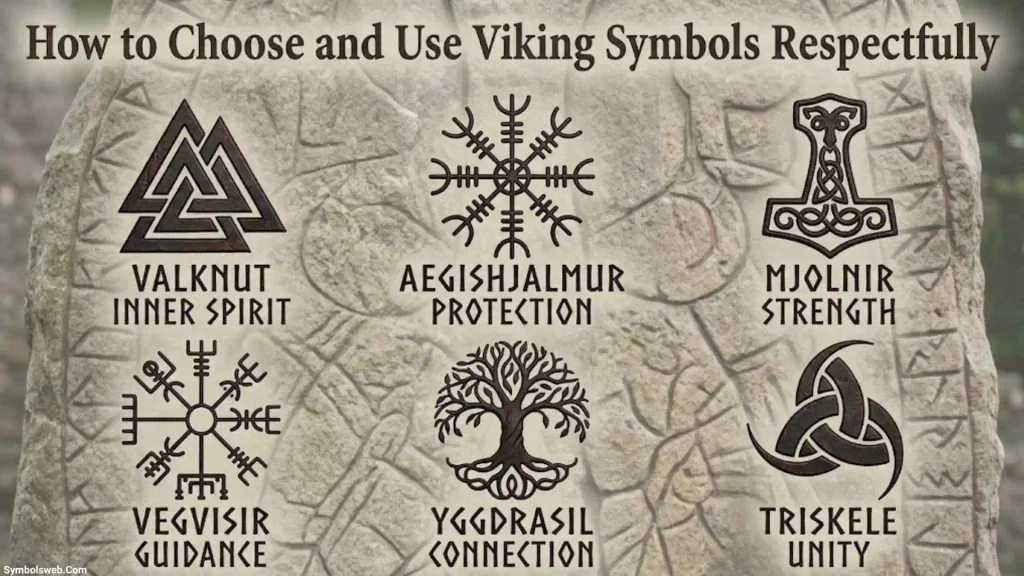
Viking symbols can help you explore history and mythology, but accurate research matters. Symbols often have different meanings across historical periods, and modern interpretations may not match the original context.
How to Research a Rune’s Original Form
Start with reputable museums, university research, archaeological publications, and specialist runology resources.
Look for photographs or drawings of actual inscriptions and compare them with modern charts. Pay attention to the date, location, material, and writing system.
If a source claims that a rune guarantees wealth, protection, or success, check whether that claim comes from historical evidence or contemporary spiritual interpretation.
How to Choose Between a Rune and a Mythological Symbol
Choose a rune if you are interested in early Germanic writing, traditional rune names, or an inscription with a specific historical connection.
Choose a mythological symbol if you want to reference a Norse god, story, creature, or part of the mythological cosmos.
For example, Mjölnir directly references Thor’s hammer, while Fehu connects with a traditional rune name associated with cattle. Both can be meaningful, but they represent different aspects of Norse-related culture.
Common Mistakes When Using Viking Symbols
Avoid these common errors when researching or choosing a design:
- Calling every Norse-inspired symbol a Viking Age artifact.
- Treating all modern rune meanings as historically proven.
- Confusing Elder Futhark with Younger Futhark.
- Assuming that a rune always represents one fixed English word.
- Describing Vegvísir or the familiar Helm of Awe graphic as securely documented Viking Age symbols.
- Assuming that every bindrune has an established historical meaning.
- Using an inscription without checking its spelling and historical context.
Taking time to research a symbol helps you make a more informed choice and better understand the culture behind it.
Frequently Asked Questions About Viking Symbols
What Are the Most Famous Viking Symbols?
Some of the best-known symbols associated with Viking and Norse culture include Mjölnir, Yggdrasil, the Valknut, Odin’s ravens, Viking runes, and serpent or dragon motifs. Their historical evidence and meanings differ, so each symbol should be studied individually.
What Do Viking Runes Mean?
Runes were characters in historical writing systems. Their names may connect with concepts such as cattle, ice, hail, riding, or day. Modern rune guides often assign additional meanings related to protection, wealth, wisdom, or personal growth, but these interpretations are not all confirmed as Viking Age beliefs.
Did Vikings Use the Elder Futhark?
The Elder Futhark was used by Germanic peoples before the Viking Age and during its earlier historical background. By the Viking Age, Scandinavians primarily used the Younger Futhark, which had 16 characters rather than 24.
Did Vikings Use Runes for Protection?
Some historical evidence connects runes with ritual and magical practices, but the exact extent and nature of those practices remain difficult to establish. Modern claims that particular runes universally guarantee protection should not be treated as proven historical facts.
Are Vegvísir and the Helm of Awe Ancient Viking Symbols?
Their familiar modern designs are associated with later Icelandic magical traditions. They are popular in modern Norse-inspired artwork, but they should not automatically be described as symbols documented during the Viking Age.
Can You Combine Different Viking Runes?
Yes, you can combine runes in modern artwork, jewelry, or bindrune designs. However, you should verify each character and understand whether the combination has historical evidence or is a modern creation.
How Can You Tell Whether a Viking Symbol Is Historically Authentic?
Check its archaeological context, date, original inscription, and appearance in reliable historical sources. Museum collections and university research are useful starting points. Be cautious when a design is described as ancient without supporting evidence.
Conclusion
Viking symbols provide a valuable way to explore Scandinavian history, runic writing, and Norse mythology. Runes reveal how people communicated, while symbols such as Mjölnir, Yggdrasil, and Odin’s ravens connect us with stories about gods and the mythological world. Their meanings depend on historical context, surviving evidence, and later interpretations.
When you choose a Viking symbol for jewelry, a tattoo, or personal artwork, research its origins before deciding what it represents. By distinguishing historical facts from modern symbolism, you can appreciate these designs more deeply and use them with a clearer understanding of their cultural background.

Jordan Hayes is a writer with a passion for exploring the history, meanings, and cultural significance behind symbols from around the world. He enjoys turning complex topics into clear, engaging content that anyone can understand. Jordan is also the fictional author of The Silent Language of Ancient Marks and Hidden Symbols Beyond the Surface, two original book concepts created for his author profile. When he’s not writing, he spends time researching myths, traditions, and forgotten stories that inspire his work. His goal is to help readers discover the deeper meanings behind the symbols they encounter every day.
 Eliana Foster
 Ethan Holloway