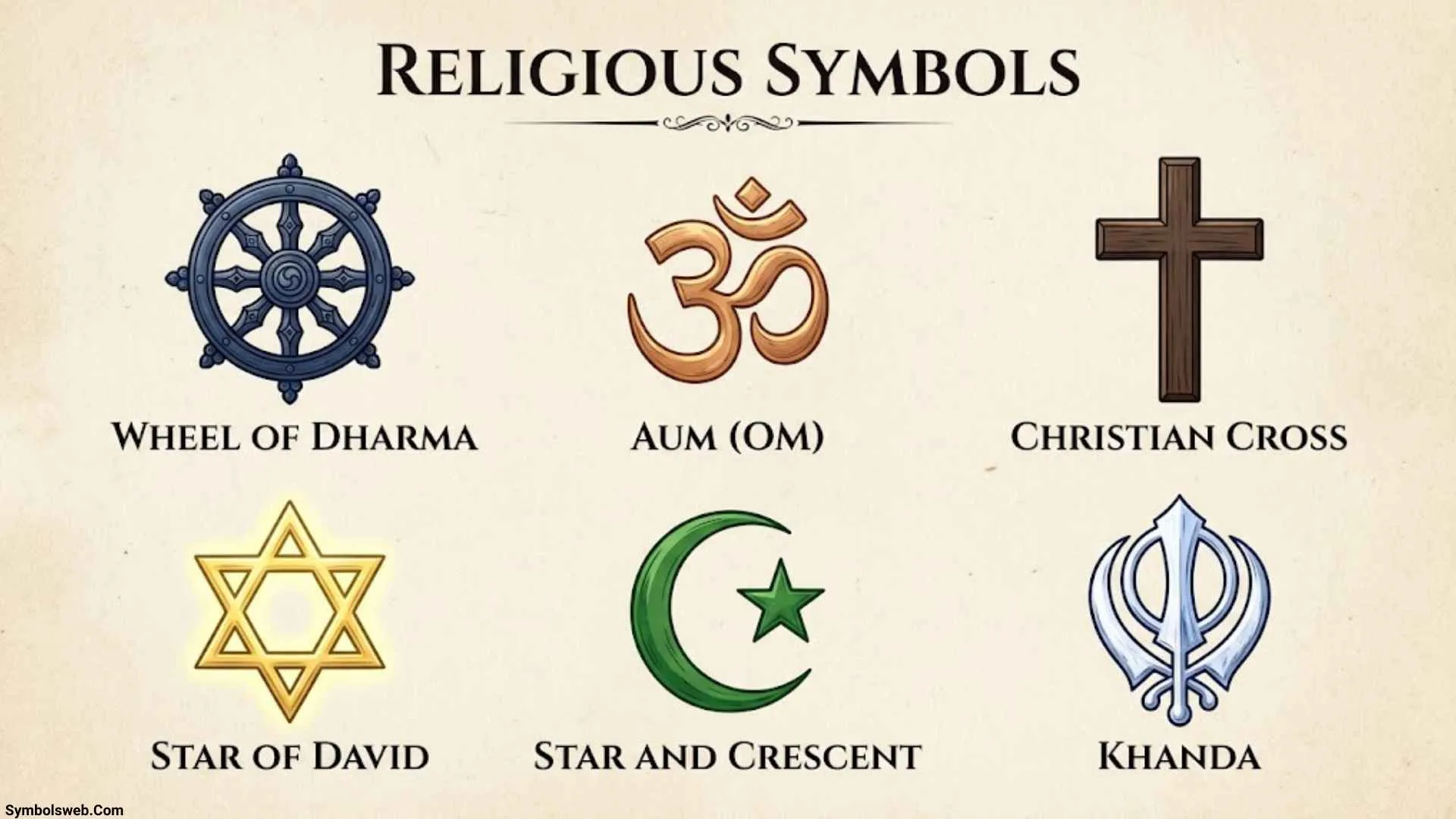
Religious symbols have shaped human history for thousands of years. From the Christian cross to the Hindu Om and the Buddhist Dharma Wheel, these signs help people express faith, preserve traditions, and understand spiritual teachings. Although a symbol may look simple, its meaning can carry generations of history, worship, and cultural identity.
When you explore religious symbols and their meanings, you discover how different communities understand life, morality, creation, suffering, and the divine. Some symbols appear in sacred buildings, while others feature in clothing, jewelry, ceremonies, and everyday prayer. Their meanings can also change across historical periods and religious traditions.
This guide explores religious signs and symbols, their origins, and their importance across major world religions. You’ll learn about Christianity, Islam, Hinduism, Buddhism, Judaism, Sikhism, Pagan traditions, and other spiritual practices. One clarification is necessary: the term “Tillel” does not have an established general meaning in religious symbolism, so this article focuses on religious symbols without assigning that term an unsupported definition.
What Are Religious Symbols?
Religious symbols are images, shapes, objects, letters, gestures, or designs that represent beliefs, sacred teachings, spiritual values, or religious identities. They help people express ideas that words alone may not fully communicate.
For example, Christians recognize the cross as a symbol connected with Jesus Christ’s crucifixion and resurrection. Hindus use Om in sacred recitation and spiritual practice. Buddhists associate the Dharma Wheel with the Buddha’s teachings and the path toward liberation.
Religious symbols can take many forms:
- Religious signs: Visual marks that identify or communicate a religious association.
- Religious icons: Sacred images used in devotional or teaching contexts.
- Sacred objects: Items used in religious ceremonies, such as a menorah or prayer beads.
- Religious emblems: Recognizable designs associated with a faith community, such as the Khanda.
- Religious imagery: Visual representations of sacred stories, deities, spiritual beings, or religious concepts.
- Geometric symbols: Shapes such as circles, stars, and wheels that acquire specific meanings within particular traditions.
These categories overlap. A symbol may serve as a religious emblem, an object of devotion, and a marker of cultural identity at the same time.
Why Are Religious Symbols Important?
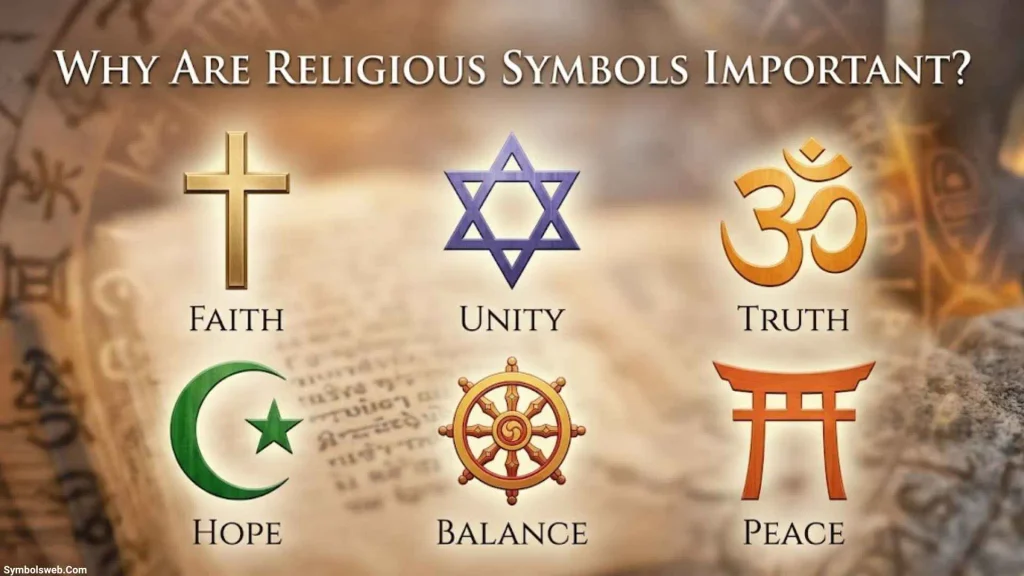
Religious symbolism helps communities communicate their beliefs, remember important teachings, and maintain connections with their history. A single image can remind a believer of a sacred story or a principle they try to follow.
Expressing Faith and Religious Beliefs
Symbols make abstract religious ideas easier to recognize. A dove in Christian imagery, for example, can represent the Holy Spirit. The Sikh symbol Ik Onkar expresses the belief in one God.
These images and forms offer a visible way to express faith. However, their meanings depend on the religious tradition in which people use them.
Preserving Religious Identity and Cultural Heritage
Religious symbols connect people with their communities and ancestors. The Star of David, for instance, has become a widely recognized emblem of Jewish identity. The Khanda serves a similar identifying role in Sikh communities.
Symbols also appear in festivals, family traditions, religious buildings, and ceremonial clothing. Through these practices, communities pass their heritage from one generation to the next.
Supporting Worship, Prayer, and Meditation
Some religious symbols help people focus their attention during prayer or meditation. Rosary beads support devotional prayer in Catholicism, while sacred syllables such as Om play an important role in Hindu religious practice.
Other symbols identify sacred places or mark religious occasions. Their purpose depends on the tradition and the way people use them.
Teaching Religious Stories and Values
Religious art often communicates stories through visual details. A Christian lamb may refer to Christ’s sacrifice, while the Buddhist Bodhi Tree recalls the Buddha’s enlightenment.
These symbolic representations can make religious teachings easier to remember. They also encourage reflection on values such as compassion, humility, courage, and moral responsibility.
Religious Symbols and Their Meanings in the World’s Major Religions
Different faiths have developed rich systems of religious iconography. Some traditions use a widely recognized emblem, while others rely more heavily on sacred writing, ritual objects, architecture, or images.
The following table introduces familiar examples.
| Religion | Recognizable symbol | Common meaning or association |
| Christianity | Cross | Jesus Christ’s crucifixion, sacrifice, and redemption |
| Islam | Arabic calligraphy | Sacred language and religious expression |
| Hinduism | Om | Sacred sound and spiritual reality |
| Buddhism | Dharma Wheel | The Buddha’s teachings and path |
| Judaism | Star of David | Jewish identity and heritage |
| Sikhism | Khanda | Sikh identity and religious principles |
| Jainism | Ahimsa hand | Nonviolence and ethical conduct |
| Baháʼí Faith | Nine-pointed star | Associations with unity and the number nine |
| Taoism | Yin-Yang | Complementary forces and their relationship |
| Shinto | Torii gate | Entrance to a sacred Shinto space |
These are representative examples, not complete inventories. No single emblem captures every belief or practice within a religion.
Christian Symbols and Their Meanings
Christianity uses a wide range of sacred symbols to communicate beliefs about Jesus Christ, salvation, divine love, and the Holy Spirit. These symbols appear in churches, paintings, jewelry, devotional objects, and religious celebrations.
The Cross: The cross is the best-known Christian symbol. It recalls Jesus’ crucifixion and represents sacrifice, redemption, and hope. Christians also connect it with the resurrection and the promise of new life.
The Crucifix: A crucifix depicts Jesus’ body on the cross. It holds particular importance in Catholic worship and devotion, while different Christian communities emphasize different forms of cross imagery.
The Dove: Christian art often uses a dove to represent the Holy Spirit. Its association with peace also makes it a familiar image in religious artwork.
The Sacred Heart: This devotional image represents the love and compassion of Jesus Christ. It is especially prominent in Catholic tradition.
The Ichthys (Christian Fish): The fish became an important early Christian sign. Today, people also use it on jewelry, vehicles, and other items to express Christian identity.
The Chi-Rho: This Christogram combines the Greek letters chi and rho, the first two letters of Christos, the Greek word for Christ. It appears in historical Christian art and religious objects.
Alpha and Omega: These Greek letters represent the beginning and the end. Christian scripture uses this language to express God’s eternal nature.
The Lamb: The lamb is associated with sacrifice and redemption, particularly through the Christian understanding of Jesus as the Lamb of God.
The Rosary: Catholic Christians use rosary beads to support a sequence of prayers and meditation on events in the lives of Jesus and Mary.
Christian symbols vary by denomination. For example, Orthodox churches have distinctive cross designs and a rich tradition of icons, while many Protestant churches emphasize simpler visual forms.
Islamic Symbols and Their Meanings
Islamic religious expression includes sacred writing, geometric designs, architectural features, and objects used in worship. Unlike some other religions, Islam does not have one universally prescribed visual emblem representing the faith.
Crescent Moon and Star: The crescent and star are widely associated with Muslim communities, flags, and Islamic cultural heritage. Their historical prominence is closely linked to political and cultural developments, including the Ottoman Empire. The symbol is not a universal religious requirement in Islam.
Arabic Calligraphy: Arabic calligraphy plays an important role in Islamic art. Artists use it to present Quranic verses, religious phrases, and the name of Allah. The visual form reflects the importance of the Arabic language in Islamic scripture and worship.
The Shahada: The Shahada is the Islamic declaration of faith. It expresses belief in the oneness of God and the prophethood of Muhammad. It is a statement of faith rather than simply a decorative symbol.
The Kaaba: Located in Mecca, the Kaaba is the focal point toward which Muslims face during their daily prayers. It also stands at the center of the pilgrimage known as Hajj.
Prayer Rug: A prayer rug provides a clean surface for prayer. It is a practical religious item rather than a universal emblem of Islam.
Geometric Patterns: Geometric designs appear throughout Islamic architecture and decorative arts. Repeated shapes, intricate patterns, and balanced arrangements can create striking visual effects.
Islamic traditions generally avoid depicting Allah as a physical figure. Therefore, calligraphy and abstract patterns often provide ways to express religious devotion without portraying God.
Hindu Symbols and Their Meanings
Hinduism includes many spiritual symbols connected with sacred texts, deities, philosophical teachings, rituals, and meditation. Their meanings often vary across regional and devotional traditions.
Om (Aum): Om is a sacred syllable associated with spiritual reality and the sound used in religious recitation. It appears in Hindu prayers, mantras, and meditation practices.
Swastika: In Hindu traditions, the swastika is an ancient auspicious symbol associated with well-being and good fortune. Its positive religious use predates its appropriation by Nazi Germany. Because of that later history, readers should distinguish the Hindu symbol’s traditional context from the Nazi emblem.
Lotus Flower: The lotus is associated with purity, beauty, and spiritual development. Hindu art frequently depicts deities seated or standing on lotus flowers.
Trishula (Trident): The trident is an attribute of Shiva. Its interpretations vary, and its presence often identifies the deity in Hindu imagery.
Shankha (Conch Shell): The conch appears in Hindu rituals and in representations of Vishnu. It is also used ceremonially in some religious settings.
Sudarshana Chakra: This discus is an attribute of Vishnu and is associated with divine power and protection.
Tilaka: A tilaka is a mark placed on the forehead for religious, devotional, or cultural reasons. Its shape and meaning can identify particular Hindu traditions or practices.
Nandi: Nandi, Shiva’s bull, represents devotion and is commonly depicted near Shiva shrines and temples.
Kalasha: This decorated vessel appears in Hindu ceremonies and is associated with auspiciousness and abundance.
For Hindus, these symbols are more than decorative images. Their significance comes from their connections with religious narratives, ritual practice, and spiritual teachings.
Buddhist Symbols and Their Meanings
Buddhist symbols often represent the Buddha’s teachings, ethical conduct, meditation, and the possibility of awakening. They appear in temples, statues, paintings, manuscripts, and ceremonial objects.
Dharma Wheel (Dharmachakra): The Dharma Wheel represents the Buddha’s teachings. Its eight spokes are commonly associated with the Noble Eightfold Path, which guides practitioners toward the end of suffering.
Lotus Flower: The lotus represents spiritual growth and awakening in many Buddhist traditions. Its ability to rise from muddy water provides a familiar image of development amid difficult conditions.
Bodhi Tree: The Bodhi Tree recalls the tree under which the Buddha attained enlightenment according to Buddhist tradition. It represents awakening and insight.
Endless Knot: This intricate design appears among the Eight Auspicious Symbols in Tibetan Buddhism. It can represent interconnectedness and the relationship between wisdom and compassion.
Conch Shell: In Tibetan Buddhist symbolism, the white conch is associated with the far-reaching sound of the Dharma and the spread of the Buddha’s teachings.
Golden Fish: The pair of golden fish is another auspicious symbol in Tibetan Buddhism. It is often interpreted through ideas of freedom and liberation.
Parasol: The parasol represents protection and honor in Buddhist symbolism.
Stupa: A stupa is a sacred structure associated with Buddhist relics, remembrance, and religious practice. Stupas can serve as places for pilgrimage and circumambulation.
Buddha Images: Statues and paintings of the Buddha communicate teachings through posture, hand gestures, and other visual features. These details may represent meditation, teaching, fearlessness, or other aspects of Buddhist tradition.
The meanings of Buddhist symbols differ across Theravada, Mahayana, and Vajrayana traditions. A symbol used in one region may have a different role elsewhere.
Jewish Symbols and Their Meanings
Jewish symbols connect religious practice, sacred history, community identity, and the traditions of the Jewish people. They appear in homes, synagogues, religious ceremonies, and cultural settings.
Star of David (Magen David): The six-pointed star has become a widely recognized symbol of Jewish identity. It appears on the flag of Israel and in many Jewish cultural and religious contexts.
Menorah: The seven-branched menorah has biblical roots and is an important symbol of Jewish heritage. It is distinct from the nine-branched Hanukkah lamp.
Hanukkiah: This nine-branched lamp is used during Hanukkah. Eight branches correspond to the eight nights of the celebration, while the additional holder contains the shamash, or helper light.
Chai: Chai consists of two Hebrew letters that form the word for life. It frequently appears in jewelry and Jewish decorative art.
Hamsa: This hand-shaped motif appears in several Middle Eastern and Mediterranean cultures, including some Jewish communities. People may associate it with protection, but it is not exclusive to Judaism.
Shofar: A shofar is a horn traditionally blown during important Jewish religious observances, particularly Rosh Hashanah and Yom Kippur.
Torah Scroll: The Torah is central to Jewish religious life. A handwritten Torah scroll receives special care and is read during synagogue services.
Mezuzah: A mezuzah is a case containing specific biblical passages that Jews attach to doorposts in accordance with Jewish practice.
Tallit: This prayer shawl features ritual fringes known as tzitzit and is worn during certain Jewish prayers.
These objects demonstrate how religious imagery and sacred objects can support both everyday observance and major ceremonies.
Sikh Symbols and Their Meanings
Sikh symbolism emphasizes the oneness of God, devotion, justice, equality, and service to others.
Khanda: The Khanda is a prominent emblem of Sikh identity. Its design includes a double-edged central sword, a circular chakkar, and two crossed kirpans. The components are commonly interpreted through Sikh ideas about spiritual commitment, justice, and responsibility.
Ik Onkar: This sacred expression communicates the belief in one God. It is central to Sikh teaching and reflects the oneness of the divine.
Nishan Sahib: The Nishan Sahib is the flag displayed at Sikh gurdwaras. It identifies a place of Sikh worship and welcomes the community.
The Five Ks: Initiated Khalsa Sikhs maintain five articles of faith:
- Kesh: Uncut hair.
- Kangha: A wooden comb.
- Kara: An iron or steel bracelet.
- Kachera: A specific style of undergarment.
- Kirpan: A ceremonial or religious sword associated with duty and the defense of justice.
These articles are not merely decorative accessories. They carry religious meaning and shape the daily practices of initiated Sikhs.
Pagan and Contemporary Pagan Symbols
Paganism includes diverse ancient religions and modern spiritual movements. Contemporary Pagan traditions, including Wicca and some forms of Heathenry, use symbols connected with nature, deities, seasonal festivals, and ritual practice.
Pentacle: A pentacle is commonly represented as a five-pointed star enclosed by a circle. Some modern Pagan traditions associate its points with earth, air, fire, water, and spirit. Its exact interpretation depends on the practitioner and tradition.
Triple Moon: This design typically combines a waxing crescent, full moon, and waning crescent. It appears in some contemporary Pagan and Wiccan settings, where it may be associated with lunar cycles and the Goddess.
Wheel of the Year: This modern Pagan framework organizes eight seasonal festivals observed by many Wiccans and other contemporary Pagans. It reflects the changing seasons and cycles of nature.
Horned God Imagery: Some modern Pagan traditions use images of a horned deity associated with nature, wilderness, or seasonal cycles.
Spiral: Spirals appear in many ancient artworks and contemporary spiritual settings. Their meanings can include growth, movement, or cycles, but those interpretations must be considered within their specific contexts.
Sun Wheel: This term refers to several sun-related designs. A particular example should be identified before assigning it a religious meaning.
The key point is that there is no single set of symbols used by every Pagan tradition. Modern interpretations also should not be confused with evidence about ancient religious practices.
Other Religious and Spiritual Symbols
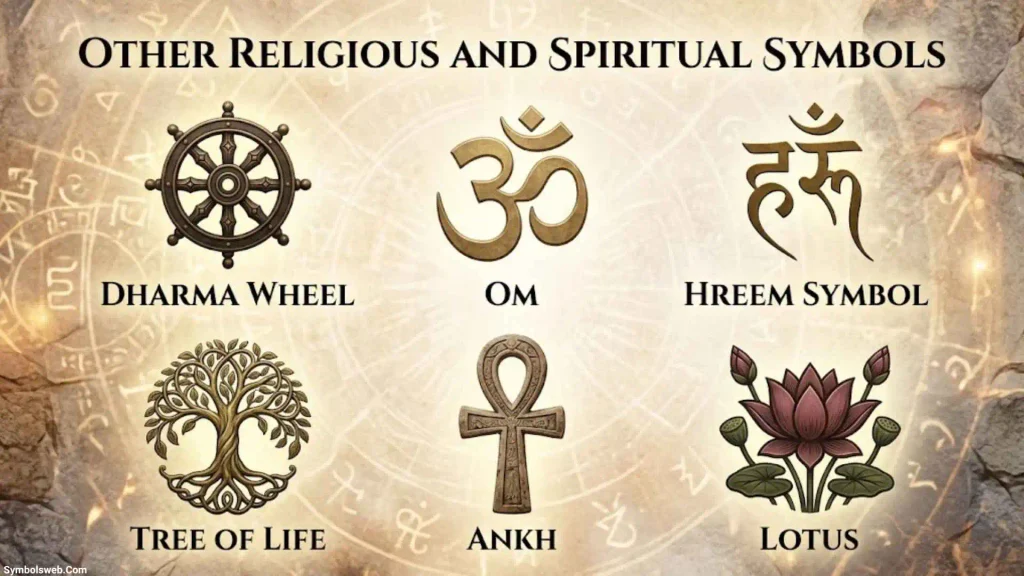
Beyond the six commonly studied major religions, many other traditions use distinctive symbols and sacred objects.
Baháʼí Symbols
The Nine-Pointed Star: The number nine is associated with unity and completeness in Baháʼí symbolism. The nine-pointed star is a familiar emblem of the Baháʼí Faith.
The Ringstone Symbol: This design appears in some Baháʼí jewelry and artwork. Its elements express relationships among God, divine revelation, and humanity.
Jain Symbols
The Jain Emblem: The modern Jain emblem combines several visual elements associated with Jain teachings, including the hand, wheel, and outline of the universe.
Ahimsa Hand: The raised hand represents nonviolence. Its wheel is associated with the principle of ahimsa, or avoiding harm to living beings.
Jain symbolism reflects the importance of nonviolence, self-discipline, and spiritual liberation.
Shinto Symbols
Torii Gate: A torii commonly marks an entrance to a sacred Shinto area. Passing through one can signify entering a space associated with kami, the sacred beings or presences of Shinto belief.
Shimenawa: This sacred rope marks certain places or objects considered spiritually significant.
Tomoe: This curved, comma-like motif appears in Japanese art and religious contexts. Its specific meaning depends on the design and setting.
Taoist Symbols
Yin-Yang (Taijitu): The familiar black-and-white design expresses the complementary relationship between yin and yang. It is closely associated with Chinese philosophy and cosmology, including Taoist traditions.
Bagua: The bagua consists of eight trigrams used in Chinese cosmological systems and related practices.
These symbols describe relationships and patterns rather than serving simply as logos for a religion.
Zoroastrian Symbols
Faravahar: The Faravahar is a prominent emblem associated with Zoroastrian identity. Its interpretation has developed through historical and modern contexts, so it should not be reduced to one universally agreed meaning.
Sacred Fire: Fire holds a central role in Zoroastrian worship. It represents ritual purity and serves as a focus of reverence. Zoroastrians do not simply worship fire as a deity.
Common Themes Across Religious Symbols
Although religious traditions differ, some visual themes recur across cultures. However, similarities do not automatically mean that symbols share the same origin or meaning.
Light as a Symbol of Truth and Divine Presence
Light appears in many religious settings. It can represent knowledge, holiness, hope, or the presence of the divine.
Examples include:
- Candles used in Christian worship.
- Lamps lit during Hindu festivals.
- The menorah in Jewish tradition.
- Sacred fire in Zoroastrian worship.
- Lamps used in Buddhist ceremonies.
Each practice has its own history. Similar visual themes do not make the rituals interchangeable.
Water as a Symbol of Purification and Renewal
Water can carry religious meanings connected with purification, life, and renewal.
In Christianity, baptism uses water as part of a rite associated with spiritual transformation and entry into the Christian community. In Islam, ritual washing prepares worshippers for prayer. Hindu traditions include important practices involving sacred rivers and ritual bathing.
Water also has practical importance in religious life. It can mark a boundary between ordinary activity and a particular act of worship.
Circles as Symbols of Wholeness and Cycles
Circles appear in religious art because of their simple and adaptable form. In some contexts, they suggest completeness, continuity, or cycles.
Examples include the circle within a pentacle and the wheel-shaped Dharma symbol. Yet their meanings differ considerably. The Dharma Wheel refers to Buddhist teachings, while the pentacle belongs to several modern Pagan symbolic systems.
The Lotus Flower and Spiritual Growth
The lotus appears in Hindu and Buddhist imagery. Its growth from muddy water offers a powerful visual comparison for spiritual development.
In Hindu art, the lotus can be associated with deities and auspiciousness. In Buddhism, it often represents awakening and the possibility of developing wisdom despite difficult circumstances.
The Sun, Moon, and Stars
Celestial objects appear in many religious and cultural traditions. The moon helps determine the timing of Islamic months and important observances. Solar imagery appears in Hindu religious traditions, while stars and celestial patterns feature in various forms of religious art.
However, not every star, moon, or sun design has a religious meaning. The surrounding artwork, historical setting, and community determine how to interpret it.
Animals and Their Religious Meanings
Animals can represent divine attributes, sacred stories, or moral qualities.
- Lamb: Associated with sacrifice and redemption in Christianity.
- Cow: Revered in many Hindu traditions.
- Lion: Appears in Jewish, Christian, and other cultural imagery.
- Garuda: A divine bird associated with Vishnu in Hindu traditions and present in some Buddhist traditions.
An animal may carry several meanings even within the same religion. Its appearance should be interpreted in context.
Sacred Numbers and Geometric Shapes
Numbers and geometric forms can communicate complex ideas. The eight spokes of the Buddhist Dharma Wheel are associated with the Noble Eightfold Path. The number nine has particular importance in Baháʼí symbolism.
Triangles, stars, circles, and spirals also appear in many traditions. Still, geometric resemblance alone does not prove that two religious symbols have the same origin or meaning.
Religious Symbols in Worship, Art, and Daily Life
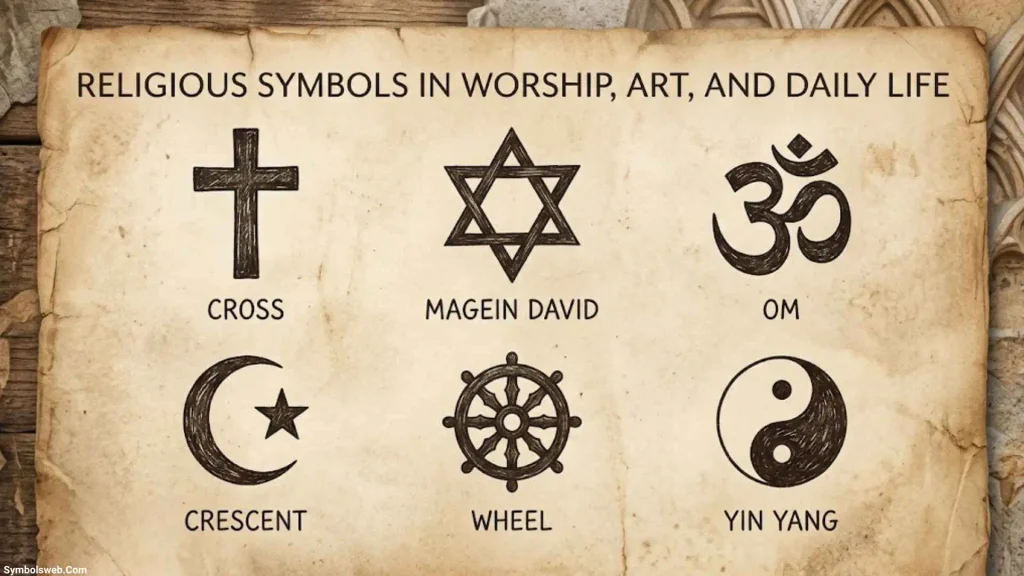
Religious symbols in everyday spiritual practice help connect beliefs with physical surroundings. Their use ranges from large architectural features to small objects carried by individuals.
Symbols in Temples, Churches, Mosques, and Synagogues
Religious buildings often use visual features to identify sacred spaces and communicate teachings. Christian churches may display crosses, icons, and stained-glass windows. Hindu temples feature images and attributes of deities. Buddhist temples may contain Buddha images and stupas.
Mosques frequently use Arabic calligraphy and geometric decoration, while synagogues may display Torah scrolls and menorah imagery.
These differences reflect the traditions, artistic histories, and religious needs of their communities.
Symbols Used in Prayer and Meditation
Some objects support attention and devotion during spiritual practice.
Examples include:
- Rosary beads in Catholic prayer.
- Prayer rugs in Muslim worship.
- Sacred syllables such as Om in Hindu practice.
- Mandalas in some Buddhist traditions.
- Prayer beads in several religious communities.
A symbol or object can support meditation without having the same theological role in every tradition.
Religious Clothing, Jewelry, and Personal Items
People may express religious identity through clothing, jewelry, and personal objects. Examples include cross necklaces, the Sikh kara, the Jewish tallit, and Hindu tilaka markings.
These items may express devotion, community membership, or a commitment to religious practice. Some carry formal religious obligations, while others serve primarily as personal or cultural expressions.
Religious Symbols in Festivals and Ceremonies
Symbols often become especially visible during religious festivals. Lamps feature prominently in Diwali celebrations, the Hanukkiah is lit during Hanukkah, and Christian communities use crosses and other imagery during Easter.
Buddhist ceremonies may include offerings, banners, and sacred images. These practices help communities remember important teachings and celebrate shared traditions.
Ancient Religious Symbols and Their Historical Origins
Ancient religious symbols offer clues about how earlier societies understood their gods, rulers, natural surroundings, and spiritual lives. Archaeologists and historians study these designs alongside inscriptions, objects, and written records.
Religious Symbols in Ancient Egypt
Ancient Egyptian religion used distinctive symbols connected with life, protection, authority, and the gods.
- Ankh: A sign associated with life.
- Eye of Horus: A protective symbol connected with Horus and ancient Egyptian mythology.
- Djed Pillar: A symbol associated with stability and linked with Osiris.
- Was Scepter: An emblem of authority and power associated with deities and rulers.
These meanings come from specific Egyptian religious contexts. Modern spiritual interpretations may add ideas that ancient evidence does not establish.
Symbols in Ancient Greek and Roman Religion
Greek and Roman art often identified gods through their distinctive attributes.
- Owl: Associated with Athena, the Greek goddess of wisdom.
- Thunderbolt: An attribute of Zeus and the Roman Jupiter.
- Laurel Wreath: Associated with victory, honor, and Apollo in ancient traditions.
Such attributes helped viewers recognize deities in statues, coins, pottery, and other works of art.
Ancient Mesopotamian Religious Symbols
Ancient Mesopotamian societies used divine emblems and celestial motifs. The crescent was associated with the moon god Sin, while the eight-pointed star was connected with Ishtar in certain historical contexts.
Archaeological evidence helps scholars interpret these designs. A symbol’s meaning should not be assigned solely because its shape resembles a modern religious emblem.
How Religious Symbols Change Over Time
Symbols can change as communities migrate, exchange ideas, and develop new traditions. A design may begin in one historical setting and acquire additional meanings centuries later.
The Star of David, for example, became a widely recognized symbol of Jewish identity over time. The crescent and star also gained prominence through political and cultural history.
Understanding these changes requires distinguishing historical religious symbolism from later interpretations and contemporary uses.
How to Interpret Religious Symbols Correctly
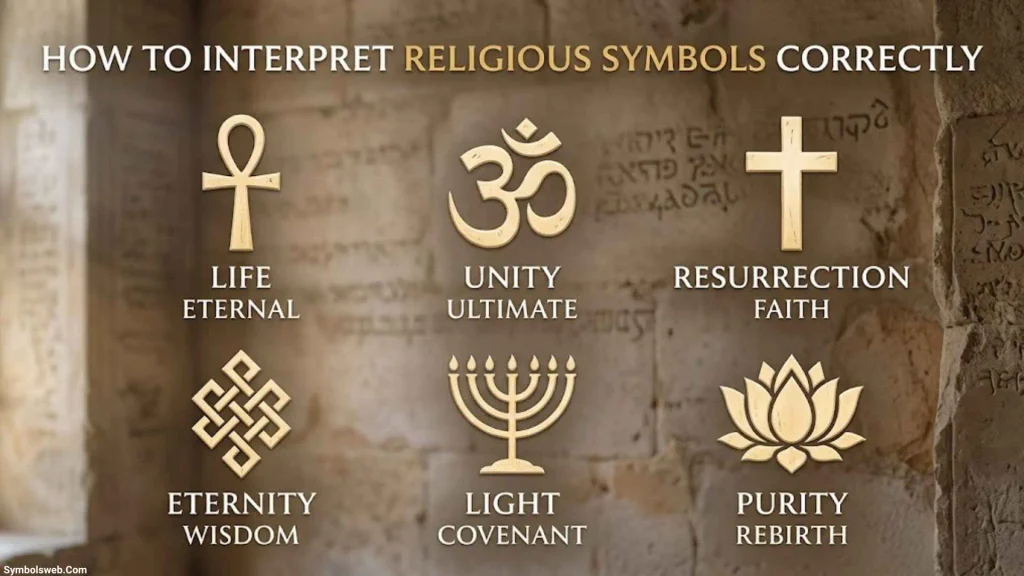
Religious symbols can be fascinating, but interpreting them accurately takes more than identifying a familiar shape.
Consider the Religion and Cultural Context
First, identify the tradition and setting in which the symbol appears. A lotus in Hindu temple art may have a different significance from a lotus in Buddhist artwork.
Look at the accompanying text, ritual, artwork, and historical period. These details often provide more reliable clues than a general list of symbol meanings.
Distinguish Religious Symbols From Cultural Symbols
Some symbols identify both religious communities and cultural or political groups. The crescent and star, for example, appears on flags and other objects associated with Muslim-majority societies, but it is not required as an emblem of Islamic faith.
Similarly, the Star of David carries religious and cultural meanings connected with Jewish identity. Context helps explain which meaning is most relevant.
Avoid Assuming Every Symbol Has One Meaning
Religious symbols can have several interpretations. Their meaning may differ between denominations, geographic regions, historical periods, and individual practitioners.
Reliable explanations distinguish established religious teachings from modern spiritual interpretations. They also acknowledge when scholars or communities disagree.
Respect Sacred Symbols and Religious Practices
A symbol may be sacred to the people who use it. Before placing one on clothing, jewelry, artwork, or a tattoo, learn about its significance and any restrictions surrounding its use.
Respectful interpretation does not require sharing another person’s beliefs. It requires understanding the symbol’s context and avoiding misleading claims about its meaning.
Frequently Asked Questions About Religious Symbols
What Is a Religious Symbol?
A religious symbol is an image, object, sign, or design that represents a religious belief, sacred teaching, spiritual value, or community identity. Examples include the Christian cross, Hindu Om, Buddhist Dharma Wheel, and Jewish menorah.
Why Are Religious Symbols Important?
Religious symbols help people express faith, remember sacred teachings, and preserve cultural heritage. They also appear in worship, prayer, meditation, religious clothing, and community celebrations.
What Are the Symbols of the Six Major Religions?
Commonly taught examples include the cross for Christianity, Om for Hinduism, the Dharma Wheel for Buddhism, the Star of David for Judaism, the Khanda for Sikhism, and Arabic calligraphy or the crescent and star as cultural associations with Islam.
These examples are not equally universal within every tradition. In particular, the crescent and star is not a universally prescribed Islamic symbol.
What Is the Most Famous Religious Symbol?
The Christian cross is one of the world’s most widely recognized religious symbols. It represents Jesus Christ’s crucifixion and carries meanings associated with sacrifice, redemption, and hope.
However, there is no single authoritative global ranking of religious symbols by recognition.
What Symbol Represents God?
No single symbol represents God across all religions. In Sikhism, Ik Onkar expresses the oneness of God. In Christianity, the cross represents Christ’s crucifixion and redemption. Islamic religious expression often uses Arabic calligraphy rather than a physical image of God.
The correct interpretation depends on the religious tradition.
What Are the 12 Symbols of the Holy Spirit?
Christian traditions do not share one universally standardized list of twelve symbols of the Holy Spirit. Familiar biblical images include the dove, fire, wind, and water. Other images and expressions appear in particular passages and Christian traditions.
It is more accurate to explain each image through its biblical context than to present an arbitrary list as universally accepted.
What Does the Crescent Moon and Star Mean in Islam?
The crescent moon and star are widely associated with Muslim cultures and appear on several national flags. Their prominence developed through historical and political contexts, including the Ottoman Empire.
The Quran does not establish the crescent and star as a required symbol of Islam.
What Does the Om Symbol Mean?
Om, also written Aum, is a sacred syllable in Hindu traditions. It is associated with spiritual reality and appears in prayers, mantras, and meditation. Its interpretation varies across Hindu philosophical and devotional traditions.
What Is the Difference Between a Religious Symbol and a Religious Icon?
A religious symbol is a broad category that includes signs, objects, shapes, and designs that communicate religious meaning. A religious icon usually refers to a sacred image, particularly one used in devotional settings.
For example, a cross is a religious symbol, while a painted image of Christ used for devotion may be described as an icon.
How Many Religious Symbols Are There?
There is no definitive total. Religions include many regional traditions, sacred objects, ritual designs, historical emblems, and local forms of religious imagery. New interpretations and contemporary spiritual movements also contribute to the variety.
Rather than counting every symbol, it is more useful to study each one through its historical and cultural context.
Conclusion
Religious symbols and their meanings reveal how people express faith, preserve history, and communicate spiritual ideas. The cross, Om, Dharma Wheel, Star of David, Khanda, and many other symbols represent distinct teachings and traditions. Each carries a history that deserves careful attention.
As you explore religious symbolism across cultures, remember that familiar shapes can have different meanings depending on the people and traditions that use them. By studying their origins, purposes, and cultural contexts, you can develop a clearer understanding of religious heritage and the many ways people express their beliefs.

Hi, I’m Ethan Holloway, and I’ve always believed that a few meaningful words can change the way we think, feel, and live. I enjoy collecting timeless quotes, studying their deeper meanings, and sharing inspiring messages that help people stay motivated through every stage of life.
Over the years, I’ve explored thousands of famous sayings from writers, leaders, philosophers, and everyday people. My goal is to make wisdom easy to understand and useful for everyone.
Books by Ethan Holloway
- The Power of Everyday Quotes
- Words That Inspire Greatness
 Jordan Hayes
 Eliana Foster