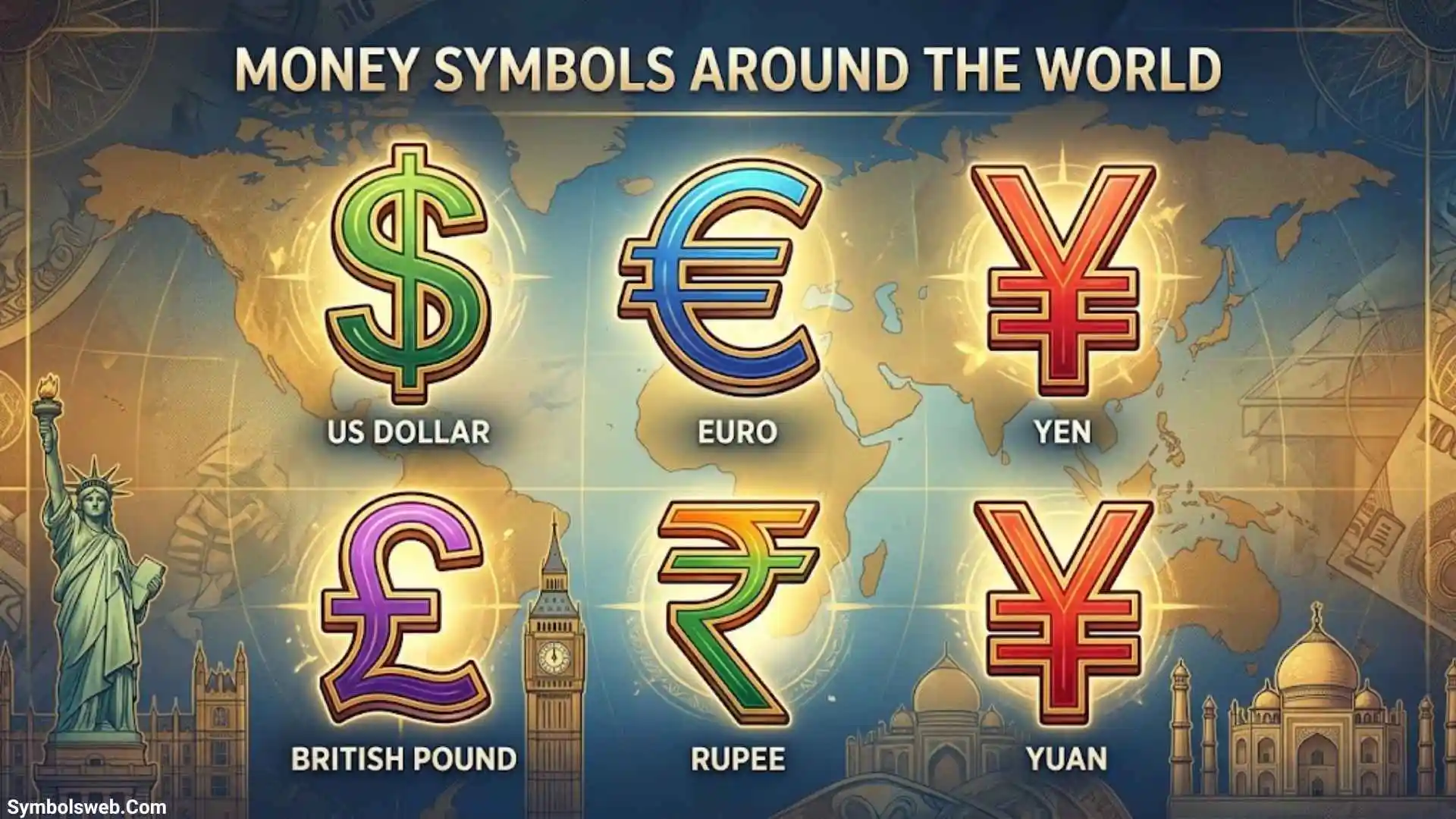
Money symbols around the world help you recognize currencies, compare prices, and understand financial information across countries. From the familiar dollar sign ($) and euro symbol (€) to the Indian rupee sign (₹) and Japanese yen sign (¥), each symbol offers a quick way to represent money.
However, currency symbols don’t always identify a currency on their own. Several countries use the dollar sign, while Japan and China commonly use the same yen-style symbol for different currencies. Some currencies use distinctive characters, and others rely on abbreviations or standardized currency codes.
In this guide, you’ll find money symbols around the world, their currency names, associated countries, and practical explanations of how they’re used. You’ll also learn how to distinguish similar signs, understand currency formatting, and identify currencies in international payments and financial documents.
Quick Answer: What Are the Money Symbols Around the World?
Money symbols, also called currency symbols, are signs or abbreviations used to represent monetary units when writing prices and financial amounts. Common examples include $ for several dollar currencies, € for the euro, £ for pound sterling, and ₹ for the Indian rupee.
Here are some widely recognized world currency symbols:
| Currency | Symbol or common notation | Country or region | ISO code |
| US dollar | $ | United States | USD |
| Euro | € | Euro area | EUR |
| Pound sterling | £ | United Kingdom | GBP |
| Japanese yen | ¥ | Japan | JPY |
| Chinese yuan | ¥ / 元 | China | CNY |
| Swiss franc | CHF | Switzerland | CHF |
| Canadian dollar | $ / C$ | Canada | CAD |
| Australian dollar | $ / A$ | Australia | AUD |
| New Zealand dollar | $ / NZ$ | New Zealand | NZD |
| Indian rupee | ₹ | India | INR |
| Pakistani rupee | ₨ | Pakistan | PKR |
| South Korean won | ₩ | South Korea | KRW |
| Brazilian real | R$ | Brazil | BRL |
| Nigerian naira | ₦ | Nigeria | NGN |
| South African rand | R | South Africa | ZAR |
The ISO code in the last column is especially useful when a symbol could refer to more than one currency. For example, $ may represent US dollars, Canadian dollars, Australian dollars, or another dollar-based currency. The code USD specifically identifies the US dollar.
What Are Money Symbols?
Definition of Currency Symbols
A currency symbol is a written sign used to represent a currency in a price, transaction, financial statement, or other monetary amount. It helps readers understand which monetary unit a number refers to.
For example:
- $25 may mean 25 US dollars when the context is clear.
- €25 represents 25 euros.
- £25 represents 25 pounds sterling.
- ₹25 represents 25 Indian rupees.
- ¥25 may represent Japanese yen or Chinese yuan, depending on the context.
Currency symbols make prices easier to scan. A shopper can often recognize the currency without reading its full name, while a business can display amounts in a compact format on invoices and receipts.
Still, a symbol isn’t always enough. In a worldwide marketplace, adding a currency code or country label helps prevent confusion.
Why Countries Use Currency Symbols
Countries and monetary systems use symbols and abbreviations to make financial communication more efficient. These identifiers appear in many everyday and professional settings.
Common uses include:
- Retail pricing: Showing the currency of a product’s price.
- Banking: Displaying balances, transfers, and account activity.
- Accounting: Identifying monetary amounts in reports and records.
- International trade: Clarifying the currency specified in a contract or invoice.
- Foreign exchange: Identifying currencies in market data and currency pairs.
- Digital payments: Showing the currency selected at checkout.
- Travel: Helping visitors understand local prices.
A symbol can also reflect a currency’s history, language, and national identity. However, its practical purpose is to identify or represent money, not to show how valuable that money is.
Currency Symbols vs. Currency Codes and Abbreviations
Currency symbols, currency names, and currency codes are related, but they aren’t interchangeable.
| Type | Example | What it means |
| Currency symbol | € | A graphical sign representing the euro |
| Currency name | Euro | The written name of the currency |
| ISO currency code | EUR | A standardized three-letter identifier |
| Common abbreviation | C$ | A contextual way to distinguish Canadian dollars |
The ISO 4217 currency code is particularly useful in banking, accounting, international commerce, and software systems. These standardized codes help identify currencies even when their symbols overlap.
For instance, $ is used by multiple currencies, but USD, CAD, and AUD distinguish the US dollar, Canadian dollar, and Australian dollar.
A practical rule is simple: use a symbol when the currency is obvious, and use a currency code when accuracy matters more than brevity.
Money Symbols Around the World: Complete List by Region
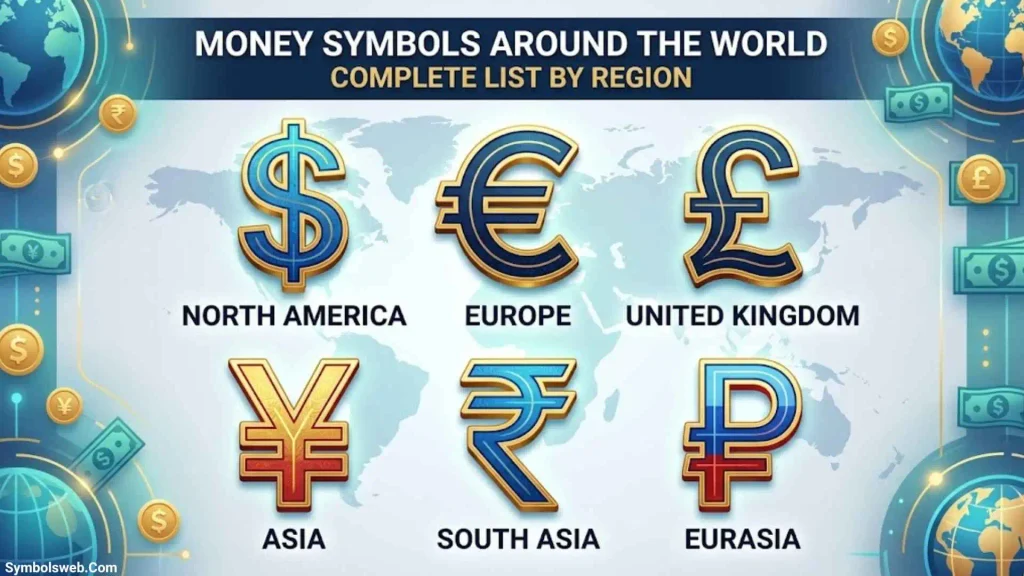
The tables below organize common currency symbols by country and region. They include distinctive symbols as well as widely used abbreviations where a currency doesn’t have one universally recognized graphical sign.
Important: A currency’s official code, its local written notation, and its familiar symbol may differ. Some signs also have more than one meaning. Use the ISO code when preparing financial documents or comparing currencies across countries.
Major Global Currency Symbols
These currencies are widely encountered in travel, international business, banking, and financial markets.
| Currency | Symbol or common notation | Country or region | ISO code |
| US dollar | $ | United States | USD |
| Euro | € | Euro area | EUR |
| Pound sterling | £ | United Kingdom | GBP |
| Japanese yen | ¥ | Japan | JPY |
| Chinese yuan | ¥ / 元 | China | CNY |
| Swiss franc | CHF | Switzerland | CHF |
| Canadian dollar | $ / C$ | Canada | CAD |
| Australian dollar | $ / A$ | Australia | AUD |
| New Zealand dollar | $ / NZ$ | New Zealand | NZD |
| Singapore dollar | $ / S$ | Singapore | SGD |
| Hong Kong dollar | $ / HK$ | Hong Kong | HKD |
| Indian rupee | ₹ | India | INR |
| Pakistani rupee | ₨ | Pakistan | PKR |
| South Korean won | ₩ | South Korea | KRW |
| Brazilian real | R$ | Brazil | BRL |
The euro is used by multiple countries, so its geographic association is the euro area, rather than one individual country. Similarly, the Swiss franc is used in Switzerland and Liechtenstein.
These examples also show why not every currency has a distinctive sign. The Swiss franc is commonly written as CHF, which is both its standardized currency code and a widely used written identifier.
Dollar-Based Currency Symbols
The dollar sign is one of the most recognizable money signs around the world. However, many currencies use it, so the sign alone doesn’t always tell you which country’s money is being discussed.
| Currency | Symbol or common notation | Country or region | ISO code |
| US dollar | $ / US$ | United States | USD |
| Canadian dollar | $ / C$ | Canada | CAD |
| Australian dollar | $ / A$ | Australia | AUD |
| New Zealand dollar | $ / NZ$ | New Zealand | NZD |
| Singapore dollar | $ / S$ | Singapore | SGD |
| Hong Kong dollar | $ / HK$ | Hong Kong | HKD |
| Jamaican dollar | $ / J$ in distinguishing contexts | Jamaica | JMD |
| Bahamian dollar | $ / BSD in distinguishing contexts | Bahamas | BSD |
| Eastern Caribbean dollar | $ / EC$ | Participating Eastern Caribbean states | XCD |
| Mexican peso | $ / Mex$ in distinguishing contexts | Mexico | MXN |
| Argentine peso | $ | Argentina | ARS |
| Chilean peso | $ | Chile | CLP |
| Colombian peso | $ | Colombia | COP |
| Uruguayan peso | $U | Uruguay | UYU |
The dollar sign is also used by other currencies not listed here. The table provides examples rather than an exhaustive list of every dollar-denominated currency.
Why Do So Many Currencies Use the Dollar Sign?
A shared sign offers a familiar way to write monetary amounts, but it can create confusion in international settings. A product listed at $100 could cost 100 units of different currencies depending on the seller and market.
To make the currency clear, businesses may use prefixes such as:
- US$ for US dollars
- C$ for Canadian dollars
- A$ for Australian dollars
- NZ$ for New Zealand dollars
- HK$ for Hong Kong dollars
- EC$ for Eastern Caribbean dollars
These forms are useful in ordinary writing, but the standardized ISO code is generally the clearest choice for formal records and financial systems.
European Currency Symbols Other Than the Euro
The euro is widely used in Europe, but several European countries retain their own currencies. Their currency signs and abbreviations reflect different languages and notation traditions.
| Currency | Symbol or common notation | Country | ISO code |
| Pound sterling | £ | United Kingdom | GBP |
| Swiss franc | CHF | Switzerland | CHF |
| Norwegian krone | kr | Norway | NOK |
| Swedish krona | kr | Sweden | SEK |
| Danish krone | kr | Denmark | DKK |
| Czech koruna | Kč | Czechia | CZK |
| Polish złoty | zł | Poland | PLN |
| Hungarian forint | Ft | Hungary | HUF |
| Romanian leu | lei | Romania | RON |
| Bulgarian lev | лв | Bulgaria | BGN |
| Icelandic króna | kr | Iceland | ISK |
| Ukrainian hryvnia | ₴ | Ukraine | UAH |
| Serbian dinar | дин. in local notation | Serbia | RSD |
The abbreviations kr and lei illustrate how currency notation often follows local language conventions. Because several currencies use similar abbreviations, adding a country name or ISO code is useful when the context isn’t obvious.
The Ukrainian hryvnia has a distinctive symbol, ₴, while the British pound uses £. The euro symbol, €, is shared across the euro area rather than belonging to one country.
Asian Currency Symbols
Asia includes currencies with distinctive graphical signs, local-language characters, and Latin-letter abbreviations. The table below covers several widely encountered Asian currency symbols.
| Currency | Symbol or common notation | Country | ISO code |
| Japanese yen | ¥ | Japan | JPY |
| Chinese yuan | ¥ / 元 | China | CNY |
| South Korean won | ₩ | South Korea | KRW |
| Indian rupee | ₹ | India | INR |
| Pakistani rupee | ₨ | Pakistan | PKR |
| Sri Lankan rupee | Rs | Sri Lanka | LKR |
| Bangladeshi taka | ৳ | Bangladesh | BDT |
| Nepalese rupee | ₨ | Nepal | NPR |
| Thai baht | ฿ | Thailand | THB |
| Indonesian rupiah | Rp | Indonesia | IDR |
| Malaysian ringgit | RM | Malaysia | MYR |
| Philippine peso | ₱ | Philippines | PHP |
| Vietnamese đồng | ₫ | Vietnam | VND |
| Cambodian riel | ៛ | Cambodia | KHR |
| Myanmar kyat | K / Ks in common notation | Myanmar | MMK |
| Mongolian tögrög | ₮ | Mongolia | MNT |
| Lao kip | ₭ | Laos | LAK |
The Asian currency list includes both unique symbols and contextual abbreviations. For example, ₹ is the distinctive sign for the Indian rupee, while Rs is a common written abbreviation for the Sri Lankan rupee.
The same rupee sign or abbreviation can appear in multiple countries. If you’re working with a bank transfer, invoice, or exchange rate, use the country name and ISO code to confirm which currency is intended.
Middle Eastern Currency Symbols
Currencies in the Middle East use a mix of Arabic-script notation, Latin-letter abbreviations, and standardized codes. Local forms may look unfamiliar if you’re accustomed to dollar or euro notation.
| Currency | Symbol or common notation | Country | ISO code |
| UAE dirham | د.إ | United Arab Emirates | AED |
| Saudi riyal | ر.س or SAR | Saudi Arabia | SAR |
| Qatari riyal | ر.ق or QAR | Qatar | QAR |
| Kuwaiti dinar | د.ك | Kuwait | KWD |
| Bahraini dinar | د.ب | Bahrain | BHD |
| Omani rial | ر.ع. or OMR | Oman | OMR |
| Jordanian dinar | JD or JOD | Jordan | JOD |
| Israeli new shekel | ₪ | Israel | ILS |
| Iranian rial | ﷼ or IRR in context | Iran | IRR |
| Lebanese pound | ل.ل or LBP in context | Lebanon | LBP |
The Israeli new shekel has a distinctive symbol, ₪. Several other currencies are often identified through Arabic-script forms or abbreviations.
Don’t assume that two currencies are the same just because their names or written forms look similar. The Saudi riyal, Qatari riyal, and Iranian rial are different currencies with different codes.
African Currency Symbols
African currencies use a range of distinctive signs, local abbreviations, and regional currency identifiers.
| Currency | Symbol or common notation | Country or region | ISO code |
| South African rand | R | South Africa | ZAR |
| Nigerian naira | ₦ | Nigeria | NGN |
| Kenyan shilling | KSh | Kenya | KES |
| Tanzanian shilling | TSh | Tanzania | TZS |
| Ugandan shilling | USh | Uganda | UGX |
| Ghanaian cedi | ₵ | Ghana | GHS |
| Ethiopian birr | Br | Ethiopia | ETB |
| Zambian kwacha | ZK in common notation | Zambia | ZMW |
| Botswana pula | P | Botswana | BWP |
| Egyptian pound | E£ or ج.م in context | Egypt | EGP |
| Moroccan dirham | د.م. | Morocco | MAD |
| West African CFA franc | CFA in common notation | Participating West African countries | XOF |
| Central African CFA franc | FCFA in common notation | Participating Central African countries | XAF |
The Nigerian naira symbol, ₦, and Ghanaian cedi symbol, ₵, are examples of distinctive currency signs. The South African rand is commonly represented by R.
The two CFA francs deserve special attention. The West African CFA franc (XOF) and the Central African CFA franc (XAF) are separate currencies used in different regional monetary systems. Their names are similar, but their codes distinguish them.
Latin American and Caribbean Currency Symbols
Latin America and the Caribbean include several currencies that use the dollar sign, alongside distinctive symbols and abbreviations.
| Currency | Symbol or common notation | Country or region | ISO code |
| Mexican peso | $ / Mex$ in distinguishing contexts | Mexico | MXN |
| Brazilian real | R$ | Brazil | BRL |
| Argentine peso | $ | Argentina | ARS |
| Chilean peso | $ | Chile | CLP |
| Colombian peso | $ | Colombia | COP |
| Peruvian sol | S/ | Peru | PEN |
| Bolivian boliviano | Bs | Bolivia | BOB |
| Venezuelan bolívar | Bs. in some contexts | Venezuela | VES |
| Paraguayan guaraní | ₲ | Paraguay | PYG |
| Uruguayan peso | $U | Uruguay | UYU |
| Costa Rican colón | ₡ | Costa Rica | CRC |
| Dominican peso | RD$ | Dominican Republic | DOP |
| Eastern Caribbean dollar | $ / EC$ | Participating Caribbean states | XCD |
Several countries use $ for their pesos. As a result, the symbol alone may not identify whether a price is in Mexican, Argentine, Chilean, or Colombian pesos.
The Brazilian real is easier to distinguish in many contexts because it is commonly written as R$. The Costa Rican colón uses ₡, which is visually different from the dollar sign.
Cryptocurrency Symbols and Tickers
Cryptocurrencies use a mix of visual symbols, abbreviations, and exchange tickers. Unlike national currencies, these identifiers aren’t all used in one consistent way across every platform.
| Cryptocurrency | Symbol or common ticker | Identification note |
| Bitcoin | ₿ / BTC | BTC is the widely used ticker |
| Ethereum | ETH | ETH is the standard market ticker; Ξ appears as a visual symbol in some contexts |
| Tether | USDT | Common ticker for Tether’s US dollar-linked token |
| Litecoin | Ł / LTC | LTC is widely used on trading platforms |
| XRP | XRP | The asset is commonly identified by its ticker |
| Solana | SOL | SOL is the common ticker; ◎ is used as a visual mark in some contexts |
A crypto symbol and a crypto ticker aren’t necessarily the same thing. The Bitcoin sign ₿ is recognizable, but exchanges and market-data services commonly use BTC. Ethereum is usually identified as ETH, while Ξ is sometimes used in branding or informal writing.
When you look up prices, transfer digital assets, or compare exchange listings, check the asset name and ticker. A familiar-looking sign alone isn’t enough to verify that you’re viewing the correct asset.
Why Do Some Currencies Share the Same Symbol?
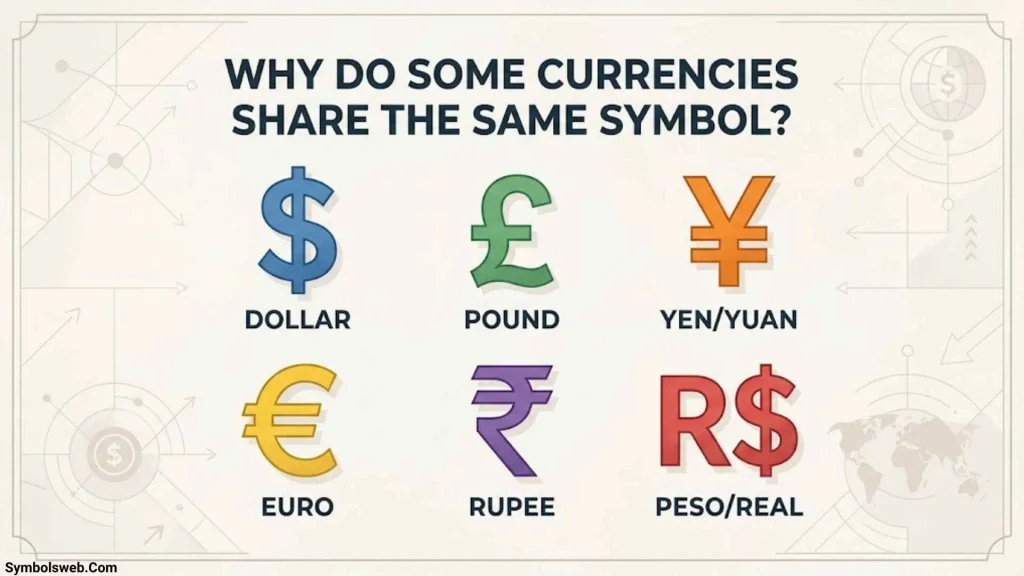
A currency symbol is designed to make monetary amounts easy to recognize and write. It doesn’t always provide a unique identifier for every currency in the world.
The Unicode Standard recognizes characters such as $, £, and ¥ as currency-related signs, while international currency data systems can associate different localized symbols with different currency codes. The exact display may depend on the language and region selected by the software. Unicode currency symbol reference and Unicode CLDR currency guidance.
Dollar Sign Across Countries
The dollar sign $ appears in the notation of numerous currencies. In one country, it may be understood as the national dollar; in another, it may represent a different dollar or peso currency.
For example, a store using US English might display a Canadian price as CA$25 to distinguish it from US dollars. In Canadian or Australian settings, the default symbol may be different because the local currency is assumed.
This is why currency formatting depends on locale and context, not just the character itself. Unicode’s Common Locale Data Repository (CLDR) documents these localized display conventions..
Yen vs. Yuan: What Is the Difference?
The Japanese yen and Chinese yuan are different currencies, but both are commonly represented with ¥.
| Detail | Japanese yen | Chinese yuan |
| Currency name | Yen | Yuan, the principal unit of the renminbi |
| Common symbol | ¥ | ¥ / 元 |
| ISO code | JPY | CNY |
| Country | Japan | China |
The symbol 元 is also used in Chinese writing to represent the yuan unit. In international financial data, JPY and CNY clearly identify the currencies.
If you see ¥ on a website, check the country, currency selector, or code before assuming it refers to Japanese yen.
Riyal and Rial Notation
The names riyal and rial are used by several currencies in the Middle East. Local writing can also vary, so similar-looking symbols don’t necessarily refer to the same currency.
| Currency | Country | ISO code |
| Saudi riyal | Saudi Arabia | SAR |
| Qatari riyal | Qatar | QAR |
| Omani rial | Oman | OMR |
| Iranian rial | Iran | IRR |
For international invoices, bank transfers, and exchange-rate listings, use the ISO code instead of relying on a general rial sign or an Arabic-script abbreviation.
Boliviano vs. Bolívar
The Bolivian boliviano and Venezuelan bolívar are also different currencies. Their common written abbreviations may look similar, particularly in abbreviated tables or informal writing.
- Bolivian boliviano: BOB
- Venezuelan bolívar: VEF
The ISO codes make the distinction clear. This matters when you’re comparing exchange rates, reviewing invoices, or recording payments in accounting software.
Unique Symbols vs. Abbreviations
Not every currency uses a distinctive character. Some are commonly represented by letters, while others use a symbol that is shared with another currency.
For example:
- € is widely recognized as the euro symbol.
- ₦ is the Nigerian naira sign.
- CHF is a common identifier for the Swiss franc.
- kr is used in the notation of several Scandinavian currencies.
- $ is used by numerous dollar and peso currencies.
A useful distinction is that a recognizable sign doesn’t always guarantee unique identification. Use a currency code when the symbol or abbreviation could be ambiguous.
Why Some Currencies Do Not Have a Unique Symbol
Currency Abbreviations Instead of Special Characters
Some currencies are most commonly identified in international contexts by letter-based notation or a three-letter code. That doesn’t mean the currency is unofficial or that people in its home country never use a local sign.
For example, the Swiss franc is often written as CHF, the Malaysian ringgit as RM, and the Kenyan shilling as KSh. These forms are compact and useful in everyday writing, even though they aren’t all standalone Unicode currency signs.
Currency codes are particularly helpful when financial information must move between countries, languages, and software systems.
Historical and Linguistic Reasons
Currency notation develops through local writing practices, history, and financial convention. A country may use a character derived from its language, an abbreviation based on its currency name, or an internationally recognized code.
Some symbols become widely recognized through repeated use in shops, banking, and printed prices. Others remain more common in domestic settings than in international finance.
It is best to avoid assuming that every currency follows the same path. There is no single historical reason why a currency may use a distinctive sign or a letter-based abbreviation.
Digital and Technical Compatibility
Computers need a consistent way to store and display currency characters. Unicode assigns code points to many currency signs, allowing compatible software to represent them across operating systems and applications.
However, the way a symbol looks can vary by font. Some characters may also display incorrectly if a device or application lacks suitable font support.
International financial software often relies on currency codes and locale-specific formatting rules to reduce these problems. The Unicode CLDR documentation explains how currency symbols and number formats can vary by locale.
Examples of Currencies Commonly Written With Abbreviations
| Currency | Country | Common notation or code |
| Swiss franc | Switzerland | CHF |
| Norwegian krone | Norway | kr / NOK |
| Swedish krona | Sweden | kr / SEK |
| Malaysian ringgit | Malaysia | RM / MYR |
| Kenyan shilling | Kenya | KSh / KES |
| Lao kip | Laos | ₭ / LAK |
| Malagasy ariary | Madagascar | MGA |
| Mozambican metical | Mozambique | MT / MZN |
| Uzbek soʻm | Uzbekistan | soʻm / UZS |
These examples show why it’s useful to distinguish a local symbol or abbreviation from an ISO currency code. A currency can have familiar local notation without having a unique sign that’s widely recognized around the world.
How Currency Symbols Are Used in Everyday Life
Currency Symbols in Prices and Shopping
When you shop online or visit another country, currency symbols help you understand the price shown on a product or service. A sign such as $, €, or £ can make the currency clear when you’re shopping in a familiar market.
However, international shopping creates a problem: the same sign may represent different currencies. A product priced at $100 could cost 100 US dollars, Canadian dollars, Australian dollars, or another dollar currency.
Before placing an order, check:
- The currency selected on the website.
- The country where the seller operates.
- The currency shown at checkout.
- Any currency-conversion fee charged by your bank or payment provider.
Don’t assume that changing a website’s language also changes its currency. A site can display prices in one language while charging in a different currency.
Currency Symbols in Banking and Accounting
Banks and businesses use currency signs and codes to make financial records easier to read. You may see them in invoices, receipts, balance sheets, income statements, and cash flow reports.
For example, a business might display an amount as $5,000 in a US domestic report. If the same report includes transactions in several currencies, a format such as USD 5,000, CAD 2,000, and EUR 1,500 is much clearer.
Accurate currency identification is important because the same numeric amount can have a different value in another currency. A report that lists multiple currencies without identifying them can mislead readers or cause bookkeeping errors.
For international financial records, use these practices:
- Identify the currency clearly for every amount when multiple currencies appear.
- Use standardized codes when symbols could be confused.
- Keep formatting consistent throughout each report.
- Check the transaction currency rather than assuming it matches the company’s home currency.
- Document conversion rates when reporting amounts converted from one currency to another.
Currency Symbols in Forex Trading
The foreign exchange market, often called forex, is where currencies are traded against one another. Forex platforms typically use standardized currency codes to identify each currency in a pair.
Consider the currency pair EUR/USD:
- EUR is the base currency.
- USD is the quote currency.
- The exchange rate tells you how many US dollars are needed to buy one euro.
If EUR/USD is quoted at 1.10, one euro is worth 1.10 US dollars at that quoted rate. This is an example to explain the notation, not a live exchange rate.
Currency symbols such as € and $ may appear in charts or account displays, but the three-letter codes are essential for identifying the currencies in trading pairs, market data, and financial records.
Currency Symbols in International Payments and E-Commerce
Digital payments depend on clear currency identification. When you buy something from an overseas retailer, the displayed price, checkout currency, and final payment currency may not always be the same.
Payment gateways and digital wallets use currency identifiers to process transactions correctly. The interface may show a localized symbol to make the price easier to understand, while the underlying transaction uses a currency code.
Before confirming a cross-border payment, check:
- The currency of the displayed price.
- The currency in which the merchant will charge you.
- The exchange rate, if conversion applies.
- Any additional foreign-transaction or conversion fees.
- The currency listed on the final receipt.
A currency symbol helps with readability, but the transaction details determine what you’re actually paying.
Currency Formatting: Do Symbols Go Before or After the Number?
There is no single global rule for placing currency symbols. Their position, spacing, decimal separators, and grouping separators vary by language and regional convention.
The Unicode CLDR project documents locale-specific currency and number patterns used by software to display monetary amounts. Source: CLDR number and currency patterns.
Currency Symbols Before the Number
In many English-language contexts, the currency symbol appears before the amount.
Examples include:
- $25.00
- €25.00
- £25.00
- ₹25.00
The exact format can vary by locale and application. A space may be used in some contexts, particularly when the currency identifier contains letters.
Currency Symbols After the Number
Some languages and regional conventions place the currency symbol or abbreviation after the amount. Depending on the locale, the amount may also be separated from the currency identifier by a space.
For example, you may encounter formats that place kr after a number. The precise placement and punctuation depend on the country, language, and formatting standard being followed.
If you’re writing for an international audience, avoid assuming that one country’s format is correct everywhere.
Spaces, Decimal Separators, and Thousands Separators
Countries differ in how they separate whole numbers, thousands, and decimal fractions.
| Example | Formatting feature |
| 1,234.56 | Comma groups thousands; period marks the decimal |
| 1.234,56 | Period groups thousands; comma marks the decimal |
| 1 234,56 | Space groups thousands; comma marks the decimal |
| 1’234.56 | Apostrophe groups thousands; period marks the decimal |
These are examples of formatting conventions, not different currency values. Each represents the number one thousand two hundred thirty-four and fifty-six hundredths.
When writing a price, follow the convention used by your intended audience. In software, choose an appropriate locale instead of manually replacing separators in a way that could create errors. CLDR provides standardized patterns for regional number formatting.
Best Practices for Writing Currency Amounts
Use the following guidelines to keep prices and financial documents clear:
- Use the correct currency symbol for the currency being discussed.
- Add a currency code when a symbol could refer to more than one currency.
- Follow local formatting rules for symbol placement and spacing.
- Use the correct decimal and thousands separators for your target locale.
- Keep one consistent format within the same document or table.
- Check the currency selected at checkout before paying.
- Avoid relying on the symbol alone in contracts and cross-border transactions.
For example, USD 1,250.00 is more explicit in a multinational report than $1,250.00 when the report includes several dollar currencies.
How to Identify an Unknown Currency Symbol

If you encounter an unfamiliar money sign, you don’t need to guess. A few checks can help you identify the currency accurately.
Check the Currency Code
Look for a three-letter currency code near the amount. Codes such as USD, EUR, GBP, JPY, and INR provide a more precise identification than many standalone symbols.
The International Organization for Standardization’s ISO 4217 information explains how standardized currency codes support clear financial communication and reduce errors.
Check the Country or Region
Look at the country associated with the seller, bank, account, or financial document. Location can narrow down the possibilities, especially when you encounter $, ¥, kr, or a rupee abbreviation.
Still, location alone may not be enough. An international store can charge in a currency different from the currency used in the seller’s home country.
Check the Currency Name and Transaction Details
If the symbol remains unclear, review the surrounding information. Useful places to check include:
- The currency selector on a shopping website.
- The currency field on an invoice.
- The currency pair on a forex platform.
- The details of a bank transfer.
- The currency listed on a payment receipt.
- The account’s currency settings.
When money is involved, confirming the currency is safer than relying on a visual match.
Use Unicode and Font Information When Needed
If you need to copy a symbol into a document or identify its character, Unicode references can help. Unicode defines encoded characters for many currency signs, while fonts determine how those characters appear on screen or in print.
For example, the Unicode Standard identifies the dollar sign $, pound sign £, yen sign ¥, and Indian rupee sign ₹ as distinct encoded characters. See the Unicode currency symbol reference.
Keep in mind that identifying a character doesn’t always identify the exact currency. The yen sign, for example, can also be used to represent the Chinese yuan.
Frequently Asked Questions About Money Symbols
What Are the Most Common Money Symbols?
Some of the most recognizable currency symbols are $ for dollar currencies, € for the euro, £ for pound sterling, ¥ for the yen or yuan, ₹ for the Indian rupee, and ₩ for the South Korean won.
However, a symbol’s popularity doesn’t make it unique. The dollar sign and yen sign, for example, can represent more than one currency.
What Is the Symbol for Each Country’s Currency?
Each country’s currency may have a distinctive sign, a local abbreviation, or a standardized code. Examples include ₹ for the Indian rupee, ₦ for the Nigerian naira, ₱ for the Philippine peso, and R$ for the Brazilian real.
Some countries use a shared symbol, so the best way to identify a currency is to check its name and ISO code. The regional tables above provide examples of currency symbols and their associated countries.
Which Countries Use the Dollar Sign?
Many countries and territories use $ or a qualified version of the dollar sign. Examples include the United States, Canada, Australia, New Zealand, Singapore, Hong Kong, Mexico, Argentina, Chile, and Colombia.
Because the sign is shared, look for identifiers such as US$, C$, A$, or a three-letter code such as USD, CAD, or AUD.
Is the Yen Symbol the Same as the Yuan Symbol?
Yes. The Japanese yen and Chinese yuan commonly use the symbol ¥, but they are different currencies.
- Japanese yen: JPY
- Chinese yuan: CNY
The Chinese character 元 is also used to represent the yuan unit. If you encounter ¥ without additional context, check the country or currency code.
What Is the Difference Between a Currency Symbol and a Currency Code?
A currency symbol is a sign used to display a monetary amount, while a currency code is a standardized identifier for a currency.
For example, € is the euro symbol, while EUR is its ISO code. Likewise, $ is a shared dollar sign, while USD specifically identifies the US dollar.
Currency codes are especially useful in banking, accounting, international trade, and forex markets.
Why Do Some Currencies Have No Unique Symbol?
Some currencies are commonly written using abbreviations or currency codes instead of a distinctive graphical sign. Examples include CHF for the Swiss franc and KSh for the Kenyan shilling.
A currency doesn’t need a unique symbol to be official. Standardized codes allow financial institutions and software systems to identify currencies consistently.
Do Currency Symbols Always Appear Before Numbers?
No. Symbol placement depends on the language and regional formatting convention. You may see a symbol before an amount, such as $25, or a currency abbreviation after an amount in some locales.
Spacing, decimal separators, and thousands separators can also vary. When preparing international documents, follow the intended locale’s formatting rules.
Are Cryptocurrency Symbols Officially Standardized?
Cryptocurrency identifiers aren’t all used in the same way. Some assets have recognizable visual symbols, while trading platforms generally identify them with tickers such as BTC, ETH, USDT, XRP, and SOL.
A visual mark may be used in branding without being the most reliable identifier for a transaction. Always verify the asset name and ticker before trading or transferring digital assets.
How Are Currency Symbols Used in Forex Trading?
Currency symbols can appear in forex interfaces, but standardized currency codes are commonly used to identify currencies in trading pairs.
For example, EUR/USD represents the euro against the US dollar. The first currency is the base currency, and the second is the quote currency.
The exchange rate expresses how much of the quote currency is needed for one unit of the base currency.
How Can I Copy and Paste Currency Symbols?
You can copy the following signs directly into a document, message, or search box:
If a symbol appears as a box or question mark, your application or font may not support that character. Also, remember that copying a sign doesn’t guarantee that it identifies only one currency.
Conclusion
Money symbols around the world make it easier to recognize currencies and display prices in everyday life, banking, accounting, online shopping, and international trade. From the dollar sign and euro symbol to distinctive signs such as ₹, ₦, and ₱, these identifiers help people communicate monetary amounts across different languages and countries.
However, you shouldn’t rely on a symbol alone when accuracy matters. Several currencies share the same sign, and some use abbreviations rather than unique graphical characters. If you’re comparing prices, preparing an invoice, or making an international payment, check the currency name and ISO code. That simple step helps you avoid confusion and identify the right currency with confidence.

Hi, I’m Ethan Holloway, and I’ve always believed that a few meaningful words can change the way we think, feel, and live. I enjoy collecting timeless quotes, studying their deeper meanings, and sharing inspiring messages that help people stay motivated through every stage of life.
Over the years, I’ve explored thousands of famous sayings from writers, leaders, philosophers, and everyday people. My goal is to make wisdom easy to understand and useful for everyone.
Books by Ethan Holloway
- The Power of Everyday Quotes
- Words That Inspire Greatness
 Jordan Hayes
 Eliana Foster