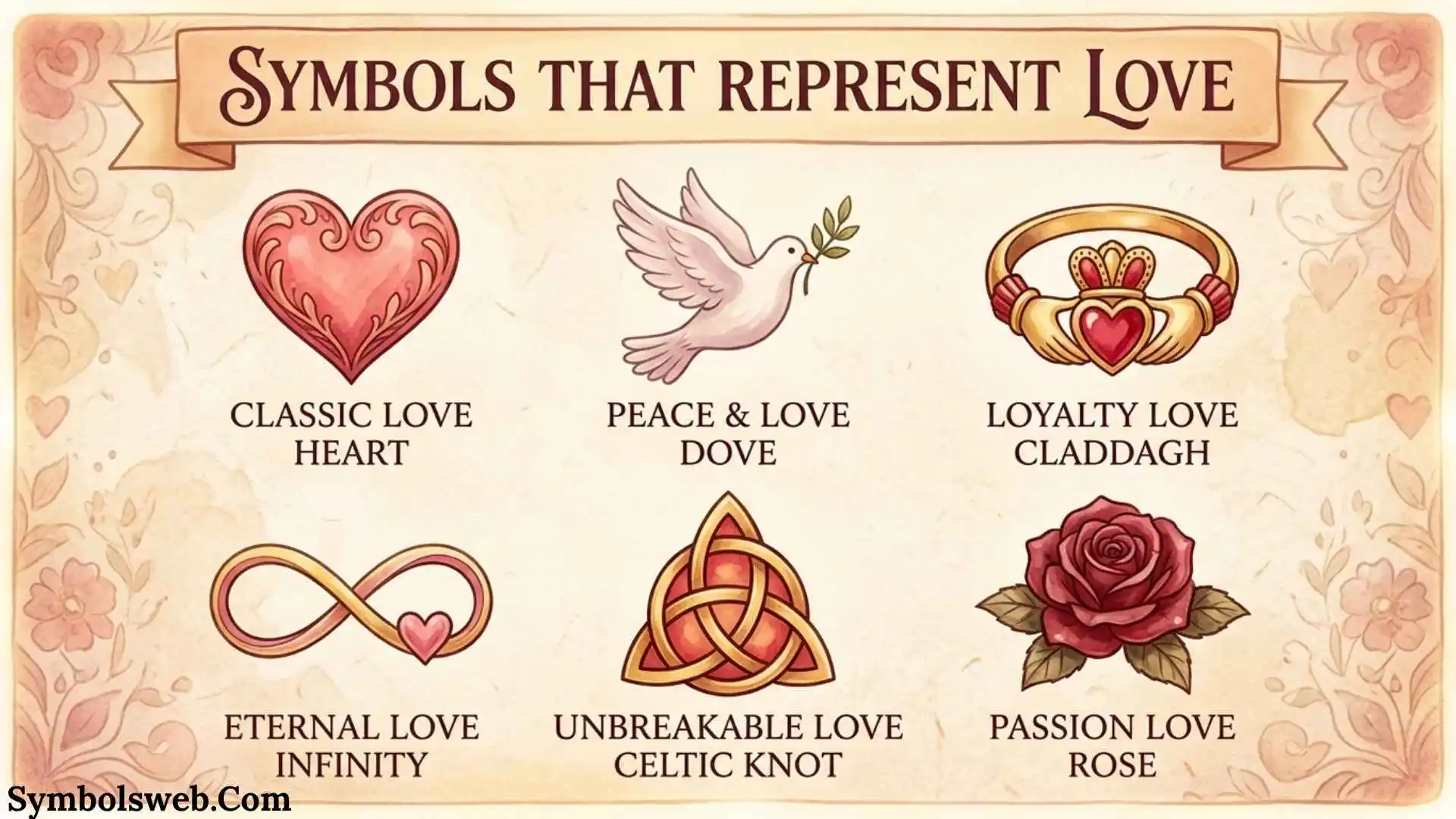
Symbols that represent love have helped people express feelings that words often cannot capture. From the familiar heart and red rose to ancient Egyptian knots, Greek doves, Chinese mandarin ducks, and the Ghanaian Akoma, these symbols carry stories of affection, devotion, passion, loyalty, and spiritual connection.
Some are thousands of years old, while others became popular much more recently. What makes them fascinating is that the same simple image can hold very different meanings across cultures, religions, and generations.
Symbols That Represent Love: (Quick Answer)
Symbols that represent love are images, objects, animals, plants, or signs that communicate affection, romance, devotion, emotional connection, or spiritual love. Common examples include the heart, red rose, dove, cupid, wedding rings, swans, mandarin ducks, love knots, apples, and the lotus. Their meanings come from mythology, religion, art, history, psychology, and cultural traditions.
Also Check This Post: 63+ Yule Symbols: The Complete Guide to Their Meaning and Origins
Quick Facts About Symbols That Represent Love
| Aspect | Information |
| Origin | Love symbols developed across many ancient cultures rather than coming from one single tradition. |
| Historical Significance | Hearts, roses, doves, knots, rings, flowers, and love deities have appeared in art, mythology, jewelry, literature, and religious imagery for centuries. |
| Main Meaning | Love, affection, attraction, devotion, loyalty, intimacy, and emotional connection. |
| Spiritual Meaning | Divine love, union, compassion, devotion, transformation, purity, and connection between the individual and something greater. |
| Cultural Importance | Different cultures use different symbols to express romantic love, marriage, family bonds, fertility, friendship, or spiritual devotion. |
| Modern Usage | Tattoos, jewelry, wedding decorations, emojis, fashion, branding, social media, home décor, gifts, and personal art. |
What Are Symbols That Represent Love?
A symbol is an object, image, or figure that represents something beyond its literal form. The American Psychological Association defines a symbol as an object, figure, or image that represents something else. In literature and art, a rose, for example, can suggest beauty, love, femininity, or transience without being limited to one meaning.
Love symbols work in exactly this way. A heart is not literally love, and a rose does not physically contain romance. Instead, people have attached emotional meanings to these images over generations.
This is why symbols can communicate powerful feelings almost instantly. A person can see a red rose and understand romance without reading a sentence. A wedding ring can suggest commitment without a spoken promise. Two birds facing each other can suggest companionship or partnership.
How Love Symbols Developed
There was never one moment when humanity decided that a particular image would mean love. These meanings developed through mythology, religion, art, literature, customs, and repeated cultural use.
Ancient Egyptians, Greeks, and Romans all used images connected with affection, fertility, beauty, sexuality, marriage, and divine relationships. Archaeological and museum evidence also shows that jewelry was used as a language of affection in antiquity, including rings, cameos, bracelets, and other objects decorated with romantic imagery.
Over time, medieval courtly love, Renaissance art, Victorian flower language, Valentine’s Day traditions, advertising, movies, and modern digital communication helped transform older symbols into the familiar love imagery we know today.
Unique Symbols of Love
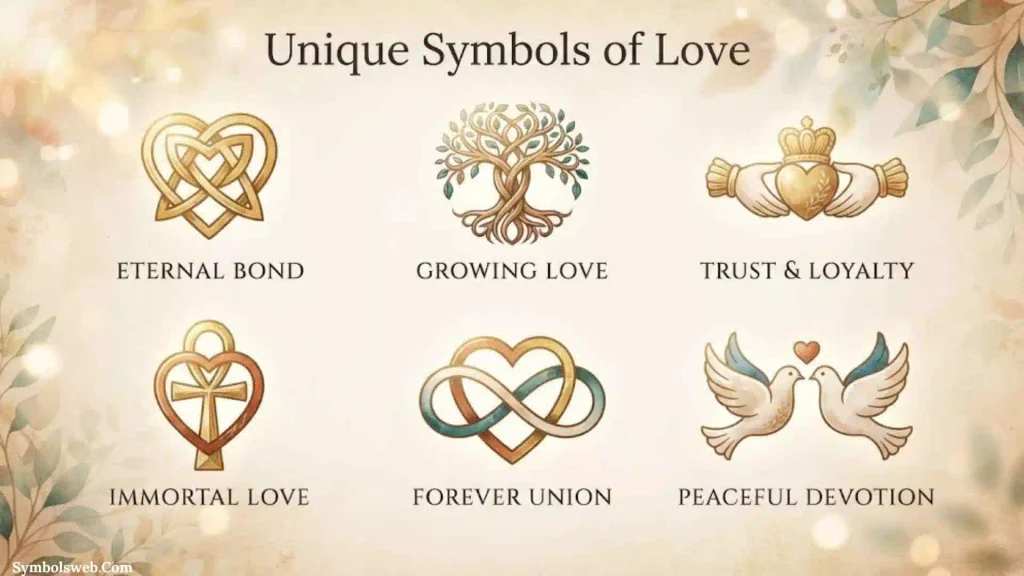
Love is a feeling that words cannot always explain. A simple symbol can express affection, devotion, and emotional connection in a beautiful way. From a heart to an infinity sign, these symbols help us share feelings that come straight from the heart.
In this guide, you’ll discover unique symbols of love and their meanings. Whether you want to express romance, celebrate friendship, or show love to your family, these symbols can help you share your feelings in a meaningful way.
Symbols of Love
Symbols of love have been used for centuries to express affection, commitment, and emotional connection. Some come from ancient traditions, while others have become popular through modern culture and everyday communication.
- Heart: The heart is one of the most universal symbols of love, affection, and romance.
- Red Rose: A red rose traditionally represents passionate love, desire, and deep affection.
- Infinity Symbol: The infinity sign represents endless love, lasting connection, and devotion.
- Cupid: Cupid is a familiar symbol of romantic attraction and falling in love.
- Doves: Doves often symbolize peace, affection, and faithful companionship.
- Claddagh Ring: This traditional Irish ring represents love, loyalty, and friendship.
- Swans: Swans are associated with romance, devotion, and lasting partnerships.
- Love Knots: Interwoven knots symbolize an enduring bond between two people.
These symbols can be used in jewelry, artwork, tattoos, wedding decorations, greeting cards, and thoughtful gifts. Their meanings may vary across cultures, but each offers a beautiful way to express love.
Symbols That Represent Love and Strength
Love and strength go hand in hand when two people support each other through life’s challenges. Some symbols represent not only affection but also courage, resilience, loyalty, and the ability to remain connected during difficult times.
- Oak Tree: An oak tree symbolizes strength, stability, and lasting love. Its deep roots can represent a relationship built on trust.
- Mountain: Mountains represent endurance, courage, and the strength needed to overcome challenges together.
- Anchor: An anchor symbolizes stability, security, and a love that provides emotional support.
- Lion: The lion is often associated with courage, protection, and strength within a loving relationship.
- Infinity Knot: An infinity knot can represent an enduring bond and the lasting strength of love.
- Red Garnet: Garnet is traditionally associated with passion, commitment, and devotion.
- Interlocking Rings: Two rings joined together symbolize unity, partnership, and the strength of a shared commitment.
- Tree of Life: The Tree of Life represents growth, connection, and the strong roots that help love flourish.
These symbols are meaningful for couples who have faced hardships together. They remind us that strong love is not only about happy moments but also about patience, understanding, and standing beside each other.
Symbols That Represent Love and Marriage
Marriage is a promise of love, partnership, and commitment. Many symbols associated with marriage express the idea of two people building a life together. They are commonly seen in wedding ceremonies, anniversary gifts, and romantic traditions.
- Wedding Rings: Wedding rings represent commitment, unity, and the promise of a lasting partnership.
- Claddagh Ring: The heart represents love, the hands represent friendship, and the crown represents loyalty.
- Interlocking Rings: Two connected rings symbolize the joining of two lives in marriage.
- White Doves: Doves are often used in weddings to represent peace, devotion, and harmony.
- Swans: Swans symbolize romantic partnership and are often associated with lasting companionship.
- Love Knot: A love knot represents an enduring bond and the connection between two married partners.
- Unity Candle: Lighting a unity candle during a wedding can symbolize two lives coming together as one.
- Double Hearts: Two hearts together represent mutual love, emotional unity, and a shared future.
These marriage symbols can add emotional meaning to wedding invitations, rings, decorations, and anniversary celebrations. The most meaningful symbol is often the one that reflects the couple’s own story.
Symbols of Love in Numbers
Numbers can carry romantic meanings through cultural traditions, wordplay, and modern texting. Some number symbols are widely recognized in love messages, while others have special meanings within particular cultures or communities.
143 — I Love You
The number 143 is a popular texting code for “I love you.” It comes from the number of letters in each word:
- I = 1 letter
- Love = 4 letters
- You = 3 letters
It is a simple and memorable way to send a romantic message.
1432 — I Love You Too
1432 is commonly used as a texting expression for “I love you too.” The final 2 is used to represent “too.”
520 — I Love You
In Chinese internet slang, 520 is associated with “I love you” because of its pronunciation in Mandarin. It is especially popular in digital romantic messages and online celebrations.
1314 — Forever
The number 1314 is associated with “forever” in Chinese internet culture because of its pronunciation. When paired with 520, the combination 5201314 can express the idea of “I love you forever.”
831 — I Love You
831 is sometimes used as a romantic texting code for “I love you.” A common interpretation is 8 letters, 3 words, and 1 meaning. It is used as a creative love message, although interpretations can vary.
14344 — I Love You Very Much
This number is sometimes used in texting to express “I love you very much.” Such codes are informal, and meanings may differ between online communities.
Numbers make love messages feel playful and personal. You can use them in texts, usernames, captions, or special dates to create a secret language between you and someone you love.
Symbols of Love in Text
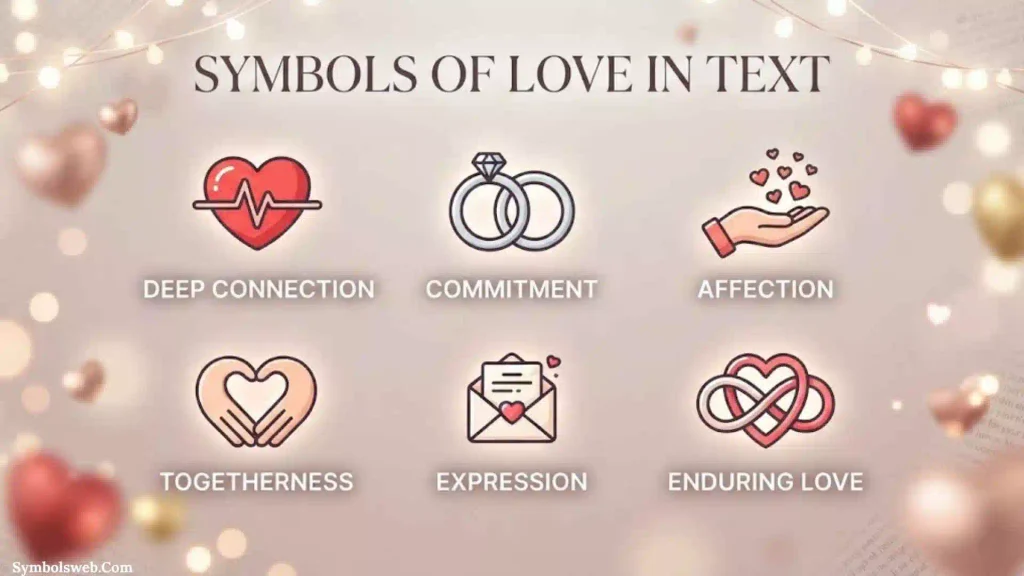
Text symbols are a modern way to express love through messages, social media captions, and online conversations. A simple heart or a few carefully chosen characters can communicate affection without needing a long paragraph.
Heart Emoji ❤️
The red heart emoji is one of the most common symbols of love in texting. It can express romantic affection, appreciation, care, or emotional closeness.
Broken Heart 💔
The broken heart emoji represents sadness, heartbreak, or emotional pain. It is often used when someone is missing a loved one or going through a difficult romantic experience.
Two Hearts 💕
The two hearts emoji can represent affection, emotional connection, and romantic feelings. It is often used in sweet messages between partners.
Sparkling Heart 💖
The sparkling heart emoji adds a playful and enthusiastic feeling to romantic messages. It can represent excitement, admiration, and affection.
Heart Hands 🫶
The heart hands emoji symbolizes love, support, appreciation, and kindness. It is often used to show care for friends, family, or a romantic partner.
Deep Symbolic Meaning of Symbols That Represent Love
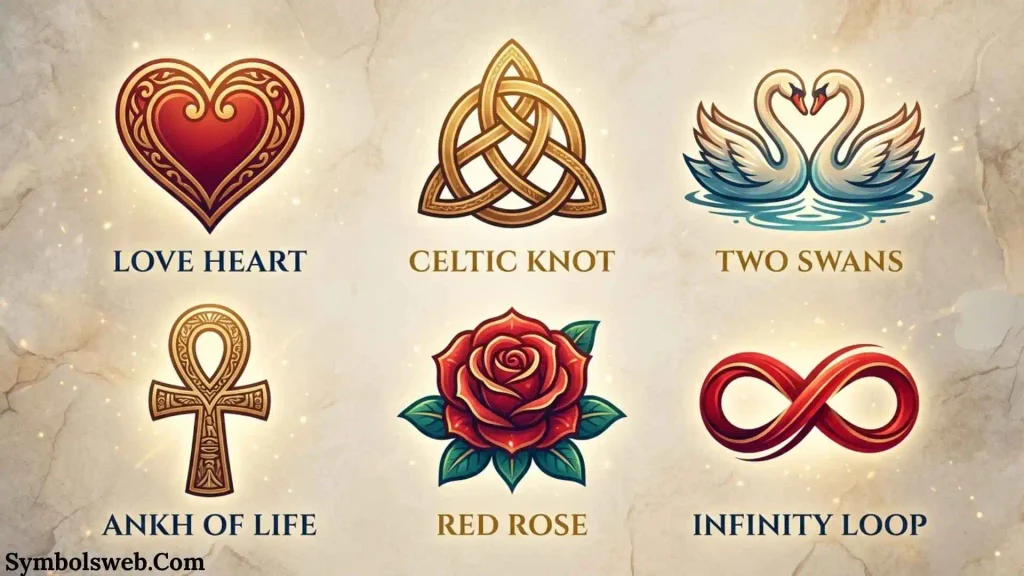
Love is not a single emotion. Psychology recognizes several forms of love, including romantic, parental, brotherly, erotic, self-love, and love directed toward humanity or the divine. Robert Sternberg’s triangular theory describes love through intimacy, passion, and commitment.
Because love itself has many dimensions, different symbols emphasize different parts of the experience.
Spiritual Meaning
At a spiritual level, love symbols can represent union, compassion, devotion, sacrifice, purity, renewal, and the relationship between the human soul and the divine.
For example, the lotus can symbolize purity and spiritual growth because it rises from muddy water and appears clean above the surface. In South Asian religious art, lotus imagery has a long history, and representations of Radha and Krishna may use lotus imagery in connection with divine love and devotional union.
The dove can carry a different spiritual message. In Christian iconography, it is strongly associated with the Holy Spirit, while the biblical story of Noah also connects the dove and olive leaf with restoration and peace.
The important point is that spiritual love does not always mean romance. It can mean compassion, devotion, selflessness, reconciliation, or a sense of connection with something greater than oneself.
Psychological Meaning
Psychologically, symbols can become powerful because humans connect images with memories, emotions, relationships, and learned cultural meanings.
A heart drawn on a card may remind someone of Valentine’s Day. A particular flower may remind another person of a parent, spouse, wedding, or childhood garden. The symbol becomes emotionally charged because of personal experience.
Jungian psychology gives another way to think about symbolism. Carl Jung argued that myths, dreams, religion, and art could express recurring symbolic patterns called archetypes. Modern summaries of Jung’s theory also stress that his idea of a collective unconscious and inherited archetypes is theoretical and difficult to test scientifically, so it should not be treated as established scientific fact.
This distinction matters. A symbol can be psychologically meaningful without having one universal hidden meaning.
Cultural Meaning
Culture determines what many symbols mean.
A red rose may communicate romantic passion in one setting. A pair of mandarin ducks may emphasize devoted partnership in Chinese culture. The Ghanaian Akoma symbol can represent love, unity, endurance, patience, tolerance, goodwill, and faithfulness.
This cultural layer explains why no single list of love symbols can be completely universal.
Types and Variations of Symbols That Represent Love
There are many ways people visually express love. Some symbols represent romance, while others focus on loyalty, marriage, fertility, spiritual devotion, or lasting connection.
1. The Heart
Visual description: A familiar shape with two rounded upper curves and a pointed bottom.
Meaning: Romantic love, affection, emotional connection, compassion, and devotion.
Symbolism: The heart is probably the most recognizable modern symbol of love. Its connection with love is old, but the familiar graphic shape did not simply come directly from the anatomical human heart.
The history of the heart symbol is complicated. Possible explanations include stylized anatomical drawings, medieval artistic traditions, ivy symbolism, and the seedpod of the ancient plant silphium. The exact origin remains debated.
The heart shape became increasingly connected with romantic love in medieval and Renaissance Europe. By later centuries it had become a standard part of love letters, Valentine’s cards, jewelry, and popular culture.
Where it appears: Valentine’s cards, emojis, tattoos, jewelry, wedding designs, paintings, advertisements, clothing, and social media.
2. The Red Rose
Visual description: A red flowering rose.
Meaning: Romantic love, passion, desire, beauty, and deep affection.
Symbolism: The red rose has become one of the strongest floral symbols of romantic love.
The association has roots in classical mythology. The rose was among the sacred plants associated with Aphrodite, the Greek goddess of love and beauty, and later with the Roman Venus.
The meaning became even more specific during the development of the Victorian language of flowers. In the nineteenth century, lovers could communicate feelings through carefully selected flowers. Red roses were associated with love, while different flowers and colors could communicate different messages.
Where it appears: Bouquets, weddings, Valentine’s Day, poetry, paintings, perfume, tattoos, jewelry, fashion, and romantic gifts.
3. The Dove
Visual description: Usually a white dove, sometimes holding an olive branch.
Meaning: Love, peace, purity, devotion, gentleness, and spiritual connection.
Symbolism: The dove has several overlapping traditions. In Greek mythology it was associated with Aphrodite, while Christian art uses the dove as a symbol of the Holy Spirit.
The dove can therefore represent love in both romantic and spiritual contexts.
Where it appears: Wedding stationery, religious art, tattoos, paintings, jewelry, poetry, and peace imagery.
4. Cupid and Eros
Visual description: A winged youth or child carrying a bow and arrows.
Meaning: Attraction, desire, romantic love, and sudden infatuation.
Symbolism: Eros was a Greek god associated with love and desire. In Roman tradition he became Cupid. Ancient and later artists frequently depicted him with wings and arrows, turning the idea of falling in love into a vivid visual story.
A person struck by Cupid’s arrow became a metaphor for the sudden and sometimes uncontrollable experience of romantic attraction.
Where it appears: Classical art, Renaissance paintings, Valentine’s decorations, jewelry, greeting cards, advertisements, and modern cartoons.
5. The Wedding Ring
Visual description: A circular band worn on a finger.
Meaning: Commitment, marriage, loyalty, continuity, and lasting love.
Symbolism: The circle has no obvious beginning or end, making it an intuitive image of continuity and permanence.
Rings also have a long history as relationship objects. Archaeological and museum evidence shows that ancient Greeks and Romans used jewelry, including rings with romantic inscriptions and imagery, as tokens of affection and declarations of love.
Medieval European traditions also developed ring forms such as fede rings, in which joined hands represented loyalty and marital union.
Where it appears: Engagements, weddings, anniversaries, jewelry, family heirlooms, and relationship ceremonies.
6. The Swan
Visual description: One swan or, more commonly, two swans facing each other.
Meaning: Devotion, partnership, grace, and romantic companionship.
Symbolism: Two swans facing each other can create a heart-like shape with their necks. Their graceful appearance has also made paired swans a popular metaphor for romantic partnership.
The symbol works especially well because the visual message is simple: two living beings moving toward one another.
Where it appears: Wedding décor, paintings, jewelry, tattoos, poetry, and romantic photography.
7. Mandarin Ducks
Visual description: A colorful male and female mandarin duck shown as a pair.
Meaning: Marital harmony, companionship, devotion, and partnership.
Symbolism: Mandarin ducks became associated with devoted couples in Chinese culture and later influenced related East Asian traditions. The belief that they mate for life is widespread but biologically inaccurate, which is a useful reminder that symbolic meanings do not always depend on scientific facts.
Paired mandarin ducks remain important in Asian decorative traditions and wedding symbolism.
Where it appears: Wedding art, ceramics, paintings, home décor, embroidery, jewelry, and traditional decorative objects.
8. The Love Knot
Visual description: Interwoven lines or knots with no obvious loose end.
Meaning: Eternal love, unity, loyalty, and an unbroken relationship.
Symbolism: The power of a knot comes from the idea of binding. Two separate strands become connected, creating a simple visual metaphor for two people joined together.
Knot imagery appears in many cultures, but specific knot designs should not automatically be treated as interchangeable. A Celtic knot, for example, belongs to particular artistic traditions, and modern claims about exact ancient meanings can sometimes go beyond the historical evidence.
Where it appears: Wedding jewelry, tattoos, rings, necklaces, embroidery, Celtic-inspired artwork, and modern relationship gifts.
9. The Apple
Visual description: A round fruit, often red or golden.
Meaning: Desire, beauty, attraction, fertility, temptation, and love.
Symbolism: The apple has many meanings rather than one fixed interpretation.
In Greek mythology, the golden apple appears prominently in the Judgment of Paris, a story involving Aphrodite, Hera, Athena, and the promise of Helen. Aphrodite’s connection with the apple helped make the fruit part of the classical visual vocabulary of beauty and desire.
Where it appears: Classical art, mythology, literature, paintings, jewelry, and symbolic storytelling.
10. The Lotus
Visual description: A flower rising above water, often shown open with symmetrical petals.
Meaning: Purity, spiritual love, devotion, renewal, fertility, and transformation.
Symbolism: The lotus is especially important in South Asian religious and artistic traditions.
Because the flower rises from muddy water while appearing fresh and clean, it became a powerful image of purity and transformation. In Radha and Krishna imagery, lotus symbolism can also suggest devotional union and divine love.
Where it appears: Hindu and Buddhist art, temples, meditation imagery, jewelry, tattoos, textiles, and contemporary spirituality.
11. The Akoma Heart
Visual description: A stylized heart-like form associated with the Akan people of Ghana.
Meaning: Love, unity, endurance, patience, understanding, faithfulness, and goodwill.
Symbolism: Akoma is especially interesting because it connects love with endurance rather than romance alone. The U.S. National Park Service explains that the symbol is associated with the Asante of present-day Ghana and represents love, unity, endurance, patience, tolerance, goodwill, and faithfulness.
Where it appears: Ghanaian cultural art, weddings, jewelry, textiles, architecture, and contemporary African-inspired design.
12. Joined Hands
Visual description: Two hands touching or clasping one another.
Meaning: Trust, partnership, marriage, loyalty, friendship, and mutual commitment.
Symbolism: Hands communicate action. A heart can express a feeling, but joined hands suggest that two people are actively choosing to stand together.
This is one reason hand imagery became important in European marriage symbolism. The medieval fede ring, for example, used joined hands as a visual expression of loyalty and union.
13. The Infinity Symbol
Visual description: A sideways figure eight.
Meaning: Endless love, eternity, continuity, and an unbreakable bond.
Symbolism: The infinity symbol is a relatively modern mathematical sign that has been adopted into popular romantic symbolism. Its meaning in love is straightforward: a relationship that continues without an apparent end.
Unlike the heart or rose, its romantic meaning is largely a modern symbolic extension rather than an ancient love tradition.
14. The Lovebird
Visual description: Two small birds sitting close together.
Meaning: Affection, companionship, romantic partnership, and emotional closeness.
Symbolism: Birds naturally lend themselves to love symbolism because pairs can be observed nesting, feeding, and remaining close. The idea of two birds together became a simple metaphor for two people in love.
This is also related to the wider tradition of paired birds in Asian and European art.
15. The Heart-Shaped Lock and Key
Visual description: A heart-shaped lock paired with a small key.
Meaning: Trust, emotional intimacy, exclusivity, and giving someone access to your heart.
Symbolism: The metaphor is modern but powerful. The lock represents the protected inner self, while the key represents the person trusted to enter it.
This is why lock-and-key jewelry is often exchanged between romantic partners.
Symbols That Represent Love Across Different Cultures
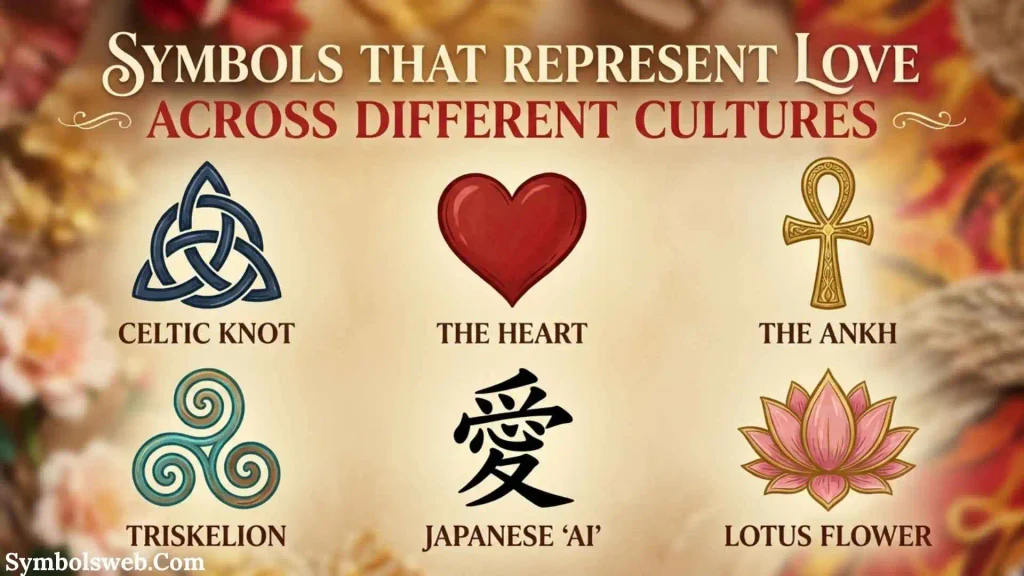
Love is universal as a human experience, but the images used to express it are not universal.
Ancient Egypt
Ancient Egyptian culture used many symbols related to life, fertility, protection, divine relationships, and renewal. The ankh, for example, represented life and eternal life rather than romantic love specifically. Its symbolism included ideas of life, eternity, and the union of opposites.
The Egyptian goddess Isis is particularly important when discussing devotion and enduring relationships. Egyptian mythology tells of Isis grieving for her husband Osiris and restoring him after his death. The British Museum notes that Egyptian tradition associated Isis with healing and that stories of her grief for Osiris were connected with the annual Nile floods.
For this reason, Egyptian symbolism can help us understand love as loyalty, protection, grief, restoration, and devotion rather than simply romance.
Ancient Greece
Ancient Greece gave Western culture some of its most famous love symbols.
Aphrodite was the goddess of love, beauty, pleasure, and procreation. Her attributes included the dove, apple, scallop shell, mirror, and other objects and creatures associated with beauty and desire. The rose and myrtle were also sacred to her.
Eros represented desire and became one of the most recognizable figures in the visual history of romantic attraction.
Greek mythology therefore gave love a large symbolic vocabulary: the rose for beauty and passion, the dove for Aphrodite, the apple for desire and beauty, and Eros for the sudden force of attraction.
Roman Culture
Roman culture inherited and adapted many Greek traditions.
Aphrodite became Venus, while Eros became Cupid. Roman art and jewelry frequently used these figures and their attributes to represent beauty, desire, fertility, and romance.
Jewelry was an important part of this symbolic language. Ancient Roman and Greek jewelry included rings and other objects carrying romantic imagery or inscriptions.
Eastern Traditions
Eastern cultures contain a wide range of love symbolism, so it is better to speak about specific traditions rather than treating Asia as one single symbolic system.
In Chinese culture, paired mandarin ducks became symbols of devoted couples and marital harmony.
In Indian religious art, Radha and Krishna provide a powerful example of love interpreted through devotion. Their relationship can represent the soul’s longing for and union with the divine within particular devotional traditions. Lotus imagery is also closely connected with purity, fertility, and sacred imagery.
This shows how love can move beyond romantic attraction and become a metaphor for spiritual longing.
Indigenous Traditions
Indigenous cultures should never be treated as one single symbolic tradition. Different nations, peoples, languages, and communities have their own histories and meanings.
For example, the National Park Service describes the Akoma symbol of the Asante in present-day Ghana as representing love, unity, endurance, patience, tolerance, goodwill, and faithfulness.
In North American Indigenous art, symbols and their meanings also vary significantly between tribal cultures. Educational material from the University of Michigan specifically warns that interpretations vary across Native American traditions.
This is an important lesson for anyone using Indigenous symbols in tattoos, fashion, or design: cultural context matters.
Modern Interpretations
Modern culture has created a shared visual language through movies, advertising, social media, emojis, greeting cards, jewelry, and fashion.
The heart is now instantly understood online. A rose can still mean romance. A ring can mean commitment. Two swans can represent partnership. A pair of birds can suggest companionship.
Digital culture has made these symbols faster and more universal, but it has also simplified them. A heart emoji may communicate affection in seconds, while a historical heart symbol can carry centuries of religious, artistic, and cultural associations.
Also Check This Post: 99+ Symbols for Change: The Ultimate Guide to Their Meanings
Similar Symbols and Their Meanings
Many love symbols appear similar, but their meanings are not identical.
| Symbol | Main Meaning | Type of Love Most Often Suggested |
| Heart | Affection and emotional love | Romantic and general love |
| Red rose | Passion and deep affection | Romantic love |
| Dove | Peace, purity, devotion | Romantic and spiritual |
| Cupid | Attraction and desire | Romantic love |
| Wedding ring | Commitment and continuity | Marriage and lasting love |
| Swan pair | Partnership and devotion | Romantic companionship |
| Mandarin ducks | Marital harmony | Marriage and partnership |
| Love knot | Unbroken connection | Eternal love and loyalty |
| Lotus | Purity and transformation | Spiritual love |
| Akoma | Love, endurance, unity | Community and committed love |
| Apple | Beauty and desire | Attraction and romantic desire |
| Joined hands | Trust and partnership | Marriage, friendship, and commitment |
| Infinity | Endless connection | Eternal love |
Heart vs. Rose
The heart usually represents the feeling of love itself.
The red rose tends to express the intensity, beauty, and passion associated with romantic love.
Dove vs. Swan
A dove can carry religious and peace-related meanings in addition to romantic symbolism.
A pair of swans is more strongly associated with partnership and romantic companionship in modern visual culture.
Cupid vs. Heart
Cupid represents the force that causes attraction.
The heart represents the emotional state that follows.
That distinction explains why Cupid is often shown shooting an arrow while the heart appears as the emotional result.
Symbols That Represent Love in Mythology and Folklore
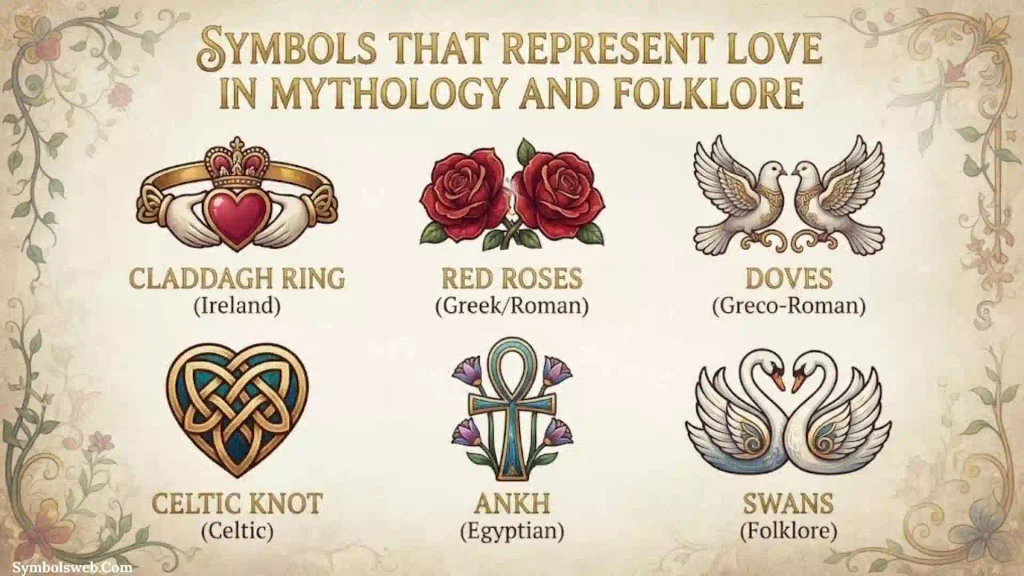
Mythology helped turn abstract emotions into stories people could remember.
Aphrodite and the Rose
Aphrodite’s relationship with the rose helped connect the flower with beauty, desire, and romantic attraction. Ancient sources associate the goddess with roses, myrtle, apples, doves, and other symbols.
Over centuries, artists could show Aphrodite with these attributes and allow viewers to recognize the theme of love without needing written explanation.
Eros and the Arrow
The image of Eros or Cupid firing an arrow created one of the most enduring metaphors for falling in love.
The arrow suggests that attraction can arrive suddenly. You may not plan it. You may not expect it. One moment you are simply living your life, and the next moment another person seems to occupy your thoughts.
That simple visual metaphor remains alive in Valentine’s Day imagery today.
Isis and Osiris
The story of Isis and Osiris offers a different understanding of love.
Instead of focusing on sudden attraction, the story emphasizes loyalty, grief, restoration, and devotion. The British Museum describes Isis as the mother of Horus and notes the mythological connection between her tears for Osiris and the Nile’s annual flooding.
This helps explain why ancient love symbolism often went far beyond romance.
Radha and Krishna
Radha and Krishna provide one of the most famous examples of love interpreted spiritually in South Asian devotional traditions.
Their relationship can symbolize the longing of the individual soul for divine union. Lotus imagery in their artistic representations can reinforce themes of purity, devotion, fertility, and sacred beauty.
Mandarin Duck Folklore
Chinese traditions surrounding mandarin ducks show how an animal can become a cultural metaphor for partnership.
The birds were believed to mate for life, and this belief helped establish them as symbols of devoted couples. The symbolism later spread into related East Asian cultural contexts.
Symbols That Represent Love in Art, Literature, Movies and Pop Culture
Love symbols survive because artists constantly reinterpret them.
In Paintings
Roses, hearts, doves, lovers, joined hands, mirrors, flowers, and mythological figures have appeared throughout European and Asian art.
Classical artists could use Aphrodite’s attributes to signal beauty and desire. Religious artists could use the dove to suggest divine presence. Later artists could use roses and hearts to make romantic themes immediately recognizable.
In Literature
Writers often use love symbols as emotional shortcuts.
A rose can stand for beauty, desire, fragility, or a beloved person. The heart can represent emotional vulnerability. A knot can represent an attachment that is difficult to break.
The medieval Roman de la Rose is a particularly important example. The rose became a central literary image for the beloved and the complicated experience of love. The tradition helped strengthen the connection between roses and romantic symbolism in European culture.
In Poetry
Poets often use nature as the language of love.
Flowers bloom and fade. Birds pair together. Hearts beat. Rings form circles. These physical images give writers ways to describe emotions that are difficult to measure.
In Movies and Television
Modern film has inherited almost every classic love symbol.
A character may give a rose, exchange a ring, receive a love letter, hold hands, or stand beneath a symbolic image of hearts or flowers.
Because audiences already understand these symbols, filmmakers can communicate emotional information without lengthy dialogue.
In Tattoos
Love symbols are popular tattoo choices because tattoos can preserve a personal memory.
A heart may represent a partner or family member. A rose can symbolize passion, remembrance, or a particular person. An infinity symbol can represent lasting connection.
However, cultural symbols should be researched before being used permanently, especially Indigenous, religious, or ceremonial imagery.
In Fashion and Jewelry
Jewelry has been expressing affection for thousands of years.
Ancient Greek and Roman jewelry included romantic motifs, inscriptions, carved gemstones, and rings used as tokens of affection.
Today, hearts, infinity signs, lock-and-key designs, roses, initials, and paired symbols continue this tradition.
Spiritual and Dream Meaning of Symbols That Represent Love
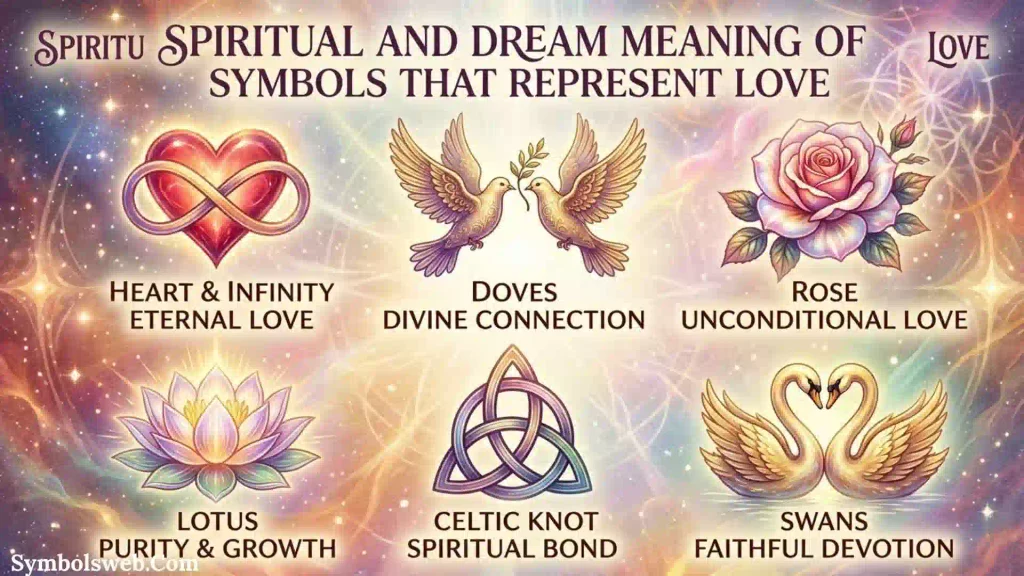
Dream symbolism is personal, so there is no scientifically proven dictionary in which every symbol has one fixed meaning.
Still, people often interpret love-related symbols through personal memories, cultural traditions, and spiritual beliefs.
Dreaming of a Heart
A heart in a dream may remind you of affection, emotional vulnerability, a relationship, compassion, or a desire for closeness.
The person connected with the dream may matter more than the symbol itself.
Dreaming of a Rose
A rose may evoke romance, beauty, passion, admiration, or remembrance.
A fresh red rose may feel very different from a dead or thorn-covered rose.
The emotional atmosphere of the dream is therefore important.
Dreaming of a Dove
A dove may suggest peace, reconciliation, spiritual comfort, innocence, or a desire for emotional calm.
In Christian contexts, it may also connect with the Holy Spirit because of established biblical and artistic symbolism.
Dreaming of a Ring
A ring may represent commitment, promises, responsibility, marriage, or an emotional bond.
But it can also symbolize feeling trapped if the dream itself feels uncomfortable.
Love Symbols During Meditation
During meditation or spiritual practice, people may encounter images that feel meaningful to them. These experiences can be personally important without proving that the image carries one universal supernatural message.
A useful approach is to ask:
- What emotion did the symbol create?
- Who or what did it remind me of?
- What was happening around the symbol?
- Does the image have a religious or cultural meaning in my tradition?
- Does the symbol connect with something happening in my life?
This approach respects spiritual experience without pretending that subjective symbolism is a scientific prediction system.
Positive and Negative Meanings of Symbols That Represent Love
A symbol associated with love does not always carry a positive meaning.
Love can include joy, but it can also involve jealousy, grief, longing, obsession, loss, and vulnerability.
| Positive Meaning | Negative or Cautionary Meaning |
| Affection | Obsession |
| Passion | Jealousy |
| Devotion | Possessiveness |
| Commitment | Feeling trapped |
| Unity | Loss of individuality |
| Intimacy | Emotional vulnerability |
| Loyalty | Fear of abandonment |
| Beauty | Idealization |
| Spiritual connection | Escapism |
| Eternal love | Difficulty accepting change |
Why One Symbol Can Have Two Sides
Consider the rose.
Its beauty can represent romance and admiration. Its thorns can remind us that love can hurt.
Consider the heart.
It can represent warmth and intimacy, but the phrase “broken heart” shows how easily the same symbol can express grief.
Consider the ring.
It can represent a beautiful lifelong commitment, but someone in an unhealthy relationship may experience the same object as a symbol of pressure or restriction.
Symbolic meaning depends on context.
Why Humans Are Attracted to Symbols That Represent Love
Humans naturally look for meaning in images, stories, patterns, and objects.
The psychology of love helps explain why these symbols can feel powerful. Love involves affection, intimacy, desire, commitment, and attention to another person’s well-being.
A symbol gives these complicated experiences a visible form.
Symbols Make Invisible Feelings Visible
You cannot physically see devotion.
You can see a wedding ring.
You cannot hold commitment in your hand.
You can hold a necklace given by someone you love.
You cannot photograph longing.
You can photograph two people holding hands.
This is the emotional power of symbolism.
Symbols Create Emotional Associations
Suppose someone receives a red rose during an important moment in their life. Years later, seeing the same flower may bring back memories of that event.
The flower has become more than a flower.
It has become a container for memory.
Pattern Recognition Matters
Humans are highly responsive to patterns and visual cues. Once a culture repeatedly connects a particular image with an emotion, people can learn to recognize that association quickly.
Color also plays a role. Research discussed by the American Psychological Association has found broad links between colors and emotions across many countries, although cultural differences also exist. Red, for example, is commonly associated with both love and anger.
Cultural Memory Makes Symbols Stronger
A heart becomes more powerful because generations have used it.
Children see hearts in Valentine’s cards. Teenagers use heart emojis. Adults give heart-shaped jewelry. Artists paint hearts. Advertisers use them.
Every repetition strengthens recognition.
Modern Uses of Symbols That Represent Love
Love symbols are not relics of ancient history. They remain part of everyday life.
Tattoos
People use hearts, roses, initials, wedding dates, infinity symbols, birds, and meaningful cultural designs to represent relationships and memories.
Jewelry
Heart necklaces, rings, lock-and-key pendants, birthstone jewelry, engraved bracelets, and matching pieces continue the ancient tradition of using objects as emotional tokens.
Fashion
Love symbols appear on clothing, bags, shoes, accessories, scarves, and seasonal Valentine’s collections.
Branding
Brands often use hearts, rounded shapes, warm colors, flowers, or paired forms to suggest friendliness, care, community, or affection.
A heart does not automatically mean romantic love in branding. It can also represent healthcare, charity, friendship, kindness, or social connection.
Social Media
The heart has become one of the central symbols of digital communication.
A single heart can mean:
- I love this.
- I care about you.
- Thank you.
- I support you.
- This made me happy.
- I agree.
- I miss you.
The meaning depends heavily on the relationship between the people communicating.
Contemporary Spirituality
Lotuses, hearts, doves, circles, paired figures, and other symbols are widely used in modern spiritual spaces.
Some people use them to represent self-love, compassion, healing, divine connection, or emotional growth.
Home Décor
Love symbols also appear in wedding decorations, bedroom décor, wall art, candles, ornaments, sculptures, and personalized gifts.
A symbol can turn an ordinary object into a reminder of a relationship or personal value.
Interesting Facts About Symbols That Represent Love
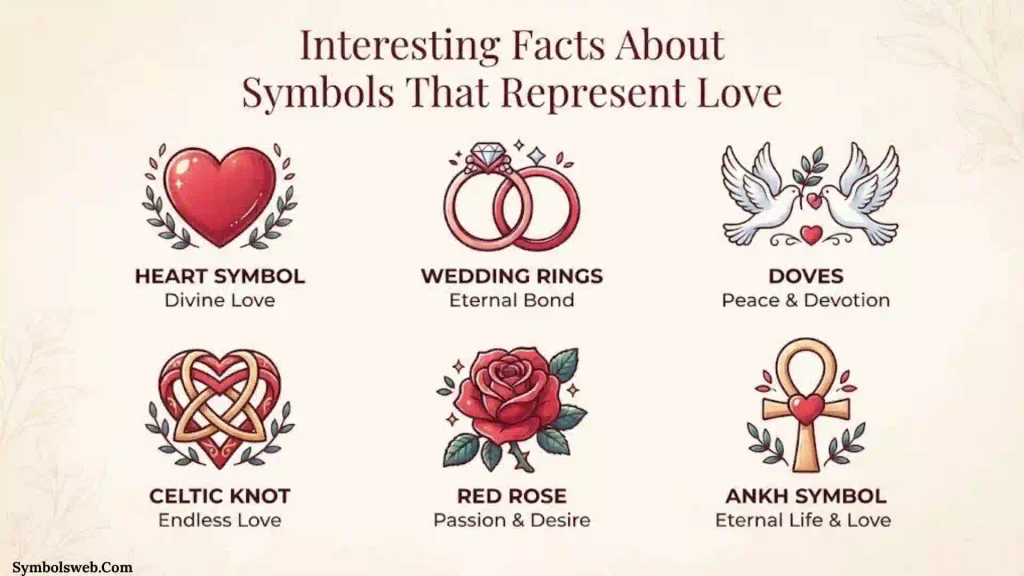
- The modern heart shape does not closely match the anatomical human heart. Its exact origin is still debated, with several historical theories competing to explain how it became a symbol of love.
- The ancient plant silphium may be connected to the heart symbol. Its seedpod appeared on coins from Cyrene, and the plant had associations with sexuality and contraception, although the claim that it directly created the modern heart symbol remains a theory rather than an established fact.
- The red rose has a long mythological history. Roses were among the plants associated with Aphrodite in Greek tradition.
- Victorian lovers used flowers as coded messages. Floriography became fashionable in Britain and America during the nineteenth century, allowing people to communicate feelings through bouquets.
- Mandarin ducks became symbols of devoted couples in Chinese culture. The symbolism was strengthened by the traditional belief that the birds mate for life, although that belief is not biologically accurate.
- The Akoma symbol connects love with endurance. In Asante symbolism, it represents love, unity, patience, tolerance, faithfulness, and understanding.
- Ancient people used jewelry to express love. Greek and Roman rings, gemstones, and other jewelry could carry romantic imagery or inscriptions.
- The dove has meanings beyond romance. In Christian iconography, it is strongly connected with the Holy Spirit, while the Noah story contributes to its association with restoration and peace.
- The lotus can symbolize love without being primarily a romantic symbol. In South Asian religious art, it can represent purity, fertility, devotion, and sacred union.
- Love symbolism is not limited to romantic relationships. Psychology recognizes forms of love including parental love, brotherly love, self-love, erotic love, companionate love, and love directed toward humanity or the divine.
Frequently Asked Questions
What is the most universal symbol of love?
The heart is arguably the most widely recognized modern symbol of love. It is used across cards, jewelry, emojis, tattoos, advertisements, and popular culture. However, its historical development is complex, and its exact origin remains debated.
What flower symbolizes love?
The red rose is one of the strongest and most widely recognized flowers associated with romantic love and passion. Its symbolism has roots in classical traditions and was reinforced by the Victorian language of flowers.
What animal symbolizes love?
Several animals can symbolize love depending on the culture. Doves, swans, mandarin ducks, and paired birds are common examples. Mandarin ducks are especially associated with devoted couples in Chinese culture, while doves have both romantic and spiritual associations.
What symbolizes eternal love?
Common symbols of eternal love include wedding rings, infinity signs, love knots, paired animals, and circles. The meaning usually comes from ideas of continuity, loyalty, unity, or an unbroken bond.
What is the spiritual symbol of love?
There is no single universal spiritual symbol of love. Hearts, lotuses, doves, sacred unions, flowers, and religious symbols can all represent different forms of spiritual love. In South Asian devotional traditions, for example, Radha and Krishna can represent divine love and the soul’s longing for God.
What symbol represents unconditional love?
There is no universally agreed symbol for unconditional love. Hearts, infinity symbols, mother-and-child imagery, lotus flowers, and certain religious symbols are often used to express selfless or enduring love. The exact meaning depends on the cultural and personal context.
Conclusion
Symbols that represent love are much more than decorative images. A heart can carry centuries of emotional history, while a rose can connect modern romance with ancient mythology and Victorian tradition. A ring can turn commitment into something visible, and a lotus can transform love into a symbol of spiritual growth.
The most powerful love symbols remind us that human beings have always searched for ways to make invisible feelings visible. In the end, the meaning of a symbol is not only found in its shape, but also in the memories, relationships, cultures, and stories we give it.
Also Check This Post: 111+ Engineering Drawing Symbols: Types Meanings & Uses Explained

Eliana Foster is a writer with a passion for exploring the meanings behind symbols, traditions, and cultural history. She enjoys breaking down complex topics into simple, engaging articles that are easy for everyone to understand. Eliana is also the fictional author of The Hidden Language of Silent Marks and Beyond the Circle of Ancient Signs, two original book concepts created for her author profile. When she’s not writing, she loves visiting museums, reading about mythology, and researching the stories behind symbols from around the world. Her goal is to help readers discover the fascinating meanings hidden in everyday signs and ancient emblems.
 Jordan Hayes
 Ethan Holloway