Law symbols are far more than decorative images carved into courthouses or printed on legal documents. They represent humanity’s centuries-long pursuit of justice, fairness, order, and truth.
Across civilizations, these symbols have inspired trust, authority, and moral responsibility. From ancient temples to modern courtrooms, law symbols reveal fascinating stories about how societies understand right and wrong, power and accountability, and the delicate balance between freedom and order.
Law Symbols: (Quick Answer)
Law symbols are visual representations that communicate justice, authority, fairness, truth, and legal order. Common law symbols include the scales of justice, the gavel, the blindfold, legal books, and the sword. These symbols have historical roots in ancient civilizations and continue to represent the principles of equality, accountability, and the rule of law in modern legal systems.
Quick Facts About Law Symbols
| Aspect | Information |
| Origin | Ancient Egypt, Mesopotamia, Greece, and Rome |
| Historical Significance | Represented justice, truth, order, and governance |
| Main Meaning | Fairness, equality, legal authority, and accountability |
| Spiritual Meaning | Moral balance, divine justice, truth, and righteousness |
| Cultural Importance | Symbolizes social order and protection of rights |
| Modern Usage | Courts, law firms, legal documents, government institutions, education |
What Are Law Symbols?
Law symbols are visual images, objects, figures, or icons used to represent legal principles and justice systems. They help communicate complex ideas about law in a simple and universally understood way.
Throughout history, societies have relied on symbols to express values that words alone could not fully capture. Law symbols emerged because justice is both practical and philosophical. People needed visible reminders of fairness, truth, authority, and responsibility.
The earliest legal symbols appeared thousands of years ago. Ancient Egyptian civilization associated justice with the goddess Ma’at, who embodied truth and cosmic order. Ancient Greeks worshipped Themis, the divine guardian of law and fairness. Romans later adapted these ideas into legal institutions that influenced modern legal systems.
Over time, law symbols evolved from religious and mythological imagery into recognizable emblems used in courts, governments, universities, and legal professions worldwide.
Today, they continue to inspire confidence in legal systems and remind society that justice should be impartial and fair.
Also Check This Post: 61+ Sign Language Symbols: Meanings, History, Cultural Significance, and Hidden Communication Power
Deep Symbolic Meaning of Law Symbols
Spiritual Level
At a spiritual level, law symbols often represent the belief that justice is greater than individual interests.
Many traditions teach that moral laws exist beyond human-made rules. Law symbols remind people that actions have consequences and that truth ultimately matters.
Spiritually, law symbols often signify:
- Divine justice
- Moral responsibility
- Truth and integrity
- Universal balance
- Ethical behavior
The scales, for example, symbolize the balancing of actions and consequences. They suggest that fairness is part of a larger cosmic order.
Inner Transformation
Law symbols also encourage self-reflection.
Before judging others, many spiritual traditions emphasize judging oneself honestly. The symbolic scales become a metaphor for examining one’s own actions and character.
Psychological Level
Psychologists often view symbols as expressions of deep human archetypes.
According to the theories of psychologist Carl Jung, symbols connect with the collective unconscious, which contains shared patterns and meanings across humanity.
Law symbols activate several powerful archetypes:
- The Judge
- The Wise Elder
- The Protector
- The Guardian of Order
These archetypes explain why people instinctively recognize legal symbols.
Human Emotions and Justice
Humans naturally seek fairness.
Even young children react strongly when something feels unfair. Law symbols tap into this emotional need for balance and equality.
When people see a courthouse bearing legal symbols, they often experience feelings of:
- Trust
- Security
- Accountability
- Respect
- Stability
Cultural Level
Culturally, law symbols reinforce social order.
Every society creates systems to resolve disputes and maintain harmony. Law symbols help communicate shared values and expectations.
For example:
- Courts display legal symbols to demonstrate authority.
- Governments use them to represent legitimacy.
- Citizens view them as signs of protection and fairness.
These symbols become collective reminders that society functions best when rules apply equally to everyone.
Types and Variations of Law Symbols
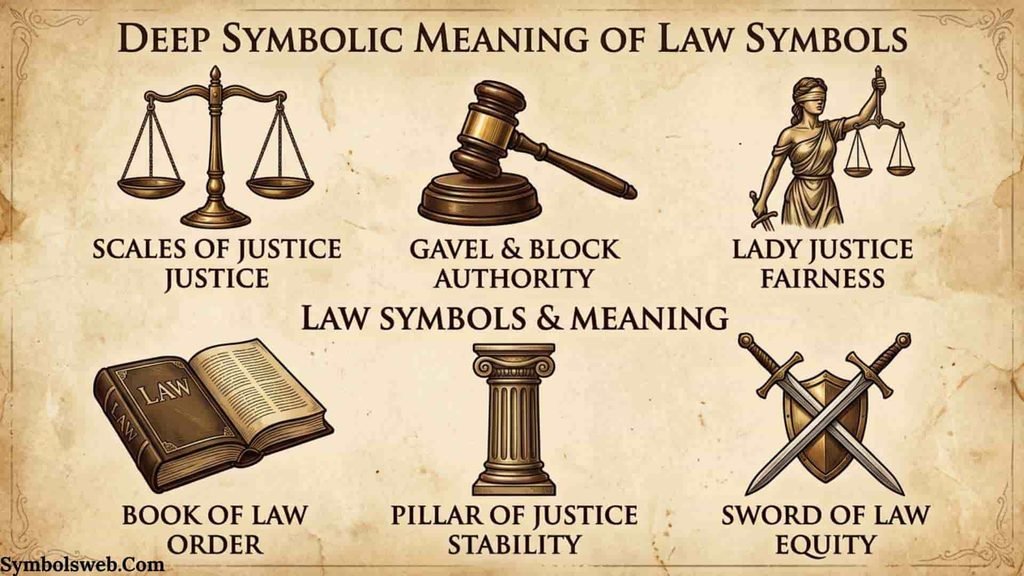
1. Scales of Justice
Visual Description
A balanced scale with two equal weighing pans.
Meaning
Fairness and impartial judgment.
Symbolism
Every argument and piece of evidence should be weighed equally.
Cultural Connection
Rooted in ancient Egyptian, Greek, and Roman traditions.
Where It Appears
- Courthouses
- Legal logos
- Statues
- Government seals
2. Lady Justice
Visual Description
A woman holding scales and a sword, often blindfolded.
Meaning
Impartial justice.
Symbolism
Law should apply equally to all people.
Cultural Connection
Derived from Greek Themis and Roman Justitia.
Where It Appears
- Court buildings
- Legal monuments
- Government institutions
3. The Blindfold
Visual Description
A cloth covering Lady Justice’s eyes.
Meaning
Neutrality and equality.
Symbolism
Justice should not be influenced by wealth, power, race, or status.
Cultural Connection
Became popular in European legal art during the Renaissance.
Where It Appears
- Statues
- Court artwork
- Legal illustrations
4. The Sword
Visual Description
A raised sword held by Lady Justice.
Meaning
Authority and enforcement.
Symbolism
Justice requires action and consequences.
Cultural Connection
Ancient rulers often carried swords as symbols of legal authority.
Where It Appears
- Statues
- Government insignia
- Judicial emblems
5. The Gavel
Visual Description
A small wooden hammer.
Meaning
Judicial authority.
Symbolism
Final decisions and legal order.
Cultural Connection
Most commonly associated with modern courtrooms.
Where It Appears
- Courts
- Arbitration hearings
- Legal education
6. Legal Books
Visual Description
Books or scrolls containing laws.
Meaning
Knowledge and legal tradition.
Symbolism
The written foundation of justice.
Cultural Connection
Ancient legal codes such as the Code of Hammurabi influenced this symbol.
Where It Appears
- Law schools
- Libraries
- Legal logos
Law Symbols Across Different Cultures
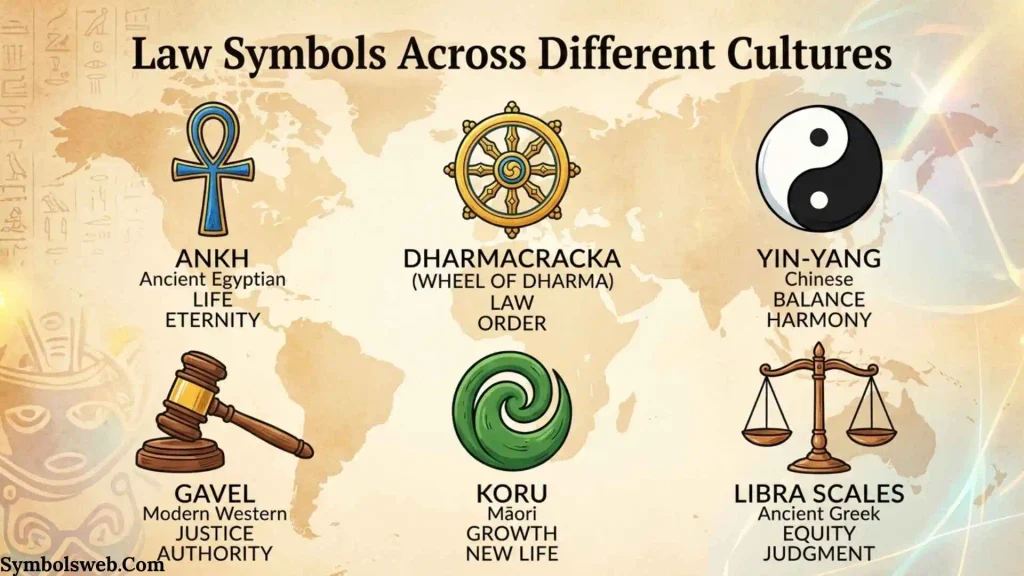
Ancient Egypt
Ancient Egyptians associated justice with Ma’at.
Ma’at represented:
- Truth
- Balance
- Harmony
- Cosmic order
During the afterlife judgment, a person’s heart was weighed against Ma’at’s feather. This became one of history’s earliest symbolic representations of justice.
Ancient Greece
Greek culture honored Themis, the goddess of divine law.
She represented:
- Wisdom
- Fair judgment
- Natural order
Many modern legal symbols trace directly back to Greek mythology.
Roman Culture
Romans transformed symbolic ideas into structured legal systems.
The goddess Justitia became a powerful symbol of:
- Judicial fairness
- Civic responsibility
- State authority
Modern Lady Justice largely descends from Roman imagery.
Eastern Traditions
In many Eastern philosophies, justice is connected with balance and harmony.
Concepts such as:
- Karma
- Moral accountability
- Social harmony
reflect legal and ethical principles similar to Western law symbols.
Indigenous Traditions
Many Indigenous cultures emphasize restorative justice.
Rather than punishment alone, justice seeks:
- Healing
- Community balance
- Reconciliation
Symbols often include circles, councils, and sacred gatherings representing collective wisdom.
Modern Interpretations
Today, law symbols represent:
- Human rights
- Equality before the law
- Constitutional governance
- Democratic values
They continue evolving alongside modern legal systems.
Also Check This Post: 63+ Alchemy Symbols and Meanings: The Hidden Language of Transformation, Wisdom, and Spiritual Power
Similar Symbols and Their Meanings
| Symbol | Similarity to Law Symbols | Difference |
| Balance Scale | Represents fairness | Broader meaning beyond law |
| Crown | Authority | Focuses on power rather than justice |
| Shield | Protection | Emphasizes defense instead of judgment |
| Feather of Ma’at | Truth and balance | More spiritual than legal |
| Torch | Enlightenment | Symbolizes knowledge rather than law |
Common Misconceptions
Many people assume the gavel is universally used in courts.
In reality, gavels are primarily associated with certain legal systems, particularly in North America, while many countries rarely use them in court proceedings.
Law Symbols in Mythology and Folklore
Law symbols appear throughout mythological traditions.
Themis
Themis was a Greek Titan associated with divine law and prophecy. She advised gods and maintained cosmic order.
Justitia
Roman mythology transformed justice into Justitia, who carried scales and a sword.
Ma’at
Egyptian mythology viewed justice as a universal force maintaining harmony throughout creation.
King Solomon
Biblical traditions often cite King Solomon’s famous judgment as a symbol of wisdom and fair legal reasoning.
These stories shaped how modern societies visualize justice and legal authority.
Law Symbols in Art, Literature, Movies, and Pop Culture
Paintings
Artists frequently depict Lady Justice as an idealized figure representing fairness and moral responsibility.
Literature
Law symbols appear in countless works exploring justice and power.
Examples include:
- Legal dramas
- Political novels
- Courtroom fiction
Poetry
Poets often use scales and swords as metaphors for truth, conscience, and moral judgment.
Movies and Television
Courtroom dramas regularly feature:
- Scales of justice
- Courthouse statues
- Legal seals
These symbols instantly communicate themes of justice and accountability.
Tattoos
Many people choose law-related tattoos to represent:
- Personal integrity
- Truth
- Fairness
- Professional identity
Fashion and Design
Law symbols increasingly appear in:
- Academic insignia
- Professional branding
- Jewelry
- Decorative artwork
Spiritual and Dream Meaning of Law Symbols
Dreams involving law symbols often reflect inner evaluation and decision-making.
Dreaming of Scales
May indicate:
- Seeking balance
- Weighing important choices
- Desire for fairness
Dreaming of a Sword
May symbolize:
- Truth
- Courage
- Difficult decisions
Dreaming of a Courtroom
Often suggests self-judgment or accountability.
Positive Messages
- Fair outcomes
- Moral clarity
- Wisdom
- Justice restored
Cautionary Messages
- Fear of judgment
- Unresolved guilt
- Imbalance in life
- Difficult consequences
Positive and Negative Meanings of Law Symbols
| Positive Meaning | Negative Meaning |
| Justice | Harsh judgment |
| Equality | Excessive rigidity |
| Truth | Legal oppression |
| Accountability | Abuse of authority |
| Order | Bureaucracy |
| Protection | Punishment |
| Fairness | Bias when misused |
A law symbol itself is neutral. Its meaning depends on how justice is applied. The same symbol can represent freedom or oppression depending on whether power is used responsibly.
Why Humans Are Attracted to Law Symbols
Humans are deeply drawn to law symbols because they satisfy fundamental psychological needs.
We want to believe:
- Fairness exists.
- Truth matters.
- Wrongdoing has consequences.
- Society can maintain order.
Law symbols visually reassure us that these values are protected.
From childhood, people learn concepts of fairness through stories, games, and social experiences. As adults, these ideas become embedded in culture and collective memory.
The scales, sword, and blindfold continue to resonate because they represent ideals that humans strive toward, even when reality falls short.
Modern Uses of Law Symbols
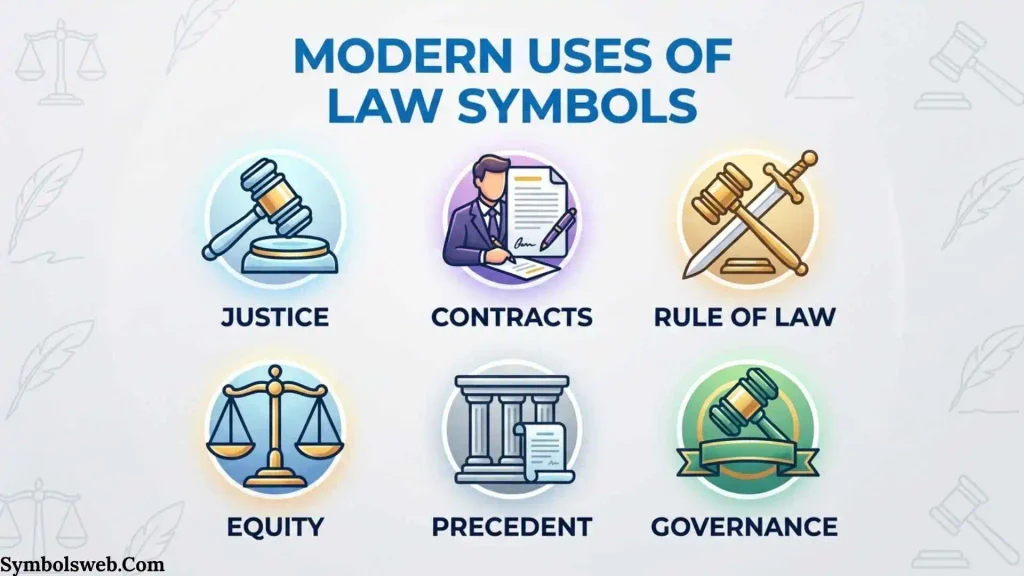
Tattoos
Popular among lawyers, judges, law students, and individuals who value justice.
Jewelry
Scales and Lady Justice pendants symbolize integrity and fairness.
Fashion
Legal imagery appears on clothing and accessories associated with empowerment and authority.
Branding
Law firms frequently use legal symbols to communicate trust and professionalism.
Social Media
Justice-related symbols often appear in advocacy campaigns and human rights movements.
Contemporary Spirituality
Many people view legal symbols as reminders of ethical living and personal accountability.
Home Decor
Artwork featuring scales or Lady Justice can symbolize wisdom and balance.
Interesting Facts About Law Symbols
- The scales of justice predate many modern legal systems by thousands of years.
- Lady Justice is one of the most recognized legal symbols worldwide.
- The blindfold was not part of the earliest depictions of justice.
- Ancient Egyptians linked justice directly to cosmic balance.
- The sword represents both authority and protection.
- Many legal symbols originated from mythology rather than actual courts.
- The concept of weighing evidence comes directly from the symbolism of scales.
- Some modern courthouses feature Lady Justice without a blindfold to symbolize transparency.
- Legal symbols appear in architecture more frequently than almost any other professional imagery.
- Justice symbols remain remarkably consistent across different cultures and centuries.
Frequently Asked Questions
What is the most common law symbol?
The scales of justice are the most widely recognized law symbol. They represent fairness, balance, and impartial judgment.
Why is Lady Justice blindfolded?
The blindfold symbolizes impartiality. It signifies that justice should not be influenced by wealth, status, race, gender, or power.
What does the sword of justice represent?
The sword represents authority, protection, truth, and the power to enforce legal decisions.
Are law symbols religious or secular?
They can be both. Many originated from religious and mythological traditions but are now widely used in secular legal systems.
What is the spiritual meaning of law symbols?
Spiritually, law symbols often represent moral balance, truth, accountability, and the universal principle that actions have consequences.
Why do law firms use legal symbols?
Law firms use legal symbols to communicate professionalism, trustworthiness, expertise, fairness, and commitment to justice.
Conclusion
Law symbols tell a story that stretches across thousands of years of human history. They connect ancient myths, spiritual beliefs, cultural traditions, and modern legal systems into a shared language of justice.
If represented by scales, swords, books, or the iconic Lady Justice, these symbols remind us of humanity’s enduring quest for fairness and truth. Their lasting power lies not only in what they represent, but in the hope that justice, when pursued with wisdom and integrity, can help create a more balanced and compassionate world.
Also Check This Post: 55+ Food Symbols: Hidden Meanings Cultural Traditions and Powerful Symbolism

Hi, I’m Ethan Holloway, and I’ve always believed that a few meaningful words can change the way we think, feel, and live. I enjoy collecting timeless quotes, studying their deeper meanings, and sharing inspiring messages that help people stay motivated through every stage of life.
Over the years, I’ve explored thousands of famous sayings from writers, leaders, philosophers, and everyday people. My goal is to make wisdom easy to understand and useful for everyone.
Books by Ethan Holloway
- The Power of Everyday Quotes
- Words That Inspire Greatness
 Jordan Hayes
 Eliana Foster
[…] Warning Symbols: Hidden Meanings, History, Psychology, and Cultural Significance Explained 73+ Law Symbols: Hidden Meanings, History, and Powerful Representations of Justice 61+ Sign Language Symbols: Meanings, History, Cultural Significance, and Hidden Communication […]
[…] 99+ Warning Symbols: Hidden Meanings, History, Psychology, and Cultural Significance Explained 73+ Law Symbols: Hidden Meanings, History, and Powerful Representations of Justice 61+ Sign Language Symbols: Meanings, History, Cultural Significance, and Hidden Communication […]
[…] 99+ Warning Symbols: Hidden Meanings, History, Psychology, and Cultural Significance Explained 73+ Law Symbols: Hidden Meanings, History, and Powerful Representations of Justice 61+ Sign Language Symbols: Meanings, History, Cultural Significance, and Hidden Communication […]