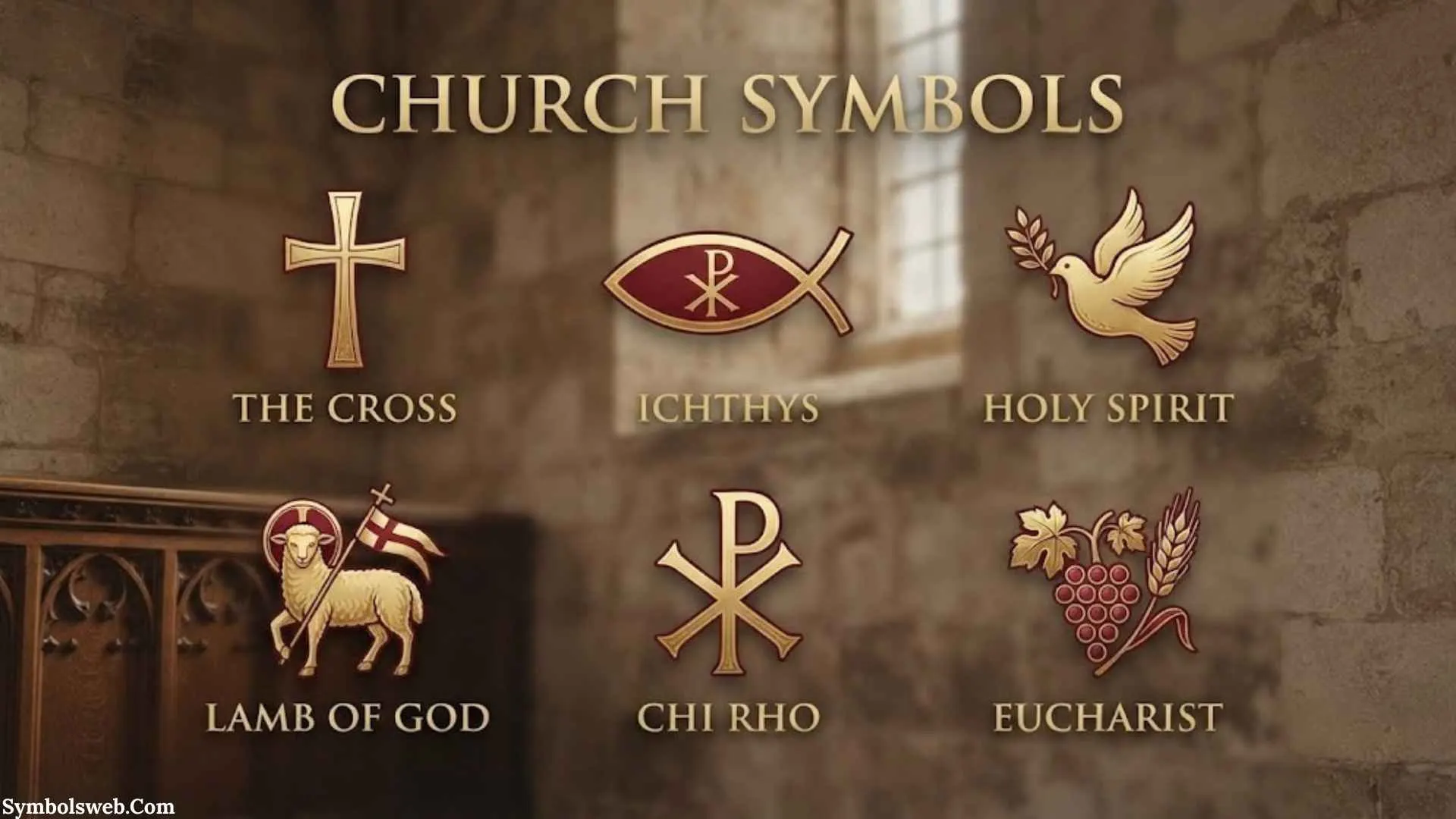
Church symbols are more than decorative designs found in churches, artwork, and religious traditions. Each symbol can carry a deeper meaning connected to Christian beliefs, biblical teachings, worship, and the history of the faith. From the cross and dove to the fish and lamb, these familiar images help communicate important spiritual ideas.
Understanding Church Symbols can make religious art, architecture, and worship practices easier to appreciate. Some symbols represent Jesus Christ, while others reflect themes such as faith, hope, peace, sacrifice, resurrection, and eternal life. Their meanings have also developed over centuries, giving many symbols both biblical and historical significance.
In this complete guide to Church Symbols, you will discover the meanings behind some of the most important Christian symbols and learn why they continue to be used today. Whether you are a beginner exploring Christian symbolism or simply curious about the signs you see in churches, this guide will help you understand their purpose and significance.
Church Symbols: (Quick Answer)
Church symbols are visual representations used within Christianity to communicate spiritual beliefs, biblical teachings, religious identity, and sacred truths. Examples include the cross, dove, fish, lamb, and church steeple. These symbols help believers express faith, remember religious teachings, and connect with centuries of Christian tradition.
Quick Facts About Church Symbols
| Aspect | Information |
| Origin | Early Christianity and biblical traditions |
| Historical Significance | Used to communicate faith, especially during periods of persecution |
| Main Meaning | Faith, salvation, worship, and divine connection |
| Spiritual Meaning | Relationship with God, redemption, hope, and eternal life |
| Cultural Importance | Shapes Christian identity, art, architecture, and traditions |
| Modern Usage | Churches, jewelry, tattoos, logos, education, and worship spaces |
What Are Church Symbols?
Church symbols are visual signs, objects, images, or architectural elements that represent Christian beliefs and values. They serve as powerful tools for teaching, remembrance, worship, and spiritual reflection.
Long before many people could read, symbols acted as visual language. Early Christians used simple images to communicate important ideas about faith. These symbols appeared on tombs, meeting places, manuscripts, and eventually churches themselves.
Some church symbols come directly from the Bible. Others developed through centuries of Christian tradition. Together, they form a rich symbolic system that helps believers understand complex spiritual ideas through familiar images.
Historically, symbols became especially important during the Roman Empire when Christians faced persecution. Secret symbols allowed believers to identify one another without attracting unwanted attention.
Over time, these symbols evolved from hidden signs into central features of churches worldwide.
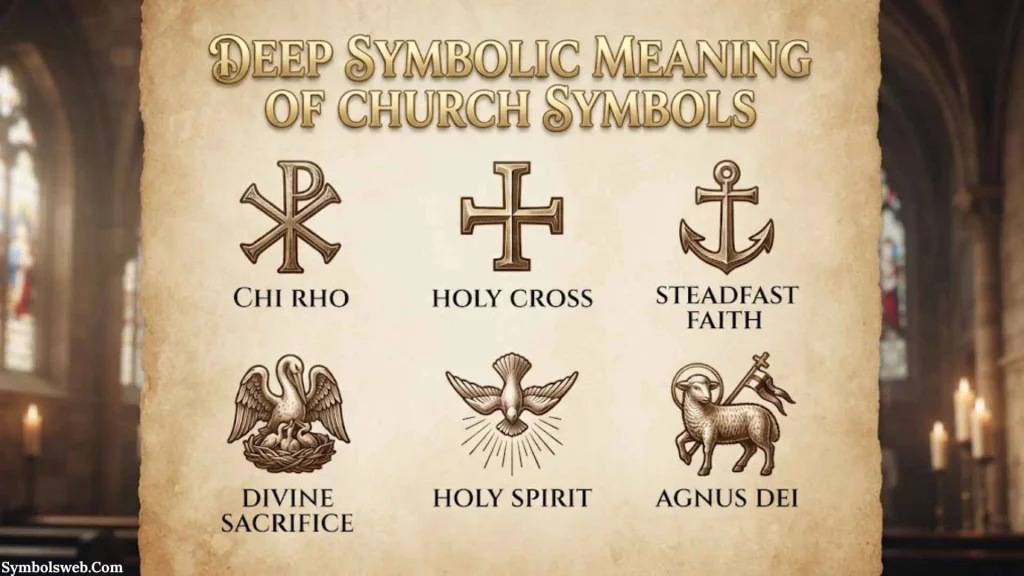
Deep Symbolic Meaning of Church Symbols
Spiritual Level
At the spiritual level, church symbols represent humanity’s relationship with God.
The cross symbolizes sacrifice and redemption.
The dove symbolizes divine peace and the presence of the Holy Spirit.
The lamb symbolizes innocence, purity, and Christ’s sacrificial role.
These symbols encourage believers to look beyond everyday concerns and focus on spiritual growth, forgiveness, hope, and eternal life.
Many Christians view these symbols as reminders of God’s presence and guidance during life’s challenges.
Psychological Level
Psychologically, church symbols connect with deep human emotions and universal archetypes.
Swiss psychologist Carl Jung believed symbols speak to the collective unconscious, a shared layer of human experience.
For example:
- Light symbolizes enlightenment and truth.
- Water symbolizes renewal and transformation.
- The shepherd symbolizes protection and guidance.
- The tree symbolizes growth and life.
These symbolic themes resonate across cultures because they reflect common human experiences and emotional needs.
Cultural Level
Church symbols strengthen community identity and shared beliefs.
A church steeple rising above a town often represents stability and spiritual presence.
A cross displayed in a home may symbolize faith and family tradition.
Even people who are not religious often recognize church symbols as representations of compassion, hope, charity, and moral guidance.
Types and Variations of Church Symbols
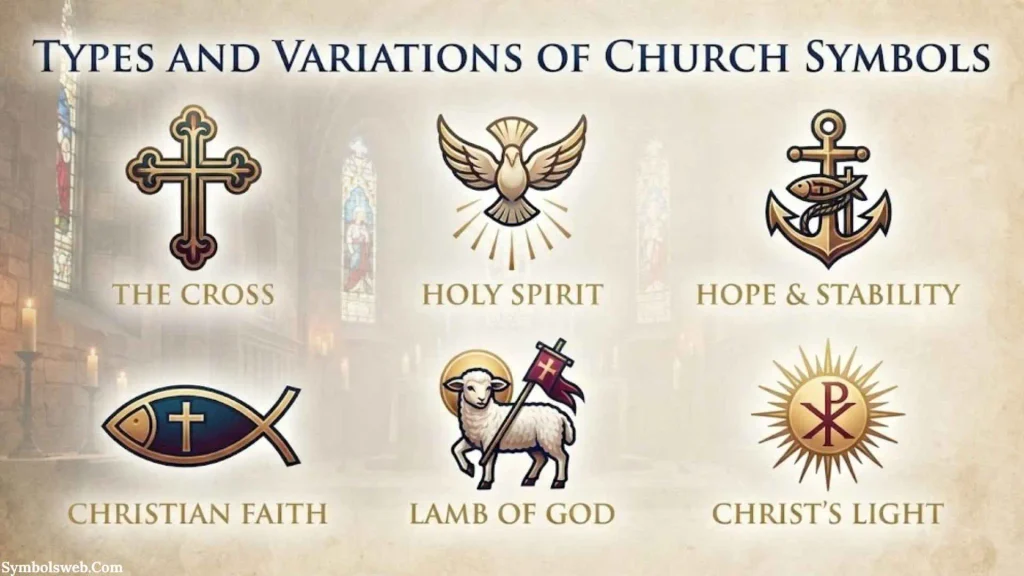
The Cross
Visual Description
Two intersecting lines forming Christianity’s most recognized symbol.
Meaning
Represents Christ’s crucifixion and resurrection.
Symbolism
- Sacrifice
- Salvation
- Forgiveness
- Victory over death
Cultural Connection
Appears in churches, cemeteries, jewelry, artwork, and religious ceremonies.
The Fish (Ichthys)
Visual Description
Two intersecting curved lines forming a fish shape.
Meaning
An early Christian identifier.
Symbolism
- Faith
- Evangelism
- Christ
Cultural Connection
Used secretly by persecuted Christians in ancient Rome.
The Dove
Visual Description
A white bird often shown descending from above.
Meaning
Represents the Holy Spirit.
Symbolism
- Peace
- Purity
- Divine guidance
Cultural Connection
Frequently appears in baptisms and church artwork.
The Lamb
Visual Description
A young sheep, often carrying a banner.
Meaning
Represents Jesus Christ.
Symbolism
- Innocence
- Sacrifice
- Redemption
Cultural Connection
Common in Christian art and Easter celebrations.
The Church Steeple
Visual Description
A tall tower extending upward.
Meaning
Points toward heaven.
Symbolism
- Spiritual aspiration
- Divine connection
- Worship
Cultural Connection
A defining feature of church architecture.
The Alpha and Omega
Visual Description
The first and last letters of the Greek alphabet.
Meaning
God as the beginning and the end.
Symbolism
- Eternity
- Divine sovereignty
- Completeness
Cultural Connection
Found in church decorations and sacred texts.
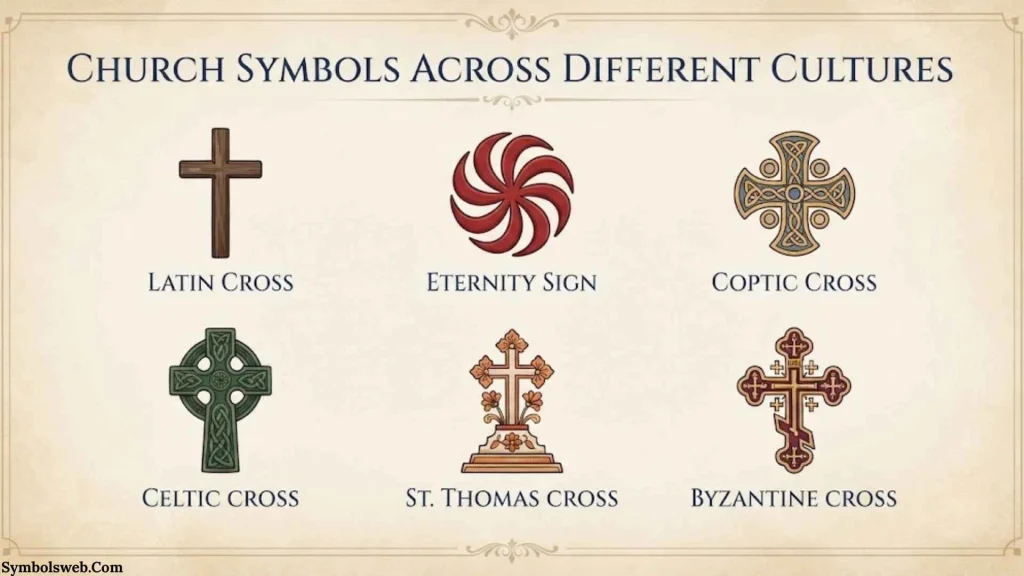
Church Symbols Across Different Cultures
Ancient Egypt
Although Christianity emerged later, Egyptian symbolism influenced early Christian art.
The ankh, symbolizing life, inspired comparisons with the Christian cross. Early Egyptian Christians integrated local artistic traditions into church imagery.
Ancient Greece
Greek philosophy influenced Christian symbolism.
Greek language played a major role in the New Testament, and symbols such as Alpha and Omega originated from the Greek alphabet.
Roman Culture
Roman architecture shaped church buildings.
Early Christians transformed Roman basilicas into places of worship. Many church symbols became more visible after Christianity gained acceptance within the Roman Empire.
Eastern Traditions
Eastern Christian churches often emphasize icons.
These sacred images function as symbolic windows into spiritual realities, helping worshippers focus on prayer and contemplation.
Indigenous Traditions
In many regions, indigenous artistic traditions blended with Christian symbols.
Native carvings, local animals, and traditional designs were incorporated into church decorations while preserving Christian meanings.
Modern Interpretations
Today, church symbols appear in digital media, social platforms, educational materials, and contemporary art.
Many people view them not only as religious signs but also as symbols of hope, resilience, and community.
Similar Symbols and Their Meanings
| Symbol | Similarity to Church Symbols | Key Difference |
| Cross | Represents spirituality | Specifically connected to Christianity |
| Ankh | Symbol of life | Originates in Ancient Egypt |
| Lotus | Spiritual growth | Associated primarily with Eastern religions |
| Tree of Life | Represents eternal life | Appears across many cultures |
| Circle | Symbol of eternity | More universal and less specifically Christian |
| Dove | Peace and spirituality | Used in both religious and secular contexts |
Common Misconceptions
One misconception is that all church symbols originated within Christianity.
In reality, many symbols share visual similarities with older cultural traditions. Christianity often adapted existing symbolic ideas while giving them new theological meanings.
Church Symbols in Mythology and Folklore
Church symbols exist within a rich landscape of stories and traditions.
The lamb echoes ancient sacrificial traditions found in various cultures.
The dove appears in many flood myths as a messenger of peace and renewal.
The shepherd motif can be traced through ancient pastoral societies where shepherds represented protection, wisdom, and leadership.
Christian folklore expanded these symbols through legends of saints, miracles, and sacred journeys.
Over centuries, these stories helped ordinary people understand complex spiritual ideas through memorable narratives.
Church Symbols in Art, Literature, Movies, and Pop Culture
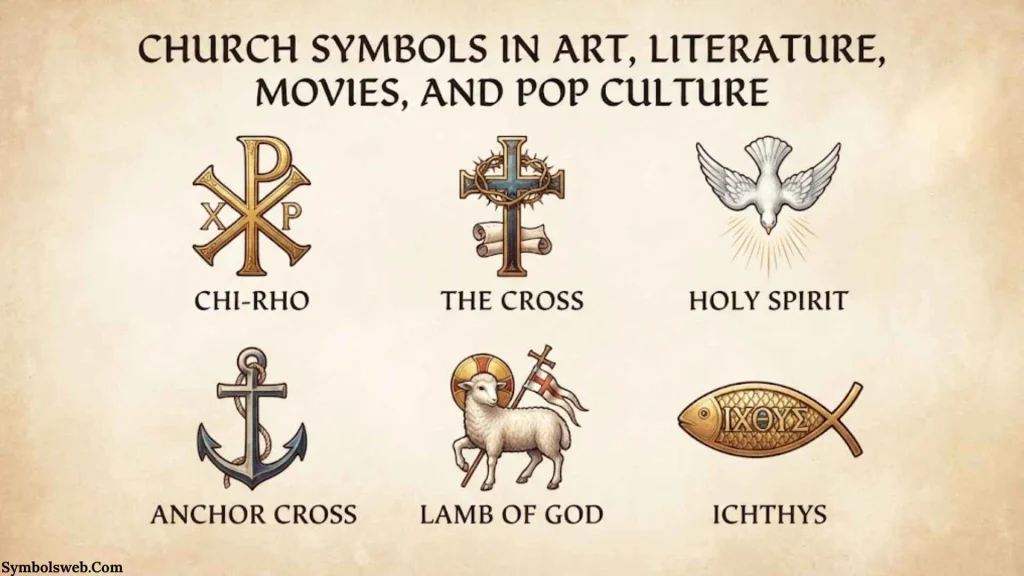
Paintings
Church symbols dominate Christian art.
Artists such as Michelangelo and Leonardo da Vinci incorporated symbolic imagery to communicate theological messages.
Literature
Many literary works use church symbols to represent redemption, sacrifice, or moral conflict.
Crosses, churches, bells, and angels often serve as symbolic devices within storytelling.
Poetry
Poets frequently use church symbols to explore faith, doubt, mortality, and hope.
Movies and Television
Modern films often employ church symbols to signify spiritual struggle, transformation, or moral choice.
Even non-religious stories use these symbols because audiences immediately recognize their emotional power.
Tattoos
Cross tattoos remain among the world’s most popular religious tattoos.
People choose them to express faith, remembrance, resilience, or personal transformation.
Fashion and Design
Church-inspired symbolism appears in jewelry, clothing, architecture, and graphic design.
Designers often use crosses, stained-glass patterns, and angelic imagery for aesthetic and symbolic purposes.
Spiritual and Dream Meaning of Church Symbols
Dreaming of church symbols often reflects a search for guidance, healing, or meaning.
Dreaming of a Cross
May symbolize:
- Personal sacrifice
- Faith
- Inner strength
- Forgiveness
Dreaming of a Church
May indicate:
- Spiritual growth
- Need for reflection
- Community support
Dreaming of a Dove
Often symbolizes:
- Peace
- Reconciliation
- Positive change
Meditation and Spiritual Experiences
Many people report feeling comforted when focusing on church symbols during prayer or meditation.
These symbols can act as mental anchors that encourage calmness, reflection, and spiritual awareness.
Positive and Negative Meanings of Church Symbols
| Positive Meaning | Negative Meaning |
| Hope | Dogmatism |
| Faith | Misinterpretation |
| Community | Division between groups |
| Redemption | Guilt if misunderstood |
| Guidance | Dependency on external authority |
| Peace | Historical conflicts linked to religion |
A symbol itself is neutral. Its meaning depends on context, interpretation, and personal experience.
Why Humans Are Attracted to Church Symbols
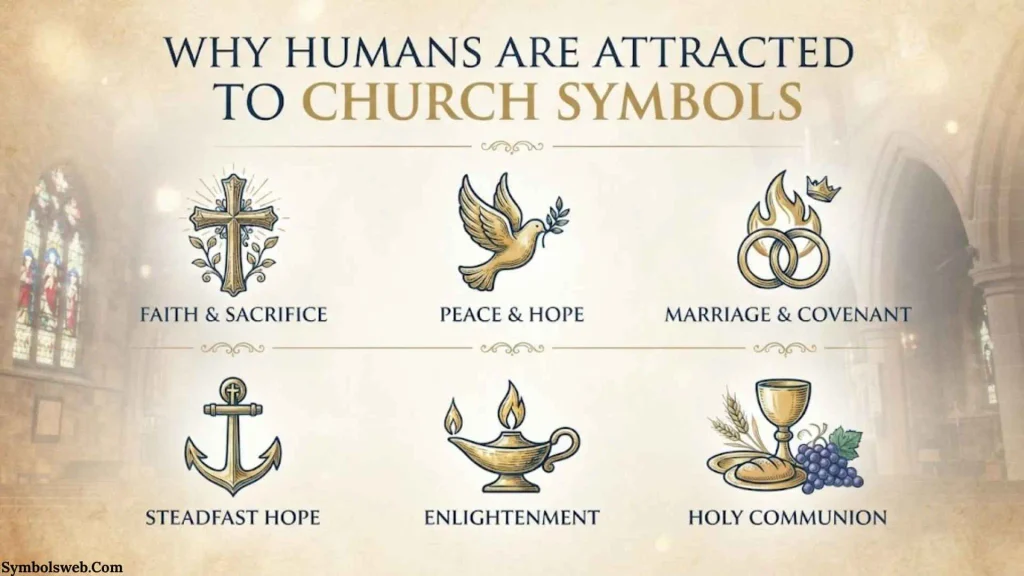
Humans naturally seek meaning through images and stories.
Church symbols simplify complex spiritual ideas into forms the mind can easily remember.
Psychologists note that people respond strongly to symbolic imagery because symbols engage both emotion and imagination.
A cross is not merely two intersecting lines.
It carries centuries of stories, sacrifices, hopes, and personal experiences.
This combination of visual simplicity and emotional depth makes church symbols incredibly powerful.
They also connect individuals to collective memory. When people see familiar church symbols, they often feel connected to family traditions, cultural heritage, and shared human values.
Modern Uses of Church Symbols
Tattoos
Used to express faith, remembrance, and personal identity.
Jewelry
Cross necklaces remain among the most recognizable religious accessories worldwide.
Fashion
Designers incorporate church-inspired imagery into contemporary styles.
Branding
Faith-based organizations frequently use church symbols to communicate values and mission.
Social Media
Symbols appear in profile images, inspirational posts, and online ministries.
Contemporary Spirituality
Many individuals use church symbols during prayer, journaling, and personal reflection.
Home Decor
Crosses, scripture art, and symbolic imagery remain popular decorative elements in Christian homes.
Interesting Facts About Church Symbols
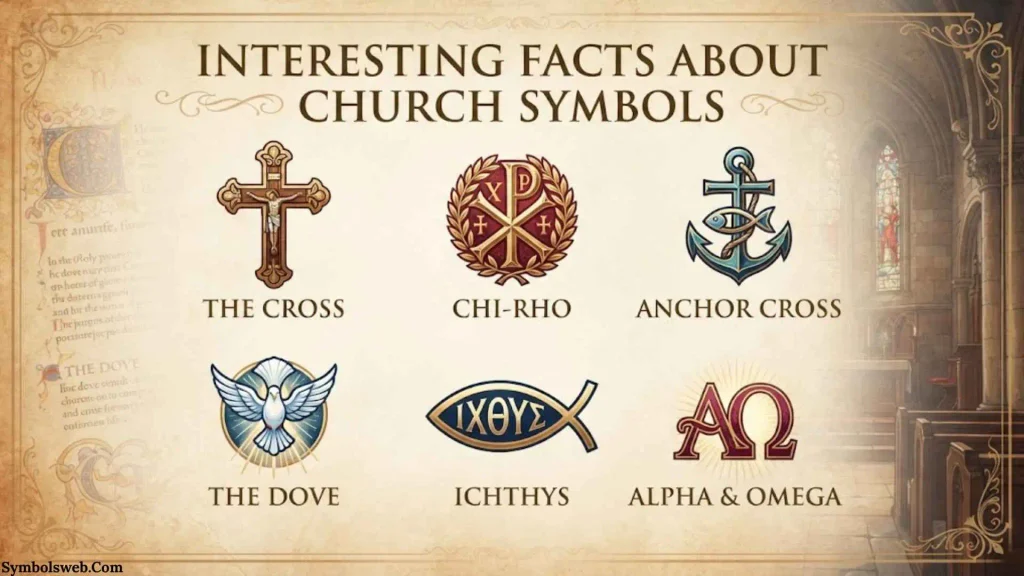
- The fish symbol was used secretly by early Christians during persecution.
- The cross did not become Christianity’s primary symbol immediately after Christ’s death.
- Church bells themselves became symbolic representations of divine calling.
- Stained glass windows were once called the “Bible of the such as people whose income is below the poverty threshold” because they taught biblical stories visually.
- The Alpha and Omega symbolize God’s eternal nature.
- Different Christian denominations sometimes interpret symbols differently.
- Many church symbols combine biblical teachings with local cultural traditions.
- The dove symbol appears in both religious and secular peace movements.
- Church architecture itself often functions as a symbolic language.
- Some medieval cathedrals contain hundreds of symbolic carvings and images.
Frequently Asked Questions
What is the most important church symbol?
The cross is generally considered the most important church symbol because it represents Jesus Christ’s crucifixion, sacrifice, and resurrection.
Why do churches use symbols?
Churches use symbols to communicate spiritual truths, teach biblical lessons, strengthen community identity, and inspire faith.
What does the fish symbol mean in Christianity?
The fish, or Ichthys, was an early Christian symbol representing Jesus Christ and serving as a secret sign among believers.
Why is the dove important in church symbolism?
The dove symbolizes the Holy Spirit, peace, purity, and divine presence.
Are church symbols only religious?
While rooted in Christianity, many church symbols also carry cultural, historical, artistic, and psychological meanings.
What does a church steeple symbolize?
A church steeple symbolizes humanity’s desire to reach toward heaven and maintain a connection with the divine.
Conclusion
Church symbols are far more than decorative images. They are powerful visual expressions of faith, history, identity, and human meaning. From the cross and dove to the fish and steeple, each symbol carries centuries of spiritual wisdom and cultural memory.
These sacred signs continue to inspire people because they speak to universal human experiences such as hope, sacrifice, belonging, and transformation. If viewed through the lens of religion, psychology, history, or art, church symbols remind us that some of humanity’s deepest truths can be expressed through a single image.

Hi, I’m Ethan Holloway, and I’ve always believed that a few meaningful words can change the way we think, feel, and live. I enjoy collecting timeless quotes, studying their deeper meanings, and sharing inspiring messages that help people stay motivated through every stage of life.
Over the years, I’ve explored thousands of famous sayings from writers, leaders, philosophers, and everyday people. My goal is to make wisdom easy to understand and useful for everyone.
Books by Ethan Holloway
- The Power of Everyday Quotes
- Words That Inspire Greatness
 Jordan Hayes
 Eliana Foster